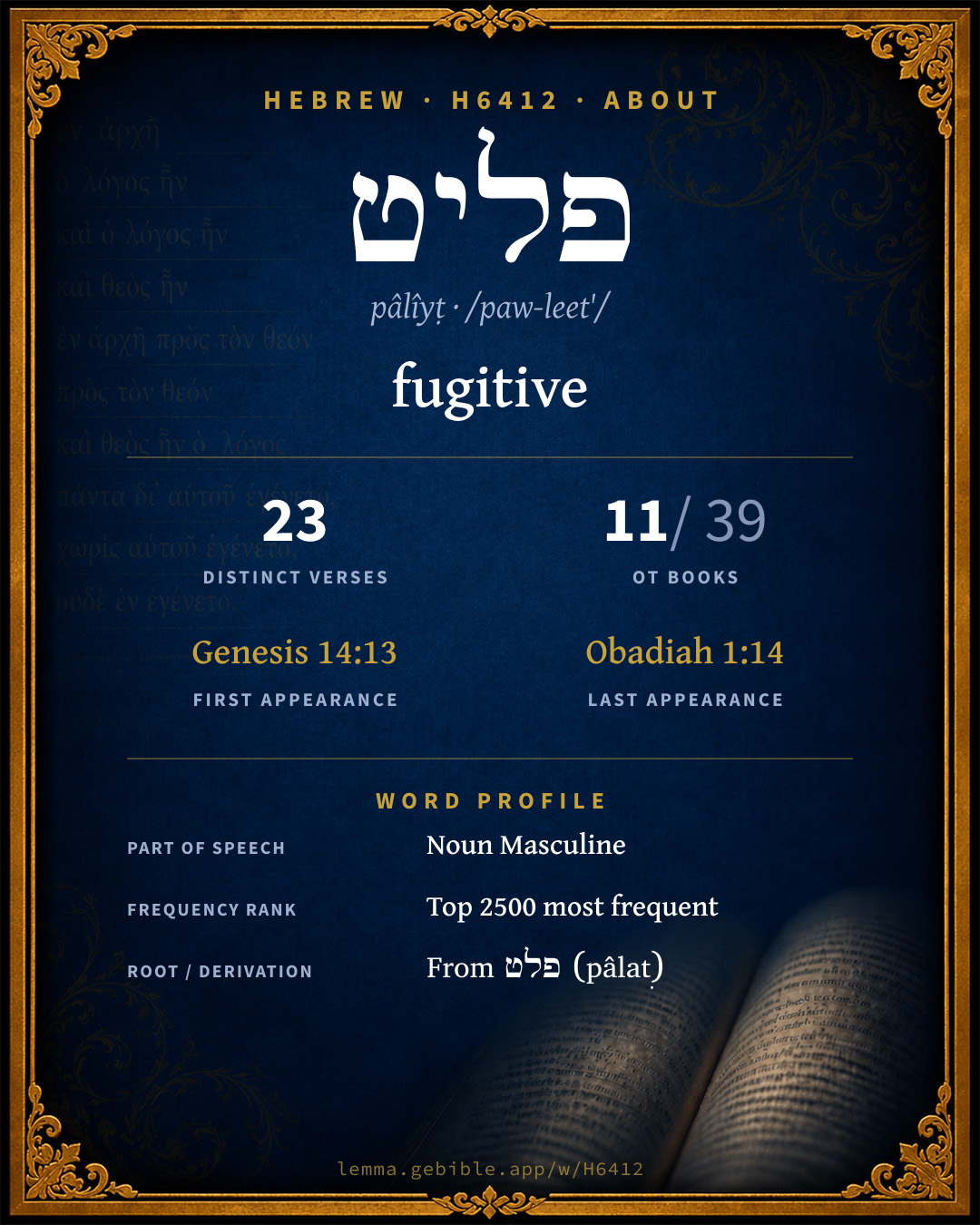
פליט
fugitive
Full lexicon entry — Brown-Driver-Briggs (BDB)
From Brown-Driver-Briggs (BDB)
Where this word appears
See every Absolute-state word in the Hebrew Bible →
Grammar key — what these labels mean
Part of speech
- Noun
- A naming word — a person, place, thing, or idea.
Noun type
- Common
- A common noun — a general class of person, place, or thing (“king,” “city,” “water”), not a specific name.
State
- Absolute
- The independent form of a noun, not bound to a following word.
- Construct
- A noun bound to a following noun in a possessive / “of” relationship (the construct chain).
Gender
- Masculine
- Grammatically masculine.
Number
- Singular
- One.
- Plural
- More than one (in Hebrew, generally three or more).
Grammatical forms
- Noun, Common, Masculine, Singular, Absolute 11 times (46%)
- Noun, Common, Masculine, Plural, Construct 8 times (33%)
- Noun, Common, Masculine, Plural, Absolute 5 times (21%)
Parsed forms decoded from the imported morphology (morphhb / Westminster Leningrad Codex — WLC text public domain, morphhb tagging CC BY 4.0), counted across 24 parsed occurrences — not distinct verses.
Every verse where H6412 appears — 23 distinct verses across 11 books. Click any verse to open its interlinear word-by-word view. Verse text shown in the World English Bible for context — . Each verse’s Hebrew form is shown with its reference; the English is not keyword-highlighted, since the data carries no word-level English alignment. Use “Compare translations” on any verse to read it across multiple English versions. This concordance covers the Hebrew Bible; Septuagint (Greek Old Testament) occurrences are not indexed here.
Genesis 1 verse
Numbers 1 verse
Joshua 1 verse
Judges 2 verses
- Judges 12:4 פְּלִיטֵ֤י n c mp cs Then Jephthah gathered together all the men of Gilead, and fought with Ephraim; and the men of Gilead struck Ephraim, because they said, You are fugitives of Ephraim, you Gileadites, in the midst of Ephraim, [and] in the midst of Manasseh.
- Judges 12:5 פְּלִיטֵ֤י n c mp cs The Gileadites took the fords of the Jordan against the Ephraimites. It was so, that when [any of] the fugitives of Ephraim said, Let me go over, the men of Gilead said to him, Are you an Ephraimite? If he said, No;
2 Kings 1 verse
Isaiah 2 verses
- Isaiah 45:20 פְּלִיטֵ֣י n c mp cs Assemble yourselves and come; draw near together, you who have escaped from the nations: they have no knowledge who carry the wood of their engraved image, and pray to a god that can't save.
- Isaiah 66:19 פְּ֠לֵיטִים n c mp I will set a sign among them, and I will send such as escape of them to the nations, to Tarshish, Pul, and Lud, who draw the bow, to Tubal and Javan, to the isles afar off, who have not heard my fame, neither have seen my glory; and they shall declare my glory among the nations.
Jeremiah 5 verses
- Jeremiah 42:17 וּ/פָלִ֔יט conj + n c ms So shall it be with all the men who set their faces to go into Egypt to sojourn there: they shall die by the sword, by the famine, and by the pestilence; and none of them shall remain or escape from the evil that I will bring on them.
- Jeremiah 44:14 פָּלִ֤יט פְּלֵטִֽים n c ms n c mp so that none of the remnant of Judah, who have gone into the land of Egypt to sojourn there, shall escape or be left, to return into the land of Judah, to which they have a desire to return to dwell there: for none shall return save such as shall escape.
- Jeremiah 44:28 וּ/פְלִיטֵ֨י conj + n c mp cs Those who escape the sword shall return out of the land of Egypt into the land of Judah, few in number; and all the remnant of Judah, who have gone into the land of Egypt to sojourn there, shall know whose word shall stand, mine, or theirs.
- Jeremiah 50:28 וּ/פְלֵטִ֖ים conj + n c mp The voice of those who flee and escape out of the land of Babylon, to declare in Zion the vengeance of Yahweh our God, the vengeance of his temple.
- Jeremiah 51:50 פְּלֵטִ֣ים n c mp You who have escaped the sword, go you, don't stand still; remember Yahweh from afar, and let Jerusalem come into your mind.
Lamentations 1 verse
Ezekiel 7 verses
- Ezekiel 6:8 פְּלִ֥יטֵי n c mp cs Yet will I leave a remnant, in that you shall have some that escape the sword among the nations, when you shall be scattered through the countries.
- Ezekiel 6:9 פְלִֽיטֵי/כֶ֜ם n c mp cs + sfx pers 2mp Those of you that escape shall remember me among the nations where they shall be carried captive, how that I have been broken with their lewd heart, which has departed from me, and with they eyes, which play the prostitute after their idols: and they shall loathe themselves in their own sight for the evils which they have committed in all their abominations.
- Ezekiel 7:16 פְּלִ֣יטֵי/הֶ֔ם n c mp cs + sfx pers 3mp But those of those who escape shall escape, and shall be on the mountains like doves of the valleys, all of them moaning, every one in his iniquity.
- Ezekiel 24:26 הַ/פָּלִ֖יט ptcl def.art + n c ms that in that day he who escapes shall come to you, to cause you to hear it with your ears?
- Ezekiel 24:27 הַ/פָּלִ֔יט ptcl def.art + n c ms In that day shall your mouth be opened to him who is escaped, and you shall speak, and be no more mute: so shall you be a sign to them; and they shall know that I am Yahweh.
- Ezekiel 33:21 הַ/פָּלִ֧יט ptcl def.art + n c ms It happened in the twelfth year of our captivity, in the tenth [month], in the fifth [day] of the month, that one who had escaped out of Jerusalem came to me, saying, The city has been struck.
- Ezekiel 33:22 הַ/פָּלִ֔יט ptcl def.art + n c ms Now the hand of Yahweh had been on me in the evening, before he who was escaped came; and he had opened my mouth, until he came to me in the morning; and my mouth was opened, and I was no more mute.
Amos 1 verse
Obadiah 1 verse
About this entry
At a glance — auto-summarized from this page’s data, not written by a person. Every figure links to its source below. This summary describes the numbers; it doesn’t interpret them.
“fugitive” is the headline sense of the Hebrew noun פליט (pâlîyṭ). Its earliest occurrence is Genesis 14:13. It turns up in 23 verses across 11 books, an uncommon footprint. It concentrates in Ezekiel, which alone accounts for 30% of its uses. It clusters with פלט, מפלט and פלט under a shared root. See the sense tree, 23-verse concordance, and the renderings breakdown below.
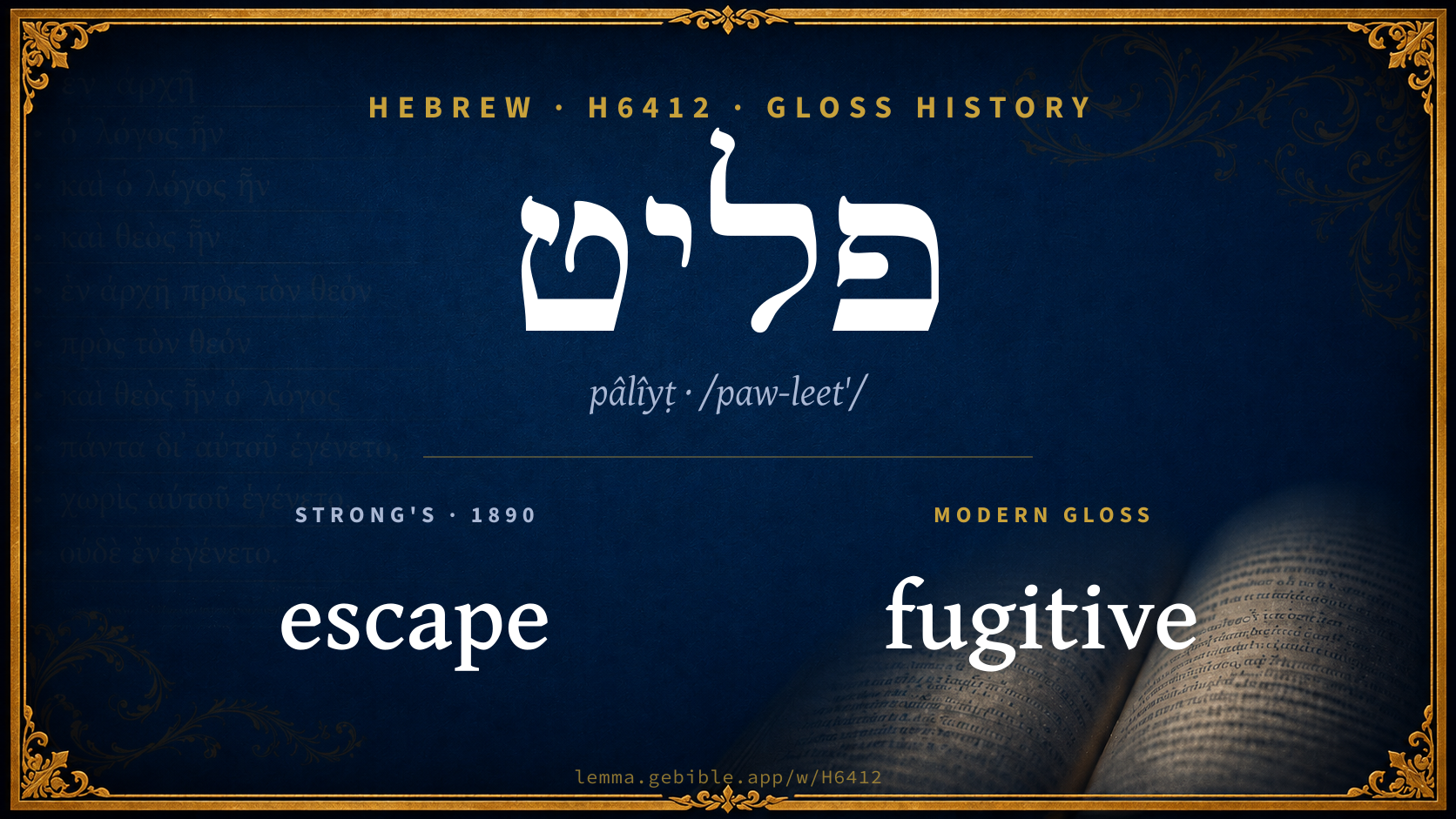
Gloss history
Strong's 1890 vs modern scholarship
About this word
Strong's H6412 catalogs a Hebrew word from the Hebrew Old Testament.
These counts are not copied from any lexicon or concordance. They are computed here, from the morphology-tagged Hebrew Old Testament. What Lemma adds →
- 23
- distinct verses
- The word appears in 23 distinct verses.
- 11 / 39
- OT books
- The word appears in 11 of 39 Old Testament books.
- #1,327
- by frequency
- Top 2500 most frequent Hebrew words (rank 1,327 of 8,640 Hebrew words by occurrence).
View all 23 occurrences in the concordance →
By section of the Old Testament
By traditional corpus
Conventional, traditional groupings — biblical authorship is debated, so this is a traditional corpus grouping, not an authorship claim. Each share is this word’s portion of its verses in that division of the Hebrew canon. Each figure is a share of the word’s 23 distinct verses.
- Prophets (Nevi'im) 20 verses · 87%
- Torah (Pentateuch) 2 verses · 9%
- Writings (Ketuvim) 1 verse · 4%
How translations render this word
Counts come from each version’s own published word-to-Strong’s tagging or interlinear alignment — an approximate guide to how each version renders this word, not a word-level alignment the data otherwise carries. Because each total is that version’s own tagged count, the per-version totals vary from one another and need not match the appearance or distinct-verse counts above. These counts may also differ from a printed concordance because Lemma counts each distinctly tagged rendering and does not collapse phrase taggings into a single head-word total. This is a fixed set of word-tagged versions (KJV, ASV, BSB, ULT) and does not change with the reading translation you choose elsewhere. Each version’s license is shown beside its name below (and on Sources).
BDB lists this Strong’s number as 2 distinct words (homographs). Each count above pools all of them and is not split by sense — see the Senses section below. A low-frequency rendering may belong to a different one of those words, not the primary meaning.
- King James Version†: Escape 3×, He that escapeth 2×, One that had escaped 2×
- American Standard Version†: Escape 2×, One that had escaped 2×, Or escape 2×
- Berean Standard Bible†: Fugitive 4×, Escape 3×, Survivors 3×
- unfoldingWord Literal Text†: Fugitives 3×, Fugitive 2×, Fugitives of 2×
King James Version Public Domain
Renders H6412 across 21† tagged occurrences — most commonly:
Plus 10 renderings that appear only once — usually multi-word phrases or single function words the recovered tagging swept in, not distinct renderings.
American Standard Version Public Domain
Renders H6412 across 21† tagged occurrences — most commonly:
Plus 15 renderings that appear only once — usually multi-word phrases or single function words the recovered tagging swept in, not distinct renderings.
Berean Standard Bible Public Domain
Renders H6412 across 24† tagged occurrences — most commonly:
Plus 10 renderings that appear only once — usually multi-word phrases or single function words the recovered tagging swept in, not distinct renderings.
unfoldingWord Literal Text CC BY-SA 4.0
Renders H6412 across 18† tagged occurrences — most commonly:
Plus 9 renderings that appear only once — usually multi-word phrases or single function words the recovered tagging swept in, not distinct renderings.
Senses in BDB
The 1 sense BDB distinguishes for this word, in lexicon order (not ranked by frequency or importance). The full entry — with sub-senses — is in the Lexicon Entry tab.
- refugee, fugitive, escaped one
Word origin
I. n.m. Am 9:1 escaped one, fugitive;—פ׳ abs. 2 K 9:15 +; pl. cstr. פְּלִיטֵי Ju 12:4 +; sf. פְּלְיטָיו Ob 14, etc.;—Am 9:1; 2 K 9:15; Gn 14:13; Ez 24:26, 27; 33:21 (+ מִן loc.), v 22; שָׂרִיד וּפ׳ Jos 8:22; Je 42:17; פ׳ וְשָׂרִיד 44:14 La 2:22; c. genit. subj. Ju 12:5 fugitives of Ephr. (del. in v 4, see GFM), so c. sf. Ez 6:9; 7:16 Ob 14; c. genit. obj., escaped of, i.e. from Is 45:20, so פְּלִיטֵי חֶרֶב Je 44:28; Ez 6:8.
I. n.m. id.;—pl. פְּלֵיטִם Nu 21:29 (as appos., or adj.), ים—ִ Is 66:19; פְּלֵטִים Je 44:14, + מִן from 50:28; 51:50.
— Brown-Driver-Briggs (Oxford 1906, public domain), digitized via Sefaria, supplemented by the OpenScriptures HebrewLexicon (CC BY 4.0). See Sources.
Derived from פלט (pâlaṭ) (H6403) — to escape.
Jastrow Dictionary
A second Hebrew/Aramaic lexicon for comparison, covering Aramaic and post-biblical (Talmudic, Targumic, Midrashic) usage that the biblical-Hebrew BDB does not. Matched by lemma rather than by Strong’s number, so a lemma may carry more than one Jastrow headword (shown separately below), and the entries cover usage well beyond the Bible.
פָּלֵיט
- , v. פָּלֵט
פָּלִיט
- one that escaped, survivor. Snh. 105ᵇ שריד ופ׳ remnant or survivor. Gen. R. s. 42 הוא עוג הוא פ׳ Og and ‘he that had escaped’ (Gen. XIV, 13) are the same person; a. e.—Pl. פְּלֵיטִים, פְּלֵטִים, v. פָּלֵט. e.g. Genesis 14:13
A Dictionary of the Targumim, the Talmud Babli and Yerushalmi, and the Midrashic Literature (Marcus Jastrow; London, Luzac, 1903) — Public Domain. Digitized via Sefaria. Digitized via Sefaria. Full attribution on Sources.
Forms in the corpus
The 21 distinct written forms H6412 takes in the Hebrew Bible, most frequent first — each parse links to that state’s occurrences in the concordance. Hebrew forms include their vowel points and cantillation, so a single lemma takes many written forms.
Same root — word family
Other BDB entries built from the same root as H6412, grouped by Strong’s listed origin. These share a root / origin per the lexicon — not necessarily a shared meaning. Each links to that word’s own entry.
Derives from
Shares the same root
Derived from this word
Proper names from this root
People and places named from this root — a name, not an additional meaning of the word.
- יפלט Yaphlêṭ H3310 Japhlet
- פלט Peleṭ H6404 Pelet
- פלטי Palṭîy H6406 Palti
- פלטיה Pᵉlaṭyâh H6410 Pelatiah
Compare all same-root words → Showing 4 of 9 — not the complete family. 4 of the same-root words are proper names (people or places). They share a root, not necessarily a meaning.
Septuagint verse parallels
This word appears in 20 verses that also exist in the Greek Old Testament (Septuagint), out of the 23 Hebrew verses it occurs in. You can read those verses in Greek by switching the Old Testament edition to the Septuagint.
Read these verses in the Septuagint
- Genesis 14:13
- Numbers 21:29
- Joshua 8:22
- Judges 12:4
- 2 Kings 9:15
- Isaiah 45:20
- Jeremiah 42:17
- Lamentations 2:22
- Ezekiel 6:8
- Amos 9:1
- Obadiah 1:14
This is a verse-level parallel only — the same verses exist in both the Hebrew and Greek Old Testaments. No word-level Hebrew↔Greek correspondence is claimed: the data carries no such alignment, so no Greek word is shown as this Hebrew word’s translation. Coverage is not total — the Septuagint omits the deuterocanon and renumbers the Psalms, so some Hebrew verses have no direct Greek parallel.