

Psalms 17:2

Hebrew (Westminster Leningrad Codex) Psalms 17:2 appears in the Hebrew Old Testament. The text above is from the Westminster Leningrad Codex. Each word links to its Strong’s number, a concise gloss, and parsing drawn from the Open Scriptures Hebrew Bible morphology. Click any word for its full Brown-Driver-Briggs (BDB) entry.
Download image
Cite this verse

Psalms 17:2 (World English Bible). Public Domain. Lemma interlinear Bible study tool, https://lemma.gebible.app/v/psalms/17/2.

Show BibTeX & RIS
BibTeX
RIS
English Translation
Let my sentence come forth from your presence; Let your eyes look on equity.
World English Bible · Public Domain
Download a study sheet

One document with this verse’s original text, its word-by-word gloss line, the meaning frame, cross-references with their text, attributed commentary, and full source and license credits — printable, and it pastes into notes with its structure intact.

This verse Autodidact and up

Study sheet (.html) Plain text (.txt)

A passage Seminary Student

Up to 50 verses in one chapter. A passage sheet keeps up to 6 commentary sources and 12 cross-references per verse, in the order this page ranks them, and says so on the sheet whenever that leaves anything out. Ask for a single verse and you get the Autodidact verse sheet above.

Everything on this page stays free to read, with no account — the sheet is a download of what is already on screen, not access to it.

Want to remove ads? Support Godless Engineer
Compare translations 3

The same verse in 3 English versions, stacked beneath the original-language interlinear above. Click any original word for its lexicon entry.

Each is an independent rendering of the whole verse — the interlinear is not word-aligned to these translations.

Highlighted words mark where these versions differ — a whole-verse word diff, not a word-by-word alignment.

  • World English Bible Public Domain
    Let my sentence come forth from your presence; Let your eyes look on equity.
  • King James Version Public Domain
    Let my sentence come forth from thy presence; let thine eyes behold the things that are equal.
  • unfoldingWord Literal Text CC BY-SA 4.0
    Let my vindication come from your face; let your eyes see rightly!

unfoldingWord Literal Text — © unfoldingWord, licensed CC BY-SA 4.0. Word-aligned USFM3 via Door43 (git.door43.org/unfoldingWord/en_ult).

Versions to compare (up to 4)

3 of 4 selected

Show all 18 translations

Every available English version of this verse, each an independent rendering of the whole verse.

  • World English Bible Public Domain
    Let my sentence come forth from your presence; Let your eyes look on equity.
  • Berean Standard Bible Public Domain
    May my vindication come from Your presence; may Your eyes see what is right.
  • Majority Standard Bible Public Domain
    May my vindication come from Your presence; may Your eyes see what is right.
  • King James Version Public Domain
    Let my sentence come forth from thy presence; let thine eyes behold the things that are equal.
  • American Standard Version (1901) Public Domain
    Let my sentence come forth from thy presence; Let thine eyes look upon equity.
  • Revised Version (1885) Public Domain
    Let my sentence come forth from thy presence; let thine eyes look upon equity.
  • Geneva Bible (1599) Public Domain
    Let my sentence come forth from thy presence, and let thine eyes beholde equitie.
  • Douay-Rheims (1899) Public Domain
    Let my judgment come forth from thy countenance: let thy eyes behold the things that are equitable.
  • Young's Literal Translation Public Domain
    From before thee my judgment doth go out; Thine eyes do see uprightly.
  • Literal Standard Version CC BY-SA 4.0
    My judgment goes out from before You; Your eyes see uprightly.
  • Unlocked Literal Bible CC BY-SA 4.0
    Let my vindication come from your presence; let your eyes see what is right!
  • unfoldingWord Literal Text CC BY-SA 4.0
    Let my vindication come from your face; let your eyes see rightly!
  • Darby Bible Public Domain
    Let my judgment come forth from thy presence, let thine eyes regard equity.
  • World Messianic Bible Public Domain
    Let my sentence come out of your presence. Let your eyes look on equity.
  • Webster's Bible Public Domain
    Let my sentence come forth from thy presence; let thy eyes behold the things that are equal.
  • Free Bible Version CC BY-SA 4.0
    Vindicate me before you—for you see what is right.
  • Bible in Basic English Public Domain
    Be my judge; for your eyes see what is right.
  • JPS Tanakh (1917) Public Domain
    Let my judgment come forth from Thy presence; let Thine eyes behold equity.

Literal Standard Version (2020), Covenant Press — licensed CC BY-SA 4.0. Text via the HelloAO Bible API (eBible.org). Unlocked Literal Bible (unfoldingWord) — licensed CC BY-SA 4.0. Text via the HelloAO Bible API (eBible.org). unfoldingWord Literal Text — © unfoldingWord, licensed CC BY-SA 4.0. Word-aligned USFM3 via Door43 (git.door43.org/unfoldingWord/en_ult). Free Bible Version, Dr. Jonathan Gallagher — licensed CC BY-SA 4.0. Text via the HelloAO Bible API (eBible.org).

Word by word

More ways to search: Search by grammar → Find every occurrence → Compare this word →

Practice this passage: Drill this verse → Learn its vocabulary →

About this verse

These counts appear in no published source. They are computed here, from the morphology-tagged text and Lemma’s own curated glosses. What Lemma adds →

6
words
6
distinct lemmas
Wisdom
section

Notable vocabulary

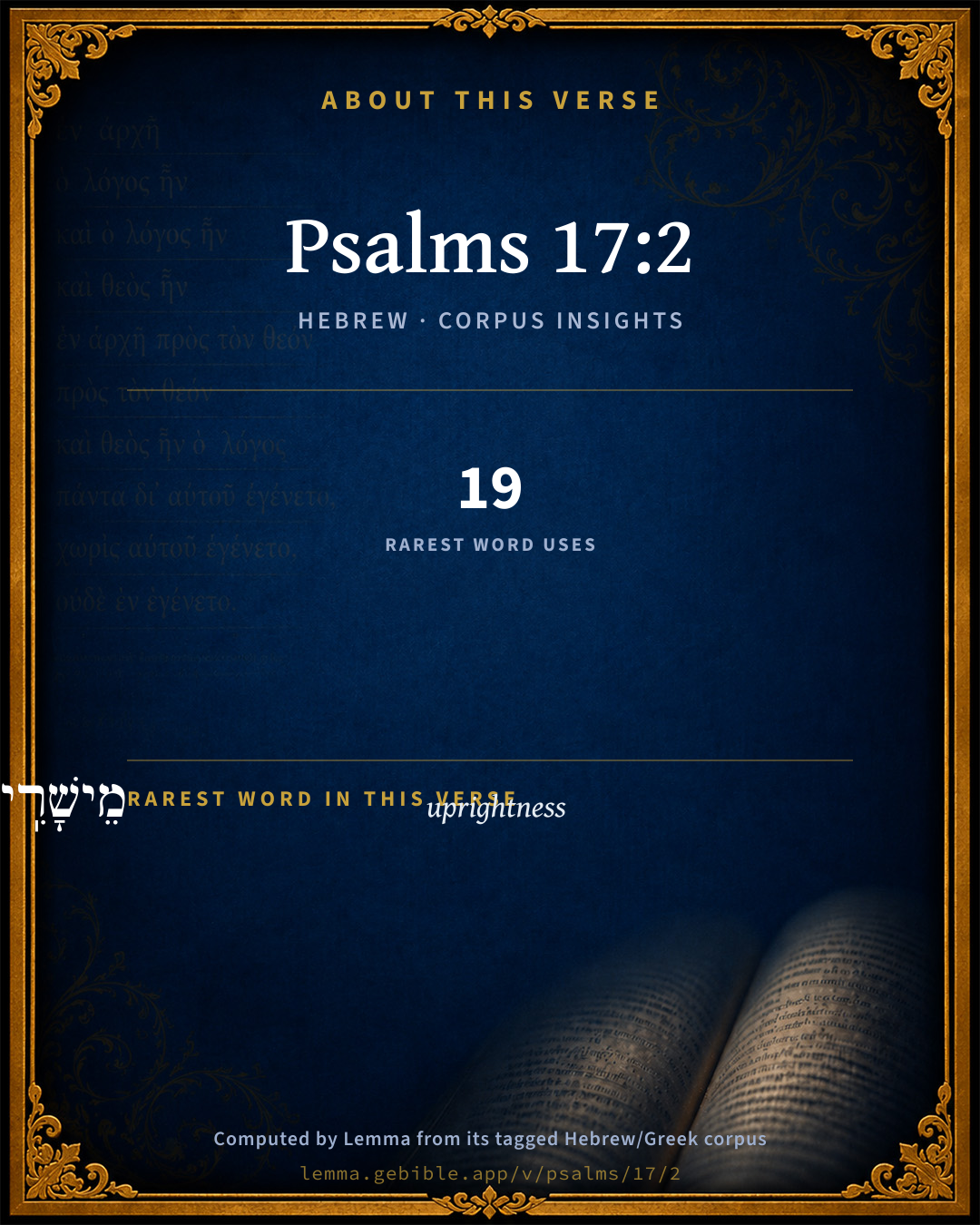
The rarest word here is מֵישָׁרִֽים uprightness H4339 — appearing just 19 times in the whole Hebrew Bible.

Shared distinctive vocabulary

מֵישָׁרִֽים uprightness H4339 occurs in 19 verses of the Hebrew Bible. Also found in:

Grammatical profile

  • 2 verbs
  • 4 nouns

Verb forms

  • יֵצֵ֑א Qal · Imperfect
  • תֶּחֱזֶ֥ינָה Qal · Imperfect

Hebrew & Septuagint length

In English translation the verse runs 14 words from the Hebrew and 13 from the Septuagint (LXX English) — closely comparable.

A rough comparison of the two English renderings, which tokenize alike — not a word-level alignment.

Word counts can differ between the Hebrew and the Greek without any difference in meaning — e.g. the Hebrew direct-object marker אֵת has no separate Greek word, and Greek often adds the article ὁ.

Cross-references

8

Topical passages linked to Psalms 17:2 in the Treasury of Scripture Knowledge — connected by theme and wording, ordered by reader-vote popularity; previews shown in the World English Bible.

  • Psalms 37:6 He will make your righteousness go forth as the light, And your justice as the noon day sun.
  • 2 Thessalonians 1:6–9 Since it is a righteous thing with God to repay affliction to those who afflict you,
  • Ezekiel 18:25 Yet you say, The way of the Lord is not equal. Hear now, house of Israel: Is my way not equal? Aren't your ways unequal?
  • Ezekiel 18:29 Yet says the house of Israel, The way of the Lord is not equal. house of Israel, are not my ways equal? are not your ways unequal?
  • Jude 1:24 Now to him who is able to keep them from stumbling, and to present you faultless before the presence of his glory in great joy,
  • Psalms 37:33 Yahweh will not leave him in his hand, Nor condemn him when he is judged.
  • Ezekiel 33:17 Yet the children of your people say, The way of the Lord is not equal: but as for them, their way is not equal.
  • Ezekiel 33:20 Yet you say, The way of the Lord is not equal. House of Israel, I will judge you everyone after his ways.

Cross-references courtesy of OpenBible.info (CC BY 4.0).

Hebrew and Greek witnesses Masoretic Hebrew ↔ Greek Septuagint

The same verse in the two great witnesses to the Old Testament, shown verse-for-verse.

You’re reading Greek Psalm 16 (Hebrew Psalm 17). The Septuagint counts the superscription, so verse numbers can differ from the Hebrew — chapter-level alignment, not verse-by-verse. Numbering follows Rahlfs.

These are two independent witnesses, not word-aligned to each other, and the Septuagint is shown in lemma (dictionary) form.

Hebrew Psalms 17:2 Masoretic · Westminster Leningrad Codex

מִ֭לְּפָנֶיךָ מִשְׁפָּטִ֣י יֵצֵ֑א עֵ֝ינֶ֗יךָ תֶּחֱזֶ֥ינָה מֵישָׁרִֽים

Let my sentence come forth from your presence; Let your eyes look on equity.

World English Bible · Public Domain

Greek LXX Greek Psalm 16:2 Septuagint · lemma form

ἐκ πρόσωπον σύ ὁ κρίμα ἐγώ ἐκἔρχομαι ὁ ὀφθαλμός ἐγώ ὁράω εὐθύτης

Let my judgment come forth from your presence; let my eyes behold righteousness.

LXX2012 (modern English Septuagint) · Public Domain

Hebrew: Westminster Leningrad Codex (CC BY 4.0). Greek: Septuagint (public domain); English from LXX2012 (modern English Septuagint) (Public Domain). How the Septuagint differs from the Hebrew →

Commentary

Notes on Psalms 17:2 from classic Christian and Jewish commentators (each source and its license shown beneath its notes). The classic Christian expositions comment on the surrounding passage and are grouped to its opening verse, so a note may address several verses; the Jewish commentaries on the Tanakh (Rashi and others) are per-verse, so they appear only where the commentator wrote on this verse.

Lemma curates 59 commentaries, every one of them public domain or Creative Commons licensed, each selected and text-cleaned for this edition rather than reprinted as found. About our sources →

Trapp's Complete Commentary

John Trapp

Psa 17:2 Let my sentence come forth from thy presence; let thine eyes behold the things that are equal.

Ver. 2. Let my sentence come forth from thy presence] Let it be both pronounced and executed forthwith.

Let thine eyes behold, &c.] i.e. Make it appear that thou both seest and likest mine integrity; and that thou winkest not at men’s wickednesses.

John Trapp, A Commentary or Exposition upon All the Books of the Old and New Testament (1647–1656) — public domain. Text from a community e-Sword module.

Joseph Benson's Commentary

Psa 17:2. Let my sentence — Hebrew, משׁפשׂי, mishpati, my judgment, that is, judgment in my cause, or on my behalf: come forth from thy presence — From thee, and from thy tribunal, to which I bring my cause. Do not suspend or delay it, but speedily examine my cause, and give sentence in it. Behold the things that are equal — Or right: for though I need and desire thy mercy and favour in many other respects, yet I beg only the interposition of thy justice in this cause between me and them.

Joseph Benson's Commentary on the Old and New Testaments (1811–1818) — public domain. Text from a community e-Sword module.

J. A. Alexander on Psalms

Joseph Addison Alexander

2. (Psa 17:2) From before thee my judgment shall come forth; thine eyes shall behold equities. This sentence really involves a prayer, but in form it is the expression of a confident hope. From before thee, from thy presence, thy tribunal. My judgment, my acquittal, vindication; or my justice, i.e. my just cause, my cause considered as a just one. Shall come forth, to the view of others, shall be seen and recognised in its true character, as being what it is. The reason is, because God's judgments are infallible. His eyes cannot fail to see innocence or righteousness where it exists. The plural, rectitudes or equities, is an emphatic abstract. See above, on the parallel passage, Psa 11:7.

Joseph Addison Alexander, The Psalms Translated and Explained (1850) — public domain. Text from a community e-Sword module.

Geneva Bible (1599)

Geneva Bible translators

The vengeance that thou shalt show against mine enemies.

Geneva Bible (1599) marginal notes — public domain. Text via Bolls.life.

Adam Clarke's Commentary

Verse 2. My sentence come forth from thy presence] Thou knowest my heart, and my ways; judge me as thou shalt find; let me not fall under the judgment of man.

Let thine eyes behold the things that are equal.] Thou knowest whether I render to all their due, and whether others act justly by me. Thou canst not be deceived: do justice between me and my adversaries.

Adam Clarke's Commentary on the Bible (1810–1826) — public domain. Text from a community e-Sword/MySword module.

John Calvin's Commentaries

2. From the presence of thy countenance. Literally it is, from before thy face, or, before thy face. By these words David intimates that if God does not rise up as the vindicator of his cause, he will be overwhelmed with calumnies though innocent, and will be looked upon as a guilty and condemned person. The cognisance which God will take of his cause is tacitly set in opposition to the dark inventions of falsehood which were spread against him. “Car la cognoissance que Dieu prendra de sa cause est tacitement mise in l’opposite des tenebres des mensonges qu’on semoit contre luy.” — Fr.

“Et qu’il ne refuse point de respondre derant le siege judicial d’iceluy.” — Fr. “Nor do I refuse to answer before his judgment-seat.”

“Qui n’ont pas moyen de se defendre.” — Fr.

John Calvin's Commentaries (1540-1563) — public domain. Text from the Calvin Translation Society English edition (1840s-50s) via the Christian Classics Ethereal Library (ccel.org). Calvin's coverage is partial (roughly two-thirds of the Bible); uncommented books and verses are honest gaps, never fabricated. The 19th-century editor's footnotes and remarks are omitted so the notes are faithfully Calvin's own voice.

Ellicott's Commentary for English Readers

(2) Let my sentence—i.e., let my cause be tried before Thy tribunal, where it is sure of success, since I am innocent and Thou art just. The second clause is better in the present, “Thine eyes behold,” &c.

The things that are equal.—Heb., meysharîm, which may be either abstract, rectitude, or concrete, the just (Son_1:4, Note), or adverbial, justly.

A Bible Commentary for English Readers, edited by Charles John Ellicott (1878–1897) — public domain. Text from a community e-Sword module.

The Cambridge Bible for Schools and Colleges

gen. ed. J. J. S. Perowne

2. The petition. Let my judgement come forth from thy presence. Cp. Psa_37:6; Isa_42:1; Isa_42:3-4; Hab_1:4. Pronounce sentence for me; publish it; give effect to it, and vindicate the justice of my cause.

Let thine eyes &c.] Better, Thine eyes behold equity, or, with equity. The prayer is based on the known character of Jehovah. His discernment is complete and impartial. Cp. Psa_11:4; Psa_9:8.

The Cambridge Bible for Schools and Colleges (gen. ed. J. J. S. Perowne; Cambridge University Press, 1878–1918) — public domain. Text from a community e-Sword module.

John Gill's Exposition

Let my sentence come forth from thy presence,.... Not of condemnation, such as came forth from God and passed on Adam and all his posterity, Rom 5:12; though such an one was executed on Christ, as he was the surety and representative of his people; but of justification, which came forth from God and passed on Christ, when he rose from the dead, and upon his people in him, Ti1 3:16. Here it chiefly designs the vindication of the innocence of the psalmist before men; and his request is, that as he was fully persuaded that he was clear of the things he was charged with in the sight of God, that he would openly and publicly make him appear so before men; that he would bring forth his righteousness as the light, and his judgment as the noonday, Psa 37:6; and of which he made no doubt but he would; so Christ, though he was traduced by men, knew he should be justified by his Father, and by his children, Isa 50:8;

let thine eyes behold the things that are equal; which is not to be understood barely of the eyes of his omniscience; for these behold things both equal and unequal, good and evil, things which agree and disagree with the law of God, the rule of righteousness and equity; but of his approbation of them, and that he would some way or other testify that approbation; for the petition intends the favouring of his just and equal cause, and making it to appear to be so.

John Gill's Exposition of the Whole Bible (1746–1763) — public domain (CC PDM 1.0). Text via the HelloAO Bible API.

Albert Barnes' Notes on the Bible

Let my sentence - Hebrew, “my judgment.” The allusion is to a judgment or sentence as coming from God in regard to the matter referred to in the psalm, to wit, the injuries which he had received from his enemies. He felt that they had done him injustice and wrong; he felt assured that a sentence or judgment from God in the case would be in his favor. So Job often felt that if he could bring his case directly before God, God would decide in his favor. Compare Job 23:1-6.

Come forth from thy presence - From before thee. That is, he asks God to pronounce a sentence in his case.

Let thine eyes behold - He asked God to examine the case with his own eyes, or attentively to consider it, and to see where justice was.

The things that are equal - The things that are just and right. He felt assured that his own cause was right, and he prays here that justice in the case may be done. He felt that, if that were done, he would be delivered from his enemies. As between ourselves and our fellow-men, it is right to pray to God that he would see that exact justice should be done, for we may be able to feel certain that justice is on our side, and that we are injured by them; but as between ourselves and God, we can never offer that prayer, for if justice were done to us we could not but be condemned. Before him our plea must be for mercy, not justice.

Albert Barnes' Notes on the Bible (1834–1885) — public domain. Text from a community e-Sword/MySword module.

Matthew Poole's English Annotations

My sentence, Heb. my right or judgment, i.e. judgment in my cause, or on my behalf.

From thy presence, i.e. from thee, and from thy tribunal, to which I bring my cause. Do not suspend or delay it, but speedily examine my cause and give sentence in it.

Things that are equal, or right. For though I desire and need thy grace and favour in many other respects, yet I beg only thy justice in this cause between me and them.

Matthew Poole's English Annotations on the Holy Bible (1683–1685) — public domain. Text from a community e-Sword/MySword module.

The Treasury of David

Charles H. Spurgeon

Ver. 2. David appeals unto God to judge the righteousness of his heart towards SaulLet my sentence come forth from thy presence. From Saul and his courtiers there comes a hard sentence; they call me traitor, they call me rebel; but, Lord, leave me not unto their sentence, "Let my sentence come from thy presence; "that I know will be another sentence than what cometh from them, for thou hast proved me, and tried me, and findest nothing in me. Jeremiah Burroughs.

Ver. 2. Let my sentence come forth from thy presence.

1. When it will come.

2. Who dare meet it now.

3. How to be among them.

Psalms 17:3*

Charles H. Spurgeon's The Treasury of David (1869–1885) — public domain. Psalms only. Text from a community e-Sword/MySword module.

Whedon's Commentary on the Bible

Daniel D. Whedon

2. Let my sentence come forth—Rather, my judgment [acquittal] shall come forth from thee. Thine eyes shall behold equity. The verb is declarative, as an expression of faith.

Things that are equal—Taken adverbially, the word denotes rightly, uprightly; thine eyes behold righteously. Pro_8:6

Daniel D. Whedon (gen. ed.), Commentary on the Old and New Testaments (1874–1909) — public domain. Text from a community e-Sword module.

The Pulpit Commentary

Let my sentence come forth from thy presence. David does not doubt, any more than Job, (Job_13:18) what the sentence will be. As right is on his side (ver. 1), it must be in his favour. Let thine eyes behold the things that are equal; literally, Let thine eyes behold equities.

The Pulpit Commentary (1880–1919), ed. H.D.M. Spence-Jones & Joseph S. Exell — public domain. Text from a community e-Sword module.

John Wesley's Explanatory Notes

Sentence - Judgment on my behalf. Come - From thy tribunal.

John Wesley, Explanatory Notes Upon the Whole Bible (1754–1765) — public domain. Text via the GEBible commentary corpus.

Rashi

Rabbi Shlomo Yitzchaki (Rashi)

May my judgment come forth from before You May the sins for which I deserve to be judged with torments, go forth from before You and not come before You in judgment.

may Your eyes see [my] upright acts If I have merits, may Your eyes see the upright acts.

Rashi on the Tanakh — English translations: “The Judaica Press complete Tanach with Rashi, translated by A. J. Rosenberg” (CC BY 4.0); “Pentateuch with Rashi's commentary by M. Rosenbaum and A.M. Silbermann, 1929-1934” (public domain); “The Metsudah Tanach series, Lakewood, N.J” (CC BY 4.0); and “The Book of Joshua, Metsudah Publications, 1997” (CC BY 4.0). Text via Sefaria.

Radak

Rabbi David Kimhi (Radak)

Let my sentence come forth from Thy presence: – My revered father, of blessed memory, has interpreted: that this prayer has reference to the incident of Bathsheba; and that he (David) is interceding before the Holy – One Blessed be He! – and says: יצא משׁפטי מלפניך, i-e. May this sentence pass forth from Thee, so that Thou wilt not condemn me in it.

Let Thine eyes regard the right: – Behold the right that I have done, and regard not this iniquity; and judge me in the multitude of my good deeds, and not for this iniquity. And he says:

Radak on the Tanakh — English translations: “Sefaria Community Translation” (CC0 1.0 (public-domain dedication)); “Eliyahu Munk, HaChut Hameshulash” (CC BY 4.0); “Rabbi Mike Feuer, Jerusalem Anthology” (CC BY 4.0); and “R. David Kimhi on the first book of Psalms, Translated by R.G. Finch, London, 1919” (public domain). Text via Sefaria.

Lesson kit

Teaching starters — assembled from the data on this page, not authored interpretation. Every prompt links to the verse data it draws on. Edit before teaching.

Psalms, in the Wisdom, opens this verse with 6 words (6 distinct Hebrew lemmas). Its most distinctive word is mêyshâr (“uprightness”). A historical commentator’s framing appears above. Read the whole chapter for the surrounding context.

Discussion questions

  1. The word mêyshâr carries the sense “uprightness.” How does it shape the verse?
  2. 1 Chronicles 29:17 shares the word «uprightness» with this verse. How do the two illuminate each other?
  3. The translations on this page render this verse differently — a whole-verse word diff, not a word-by-word alignment. What might account for the different wordings?
  4. The verb «יֵצֵ֑א» is Qal Imperfect. How does its form color the action?
  5. Reading how Trapp's Complete Commentary and Joseph Benson's Commentary read this verse, where do the two commentators agree and where do they part?

Things to notice

Reading settings

Reading text

Shown beneath each verse's original-language words.

Old Testament
Old Testament edition

Read the OT as the Masoretic Hebrew (MT) or the Greek Septuagint (LXX).

English shown for the Greek Septuagint (in the Hebrew ↔ Greek comparison).

Comparing translations? Open the Compare panel on any verse page to stack up to four side by side.