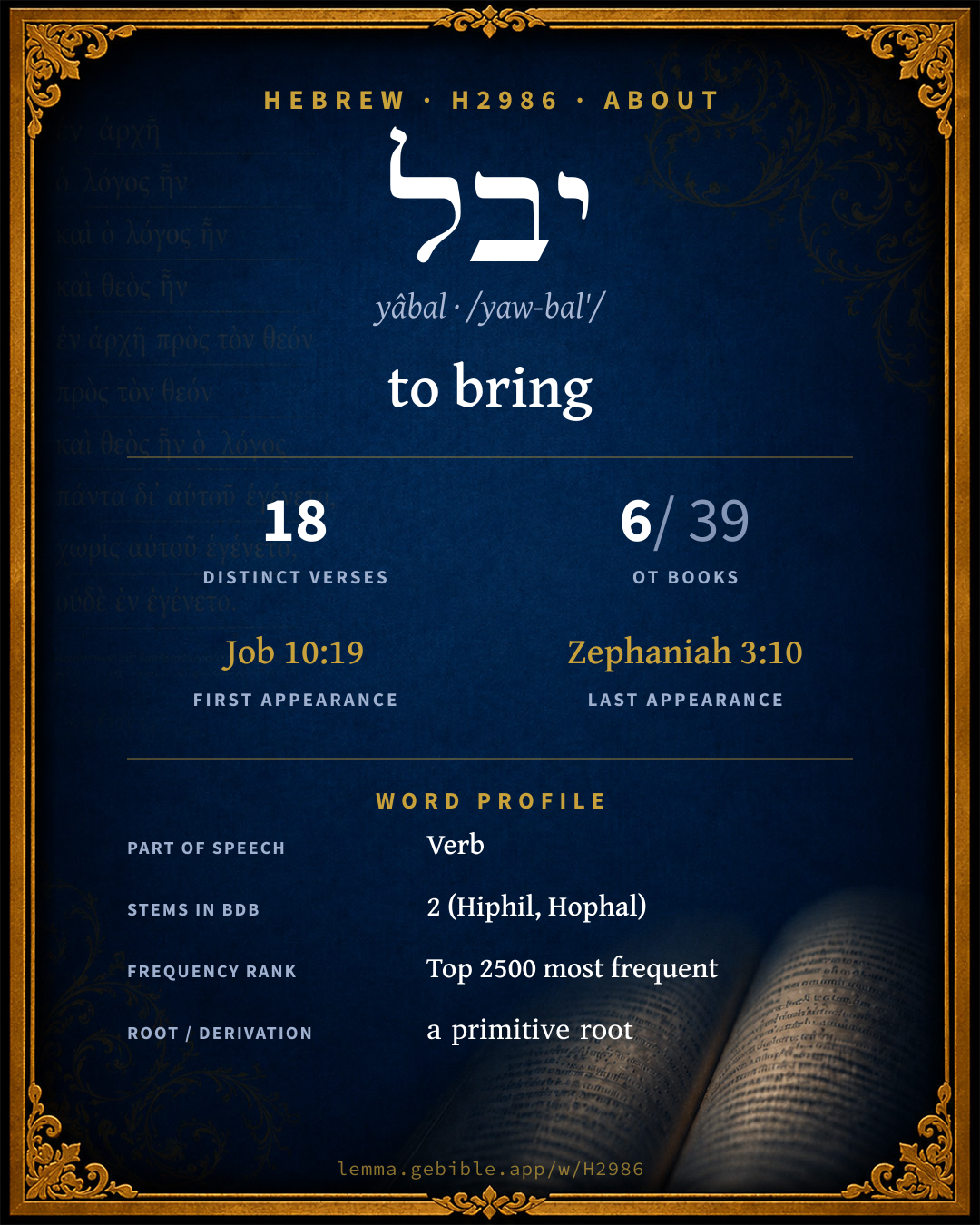
יָבַל
to bring
also: lead, carry, conduct, bear along fuller range ↓
Full lexicon entry — Brown-Driver-Briggs (BDB)
From Brown-Driver-Briggs (BDB)
Where this word appears
See every Hophal verb in the Hebrew Bible →
Grammar key — what these labels mean
Part of speech
- Verb
- An action or state-of-being word.
Stem
- Hophal
- The passive counterpart of the Hiphil (“he was caused to…”). Here: ‘be borne along’
- Hiphil
- The causative active stem (“he caused / brought about”). Here: ‘bear along offerings’
Form
- Imperfect
- An incomplete, ongoing, or future action (“he will / would write”).
Person
- 3rd Person
- The one spoken about (“he / she / it / they”).
- 1st Person
- The speaker (“I / we”).
- 2nd Person
- The one addressed (“you”).
Gender
- Masculine
- Grammatically masculine.
- Common
- Either gender — not distinguished for this form.
- Feminine
- Grammatically feminine.
Number
- Singular
- One.
- Plural
- More than one (in Hebrew, generally three or more).
Grammatical forms 9 distinct
- Verb, Hophal, Imperfect, 3rd Person, Masculine, Singular 6 times (33%)
- Verb, Hiphil, Imperfect, 3rd Person, Masculine, Plural 4 times (22%)
- Verb, Hiphil, Imperfect, 3rd Person, Masculine, Singular 2 times (11%)
- Verb, Hophal, Imperfect, 1st Person, Common, Singular 1 time (6%)
- Verb, Hophal, Imperfect, 2nd Person, Masculine, Plural 1 time (6%)
- Verb, Hophal, Imperfect, 3rd Person, Feminine, Plural 1 time (6%)
- Verb, Hophal, Imperfect, 3rd Person, Feminine, Singular 1 time (6%)
- Verb, Hophal, Imperfect, 3rd Person, Masculine, Plural 1 time (6%)
+1 more form (1 occurrence)
Parsed forms decoded from the imported morphology (morphhb / Westminster Leningrad Codex — WLC text public domain, morphhb tagging CC BY 4.0), counted across 18 parsed occurrences — not distinct verses.
Every verse where H2986 appears — 18 distinct verses across 6 books. Click any verse to open its interlinear word-by-word view. Verse text shown in the World English Bible for context — . Each verse’s Hebrew form is shown with its reference; the English is not keyword-highlighted, since the data carries no word-level English alignment. Use “Compare translations” on any verse to read it across multiple English versions. This concordance covers the Hebrew Bible; Septuagint (Greek Old Testament) occurrences are not indexed here.
Job 3 verses
- Job 10:19 אוּבָֽל Hophal impf 1cs I should have been as though I had not been. I should have been carried from the womb to the grave.
- Job 21:30 יוּבָֽלוּ Hophal impf 3mp That the evil man is reserved to the day of calamity? That they are led forth to the day of wrath?
- Job 21:32 יוּבָ֑ל Hophal impf 3ms Yet shall he be borne to the grave, Men shall keep watch over the tomb.
Psalms 6 verses
- Psalms 45:14 תּוּבַ֪ל Hophal impf 3fs She shall be led to the king in embroidered work. The virgins, her companions who follow her, shall be brought to you.
- Psalms 45:15 תּ֭וּבַלְנָה Hophal impf 3fp With gladness and rejoicing they shall be led. They shall enter into the king's palace.
- Psalms 60:9 יֹ֭בִלֵ/נִי Hiphil impf 3ms + sfx pers 1cs Who will bring me into the strong city? Who has led me to Edom?
- Psalms 68:29 יוֹבִ֖ילוּ Hiphil impf 3mp Because of your temple at Jerusalem, Kings shall bring presents to you.
- Psalms 76:11 יוֹבִ֥ילוּ Hiphil impf 3mp Make vows to Yahweh your God, and fulfill them! Let all of his neighbors bring presents to him who is to be feared.
- Psalms 108:10 יֹ֭בִלֵ/נִי Hiphil impf 3ms + sfx pers 1cs Who will bring me into the fortified city? Who has led me to Edom?
Isaiah 4 verses
- Isaiah 18:7 יֽוּבַל Hophal impf 3ms In that time shall a present be brought to Yahweh of Hosts [from] a people tall and smooth, even from a people awesome from their beginning onward, a nation that measures out and treads down, whose land the rivers divide, to the place of the name of Yahweh of Hosts, Mount Zion.
- Isaiah 23:7 יֹבִל֣וּ/הָ Hiphil impf 3mp + sfx pers 3fs Is this your joyous [city], whose antiquity is of ancient days, whose feet carried her afar off to sojourn?
- Isaiah 53:7 יוּבָ֔ל Hophal impf 3ms He was oppressed, yet when he was afflicted he didn't open his mouth; as a lamb that is led to the slaughter, and as a sheep that before its shearers is mute, so he didn't open his mouth.
- Isaiah 55:12 תּֽוּבָל֑וּ/ן Hophal impf 2mp + sfx n For you shall go out with joy, and be led forth with peace: the mountains and the hills shall break forth before you into singing; and all the trees of the fields shall clap their hands.
Jeremiah 2 verses
- Jeremiah 11:19 יוּבַ֣ל Hophal impf 3ms But I was like a gentle lamb that is led to the slaughter; and I didn't know that they had devised devices against me, [saying], Let us destroy the tree with the fruit of it, and let us cut him off from the land of the living, that his name may be no more remembered.
- Jeremiah 31:9 אֽוֹבִילֵ/ם֒ Hiphil impf 1cs + sfx pers 3mp They shall come with weeping; and with petitions will I lead them: I will cause them to walk by rivers of waters, in a straight way in which they shall not stumble; for I am a father to Israel, and Ephraim is my firstborn.
Hosea 2 verses
- Hosea 10:6 יוּבָ֔ל Hophal impf 3ms It also will be carried to Assyria for a present to a great king. Ephraim will receive shame, And Israel will be ashamed of his own counsel.
- Hosea 12:1 יוּבָֽל Hophal impf 3ms Ephraim feeds on wind, And chases the east wind. He continually multiplies lies and desolation. They make a covenant with Assyria, And oil is carried into Egypt.
Zephaniah 1 verse
About this entry
At a glance — auto-summarized from this page’s data, not written by a person. Every figure links to its source below. This summary describes the numbers; it doesn’t interpret them.
The Hebrew verb יבל centers on the idea of “to bring.” Its earliest occurrence is Job 10:19. Spanning 18 verses in 6 books, it ranks among the uncommon words of the Hebrew Bible. Psalms dominates its distribution — 6 of 18 verses. Read the stem: it spans 2 stems, including Hiphil and Hophal. For the data behind this summary, explore the sense tree and the renderings breakdown below.
Gloss history
Strong's 1890 vs modern scholarship
About this word
Strong's H2986 catalogs a Hebrew word from the Hebrew Old Testament.
These counts are not copied from any lexicon or concordance. They are computed here, from the morphology-tagged Hebrew Old Testament. What Lemma adds →
- 18
- distinct verses
- The word appears in 18 distinct verses.
- 6 / 39
- OT books
- The word appears in 6 of 39 Old Testament books.
- #1,612
- by frequency
- Top 2500 most frequent Hebrew words (rank 1,612 of 8,640 Hebrew words by occurrence).
View all 18 occurrences in the concordance →
By section of the Old Testament
By traditional corpus
Conventional, traditional groupings — biblical authorship is debated, so this is a traditional corpus grouping, not an authorship claim. Each share is this word’s portion of its verses in that division of the Hebrew canon. Each figure is a share of the word’s 18 distinct verses.
- Prophets (Nevi'im) 9 verses · 50%
- Writings (Ketuvim) 9 verses · 50%
How translations render this word
Counts come from each version’s own published word-to-Strong’s tagging or interlinear alignment — an approximate guide to how each version renders this word, not a word-level alignment the data otherwise carries. Because each total is that version’s own tagged count, the per-version totals vary from one another and need not match the appearance or distinct-verse counts above. These counts may also differ from a printed concordance because Lemma counts each distinctly tagged rendering and does not collapse phrase taggings into a single head-word total. This is a fixed set of word-tagged versions (KJV, ASV, BSB, ULT) and does not change with the reading translation you choose elsewhere. Each version’s license is shown beside its name below (and on Sources).
- King James Version: Bring 2×, Will bring 2×
- American Standard Version: Is led 2×, Shall bring 2×, Will bring 2×
- Berean Standard Bible: Will bring me 3×
- unfoldingWord Literal Text: Will bring 2×, Will bring me 2×
King James Version Public Domain
Renders H2986 across 18 tagged occurrences — most commonly:
Plus 14 renderings that appear only once — usually multi-word phrases or single function words the recovered tagging swept in, not distinct renderings.
American Standard Version Public Domain
Renders H2986 across 18 tagged occurrences — most commonly:
Plus 12 renderings that appear only once — usually multi-word phrases or single function words the recovered tagging swept in, not distinct renderings.
Berean Standard Bible Public Domain
Renders H2986 across 18 tagged occurrences — most commonly:
Plus 15 renderings that appear only once — usually multi-word phrases or single function words the recovered tagging swept in, not distinct renderings.
unfoldingWord Literal Text CC BY-SA 4.0
Renders H2986 across 18 tagged occurrences — most commonly:
Plus 14 renderings that appear only once — usually multi-word phrases or single function words the recovered tagging swept in, not distinct renderings.
8 senses and sub-senses in the full BDB
Hebrew verbs can shift meaning by stem (binyan): Qal is the basic action, Niphal is often passive or reflexive, Piel often intensifies or makes it factitive, and Hiphil is typically causative. The senses below are grouped under the stem BDB assigns to each. This entry also uses Hophal (the passive of Hiphil).
What do BDB’s symbols mean?
BDB uses these scholarly abbreviations:
| Symbol | Meaning |
|---|---|
| 𝔊 | the Septuagint (the ancient Greek translation, LXX) |
| 𝔙 | the Vulgate (the Latin translation) |
| 𝔖 | the Syriac version (the Peshitta) |
| 𝔗 | the Targum (the Aramaic translation) |
| ψ | the Psalms |
| √ | root (the underlying root or stem) |
| ‖ | parallel passage (a synonymous or contrasted parallel) |
| † | the dagger: every passage where the word occurs is cited |
The 8 senses and sub-senses the full Brown-Driver-Briggs lexicon distinguishes for this word, in lexicon order (not ranked by frequency), with BDB’s own verbatim wording and sub-sense lettering. Shown in Hebrew script with BDB’s own scholarly abbreviations. The condensed entry is in the Lexicon Entry tab. See also the Forms in the corpus table below.
Hiphil
- Impf. 3 ms. sf. יוֹבִילֵנִי ψ 60:11; 108:11; 1 s. sf. אוֹבִילֵם Je 31:9; 3 mpl. יוֹבִילוּ ψ 68:30; יֹבִילוּ 76:12 (juss.); יוֹבִלוּן Zp 3:10; sf. יֹבִלוּהָ Is 23:7;— e.g. Psalms 60:11
- 1. bear along offerings, c. acc. rei, Zp 3:10; c. ל pers. ψ 68:30; 76:12. e.g. Zephaniah 3:10
- 2. carry away, only י׳ רַגְלֶיהָ מֵרָחוֹק לָגוּר Is 23:7 her feet used to carry her far away to sojourn (of Tyre as colonizing and trading city). e.g. Isaiah 23:7
- 3. lead, conduct, c. obj. as sf., of returning exiles Je 31:9; triumphant army, sq. acc. loc., ψ 60:11 = 108:11. e.g. Jeremiah 31:9
Hophal
- Impf. 3 ms. יוּבַל(־) Is 18:7 Je 11:19; יוּבָ֑ל Ho 12:2 + 3 times; 3 fs. תּוּבַל ψ 45:15; 1 s. אוּבָ֑ל Jb 10:19; 3 mpl. יוּבָ֑לוּ Jb 21:30; 3 fpl. תּוּבַלְנָה ψ 45:16; 2 mpl. תּוּבָל֑וּן Is 55:12;— e.g. Isaiah 18:7
- 1. be borne along: of things, sq. לְ, a gift Is 18:7; idol Ho 10:6; oil 12:2. e.g. Isaiah 18:7
- 2. be borne to the grave: מִבֶּטֶן לַקֶּבֶר אוּבָ֑ל Jb 10:19; לִקְבָרוֹת יוּבָ֑ל 21:32. e.g. Job 10:19
- 3. be led, conducted, sq. לְ, ψ 45:15 Je 11:19 Is 53:7; abs. ψ 45:16; be led forth (from captivity in Babylon) Is 55:12, abs. (‖ יצא); the wicked (in triumph) abs. Jb 21:30. e.g. Psalms 45:15
Senses from the full Brown-Driver-Briggs lexicon (Brown, Driver, Briggs; Oxford 1906 — public domain), digitized via Sefaria, supplemented by the OpenScriptures HebrewLexicon (CC BY 4.0). Full attribution on Sources.
Word origin
vb. Hiph. conduct, bear along, especially in procession (Aramaic יַבֵּל, אוֹבִיל id., ܝܰܒܶܠ Pa. lead along, also Ethpa.; Aph. lead, conduct; Zinj. יבל id., DHMSendsch.Gloss..; Assyrian abâlu (ובל), bring, conduct, COT Gloss.. DlPr 122 ff.; Arabic وَبَلَ is run vehemently (of horse), pursue sharply, pour down rain, وَبْلٌ violent rain)—
— Brown-Driver-Briggs (Oxford 1906, public domain), digitized via Sefaria, supplemented by the OpenScriptures HebrewLexicon (CC BY 4.0). See Sources.
Origin: a primitive root
Jastrow Dictionary
A second Hebrew/Aramaic lexicon for comparison, covering Aramaic and post-biblical (Talmudic, Targumic, Midrashic) usage that the biblical-Hebrew BDB does not. Matched by lemma rather than by Strong’s number, so a lemma may carry more than one Jastrow headword (shown separately below), and the entries cover usage well beyond the Bible.
יָבַל I
- (b. h.) [to break through, come forth, run, flow.—V. יְבוּל, יִבְלָא &c.]
- to lead; to carry, bring. Sifré Deut. 43 (ref. to יבולה, Deut. XI, 17) אף לא מה שאתה מוֹבִיל לה not even as much as thou carriest to it (as seed); Yalk. ib. 869. R. Hash. 9ᵇ, v. דּוּר ch.—Part. pass. מוּבָל one carried, unable to move, feetless &c. Toh. VII, 5 אפי׳ מ׳ אפי׳ כפות even if he is unable to move, even if he is tied; Tosef. ib. VIII, 7 והלה מוּוָל או כפות ed. Zuck. (ed. ממלאו, read: מוול או); Y. Ḥag. II, end, 78ᶜ אפי׳ מאכל ואפי׳ כסות (corr. acc.). [For הוֹבִיל to study, v. בִּיל h.] e.g. Deuteronomy 11:17
יְבַל
- , Af. אוֹבִיל, אֵיבֵיל (הֵיבֵל), אַיְיבֵל ch. same. Targ. Ps. LXVI, 6. Targ. Is. X, 32 (v. infra); a. fr.—Erub. 27ᵇ, a. e. מוֹבִילְנָא מאניה וכ׳ I will carry his clothes after him to the bath-house. Snh. 95ᵃ (ref. to ינפף, Is. l. c.) מוֹבִיל ומייתי וכ׳ moving his hand to and back (= h. מוליך ומביא, v. בּוֹא); a. fr.—[Ezra V, 14; VI, 5.]—Y. Meg. IV, 75ᵇ bot. כד דאינן תרתייתי מֵיבֵל וכ׳ when two scrolls are used, he carries one away and brings another in; Y. Sot. VII, end, 22ᵃ תרתיי תו מַיְיבֵל (corr. acc.); Y. Yoma VIII, 44ᵇ top מייכל (corr. acc.). Y. Sot. l. c. מַיְיבְלִין, v. אוֹרָיָיא. Y. Taan. III, 66ᵈ bot. הוה מַיְיבְלָהּ וכ׳ (not מייבללה) brought it thither.—[Y. Ab. Zar. III, 43ᵃ נייבל, v. בִּיל ch. e.g. Ezra 5:14
- to be carried. Targ. Is. XXXIX, 6.
יָבַל II
- Pi. יִיבֵּל (denom. of יַבֶּלֶת) to cut off dry twigs, warts &c., to trim. Shebi. II, 2 מְיַבְּלִין מפרקין (Ms. M. a. Y. ed. מְזַבְּלִין, incorr.); expl. Y. ib. 33ᵈ top, v. יַבֶּלֶת.
A Dictionary of the Targumim, the Talmud Babli and Yerushalmi, and the Midrashic Literature (Marcus Jastrow; London, Luzac, 1903) — Public Domain. Digitized via Sefaria. Digitized via Sefaria. Full attribution on Sources.
Forms in the corpus
The 16 distinct written forms H2986 takes in the Hebrew Bible, most frequent first — each parse links to that stem’s occurrences in the concordance. Hebrew forms include their vowel points and cantillation, so a single lemma takes many written forms.
Same root — word family
Other BDB entries built from the same root as H2986, grouped by Strong’s listed origin. These share a root / origin per the lexicon — not necessarily a shared meaning. Each links to that word’s own entry.
Derived from this word
- אובל ʼûwbâl H180 stream
- יבול yᵉbûwl H2981 produce
- יבל yᵉbal H2987 to bring
- יבל yâbâl H2988 stream
- יבל yabbêl H2990 running sore
- יובל yôwbêl H3104 ram's horn
- יובל yûwbal H3105 stream
- מבול mabbûwl H3999 flood
- תבל têbêl H8398 world
Proper names from this root
People and places named from this root — a name, not an additional meaning of the word.
Compare all same-root words → Showing 4 of 12 — not the complete family. 2 of the same-root words are proper names (people or places). They share a root, not necessarily a meaning.
Septuagint verse parallels
This word appears in 16 verses that also exist in the Greek Old Testament (Septuagint), out of the 18 Hebrew verses it occurs in. You can read those verses in Greek by switching the Old Testament edition to the Septuagint.
Read these verses in the Septuagint
This is a verse-level parallel only — the same verses exist in both the Hebrew and Greek Old Testaments. No word-level Hebrew↔Greek correspondence is claimed: the data carries no such alignment, so no Greek word is shown as this Hebrew word’s translation. Coverage is not total — the Septuagint omits the deuterocanon and renumbers the Psalms, so some Hebrew verses have no direct Greek parallel.