Ezekiel 27:32

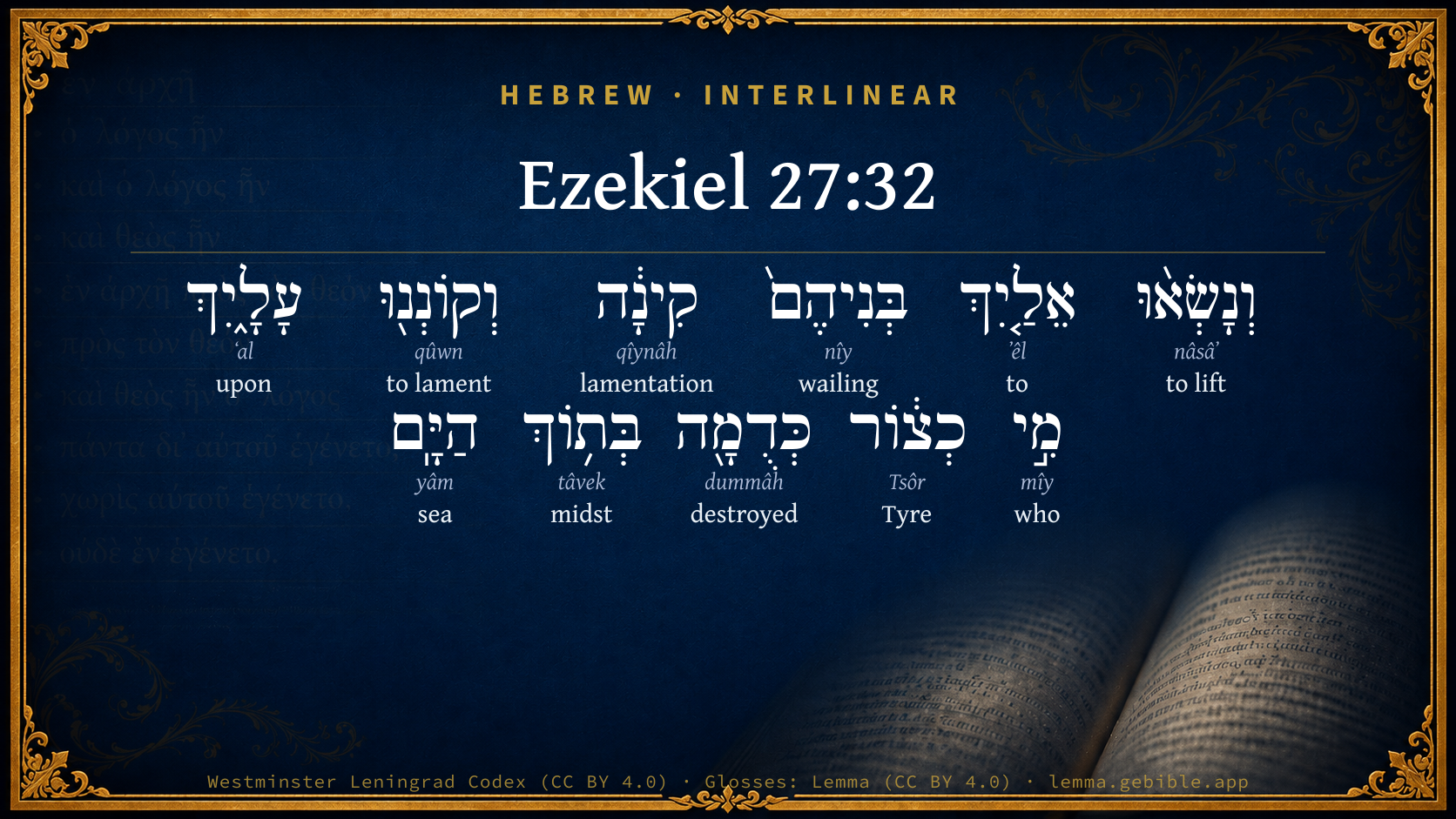
Hebrew (Westminster Leningrad Codex) Ezekiel 27:32 appears in the Hebrew Old Testament. The text above is from the Westminster Leningrad Codex. Each word links to its Strong’s number, a concise gloss, and parsing drawn from the Open Scriptures Hebrew Bible morphology. Click any word for its full Brown-Driver-Briggs (BDB) entry.
Download image
Cite this verse

Ezekiel 27:32 (World English Bible). Public Domain. Lemma interlinear Bible study tool, https://lemma.gebible.app/v/ezekiel/27/32.

Show BibTeX & RIS
BibTeX
RIS
English Translation
In their wailing they shall take up a lamentation for you, and lament over you, [saying], Who is there like Tyre, like her who is brought to silence in the midst of the sea?
World English Bible · Public Domain
Highlights Full analysis ↓
Download a study sheet

One document with this verse’s original text, its word-by-word gloss line, the meaning frame, cross-references with their text, attributed commentary, and full source and license credits — printable, and it pastes into notes with its structure intact.

This verse Autodidact and up

Study sheet (.html) Plain text (.txt)

A passage Seminary Student

Up to 50 verses in one chapter. A passage sheet keeps up to 6 commentary sources and 12 cross-references per verse, in the order this page ranks them, and says so on the sheet whenever that leaves anything out. Ask for a single verse and you get the Autodidact verse sheet above.

Everything on this page stays free to read, with no account — the sheet is a download of what is already on screen, not access to it.

Want to remove ads? Support Godless Engineer
Compare translations 3

The same verse in 3 English versions, stacked beneath the original-language interlinear above. Click any original word for its lexicon entry.

Each is an independent rendering of the whole verse — the interlinear is not word-aligned to these translations.

Highlighted words mark where these versions differ — a whole-verse word diff, not a word-by-word alignment.

  • World English Bible Public Domain
    In their wailing they shall take up a lamentation for you, and lament over you, [saying], Who is there like Tyre, like her who is brought to silence in the midst of the sea?
  • King James Version Public Domain
    And in their wailing they shall take up a lamentation for thee, and lament over thee, saying, What city is like Tyrus, like the destroyed in the midst of the sea?
  • unfoldingWord Literal Text CC BY-SA 4.0
    They will lift up their wails of lamentation for you and sing dirges over you, Who is like Tyre, who has now been brought to silence in the middle of the sea?

unfoldingWord Literal Text — © unfoldingWord, licensed CC BY-SA 4.0. Word-aligned USFM3 via Door43 (git.door43.org/unfoldingWord/en_ult).

Versions to compare (up to 4)

3 of 4 selected

Show all 18 translations

Every available English version of this verse, each an independent rendering of the whole verse.

  • World English Bible Public Domain
    In their wailing they shall take up a lamentation for you, and lament over you, [saying], Who is there like Tyre, like her who is brought to silence in the midst of the sea?
  • Berean Standard Bible Public Domain
    As they wail and mourn over you, they will take up a lament for you: ‘Who was ever like Tyre, silenced in the middle of the sea?
  • Majority Standard Bible Public Domain
    As they wail and mourn over you, they will take up a lament for you: ‘Who was ever like Tyre, silenced in the middle of the sea?
  • King James Version Public Domain
    And in their wailing they shall take up a lamentation for thee, and lament over thee, saying, What city is like Tyrus, like the destroyed in the midst of the sea?
  • American Standard Version (1901) Public Domain
    And in their wailing they shall take up a lamentation for thee, and lament over thee, `saying', Who is there like Tyre, like her that is brought to silence in the midst of the sea?
  • Revised Version (1885) Public Domain
    And in their wailing they shall take up a lamentation for thee, and lament over thee, saying, Who is there like Tyre, like her that is brought to silence in the midst of the sea?
  • Geneva Bible (1599) Public Domain
    And in their mourning, they shall take vp a lametation for thee, saying, What citie is like Tyrus, so destroied in the middes of the sea!
  • Douay-Rheims (1899) Public Domain
    And they shall take up a mournful song for thee, and snail lament thee: What city is like Tyre, which is become silent in the midst of the sea?
  • Young's Literal Translation Public Domain
    And lifted up for thee have their sons a lamentation, And they have lamented over thee, who `is' as Tyre? As the cut-off one in the midst of the sea?
  • Literal Standard Version CC BY-SA 4.0
    And their sons have lifted up a lamentation for you, || And they have lamented over you, Who [is] as Tyre? As the cut-off one in the midst of the sea?
  • Unlocked Literal Bible CC BY-SA 4.0
    They will lift up their wails of lamentation for you and sing dirges over you, Who is like Tyre, who has now been brought to silence in the middle of the sea?
  • unfoldingWord Literal Text CC BY-SA 4.0
    They will lift up their wails of lamentation for you and sing dirges over you, Who is like Tyre, who has now been brought to silence in the middle of the sea?
  • Darby Bible Public Domain
    And in their wailing they shall take up a lamentation for thee, and lament over thee, [saying,] Who is like Tyre, like her that is destroyed in the midst of the sea?
  • World Messianic Bible Public Domain
    In their wailing they will take up a lamentation for you, and lament over you, saying, ‘Who is there like Tyre, like her who is brought to silence in the middle of the sea?’
  • Webster's Bible Public Domain
    And in their wailing they shall take up a lamentation for thee, and lament over thee, saying, What city is like Tyre, like the destroyed in the midst of the sea?
  • Free Bible Version CC BY-SA 4.0
    As they weep and wail over you, they sing a funeral song for you: ‘Who could compare to Tyre, now destroyed out in the sea?
  • Bible in Basic English Public Domain
    And in their weeping they will make a song of grief for you, sorrowing over you and saying, Who is like Tyre, who has come to an end in the deep sea?
  • JPS Tanakh (1917) Public Domain
    And in their wailing they shall take up a lamentation for thee, and lament over thee: who was there like Tyre, fortified in the midst of the sea?

Literal Standard Version (2020), Covenant Press — licensed CC BY-SA 4.0. Text via the HelloAO Bible API (eBible.org). Unlocked Literal Bible (unfoldingWord) — licensed CC BY-SA 4.0. Text via the HelloAO Bible API (eBible.org). unfoldingWord Literal Text — © unfoldingWord, licensed CC BY-SA 4.0. Word-aligned USFM3 via Door43 (git.door43.org/unfoldingWord/en_ult). Free Bible Version, Dr. Jonathan Gallagher — licensed CC BY-SA 4.0. Text via the HelloAO Bible API (eBible.org).

Word by word

More ways to search: Search by grammar → Find every occurrence → Compare this word →

Practice this passage: Drill this verse → Learn its vocabulary →

בְּנִיהֶם֙
nîy
H5204
“in/at · wailing · their”
Preposition + Noun, Common, Masculine, Singular, Construct + Suffix, Personal, 3rd Person, Masculine, Plural
Part of Speech
Preposition + Noun
Type
Common
Gender
Masculine
Number
Singular
State
Construct
Full BDB Definition

Origin: a doubtful word

TWOT: 1311c

wailing
  1. וְנָשְׂא֨וּ nâsâʼ H5375 “and · to lift” Conjunction + Verb, Qal, Sequential Perfect, 3rd Person, Common, Plural
  2. אֵלַ֤יִךְ ʼêl H413 “to · you” Preposition + Suffix, Personal, 2nd Person, Feminine, Singular
  3. קִינָ֔ה qîynâh H7015 “lamentation” Noun, Common, Feminine, Singular, Absolute
  4. וְקוֹנְנ֖וּ qûwn H6969 “and · to lament” Conjunction + Verb, Polel, Sequential Perfect, 3rd Person, Common, Plural
  5. עָלָ֑יִךְ ʻal H5921 “upon · you” Preposition + Suffix, Personal, 2nd Person, Feminine, Singular
  6. מִ֣י mîy H4310 “who” Particle, Interrogative
  7. כְצ֔וֹר Tsôr H6865 “like/as · Tyre” Preposition + Noun, Proper
  8. כְּדֻמָ֖ה dummâh H1822 “like/as · destroyed” Preposition + Noun, Common, Feminine, Singular, Absolute
  9. בְּת֥וֹךְ tâvek H8432 “in/at · midst of” Preposition + Noun, Common, Masculine, Singular, Construct
  10. הַיָּֽם yâm H3220 “the · sea” Particle, Definite Article + Noun, Common, Masculine, Singular, Absolute

About this verse

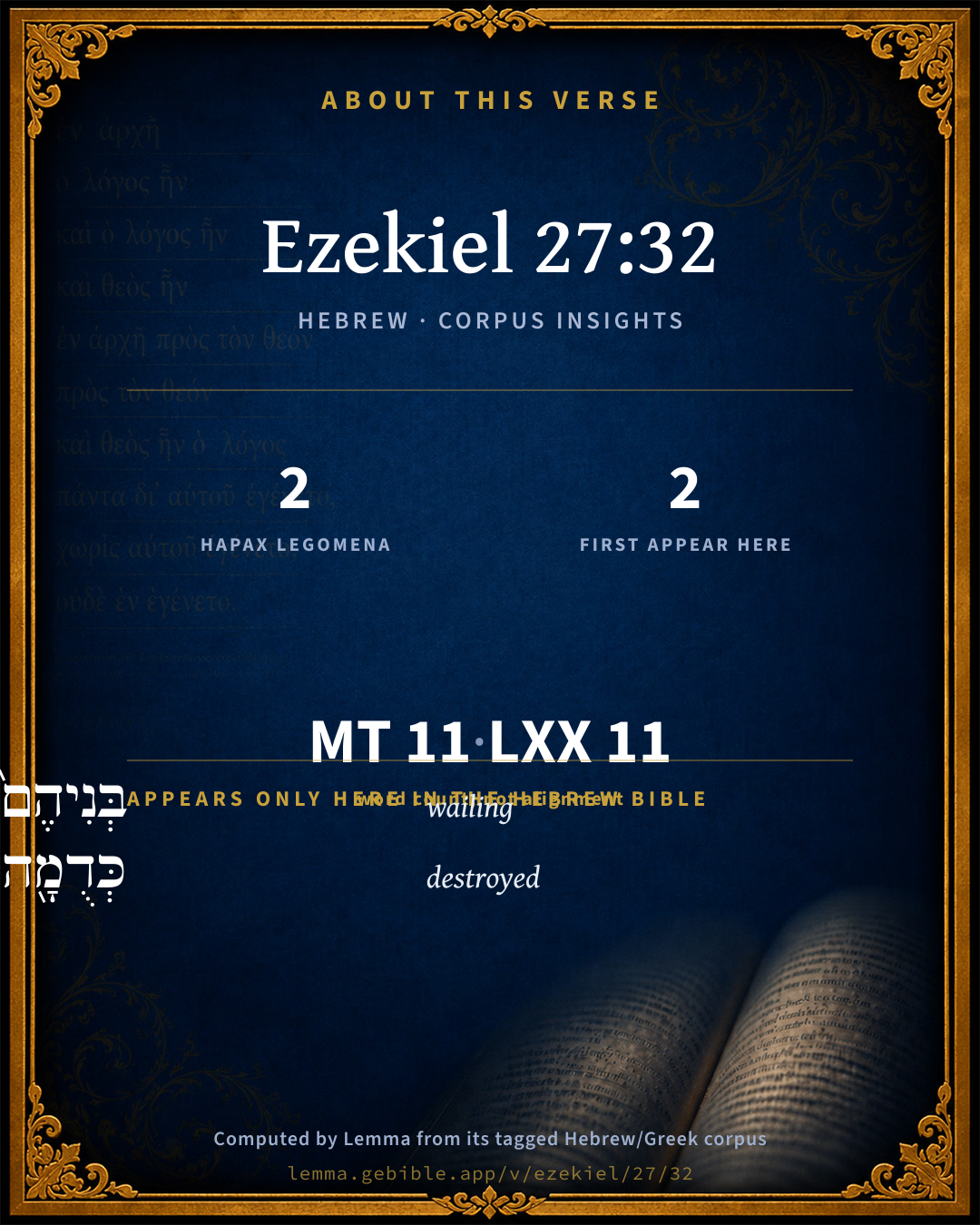
These counts appear in no published source. They are computed here, from the morphology-tagged text and Lemma’s own curated glosses. What Lemma adds →

11
words
11
distinct lemmas
Prophets
section

Notable vocabulary

2 hapax legomena — words that appear only here in the entire Hebrew Bible:

  • בְּנִיהֶם֙ wailing H5204
  • כְּדֻמָ֖ה destroyed H1822

First appearance in Scripture

These words make their first canonical appearance in the Hebrew Bible here:

  • בְּנִיהֶם֙ wailing H5204
  • כְּדֻמָ֖ה destroyed H1822

Shared distinctive vocabulary

וְקוֹנְנ֖וּ to lament H6969 occurs in 6 verses of the Hebrew Bible. Also found in:

Grammatical profile

  • 2 verbs
  • 6 nouns
  • 2 prepositions
  • 1 particle

Verb forms

  • וְנָשְׂא֨וּ Qal · Sequential Perfect
  • וְקוֹנְנ֖וּ Polel · Sequential Perfect

Hebrew & Septuagint length

In English translation the verse runs 34 words from the Hebrew and 16 from the Septuagint (LXX English) — the Septuagint runs noticeably shorter here. See the side-by-side →

A rough comparison of the two English renderings, which tokenize alike — not a word-level alignment.

Word counts can differ between the Hebrew and the Greek without any difference in meaning — e.g. the Hebrew direct-object marker אֵת has no separate Greek word, and Greek often adds the article ὁ.

In the original languages it is 11 Hebrew tokens and 11 Greek tokens — but the two are counted differently (Hebrew bundles its prefixes and suffixes into one token; the Greek is in lemma form), so that isn’t a like-for-like length.

Cross-references

7

Topical passages linked to Ezekiel 27:32 in the Treasury of Scripture Knowledge — connected by theme and wording, ordered by reader-vote popularity; previews shown in the World English Bible.

  • Ezekiel 26:17 They shall take up a lamentation over you, and tell you, How are you destroyed, who were inhabited by seafaring men, the renowned city, who was strong in the sea, she and her inhabitants, who caused their terror to be on all who lived there!
  • Ezekiel 27:2 You, son of man, take up a lamentation over Tyre;
  • Revelation 18:18 and cried out as they looked at the smoke of her burning, saying, 'What is like the great city?'
  • Lamentations 1:12 Is it nothing to you, all you who pass by? Look, and see if there be any sorrow like my sorrow, which is brought on me, With which Yahweh has afflicted [me] in the day of his fierce anger.
  • Lamentations 2:13 What shall I testify to you? what shall I liken to you, daughter of Jerusalem? What shall I compare to you, that I may comfort you, virgin daughter of Zion? For your breach is great like the sea: who can heal you?
  • Ezekiel 26:4–5 They shall destroy the walls of Tyre, and break down her towers: I will also scrape her dust from her, and make her a bare rock.
  • Ezekiel 27:26 Your rowers have brought you into great waters: the east wind has broken you in the heart of the seas.

Cross-references courtesy of OpenBible.info (CC BY 4.0).

Hebrew and Greek witnesses Masoretic Hebrew ↔ Greek Septuagint

The same verse in the two great witnesses to the Old Testament, shown verse-for-verse.

Here the Septuagint runs noticeably shorter than the Hebrew — LXX2012 (modern English Septuagint) 16 words vs World English Bible 34. A rough length comparison of the two English translations, not a word-level alignment — read both below.

These are two independent witnesses, not word-aligned to each other, and the Septuagint is shown in lemma (dictionary) form.

Hebrew Ezekiel 27:32 Masoretic · Westminster Leningrad Codex

וְנָשְׂא֨וּ אֵלַ֤יִךְ בְּנִיהֶם֙ קִינָ֔ה וְקוֹנְנ֖וּ עָלָ֑יִךְ מִ֣י כְצ֔וֹר כְּדֻמָ֖ה בְּת֥וֹךְ הַיָּֽם

In their wailing they shall take up a lamentation for you, and lament over you, [saying], Who is there like Tyre, like her who is brought to silence in the midst of the sea?

World English Bible · Public Domain

Greek LXX Ezekiel 27:32 Septuagint · lemma form

καί λαμβάνω ὁ υἱός αὐτός ἐπί σύ θρῆνος καί θρήνημα σύ

And their sons shall take up a lament for you, even a lamentation for Sor, saying,

LXX2012 (modern English Septuagint) · Public Domain

Hebrew: Westminster Leningrad Codex (CC BY 4.0). Greek: Septuagint (public domain); English from LXX2012 (modern English Septuagint) (Public Domain). How the Septuagint differs from the Hebrew →

Targum (Aramaic paraphrase)

1

The Targum is the ancient Jewish Aramaic paraphrase of the Hebrew Scriptures — an interpretive translation, not the Hebrew text itself. Onkelos (literal) and Pseudo-Jonathan (expansive) render the Torah, and Jonathan the Prophets. Coverage is partial: where no permissively-licensed English translation exists for a verse, only the Aramaic is shown. This is verse-level text, not a word-by-word alignment to the Hebrew.

  1. Targum Jonathan Prophets (Joshua–Malachi)
    וְיִטְלוּן עֲלָךְ בְּעִינוּיֵהוֹן אִילְיָא וְיֵלִילוּן עֲלָךְ מַן כְּצוֹר לֵית דְדָמֵי לָהּ בְּגוֹ יַמַיָא:

    (no public-domain English translation for this verse)

    Targum Jonathan — Aramaic: “Mikraot Gedolot” (public domain). English: “Sefaria Community Translation” (CC0 1.0 (public-domain dedication)); “London "Chaldee Paraphrase," 1871” (public domain). Text via Sefaria.

Commentary

Notes on Ezekiel 27:32 from classic Christian and Jewish commentators (each source and its license shown beneath its notes). The classic Christian expositions comment on the surrounding passage and are grouped to its opening verse, so a note may address several verses; the Jewish commentaries on the Tanakh (Rashi and others) are per-verse, so they appear only where the commentator wrote on this verse.

Lemma curates 59 commentaries, every one of them public domain or Creative Commons licensed, each selected and text-cleaned for this edition rather than reprinted as found. About our sources →

Trapp's Complete Commentary

John Trapp

Eze 27:32 And in their wailing they shall take up a lamentation for thee, and lament over thee, [saying], What [city is] like Tyrus, like the destroyed in the midst of the sea?

Ver. 32. What city.] An elegant mimesis.

Like the destroyed.] Quae obmutuit, like her that lost her voice and life together.

John Trapp, A Commentary or Exposition upon All the Books of the Old and New Testament (1647–1656) — public domain. Text from a community e-Sword module.

Adam Clarke's Commentary

Verse 32. What city is like Tyrus] This, to the end of the chapter, is the lamentation.

Adam Clarke's Commentary on the Bible (1810–1826) — public domain. Text from a community e-Sword/MySword module.

The Cambridge Bible for Schools and Colleges

gen. ed. J. J. S. Perowne

32–36. Lament over Tyre

The lament appears to be in elegiac metre. The word “wailing” is a contracted form (ni = nehi).

What city] Rather: who is like Tyre.

like the destroyed] The form is very obscure, but nothing better has been proposed.

The Cambridge Bible for Schools and Colleges (gen. ed. J. J. S. Perowne; Cambridge University Press, 1878–1918) — public domain. Text from a community e-Sword module.

John Gill's Exposition

When thy wares went forth out of the seas,.... When they were took out of ships, which came to Tyre from all parts, and were landed on the shore, and put up in warehouses, and exposed in markets and The Targum is,

"when thy merchandise went out from among the nations;''

being brought from all parts thither:

thou filledst many people; by selling them in their markets commodities they wanted, for which they came from all quarters; and by sending them to others in ships, where they knew they stood in need of them, and would fetch them a good price; and they had enough to answer the demands of all, and to supply them to the full:

thou didst enrich the kings of the earth with the multitude of thy riches and pithy merchandise; by taking off the goods of their subjects, whereby they were able the better to pay their taxes, and support them in their grandeur and dignity; as well as by furnishing them gold and silver, and precious stones, which they gave for the produce of their country; or by the toll and custom of the goods imported or exported.

John Gill's Exposition of the Whole Bible (1746–1763) — public domain (CC PDM 1.0). Text via the HelloAO Bible API.

Matthew Poole's English Annotations

In their wailing; in their sorrowful speeches of Tyre. Shall take up into their mouths, or with a composed, significant, and comprehensive form of speech, to show much grief in few words.

What city is like Tyrus? a few years since no city like her in beauty, riches, glory, and joy, now none like her in all the contraries.

The destroyed; now no more Tyre the flourishing, the renowned, the mart of nations, and the stately built; but now the destroyed, the silent, overwhelmed with grief, which was full of songs.

In the midst of the sea: alas! what was once her safeguard is now her grave, what enriched her once hath now swallowed all up at once.

Matthew Poole's English Annotations on the Holy Bible (1683–1685) — public domain. Text from a community e-Sword/MySword module.

The Pulpit Commentary

As in other instances of extreme sorrow, the inarticulate signs of grief pass after a time into spoken words. What city is like Tyrus, etc.? What parallel can be found in the world"s history, either for her magnificence or her fall? The shipwreck of her fortunes (we are still in the region of the prophet"s metaphors) would be utter and irretrievable.

An incomparable doom.

The dreadful doom of Tyre is regarded as without parallel. Consider why this is so.

I THE GREATEST SIN BRINGS THE GREATEST DOOM. All men do not sin equally, and all will not be punished to the same extent some with few stripes, others with many stripes. Tyre sinned grievously, therefore Tyre was to be punished grievously. It is not the man who thinks himself the lightest sinner who will certainly be let off with the smallest amount of punishment. We are not to be our own judges and the assessors of our own guilt. There will be many great surprises in the day of judgment. The heaviest doom will be for those who knew the right way and yet did not walk in it. (Luk_12:47, Luk_12:48) Therefore there will be heavier penalties even than those earned by Tyre. Christ says it will be more tolerable for Tyre and Sidon in the day of judgment than for Bethsaida and Chorazin, for the heathen Phoenician cities had not the opportunities that were afforded to the Galilaean towns in which Christ had labored. (Luk_10:13) If London sins like Tyre, London"s doom must be greater than Tyre"s, for a city of Christendom has privileges which the pagans never enjoyed.

II THE GREATEST DOOM WILL BE FELT IN CONTRAST TO THE HIGHEST PROSPERITY. The fall of Tyre was most appalling because her previous splendor had been most imposing. Dives writhing in agony in Hades arrests attention because he was previously enjoying the greatest luxury. The contrast is not merely a striking dramatic effect for the outside observer. It produces the most intense results in the feelings of the sufferer. We feel by contrast, and the greater the contrast the keener are our feelings. Thus a millionaire brought down to destitution feels the hardships of the poor-house far more acutely than the beggar who has never been accustomed to more sumptuous fare. Souls that have tasted of Christ"s grace must suffer more agonies, if they become castaways at last, than souls that have never experienced its blessedness.

III THE GREATEST DOOM MAY BE AVERTED. These things are written for our instruction to warn us to flee from the approaching wrath, not to paralyze us with hopeless dismay. Tyre was overthrown, and its foundations became drying-grounds for the fisherman"s nets exactly as Ezekiel had predicted. (Eze_26:5) The threats of future punishment are equally certain so long as the sin that rouses them remains. But Christ has come to destroy the curse of sin and to free the soul from its doom. It is foolish to seek some faint encouragement from risky attempts to minimize the prospect of future punishment, and so to lull the soul to sleep in its peril. There can be no use in exaggerating the statements of Scripture, nor can there be any wisdom in making the least of them. True wisdom lies in recognizing the unspeakable horror of sin and its doom to the full, and then turning to Christ for deliverance from the sin as much as from its penalties.

The Pulpit Commentary (1880–1919), ed. H.D.M. Spence-Jones & Joseph S. Exell — public domain. Text from a community e-Sword module.

John Wesley's Explanatory Notes

In the sea - Alas! what was once her safeguard, is now her grave.

John Wesley, Explanatory Notes Upon the Whole Bible (1754–1765) — public domain. Text via the GEBible commentary corpus.

Rashi

Rabbi Shlomo Yitzchaki (Rashi)

And they will lift up over you with their wailing [Heb. בְּנִיהֶם,] with their wailing.

“as Dummah” [Heb. כְּדֻמָּה.] This was the name of the heads of Edom, as the matter is stated (Isa. 21: 11): “The harsh prophecy about Dumah (דּוּמָה).” Jonathan renders: There is none like (דָמֵי) as one of her likeness (כַּדוֹמָה).

Rashi on the Tanakh — English translations: “The Judaica Press complete Tanach with Rashi, translated by A. J. Rosenberg” (CC BY 4.0); “Pentateuch with Rashi's commentary by M. Rosenbaum and A.M. Silbermann, 1929-1934” (public domain); “The Metsudah Tanach series, Lakewood, N.J” (CC BY 4.0); and “The Book of Joshua, Metsudah Publications, 1997” (CC BY 4.0). Text via Sefaria.

Lesson kit

Teaching starters — assembled from the data on this page, not authored interpretation. Every prompt links to the verse data it draws on. Edit before teaching.

Ezekiel, in the Prophets, opens this verse with 11 words (11 distinct Hebrew lemmas). Its most distinctive word is nîy (“wailing”). The Greek Septuagint runs shorter here. A historical commentator’s framing appears above. Read the whole chapter for the surrounding context.

Discussion questions

  1. What does “wailing” (nîy) contribute to the verse as a whole?
  2. 2 words here appear nowhere else in the Hebrew Bible. Why might the author reach for such rare wording?
  3. 2 words make their first appearance in Scripture here. What does this debut establish?
  4. How does 2 Samuel 1:17, which shares the word «to lament», read alongside this verse?
  5. The Septuagint runs shorter here than the Hebrew. What might account for the difference?
  6. These translations render this verse differently. What is at stake in choosing one wording over another?
  7. «וְנָשְׂא֨וּ» is a Qal Sequential Perfect verb. How does that grammatical form shape the action described?
  8. Compare how Trapp's Complete Commentary and Adam Clarke's Commentary read this verse. Where do they agree or differ?

Things to notice

Reading settings

Reading text

Shown beneath each verse's original-language words.

Old Testament
Old Testament edition

Read the OT as the Masoretic Hebrew (MT) or the Greek Septuagint (LXX).

English shown for the Greek Septuagint (in the Hebrew ↔ Greek comparison).

Comparing translations? Open the Compare panel on any verse page to stack up to four side by side.