
Romans 5:4

Greek (Tischendorf 8th ed.) Romans 5:4 appears in the Greek New Testament. The text above is from the Tischendorf 8th edition. Each word links to its Strong’s number and a concise gloss. Click any word for its full Thayer’s Greek Lexicon entry.
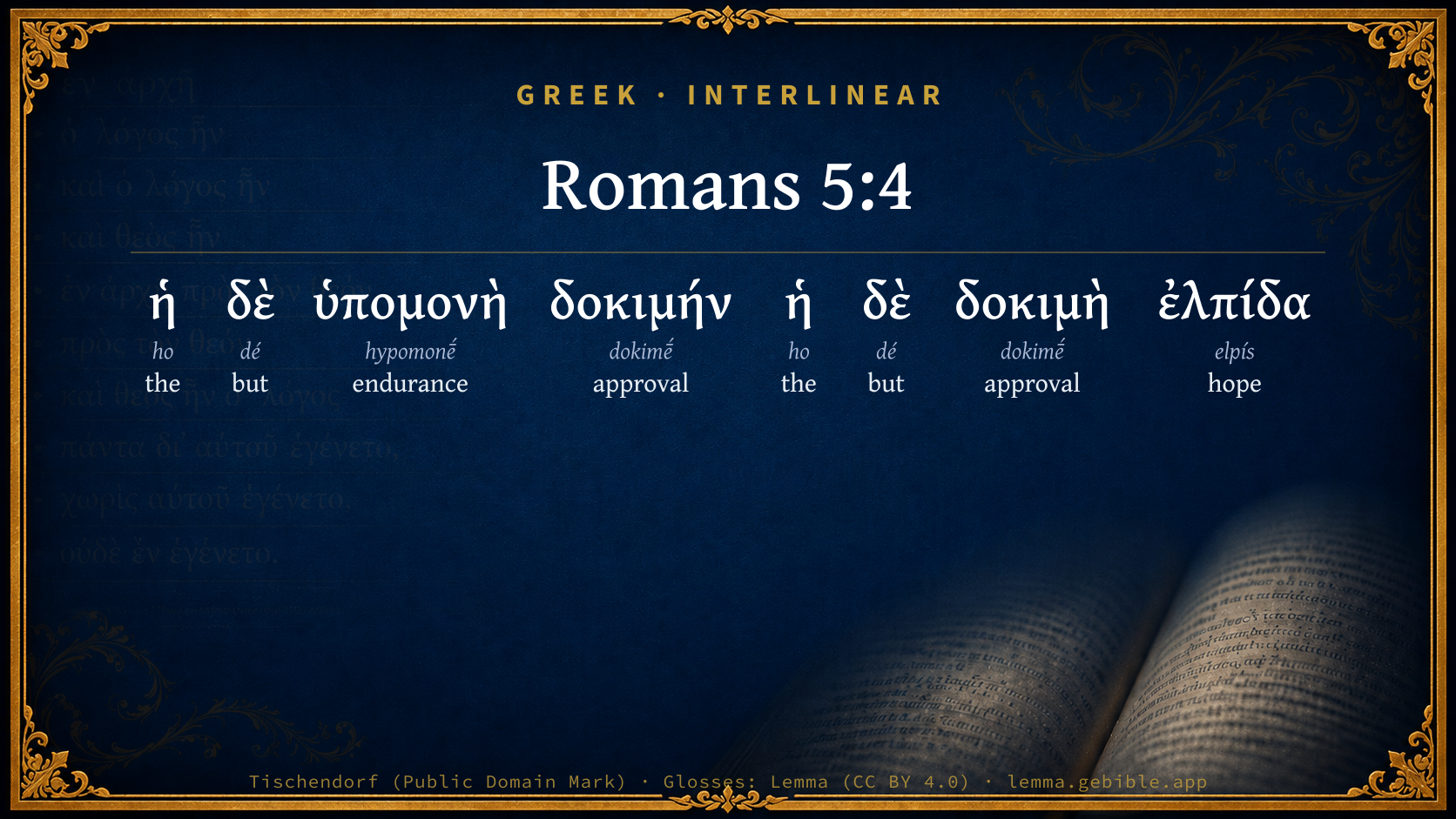
Download image
Cite this verse

Romans 5:4 (World English Bible). Public Domain. Lemma interlinear Bible study tool, https://lemma.gebible.app/v/romans/5/4.

Show BibTeX & RIS
BibTeX
RIS
English Translation
and perseverance, proven character; and proven character, hope:
World English Bible · Public Domain
Highlights
  • 1 first appearance in the Greek New Testament
Full analysis ↓
Download a study sheet

One document with this verse’s original text, its word-by-word gloss line, the meaning frame, cross-references with their text, attributed commentary, and full source and license credits — printable, and it pastes into notes with its structure intact.

This verse Autodidact and up

Study sheet (.html) Plain text (.txt)

A passage Seminary Student

Up to 50 verses in one chapter. A passage sheet keeps up to 6 commentary sources and 12 cross-references per verse, in the order this page ranks them, and says so on the sheet whenever that leaves anything out. Ask for a single verse and you get the Autodidact verse sheet above.

Everything on this page stays free to read, with no account — the sheet is a download of what is already on screen, not access to it.

Want to remove ads? Support Godless Engineer
Compare translations 3

The same verse in 3 English versions, stacked beneath the original-language interlinear above. Click any original word for its lexicon entry.

Each is an independent rendering of the whole verse — the interlinear is not word-aligned to these translations.

Highlighted words mark where these versions differ — a whole-verse word diff, not a word-by-word alignment.

  • World English Bible Public Domain
    and perseverance, proven character; and proven character, hope:
  • King James Version Public Domain
    And patience, experience; and experience, hope:
  • unfoldingWord Literal Text CC BY-SA 4.0
    and this endurance, character; and this character, hope.

unfoldingWord Literal Text — © unfoldingWord, licensed CC BY-SA 4.0. Word-aligned USFM3 via Door43 (git.door43.org/unfoldingWord/en_ult).

Versions to compare (up to 4)

3 of 4 selected

Show all 19 translations

Every available English version of this verse, each an independent rendering of the whole verse.

  • World English Bible Public Domain
    and perseverance, proven character; and proven character, hope:
  • Berean Standard Bible Public Domain
    perseverance, character; and character, hope.
  • Majority Standard Bible Public Domain
    perseverance, character; and character, hope.
  • King James Version Public Domain
    And patience, experience; and experience, hope:
  • American Standard Version (1901) Public Domain
    and stedfastness, approvedness; and approvedness, hope:
  • Revised Version (1885) Public Domain
    and patience, probation; and probation, hope:
  • Geneva Bible (1599) Public Domain
    And patience experience, and experience hope,
  • Douay-Rheims (1899) Public Domain
    And patience trial; and trial hope;
  • Young's Literal Translation Public Domain
    and the endurance, experience; and the experience, hope;
  • Literal Standard Version CC BY-SA 4.0
    and the endurance, experience; and the experience, hope;
  • Unlocked Literal Bible CC BY-SA 4.0
    Endurance produces character, and character produces certain hope,
  • unfoldingWord Literal Text CC BY-SA 4.0
    and this endurance, character; and this character, hope.
  • Darby Bible Public Domain
    and endurance, experience; and experience, hope;
  • World Messianic Bible Public Domain
    and perseverance, proven character; and proven character, hope;
  • Webster's Bible Public Domain
    And patience, experience; and experience, hope:
  • Free Bible Version CC BY-SA 4.0
    Spiritual stamina in turn develops a mature character, and this mature character results in confident hope.
  • Bible in Basic English Public Domain
    And waiting gives experience; and experience, hope:
  • Text-Critical English NT CC BY 4.0
    endurance produces proven character, proven character produces hope,
  • Tyndale New Testament (1534) Public Domain
    pacience bringeth experience experience bringeth hope.

Literal Standard Version (2020), Covenant Press — licensed CC BY-SA 4.0. Text via the HelloAO Bible API (eBible.org). Unlocked Literal Bible (unfoldingWord) — licensed CC BY-SA 4.0. Text via the HelloAO Bible API (eBible.org). unfoldingWord Literal Text — © unfoldingWord, licensed CC BY-SA 4.0. Word-aligned USFM3 via Door43 (git.door43.org/unfoldingWord/en_ult). Free Bible Version, Dr. Jonathan Gallagher — licensed CC BY-SA 4.0. Text via the HelloAO Bible API (eBible.org).

Word by word

More ways to search: Search by grammar → Find every occurrence → Compare this word →

Practice this passage: Drill this verse → Learn its vocabulary →

About this verse

These counts appear in no published source. They are computed here, from the morphology-tagged text and Lemma’s own curated glosses. What Lemma adds →

8
words
5
distinct lemmas
Pauline Epistles
section

Notable vocabulary

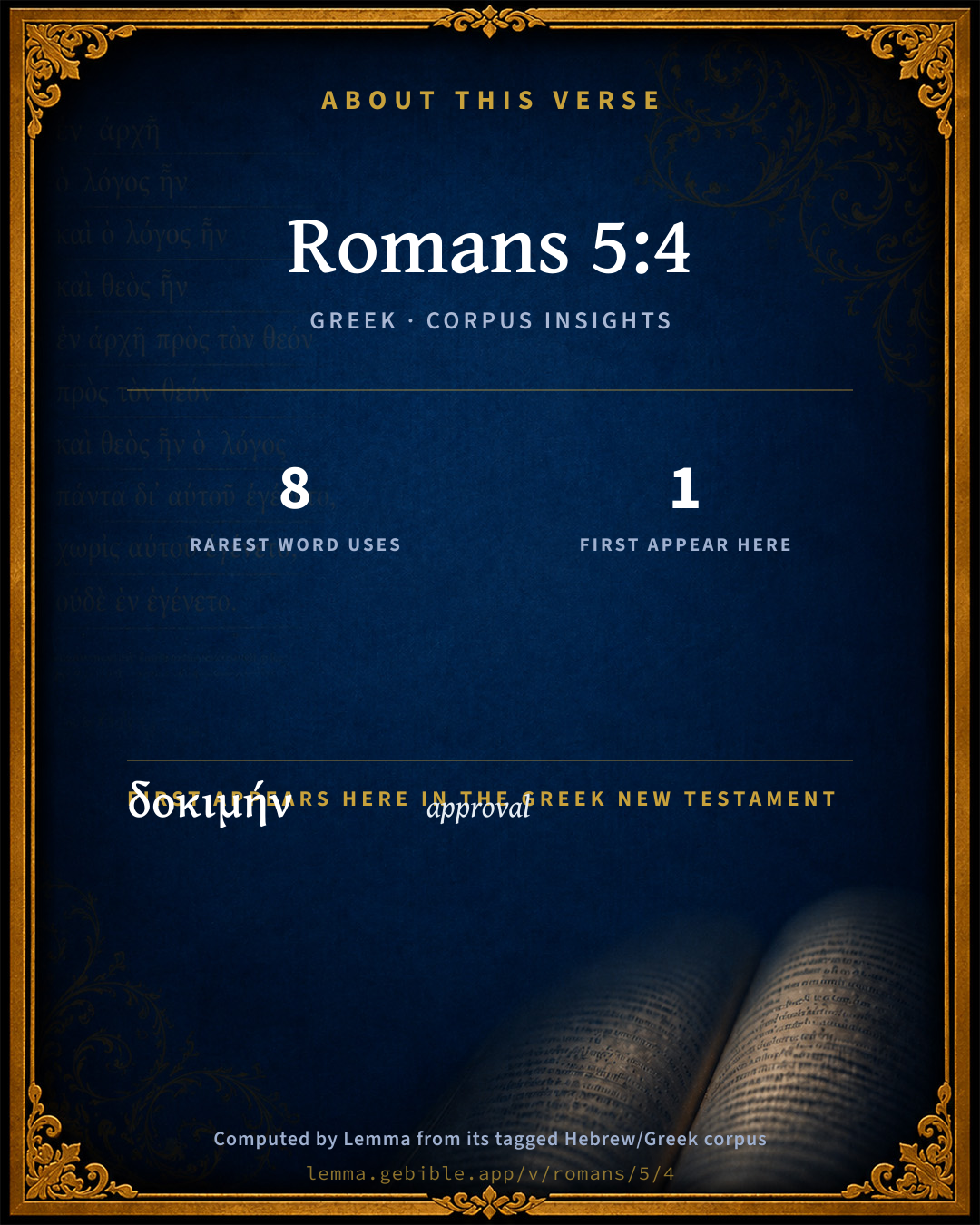
The rarest word here is δοκιμήν approval G1382 — appearing just 8 times in the whole Greek New Testament.

First appearance in Scripture

This word makes its first canonical appearance in the Greek New Testament here:

  • δοκιμήν approval G1382

Shared distinctive vocabulary

δοκιμήν approval G1382 occurs in 7 verses of the Greek New Testament. Also found in:
Repetition

Words recur within this verse:

Cross-references

14

Topical passages linked to Romans 5:4 in the Treasury of Scripture Knowledge — connected by theme and wording, ordered by reader-vote popularity; previews shown in the World English Bible.

  • 1 Peter 5:10 But may the God of all grace, who called you to his eternal glory by Christ Jesus, after you have suffered a little while, perfect, establish, strengthen, and settle you.
  • James 1:12 Blessed is the man who endures temptation, for when he has been approved, he will receive the crown of life, which the Lord promised to those who love him.
  • 2 Corinthians 4:8–12 We are pressed on every side, yet not crushed; perplexed, yet not to despair;
  • Psalms 71:18–24 Yes, even when I am old and gray-haired, God, don't forsake me, Until I have declared your strength to the next generation, Your might to everyone who is to come.
  • 2 Timothy 4:16–18 At my first defense, no one came to help me, but all left me. May it not be held against them.
  • 1 Peter 1:6–7 Wherein you greatly rejoice, though now for a little while, if need be, you have been put to grief in various trials,
  • Psalms 27:2–3 When evil-doers came at me to eat up my flesh, Even my adversaries and my foes, they stumbled and fell.
  • Psalms 42:4–5 These things I remember, and pour out my soul within me, How I used to go with the crowd, and led them to the house of God, With the voice of joy and praise, a multitude keeping a holy day.
  • 2 Corinthians 1:4–6 who comforts us in all our affliction, that we may be able to comfort those who are in any affliction, through the comfort with which we ourselves are comforted by God.
  • 2 Corinthians 6:9–10 as unknown, and yet well known; as dying, and behold, we live; as punished, and not killed;
  • Joshua 10:24–25 It happened, when they brought forth those kings to Joshua, that Joshua called for all the men of Israel, and said to the chiefs of the men of war who went with him, Come near, put your feet on the necks of these kings. They came near, and put their feet on the necks of them.
  • 1 Samuel 17:34–37 David said to Saul, Your servant was keeping his father's sheep; and when there came a lion, or a bear, and took a lamb out of the flock,
  • Psalms 71:14 But I will always hope, And will add to all of your praise.
  • Romans 15:4 For whatever things were written before were written for our learning, that through patience and through encouragement of the Scriptures we might have hope.

Cross-references courtesy of OpenBible.info (CC BY 4.0).

Commentary

Notes on Romans 5:4 from classic Christian and Jewish commentators (each source and its license shown beneath its notes). The classic Christian expositions comment on the surrounding passage and are grouped to its opening verse, so a note may address several verses; the Jewish commentaries on the Tanakh (Rashi and others) are per-verse, so they appear only where the commentator wrote on this verse.

Lemma curates 59 commentaries, every one of them public domain or Creative Commons licensed, each selected and text-cleaned for this edition rather than reprinted as found. About our sources →

The Biblical Illustrator

Joseph S. Exell

Rom_5:4

And patience experience.

Patience working experience

The benefit of trials is lost when we either despise the chastening of the Lord, or faint when we are rebuked of Him. It is only when they are borne with Christian patience that experience is their happy fruit. The word signifies properly proof: and there are various things proved to us by our trials, endured with patience.

I. The love, care, faithfulness, and power of our father. He has assured us that whom He loves He chastens. He has encouraged us to cast all our care upon Him, by the declaration, and, in the gift of His Son, the convincing evidence, that He careth for us. He has promised never to leave, never to forsake us. He has reproved the fears of His people by reminding them that the everlasting God, Jehovah, the Creator of the ends of the earth, fainteth not neither is weary, and assuring them that He giveth power to the weak. When patient in tribulation, we learn, by sweet experience, that God is indeed to His people all that He declares Himself to be.

II. Our own weakness and emptiness, and the all-sufficiency of Jesus. We feel the repugnance of our nature to suffering; the difficulty of bowing to the Divine will, our proneness to doubt and to rebel. But when we are enabled to bear our trials with patience, they teach us, by experience, which imparts present delight, and encouragement for the future, that His grace is sufficient for us; that we can do all things through Christ who strengtheneth us.

III. The vanity of all earthly things, when sought after, and depended upon, as a portion. Sanctified trouble dissolves the delusive charm of prosperity. When the cup of worldly enjoyment is at our lips, the bitter that is infused prevents its deadly influence. The heart is brought back to the relish, which it was losing, of higher joys. And at the same time we feel the gladdening influence, and the inestimable preciousness of the truths of God, and of the good hope which the faith of them inspires. Thus the case of the prophets little book is reversed. The trial itself is bitter to the taste; but the experience resulting from it is sweet.

IV. The Divine excellence and sufficiency of the Word of God. How precious has this volume of inspiration ever been felt by the children of God in their seasons of trial! How rich the treasures of its exceeding great and precious promises, when our worldly resources have made themselves wings and flown away--how sweet the celestial music of its devotion, when our harp has been turned to mourning, and our organ to the voice of them that weep!--how delightful the still small voice of a Saviours love, amidst all the harassing turmoils of a turbulent world! The believer now learns to clasp this Divine treasure to his heart, and to say, The law of Thy mouth is better unto me than thousands of gold and silver!

V. The reality of our faith in Jesus and of our consequent interest in his salvation. We judge from the fruit of the soundness of the root and stem. The man whose professed faith allows him to fret and murmur under his trials has good cause to suspect that the gospel has come to him in word only. But when the faith of the truth inspires tranquil resignation, and patience has her perfect work, we have the witness in ourselves of our connection with Him who said, The cup which My Father hath given Me shall I not drink it? By adding to our faith--patience, we make our calling and election sure.

VI. The value and certainty of the gospel hope. Whatever bears testimony to the truth of those doctrines which the Christian believes serves to establish the hope of which these doctrines are the foundation. His experience, therefore, confirms his faith; and the confirmation of his faith gives additional confidence to his hope. It settles and animates its exercise. He abounds in hope through the power of the Holy Ghost. (R. Wardlaw, D. D.)

Experience confirms men in the right

A man propounds the wonderful discovery that honey is not sweet. But I had some for breakfast, and I found it very sweet, say you, and your reply is conclusive. He tells you that salt is poisonous; but you point to your own health and declare that you have eaten salt these twenty years. He says that to eat bread is a mistake--a vulgar error, an antiquated absurdity; but at each meal you make his protest the subject for a merry laugh. If you are daily and habitually experienced in the truth of Gods Word, I am not afraid of your being shaken in mind in reference to it. (C. H. Spurgeon.)

Experience expensive

Experience is an excellent schoolmaster; but he does charge such dreadful fees. (T. Carlyle.)

A dead experience

In my Bible at home I have in the Old Testament a folded sheet of paper, in which are tastefully arranged some flowers and leaves. I was looking at it this morning, and it was very beautiful. Every colour was fading; but I saw, by the help of imagination, what they had been. If, however, I had no other summer than that it would be poor indeed; but I have roses and daisies, and honeysuckles and asters, and various other flowers, all of which are fresh every year, and some of which are fresh almost every month of the year; and I am not obliged to make this herbarium leaf of dried flowers my only summer. But I have known Christians that had but three or four old leaves in their Bible which they would go and pull out and show you every time they alluded to their religious history. They would say, I was converted so-and-so, when they would exhibit these dry memorials, and then they would put them up again very carefully, and leave them; and the next time they talked with you they would show you these old experiences again--the same dry flowers and leaves--no more and no less. (H. W. Beecher.)

Experience and faith

Faith, in its reproductive power and progress of growth, may be compared to the great Oriental banyan tree. It springs up in God, rooted in Gods Word; and soon there are the great waving branches of experience. Then from these very branches the runners go down again into Gods Word; and thence spring up again new products of faith, and new trees of experience, till one and the same tree becomes in itself a grove, with pillared shades and echoing walks between. So experience first grows out of faith; and then greater faith grows out of experience, the Word of God being all the while the region of its roots; and, again, a still vaster, richer experience grows out of that faith, till every branch becomes not only a product, but a parent stock set in the same word, and all expanding into a various magnificent and enlarging forest. (G. B. Cheever, D. D.)

Experience, knowledge by

Practical sciences are not to be learned but in the way of action. It is experience that must give knowledge in the Christian profession, as well as in all others; and the knowledge drawn from experience is quite of another kind from that which flows from speculation or discourse. It is not the opinion, but the path, of the just, that the wisest of men tells us shines more and more unto a perfect day. The obedient, and the men of practice, are those sons of light that shall outgrow all their doubts and ignorances, that shall ride upon these clouds, and triumph over their present imperfections, till persuasion pass into knowledge, and know, ledge advance into assurance, and all come at length to be completed in the beatific vision, and a full fruition of those joys. Which God has in reserve for them whom by His grace He shall prepare for glory. (R. South, D. D.)

Experience, power of

Said a poor pious widow to a scoffing sceptic, when he asked, How do you know your Bible is true? What proof have you of its truth?--Sir, my own experience--the experience of my heart. Oh, said he, contemptuously, your experience is nothing to me. That may be, sir; but it is everything to me.

Experience, various

You are too apt to feel that your religious experience must be the same as others have; but where will you find analogies for this? Certainly not in nature. Gods works do not come from His hand like coin from the mint. It seems as if it were a necessity that each one should be, in some sort, distinct from every other. No two leaves on the same tree are precisely alike; no two buds on one bush have the same unfolding, nor do they seek to have. What if God should command the flowers to appear before Him, and the sunflower should come bending low with shame because it was not a violet; and the violet should come striving to lift itself up to be like a sunflower; and the lily should seek to gain the bloom of the rose; and the rose, the whiteness of the lily: and so each one, disdaining itself, should seek to grow into the likeness of the other? God would say, Stop, foolish flowers! I gave you your own forms and hues and odours; and I wish you to bring what you have received. O sunflower! come as a sunflower; and you, sweet violet, come as a violet; and let the rose bring the roses bloom; and the lily the lilys whiteness. Perceiving their folly, and ceasing to long for what they had not, violet and rose, lily and geranium, mignonette and anemone, and all the floral train, would come, each in its own loveliness, to send up its fragrance as incense, and all wreathe themselves in a garland of beauty about the throne of God. Now, God speaks to you as to the flowers, and says, Come with the form and nature that I gave you. If you are made a violet, come as a violet; if you are a rose, come as a rose; it you are a shrub, do not desire to be a tree; let everything abide in the nature which I gave it, and grow to the full excellence that is contained in that nature. (H. W. Beecher.)

And experience hope.

The well-grounded hope

Experience worketh hope. Take that principle in its largest sense, apply it to the interests of this life and this world, and who is there that does not know that the apostles statement would be utterly wrong? The inexperienced man is all buoyant anticipation; he sees no difficulties in the way; he looks for brilliant success in life. How different with the man who has had some experience of the realities of life, how modest are his hopes of earthly happiness and success! But it was not of earthly experience that the apostle spake, nor of earthly hope. As regards our blessed Saviour, His grace and preciousness and love: as regards the solid peace and happiness to be found when we find a part in His great salvation: as regards the sanctifying and comforting influences of the Holy Spirit: as regards the power and prevalence of earnest prayer: as regards the rest and refreshment the weary soul may find in a Lords day duly sanctified: as regards the consolation which religion can impart amid earthly disappointments; as regards the peace that Christ can give in death: as regards such things as these, experience worketh hope; the more you know of Jesus, His promises and His grace, the more you will expect from Him; and instead of experience leading us to say, as it does lead us to say of most earthly things, I have tried it, it cannot make me happy, I shall trust it no more, experience of God leads us rather to say, I know whom I have believed, and am persuaded that He is able to keep that which I have committed to Him against that day; I love the Lord, because He hath heard my voice and my supplication; because He hath inclined His ear unto me, therefore will I call upon Him as long as I live; The Lord hath been mindful of us: He will bless us still! And now, concerning St. Pauls declaration that experience worketh hope, let me suggest to you two thoughts which are implied in the apostles principle, and which are the great reasons why the apostles principle is true.

I. First, then, in the great concern of religion you are sure, if you seek in the right way, to get what you seek. Now here at once we find a point in regard to which there is a total contrariety between worldly and spiritual things. Who is there that needs to be told that one great cause of human disappointment in worldly things lies in this, that however anxious you may be to get something on which you have set your heart, and however diligent you may be in using all the means which you think tend towards your getting it, you may yet entirely fail of getting it? But when we pray for spiritual blessings, for repentance towards God and faith in Christ and a sanctifying Spirit, we may pray with the absolute certainty that our prayer will be granted, because we pray with the absolute certainty that we are asking that which it will be for our good to get, and for Gods glory to give.

II. Another fact on which the principle in the text founds is, that in the matter of spiritual blessings you are sure, when you get what you seek, to find it equal your expectations. There never was the human being who said, I was earnestly desirous to gain the favour of God, to gain the good part in Christ, and now I have gained them, I find they are no such great matter after all, the prize is hardly worth the cost. God is indeed my Father, Christ is indeed my Saviour, the Holy Spirit dwells within my breast, and I know that heaven is my home; but these things leave me still unsatisfied and unhappy. No; experience never brought any human being to such a mind as that. That is the strain in which experience has taught men to speak of earthly ends after they were won. But the man never breathed who would say the like of the blessings of grace. (A. K. H. Boyd, D. D.)

The hope of faith and the hope of experience

The hope of the fourth verse is distinct from, and posterior to the hope of the second, and is derived from another source. The first hope is hope in believing; a hope which hangs direct on the testimony of God. The second hope is the fruit of experience, and is gathered, not from the word that is without, but from the feeling of what passes within. I make a two-fold promise to an acquaintance--the lesser part of which should be fulfilled tomorrow, and the latter on this day twelvemonth. If he believe me, then will there be a hope of the fulfilment of both, and, for a whole day at least, he may rejoice in this hope. Tomorrow comes, and if tomorrows promise is not fulfilled, the hope which emanated from faith is overthrown, and the man is ashamed of his rash and rejoicing expectations! But if instead of a failure there is a punctual fulfilment without shame or without suspicion, he will now look to the coming round of the year with more confident expectation than ever. It is quite true that there is a hope in believing, but it is just as true that experience worketh hope. Now in the gospel there are promises, the accomplishment of one of which is far off and the other of which is near. By faith we may rejoice in hope of the coming glory, and it will be the confirmation of our hope if we find in ourselves a present holiness. He who hath promised to translate us into a new heaven hereafter has also promised to confer on us a new heart here. Directly appended to our belief in Gods testimony may we hope for both these fulfillments; but should the earlier fulfilment not take place, this ought to convince us that we are not the subjects of the latter fulfilment. A true faith would ensure to us both, but as the one has not cast up at its proper time neither will the other cast up at its time--and, having no part nor lot in the present grace, we can have as little in the future inheritance. (T. Chalmers, D. D.)

The Biblical Illustrator, edited by Joseph S. Exell (c. 1880s–1900s) — public domain. Text from a community e-Sword module.

Bengel's Gnomon

Johann Albrecht Bengel

Rom 5:4. Ἡ δὲ ὑπομονὴ δοκιμήν) Again, conversely, τὸ δοκίμιον τῆς πίστεως, ὑπομονήν. [The trying of your faith, or experience, worketh patience] Jas 1:3. It will be difficult to find an instance of any one having used δοκιμὴ before Paul: δοκιμὴ is the quality of that man, who is δόχιμος.—[—who has been proved through various casualties and trying circumstances of peril.—V. g.]—δοκιμὴ ἐλπίδα, experience, hope) Heb 6:9-11; where Rom 5:10 illustrates δοκιμὴ, experience; Rom 5:9; Rom 5:11, illustrate hope. Comp. Rev 3:10.—ἐλπίδα, hope) to which our attention is directed at the end of Rom 5:2. The discourse returns in a circle [reverting to hope, from which he started in Rom 5:2]; and it is to this whole [i.e., from rejoice, in Rom 5:2, to maketh not ashamed, Rom 5:5] that the Aetiology[49] [reason assigned by the] because, at Rom 5:5, refers.

[49] See Appendix.

Bengel's Gnomon of the New Testament — English translation (T&T Clark, Edinburgh, 1860) — public domain. Text from a community e-Sword module.

Expositor's Greek Testament

ed. W. Robertson Nicoll

Rom 5:4 . ὑπομονὴν κατεργάζεται : has as its fruit, or effect, endurance. ὑπομονὴ has more of the sense of bravery and effort than the English “patience”: it is not so passive. ἡ δὲ ὑπομονὴ δοκιμήν : endurance produces approvedness its result is a spiritual state which has shown itself proof under trial. Cf. Jas 1:12 ( δόκιμος γενόμενος = when he has shown himself proof). Perhaps the best English equivalent of δοκιμή would be character . This in its turn results again in hope: the experience of what God can do, or rather of what He does, for the justified amid the tribulations of this life, animates into new vigour the hope with which the life of faith begins.

The Expositor's Greek Testament, edited by W. Robertson Nicoll (1897–1910) — public domain. Text from a community e-Sword module.

Hodge's Commentary on Romans, Ephesians & First Corinthians

Charles Hodge

Rom_5:3, Rom_5:4

And not only so, but we glory in tribulations also. Not only do we rejoice in this hope of future glory, but we glory in tribulations also. Since our relation to God is changed, the relation of all things to us is changed. Afflictions, which before were the expressions of Gods displeasure, are now the benevolent and beneficent manifestations of his love. And instead of being inconsistent with our filial relation to him, they serve to prove that he regards and loves us as his children; Rom_8:18; Heb_12:6. Tribulations, therefore, although for the present not joyous, but grievous, become to the believer matter of joy and thankfulness. The words καυχώμεθα ἐν ταῖς θλίψεσιν do not mean that we glory in the midst of afflictions, but on account of them. They are themselves the matter or ground of the glorying. So the Jews are said to glory (ἐν) in the law, others glory in men, the believer glories in the Lord; so constantly. Afflictions themselves are to the Christian a ground of glorying; he feels them to be an honor and a blessing. This is a sentiment often expressed in the word of God. Our Lord says, Blessed are they who mourn; Blessed are the persecuted; Blessed are ye when men shall revile you. He calls on his suffering disciples to rejoice and be exceeding glad when they are afflicted. Mat_5:4, Mat_5:10-12. The apostles departed from the Jewish council, rejoicing that they were counted worthy to suffer shame for Christs name. Act_5:41. Peter calls upon Christians to rejoice when they are partakers of Christs sufferings, and pronounces them happy when they are reproached for his sake. 1Pe_4:13, 1Pe_4:14. And Paul says, Most gladly therefore will I glory in (on account of) my infirmities, (i.e. my sufferings.) I take pleasure, he says, in infirmities, in reproaches, in necessities, in persecutions, in distresses for Christs sake. 2Co_12:9, 2Co_12:10. This is not irrational or fanatical. Christians do not glory in suffering, as such, or for its own sake, but as the Bible teaches,

1. Because they consider it an honor to suffer for Christ.

2. Because they rejoice in being the occasion of manifesting his power in their support and deliverance; and,

3. Because suffering is made the means of their own sanctification and preparation for usefulness here, and for heaven hereafter.

The last of these reasons is that to which the apostle refers in the context. We glory in afflictions, he says, because affliction worketh patience, ὑπομονή, constancy. It calls into exercise that strength and firmness evinced in patient endurance of suffering, and in perseverance in fidelity to truth and duty, under the severest trials. And this constancy worketh experience, δοκιμή. This word means,

1. Trial, as in 2Co_8:2, In a great trial of affliction, i.e. in affliction which is a trial, that which puts men to the test.

2. Evidence or proof, as in 2Co_13:3, Since ye seek a proof of Christ speaking in me. Compare 2Co_2:9; Phi_2:22. This would give a good sense here: Constancy produces evidence of the fidelity of God, or of our fidelity.

3. The word is used metonymically for the result of trial, i.e. approbation, or that which is proved worthy of approbation: δοκιμή est qualitas ejus, qui est δόκιμος. Bengel. It is tried integrity, a state of mind which has stood the test. Compare Jam_1:12, Blessed is the man that endureth temptation, (ὃς ὑπομένει πειρασμόν;) for when he is tried (ὃτι δόκιμος γενόμενος) he shall receive the crown of life. Ὑπομονή, the endurance of trial, therefore, makes a man δόκιμος; in other words, it worketh δοκιμή. It produces a strong, tested faith. Hence the parallel expression, τὸ δοκίμιον ὑμῶν τῆς πίστεως, the trying of your faith. 1Pe_1:7. And this δοκιμή, well tested faith, or this endurance of trial produces hope; tends to confirm and strengthen the hope of the glory of God, which we owe to our justification through Jesus Christ.

Charles Hodge — Commentary on Romans (1835), First Corinthians (1857), and Ephesians (1856) — public domain. Text from a community e-Sword module.

Jamieson, Fausset & Brown

Robert Jamieson, A. R. Fausset & David Brown

patience worketh experience--rather, "proof," as the same word is rendered in Co2 2:9; Co2 13:3; Phi 2:22; that is, experimental evidence that we have "believed through grace."

and experience--"proof."

hope--"of the glory of God," as prepared for us. Thus have we hope in two distinct ways, and at two successive stages of the Christian life: first, immediately on believing, along with the sense of peace and abiding access to God (Rom 5:1); next, after the reality of this faith has been "proved," particularly by the patient endurance of trials sent to test it. We first get it by looking away from ourselves to the Lamb of God; next by looking into or upon ourselves as transformed by that "looking unto Jesus." In the one case, the mind acts (as they say) objectively; in the other, subjectively. The one is (as divines say) the assurance of faith; the other, the assurance of sense.

Jamieson, Fausset & Brown — Commentary Critical and Explanatory on the Whole Bible (1871) — public domain (CC PDM 1.0). Text via the HelloAO Bible API.

Adam Clarke's Commentary

Verse 4. And patience, experience] δοκιμεν, Full proof, by trial, of the truth of our religion, the solidity of our Christian state, and the faithfulness of our God. In such cases we have the opportunity of putting our religion to the test; and, by every such test, it receives the deeper sterling stamp. The apostle uses here also a metaphor taken from the purifying, refining, and testing of silver and gold.

Experience, hope] For we thus calculate, that he who has supported us in the past will support us in those which may yet come; and as we have received so much spiritual profiting by means of the sufferings through which we have already passed, we may profit equally by those which are yet to come: and this hope prevents us from dreading coming trials; we receive them as means of grace, and find that all things work together for good to them that love God.

Adam Clarke's Commentary on the Bible (1810–1826) — public domain. Text from a community e-Sword/MySword module.

John Calvin's Commentaries

4. Patience, probation, etc. James, adopting a similar gradation, seems to follow a different order; for he says, that patience proceeds from probation: but the different meaning of the word is what will reconcile both. Paul takes probation for the experience which the faithful have of the sure protection of God, when by relying on his aid they overcome all difficulties, even when they experience, whilst in patiently enduring they stand firm, how much avails the power of the Lord, which he has promised to be always present with his people. James takes the same word for tribulation itself, according to the common usage of Scripture; for by these God proves and tries his servants: and they are often called trials.

According then to the present passage, we then only make advances in patience as we ought, when we regard it as having been continued to us by God’s power, and thus entertain hope as to the future, that God’s favor, which has ever succored us in our necessities, will never be wanting to us. Hence he subjoins, that from probation arises hope; for ungrateful we should be for benefits received, except the recollection of them confirms our hope as to what is to come.

John Calvin's Commentaries (1540-1563) — public domain. Text from the Calvin Translation Society English edition (1840s-50s) via the Christian Classics Ethereal Library (ccel.org). Calvin's coverage is partial (roughly two-thirds of the Bible); uncommented books and verses are honest gaps, never fabricated. The 19th-century editor's footnotes and remarks are omitted so the notes are faithfully Calvin's own voice.

Ellicott's Commentary for English Readers

(4) Experience.—“Approvedness,” the quality of being tried and approved. The result of patient endurance is to test, confirm, and refine the better elements of faith. Out of this, in its turn, grows hope. Hope began and ends the circle. It is the knowledge of what is in store for him that, in the first instance, nerves the Christian to endure; and that endurance, being prolonged, gives him the steady, calm assurance no longer of the novice but of the veteran.

A Bible Commentary for English Readers, edited by Charles John Ellicott (1878–1897) — public domain. Text from a community e-Sword module.

The Cambridge Bible for Schools and Colleges

gen. ed. J. J. S. Perowne

4. experience] The Gr. properly means “a proof, a test.” So usually in N. T.: e.g. 2Co_8:2 (where E. V. “trial”), Rom_13:3 (where E. V. “proof”); Php_2:22 (“proof”). The word here cannot refer to the testing of the believer by his Master, for the next clause shews it is something in his own consciousness, producing hope there. It is rather his own testing of himself; his discovery of what he can bear and do, through grace; promoting courage for future efforts, and steady hopes of final victory.

hope] Of future grace and (perhaps mainly here) of the glory to follow. Each “test” of the power given enhances the confidence that He who gives it will continue it till the course of “patience” ends in the eternal welcome.

The Cambridge Bible for Schools and Colleges (gen. ed. J. J. S. Perowne; Cambridge University Press, 1878–1918) — public domain. Text from a community e-Sword module.

John Gill's Exposition

And patience experience,.... As tribulations tend to exercise and increase patience, so patience being exercised and increased, enlarges the saints' stock and fund of experience; of the love and grace of God communicated to them at such seasons; of his faithfulness in fulfilling his promises; of his power in supporting them; and of their own frailty and weakness; and so are taught humility, thankfulness, and resignation to the will of God:

and experience, hope; hope is a gift of God's grace, and is implanted in regeneration, but abounds, increases, and becomes more strong and lively by experience of the love, grace, mercy, power, and faithfulness of God.

John Gill's Exposition of the Whole Bible (1746–1763) — public domain (CC PDM 1.0). Text via the HelloAO Bible API.

Trapp's Complete Commentary

John Trapp

4 And patience, experience; and experience, hope:

Ver. 4. And experience, hope] Without hope patience is cold almost in the fourth degree, and that is but a little from poison.

John Trapp, A Commentary or Exposition upon All the Books of the Old and New Testament (1647–1656) — public domain. Text from a community e-Sword module.

Albert Barnes' Notes on the Bible

And patience, experience - Patient endurance of trial produces experience. The word rendered “experience” (δοκιμήν dokimēn) means trial, testing, or that thorough examination by which we ascertain the quality or nature of a thing, as when we test a metal by fire, or in any other way, to ascertain that it is genuine. It also means approbations, or the result of such a trial; the being approved, and accepted as the effect of a trying process. The meaning is, that long afflictions borne patiently show a Christian what he is; they test his religion, and prove that it is genuine. Afflictions are often sent for this purpose, and patience in the midst of them shows that the religion which can sustain them is from God.

And experience, hope - The result of such long trial is to produce hope. They show that religion is genuine; that it is from God; and not only so, but they direct the mind onward to another world; and sustain the soul by the prospect of a glorious immortality there. The various steps and stages of the benefits of afflictions are thus beautifully delineated by the apostle in a manner which accords with the experience of all the children of God.

Albert Barnes' Notes on the Bible (1834–1885) — public domain. Text from a community e-Sword/MySword module.

Matthew Poole's English Annotations

And patience, experience; viz. of God’s sustentation and care of us, and of his faithfulness in fulfilling his promises, Psa 91:15; Isa 43:2; 2Co 1:4,5; as also of our own sincerity, and strength to endure and persevere, Mat 13:21.

And experience, hope; i.e. of the glory of God, as before in Rom 3:2, or hope of further mercy and seasonable deliverance. Believers find and feel that God hath delivered them, and doth deliver them, and in him they trust and hope that he will still deliver them.

Matthew Poole's English Annotations on the Holy Bible (1683–1685) — public domain. Text from a community e-Sword/MySword module.

Whedon's Commentary on the Bible

Daniel D. Whedon

4. Patience, experience—Rather translate, endurance worketh approvedness. Our endurance of trial brings into an approved state with our heavenly Master.

Experience, hope—Our approvedness produces a firm hope that we shall stand the final test and attain the future glory.

Daniel D. Whedon (gen. ed.), Commentary on the Old and New Testaments (1874–1909) — public domain. Text from a community e-Sword module.

John Wesley's Explanatory Notes

And patience works more experience of the sincerity of our grace, and of God's power and faithfulness.

John Wesley, Explanatory Notes Upon the Whole Bible (1754–1765) — public domain. Text via the GEBible commentary corpus.

Godbey's Commentary on the New Testament

William B. Godbey

4. “And endurance, approval,” i. e., this indefatigable endurance of all the abuses and persecutions which Satan can possibly turn on us is the very thing to work out the divine approval of our hardihood, fidelity, loyalty and heroism — a most profitable curriculum in the school of Christ. “And approval hope,” i. e., this divine approval of our endurance in all the troubles, trials and persecutions amid this vile God-forgetting and Satan- ridden world, is the great salient confirmation of our heavenly hope, actually working it out and making it a glorious eternal verity.

William B. Godbey, Commentary on the New Testament (1896–1900) — public domain. Text from a community e-Sword module.

McGarvey & Pendleton's Commentaries

J. W. McGarvey

and stedfastness, approvedness; and approvedness, hope :

J. W. McGarvey (with Philip Y. Pendleton), Commentaries on the New Testament (The Fourfold Gospel, 1914; Acts; and the epistles) — public domain. Text from a community e-Sword/MySword module.

The People's New Testament

B. W. Johnson

4. Experience, hope. The sense of the divine approval fills the soul with hope.

B. W. Johnson's The People's New Testament with Notes (1889–1891) — public domain. Electronic text from the Christian Classics Ethereal Library (CCEL) ThML edition.

Cambridge Greek Testament for Schools and Colleges

4. δοκιμὴ. (1) The process of testing, 2Co 8:2; (2) the result—the temper given to the steel, Php 2:22; 2Co 2:9; 2Co 9:13; 2Co 13:3: here the latter; cf. 1Pe 1:6 ff.; Jas 1:2; Jas 1:12. θλίψις produces in the Christian endurance or resistance, and this Christian endurance tempers character; the tempered character, as evidence of GOD’S working so far, itself produces hope; and this hope, so grounded and won, cannot disappoint him who has it.

Cambridge Greek Testament for Schools and Colleges (Cambridge University Press, 1896; 21 vols, various authors incl. Carr, Maclear, Plummer, Farrar, Lumby, Moule, M. R. James, Simcox) — public domain. Text from a community e-Sword module.

International Critical Commentary

4. δοκιμή: the character which results from the process of trial, the temper of the veteran as opposed to that of the raw recruit; cf. Jas 1:12, &c. The exact order of ὑπομονή and δοκιμή must not be pressed too far: in St. Jas 1:3 τὸ δοκίμιον τῆς πίστεως produces ὑπομονή. If St. James had seen this Epistle (which is doubtful) we might suppose that he had this passage in his mind. The conception is that of 2Ti 2:3 (in the revised as well as the received text).

ἡ δὲ δοκιμὴ ἐλπίδα. It is quite intelligible as a fact of experience that the hope which is in its origin doctrinal should be strengthened by the hardening and bracing of character which come from actual conflict. Still the ultimate basis of it is the overwhelming sense of God’s love, brought home through the Death of Christ; and to this the Apostle returns.

International Critical Commentary — older volumes (1896–1929), various authors — public domain. Text from a community e-Sword module.

Vincent's Word Studies in the New Testament

Marvin R. Vincent

Experience [δοκιμην] . Wrong. The word means either the process of trial, proving, as 2Co 8:2, or the result of trial, approvedness, Phi 2:22. Here it can only be the latter : tried integrity, a state of mind which has stood the test. The process has already been expressed by tribulation. Rev. renders probation, which might be defended on the ground of English classical usage. Thus Shakespeare :

" And of the truth herein This present object made probation.

"Hamlet," 1, 1 Jeremy Taylor : "When by miracle God dispensed great gifts to the laity, He gave probation that He intended that all should prophecy and preach." But probation has come to be understood, almost universally, of the process of trial. The more accurate rendering is proof or approval.

Marvin R. Vincent, Word Studies in the New Testament (1887–1900) — public domain. Text from a community e-Sword/MySword module.

Lesson kit

Teaching starters — assembled from the data on this page, not authored interpretation. Every prompt links to the verse data it draws on. Edit before teaching.

Romans, in the Pauline Epistles, opens this verse with 8 words (5 distinct Greek lemmas). Its most distinctive word is dokimḗ (“approval”). A historical commentator’s framing appears above. Read the whole chapter for the surrounding context.

Discussion questions

  1. How does “approval” (dokimḗ) shape what this verse is saying?
  2. This is the first place “approval” appears in Scripture (first appears here). What does its debut here establish?
  3. How does 2 Corinthians 2:9, which shares the word «approval», read alongside this verse?
  4. What does the repetition of “approval” (2× in this one verse) do in this verse?
  5. These translations render this verse differently; the difference is in the English rendering, not the original. What questions does that raise?
  6. Compare how The Biblical Illustrator and Bengel's Gnomon read this verse. Where do they agree or differ?

Things to notice

  • 1 word makes its first canonical appearance in Scripture here.
  • These translations choose different wording for 6 words in this verse.
  • “approval” occurs 2× in this single verse.
  • 5 distinct Greek lemmas span 8 words in this verse.

Reading settings

Reading text

Shown beneath each verse's original-language words.

Old Testament
Old Testament edition

Read the OT as the Masoretic Hebrew (MT) or the Greek Septuagint (LXX).

English shown for the Greek Septuagint (in the Hebrew ↔ Greek comparison).

Comparing translations? Open the Compare panel on any verse page to stack up to four side by side.