
Psalms 119:63

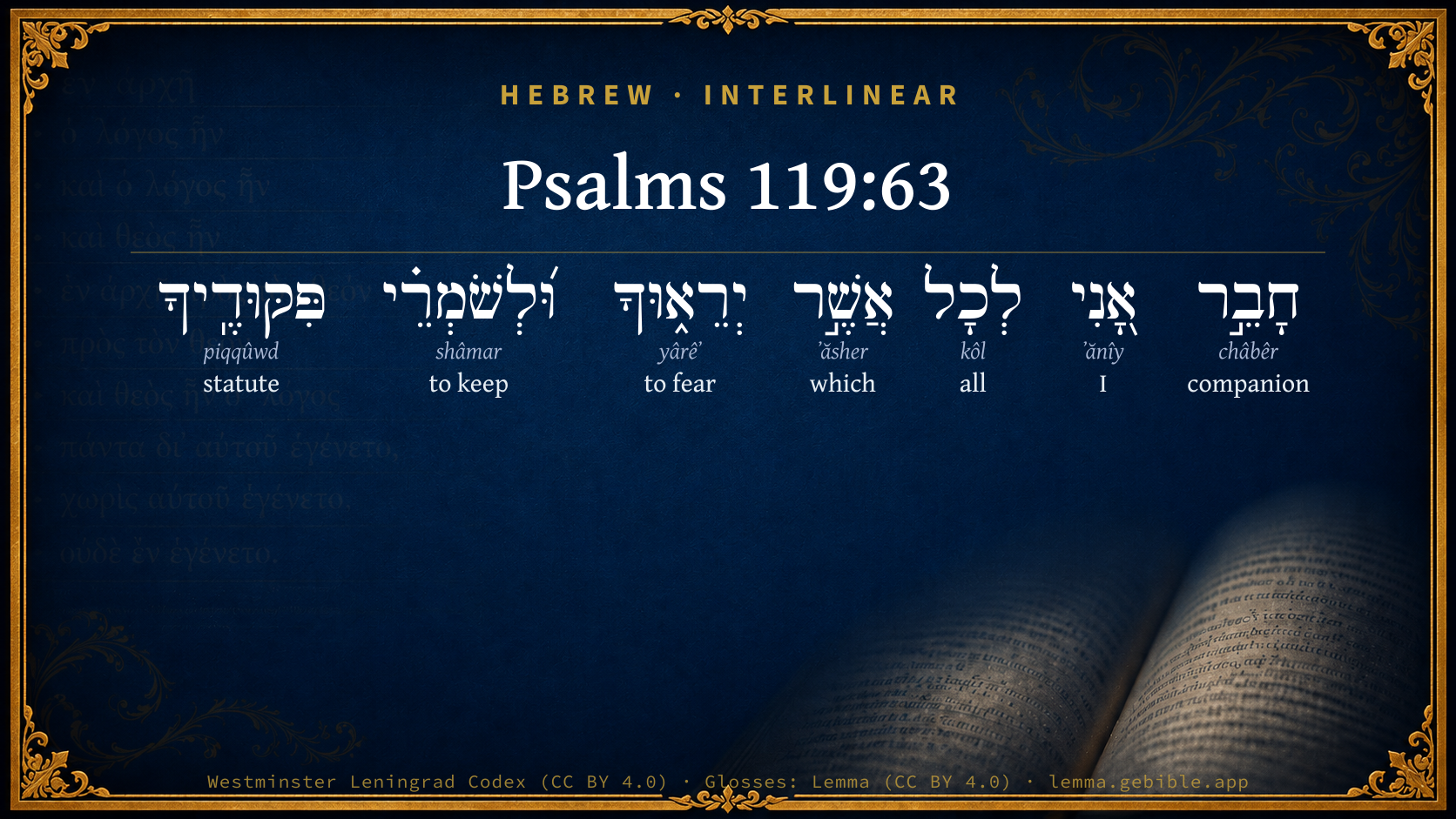
Hebrew (Westminster Leningrad Codex) Psalms 119:63 appears in the Hebrew Old Testament. The text above is from the Westminster Leningrad Codex. Each word links to its Strong’s number, a concise gloss, and parsing drawn from the Open Scriptures Hebrew Bible morphology. Click any word for its full Brown-Driver-Briggs (BDB) entry.
Download image
Cite this verse

Psalms 119:63 (World English Bible). Public Domain. Lemma interlinear Bible study tool, https://lemma.gebible.app/v/psalms/119/63.

Show BibTeX & RIS
BibTeX
RIS
English Translation
I am a friend of all those who fear you, Of those who observe your precepts.
World English Bible · Public Domain
Download a study sheet

One document with this verse’s original text, its word-by-word gloss line, the meaning frame, cross-references with their text, attributed commentary, and full source and license credits — printable, and it pastes into notes with its structure intact.

This verse Autodidact and up

Study sheet (.html) Plain text (.txt)

A passage Seminary Student

Up to 50 verses in one chapter. A passage sheet keeps up to 6 commentary sources and 12 cross-references per verse, in the order this page ranks them, and says so on the sheet whenever that leaves anything out. Ask for a single verse and you get the Autodidact verse sheet above.

Everything on this page stays free to read, with no account — the sheet is a download of what is already on screen, not access to it.

Want to remove ads? Support Godless Engineer
Compare translations 3

The same verse in 3 English versions, stacked beneath the original-language interlinear above. Click any original word for its lexicon entry.

Each is an independent rendering of the whole verse — the interlinear is not word-aligned to these translations.

Highlighted words mark where these versions differ — a whole-verse word diff, not a word-by-word alignment.

  • World English Bible Public Domain
    I am a friend of all those who fear you, Of those who observe your precepts.
  • King James Version Public Domain
    I am a companion of all them that fear thee, and of them that keep thy precepts.
  • unfoldingWord Literal Text CC BY-SA 4.0
    I a companion to all who fear you and to observers of your precepts.

unfoldingWord Literal Text — © unfoldingWord, licensed CC BY-SA 4.0. Word-aligned USFM3 via Door43 (git.door43.org/unfoldingWord/en_ult).

Versions to compare (up to 4)

3 of 4 selected

Show all 17 translations

Every available English version of this verse, each an independent rendering of the whole verse.

  • World English Bible Public Domain
    I am a friend of all those who fear you, Of those who observe your precepts.
  • Berean Standard Bible Public Domain
    I am a friend to all who fear You, and to those who keep Your precepts.
  • Majority Standard Bible Public Domain
    I am a friend to all who fear You, and to those who keep Your precepts.
  • King James Version Public Domain
    I am a companion of all them that fear thee, and of them that keep thy precepts.
  • American Standard Version (1901) Public Domain
    I am a companion of all them that fear thee, And of them that observe thy precepts.
  • Revised Version (1885) Public Domain
    I am a companion of all them that fear thee, and of them that observe thy precepts.
  • Geneva Bible (1599) Public Domain
    I am companion of all them that feare thee, and keepe thy precepts.
  • Young's Literal Translation Public Domain
    A companion I `am' to all who fear Thee, And to those keeping Thy precepts.
  • Literal Standard Version CC BY-SA 4.0
    I [am] a companion to all who fear You, || And to those keeping Your precepts.
  • Unlocked Literal Bible CC BY-SA 4.0
    I am a companion of all who honor you, to all who observe your instructions.
  • unfoldingWord Literal Text CC BY-SA 4.0
    I a companion to all who fear you and to observers of your precepts.
  • Darby Bible Public Domain
    I am the companion of all that fear thee, and of them that keep thy precepts.
  • World Messianic Bible Public Domain
    I am a friend of all those who fear you, of those who observe your precepts.
  • Webster's Bible Public Domain
    I am a companion of all them that fear thee, and of them that keep thy precepts.
  • Free Bible Version CC BY-SA 4.0
    I identify with all those who follow you, those who do what you tell them.
  • Bible in Basic English Public Domain
    I keep company with all your worshippers, and those who have your orders in their memory.
  • JPS Tanakh (1917) Public Domain
    I am a companion of all them that fear Thee, and of them that observe Thy precepts.

Literal Standard Version (2020), Covenant Press — licensed CC BY-SA 4.0. Text via the HelloAO Bible API (eBible.org). Unlocked Literal Bible (unfoldingWord) — licensed CC BY-SA 4.0. Text via the HelloAO Bible API (eBible.org). unfoldingWord Literal Text — © unfoldingWord, licensed CC BY-SA 4.0. Word-aligned USFM3 via Door43 (git.door43.org/unfoldingWord/en_ult). Free Bible Version, Dr. Jonathan Gallagher — licensed CC BY-SA 4.0. Text via the HelloAO Bible API (eBible.org).

Word by word

More ways to search: Search by grammar → Find every occurrence → Compare this word →

Practice this passage: Drill this verse → Learn its vocabulary →

About this verse

These counts appear in no published source. They are computed here, from the morphology-tagged text and Lemma’s own curated glosses. What Lemma adds →

7
words
7
distinct lemmas
Wisdom
section

Notable vocabulary

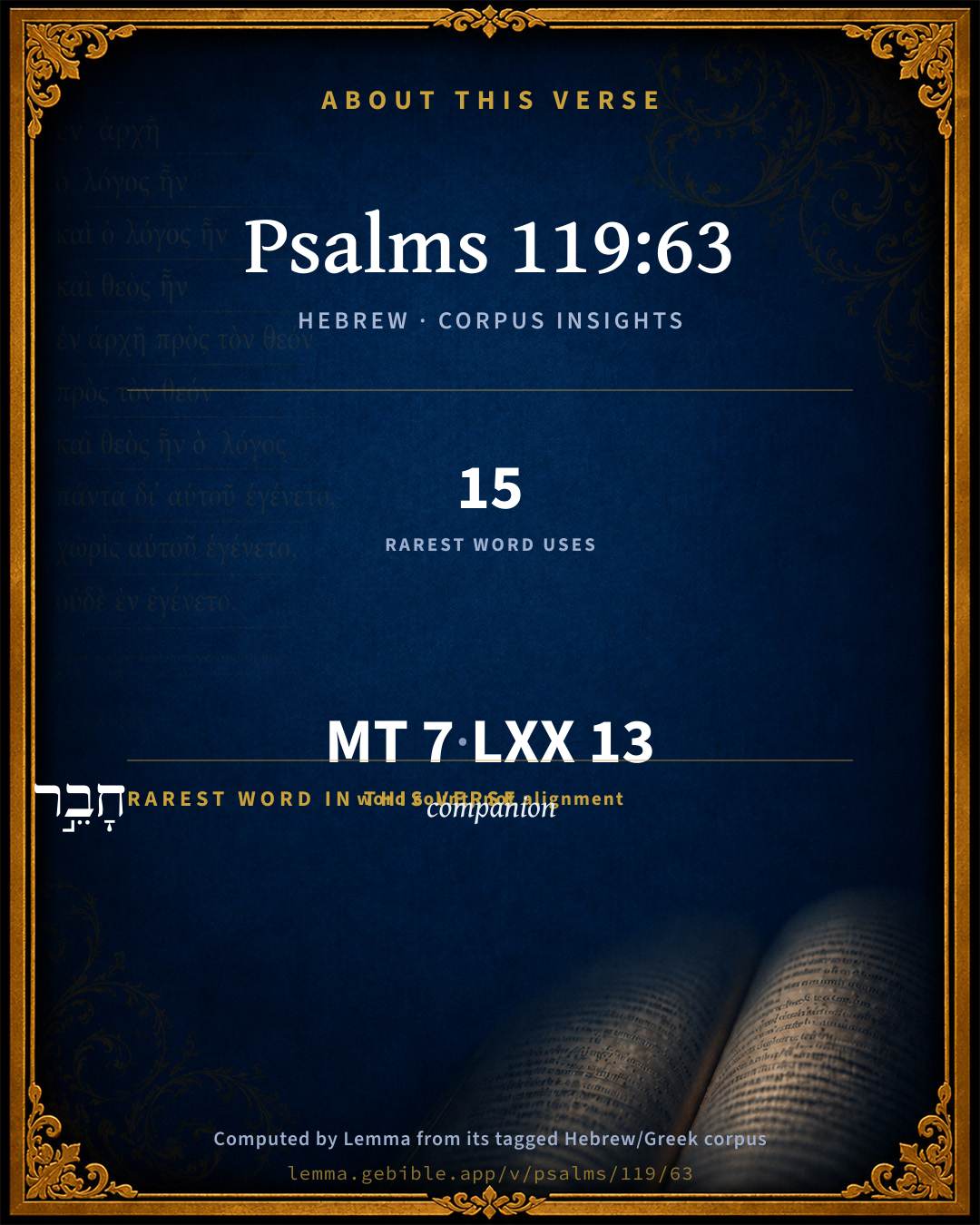
The rarest word here is חָבֵ֣ר companion H2270 — appearing just 15 times in the whole Hebrew Bible.

Shared distinctive vocabulary

חָבֵ֣ר companion H2270 occurs in 11 verses of the Hebrew Bible. Also found in:

Grammatical profile

  • 2 verbs
  • 3 nouns
  • 1 pronoun
  • 1 particle

Verb forms

  • יְרֵא֑וּךָ Qal · Perfect
  • וּ֝לְשֹׁמְרֵ֗י Qal · Participle Active

Hebrew & Septuagint length

In English translation the verse runs 16 words from the Hebrew and 17 from the Septuagint (LXX English) — closely comparable.

A rough comparison of the two English renderings, which tokenize alike — not a word-level alignment.

Word counts can differ between the Hebrew and the Greek without any difference in meaning — e.g. the Hebrew direct-object marker אֵת has no separate Greek word, and Greek often adds the article ὁ.

In the original languages it is 7 Hebrew tokens and 13 Greek tokens — but the two are counted differently (Hebrew bundles its prefixes and suffixes into one token; the Greek is in lemma form), so that isn’t a like-for-like length.

Cross-references

10

Topical passages linked to Psalms 119:63 in the Treasury of Scripture Knowledge — connected by theme and wording, ordered by reader-vote popularity; previews shown in the World English Bible.

  • Psalms 101:6 My eyes will be on the faithful of the land, That they may dwell with me. He who walks in a perfect way, He will serve me.
  • Proverbs 13:20 One who walks with wise men grows wise, But a companion of fools suffers harm.
  • Malachi 3:16–18 Then those who feared Yahweh spoke one with another; and Yahweh listened, and heard, and a book of memory was written before him, for those who feared Yahweh, and who honored his name.
  • 1 John 1:3 that which we have seen and heard we declare to you, that you also may have fellowship with us. Yes, and our fellowship is with the Father, and with his Son, Jesus Christ.
  • Psalms 119:79 Let those who fear you turn to me. They will know your statutes.
  • Psalms 16:3 As for the saints who are in the earth, They are the excellent ones in whom is all my delight.
  • Psalms 119:115 Depart from me, you evildoers, That I may keep the commandments of my God.
  • Psalms 142:7 Bring my soul out of prison, That I may give thanks to your name. The righteous will surround me, For you will be good to me.
  • 2 Corinthians 6:14–17 Don't be unequally yoked with unbelievers, for what fellowship have righteousness and iniquity? Or what communion has light with darkness?
  • 1 John 3:14 We know that we have passed out of death into life, because we love the brothers. He who doesn't love his brother remains in death.

Cross-references courtesy of OpenBible.info (CC BY 4.0).

Hebrew and Greek witnesses Masoretic Hebrew ↔ Greek Septuagint

The same verse in the two great witnesses to the Old Testament, shown verse-for-verse.

You’re reading Greek Psalm 118 (Hebrew Psalm 119). The Septuagint counts the superscription, so verse numbers can differ from the Hebrew — chapter-level alignment, not verse-by-verse. Numbering follows Rahlfs.

These are two independent witnesses, not word-aligned to each other, and the Septuagint is shown in lemma (dictionary) form.

Hebrew Psalms 119:63 Masoretic · Westminster Leningrad Codex

חָבֵ֣ר אָ֭נִי לְכָל אֲשֶׁ֣ר יְרֵא֑וּךָ וּ֝לְשֹׁמְרֵ֗י פִּקּוּדֶֽיךָ

I am a friend of all those who fear you, Of those who observe your precepts.

World English Bible · Public Domain

Greek LXX Greek Psalm 118:63 Septuagint · lemma form

μέτοχος ἐγώ εἰμί πᾶς ὁ φοβέω σύ καί ὁ φυλάσσω ὁ ἐντολή σύ

I am a companion of all them that fear you, and of them that keep your commandments.

LXX2012 (modern English Septuagint) · Public Domain

Hebrew: Westminster Leningrad Codex (CC BY 4.0). Greek: Septuagint (public domain); English from LXX2012 (modern English Septuagint) (Public Domain). How the Septuagint differs from the Hebrew →

Commentary

Notes on Psalms 119:63 from classic Christian and Jewish commentators (each source and its license shown beneath its notes). The classic Christian expositions comment on the surrounding passage and are grouped to its opening verse, so a note may address several verses; the Jewish commentaries on the Tanakh (Rashi and others) are per-verse, so they appear only where the commentator wrote on this verse.

Lemma curates 59 commentaries, every one of them public domain or Creative Commons licensed, each selected and text-cleaned for this edition rather than reprinted as found. About our sources →

Trapp's Complete Commentary

John Trapp

Psa 119:63 I [am] a companion of all [them] that fear thee, and of them that keep thy precepts.

Ver. 63. I am a companion of all them] Though never so mean, if there be aliquid Christi in them. Grace is of a uniting property, and purgeth out partiality, Jas 2:1-2.

That keep thy precepts] The best proof of true fear of God, Psa 103:13 Act 10:35.

John Trapp, A Commentary or Exposition upon All the Books of the Old and New Testament (1647–1656) — public domain. Text from a community e-Sword module.

The Biblical Illustrator

Joseph S. Exell

Psa_119:63

I am a companion of all them that fear Thee, and of them that keep Thy precepts.

Good society

God has made man for society and society for man. The society, however, to which the text points is the society of the highest type, composed of those who fear God and keep His precepts.

I. This is the most honourable society. The only honourable society is the society of honourable men, and the only honourable men are those who fear God and keep His commandments.

II. This is the most happy society. All good men are happy.

III. This is the most growing society. It is large now, composed of an innumerable company of angels, and the spirits of just men made perfect; its numbers increase with every conversion. (Homilist)

The best company

I. The character of the people of God.

1. They fear Him. There is a twofold fear of God:--

(1) A servile fear.

(2) A filial fear: this is the fear intended in the text. This fear is promised (Jer_32:40).

2. They keep Gods precepts.

(1) In purpose and resolution; they approve of them all (Psa_119:117).

(2) In affection (Psa_19:10; Psa_119:77).

(3) They endeavour to observe them; and to observe them all (Psa_119:1; Psa_119:28).

II. What is implied in being a companion of those that fear God

1. A high esteem and affection for them (1Jn_4:20-21; Lev_19:18; Joh_13:34; Joh_15:12).

2. A delight in communion with them (Psa_16:3).

3. Joining with them in public worship (Psa_42:1-2; Psa_84:1-2).

4. A readiness to converse with them (Mal_3:16; Psa_15:4; Rom_1:12).

5. To sympathize with them (Rom_12:15; Rev_1:9; Heb_10:33).

6. A readiness to do them good (Gal_6:10; Jam_2:15-16; Mat_25:34).

III. The obligations we are under to aspire after such a temper and behaviour.

1. The relation we profess to stand in to God. Children of one Father (1Jn_3:1).

2. This temper and behaviour are represented as inseparably connected with true love to God Himself (1Jn_3:14; 1Jn_5:1).

3. Love to all who fear God is mentioned as the most essential and vital part of true religion (1Co_13:4-8; 1Co_13:13).

4. Jesus Christ, as our Redeemer, hath laid us under this obligation (Joh_13:34; 1Jn_3:16-19; Gal_2:20).

5. The utility or profit that resulteth from being a companion of those who fear God (Psa_87:2). (T. Hannam.)

A proper choice of company recommended

I. Its influence on our principles. But if you mingle without caution with the men of the world; if you come into their counsel, and unite in their pursuits, you may expect in time to adopt their maxims, and to abandon your own.

II. Its influence on our conduct. It is dangerous to form an intimacy with those who despise the laws which ye wish to obey, and are addicted to the practices from which you ought to abstain. By degrees you will venture to copy their manners. But, on the contrary, while the companions of ungodly men are in danger of exhibiting in their own behaviour all the deceivableness of unrighteousness, those whose companions are chosen among the servants of the Lord make use of a powerful means of preserving and improving their virtue.

III. Its influence on our enjoyment. In the company of those who fear God and keep His precepts, your happiness will be promoted, whatever may be your rank and situation in life. The best affections of your hearts will be called forth into exercise; and an entertainment will be furnished, of which you may partake without degrading your character, and on which you may afterwards reflect without pain and remorse.

IV. Its tendency to prepare us for heaven. (John Johnstone.)

Advantages of good companionship

I would remind you that for climbers of the Alps the only way of safety is to fasten each other together with a rope, and for you, too, a great way of safety is to join yourself to some one else. Ask your companion if he will allow you to draw a little strength from him. He will most likely tell you in his next breath that that is just what he is wanting himself, and you two together will be stronger than if you had been alone. The young man who lives in lonely lodgings and never speaks to any one has a very poor chance of standing temptation. Christianity is a social thing; that is one reason why Christ instituted the Christian Church and the Sacraments, that there might be a bond of union between all His followers. (Henry Drummond.)

The Biblical Illustrator, edited by Joseph S. Exell (c. 1880s–1900s) — public domain. Text from a community e-Sword module.

J. A. Alexander on Psalms

Joseph Addison Alexander

63. (Psa 119:63) A fellow (am) I to all who fear thee, and to the keepers of thy precepts. Not merely a companion or frequenter of their company, but an associate,a congenial spirit, one of the same character. Compare the use of the same Hebrew word in Psa 45:7, where the plural is translated fellows in the English Bible. The verse before us is one of those which it seems most difficult to understand of Israel as a whole; for in what sense was the church or chosen people a companion of those fearing God and keeping his commandments, when all the people in the world of that description were embraced within her own communion? The force of this objection is so great that Hengstenberg applies the description to the pious ancestors of the returned Jews, and refers to Mal. 3:24, 4:6. The necessity of such a forced construction goes far to confirm the exegetical hypothesis, already stated as most probably the true one, that the psalm was intended to express the feelings of an individual believer, but that some of its terms are, from parity of circumstances, equally descriptive of what had been experienced by the house of Israel as a church and nation.

Joseph Addison Alexander, The Psalms Translated and Explained (1850) — public domain. Text from a community e-Sword module.

Geneva Bible (1599)

Geneva Bible translators

Not only in mutual consent, but also with aid and succor.

Geneva Bible (1599) marginal notes — public domain. Text via Bolls.life.

Matthew Henry's Commentary

David had often expressed the great love he had to God; here he expresses the great love he had to the people of God; and observe, 1. Why he loved them; not so much because they were his best friends, most firm to his interest and most forward to serve him, but because they were such as feared God and kept his precepts, and so did him honour and helped to support his kingdom among men. Our love to the saints is then sincere when we love them for the sake of what we see of God in them and the service they do to him. 2. How he showed his love to them: He was a companion of them. He had not only a spiritual communion with them in the same faith and hope, but he joined with them in holy ordinances in the courts of the Lord, where rich and poor, prince and peasant, meet together. He sympathized with them in their joys and sorrows (Heb 10:33); he conversed familiarly with them, communicated his experiences to them, and consulted theirs. He not only took such to be his companions as did fear God, but he vouchsafed himself to be a companion with all, with any, that did so, wherever he met with them. Though he was a king, he would associate with the poorest of his subjects that feared God, Psa 15:4 : Jam 2:1.

Matthew Henry's Commentary on the Whole Bible (1708–1710) — public domain (CC PDM 1.0). Text via the HelloAO Bible API.

Adam Clarke's Commentary

Verse 63. I am a companion] This was the natural consequence of his own conversion; he abandoned the workers of iniquity, and associated with them that feared the Lord.

Adam Clarke's Commentary on the Bible (1810–1826) — public domain. Text from a community e-Sword/MySword module.

John Calvin's Commentaries

63. I am a companion to all those who fear thee He does not simply speak of the brotherly love and concord which true believers cultivate among themselves, but intimates that, whenever he met with any individual who feared God, he gave him his hand in token of fellowship, and that he was not only one of the number of God’s servants, but also their helper. Such concord is undoubtedly required in all the godly, that they may contribute to each other’s advancement in the fear of God. There seems to be a tacit comparison between this holy combination, by which the faithful mutually keep up and foster among themselves the worship of God and true godliness, and the impious associations which prevail every where in the world. We see how worldly men array their troops against God, and assist one another in their attempts to overthrow his worship. The more then is it necessary for the children of God to be stirred up to the maintenance of a holy unity. The Psalmist commends the faithful, first, for their fearing God, and, secondly, for their observing the law. The fear of God is the root or origin of all righteousness, and by dedicating our life to His service, we manifest that His fear dwells in our hearts.

John Calvin's Commentaries (1540-1563) — public domain. Text from the Calvin Translation Society English edition (1840s-50s) via the Christian Classics Ethereal Library (ccel.org). Calvin's coverage is partial (roughly two-thirds of the Bible); uncommented books and verses are honest gaps, never fabricated. The 19th-century editor's footnotes and remarks are omitted so the notes are faithfully Calvin's own voice.

John Gill's Exposition

Teach me good judgment and knowledge,.... Or, "a good taste" (p): of the Lord himself, how good and gracious he is; of his grace and love, which is better than wine; of his word and the truths of it, which are sweeter to a spiritual taste than honey or the honeycomb; and of the things of the Spirit of God, which are seventy to a spiritual man, a distinguishing taste of things; for as "the taste discerns perverse things" in food, so a man of a spiritual taste distinguishes good from evil, truth from error; discerns things that differ, and approves of those that are most excellent, and abides by them. Or, "a good sense" (q), as it may be rendered; a good sense of the Scriptures, the true and right sense of them; and to have the mind of God and of Christ, and of the Spirit of Christ, in the word; and to have distinguishing light in it, and a well established judgment in the truths of it, is very desirable: as is also a spiritual and experimental "knowledge" of them, a growing and increasing one; a knowledge of God in Christ, and of his will; a knowledge of Christ, his person and offices, and the mysteries of his grace; which a truly gracious and humble soul desires to be taught, and is taught of God more or less;

for I have believed thy commandments; the whole word of God, and all that is said in it; that it is of God, is the word of God and not the word of man; and therefore he was desirous of being taught the true meaning of it, and to be experimentally acquainted with it; the word of God is called his commandment, Psa 19:7. Or the precepts of the word; he believed these were the commandments of God, and not of men; delivered out by him, and enforced by his authority; and therefore he gave credit to them, and loved them, and desired better to understand and do them: or the promises and threatenings annexed to them, which he believed would be punctually fulfilled upon the doers or transgressors of them; and as for himself, he cheerfully yielded the obedience of faith unto them.

(p) "bonitatem gustus", Piscator, Michaelis. (q) "Bonitatem sensus", Montanus; i.e. "sensum bonum", Gejerus.

John Gill's Exposition of the Whole Bible (1746–1763) — public domain (CC PDM 1.0). Text via the HelloAO Bible API.

Albert Barnes' Notes on the Bible

I am a companion of all them that fear thee - I find my associates and friends among those who worship thee; not with the profane and the wicked. “A man is known by the company that he keeps;” and it is an evidence of piety when we seek our companions and friends among the pious. It shows where the heart is; what the preferences are; what are the tastes; what is the real condition of the soul. We seek our friends in accordance with our tastes and preferences; our love to God is indicated by our love to his friends. Compare Psa 139:21-22.

And of them that keep thy precepts - That obey thy law. On the sentiment here, compare the notes at Psa 1:1. A man may determine much in regard to his own character by asking himself what is the character of his chosen friends and companions. A member of a church should regard it as a dark sign against himself in regard to his piety, if his chosen friends are taken from the world, and not from the professed friends of God; if he finds more pleasure in their society, and in the scenes where they meet, than he does in the society of Christians however humble, or in places where they assemble for prayer and praise.

Albert Barnes' Notes on the Bible (1834–1885) — public domain. Text from a community e-Sword/MySword module.

Matthew Poole's English Annotations

Not excepting the poorest and meanest, whose society other princes disdain.

Matthew Poole's English Annotations on the Holy Bible (1683–1685) — public domain. Text from a community e-Sword/MySword module.

The Treasury of David

Charles H. Spurgeon

Ver. 63. I am a companion of all them that fear thee. The last verse said, "I will, "and this says, "I am." We can hardly hope to be right in the future unless we are right now. The holy man spent his nights with God and his days with God's people. Those who fear God love those who fear him, and they make small choice in their company so long as the men are truly God fearing. David was a king, and yet he consorted with "all" who feared the Lord, whether they were obscure or famous, poor or rich. He was a fellow commoner of the College of All saints.

He did not select a few specially eminent saints and leave ordinary believers alone. No, he was glad of the society of those who had only the beginning of wisdom in the shape of "the fear of the Lord": he was pleased to sit with them on the lower forms of the school of faith. He looked for inward godly fear, but he also expected to see outward piety in those whom he admitted to his society; hence he adds,

and of them that keep thy precepts. If they would keep the Lord's commands the Lord's servant would keep their company. David was known to be on the godly side, he was ever of the Puritanic party: the men of Belial hated him for this, and no doubt despised him for keeping such unfashionable company as that of humble men and women who are straitlaced and religious; but the man of God is by no means ashamed of his associates; so far from this, he even glories to avow his union with them, let his enemies make what they can of it. He found both pleasure and profit in saintly society: he grew better by consorting with the good, and derived honour from keeping right honourable company. What says the reader? Does he relish holy society? Is he at home among gracious people? If so he may derive comfort from the fact. Birds of a feather flock together. A man is known by his company. Those who have no fear of God before their eyes seldom desire the society of saints; it is too slow, too dull for them. Be this our comfort, that when we are let go by death we shall go to our own company, and those who loved the saints on earth shall be numbered with their in heaven.

There is a measure of parallelism between this seventh of its octave and the seventh or Teth (Ps 119:71) and of Jod (Ps 119:79); but, as a rule, the similarities which were so manifest in earlier verses are now becoming dim. As the sense deepens, the artificial form of expression is less regarded.

Ver. 63. I am a companion, etc. He said in the first verse of this section that God was his portion; now he saith, that all the saints of God are his companions. These two go together the love of God and the love of his saints. He that loveth not his brother, made in God's image, whom he seeth, how shall he love God whom he hath not seen? Seeing our goodness extends not to the Lord; if it be showed to his saints and excellent ones upon earth, for his sake, it shall be no small argument of our loving affection towards himself.

Godly David, when Jonathan was dead, made diligent inquisition. Is there none of Jonathan's posterity to whom I may show kindness for Jonathan's sake? and at length he found a silly, lame Mephibosheth. So if we enquire diligently, is there none upon earth to whom I may show kindness for Christ's sake who is in heaven? We shall ever find some, to whom whatsoever we do shall be accepted as done to himself.

His great modesty is to be marked. He saith not, I am companion of all that follow thee, but of all that fear thee. The fear of God is the beginning of wisdom. He places himself among novices in humility, though he excelled ancients in piety. William Cowper.

Ver. 63. I am a companion of all them that fear thee. How weak is human nature! Verily there are times when the presence of one so great as the Almighty becomes oppressive, and we feel our need of one like ourselves to sympathize with us. And there have been provided for us by the way many kind, sympathizing friends, like Jesus. As we pass on, we get the human supports which the Lord hath provided. We get them for fellowship too. John Stephen.

Ver. 63. I am a companion of all them that fear thee. Birds of a feather will flock together. Servants of the same Lord, if faithful, will join with their fellows, and not with the servants of his enemy. When a man comes to an inn you may give a notable guess for what place he is bound by the company he enquires after. His question, "Do you know of any travelling towards London? I should be heartily glad of their company, "will speak his mind and his course. If he hear of any bound for another coast he regards them not; but if he know of any honest passengers that are to ride in the same road, and set out for the same city with himself he sends to them, and begs the favour of their good company. This world is an inn, all men are in some sense pilgrims and strangers, they have no abiding place here. Now the company they enquire after, and delight in, whether those that walk in the "broad way" of the flesh, or those who walk in the "narrow way" of the Spirit, will declare whether they are going towards heaven or towards hell. A wicked man will not desire the company of them who walk in a contrary way, nor a saint delight in their society who go cross to his journey. "Can two walk together except they be agreed?" The young partridges hatched under a hen go for a time along with her chickens, and keep them company, scraping in the earth together; but when they are grown up, and their wings fit for the purpose, they mount up into the air, and seek for birds of their own nature. A Christian, before his conversion, is brought up under the prince of darkness, and walks in company with his cursed crew, according to the course of this world; but when the Spirit changes his disposition, he quickly changes his companions, and delights only in the saints that are on earth. George Swinnock.

Ver. 63. I am a companion of all them that fear thee. 1. The person speaking. The disparity of the persons is to be observed. David, who was a great prophet, yea, a king, yet saith, "I am a companion of all them that fear thee." Christ himself called them his "fellows": "Thy God hath anointed thee with the oil of gladness above thy fellows" (Ps 65:7); and therefore David might well say, "I am a companion."

2. The persons spoken of. David saith of "all them that fear thee." The universal particle is to be observed; not only some, but "all": when any lighted upon him, or he upon any of them, they were welcome to him. How well would it be for the world, if the great potentates of the earth would thus think, speak, and do, "I am a companion, of all them that fear thee." Self love reigneth in most men: we love the rich and despise the poor, and so have the faith of our Lord Jesus Christ with respect of persons (Jas 2:1): therefore this universality is to be regarded. Hearing of your faith and love to all the saints (Eph 1:15), to the mean as well as the greatest. Meanness doth not take away church relations (1Co 11:20). There are many differences in worldly respects between one Christian and another; yea, in spiritual gifts, some weaker, some stronger; but we must love all; for all are children of one Father, all owned by Christ: "He is not ashamed to call them brethren" (Heb 2:11).

This, I say, is observable, the disparity of the persons: on the one side, David, on the other, all the people of God. Thomas Manton.

Ver. 63. I am a companion, etc.: as if he would say, This is a sign to me that I belong to thy family; because "I am the companion of all those fearing thee" with a filial fear, and keeping "thy precepts." Paulus Palanterius.

Ver. 63. A companion, properly is such an one as I do choose to walk and converse with ordinarily in a way of friendship; so that company keeping doth imply three things; first, it is a matter of choice, and therefore relations, as such, are not properly said to be our companions; secondly, it implies a constant walking and converse with another, and so it is expressed, Job 34:8 Pr 13:20. And, thirdly, this ordinary converse or walking with another, must be in a way of friendship. William Bridge, 1600-1670.

Ver. 63. Shun the company that shuns God, and keep the company that God keeps. Look on the society of the carnal or profane as infectious, but reckon serious, praying persons the excellent ones of the earth. Such will serve to quicken you when and warm you when cold. Make the liveliest of God's people your greatest intimates, and see that their love and likeness to Christ be the great motive of your love to them, more than their love or likeness to you. John Willisor, 1680-1750.

Ver. 63.

1. True religion is friendly.

2. Our friendliness should be catholic.

3. Our friendliness should be discriminating.

4. Such friendliness is most useful.

Ver. 63. Of good and bad company. How to avoid the one, and improve the other. See W. Bridge's Sermon, in his works, vol. v. p.

90. Tegg's edition, 1845.

Ver. 63. The believer's choice of companions.

1. Ought to be decided by their piety: "Them that fear thee."

2. Is directed by their conduct: "Them that keep thy precepts."

3. Should be extended as far as: possible: "All."

4. Involves reciprocal obligation: "I am a companion." J.F.

Psalms 119:64*

Charles H. Spurgeon's The Treasury of David (1869–1885) — public domain. Psalms only. Text from a community e-Sword/MySword module.

The Pulpit Commentary

I am a companion of all them that fear thee; i.e. I do not consort with the ungodly or the careless, but only with those who love and reverence thee. It is well to live "separate from sinners". (comp. Psa_1:1) And of them that keep thy precepts. Obedience necessarily follows on reverence and godly fear.

The good man"s friends.

"I am a companion of all them that fear thee." The man who most entirely turns to God as his Helper is the man who most anxiously seeks, and most wisely uses, the help of godly associations and friendships. Men"s help to one another in the godly life is brought before us in this verse. "How weak is human nature! Verily there are times when the presence of one so great as the Almighty becomes oppressive, and we feel our need of one like ourselves to sympathize with us. And there have been provided for us, by the way, many kind, sympathizing friends, like Jesus. As we pass on, we get the human supports which the Lord hath provided. We get them for fellowship too" (Jno. Stephen).

I THE GOOD MAN FINDS FRIENDS. Every living thing looks for something akin to it, and finds that God has always provided the answering thing. This is typified in the fact that God provided for Adam a "help meet for him." If a man is a good man, he will discover that he need not, and must not, live a lonely life. He is not the only good man, and his good life will only grow aright, grow healthily, when it grows in company. The individual and personal relations of converted men to God are often presented in an exaggerated form. The true ideal is presented by Malachi, "Then they that feared the Lord spake often one to another." The ordinary laws of human friendship apply to religious friendship. For close relationship there must be felt kinship; but for ordinary relations the common object and common interest will suffice. All who fear God, and obey him, can be true helpers one of another.

II THE USE THE GOOD MAN MAKES OF FRIENDS DEPENDS UPON HIMSELF. It depends upon the maintenance and culture of his own godly life. So one of the first signs of flagging Christian life is flagging Christian friendship. Loosen your relations with God, and you will soon hold loose relations with his people. The law of friendship is this, "He that would have friends must show himself friendly;" and the friendliness of the godly man is bound up with the maintenance of his godliness.

III THE USE A GOOD MAN CAN MAKE OF HIS GODLY FRIENDS DEPENDS UPON THEM. They must maintain their godliness. They can be nothing to him as helpers unless they keep fearing God, and observing his precepts. The good man soon finds his friends cease to help him when they fail from the godly life. Let each be at his best, and then godly friendship becomes one of the truest and best helps in the godly life. R.T.

The Pulpit Commentary (1880–1919), ed. H.D.M. Spence-Jones & Joseph S. Exell — public domain. Text from a community e-Sword module.

Scofield Reference Notes

C. I. Scofield

fear

Also; Psa 119:74, (See Scofield "Psa 19:9").

The Scofield Reference Bible (1917 edition), notes by C. I. Scofield — public domain. Text from a community e-Sword module.

unfoldingWord translationNotes

Door43 World Missions Community

I am a companion of all who honor you

"I am a friend of all who honor you"

The earth, Yahweh, is full of your covenant faithfulness

People everywhere in the world being able to see evidence of Yahweh's covenant faithfulness is spoken of as if his covenant faithfulness filled the earth. The abstract noun "covenant faithfulness" can be translated as an adjective. See how you translated a similar phrase in Psalms 33:5. AT: "People everywhere on earth can see that you, Yahweh, are faithful to your covenant" or "Throughout the earth, there is evidence that you, Yahweh, are faithful to your covenant" (See: Metaphor and Abstract Nouns)

translationWords

honor

earth

covenant faithfulness

statute

unfoldingWord translationNotes — © Distant Shores Media and the Door43 World Missions Community, licensed CC BY-SA 4.0. Source: git.door43.org/Door43/en_tn.

Lesson kit

Teaching starters — assembled from the data on this page, not authored interpretation. Every prompt links to the verse data it draws on. Edit before teaching.

Psalms, in the Wisdom, opens this verse with 7 words (7 distinct Hebrew lemmas). Its most distinctive word is châbêr (“companion”). A historical commentator’s framing appears above. Read the whole chapter for the surrounding context.

Discussion questions

  1. What does “companion” (châbêr) contribute to the verse as a whole?
  2. Judges 20:11 shares the word «companion» with this verse. How do the two illuminate each other?
  3. These translations render this verse differently; the difference is in the English rendering, not the original. What questions does that raise?
  4. The verb «יְרֵא֑וּךָ» is Qal Perfect. How does its form color the action?
  5. Reading how Trapp's Complete Commentary and The Biblical Illustrator read this verse, where do the two commentators agree and where do they part?

Things to notice

Reading settings

Reading text

Shown beneath each verse's original-language words.

Old Testament
Old Testament edition

Read the OT as the Masoretic Hebrew (MT) or the Greek Septuagint (LXX).

English shown for the Greek Septuagint (in the Hebrew ↔ Greek comparison).

Comparing translations? Open the Compare panel on any verse page to stack up to four side by side.