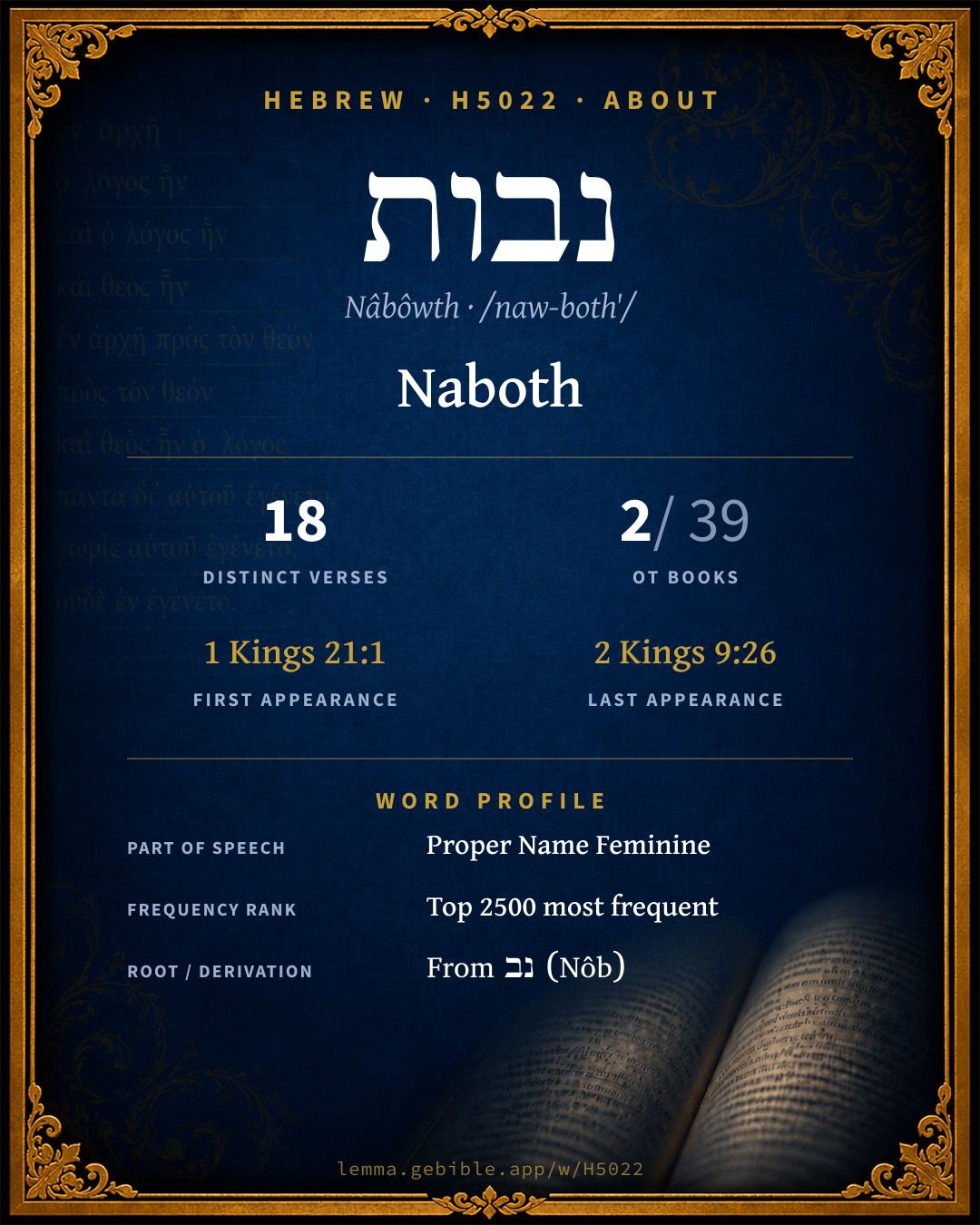
נָבוֹת
Naboth
BDB lists 2 entries for ‘Naboth’ fuller range ↓
Full lexicon entry — Brown-Driver-Briggs (BDB)
From Brown-Driver-Briggs (BDB)
Where this word appears
Grammar key — what these labels mean
Part of speech
- Noun
- A naming word — a person, place, thing, or idea.
Noun type
- Proper
- A name of a specific person, place, or people (e.g. Abraham, Zion, Israel).
Every verse where H5022 appears — 18 distinct verses across 2 books. Click any verse to open its interlinear word-by-word view. Verse text shown in the World English Bible for context — . Each verse’s Hebrew form is shown with its reference; the English is not keyword-highlighted, since the data carries no word-level English alignment. Use “Compare translations” on any verse to read it across multiple English versions. This concordance covers the Hebrew Bible; Septuagint (Greek Old Testament) occurrences are not indexed here.
1 Kings 15 verses
- 1 Kings 21:1 לְ/נָב֥וֹת prep + n Proper It happened after these things, that Naboth the Jezreelite had a vineyard, which was in Jezreel, hard by the palace of Ahab king of Samaria.
- 1 Kings 21:2 נָב֣וֹת n Proper Ahab spoke to Naboth, saying, Give me your vineyard, that I may have it for a garden of herbs, because it is near to my house; and I will give you for it a better vineyard than it: or, if it seem good to you, I will give you the worth of it in money.
- 1 Kings 21:3 נָב֖וֹת n Proper Naboth said to Ahab, Yahweh forbid it me, that I should give the inheritance of my fathers to you.
- 1 Kings 21:4 נָבוֹת֙ n Proper Ahab came into his house sullen and angry because of the word which Naboth the Jezreelite had spoken to him; for he had said, I will not give you the inheritance of my fathers. He laid him down on his bed, and turned away his face, and would eat no bread.
- 1 Kings 21:6 נָב֨וֹת n Proper He said to her, Because I spoke to Naboth the Jezreelite, and said to him, Give me your vineyard for money; or else, if it please you, I will give you [another] vineyard for it: and he answered, I will not give you my vineyard.
- 1 Kings 21:7 נָב֥וֹת n Proper Jezebel his wife said to him, Do you now govern the kingdom of Israel? arise, and eat bread, and let your heart be merry: I will give you the vineyard of Naboth the Jezreelite.
- 1 Kings 21:8 נָבֽוֹת n Proper So she wrote letters in Ahab's name, and sealed them with his seal, and sent the letters to the elders and to the nobles who were in his city, [and] who lived with Naboth.
- 1 Kings 21:9 נָב֖וֹת n Proper She wrote in the letters, saying, Proclaim a fast, and set Naboth on high among the people:
- 1 Kings 21:12 נָב֖וֹת n Proper They proclaimed a fast, and set Naboth on high among the people.
- 1 Kings 21:13 נָב֗וֹת נָב֛וֹת n Proper n Proper The two men, the base fellows, came in and sat before him: and the base fellows bore witness against him, even against Naboth, in the presence of the people, saying, Naboth did curse God and the king. Then they carried him forth out of the city, and stoned him to death with stones.
- 1 Kings 21:14 נָב֖וֹת n Proper Then they sent to Jezebel, saying, Naboth is stoned, and is dead.
- 1 Kings 21:15 נָב֖וֹת נָב֣וֹת נָב֛וֹת n Proper n Proper n Proper It happened, when Jezebel heard that Naboth was stoned, and was dead, that Jezebel said to Ahab, Arise, take possession of the vineyard of Naboth the Jezreelite, which he refused to give you for money; for Naboth is not alive, but dead.
- 1 Kings 21:16 נָב֑וֹת נָב֥וֹת n Proper n Proper It happened, when Ahab heard that Naboth was dead, that Ahab rose up to go down to the vineyard of Naboth the Jezreelite, to take possession of it.
- 1 Kings 21:18 נָב֔וֹת n Proper Arise, go down to meet Ahab king of Israel, who dwells in Samaria: behold, he is in the vineyard of Naboth, where he is gone down to take possession of it.
- 1 Kings 21:19 נָב֔וֹת n Proper You shall speak to him, saying, Thus says Yahweh, Have you killed and also taken possession? You shall speak to him, saying, Thus says Yahweh, In the place where dogs licked the blood of Naboth shall dogs lick your blood, even yours.
2 Kings 3 verses
- 2 Kings 9:21 נָב֥וֹת n Proper Joram said, Make ready. They made ready his chariot. Joram king of Israel and Ahaziah king of Judah went out, each in his chariot, and they went out to meet Jehu, and found him in the portion of Naboth the Jezreelite.
- 2 Kings 9:25 נָב֣וֹת n Proper Then said [Jehu] to Bidkar his captain, Take up, and cast him in the portion of the field of Naboth the Jezreelite; for remember how that, when I and you rode together after Ahab his father, Yahweh laid this burden on him:
- 2 Kings 9:26 נָבוֹת֩ n Proper Surely I have seen yesterday the blood of Naboth, and the blood of his sons, says Yahweh; and I will requite you in this plat, says Yahweh. Now therefore take and cast him into the plat [of ground], according to the word of Yahweh.
About this entry
At a glance — auto-summarized from this page’s data, not written by a person. Every figure links to its source below. This summary describes the numbers; it doesn’t interpret them.
נבות (Nâbôwth) is a Hebrew name most often rendered “Naboth.” 1 Kings dominates its distribution — 15 of 18 verses. Spanning 18 verses in 2 books, it ranks among the uncommon words of the Hebrew Bible. It first appears in 1 Kings 21:1. The sections below give every occurrence and version rendering.
Gloss history
Strong's 1890 vs modern scholarship
About this word
Strong's H5022 catalogs a Hebrew word from the Hebrew Old Testament.
These counts are not copied from any lexicon or concordance. They are computed here, from the morphology-tagged Hebrew Old Testament. What Lemma adds →
- 18
- distinct verses
- The word appears in 18 distinct verses.
- 2 / 39
- OT books
- The word appears in 2 of 39 Old Testament books.
- #1,412
- by frequency
- Top 2500 most frequent Hebrew words (rank 1,412 of 8,640 Hebrew words by occurrence).
View all 18 occurrences in the concordance →
By traditional corpus
Conventional, traditional groupings — biblical authorship is debated, so this is a traditional corpus grouping, not an authorship claim. Each share is this word’s portion of its verses in that division of the Hebrew canon. Each figure is a share of the word’s 18 distinct verses.
- Prophets (Nevi'im) 18 verses · 100%
How translations render this word
Counts come from each version’s own published word-to-Strong’s tagging or interlinear alignment — an approximate guide to how each version renders this word, not a word-level alignment the data otherwise carries. Because each total is that version’s own tagged count, the per-version totals vary from one another and need not match the appearance or distinct-verse counts above. These counts may also differ from a printed concordance because Lemma counts each distinctly tagged rendering and does not collapse phrase taggings into a single head-word total. This is a fixed set of word-tagged versions (KJV, ASV, BSB, ULT) and does not change with the reading translation you choose elsewhere. Each version’s license is shown beside its name below (and on Sources).
- King James Version: Naboth 21×
- American Standard Version: Naboth 19×
- Berean Standard Bible: Naboth 21×
- unfoldingWord Literal Text: Naboth 22×
King James Version Public Domain
Renders H5022 across 22 tagged occurrences — most commonly:
Plus 1 rendering that appears only once — usually multi-word phrases or single function words the recovered tagging swept in, not distinct renderings.
American Standard Version Public Domain
Renders H5022 across 22 tagged occurrences — most commonly:
Plus 3 renderings that appear only once — usually multi-word phrases or single function words the recovered tagging swept in, not distinct renderings.
Berean Standard Bible Public Domain
Renders H5022 across 22 tagged occurrences — most commonly:
Plus 1 rendering that appears only once — usually multi-word phrases or single function words the recovered tagging swept in, not distinct renderings.
unfoldingWord Literal Text CC BY-SA 4.0
Renders H5022 across 22 tagged occurrences — most commonly:
Senses in BDB
The 2 senses BDB distinguishes for this word, in lexicon order (not ranked by frequency or importance). The full entry — with sub-senses — is in the Lexicon Entry tab.
- Naboth = "fruits"
- the vineyard owner of Jezreel who Ahab and Jezebel had killed so that they could have his vineyard
Word origin
n.pr.m. a Jezreelite;—1 K 21:1, 2, 3 + 16 times 1 K 21; 2 K 9:21, 25, 26. 𝔊 Ναβουθαι.
— Brown-Driver-Briggs (Oxford 1906, public domain), digitized via Sefaria, supplemented by the OpenScriptures HebrewLexicon (CC BY 4.0). See Sources.
Derived from נב (Nôb) (H5011) — Nob.
Jastrow Dictionary
A second Hebrew/Aramaic lexicon for comparison, covering Aramaic and post-biblical (Talmudic, Targumic, Midrashic) usage that the biblical-Hebrew BDB does not. Matched by lemma rather than by Strong’s number, so a lemma may carry more than one Jastrow headword (shown separately below), and the entries cover usage well beyond the Bible.
נָבוֹת
- (b. h.) pr. n. m. Naboth, a citizen of Jezreel. Snh. 102ᵇ, a. e. (ref. to I Kings XXII, 22) רוחו של נ׳ the spirit of (the murdered) Naboth. Shebu. 35ᵇ כל שמות … בנ׳ וכ׳ all the names (Elohim) mentioned in connection with Naboth (I Kings XXI, 10; 13) are sacred (meaning God). e.g. 1 Kings 22:22
A Dictionary of the Targumim, the Talmud Babli and Yerushalmi, and the Midrashic Literature (Marcus Jastrow; London, Luzac, 1903) — Public Domain. Digitized via Sefaria. Digitized via Sefaria. Full attribution on Sources.
Forms in the corpus
The 12 distinct written forms H5022 takes in the Hebrew Bible, most frequent first — each parse links to that state’s occurrences in the concordance. Hebrew forms include their vowel points and cantillation, so a single lemma takes many written forms.
| Form | Parsing | Example | Uses |
|---|---|---|---|
| נָב֖וֹת | Noun, Proper | 1 Kings 21:3 | 5 |
| נָב֣וֹת | Noun, Proper | 1 Kings 21:2 | 3 |
| נָב֥וֹת | Noun, Proper | 1 Kings 21:7 | 3 |
| נָב֔וֹת | Noun, Proper | 1 Kings 21:18 | 2 |
| נָב֛וֹת | Noun, Proper | 1 Kings 21:13 | 2 |
| לְ/נָב֥וֹת | Noun, Proper | 1 Kings 21:1 | 1 |
| נָב֑וֹת | Noun, Proper | 1 Kings 21:16 | 1 |
| נָב֗וֹת | Noun, Proper | 1 Kings 21:13 | 1 |
| נָב֨וֹת | Noun, Proper | 1 Kings 21:6 | 1 |
| נָבֽוֹת | Noun, Proper | 1 Kings 21:8 | 1 |
| נָבוֹת֙ | Noun, Proper | 1 Kings 21:4 | 1 |
| נָבוֹת֩ | Noun, Proper | 2 Kings 9:26 | 1 |
Bible dictionary
Public-domain dictionary articles matched to this entry by name (Naboth). A biblical name can be shared by more than one person or place, so an article may treat several.
Easton's Bible Dictionary · M. G. Easton, 1897
Fruits, "the Jezreelite," was the owner of a portion of ground on the eastern slope of the hill of Jezreel (2 Kings 9:25, 26). This small "plat of ground" seems to have been all he possessed. It was a vineyard, and lay "hard by the palace of Ahab" (1 Kings 21:1, 2), who greatly coveted it. Naboth, however, refused on any terms to part with it to the king. He had inherited it from his fathers, and no Israelite could lawfully sell his property (Lev. 25:23). Jezebel, Ahab's wife, was grievously offended at Naboth's refusal to part with his vineyard. By a crafty and cruel plot she compassed his death. His sons also shared his fate (2 Kings 9:26; 1 Kings 21:19). She then came to Ahab and said, "Arise, take possession of the vineyard; for Naboth is not alive, but dead." Ahab arose and went forth into the garden which had so treacherously and cruelly been acquired, seemingly enjoying his new possession, when, lo, Elijah suddenly appeared before him and pronounced against him a fearful doom (1 Kings 21:17-24). Jehu and Bidcar were with Ahab at this time, and so deeply were the words of Elijah imprinted on Jehu's memory that many years afterwards he refers to them (2 Kings 9:26), and he was the chief instrument in inflicting this sentence on Ahab and Jezebel and all their house (9:30-37). The house of Ahab was extinguished by him. Not one of all his great men and his kinsfolk and his priests did Jehu spare (10:11).
Ahab humbled himself at Elijah's words (1 Kings 21:28, 29), and therefore the prophecy was fulfilled not in his fate but in that of his son Joram (2 Kings 9:25).
The history of Naboth, compared with that of Ahab and Jezebel, furnishes a remarkable illustration of the law of a retributive providence, a law which runs through all history (comp. Ps. 109:17, 18).
Smith's Bible Dictionary · William Smith, 1863
(fruits), the victim of Ahab and Jezebel, was the owner of a small vineyard at Jezreel, close to the royal palace of Shab. (1 Kings 21:1,2) (B.C. 897.) It thus became an object of desire to the king, who offered an equivalent in money or another vineyard. In exchange for this Naboth, in the independent spirit of a Jewish landholder, refused: "The Lord forbid it me that I should give the inheritance of my father unto thee." Ahab was cowed by this reply; but the proud spirit of Jezebel was aroused. She took the matter into her own hands. A fast was proclaimed, as on the announcement of some impending calamity. Naboth was "set on high" in the public place of Samaria; two men of worthless character accused him of having "cursed God and the king." He and his children, (2 Kings 9:26) were dragged out of the city and despatched; the same night. The place of execution there was by the large tank or reservoir which still remains an the slope of the hill of Samaria, immediately outside the walls. The usual punishment for blasphemy was enforced: Naboth and his sons were stoned; and the blood from their wounds ran down into the waters of the tank below. For the signal retribution taken on this judicial murder--a remarkable proof of the high regard paid in the old dispensation to the claims of justice and independence--see Ahab; Jehu; Jezebel.
Hitchcock's Bible Names Dictionary · Roswell D. Hitchcock, 1869
words; prophecies
Classic public-domain reference works; full attribution on Sources.
Septuagint verse parallels
This word appears in 18 verses that also exist in the Greek Old Testament (Septuagint), out of the 18 Hebrew verses it occurs in. You can read those verses in Greek by switching the Old Testament edition to the Septuagint.
Read these verses in the Septuagint
This is a verse-level parallel only — the same verses exist in both the Hebrew and Greek Old Testaments. No word-level Hebrew↔Greek correspondence is claimed: the data carries no such alignment, so no Greek word is shown as this Hebrew word’s translation. Coverage is not total — the Septuagint omits the deuterocanon and renumbers the Psalms, so some Hebrew verses have no direct Greek parallel.