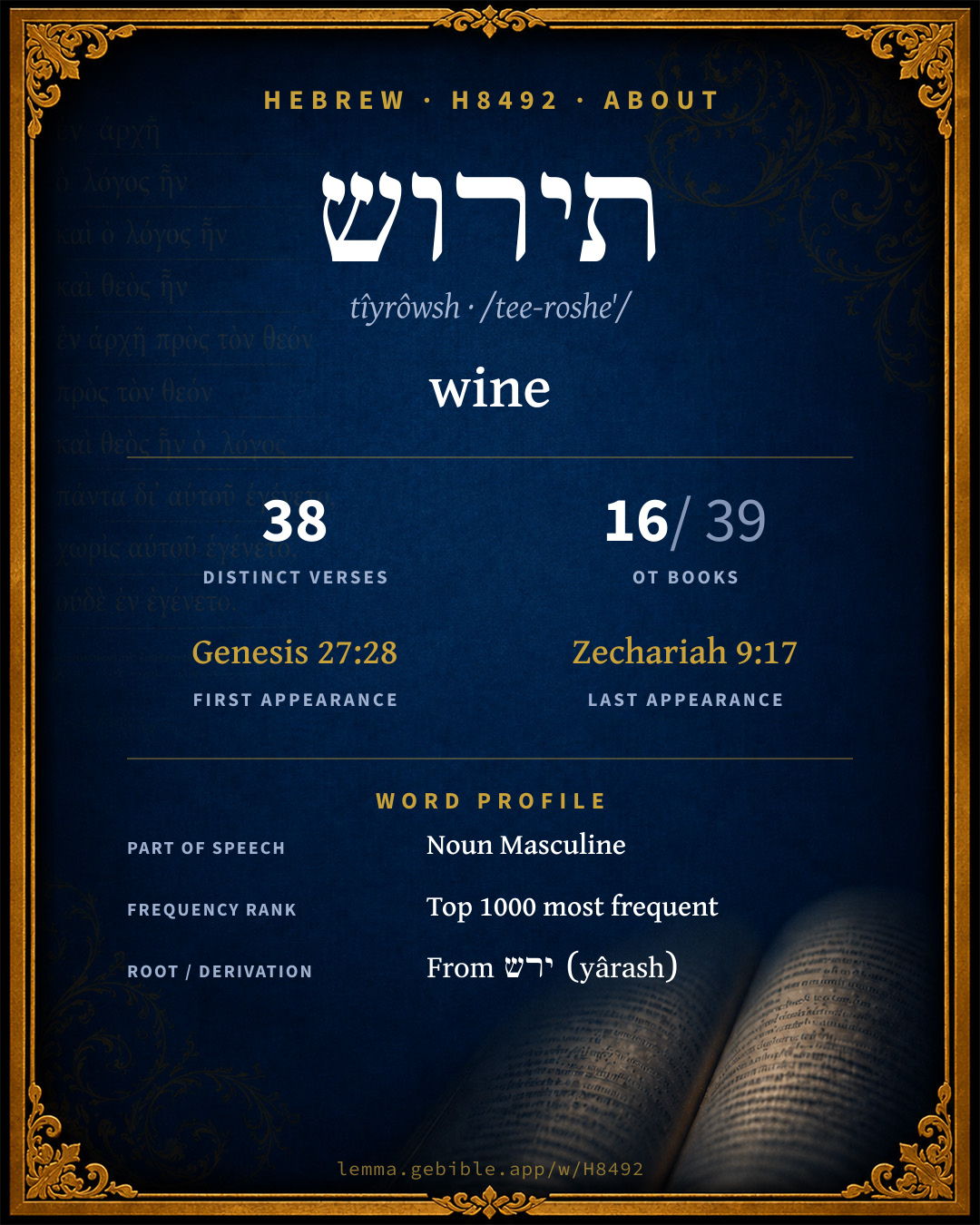
תִּירוֹשׁ
wine
Full lexicon entry — Brown-Driver-Briggs (BDB)
From Brown-Driver-Briggs (BDB)
Where this word appears
See every Construct-state word in the Hebrew Bible →
Grammar key — what these labels mean
Part of speech
- Noun
- A naming word — a person, place, thing, or idea.
Noun type
- Common
- A common noun — a general class of person, place, or thing (“king,” “city,” “water”), not a specific name.
State
- Absolute
- The independent form of a noun, not bound to a following word.
- Construct
- A noun bound to a following noun in a possessive / “of” relationship (the construct chain).
Gender
- Masculine
- Grammatically masculine.
Number
- Singular
- One.
Every verse where H8492 appears in the Book of Deuteronomy — 7 distinct verses. Click any verse to open its interlinear word-by-word view. Verse text shown in the World English Bible for context — . Each verse’s Hebrew form is shown with its reference; the English is not keyword-highlighted, since the data carries no word-level English alignment. Use “Compare translations” on any verse to read it across multiple English versions. This concordance covers the Hebrew Bible; Septuagint (Greek Old Testament) occurrences are not indexed here.
Deuteronomy
- Deuteronomy 7:13 וְ/תִֽירֹשְׁ/ךָ֣ conj + n c ms cs + sfx pers 2ms and he will love you, and bless you, and multiply you; he will also bless the fruit of your body and the fruit of your ground, your grain and your new wine and your oil, the increase of your cattle and the young of your flock, in the land which he swore to your fathers to give you.
- Deuteronomy 11:14 וְ/תִֽירֹשְׁ/ךָ֖ conj + n c ms cs + sfx pers 2ms that I will give the rain of your land in its season, the former rain and the latter rain, that you may gather in your grain, and your new wine, and your oil.
- Deuteronomy 12:17 וְ/תִֽירֹשְׁ/ךָ֣ conj + n c ms cs + sfx pers 2ms You may not eat within your gates the tithe of your grain, or of your new wine, or of your oil, or the firstborn of your herd or of your flock, nor any of your vows which you vow, nor your freewill-offerings, nor the heave-offering of your hand;
- Deuteronomy 14:23 תִּֽירֹשְׁ/ךָ֣ n c ms cs + sfx pers 2ms You shall eat before Yahweh your God, in the place which he shall choose, to cause his name to dwell there, the tithe of your grain, of your new wine, and of your oil, and the firstborn of your herd and of your flock; that you may learn to fear Yahweh your God always.
- Deuteronomy 18:4 תִּֽירֹשְׁ/ךָ֣ n c ms cs + sfx pers 2ms The first fruits of your grain, of your new wine, and of your oil, and the first of the fleece of your sheep, shall you give him.
- Deuteronomy 28:51 תִּיר֣וֹשׁ n c ms and shall eat the fruit of your cattle, and the fruit of your ground, until you are destroyed; that also shall not leave you grain, new wine, or oil, the increase of your cattle, or the young of your flock, until they have caused you to perish.
- Deuteronomy 33:28 וְ/תִיר֑וֹשׁ conj + n c ms Israel dwells in safety, The fountain of Jacob alone, In a land of grain and new wine; Yes, his heavens drop down dew.
About this entry
At a glance — auto-summarized from this page’s data, not written by a person. Every figure links to its source below. This summary describes the numbers; it doesn’t interpret them.
At its core, תירוש (tîyrôwsh) means “wine.” First canonically at Genesis 27:28, it enters the text early. It appears 38 verses across 16 books of the Hebrew Bible, among its moderately common vocabulary. It shares a root with ירש, ירשה and ירשה. Dig into 38-verse concordance and the renderings breakdown below.
Gloss history
Strong's 1890 vs modern scholarship
About this word
Strong's H8492 catalogs a Hebrew word from the Hebrew Old Testament.
These counts are not copied from any lexicon or concordance. They are computed here, from the morphology-tagged Hebrew Old Testament. What Lemma adds →
- 38
- distinct verses
- The word appears in 38 distinct verses.
- 16 / 39
- OT books
- The word appears in 16 of 39 Old Testament books.
- #947
- by frequency
- Top 1000 most frequent Hebrew words (rank 947 of 8,640 Hebrew words by occurrence).
View all 38 occurrences in the concordance →
Most concentrated in
- Deuteronomy 7 verses 18%
- Hosea 6 verses 16%
- Nehemiah 5 verses 13%
By section of the Old Testament
By traditional corpus
Conventional, traditional groupings — biblical authorship is debated, so this is a traditional corpus grouping, not an authorship claim. Each share is this word’s portion of its verses in that division of the Hebrew canon. Each figure is a share of the word’s 38 distinct verses.
- Prophets (Nevi'im) 19 verses · 50%
- Torah (Pentateuch) 10 verses · 26%
- Writings (Ketuvim) 9 verses · 24%
How translations render this word
Counts come from each version’s own published word-to-Strong’s tagging or interlinear alignment — an approximate guide to how each version renders this word, not a word-level alignment the data otherwise carries. Because each total is that version’s own tagged count, the per-version totals vary from one another and need not match the appearance or distinct-verse counts above. These counts may also differ from a printed concordance because Lemma counts each distinctly tagged rendering and does not collapse phrase taggings into a single head-word total. This is a fixed set of word-tagged versions (KJV, ASV, BSB, ULT) and does not change with the reading translation you choose elsewhere. Each version’s license is shown beside its name below (and on Sources).
- King James Version: Wine 24×, New wine 11×
- American Standard Version: New wine 32×, Vintage 2×
- Berean Standard Bible: New wine 34×, Or new wine 2×
- unfoldingWord Literal Text: New wine 28×, Wine 6×
King James Version Public Domain
Renders H8492 across 38 tagged occurrences — most commonly:
Plus 3 renderings that appear only once — usually multi-word phrases or single function words the recovered tagging swept in, not distinct renderings.
American Standard Version Public Domain
Renders H8492 across 39 tagged occurrences — most commonly:
Plus 5 renderings that appear only once — usually multi-word phrases or single function words the recovered tagging swept in, not distinct renderings.
Berean Standard Bible Public Domain
Renders H8492 across 38 tagged occurrences — most commonly:
Plus 2 renderings that appear only once — usually multi-word phrases or single function words the recovered tagging swept in, not distinct renderings.
unfoldingWord Literal Text CC BY-SA 4.0
Renders H8492 across 37 tagged occurrences — most commonly:
Plus 3 renderings that appear only once — usually multi-word phrases or single function words the recovered tagging swept in, not distinct renderings.
16 senses and sub-senses in the full BDB
Hebrew verbs can shift meaning by stem (binyan): Qal is the basic action, Niphal is often passive or reflexive, Piel often intensifies or makes it factitive, and Hiphil is typically causative. The senses below are grouped under the stem BDB assigns to each.
What do BDB’s symbols mean?
BDB uses these scholarly abbreviations:
| Symbol | Meaning |
|---|---|
| 𝔊 | the Septuagint (the ancient Greek translation, LXX) |
| 𝔙 | the Vulgate (the Latin translation) |
| 𝔖 | the Syriac version (the Peshitta) |
| 𝔗 | the Targum (the Aramaic translation) |
| ψ | the Psalms |
| √ | root (the underlying root or stem) |
| ‖ | parallel passage (a synonymous or contrasted parallel) |
| † | the dagger: every passage where the word occurs is cited |
The 16 senses and sub-senses the full Brown-Driver-Briggs lexicon distinguishes for this word, in lexicon order (not ranked by frequency), with BDB’s own verbatim wording and sub-sense lettering. Shown in Hebrew script with BDB’s own scholarly abbreviations. The condensed entry is in the Lexicon Entry tab. See also the Forms in the corpus table below.
Qal
- Pf. 3 ms. יָרַשׁ Je 49:1; וְיָרַשׁ consec. Je 49:2 Nu 27:11; 2 ms. יָרָ֑שְׁתָּ 1 K 21:19; וְיָרַשְׁתָּ֫ Dt 6:18 + 2 times; sf. וִירִשְׁתָּהּ consec. Dt 17:14 + 2 times (on this and kindred forms v. Köi. 406, 411); וִירִשְׁתָּם consec. Dt 19:1; 31:3; 3 pl. יָֽרְשׁוּ Dt 3:20 +; sf. וִירֵשׁוּךָ consec. Ez 36:12 (Köl.c.); וִירֵשׁוּהָ consec. Is 34:11 + 3 times; 2 mpl. וִירִשְׁתֶּם consec. Dt 4:1 + 7 times; 1 pl. יָרַשְׁנוּ Dt 3:12, etc.; Impf. 3 ms. יִירַשׁ Gn 21:10 ψ 25:13; 2 mpl. תִּירְשׁוּ Lv 20:24 1 Ch 28:8; תִּירָ֑שׁוּ Ez 33:25, 26; תִּירָשׁ֑וּן Dt 5:30, etc.; Imv. ms. יְרָ֑שָׁה Dt 33:23; רֵשׁ Dt 1:21 1 K 21:15; רָ֑שׁ Dt 2:24, 31; mpl. וּרְשׁוּ Dt 1:8; 9:23; Inf. cstr. לָרֶ֫שֶׁת Dt 2:31 + 17 times; לָרָ֑שֶׁת Ne 9:23; sf. לְרִשְׁתְּךָ Gn 28:4; לְרִשְׁתּוֹ 1 K 21:16, 18; לְרִשְׁתָּהּ Gn 15:7 + 28 times; Pt. יוֹרֵשׁ Gn 15:3 + 6 times; pl. י(וֹ)רְשִׁים Dt 12:2 Je 8:10; sf. יֹרְשָׁיו Je 49:2;— e.g. Jeremiah 49:1
- 1. take possession of, especially by force, have as a possession, often with collat. idea of taking in place of others, succeeding to, inheriting (cf. 2:
- a. land, sq. acc. Gn 15:7, 8 Nu 13:30; 21:24, 35 Jos 18:3 (all JE), 24:4, 8 (E), Ju 2:6; 11:21, 22, 23, 24(×2); 18:9 Dt 1:8, 21, 39 + 25 times Dt, + †Dt 11:31; 17:14; 26:1 (all possess land and dwell therein), similarly Is 65:9(×2) ψ 69:36; בְּאַרְצָם מִשְׁנֶה יִירָ֑שׁוּ Is 61:7 in their land they shall possess the double; הָחֵל רָשׁ Dt 2:24; הָחֵל רָשׁ לָרֶשֶׁת אֶת־אַרְצוֹ v 31; especially phr. (הארץ) שָׁמָּה לְרִשְׁתָּהּ (etc. עֹבְרִים) אֲשֶׁר אַתֶּם בָּאִים Dt 4:5, 14, 26 + 12 times Dt, also Ezr 9:10; v. Dt 30:18 Jos 1:11(×2), 15(×2); 12:1; 13:1; 21:41; 23:5 (all D); Am 2:10 Ob 19, 19 Hb 1:6 Ez 33:24, 25, 26 Lv 20:24(×2) (H), Gn 28:4 Nu 33:53 (both P), 1 Ch 28:8 Ne 9:15, 22, 23, 24; ψ 25:13; 37:9, 11, 22, 29, 34; + ב instr. 44:4; also וַעֲמַל לְאֻמִּים יִירָ֑שׁוּ 105:44 (‖ (וִיִּתֵּן לָהֶם אַרְצוֹת גּוֹיִם); †take possession of fields Je 8:10 (obj. not expr.), 1 K 21:15, 16, 18, 19 ψ 83:13; inheritance (in land) Nu 27:11; 36:8(×2) (all P); city (cities), Jos 19:47 (JE), Ju 3:13 Ob 20; so הַר־קָדְשִׁי Is 57:13 (‖ נחל ארץ), 63:18 where read prob. הַר־קָדְשֶׁ֑ךָ (for MT עַם־ק׳, see 𝔊 VB and ‖ cl.); possess city and dwell therein 2 K 17:24 Is 34:17; Is 34:11 yea the pelican and bittern shall possess it; so of nettles Ho 9:6; וְיִרַשׁ זַרְעֲךָ אֵת שַׁעַר אֹיְבָיו Gn 22:17, cf. 24:60 (both J); possess houses Ez 7:24 (del. Co), Ne 9:25; יוֹרֵשׁ עֶצֶר Ju 18:7 possessing wealth (? see VB)†. e.g. Genesis 15:7
- b. a people (with collat. idea of being their heir (2), and so dispossessing them), so especially in Dt 2:12, 21, 22; 9:1 (+ cities), 11:23; 12:2, 29(×2); 18:14; 19:1; 31:3; Nu 21:32 (Kt וַיִּירַשׁ; JE), Am 9:12; מַדּוּעַ יָרַשׁ מִלְכֹּם אֶת־גָּ֑ד Je 49:1 (on text see VB), v 2, 2 (in these 3 perhaps play on meaning inherit, cf. v 1 a); Ez 36:12 Ob 17 Is 54:3; nations + countries Ez 35:10. e.g. Deuteronomy 2:12
- 2. inherit, sq. acc. pers. = be one’s heir Gn 15:3, 4(×2) (JE); שִׁפְחָה כִּי־תִירַשׁ גְּבִרְתָּהּ Pr 30:23 (or, dispossess?); abs. be heir, sq. עִם pers. = jointly with 21:10 (E); (הַ)יּוֹרֵשׁ (the) heir 2 S 14:7 Je 49:1 (‖ בָּנִים); Mi 1:15 (= possessor, captor), where paronom. with n.pr.loc. מָרֵשָׁה; inherit persons, as slaves לָרֶשֶׁת אֲחֻזָּה Lv 25:46 (H). e.g. Genesis 15:3
- 3. = impoverish, הַלְיָרְשֵׁנוּ קְרָאתֶם (var. Pi. הַלְיָֽרְ׳ Ju 14:15 (v. Ges§ 69 m)) to impoverish us did ye call (us)? e.g. Judges 14:15
Niphal
- Impf. יִוָּרֵשׁ Pr 23:21; 2 ms. תִּוָּרֵשׁ Gn 45:11 Pr 20:13; אִוָּרֵשׁ Pr 30:9;—be (dispossessed =) impoverished, come to poverty Gn 45:11 (E), Pr 20:13; 23:21; 30:9 (opp. אֶשְׂבַּע). e.g. Proverbs 23:21
Piel
- Impf. פְּרִי אַדְמָתֶ֑ךָ יְיָרֵשׁ הַצְּלָצַֽל Dt 28:42 the fruit of thy ground shall the cricket get full possession of (cf. Qal Ho 9:6 Is 34:11), i.e. devour. e.g. Deuteronomy 28:42
Hiphil
- Pf. 3 ms. הוֹרִישׁ Ju 1:27 +; 2 ms. הוֹרַשְׁתָּ 2 Ch 20:7 ψ 44:3, etc.; Impf. 3 ms. יוֹרִישׁ Jos 3:10; וַיּ֫(וֹ)רֶשׁ Ju 1:19 +; 3 fs. sf. 3 mpl. תּוֹרִישֵׁמוּ Ex 15:9, etc.; Inf. abs. הוֹרֵשׁ Jos 3:10; 17:13; הוֹרֵישׁ Ju 1:28; cstr. לְהוֹרִישׁ Dt 4:38 +, etc.; Pt. מוֹרִישׁ 1 S 2:7 Dt 18:12; sf. מוֹרִישָׁם Dt 9:4, 5;— e.g. Judges 1:27
- 1. cause to possess, or inherit Ju 11:24; מִיְּרֻשָֽׁתְךָ אֲשֶׁר הוֹרַשְׁתָּנוּ 2 Ch 20:11; sq. ל pers., וְהוֹרַשְׁתֶּם לִבְנֵיכֶם Ezr 9:12 and cause your sons to inherit (it); fig. תּוֹרִישֵׁנִי עֲוֹנוֹת נְעוּרָ֑י Jb 13:26 thou makest me to inherit (the consequences of) the iniquities of my youth. e.g. Judges 11:24
- 2. cause (others) to possess or inherit, then gen. dispossess:
- a. sq. acc. gent. vel pers., Jos 13:13; 16:10 (both JE), Ju 1:29, 30, 31, 32, 33 (all opp. ישׁב בְּקֶרֶב), Jos 14:12 (JE), 17:13 (JE; הוֹרֵשׁ לֹא הוֹרִישׁוֹ), Ju 1:28 (id.); opp. ישׁב אֵת Jos 15:63; opp. ישׁב בְּ Ju 1:21, 27; also Nu 21:32 Qr, 32:39 Jos 17:18 (all JE), 13:12 (D), Ju 1:19b; 2:23; also וַיֹּרֶשׁ אֶת־הָהָר 1:19a (= את־יושׁבי ההר see v b), Dt 7:17 ψ 44:3; וְהוֹרַשְׁתָּם וְהַאֲבַדְתָּם Dt 9:3; sq. acc. + מִפְּנֵי Ex 34:24 Nu 32:21 Jos 3:10 (הוֹרֵשׁ יוֹרִישׁ; all these JE), Dt 4:38; 9:4, 5; 18:12 Jos 13:6; 23:9 (both D), Nu 33:52, 55 (both P), Ju 2:21; 11:23, 24 1 K 14:24; 21:26 2 K 16:3; 17:8; 21:2 (all D), 2 Ch 28:3; 33:2; acc. + מִלִּפְנֵי Dt 11:23 Jos 23:5, 13 (D; ‖ הָדַף), 2 Ch 20:7; acc. + מִשָּׁם Jos 15:14 (JE) = Ju 1:20; of cities (i.e. their inhabitants) Jos 8:7; 17:12; so of a land = Nu 33:53 (P), see v 52, 55 [𝔊 + יושׁבי] e.g. Joshua 13:13
- b. sq. acc. rei, מִבִּטְנוֹ יֹרִשֶׁנּוּ אֵל Jb 20:15 God shall cast them out of his belly, i.e. riches (‖ חַיִל בָּלַע וַיְקִאֶנּוּ). e.g. Job 20:15
- 3. = impoverish, יהוה מוֹרִישׁ וּמַעֲשׁיר 1 S 2:7 (song) י׳ impoverisheth and maketh rich; sq. acc. (of Tyre) אֲדֹנָי יוֹרִשֶׁנָּה Zc 9:4 (see v 3). e.g. 1 Samuel 2:7
- 4. nearly = bring to ruin, destroy, sq. acc. gent. אָרִיק חַרְבִּי תּוֹרִישֵׁמוֹ יָדִי Ex 15:9 (poem in E); so perhaps also Nu 14:12 (JE; AV disinherit; ‖ אַכֶּנּוּ בַדֶּבֶר). e.g. Exodus 15:9
- 5. = Qal take possession of a land Nu 14:24 (JE), but read prob. יִרָשֶׁנָּה. e.g. Numbers 14:24
Senses from the full Brown-Driver-Briggs lexicon (Brown, Driver, Briggs; Oxford 1906 — public domain), digitized via Sefaria, supplemented by the OpenScriptures HebrewLexicon (CC BY 4.0). Full attribution on Sources.
Word origin
vb. take possession of, inherit, dispossess (MI7 וירש take possession of; Aramaic יְרֵית, ܝܺܪܶܬ take possession of, and be heir to, inherit; so Ethiopic ወረሰ Arabic وَرِثَ inherit; v. also Sab. ורתֿ, inherit, CISiv, 37, 3), especially D (62 times Qal, 1 times Pi, 7 times Hiph. in Dt + 13 times D in Jos);—
— Brown-Driver-Briggs (Oxford 1906, public domain), digitized via Sefaria, supplemented by the OpenScriptures HebrewLexicon (CC BY 4.0). See Sources.
Derived from ירש (yârash) (H3423) — to inherit.
Jastrow Dictionary
A second Hebrew/Aramaic lexicon for comparison, covering Aramaic and post-biblical (Talmudic, Targumic, Midrashic) usage that the biblical-Hebrew BDB does not. Matched by lemma rather than by Strong’s number, so a lemma may carry more than one Jastrow headword (shown separately below), and the entries cover usage well beyond the Bible.
תִּירוֹשׁ
- juice, must, wine. Tosef. Ned. IV, 3 הנודר מן הת׳ … ומותר ביין he that vows abstinence from tirosh is forbidden all kinds of sweet juice, but is permitted (fermented) wine; Y. ib. VII, 40ᵇ bot. כמאן דאמר … התורה קראת אותו ת׳ תִּירוֹשְׁךָ זה היין this is according to him who says, that in vows we follow the ordinary usage, but according to him who says that we must be guided by Biblical usage, the Bible calls it (wine) tirosh; ‘thy tirosh’ (Deut. XI, 14) means wine; (quot. from) Sifré Deut. 42. Ib. תרושך מלא (read תיר׳) ‘thy wine’, that means in abundance. Pesik. ‘Asser, p. 100ᵃ (ref. to Deut. XIV, 22, a. Hos. II, 11) אם זכיתם תירושך ואם לאו תִּירוֹשִׁי if you do good, it is thb must, if not, it is my must; Yalk. Deut. 897; a. e. e.g. Deuteronomy 11:14
A Dictionary of the Targumim, the Talmud Babli and Yerushalmi, and the Midrashic Literature (Marcus Jastrow; London, Luzac, 1903) — Public Domain. Digitized via Sefaria. Digitized via Sefaria. Full attribution on Sources.
Forms in the corpus
The 25 distinct written forms H8492 takes in the Hebrew Bible, most frequent first — each parse links to that state’s occurrences in the concordance. Hebrew forms include their vowel points and cantillation, so a single lemma takes many written forms.
Same root — word family
Other BDB entries built from the same root as H8492, grouped by Strong’s listed origin. These share a root / origin per the lexicon — not necessarily a shared meaning. Each links to that word’s own entry.
Derives from
Shares the same root
- ירשה yᵉrêshâh H3424 possession
- ירשה yᵉrushshâh H3425 inheritance
- מורש môwrâsh H4180 possession
- רשת resheth H7568 net
Proper names from this root
People and places named from this root — a name, not an additional meaning of the word.
Compare all same-root words → Showing 4 of 8 — not the complete family. 2 of the same-root words are proper names (people or places). They share a root, not necessarily a meaning.
Septuagint verse parallels
This word appears in 33 verses that also exist in the Greek Old Testament (Septuagint), out of the 38 Hebrew verses it occurs in. You can read those verses in Greek by switching the Old Testament edition to the Septuagint.
Read these verses in the Septuagint
- Genesis 27:28
- Numbers 18:12
- Deuteronomy 7:13
- Judges 9:13
- 2 Kings 18:32
- 2 Chronicles 31:5
- Psalms 4:7
- Proverbs 3:10
- Isaiah 24:7
- Jeremiah 31:12
- Hosea 2:8
- Joel 1:10
This is a verse-level parallel only — the same verses exist in both the Hebrew and Greek Old Testaments. No word-level Hebrew↔Greek correspondence is claimed: the data carries no such alignment, so no Greek word is shown as this Hebrew word’s translation. Coverage is not total — the Septuagint omits the deuterocanon and renumbers the Psalms, so some Hebrew verses have no direct Greek parallel.