
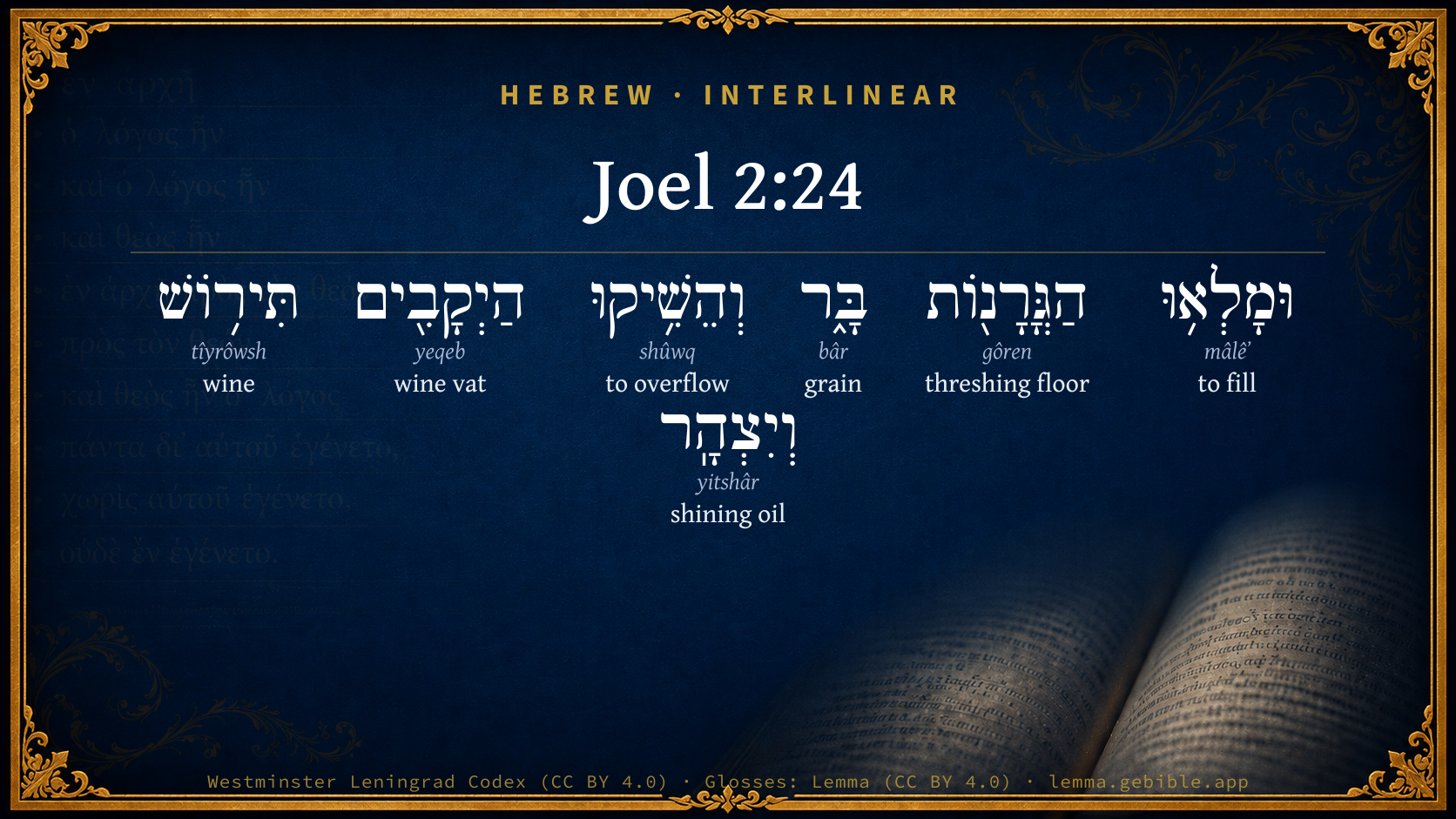
Joel 2:24

Hebrew (Westminster Leningrad Codex) Joel 2:24 appears in the Hebrew Old Testament. The text above is from the Westminster Leningrad Codex. Each word links to its Strong’s number, a concise gloss, and parsing drawn from the Open Scriptures Hebrew Bible morphology. Click any word for its full Brown-Driver-Briggs (BDB) entry.
Download image
Cite this verse

Joel 2:24 (World English Bible). Public Domain. Lemma interlinear Bible study tool, https://lemma.gebible.app/v/joel/2/24.

Show BibTeX & RIS
BibTeX
RIS
English Translation
The threshing floors will be full of wheat, And the vats will overflow with new wine and oil.
World English Bible · Public Domain
Download a study sheet

One document with this verse’s original text, its word-by-word gloss line, the meaning frame, cross-references with their text, attributed commentary, and full source and license credits — printable, and it pastes into notes with its structure intact.

This verse Autodidact and up

Study sheet (.html) Plain text (.txt)

A passage Seminary Student

Up to 50 verses in one chapter. A passage sheet keeps up to 6 commentary sources and 12 cross-references per verse, in the order this page ranks them, and says so on the sheet whenever that leaves anything out. Ask for a single verse and you get the Autodidact verse sheet above.

Everything on this page stays free to read, with no account — the sheet is a download of what is already on screen, not access to it.

Want to remove ads? Support Godless Engineer
Compare translations 3

The same verse in 3 English versions, stacked beneath the original-language interlinear above. Click any original word for its lexicon entry.

Each is an independent rendering of the whole verse — the interlinear is not word-aligned to these translations.

Highlighted words mark where these versions differ — a whole-verse word diff, not a word-by-word alignment.

  • World English Bible Public Domain
    The threshing floors will be full of wheat, And the vats will overflow with new wine and oil.
  • King James Version Public Domain
    And the floors shall be full of wheat, and the vats shall overflow with wine and oil.
  • unfoldingWord Literal Text CC BY-SA 4.0
    And the threshing floors will be full grain, and the vats will overflow new wine and oil.

unfoldingWord Literal Text — © unfoldingWord, licensed CC BY-SA 4.0. Word-aligned USFM3 via Door43 (git.door43.org/unfoldingWord/en_ult).

Versions to compare (up to 4)

3 of 4 selected

Show all 18 translations

Every available English version of this verse, each an independent rendering of the whole verse.

  • World English Bible Public Domain
    The threshing floors will be full of wheat, And the vats will overflow with new wine and oil.
  • Berean Standard Bible Public Domain
    The threshing floors will be full of grain, and the vats will overflow with new wine and oil.
  • Majority Standard Bible Public Domain
    The threshing floors will be full of grain, and the vats will overflow with new wine and oil.
  • King James Version Public Domain
    And the floors shall be full of wheat, and the vats shall overflow with wine and oil.
  • American Standard Version (1901) Public Domain
    And the floors shall be full of wheat, and the vats shall overflow with new wine and oil.
  • Revised Version (1885) Public Domain
    And the floors shall be full of wheat, and the vats shall overflow with wine and oil.
  • Geneva Bible (1599) Public Domain
    And the barnes shalbe full of wheate, and the presses shall abound with wine and oyle.
  • Douay-Rheims (1899) Public Domain
    And the floors shall be filled with wheat, and the presses shall overflow with wine and oil.
  • Young's Literal Translation Public Domain
    And full have been the floors `with' pure corn, And overflown have the presses `with' new wine and oil.
  • Literal Standard Version CC BY-SA 4.0
    And the floors have been full [with] pure grain, || And the presses have overflown [with] new wine and oil.
  • Unlocked Literal Bible CC BY-SA 4.0
    The threshing floors will be full of wheat, and the vats will overflow with new wine and oil.
  • unfoldingWord Literal Text CC BY-SA 4.0
    And the threshing floors will be full grain, and the vats will overflow new wine and oil.
  • Darby Bible Public Domain
    And the floors shall be full of corn, and the vats shall overflow with new wine and oil.
  • World Messianic Bible Public Domain
    The threshing floors will be full of wheat, and the vats will overflow with new wine and oil.
  • Webster's Bible Public Domain
    And the floors shall be full of wheat, and the vats shall overflow with wine and oil.
  • Free Bible Version CC BY-SA 4.0
    The threshing floors will be full of grain, the vats will overflow with new wine and olive oil.
  • Bible in Basic English Public Domain
    And the floors will be full of grain, and the crushing-places overflowing with wine and oil.
  • JPS Tanakh (1917) Public Domain
    And the floors shall be full of corn, and the vats shall overflow with wine and oil.

Literal Standard Version (2020), Covenant Press — licensed CC BY-SA 4.0. Text via the HelloAO Bible API (eBible.org). Unlocked Literal Bible (unfoldingWord) — licensed CC BY-SA 4.0. Text via the HelloAO Bible API (eBible.org). unfoldingWord Literal Text — © unfoldingWord, licensed CC BY-SA 4.0. Word-aligned USFM3 via Door43 (git.door43.org/unfoldingWord/en_ult). Free Bible Version, Dr. Jonathan Gallagher — licensed CC BY-SA 4.0. Text via the HelloAO Bible API (eBible.org).

Word by word

More ways to search: Search by grammar → Find every occurrence → Compare this word →

Practice this passage: Drill this verse → Learn its vocabulary →

About this verse

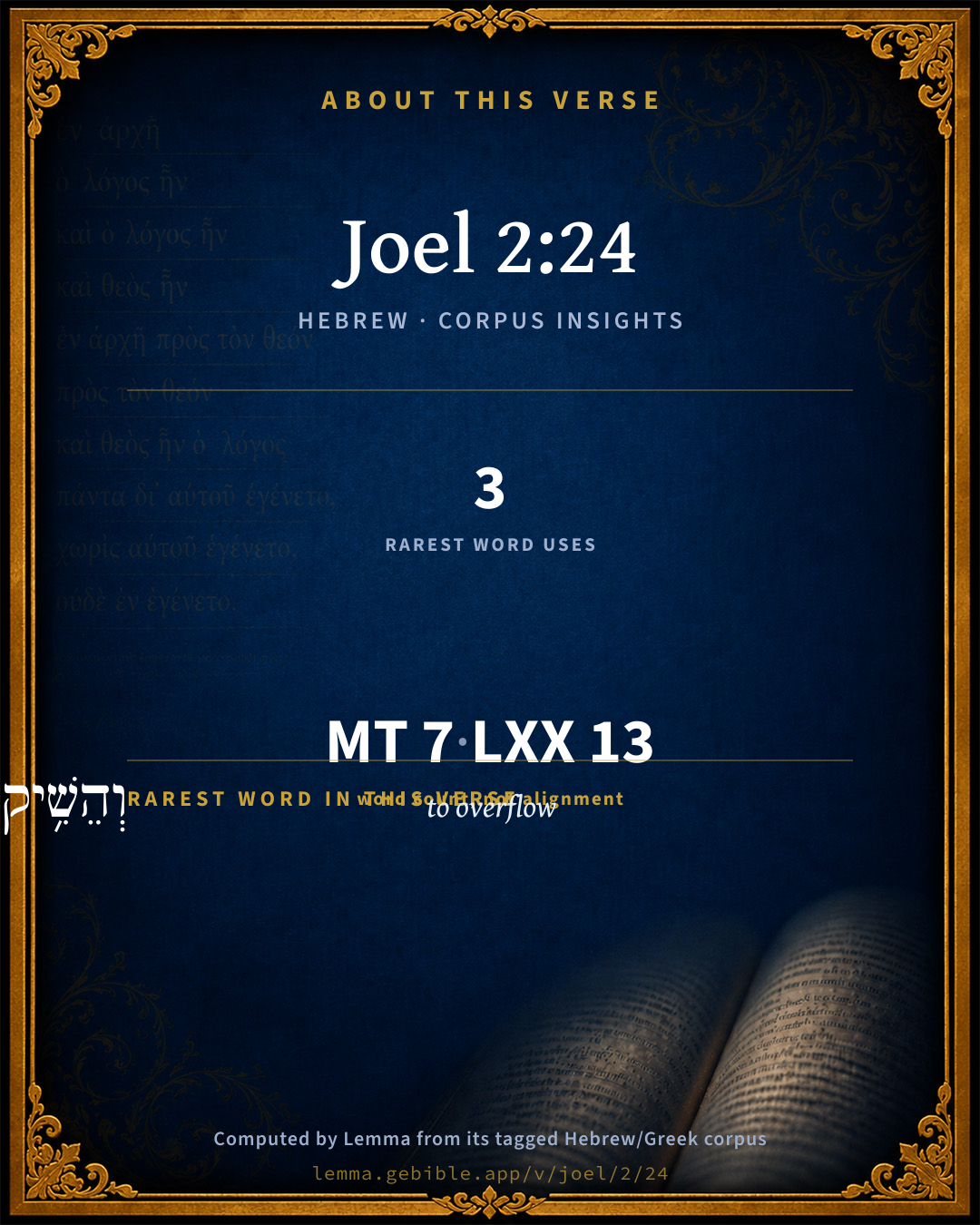
These counts appear in no published source. They are computed here, from the morphology-tagged text and Lemma’s own curated glosses. What Lemma adds →

7
words
7
distinct lemmas
Prophets
section

Notable vocabulary

The rarest word here is וְהֵשִׁ֥יקוּ to overflow H7783 — appearing just 3 times in the whole Hebrew Bible.

Shared distinctive vocabulary

וְהֵשִׁ֥יקוּ to overflow H7783 occurs in 3 verses of the Hebrew Bible. Also found in:

Grammatical profile

  • 2 verbs
  • 5 nouns

Verb forms

  • וּמָלְא֥וּ Qal · Perfect
  • וְהֵשִׁ֥יקוּ Hiphil · Perfect

Hebrew & Septuagint length

In English translation the verse runs 18 words from the Hebrew and 17 from the Septuagint (LXX English) — closely comparable.

A rough comparison of the two English renderings, which tokenize alike — not a word-level alignment.

Word counts can differ between the Hebrew and the Greek without any difference in meaning — e.g. the Hebrew direct-object marker אֵת has no separate Greek word, and Greek often adds the article ὁ.

In the original languages it is 7 Hebrew tokens and 13 Greek tokens — but the two are counted differently (Hebrew bundles its prefixes and suffixes into one token; the Greek is in lemma form), so that isn’t a like-for-like length.

Cross-references

6

Topical passages linked to Joel 2:24 in the Treasury of Scripture Knowledge — connected by theme and wording, ordered by reader-vote popularity; previews shown in the World English Bible.

  • Amos 9:13 "Behold, the days come," says Yahweh, "That the plowman shall overtake the reaper, And the one treading grapes him who sows seed; And sweet wine will drip from the mountains, And flow from the hills.
  • Malachi 3:10 Bring the whole tithe into the store-house, that there may be food in my house, and test me now in this," says Yahweh of hosts, "if I will not open you the windows of heaven, and pour you out a blessing, that there shall not be room enough for.
  • Joel 3:18 It will happen in that day, That the mountains will drop down sweet wine, The hills will flow with milk, All the brooks of Judah will flow with waters; And a fountain will come forth from the house of Yahweh, And will water the valley of Shittim.
  • Proverbs 3:9–10 Honor Yahweh with your substance, With the first fruits of all your increase:
  • Joel 3:13 Put in the sickle; For the harvest is ripe. Come, tread, for the winepress is full, The vats overflow, for their wickedness is great."
  • Leviticus 26:10 You shall eat old store long kept, and you shall move out the old because of the new.

Cross-references courtesy of OpenBible.info (CC BY 4.0).

Hebrew and Greek witnesses Masoretic Hebrew ↔ Greek Septuagint

The same verse in the two great witnesses to the Old Testament, shown verse-for-verse.

These are two independent witnesses, not word-aligned to each other, and the Septuagint is shown in lemma (dictionary) form.

Hebrew Joel 2:24 Masoretic · Westminster Leningrad Codex

וּמָלְא֥וּ הַגֳּרָנ֖וֹת בָּ֑ר וְהֵשִׁ֥יקוּ הַיְקָבִ֖ים תִּיר֥וֹשׁ וְיִצְהָֽר

The threshing floors will be full of wheat, And the vats will overflow with new wine and oil.

World English Bible · Public Domain

Greek LXX Joel 2:24 Septuagint · lemma form

καί πίμπλημι ὁ ἅλων σῖτος καί ὑπερ ἐκχέω ὁ ληνός οἶνος καί ἔλαιον

And the floors shall be filled with corn, and the presses shall overflow with wine and oil.

LXX2012 (modern English Septuagint) · Public Domain

Hebrew: Westminster Leningrad Codex (CC BY 4.0). Greek: Septuagint (public domain); English from LXX2012 (modern English Septuagint) (Public Domain). How the Septuagint differs from the Hebrew →

Targum (Aramaic paraphrase)

1

The Targum is the ancient Jewish Aramaic paraphrase of the Hebrew Scriptures — an interpretive translation, not the Hebrew text itself. Onkelos (literal) and Pseudo-Jonathan (expansive) render the Torah, and Jonathan the Prophets. Coverage is partial: where no permissively-licensed English translation exists for a verse, only the Aramaic is shown. This is verse-level text, not a word-by-word alignment to the Hebrew.

  1. Targum Jonathan Prophets (Joshua–Malachi)
    וְיִתְמְלוּן אִדְרַיָא עִבּוּרָא וִיטוּפוּן נַעֲוַיָא חַמְרָא וּבֵירַיָא מִשְׁרָא:

    (no public-domain English translation for this verse)

    Targum Jonathan — Aramaic: “Mikraot Gedolot” (public domain). English: “Sefaria Community Translation” (CC0 1.0 (public-domain dedication)); “London "Chaldee Paraphrase," 1871” (public domain). Text via Sefaria.

Commentary

Notes on Joel 2:24 from classic Christian and Jewish commentators (each source and its license shown beneath its notes). The classic Christian expositions comment on the surrounding passage and are grouped to its opening verse, so a note may address several verses; the Jewish commentaries on the Tanakh (Rashi and others) are per-verse, so they appear only where the commentator wrote on this verse.

Lemma curates 59 commentaries, every one of them public domain or Creative Commons licensed, each selected and text-cleaned for this edition rather than reprinted as found. About our sources →

Trapp's Complete Commentary

John Trapp

Joe 2:24 And the floors shall be full of wheat, and the fats shall overflow with wine and oil.

Ver. 24. And the floors shall be full of wheat] Such fatness shall God’s footsteps drop, that your houses shall be full of all "precious and pleasant riches," Pro 24:4; so that you shall, as rich men love to do, de pleno tollere acervo. Only take heed you have not, as that rich fool, animam triticeam, a wheaten soul, that your abundance get not within you, Tα ενοντα, as the Pharisees’ did, Luk 11:41 (so that they did not more possess than were possessed of what they had), that ye set not your hearts upon your riches, Psa 62:11.

- “ difficile est opibus non tradere mentem. ”

(Martial.)

And the fats shall overflow] There shall be plenty of all things, as Pro 3:10, the fruits and effect of that rain promised before. And doth not God daily turn water into wine, when of water falling upon the vine, and concocted by the heat of the sun, he produceth the grape, whence wine is pressed?

John Trapp, A Commentary or Exposition upon All the Books of the Old and New Testament (1647–1656) — public domain. Text from a community e-Sword module.

Keil & Delitzsch

C. F. Keil & F. Delitzsch

Effects of the rain. Joe 2:24. "And the barns become full of corn, and the vats flow over with new wine and oil. Joe 2:25. And I repay to you the years which the locust has eaten, the licker, and the devourer, and the gnawer, my great army which I sent among you. Joe 2:26. And ye will eat, eat and be satisfied, and praise the name of Jehovah your God, who hath done wondrously with you; and my people shall not be put to shame to all eternity. Joe 2:27. And ye will know that I am in the midst of Israel, and I (am) Jehovah your God, and none else, and my people shall not be put to shame to all eternity." Joe 2:24 is practically the same as Joe 2:19, and the counterpart to Joe 1:10-12. השׁיק from שׁוּק, to run, hiphil only here and Joe 3:13, to run over, to overflow; pilel, Psa 65:10, shōqēq, to cause to overflow. יקבים, the vats of the wine-presses, into which the wine flows when trodden out; here it also applies to the vats of the oil-presses, into which the oil ran as it was pressed out. Through these bountiful harvests God would repay to the people the years, i.e., the produce of the years, which the locusts ate. The plural, shânı̄m, furnishes no certain proof that Joel referred in ch. 1 to swarms of locusts of several successive years; but is used either with indefinite generality, as in Gen 21:7, or with a distinct significance, viz., as a poetical expression denoting the greatness and violence of the devastation. On the different names of the locusts, see at Joe 1:4. It is to be observed here that the copula stands before the last two names, but not before yeleq, so that the last three names belong to one another as co-ordinates (Hitzig), i.e., they are merely different epithets used for 'arbeh, the locusts.

Keil & Delitzsch — Biblical Commentary on the Old Testament (1861–1891) — public domain (CC PDM 1.0). Text via the HelloAO Bible API. (Old Testament only.)

Jamieson, Fausset & Brown

Robert Jamieson, A. R. Fausset & David Brown

The effect of the seasonable rains shall be abundance of all articles of food.

Jamieson, Fausset & Brown — Commentary Critical and Explanatory on the Whole Bible (1871) — public domain (CC PDM 1.0). Text via the HelloAO Bible API.

John Calvin's Commentaries

He goes on with the same subject in this verse, and shows the effects of rain; for when the earth is irrigated and satiated with sufficient moisture, it brings forth fruit, rich and plentiful. God then will cause that the rains shall not be useless, for the floors shall be full of wheat, and the fats shall overflow with wine as well as oil. He afterwards adds —

John Calvin's Commentaries (1540-1563) — public domain. Text from the Calvin Translation Society English edition (1840s-50s) via the Christian Classics Ethereal Library (ccel.org). Calvin's coverage is partial (roughly two-thirds of the Bible); uncommented books and verses are honest gaps, never fabricated. The 19th-century editor's footnotes and remarks are omitted so the notes are faithfully Calvin's own voice.

The Cambridge Bible for Schools and Colleges

gen. ed. J. J. S. Perowne

24. The reversal of Joe_1:10-12.

the floors] i.e. the threshing-floors—which, however, were not like our threshing-floors: see the description in the footnote on p. 227.

fats] i.e. (as we should say) vats, fat being an old form of vat, A.S. fœt, Germ. Fass: so constantly in A.V., as Joe_3:13; Hag_2:16. Both the gath, in which the grapes were trodden (Neh_13:15; Isa_63:2, where winefat is wrong), and the yeḳeb (lit. a place hollowed out), in which the expressed juice was received (cf. on Amo_9:13), were commonly excavated in the rock (cf. Isa_5:2, “and also hewed out in it a yeḳeb,” or winefat [R.V. marg.]): and remains of those dug in ancient times are still to be seen in Palestine. Robinson (B.R[44] 3:137) describes one: on the upper side of a ledge of rock, a shallow vat had been dug out, 8 feet square, and 15 inches deep; two feet below there was another smaller vat, 4 feet square and 3 feet deep; the grapes were trodden in the shallow upper vat, and the hole by which the juice was drawn off into the lower vat still remained. Cf. ib. p. 381 (a similar arrangement in use in 1852). Sometimes there were two such lower receptacles, communicating with each other, attached to the gath; and Schick (Z.D.P.V[45] 10:1887, p. 146 f.) describes one with three: the must, in such cases, would be transferred from one to the other in order gradually to clarify.

[44] .R. … Edw. Robinson, Biblical Researches in Palestine (ed. 2, 1856).

[45] .D.P.V. … Zeitschrift des Deutschen Palästina-Vereins.

overflow] Joe_3:13. Comp. Pro_3:10, “and thy vats shall burst with must (or new wine).”

wine and oil] new wine (or must) and fresh oil (as Joe_1:10). Olives are now usually crushed by a large circular stone revolving in a kind of mortar; but formerly (see Mic_6:15; and cf. the name Gethsemane, “oil-press”) they were trodden by the feet of men, like grapes.

The Cambridge Bible for Schools and Colleges (gen. ed. J. J. S. Perowne; Cambridge University Press, 1878–1918) — public domain. Text from a community e-Sword module.

John Gill's Exposition

And the floors shall be full of wheat,.... The churches of Christ, which will now be in Judea, and in the Gentile world, which are his "floors", Mat 3:12; and which will be set up everywhere through the preaching of the Gospel, the descent of the former and latter rain; these will be full of precious souls gathered in, compared to wheat, and of the choice and excellent, doctrines of the Gospel, and of all spiritual provisions, Mat 13:30;

and the fats shall overflow with wine and oil; with the wine of Gospel doctrine, and the oil of true grace; there shall be a flow, an overflow, a redundancy of these, both in the ministers of the word and private Christians, in whom the grace of God shall abound and superabound; see Rom 5:20.

John Gill's Exposition of the Whole Bible (1746–1763) — public domain (CC PDM 1.0). Text via the HelloAO Bible API.

Haydock's Catholic Bible Commentary

Presses, or subterraneous reservoirs.

George Leo Haydock (1774–1849), Haydock's Catholic Family Bible and Commentary, 1859 edition — public domain. Excludes Psalms (Douay-Rheims chapter numbering differs from Protestant) and Deuterocanonical books (Catholic canon only).

Matthew Poole's English Annotations

The floors, where they thrashed their corn, shall be full of wheat, the best and most useful grain, the bread corn for man’s life and support.

The fats, the vessels into which the liquor ran out of the press,

shall overflow with wine and oil; there shall be of the grape and olive enough to fill the vessels, nay, to make them run over, though the care of good husbands will save it; for what was said, Joe 2:22, is here fulfilled, the vine doth yield its strength.

Matthew Poole's English Annotations on the Holy Bible (1683–1685) — public domain. Text from a community e-Sword/MySword module.

Whedon's Commentary on the Bible

Daniel D. Whedon

24-27. The heavens are open once more, the drought will come to an end, the locusts will disappear, the harvest and vintage will be plentiful, so that the presence of Jehovah will indeed be realized. 24. A repetition by the prophet of the thought expressed by Jehovah in Joe_2:19. The conditions described in Joe_1:10-12, are to be reversed; corn, wine, and oil will be plentiful.

Floors — Threshing floors, where corn is threshed out and heaped up (Thomson, 2:314-316).

Fats — Modern form, vats. Not the wine presses, but the receptacles into which the wine flows from the presses, usually excavated in the natural rock (Isa_5:2), a little lower than the presses (Van Lennep, 117ff.); applied here also to the receptacles for the oil. The vintage will be so plentiful that the vats will overflow (Pro_3:10).

Daniel D. Whedon (gen. ed.), Commentary on the Old and New Testaments (1874–1909) — public domain. Text from a community e-Sword module.

The Pulpit Commentary

Vers. 24-27. In these verses the prophet pictures the blessed effects of the abundant rain on the parched and barren land. Ver. 2 presents a contrast to vers. 10-12 of ch. 1; while the promise of corn and wine and oil in ver. 19, with which the present is closely connected, is performed. The perfects exhibit the Divine promise as actually accomplished.

(1) The word rB, from rrB, to separate, denotes the pure grain separated from the husk or chaff and straw.

(2) qWv is" to run," and in Hiph.," to cause to run" as of fluids, then overflow; and Pilel in Psa_65:10, shoqeq, "to cause to overflow.

(3) bqy, equivalent to bqn, is a vessel bored or hewn out, then the vat into which the wine trodden out in the wine-press, or the oil trodden out in the oil-press, flows; while jg is the press in which wine or oil, especially the former, is trodden out. I will restore to you the years.

(1) the greatness and violence of the destruction made by the locusts, or

(2) it implies that, only for the timely interposition of Jehovah in destroying the locusts, the people would have had to sustain the loss of the harvest, not of one year only, but of several in other words, the disastrous effects of their ravages would have been felt for a number of years; but

(3) not that the locusts invaded the land several successive yours. The absence of the copula before yeleq, and its presence before the last two names, viz. ehasil aud gazam, prove that these three names, being thus coordinated, are either epithets or species of arbeh: thus, the losses of the years which the locust, or multitudinous one, hath eaten the licker and the devourer and the biter (or gnawer) were compensated. Abarbauel maintains these names of the locusts to refer to the four world-powers that one after another desolated Palestine: "For they," he says, "were the army of Jehovah and the messengers of his providence to punish Israel by their means." The effect of the plentiful supply of their wants and of the full satisfaction enjoyed thereby becomes the occasion of devout acknowledgment of God as their Protector and Patron, and of the warmest expressions of gratitude for his goodness, so they praise the Name of the Lord their God, that had dealt wondrously with them; literally, had acted towards them even to the doing of wonders. Then follows the practical conclusion, very poetically expressed, and comprising the assurance of the presence of God among his people, his sole Divinity and sure protection of them, a guarantee of his grace to them at all times, freedom from reproach and shame evermore. Thus closes the promise of temporal or material bless-tugs. "Ye shall recognize," says Kimchi, that I am in your midst, hearing your cries."

The Pulpit Commentary (1880–1919), ed. H.D.M. Spence-Jones & Joseph S. Exell — public domain. Text from a community e-Sword module.

John Wesley's Explanatory Notes

The fats - The vessels into which the liquor ran out of the press.

John Wesley, Explanatory Notes Upon the Whole Bible (1754–1765) — public domain. Text via the GEBible commentary corpus.

unfoldingWord translationNotes

Door43 World Missions Community

Connecting Statement:

Yahweh begins a long speech to the Israelites.

vats

large containers for liquids

the years of crops that the swarming locust has eaten

"the crops that you took care of for years and that the swarming locusts have eaten"

swarming locust ... the great locust, the devouring locust, and the destroying locust

These are, respectively, an adult locust that can fly, a locust too large to fly easily, a locust with wings too young to fly, and a newborn locust that has not yet developed wings. Use names that would be understood in your language. See how you translated this in Joel 1:4.

translationWords

thresh

wheat

wine

oil

restore

unfoldingWord translationNotes — © Distant Shores Media and the Door43 World Missions Community, licensed CC BY-SA 4.0. Source: git.door43.org/Door43/en_tn.

Rashi

Rabbi Shlomo Yitzchaki (Rashi)

shall roar Heb. וְהֵשִׁיקוּ, an expression of making noise when the stream runs down from the winepress into the vat (הַיֶקֶב), which is the pit before the winepress

Rashi on the Tanakh — English translations: “The Judaica Press complete Tanach with Rashi, translated by A. J. Rosenberg” (CC BY 4.0); “Pentateuch with Rashi's commentary by M. Rosenbaum and A.M. Silbermann, 1929-1934” (public domain); “The Metsudah Tanach series, Lakewood, N.J” (CC BY 4.0); and “The Book of Joshua, Metsudah Publications, 1997” (CC BY 4.0). Text via Sefaria.

Lesson kit

Teaching starters — assembled from the data on this page, not authored interpretation. Every prompt links to the verse data it draws on. Edit before teaching.

Joel, in the Prophets, opens this verse with 7 words (7 distinct Hebrew lemmas). Its most distinctive word is shûwq (“to overflow”). A historical commentator’s framing appears above. Read the whole chapter for the surrounding context.

Discussion questions

  1. The word shûwq carries the sense “to overflow.” How does it shape the verse?
  2. Psalms 65:9 shares the word «to overflow» with this verse. How do the two illuminate each other?
  3. These translations render this verse differently. What is at stake in choosing one wording over another?
  4. The verb «וּמָלְא֥וּ» is Qal Perfect. How does its form color the action?
  5. Reading how Trapp's Complete Commentary and Keil & Delitzsch read this verse, where do the two commentators agree and where do they part?

Things to notice

Reading settings

Reading text

Shown beneath each verse's original-language words.

Old Testament
Old Testament edition

Read the OT as the Masoretic Hebrew (MT) or the Greek Septuagint (LXX).

English shown for the Greek Septuagint (in the Hebrew ↔ Greek comparison).

Comparing translations? Open the Compare panel on any verse page to stack up to four side by side.