
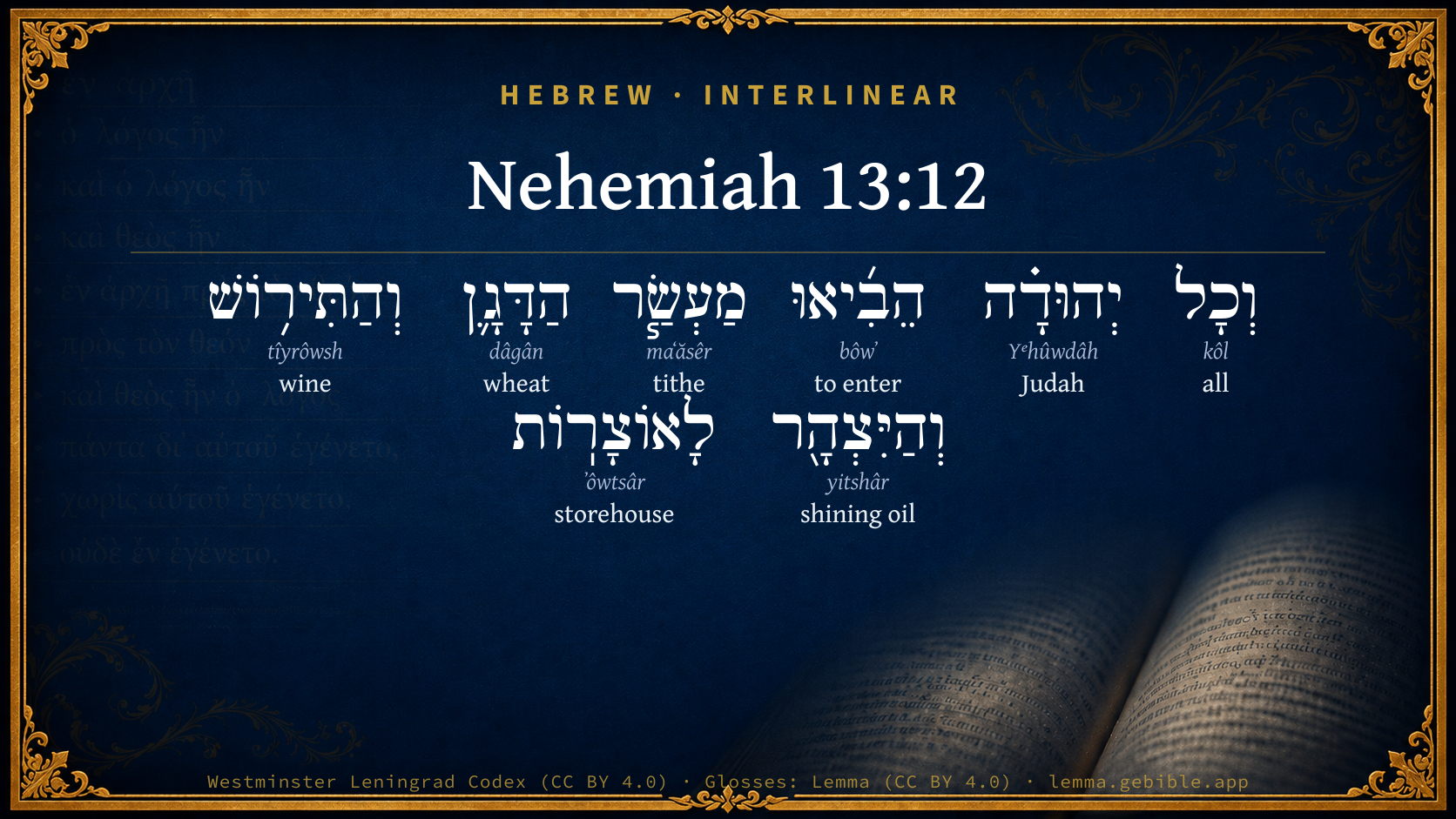
Nehemiah 13:12

Hebrew (Westminster Leningrad Codex) Nehemiah 13:12 appears in the Hebrew Old Testament. The text above is from the Westminster Leningrad Codex. Each word links to its Strong’s number, a concise gloss, and parsing drawn from the Open Scriptures Hebrew Bible morphology. Click any word for its full Brown-Driver-Briggs (BDB) entry.
Download image
Cite this verse

Nehemiah 13:12 (World English Bible). Public Domain. Lemma interlinear Bible study tool, https://lemma.gebible.app/v/nehemiah/13/12.

Show BibTeX & RIS
BibTeX
RIS
English Translation
Then brought all Judah the tithe of the grain and the new wine and the oil to the treasuries.
World English Bible · Public Domain
Download a study sheet

One document with this verse’s original text, its word-by-word gloss line, the meaning frame, cross-references with their text, attributed commentary, and full source and license credits — printable, and it pastes into notes with its structure intact.

This verse Autodidact and up

Study sheet (.html) Plain text (.txt)

A passage Seminary Student

Up to 50 verses in one chapter. A passage sheet keeps up to 6 commentary sources and 12 cross-references per verse, in the order this page ranks them, and says so on the sheet whenever that leaves anything out. Ask for a single verse and you get the Autodidact verse sheet above.

Everything on this page stays free to read, with no account — the sheet is a download of what is already on screen, not access to it.

Want to remove ads? Support Godless Engineer
Compare translations 3

The same verse in 3 English versions, stacked beneath the original-language interlinear above. Click any original word for its lexicon entry.

Each is an independent rendering of the whole verse — the interlinear is not word-aligned to these translations.

Highlighted words mark where these versions differ — a whole-verse word diff, not a word-by-word alignment.

  • World English Bible Public Domain
    Then brought all Judah the tithe of the grain and the new wine and the oil to the treasuries.
  • King James Version Public Domain
    Then brought all Judah the tithe of the corn and the new wine and the oil unto the treasuries.
  • unfoldingWord Literal Text CC BY-SA 4.0
    And all Judah brought the tithe of the grain, and the wine, and the oil to the treasuries.

unfoldingWord Literal Text — © unfoldingWord, licensed CC BY-SA 4.0. Word-aligned USFM3 via Door43 (git.door43.org/unfoldingWord/en_ult).

Versions to compare (up to 4)

3 of 4 selected

Show all 18 translations

Every available English version of this verse, each an independent rendering of the whole verse.

  • World English Bible Public Domain
    Then brought all Judah the tithe of the grain and the new wine and the oil to the treasuries.
  • Berean Standard Bible Public Domain
    and all Judah brought a tenth of the grain, new wine, and oil into the storerooms.
  • Majority Standard Bible Public Domain
    and all Judah brought a tenth of the grain, new wine, and oil into the storerooms.
  • King James Version Public Domain
    Then brought all Judah the tithe of the corn and the new wine and the oil unto the treasuries.
  • American Standard Version (1901) Public Domain
    Then brought all Judah the tithe of the grain and the new wine and the oil unto the treasuries.
  • Revised Version (1885) Public Domain
    Then brought all Judah the tithe of the corn and the wine and the oil unto the treasuries.
  • Geneva Bible (1599) Public Domain
    Then brought all Iudah the tithes of corne and of wine, and of oyle vnto the treasures.
  • Douay-Rheims (1899) Public Domain
    And all Juda brought the tithe of the corn, and the wine, and the oil into the storehouses.
  • Young's Literal Translation Public Domain
    and all Judah have brought in the tithe of the corn, and of the new wine, and of the oil, to the treasuries.
  • Literal Standard Version CC BY-SA 4.0
    and all Judah has brought in the tithe of the grain, and of the new wine, and of the oil, to the treasuries.
  • Unlocked Literal Bible CC BY-SA 4.0
    Then all Judah brought in the tithe of the grain, the new wine, and the oil to the storerooms.
  • unfoldingWord Literal Text CC BY-SA 4.0
    And all Judah brought the tithe of the grain, and the wine, and the oil to the treasuries.
  • Darby Bible Public Domain
    And all Judah brought the tithe of the corn and the new wine and the oil into the storehouses.
  • World Messianic Bible Public Domain
    Then all Judah brought the tithe of the grain, the new wine, and the oil to the treasuries.
  • Webster's Bible Public Domain
    Then all Judah brought the tithe of the corn and the new wine and the oil to the treasuries.
  • Free Bible Version CC BY-SA 4.0
    Everyone in Judah then brought the tithes of grain, new wine, and olive oil into the storerooms.
  • Bible in Basic English Public Domain
    Then all Judah came with the tenth part of the grain and wine and oil and put it into the store-houses.
  • JPS Tanakh (1917) Public Domain
    Then brought all Judah the tithe of the corn and the wine and the oil unto the treasuries.

Literal Standard Version (2020), Covenant Press — licensed CC BY-SA 4.0. Text via the HelloAO Bible API (eBible.org). Unlocked Literal Bible (unfoldingWord) — licensed CC BY-SA 4.0. Text via the HelloAO Bible API (eBible.org). unfoldingWord Literal Text — © unfoldingWord, licensed CC BY-SA 4.0. Word-aligned USFM3 via Door43 (git.door43.org/unfoldingWord/en_ult). Free Bible Version, Dr. Jonathan Gallagher — licensed CC BY-SA 4.0. Text via the HelloAO Bible API (eBible.org).

Word by word

More ways to search: Search by grammar → Find every occurrence → Compare this word →

Practice this passage: Drill this verse → Learn its vocabulary →

וְהַיִּצְהָ֖ר
yitshâr
H3323
“and · the · shining oil”
Conjunction + Particle, Definite Article + Noun, Common, Masculine, Singular, Absolute
Part of Speech
Conjunction + Particle + Noun
Type
Common
Gender
Masculine
Number
Singular
State
Absolute
Full BDB Definition

Origin: from H6671

TWOT: 1883c

fresh oil, shining (pure) oil
  1. וְכָל kôl H3605 “and · all of” Conjunction + Noun, Common, Masculine, Singular, Construct
  2. יְהוּדָ֗ה Yᵉhûwdâh H3063 “Judah” Noun, Proper
  3. הֵבִ֜יאוּ bôwʼ H935 “to enter” Verb, Hiphil, Perfect, 3rd Person, Common, Plural
  4. מַעְשַׂ֧ר maʻăsêr H4643 “tithe of” Noun, Common, Masculine, Singular, Construct
  5. הַדָּגָ֛ן dâgân H1715 “the · wheat” Particle, Definite Article + Noun, Common, Masculine, Singular, Absolute
  6. וְהַתִּיר֥וֹשׁ tîyrôwsh H8492 “and · the · wine” Conjunction + Particle, Definite Article + Noun, Common, Masculine, Singular, Absolute
  7. לָאוֹצָרֽוֹת ʼôwtsâr H214 “to/for the · storehouses” Preposition, Determined + Noun, Common, Masculine, Plural, Absolute

About this verse

These counts appear in no published source. They are computed here, from the morphology-tagged text and Lemma’s own curated glosses. What Lemma adds →

8
words
8
distinct lemmas
Historical
section

Notable vocabulary

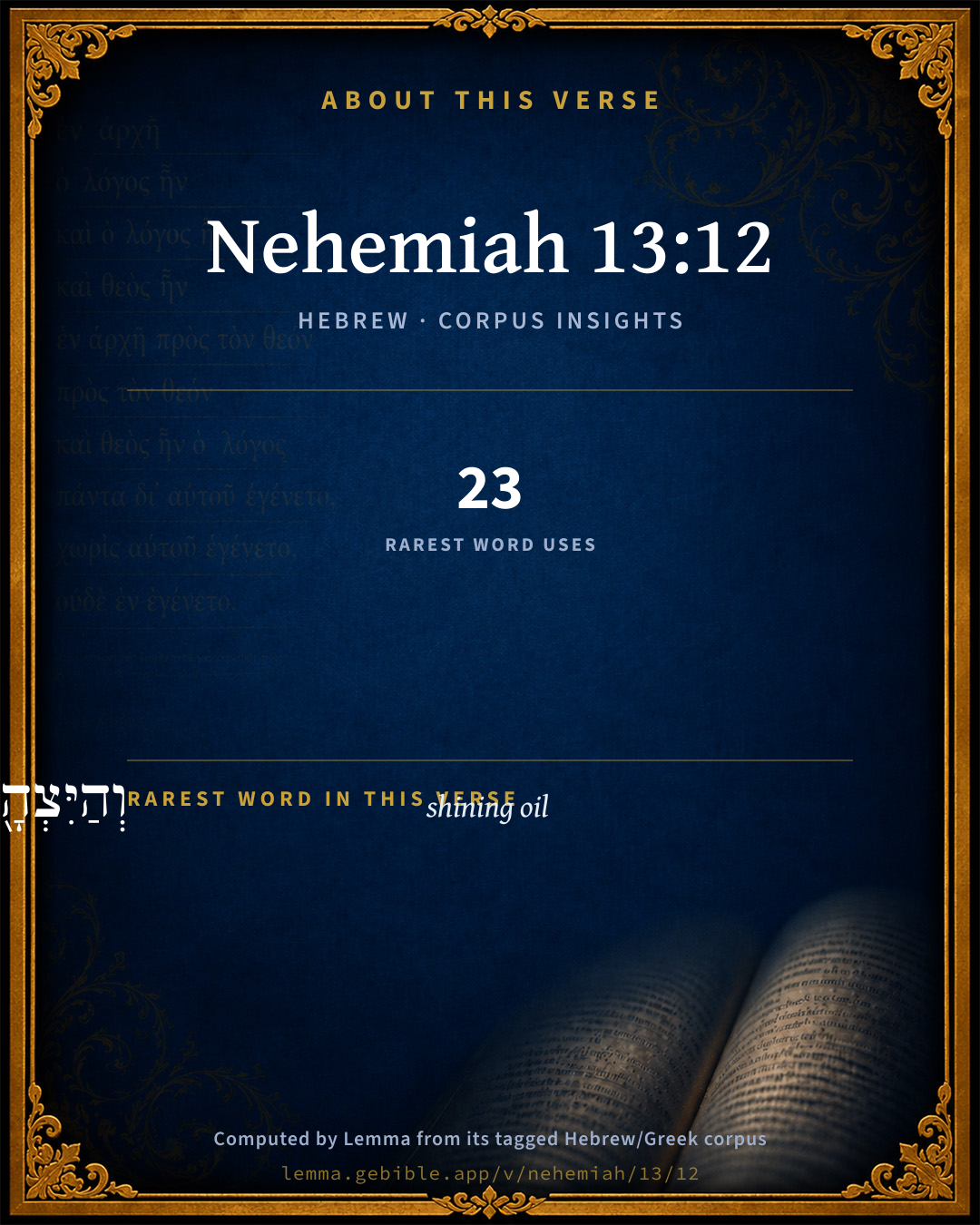
The rarest word here is וְהַיִּצְהָ֖ר shining oil H3323 — appearing just 23 times in the whole Hebrew Bible.

Shared distinctive vocabulary

וְהַיִּצְהָ֖ר shining oil H3323 occurs in 23 verses of the Hebrew Bible. Also found in:

Grammatical profile

  • 1 verb
  • 7 nouns

Verb forms

  • הֵבִ֜יאוּ Hiphil · Perfect

Cross-references

6

Topical passages linked to Nehemiah 13:12 in the Treasury of Scripture Knowledge — connected by theme and wording, ordered by reader-vote popularity; previews shown in the World English Bible.

  • Nehemiah 10:37–39 and that we should bring the first fruits of our dough, and our heave-offerings, and the fruit of all manner of trees, the new wine and the oil, to the priests, to the chambers of the house of our God; and the tithes of our ground to the Levites; for they, the Levites, take the tithes in all the cities of our tillage.
  • Nehemiah 12:44 On that day were men appointed over the chambers for the treasures, for the heave-offerings, for the first fruits, and for the tithes, to gather into them, according to the fields of the cities, the portions appointed by the law for the priests and Levites: for Judah rejoiced for the priests and for the Levites who waited.
  • Malachi 3:10 Bring the whole tithe into the store-house, that there may be food in my house, and test me now in this," says Yahweh of hosts, "if I will not open you the windows of heaven, and pour you out a blessing, that there shall not be room enough for.
  • Leviticus 27:30 "'All the tithe of the land, whether of the seed of the land or of the fruit of the trees, is Yahweh's. It is holy to Yahweh.
  • Numbers 18:20–26 Yahweh said to Aaron, You shall have no inheritance in their land, neither shall you have any portion among them: I am your portion and your inheritance among the children of Israel.
  • Deuteronomy 14:22 You shall surely tithe all the increase of your seed, that which comes forth from the field year by year.

Cross-references courtesy of OpenBible.info (CC BY 4.0).

Hebrew and Greek witnesses Masoretic Hebrew ↔ Greek Septuagint

The same verse in the two great witnesses to the Old Testament, shown verse-for-verse.

These are two independent witnesses, not word-aligned to each other, and the Septuagint is shown in lemma (dictionary) form.

Hebrew Nehemiah 13:12 Masoretic · Westminster Leningrad Codex

וְכָל יְהוּדָ֗ה הֵבִ֜יאוּ מַעְשַׂ֧ר הַדָּגָ֛ן וְהַתִּיר֥וֹשׁ וְהַיִּצְהָ֖ר לָאוֹצָרֽוֹת

Then brought all Judah the tithe of the grain and the new wine and the oil to the treasuries.

World English Bible · Public Domain

Greek LXX Structure differs

The Septuagint has no separate book of Nehemiah. Its Greek text is the second half of Esdras B (2 Esdras), chapters 11–23; Ezra is the first half (1–10).

A verse-for-verse comparison isn’t shown here because the chapters and verses don’t line up. Switch to the LXX edition with the MT / LXX toggle above to read the Greek directly.

On this verse, The Cambridge Bible for Schools and Colleges discusses the Septuagint’s reading. Read the note in Commentary ↓

Hebrew: Westminster Leningrad Codex (CC BY 4.0). Greek: Septuagint (public domain); English from a public-domain English Septuagint. How the Septuagint differs from the Hebrew →

Commentary

Notes on Nehemiah 13:12 from classic Christian and Jewish commentators (each source and its license shown beneath its notes). The classic Christian expositions comment on the surrounding passage and are grouped to its opening verse, so a note may address several verses; the Jewish commentaries on the Tanakh (Rashi and others) are per-verse, so they appear only where the commentator wrote on this verse.

Lemma curates 59 commentaries, every one of them public domain or Creative Commons licensed, each selected and text-cleaned for this edition rather than reprinted as found. About our sources →

Trapp's Complete Commentary

John Trapp

Neh 13:12 Then brought all Judah the tithe of the corn and the new wine and the oil unto the treasuries.

Ver. 12. Then brought all Judah] Then, when there was no other remedy. There must be a compulsory means, or ministers shall be poorly maintained. Quod si sustentandi essent de contributione populi, misere profecto et duriter viverent, saith Luther. If once they be brought to live upon the people’s benevolence, they shall have a poor life of it. Once, in times of Popery, there was need of a statute of Mortmain, providing that they should give no more to the Church. But now it is otherwise; these last and worst times have seen the springs of bounty, like Jordan, turned back; which heretofore did run so fresh and fast into the Church. Our statesmen have ministers’ maintenance now under debate; and much lifting there is by a levelling party (not without a Jesuit to help them) at tithes and college lands. The Lord direct our rulers; and preserve us out of the hands of those hateful harpies. {A fabulous monster, rapacious and filthy, having a woman’s face and body and a bird’s wings and claws, and supposed to act as a minister of divine vengeance.} (This was written July 30, A. D. 1653.)

John Trapp, A Commentary or Exposition upon All the Books of the Old and New Testament (1647–1656) — public domain. Text from a community e-Sword module.

Joseph Benson's Commentary

Neh 13:12. Then brought all Judah the tithe, &c. — Out of the respect which they had to Nehemiah, and because they saw these tithes would now be applied to their proper uses. The people (as Conradus Pellicanus here observes) readily obey, if the magistrates and the priests be not remiss in their duty. As soon as the people saw the Levites at their work, they could not, for shame, withhold their wages any longer, but honestly and cheerfully brought them in. “The better church-work is done, the better will church-dues be paid.” — Henry.

Joseph Benson's Commentary on the Old and New Testaments (1811–1818) — public domain. Text from a community e-Sword module.

The Cambridge Bible for Schools and Colleges

gen. ed. J. J. S. Perowne

12. Then brought all Judah] Nehemiah’s expostulation produced an immediate result. For the expression ‘all Judah’ = ‘the whole nation,’ cf. Neh_12:34-44.

the tithe … corn … new wine (R.V. wine) … oil] This is the tithe spoken of in Neh_13:5 and in Neh_10:37, the contribution of which was described in Neh_12:44-47.

unto the treasuries] The same word in the Hebrew as that rendered ‘treasures’ in Neh_12:44; and it might here be rendered ‘for (or, as) treasures,’ i.e. to be stored. But the sense in the English version is preferable, so also LXX. εἰς τοὺς θησαυρούς, Vulg. ‘in horrea:’ and it occurs with the same meaning in Mal_3:10, which aptly illustrates the present passage.

The Cambridge Bible for Schools and Colleges (gen. ed. J. J. S. Perowne; Cambridge University Press, 1878–1918) — public domain. Text from a community e-Sword module.

John Gill's Exposition

Remember me, O my God, concerning this,.... Not in a way of strict justice, as if he thought he merited anything at the hand of God for what he had done; but in a way of grace and mercy, that he would graciously accept thereof, as done for the honour of his name, and overlook all failings and infirmities therein, see Neh 13:22

and wipe not out my good deeds that I have done for the house of my God, and for the offices thereof; for the support of the worship of God in the temple, and for the regulating of the wards and courses in it, both priests and Levites, and for the maintenance of them; which being done from a right principle, love to God, and with a right view, the glory of his name, might be truly reckoned good works: and which he desires might not be wiped or blotted out of the book of his remembrance, see Hos 6:10.

John Gill's Exposition of the Whole Bible (1746–1763) — public domain (CC PDM 1.0). Text via the HelloAO Bible API.

Matthew Poole's English Annotations

Partly out of the respect which they had to Nehemiah, and to his command; and partly because they saw they would be applied to their proper uses, and not abused, as they had been.

Matthew Poole's English Annotations on the Holy Bible (1683–1685) — public domain. Text from a community e-Sword/MySword module.

Whedon's Commentary on the Bible

Daniel D. Whedon

12. Then brought all Judah the tithe — No doubt the words of the prophet Malachi, (Mal_3:10,) as well as those of the governor, were instrumental in bringing about this result. The prophet charged them with robbing God, but at the same time reminded them of Jehovah’s long-suffering and mercy: “Bring ye all the tithes into the storehouse, that there may be meat in mine house, and prove me now herewith, saith the Lord of hosts, if I will not open you the windows of heaven, and pour you out a blessing, that there shall not be room enough to receive it.” Nehemiah’s rebuke was effectual, the prophetic challenge of Malachi was accepted, and a blessed reformation was wrought.

Daniel D. Whedon (gen. ed.), Commentary on the Old and New Testaments (1874–1909) — public domain. Text from a community e-Sword module.

John Wesley's Explanatory Notes

Bought - Out of the respect which they had to Nehemiah, and because they saw they would now be applied to their proper uses.

John Wesley, Explanatory Notes Upon the Whole Bible (1754–1765) — public domain. Text via the GEBible commentary corpus.

unfoldingWord translationNotes

Door43 World Missions Community

all Judah

The name of the land is a metonym for the people of the land. This is probably a generalization. AT: "all the people who lived in Judah" (See: Metonymy and Hyperbole and Generalization)

Shelemiah ... Zadok ... Pedaiah ... Hanan ... Zaccur ... Mattaniah

These are the names of men. (See: How to Translate Names)

they were counted as trustworthy

This can be translated in active form. The abstract noun "trustworthy" can be translated as a verb. AT: "I knew that I could trust them" (See: Active or Passive and Abstract Nouns)

Call me to mind, my God, concerning this

"My God, remember me concerning this"

translationWords

kingdom of Judah

tenth

grain

wine

oil

priest

Zadok

scribe

Levi

son

trust

call

mind

God

good

works

house of God

unfoldingWord translationNotes — © Distant Shores Media and the Door43 World Missions Community, licensed CC BY-SA 4.0. Source: git.door43.org/Door43/en_tn.

Lesson kit

Teaching starters — assembled from the data on this page, not authored interpretation. Every prompt links to the verse data it draws on. Edit before teaching.

Nehemiah, in the Historical, opens this verse with 8 words (8 distinct Hebrew lemmas). Its most distinctive word is yitshâr (“shining oil”). A historical commentator’s framing appears above. Read the whole chapter for the surrounding context.

Discussion questions

  1. How does “shining oil” (yitshâr) shape what this verse is saying?
  2. Numbers 18:12 shares the word «shining oil» with this verse. How do the two illuminate each other?
  3. The translations on this page render this verse differently — a whole-verse word diff, not a word-by-word alignment. What might account for the different wordings?
  4. The verb «הֵבִ֜יאוּ» is Hiphil Perfect. How does its form color the action?
  5. Reading how Trapp's Complete Commentary and Joseph Benson's Commentary read this verse, where do the two commentators agree and where do they part?

Things to notice

Reading settings

Reading text

Shown beneath each verse's original-language words.

Old Testament
Old Testament edition

Read the OT as the Masoretic Hebrew (MT) or the Greek Septuagint (LXX).

English shown for the Greek Septuagint (in the Hebrew ↔ Greek comparison).

Comparing translations? Open the Compare panel on any verse page to stack up to four side by side.