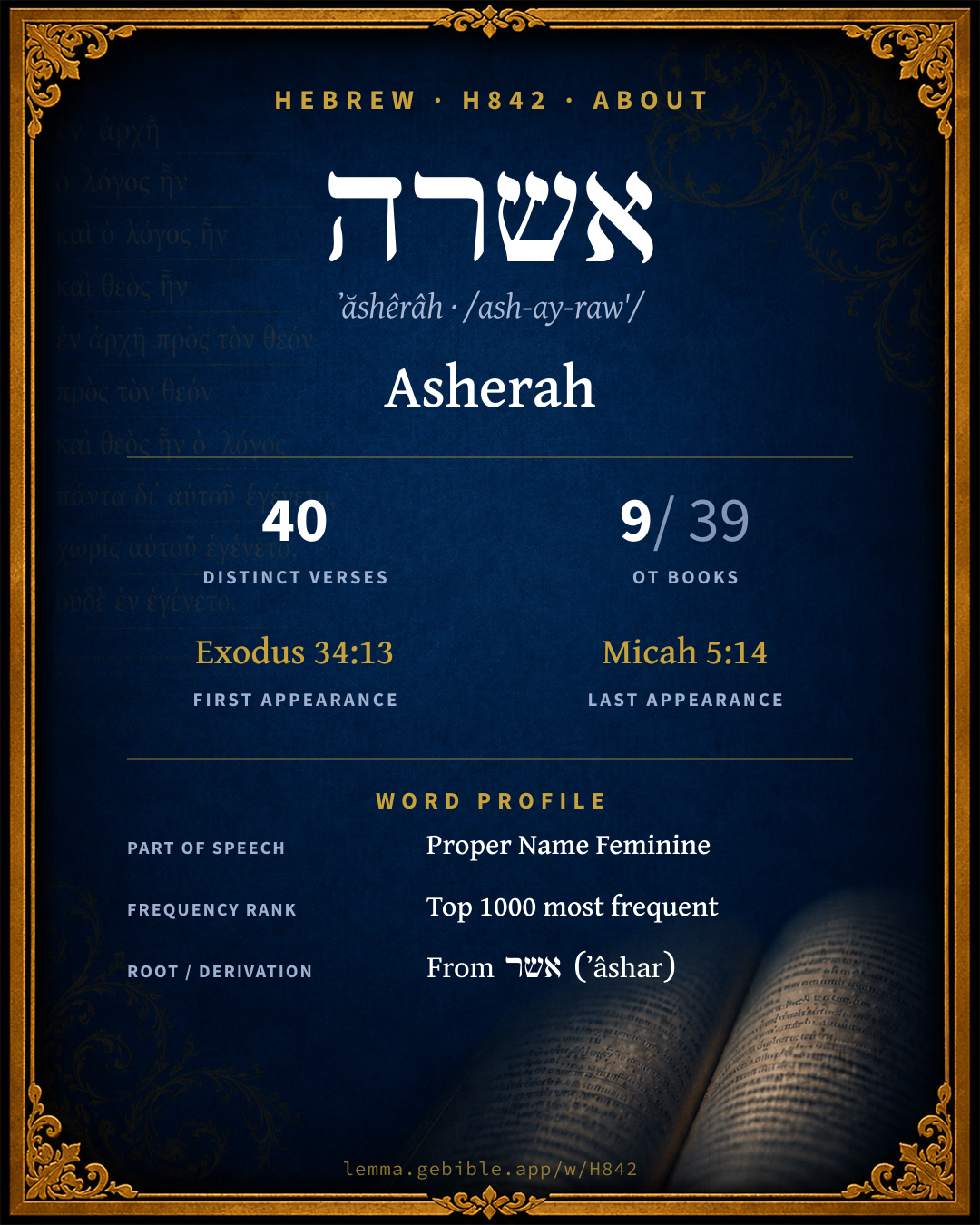
אֲשֵׁרָה
Asherah
BDB lists 2 entries for ‘Asherah’ fuller range ↓
Full lexicon entry — Brown-Driver-Briggs (BDB)
From Brown-Driver-Briggs (BDB)
Where this word appears
Grammar key — what these labels mean
Part of speech
- Noun
- A naming word — a person, place, thing, or idea.
Noun type
- Proper
- A name of a specific person, place, or people (e.g. Abraham, Zion, Israel).
Every verse where H842 appears in the Book of 1 Kings — 5 distinct verses. Click any verse to open its interlinear word-by-word view. Verse text shown in the World English Bible for context — . Each verse’s Hebrew form is shown with its reference; the English is not keyword-highlighted, since the data carries no word-level English alignment. Use “Compare translations” on any verse to read it across multiple English versions. This concordance covers the Hebrew Bible; Septuagint (Greek Old Testament) occurrences are not indexed here.
1 Kings
- 1 Kings 14:15 אֲשֵׁ֣רֵי/הֶ֔ם n Proper + sfx pers 3mp For Yahweh will strike Israel, as a reed is shaken in the water; and he will root up Israel out of this good land which he gave to their fathers, and will scatter them beyond the River, because they have made their Asherim, provoking Yahweh to anger.
- 1 Kings 14:23 וַ/אֲשֵׁרִ֑ים conj + n Proper For they also built them high places, and pillars, and Asherim, on every high hill, and under every green tree;
- 1 Kings 15:13 לָ/אֲשֵׁרָ֑ה prep det + n Proper Also Maacah his mother he removed from being queen, because she had made an abominable image for an Asherah; and Asa cut down her image, and burnt it at the brook Kidron.
- 1 Kings 16:33 הָ/אֲשֵׁרָ֑ה ptcl def.art + n Proper Ahab made the Asherah; and Ahab did yet more to provoke Yahweh, the God of Israel, to anger than all the kings of Israel who were before him.
- 1 Kings 18:19 הָֽ/אֲשֵׁרָה֙ ptcl def.art + n Proper Now therefore send, and gather to me all Israel to Mount Carmel, and the prophets of Baal four hundred fifty, and the prophets of the Asherah four hundred, who eat at Jezebel's table.
About this entry
At a glance — auto-summarized from this page’s data, not written by a person. Every figure links to its source below. This summary describes the numbers; it doesn’t interpret them.
אשרה — transliterated ʼăshêrâh — is a Hebrew name carrying the sense “Asherah.” Debuting at Exodus 34:13, it then recurs through the corpus. Spanning 40 verses in 9 books, it ranks among the moderately common words of the Hebrew Bible. Its uses concentrate in 2 Kings (28% of all occurrences). Each statement above links to its evidence; the full detail follows below.
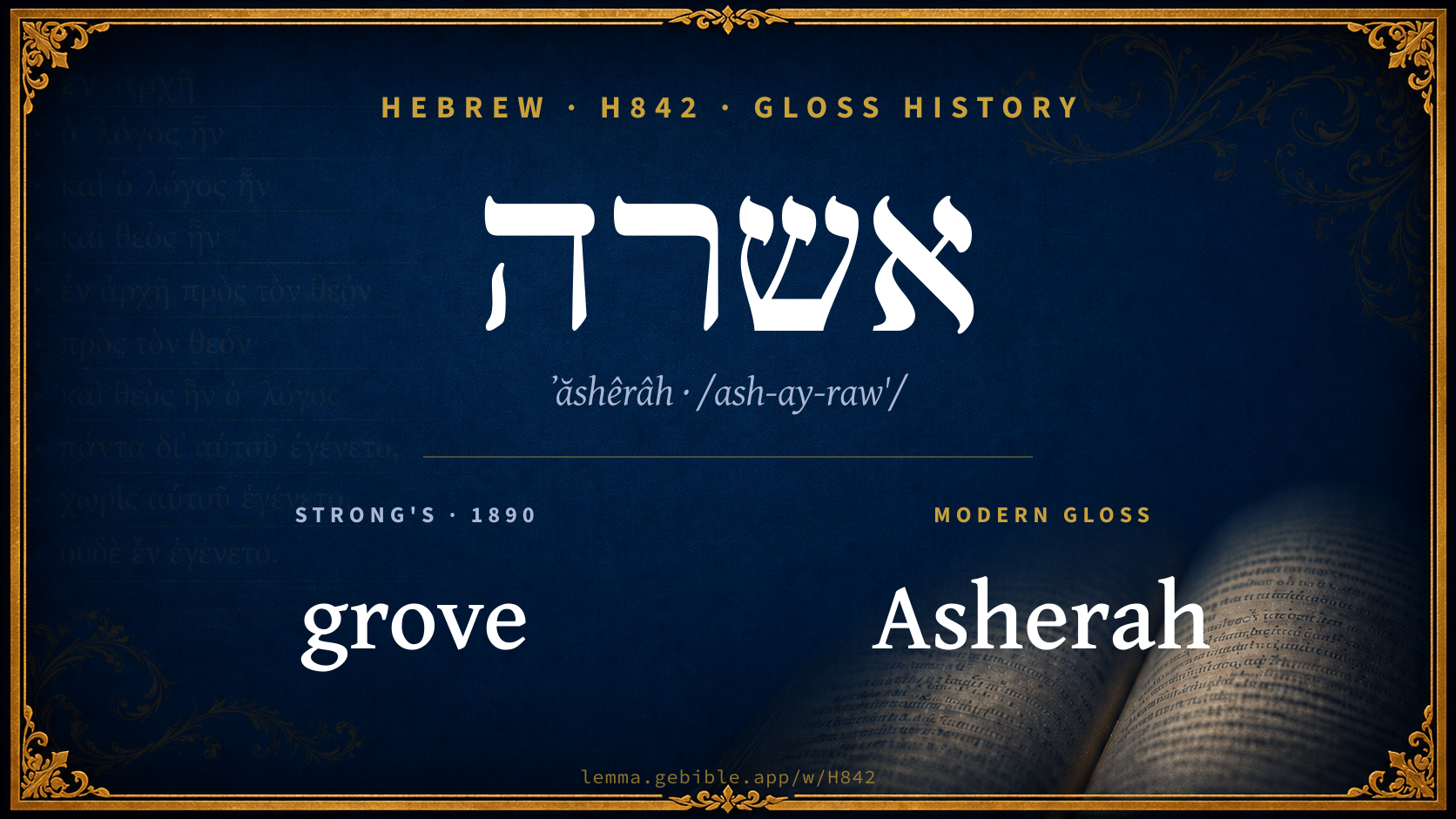
Gloss history
Strong's 1890 vs modern scholarship
About this word
Strong's H842 catalogs a Hebrew word from the Hebrew Old Testament.
These counts are not copied from any lexicon or concordance. They are computed here, from the morphology-tagged Hebrew Old Testament. What Lemma adds →
- 40
- distinct verses
- The word appears in 40 distinct verses.
- 9 / 39
- OT books
- The word appears in 9 of 39 Old Testament books.
- #909
- by frequency
- Top 1000 most frequent Hebrew words (rank 909 of 8,640 Hebrew words by occurrence).
View all 40 occurrences in the concordance →
Most concentrated in
- 2 Kings 11 verses 28%
- 2 Chronicles 11 verses 28%
- Judges 5 verses 13%
By section of the Old Testament
By traditional corpus
Conventional, traditional groupings — biblical authorship is debated, so this is a traditional corpus grouping, not an authorship claim. Each share is this word’s portion of its verses in that division of the Hebrew canon. Each figure is a share of the word’s 40 distinct verses.
- Prophets (Nevi'im) 25 verses · 63%
- Writings (Ketuvim) 11 verses · 28%
- Torah (Pentateuch) 4 verses · 10%
How translations render this word
Counts come from each version’s own published word-to-Strong’s tagging or interlinear alignment — an approximate guide to how each version renders this word, not a word-level alignment the data otherwise carries. Because each total is that version’s own tagged count, the per-version totals vary from one another and need not match the appearance or distinct-verse counts above. These counts may also differ from a printed concordance because Lemma counts each distinctly tagged rendering and does not collapse phrase taggings into a single head-word total. This is a fixed set of word-tagged versions (KJV, ASV, BSB, ULT) and does not change with the reading translation you choose elsewhere. Each version’s license is shown beside its name below (and on Sources).
- King James Version: Groves 24×, Grove 15×
- American Standard Version: Asherim 19×, Asherah 14×, Asheroth 2×
- Berean Standard Bible: Asherah poles 21×, Asherah pole 13×, Asherah 4×
- unfoldingWord Literal Text: Asherah 20×, Asherim 9×, Asherahs 7×
King James Version Public Domain
Renders H842 across 40 tagged occurrences — most commonly:
Plus 1 rendering that appears only once — usually multi-word phrases or single function words the recovered tagging swept in, not distinct renderings.
American Standard Version Public Domain
Renders H842 across 40 tagged occurrences — most commonly:
Plus 5 renderings that appear only once — usually multi-word phrases or single function words the recovered tagging swept in, not distinct renderings.
Berean Standard Bible Public Domain
Renders H842 across 40 tagged occurrences — most commonly:
Plus 2 renderings that appear only once — usually multi-word phrases or single function words the recovered tagging swept in, not distinct renderings.
unfoldingWord Literal Text CC BY-SA 4.0
Renders H842 across 43 tagged occurrences — most commonly:
Plus 1 rendering that appears only once — usually multi-word phrases or single function words the recovered tagging swept in, not distinct renderings.
Senses in the full BDB
What do BDB’s symbols mean?
BDB uses these scholarly abbreviations:
| Symbol | Meaning |
|---|---|
| 𝔊 | the Septuagint (the ancient Greek translation, LXX) |
| 𝔙 | the Vulgate (the Latin translation) |
| 𝔖 | the Syriac version (the Peshitta) |
| 𝔗 | the Targum (the Aramaic translation) |
| ψ | the Psalms |
| √ | root (the underlying root or stem) |
| ‖ | parallel passage (a synonymous or contrasted parallel) |
| † | the dagger: every passage where the word occurs is cited |
The 5 senses and sub-senses the full Brown-Driver-Briggs lexicon distinguishes for this word, in lexicon order (not ranked by frequency), with BDB’s own verbatim wording and sub-sense lettering. Shown in Hebrew script with BDB’s own scholarly abbreviations. The condensed entry is in the Lexicon Entry tab. See also the Forms in the corpus table below.
- a. a Canaanitish goddess of fortune & happiness; having prophets 1 K 18:19, an image 15:13 = 2 Ch 15:16 2 K 21:7, sacred vessels 2 K 23:4, houses v 7. e.g. 1 Kings 18:19
- b. a symbol of this goddess, a sacred tree or pole set up near an altar 1 K 16:33 2 K 13:6; 17:16; 18:4; 21:3; 23:6, 15; prohibited Dt 16:21; burnt by Gideon Ju 6:25, 26, 28, 30. e.g. 1 Kings 16:33
Pl
- אֲשֵׁרוֹת
- a. the goddess Ju 3:7 (prob. error for עַשְׁתָּרֹת 𝔙). e.g. Judges 3:7
- b. sacred trees or poles 2 Ch 19:3; 33:3; elsewhere אֲשֵׁרִים id. Is 27:9 + 12 times; sf. Mi 5:13 + 5 times;—Ex 34:13 (J) Dt 7:5; 12:3 Is 17:8; 27:9 Je 17:2 Mi 5:13 1 K 14:15, 23 2 K 17:10, 23:14 2 Ch 14:2; 17:6; 24:18; 31:1; 33:19; 34:3, 4, 7.—(Cf. also StaZAW 1881, 344 f. RSSem i. 171 f., 175n. WeH 235, who think א׳ only the sacred pole.) e.g. 2 Chronicles 19:3
Senses from the full Brown-Driver-Briggs lexicon (Brown, Driver, Briggs; Oxford 1906 — public domain), digitized via Sefaria, supplemented by the OpenScriptures HebrewLexicon (CC BY 4.0). Full attribution on Sources.
Word origin
2 K 17:16 n.pr.f. Ashera (Assyrian n.pr.f. Aš-ra-tu, c. sign for deity, in Canaanitish n.pr. Abad-Ašratum, servant of A. SchrZA 1888, 363, cf. Wkl & AbelThontafelfund v. El Amarna ii. No. 77, 1. 9, & SayceRP2. ii. 67, iii. 71; on deriv. cf. Assyrian aširat, adj. fem. gracious, COTGloss) see now also GFMEB Asherah Dr Dt 16:21 AllenDB Asherah, all doubtful as to Can. goddess Asherah; question left open by ZimKAT3. 436 ff. (on Sem. goddess Aširtu-Ašratu Id. ib. 432 ff.); but v. JeremAT1 im Licht d. Alten Orients 207 (name of goddess Aširat in letter found at Taanach by Sellin (1902–3) and Id. ib. 37. 237) (Oppenheim’s find at Ras el-’Ain in Mesop., stone shaft with veiled head as top, supposed to identify post with goddess; if 2 K 23:7 refers to draped Asherim [v. on text Benz Bur], this even more plausible), Id. ib. 23, 208 f., 286. On pictorial representations of Asherah-symbol v. WHWardAJSL xix. 1 (Oct. 1902).:—usually with the art.: prob.
— Brown-Driver-Briggs (Oxford 1906, public domain), digitized via Sefaria, supplemented by the OpenScriptures HebrewLexicon (CC BY 4.0). See Sources.
Derived from אשר (ʼâshar) (H833) — to go straight.
Jastrow Dictionary
A second Hebrew/Aramaic lexicon for comparison, covering Aramaic and post-biblical (Talmudic, Targumic, Midrashic) usage that the biblical-Hebrew BDB does not. Matched by lemma rather than by Strong’s number, so a lemma may carry more than one Jastrow headword (shown separately below), and the entries cover usage well beyond the Bible.
אַשָּׁרָה
- , f. legal attestation. Y. Gitt. IX, 50ᶜ bot. אַשָּׁרַת הדיינין; v. אַשַּׁרְתָּא.
אֲשֵׁרָה
- , v. אֲשֵּׁירָה
A Dictionary of the Targumim, the Talmud Babli and Yerushalmi, and the Midrashic Literature (Marcus Jastrow; London, Luzac, 1903) — Public Domain. Digitized via Sefaria. Digitized via Sefaria. Full attribution on Sources.
Forms in the corpus
The 36 distinct written forms H842 takes in the Hebrew Bible, most frequent first — each parse links to that state’s occurrences in the concordance. Hebrew forms include their vowel points and cantillation, so a single lemma takes many written forms.
| Form | Parsing | Example | Uses |
|---|---|---|---|
| הָ/אֲשֵׁרִ֖ים | Noun, Proper | 2 Chronicles 17:6 | 2 |
| הָ/אֲשֵׁרָ֖ה | Noun, Proper | 2 Kings 21:7 | 2 |
| הָ/אֲשֵׁרָ֥ה | Noun, Proper | Judges 6:25 | 2 |
| וַ/אֲשֵׁרִ֑ים | Noun, Proper | 1 Kings 14:23 | 2 |
| אֲשֵׁ֣רֵי/הֶ֔ם | Noun, Proper | 1 Kings 14:15 | 1 |
| אֲשֵׁירֶ֖י/ךָ | Noun, Proper | Micah 5:14 | 1 |
| אֲשֵׁירָ֗ה | Noun, Proper | 2 Kings 17:16 | 1 |
| אֲשֵׁר֔וֹת | Noun, Proper | 2 Chronicles 33:3 | 1 |
| אֲשֵׁרִ֖ים | Noun, Proper | Isaiah 27:9 | 1 |
| אֲשֵׁרָ֖ה | Noun, Proper | Deuteronomy 16:21 | 1 |
| אֲשֵׁרָ֖י/ו | Noun, Proper | Exodus 34:13 | 1 |
| אֲשֵׁרָֽה | Noun, Proper | 2 Kings 23:15 | 1 |
| אֲשֵׁרָה֙ | Noun, Proper | 2 Kings 21:3 | 1 |
| הָ/אֲשֵׁרִ֑ים | Noun, Proper | 2 Kings 23:14 | 1 |
| הָ/אֲשֵׁרִ֡ים | Noun, Proper | 2 Chronicles 31:1 | 1 |
| הָ/אֲשֵׁרִ֣ים | Noun, Proper | 2 Chronicles 33:19 | 1 |
| הָ/אֲשֵׁרִ֤ים | Noun, Proper | 2 Chronicles 34:7 | 1 |
| הָ/אֲשֵׁרִֽים | Noun, Proper | 2 Chronicles 14:3 | 1 |
| הָ/אֲשֵׁרָ֑ה | Noun, Proper | 1 Kings 16:33 | 1 |
| הָ/אֲשֵׁרָ֔ה | Noun, Proper | 2 Kings 13:6 | 1 |
| הָ/אֲשֵׁרָה֩ | Noun, Proper | 2 Kings 23:6 | 1 |
| הָ/אֲשֵׁרֽוֹת | Noun, Proper | Judges 3:7 | 1 |
| הָ/אֲשֵׁרוֹת֙ | Noun, Proper | 2 Chronicles 19:3 | 1 |
| הָֽ/אֲשֵׁרָ֑ה | Noun, Proper | 2 Kings 18:4 | 1 |
| הָֽ/אֲשֵׁרָה֙ | Noun, Proper | 1 Kings 18:19 | 1 |
| וְ/הָ/אֲשֵׁרִ֖ים | Noun, Proper | Isaiah 17:8 | 1 |
| וְ/הָ/אֲשֵׁרָ֥ה | Noun, Proper | Judges 6:28 | 1 |
| וְ/הָ֣/אֲשֵׁרִ֔ים | Noun, Proper | 2 Chronicles 34:3 | 1 |
| וְ/לָֽ/אֲשֵׁרָ֔ה | Noun, Proper | 2 Kings 23:4 | 1 |
| וְ֠/הָ/אֲשֵׁרִים | Noun, Proper | 2 Chronicles 34:4 | 1 |
| וַ/אֲשֵֽׁירֵ/הֶם֙ | Noun, Proper | Deuteronomy 7:5 | 1 |
| וַ/אֲשֵֽׁרֵי/הֶם֙ | Noun, Proper | Deuteronomy 12:3 | 1 |
| וַ/אֲשֵׁרֵי/הֶ֖ם | Noun, Proper | Jeremiah 17:2 | 1 |
| לַ/אֲשֵׁרָ֖ה | Noun, Proper | 2 Chronicles 15:16 | 1 |
| לָ/אֲשֵׁרָ֑ה | Noun, Proper | 1 Kings 15:13 | 1 |
| לָ/אֲשֵׁרָֽה | Noun, Proper | 2 Kings 23:7 | 1 |
Same root — word family
Other BDB entries built from the same root as H842, grouped by Strong’s listed origin. These share a root / origin per the lexicon — not necessarily a shared meaning. Each links to that word’s own entry.
Derives from
Shares the same root
- אשר ʼesher H835 blessed
- אשר ʼôsher H837 happiness
- אשר ʼâshur H838 step
- אשרנא ʼushsharnâʼ H846 wall
- תאשור tᵉʼashshûwr H8391 box tree
Proper names from this root
People and places named from this root — a name, not an additional meaning of the word.
Compare all same-root words → Showing 4 of 10 — not the complete family. 3 of the same-root words are proper names (people or places). They share a root, not necessarily a meaning.
Bible dictionary
Public-domain dictionary articles matched to this entry by name (Asherah). A biblical name can be shared by more than one person or place, so an article may treat several.
Easton's Bible Dictionary · M. G. Easton, 1897
And pl. Asherim in Revised Version, instead of "grove" and "groves" of the Authorized Version. This was the name of a sensual Canaanitish goddess Astarte, the feminine of the Assyrian Ishtar. Its symbol was the stem of a tree deprived of its boughs, and rudely shaped into an image, and planted in the ground. Such religious symbols ("groves") are frequently alluded to in Scripture (Ex. 34:13; Judg. 6:25; 2 Kings 23:6; 1 Kings 16:33, etc.). These images were also sometimes made of silver or of carved stone (2 Kings 21:7; "the graven image of Asherah," R.V.). (See GROVE .).
Smith's Bible Dictionary · William Smith, 1863
(straight), the name of a Phoenician goddess, or rather of the idol itself (Authorized Version "grove"). Asherah is closely connected with Ashtoreth and her worship, (Judges 3:7) comp. Judg 2:3; 6:25; 1Kin 18:19 Ashtoreth being, perhaps, the proper name of the goddess, whilst Asherah is the name of her image or symbol, which was of wood. See (Judges 6:25-30; 2 Kings 23:14)
Classic public-domain reference works; full attribution on Sources.
Septuagint verse parallels
This word appears in 37 verses that also exist in the Greek Old Testament (Septuagint), out of the 40 Hebrew verses it occurs in. You can read those verses in Greek by switching the Old Testament edition to the Septuagint.
Read these verses in the Septuagint
- Exodus 34:13
- Deuteronomy 7:5
- Judges 3:7
- 1 Kings 15:13
- 2 Kings 13:6
- 2 Chronicles 14:3
- Isaiah 17:8
- Micah 5:14
This is a verse-level parallel only — the same verses exist in both the Hebrew and Greek Old Testaments. No word-level Hebrew↔Greek correspondence is claimed: the data carries no such alignment, so no Greek word is shown as this Hebrew word’s translation. Coverage is not total — the Septuagint omits the deuterocanon and renumbers the Psalms, so some Hebrew verses have no direct Greek parallel.