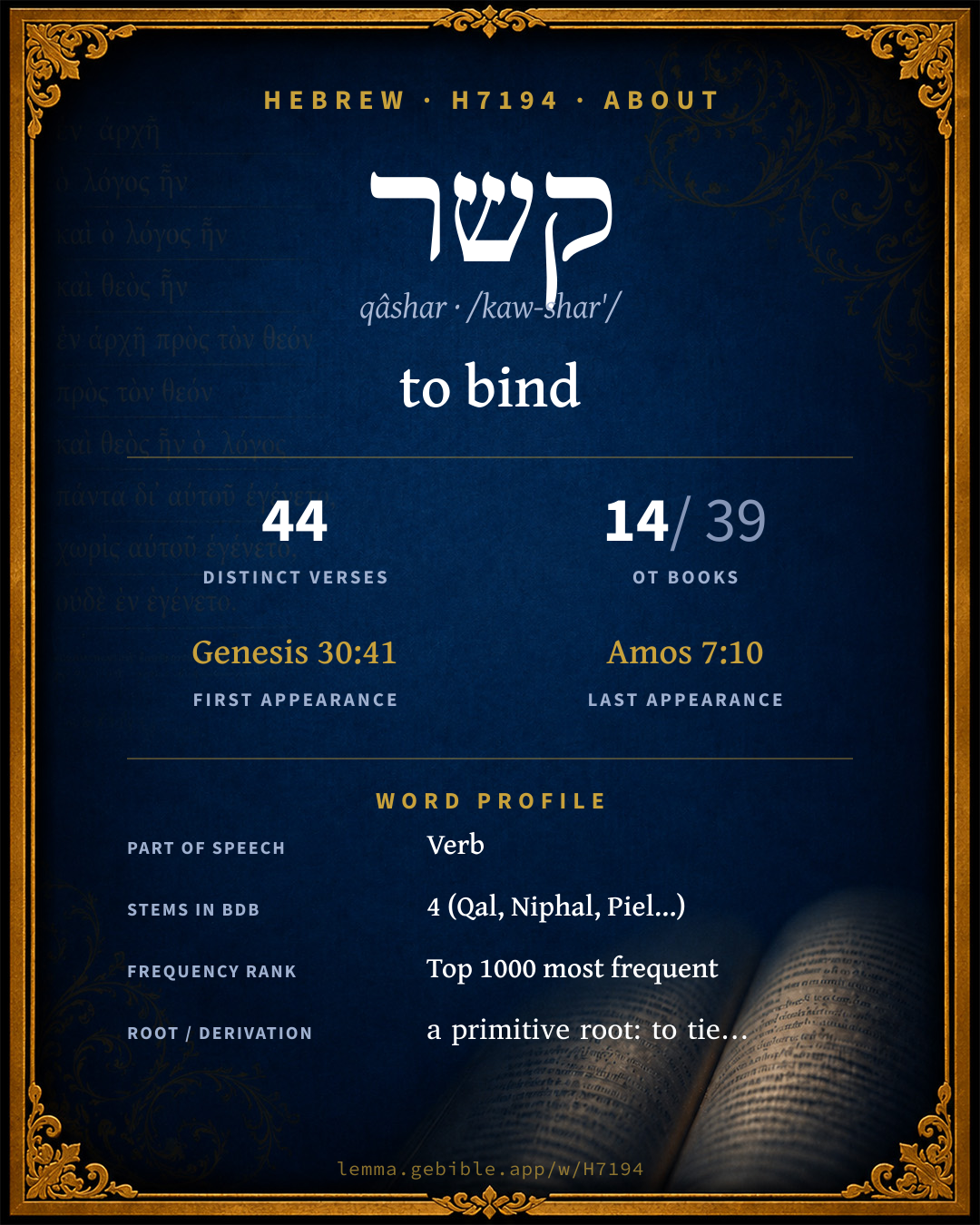
קָשַׁר
to bind
also: tie, bind together, league together, conspire fuller range ↓
Full lexicon entry — Brown-Driver-Briggs (BDB)
From Brown-Driver-Briggs (BDB)
Where this word appears
See every Qal verb in the Hebrew Bible →
Grammar key — what these labels mean
Part of speech
- Verb
- An action or state-of-being word.
Stem
- Qal
- The basic, simple active stem — the plain form of the verb (“he wrote”). Here: ‘bind’
- Niphal
- Usually the simple passive or reflexive of the Qal (“he was written”).
- Piel
- An intensive or resultative active stem. Here: ‘bind on’
- Hithpael
- The reflexive or reciprocal stem (the subject acts on itself).
- Pual
- The passive counterpart of the Piel.
Form
- Sequential Imperfect
- An imperfect with prefixed waw — the standard past-narrative form (waw-consecutive imperfect).
- Perfect
- A completed action or state — Hebrew marks aspect (completeness) more than strict tense (“he wrote”).
- Imperative
- A direct command (“write!”).
- Participle Active
- A verbal adjective expressing ongoing or characteristic action (“writing / one who writes”).
- Participle Passive
- A verbal adjective expressing action received (“written”).
- Imperfect
- An incomplete, ongoing, or future action (“he will / would write”).
- Sequential Perfect
- A perfect with prefixed waw continuing a preceding imperfect or command (waw-consecutive perfect).
State
- Absolute
- The independent form of a noun, not bound to a following word.
Person
- 3rd Person
- The one spoken about (“he / she / it / they”).
- 2nd Person
- The one addressed (“you”).
- 1st Person
- The speaker (“I / we”).
Gender
- Masculine
- Grammatically masculine.
- Feminine
- Grammatically feminine.
- Common
- Either gender — not distinguished for this form.
Number
- Plural
- More than one (in Hebrew, generally three or more).
- Singular
- One.
36 distinct verses where H7194 appears in the Qal stem, across 13 books. Filtered view — show all forms. Click any verse to open its interlinear word-by-word view. Verse text shown in the World English Bible for context — . Each verse’s Hebrew form is shown with its reference; the English is not keyword-highlighted, since the data carries no word-level English alignment. Use “Compare translations” on any verse to read it across multiple English versions. This concordance covers the Hebrew Bible; Septuagint (Greek Old Testament) occurrences are not indexed here.
Genesis 3 verses
- Genesis 30:42 וְ/הַ/קְּשֻׁרִ֖ים conj + ptcl def.art + Qal ptcp.pass mp but when the flock were feeble, he didn't put them in. So the feebler were Laban's, and the stronger Jacob's.
- Genesis 38:28 וַ/תִּקְשֹׁ֨ר conj + Qal wimpf 3fs It happened, when she travailed, that one put out a hand: and the midwife took and tied a scarlet thread on his hand, saying, "This came out first."
- Genesis 44:30 קְשׁוּרָ֥ה Qal ptcp.pass fs Now therefore when I come to your servant my father, and the boy is not with us; seeing that his life is bound up in the boy's life;
Deuteronomy 2 verses
- Deuteronomy 6:8 וּ/קְשַׁרְתָּ֥/ם conj + Qal wpf 2ms + sfx pers 3mp You shall bind them for a sign on your hand, and they shall be for symbols between your eyes.
- Deuteronomy 11:18 וּ/קְשַׁרְתֶּ֨ם conj + Qal wpf 2mp Therefore shall you lay up these my words in your heart and in your soul; and you shall bind them for a sign on your hand, and they shall be for symbols between your eyes.
Joshua 2 verses
- Joshua 2:18 תִּקְשְׁרִ֗י Qal impf 2fs Behold, when we come into the land, you shall bind this line of scarlet thread in the window which you did let us down by: and you shall gather to you into the house your father, and your mother, and your brothers, and all your father's household.
- Joshua 2:21 וַ/תִּקְשֹׁ֛ר conj + Qal wimpf 3fs She said, According to your words, so be it. She sent them away, and they departed: and she bound the scarlet line in the window.
1 Samuel 2 verses
- 1 Samuel 22:8 קְשַׁרְתֶּ֨ם Qal pf 2mp that all of you have conspired against me, and there is none who discloses to me when my son makes a league with the son of Jesse, and there is none of you who is sorry for me, or discloses to me that my son has stirred up my servant against me, to lie in wait, as at this day?
- 1 Samuel 22:13 קְשַׁרְתֶּ֣ם Qal pf 2mp Saul said to him, Why have you conspired against me, you and the son of Jesse, in that you have given him bread, and a sword, and have inquired of God for him, that he should rise against me, to lie in wait, as at this day?
2 Samuel 1 verse
1 Kings 4 verses
- 1 Kings 15:27 וַ/יִּקְשֹׁ֨ר conj + Qal wimpf 3ms Baasha the son of Ahijah, of the house of Issachar, conspired against him; and Baasha struck him at Gibbethon, which belonged to the Philistines; for Nadab and all Israel were laying siege to Gibbethon.
- 1 Kings 16:9 וַ/יִּקְשֹׁ֤ר conj + Qal wimpf 3ms His servant Zimri, captain of half his chariots, conspired against him. Now he was in Tirzah, drinking himself drunk in the house of Arza, who was over the household in Tirzah:
- 1 Kings 16:16 קָשַׁ֣ר Qal pf 3ms The people who were encamped heard say, Zimri has conspired, and has also struck the king: therefore all Israel made Omri, the captain of the host, king over Israel that day in the camp.
- 1 Kings 16:20 קָשָׁ֑ר Qal pf 3ms Now the rest of the acts of Zimri, and his treason that he did, aren't they written in the book of the chronicles of the kings of Israel?
2 Kings 9 verses
- 2 Kings 10:9 קָשַׁ֤רְתִּי Qal pf 1cs It happened in the morning, that he went out, and stood, and said to all the people, You are righteous: behold, I conspired against my master, and killed him; but who struck all these?
- 2 Kings 12:20 וַ/יִּקְשְׁרֽוּ conj + Qal wimpf 3mp His servants arose, and made a conspiracy, and struck Joash at the house of Millo, [on the way] that goes down to Silla.
- 2 Kings 14:19 וַ/יִּקְשְׁר֨וּ conj + Qal wimpf 3mp They made a conspiracy against him in Jerusalem; and he fled to Lachish: but they sent after him to Lachish, and killed him there.
- 2 Kings 15:10 וַ/יִּקְשֹׁ֤ר conj + Qal wimpf 3ms Shallum the son of Jabesh conspired against him, and struck him before the people, and killed him, and reigned in his place.
- 2 Kings 15:15 קָשָׁ֑ר Qal pf 3ms Now the rest of the acts of Shallum, and his conspiracy which he made, behold, they are written in the book of the chronicles of the kings of Israel.
- 2 Kings 15:25 וַ/יִּקְשֹׁ֣ר conj + Qal wimpf 3ms Pekah the son of Remaliah, his captain, conspired against him, and struck him in Samaria, in the castle of the king's house, with Argob and Arieh; and with him were fifty men of the Gileadites: and he killed him, and reigned in his place.
- 2 Kings 15:30 וַ/יִּקְשָׁר conj + Qal wimpf 3ms Hoshea the son of Elah made a conspiracy against Pekah the son of Remaliah, and struck him, and killed him, and reigned in his place, in the twentieth year of Jotham the son of Uzziah.
- 2 Kings 21:23 וַ/יִּקְשְׁר֥וּ conj + Qal wimpf 3mp The servants of Amon conspired against him, and put the king to death in his own house.
- 2 Kings 21:24 הַ/קֹּשְׁרִ֖ים ptcl def.art + Qal ptcp.act mp But the people of the land killed all those who had conspired against king Amon; and the people of the land made Josiah his son king in his place.
2 Chronicles 4 verses
- 2 Chronicles 24:21 וַ/יִּקְשְׁר֣וּ conj + Qal wimpf 3mp They conspired against him, and stoned him with stones at the commandment of the king in the court of the house of Yahweh.
- 2 Chronicles 25:27 וַ/יִּקְשְׁר֨וּ conj + Qal wimpf 3mp Now from the time that Amaziah did turn away from following Yahweh they made a conspiracy against him in Jerusalem; and he fled to Lachish: but they sent after him to Lachish, and killed him there.
- 2 Chronicles 33:24 וַ/יִּקְשְׁר֤וּ conj + Qal wimpf 3mp His servants conspired against him, and put him to death in his own house.
- 2 Chronicles 33:25 הַ/קֹּֽשְׁרִ֖ים ptcl def.art + Qal ptcp.act mp But the people of the land killed all those who had conspired against king Amon; and the people of the land made Josiah his son king in his place.
Nehemiah 1 verse
Job 2 verses
Proverbs 4 verses
- Proverbs 3:3 קָשְׁרֵ֥/ם Qal impv 2ms + sfx pers 3mp Don't let kindness and truth forsake you. Bind them around your neck. Write them on the tablet of your heart.
- Proverbs 6:21 קָשְׁרֵ֣/ם Qal impv 2ms + sfx pers 3mp Bind them continually on your heart. Tie them around your neck.
- Proverbs 7:3 קָשְׁרֵ֥/ם Qal impv 2ms + sfx pers 3mp Bind them on your fingers. Write them on the tablet of your heart.
- Proverbs 22:15 קְשׁוּרָ֣ה Qal ptcp.pass fs Folly is bound up in the heart of a child: The rod of discipline drives it far from him.
Jeremiah 1 verse
Amos 1 verse
About this entry
At a glance — auto-summarized from this page’s data, not written by a person. Every figure links to its source below. This summary describes the numbers; it doesn’t interpret them.
קשר — transliterated qâshar — is a Hebrew verb carrying the sense “to bind.” Across 4 stems, its meaning turns on the binyan (Qal, Niphal). The Hebrew Bible uses it across 44 verses — moderately common. Debuting at Genesis 30:41, it then recurs through the corpus. It shares a root with קשר and קשר. See the sense tree, 44-verse concordance, and the renderings breakdown below.
Gloss history
Strong's 1890 vs modern scholarship
About this word
Strong's H7194 catalogs a Hebrew word from the Hebrew Old Testament.
These counts are not copied from any lexicon or concordance. They are computed here, from the morphology-tagged Hebrew Old Testament. What Lemma adds →
- 44
- distinct verses
- The word appears in 44 distinct verses.
- 14 / 39
- OT books
- The word appears in 14 of 39 Old Testament books.
- #819
- by frequency
- Top 1000 most frequent Hebrew words (rank 819 of 8,640 Hebrew words by occurrence).
View all 44 occurrences in the concordance →
Most concentrated in
- 2 Kings 10 verses 23%
- 2 Chronicles 6 verses 14%
- Genesis 4 verses 9%
By section of the Old Testament
By traditional corpus
Conventional, traditional groupings — biblical authorship is debated, so this is a traditional corpus grouping, not an authorship claim. Each share is this word’s portion of its verses in that division of the Hebrew canon. Each figure is a share of the word’s 44 distinct verses.
- Prophets (Nevi'im) 23 verses · 52%
- Writings (Ketuvim) 15 verses · 34%
- Torah (Pentateuch) 6 verses · 14%
How translations render this word
Counts come from each version’s own published word-to-Strong’s tagging or interlinear alignment — an approximate guide to how each version renders this word, not a word-level alignment the data otherwise carries. Because each total is that version’s own tagged count, the per-version totals vary from one another and need not match the appearance or distinct-verse counts above. These counts may also differ from a printed concordance because Lemma counts each distinctly tagged rendering and does not collapse phrase taggings into a single head-word total. This is a fixed set of word-tagged versions (KJV, ASV, BSB, ULT) and does not change with the reading translation you choose elsewhere. Each version’s license is shown beside its name below (and on Sources).
- King James Version: Conspired 9×, Bind 4×, Thou shalt bind 3×
- American Standard Version: Conspired 8×, Thou shalt bind 3×, All them that had conspired 2×
- Berean Standard Bible: Conspired 12×, Had conspired 3×, Tie 2×
- unfoldingWord Literal Text: Conspired 10×, And 9×, They conspired 3×
King James Version Public Domain
Renders H7194 across 44 tagged occurrences — most commonly:
Plus 20 renderings that appear only once — usually multi-word phrases or single function words the recovered tagging swept in, not distinct renderings.
American Standard Version Public Domain
Renders H7194 across 44 tagged occurrences — most commonly:
Plus 19 renderings that appear only once — usually multi-word phrases or single function words the recovered tagging swept in, not distinct renderings.
Berean Standard Bible Public Domain
Renders H7194 across 44 tagged occurrences — most commonly:
Plus 25 renderings that appear only once — usually multi-word phrases or single function words the recovered tagging swept in, not distinct renderings.
unfoldingWord Literal Text CC BY-SA 4.0
Renders H7194 across 55 tagged occurrences — most commonly:
Plus 25 renderings that appear only once — usually multi-word phrases or single function words the recovered tagging swept in, not distinct renderings.
11 senses and sub-senses in the full BDB
Hebrew verbs can shift meaning by stem (binyan): Qal is the basic action, Niphal is often passive or reflexive, Piel often intensifies or makes it factitive, and Hiphil is typically causative. The senses below are grouped under the stem BDB assigns to each. This entry also uses Pual (the passive of Piel).
What do BDB’s symbols mean?
BDB uses these scholarly abbreviations:
| Symbol | Meaning |
|---|---|
| 𝔊 | the Septuagint (the ancient Greek translation, LXX) |
| 𝔙 | the Vulgate (the Latin translation) |
| 𝔖 | the Syriac version (the Peshitta) |
| 𝔗 | the Targum (the Aramaic translation) |
| ψ | the Psalms |
| √ | root (the underlying root or stem) |
| ‖ | parallel passage (a synonymous or contrasted parallel) |
| † | the dagger: every passage where the word occurs is cited |
The 11 senses and sub-senses the full Brown-Driver-Briggs lexicon distinguishes for this word, in lexicon order (not ranked by frequency), with BDB’s own verbatim wording and sub-sense lettering. Shown in Hebrew script with BDB’s own scholarly abbreviations. The condensed entry is in the Lexicon Entry tab. See also the Forms in the corpus table below.
Qal
- Pf. 3 ms. קָשַׁר Am 7:10; 1 K 16:16; 2 ms. sf. וּקְשַׁרְתָּם consec. Dt 6:8, etc.; Impf. 3 ms. וַיִּקְשֹׁר 1 K 15:27 +, וַיִּקְשָׁר־ 2 K 15:30, etc.; Imv. ms. sf. קָשְׁרֵם Pr 3:3 +; Pt. act. pl. קשְׁרִים 2 S 15:31 +; pass. fs. קְשׁוּרָה Gn 44:30; Pr 22:15; pl. קְשֻׁרִים Gn 30:42;— e.g. Amos 7:10
- 1. bind:
- a. lit., c. acc. rei + עַל Gn 38:28 (J), Je 51:63, + ב, Jos 2:18, 21 (JE); bind, confine, c. acc. רֵים Jb 39:10 (+ בְּתֶלֶם), acc. of crocod. 40:29. e.g. Genesis 38:28
- b. fig., c. acc. + עַל Dt 6:8; 11:18; Pr 3:3; 6:21; 7:3 (all of religious and moral precepts); c. ב, נַפְשׁוֹ קְשׁוּרָה בְנַפְשׁוֹ Gn 44:30 his life is bound up with his [viz. the boy’s] life (J; of strong affection); אִוֶּלֶת ק׳ בְלֶב־נָ֑עַר Pr 22:15. e.g. Deuteronomy 6:8
- c. pt. pass. vigorous (proposes well-knit; opp. עֲטֻפִים) Gn 30:42 (J) e.g. Genesis 30:42
- 2. league together, conspire: c. על pers. against 1 S 22:8, 13; Am 7:10; 1 K 15:27; 16:9; 2 K 10:9; 15:10, 25; 21:23, 24 = 2 Ch 33:24, 25; 2 Ch 24:21; c. acc. cogn. קֶשֶׁר, 1 K 16:20; 2 K 12:21; 15:15, + עַל pers. 14:19 = 2 Ch 25:27; 2 K 15:30; abs. 1 K 16:16; Ne 4:2 (+ inf. purpose); c. עִם, together with, 2 S 15:31. e.g. 1 Samuel 22:8
Niphal
- Pf. 3 fs. נִקְשְׁרָה 1 S 18:1 the life of Jonathan was bound up with the life of D. (Qal 1 b); Impf. 3 fs. וַתִּקָּשֵׁר כָּל־הַחוֹמָה Ne 3:38 all the wall was joined together (the circuit complete). e.g. 1 Samuel 18:1
Piel
- Impf.
- 1. bind on (as ornament), 2 fs. sf. וּתְקַשְּׁרִים Is 49:18 (fig.; ‖ תִּלְבְּשִׁי). e.g. Isaiah 49:18
- 2. bind fast, 2 ms. (הַ)תְקַשֵּׁר מַעֲדַנּוֹת כִּימָה Jb 38:31 canst thou bind fast the bands of the Pleiades? e.g. Job 38:31
Pual
- Pt. הַצֹּאן הַמְּקֻשָּׁרוֹת Gn 30:41 (J), = Qal 1 c. Hithp. conspire: Pf. 3 pl. הִתְקַשְּׁרוּ עַל־ 2 Ch 24:25 (‖ 2 K 12:21 Qal 2); Impf. 3 ms. וַיִּתְקַשֵּׁר אֶל־ 2 K 9:14; Pt. pl. הַמִּתְקַשְּׁרִים עָלָיו 2 Ch 24:26. e.g. Genesis 30:41
Senses from the full Brown-Driver-Briggs lexicon (Brown, Driver, Briggs; Oxford 1906 — public domain), digitized via Sefaria, supplemented by the OpenScriptures HebrewLexicon (CC BY 4.0). Full attribution on Sources.
Word origin
vb. bind, league together, conspire (NH id., bind, join, קֶשֶׁר knot; 𝔗 קְטַר, Syriac ܩܛܰܪ bind (ט for ת after ק) NöZMG xl.735, who cp. also (‘perhaps’) Arabic قَسَرَ force to do a thing, Ethiopic ቈጸረ: bind);—
— Brown-Driver-Briggs (Oxford 1906, public domain), digitized via Sefaria, supplemented by the OpenScriptures HebrewLexicon (CC BY 4.0). See Sources.
Origin: a primitive root: to tie, physically (gird, confine, compact) or mentally (in love, league)
Jastrow Dictionary
A second Hebrew/Aramaic lexicon for comparison, covering Aramaic and post-biblical (Talmudic, Targumic, Midrashic) usage that the biblical-Hebrew BDB does not. Matched by lemma rather than by Strong’s number, so a lemma may carry more than one Jastrow headword (shown separately below), and the entries cover usage well beyond the Bible.
קָשַׁר
- (b. h.) [to strengthen, v. Gen. XXX, 41, sq.] to join, knot, tie; to fold. Sabb. VII, 2 הקוֹשֵׁר והמתיר he that makes a knot or unties it. Y. ib. 10ᶜ שהיו קוֹשְׁרִין וכ׳ they knotted the ropes (of the Tabernacle). Ib. נפסק היה קוֹשְׁרוֹ when a thread was broken (in weaving), one knotted it. Y. Gitt. VIII, end, 49ᵈ אפי׳ קושר וכ׳ even if he folds (the document) up, and then has it signed. Ib. בשׁקְשָׁרוֹ וחתמו וכ׳ when he folded it and had it signed inside; a. fr.—Trnsf. a) (cmp. חָרַז) to compose and arrange (a funeral song or eulogy). Y. Yoma I, 38ᵇ קָשְׁרוּ הספידו they arranged his eulogy. Lam. R. introd. (R. Joḥ. 1), v. מִסְפֵּד; a. fr.—b) conceive, form an affection. Pesik. B’shallaḥ, p. 80ᵃ הוא קושר לו אהבה וכ׳ he acquires love and affection for him; Gen. R. s. 54; Yalk. Prov. 954; a. e.—Part. pass. קָשׁוּר; f. קְשׁוּרָה &c. Y. Nidd. I, 49ᵇ top אילו יהושע שהיה ק׳ למשה וכ׳ a Joshua who was tied to Moses (his constant attendant) could not have spoken so (that Moses had not said a certain thing), and he says so (of R. Jeremiah)? Erub. II, 1 קְשׁוּרוֹת, v. נָתַר. Y. Yeb. XVI, 15ᵈ top, v. הֶסְפֵּד; a. e. e.g. Genesis 30:41
- same, esp. to fold a document, to write a portion and fold it and have witnesses signed on the fold, and so continue to the end of the document. Y. Gitt. l. c. היה מְקַשֵּׁר ראשון ראשון if he folded up the signatures one by one; a. e.—Part. pass. מְקוּשָּׁר. מק׳ (גט) a folded document, opp. פָּשׁוּט. B. Bath. X, 1 גט פשוט … ומק׳ עדיו אחוריו a plain document has its signatures of witnesses inside, a folded one, on its back. Ib. 160ᵃ sq. (ref. to Jer. XXXII, 44) וכתוב … וחתום זה מק׳ ‘and write the deed’, this refers to the plain document, ‘and sign’, this means the folded document; Y. ib. X, beg. 17ᶜ (ref. to Jer. ib. 11) את החתום זה המק׳ ואת הגלוי זה הפשוט שבמק׳ ‘the sealed’ means the folded, ‘and the open’ means the plain document which goes with the folded. Ib. bot. טופס שטרות מְקוּשָּׁרוֹת וכ׳ such is the formula of folded documents; a. fr. e.g. Jeremiah 32:44
- 1. to be tied. Snh. 108ᵇ כלב נ׳ the dog was doomed to be tied.
- 2. to be joined, harden, become knotty. Shebi. III, 1 משׁיִקָּשֵׁר (Mish. ed. משיקשור, incorr.) when the mathoḳ (v. מָתוֹק II) gets knotty excrescences; (R. S.: when the dung in its juice becomes bound, begins to harden); expl. Y. ib. 34ᶜ top משיעשה קשרין קשרין when it gets full of knotty excrescences; ib. מכיון שנקשר בו קשר וכ׳ R. S. to Shebi. l. c. (ed. שנִתְקַשֵּׁר) as soon as the uppermost protuberance is formed, it begins to dry up.
- same, to become knotty; to become thick. Y. Shebi. l. c., v. supra. Taan. 20ᵃ נִתְקַשְּׁרוּ שמים וכ׳, v. עָב II.
- to be tied, joined. Lev. R. s. 30 יוּקְשְׁרוּ כולם אגודה וכ׳ let all of them be tied together with one band (of brotherhood; Yalk. ib. 651 יֵעָשׂוּ כולן וכ׳).
קֶשֶׁר
- preced.)
- 1. knot, band, loop. Sabb. XV, 1 ק׳ הגמלין a knot like that which the camel drivers make (v. זְמָמָא); ק׳ הספנין the sailors’ knot (v. אִיסְטְרִידָא). Ib. 111ᵇ ק׳ שאינו של קיימא a knot which is not intended to be permanent, a temporary knot. Ber. 7ᵃ ק׳ של תפלין the knot in the band of the T’fillin (resting on the back of the head); a. v. fr.—Trnsf. union, conspiracy. Snh. 26ᵃ (ref. to Is. VIII, 12) ק׳ רשעים הוא וק׳ רשעים אינו וכ׳ it is a council of wicked men &c., v. מִנְיָן.—Pl. קְשָׁרִים, קְשָׁרִין. Sabb. XV, 1. Bekh. 30ᵇ; Ab. Zar. 39ᵃ קִשְׁרֵי מוכס, v. מוֹכֵס. Mikv. X, 3 קשרי העני the knots in the poor man’s garment. Tanḥ. Korah 12 ח׳ חוטין וה׳ ק׳ eight threads (of the show fringe) and five knots; Num. R. s. 18 ח׳ גרורין וה׳ קִשּׁוּרִין. Sabb. VI, 9 הבנים יוצאין בק׳ children may go out (on the Sabbath) with garlands, v. פּוּאָה; a. fr.—Sot. VIII, 5 קשרי המלחמה the joined ranks in battle (Y. ed. קישוי, corr. acc.); Y. ib. VIII, end, 23ᵃ קִישְׁרֵי המלחמות.—2) protuberance, joint. Y. Shebi. III, 34ᶜ top, v. preced. Gen. R. s. 10 (ref. to Job XXXVIII, 31) כסיל מושך בין ק׳ לק׳ the planet K’sil draws (the connection) between bud and bud (v. עָדַן Hif.); a. e.—Pl. as ab. Y. Shebi. l. c., v. preced. Nidd. 52ᵇ קשרי אצבעותיה של יד the joints of her fingers; של רגל of her toes. Y. Ber. VIII, 12ᵃ bot. עד קישרי אצבעותיו to the second joints of the fingers, contrad. to פֶּרֶק, q. v.; a. e. e.g. Isaiah 8:12
- 3. fold of a document, plicature. B. Bath. 160ᵇ בין ק׳ לק׳ the witnesses sign between the folds; a. fr.—Pl. as ab. Ib. מתוך שנתרבה בקְשָׁרָיו וכ׳ because it has many folds, it must have many witnesses. Gitt. VIII, 10 (expl. גט קרח, v. קֵרֵחַ) כל שקשריו מרובין וכ׳ which has more folds than signatures of witnesses; a. fr.
A Dictionary of the Targumim, the Talmud Babli and Yerushalmi, and the Midrashic Literature (Marcus Jastrow; London, Luzac, 1903) — Public Domain. Digitized via Sefaria. Digitized via Sefaria. Full attribution on Sources.
Forms in the corpus
The 39 distinct written forms H7194 takes in the Hebrew Bible, most frequent first — each parse links to that stem’s occurrences in the concordance. Hebrew forms include their vowel points and cantillation, so a single lemma takes many written forms.
Same root — word family
Other BDB entries built from the same root as H7194, grouped by Strong’s listed origin. These share a root / origin per the lexicon — not necessarily a shared meaning. Each links to that word’s own entry.
Derived from this word
Compare all same-root words → They share a root, not necessarily a meaning.
Septuagint verse parallels
This word appears in 41 verses that also exist in the Greek Old Testament (Septuagint), out of the 44 Hebrew verses it occurs in. You can read those verses in Greek by switching the Old Testament edition to the Septuagint.
Read these verses in the Septuagint
- Genesis 30:41
- Deuteronomy 6:8
- Joshua 2:18
- 1 Samuel 18:1
- 2 Samuel 15:31
- 1 Kings 15:27
- 2 Kings 9:14
- 2 Chronicles 24:21
- Job 38:31
- Proverbs 3:3
- Isaiah 49:18
- Amos 7:10
This is a verse-level parallel only — the same verses exist in both the Hebrew and Greek Old Testaments. No word-level Hebrew↔Greek correspondence is claimed: the data carries no such alignment, so no Greek word is shown as this Hebrew word’s translation. Coverage is not total — the Septuagint omits the deuterocanon and renumbers the Psalms, so some Hebrew verses have no direct Greek parallel.