2 Kings 12:20

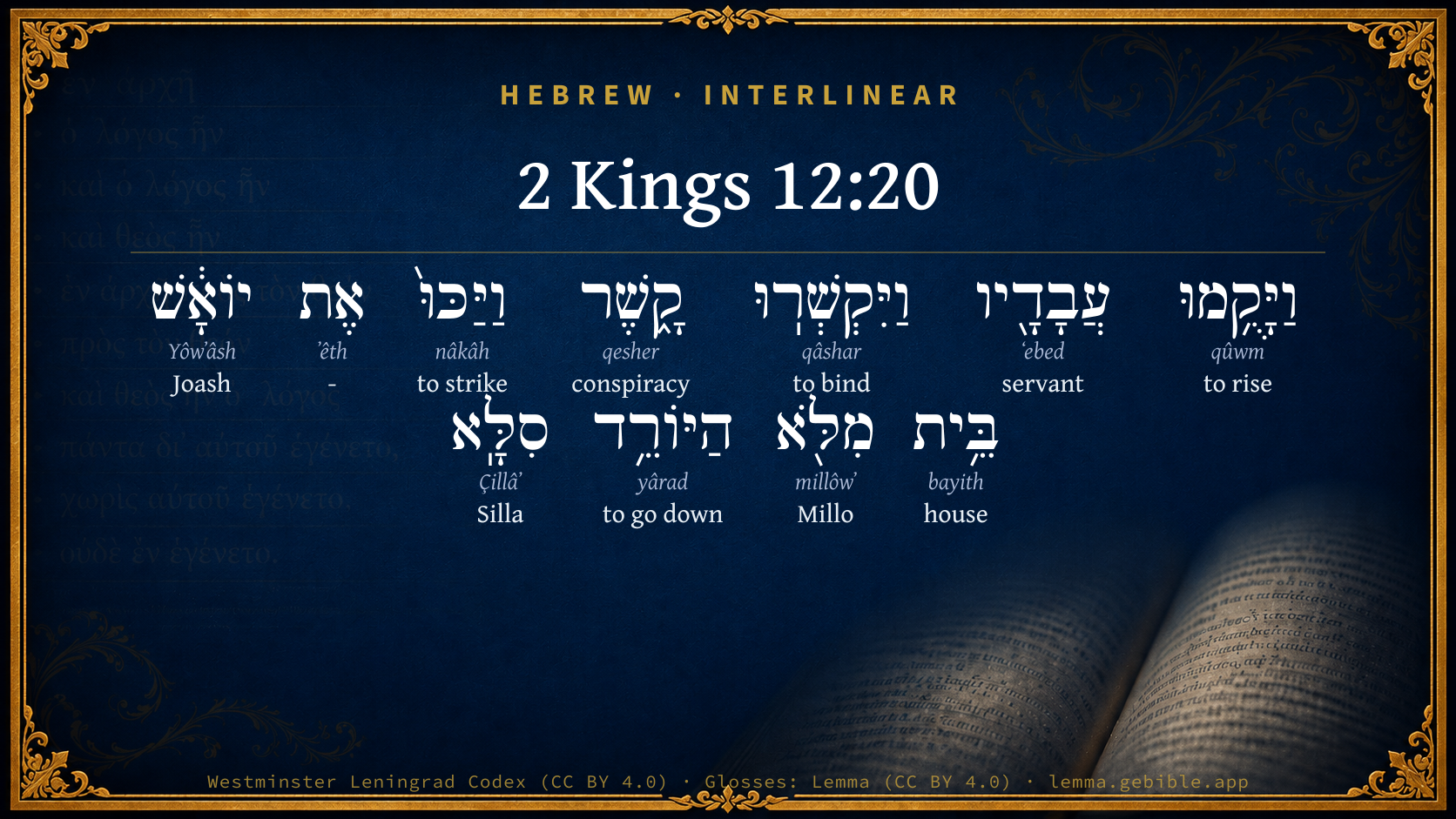
Hebrew (Westminster Leningrad Codex) 2 Kings 12:20 appears in the Hebrew Old Testament. The text above is from the Westminster Leningrad Codex. Each word links to its Strong’s number, a concise gloss, and parsing drawn from the Open Scriptures Hebrew Bible morphology. Click any word for its full Brown-Driver-Briggs (BDB) entry.
Download image
Cite this verse

2 Kings 12:20 (World English Bible). Public Domain. Lemma interlinear Bible study tool, https://lemma.gebible.app/v/2-kings/12/20.

Show BibTeX & RIS
BibTeX
RIS
English Translation
His servants arose, and made a conspiracy, and struck Joash at the house of Millo, [on the way] that goes down to Silla.
World English Bible · Public Domain
Highlights
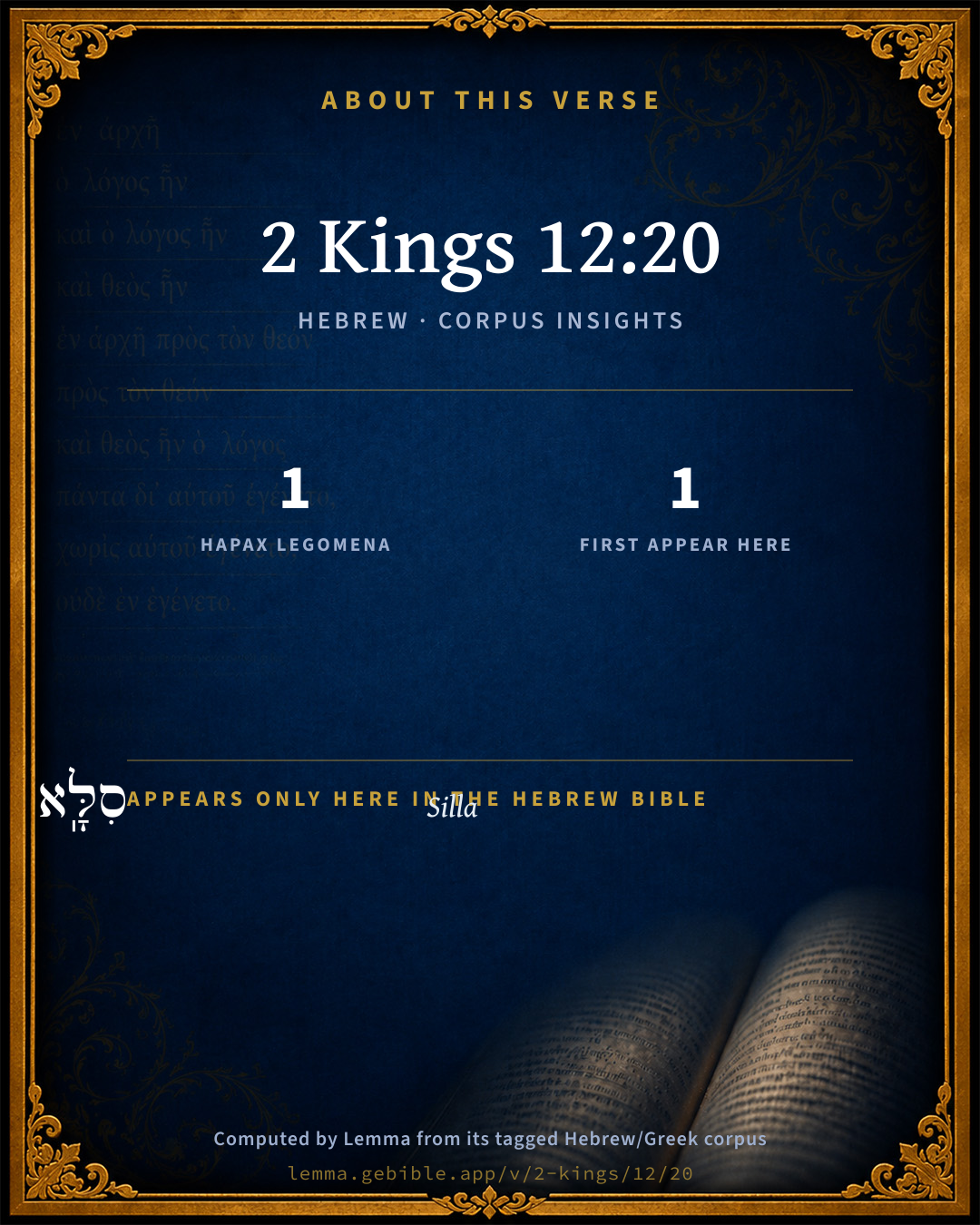
  • 1 hapax legomenon — only here in the Hebrew Bible
  • 1 first appearance in the Hebrew Bible
Full analysis ↓
Download a study sheet

One document with this verse’s original text, its word-by-word gloss line, the meaning frame, cross-references with their text, attributed commentary, and full source and license credits — printable, and it pastes into notes with its structure intact.

This verse Autodidact and up

Study sheet (.html) Plain text (.txt)

A passage Seminary Student

Up to 50 verses in one chapter. A passage sheet keeps up to 6 commentary sources and 12 cross-references per verse, in the order this page ranks them, and says so on the sheet whenever that leaves anything out. Ask for a single verse and you get the Autodidact verse sheet above.

Everything on this page stays free to read, with no account — the sheet is a download of what is already on screen, not access to it.

Want to remove ads? Support Godless Engineer
Compare translations 3

The same verse in 3 English versions, stacked beneath the original-language interlinear above. Click any original word for its lexicon entry.

Each is an independent rendering of the whole verse — the interlinear is not word-aligned to these translations.

Highlighted words mark where these versions differ — a whole-verse word diff, not a word-by-word alignment.

  • World English Bible Public Domain
    His servants arose, and made a conspiracy, and struck Joash at the house of Millo, [on the way] that goes down to Silla.
  • King James Version Public Domain
    And his servants arose, and made a conspiracy, and slew Joash in the house of Millo, which goeth down to Silla.
  • unfoldingWord Literal Text CC BY-SA 4.0
    And his servants arose, and they conspired a conspiracy, and they struck Joash Beth Millo, on the descent Silla.

unfoldingWord Literal Text — © unfoldingWord, licensed CC BY-SA 4.0. Word-aligned USFM3 via Door43 (git.door43.org/unfoldingWord/en_ult).

Versions to compare (up to 4)

3 of 4 selected

Show all 18 translations

Every available English version of this verse, each an independent rendering of the whole verse.

  • World English Bible Public Domain
    His servants arose, and made a conspiracy, and struck Joash at the house of Millo, [on the way] that goes down to Silla.
  • Berean Standard Bible Public Domain
    And the servants of Joash rose up and formed a conspiracy and killed him at Beth-millo, on the road down to Silla.
  • Majority Standard Bible Public Domain
    And the servants of Joash rose up and formed a conspiracy and killed him at Beth-millo, on the road down to Silla.
  • King James Version Public Domain
    And his servants arose, and made a conspiracy, and slew Joash in the house of Millo, which goeth down to Silla.
  • American Standard Version (1901) Public Domain
    And his servants arose, and made a conspiracy, and smote Joash at the house of Millo, `on the way' that goeth down to Silla.
  • Revised Version (1885) Public Domain
    And his servants arose, and made a conspiracy, and smote Joash at the house of Millo, on the way that goeth down to Silla.
  • Geneva Bible (1599) Public Domain
    And his seruants arose and wrought treason, and slewe Ioash in the house of Millo, when he came downe to Silla:
  • Douay-Rheims (1899) Public Domain
    And his servants arose, and conspired among themselves, and slew Joas in the house of Mello in the descent of Sella.
  • Young's Literal Translation Public Domain
    And his servants rise, and make a conspiracy, and smite Joash in the house of Millo, that is going down to Silla:
  • Literal Standard Version CC BY-SA 4.0
    And his servants rise, and make a conspiracy, and strike Joash in the house of Millo, that is going down to Silla.
  • Unlocked Literal Bible CC BY-SA 4.0
    His servants arose and plotted together; they attacked Joash in Beth Millo, on the way that goes down to Silla.
  • unfoldingWord Literal Text CC BY-SA 4.0
    And his servants arose, and they conspired a conspiracy, and they struck Joash Beth Millo, on the descent Silla.
  • Darby Bible Public Domain
    And his servants rose up and made a conspiracy, and smote Joash in the house of Millo, at the descent of Silla.
  • World Messianic Bible Public Domain
    His servants arose and made a conspiracy, and struck Joash at the house of Millo, on the way that goes down to Silla.
  • Webster's Bible Public Domain
    And his servants arose, and made a conspiracy, and slew Joash in the house of Millo, which goeth down to Silla.
  • Free Bible Version CC BY-SA 4.0
    His officials plotted against him and murdered him at Beth Millo, on the road that goes down to Silla.
  • Bible in Basic English Public Domain
    And his servants made a secret design and put Joash to death at the house of Millo on the way down to Silla.
  • JPS Tanakh (1917) Public Domain
    (12-21) And his servants arose, and made a conspiracy, and smote Joash at Beth-millo, on the way that goeth down to Silla.

Literal Standard Version (2020), Covenant Press — licensed CC BY-SA 4.0. Text via the HelloAO Bible API (eBible.org). Unlocked Literal Bible (unfoldingWord) — licensed CC BY-SA 4.0. Text via the HelloAO Bible API (eBible.org). unfoldingWord Literal Text — © unfoldingWord, licensed CC BY-SA 4.0. Word-aligned USFM3 via Door43 (git.door43.org/unfoldingWord/en_ult). Free Bible Version, Dr. Jonathan Gallagher — licensed CC BY-SA 4.0. Text via the HelloAO Bible API (eBible.org).

Word by word

More ways to search: Search by grammar → Find every occurrence → Compare this word →

Practice this passage: Drill this verse → Learn its vocabulary →

סִלָּֽא
Çillâʼ
H5538
“Silla”
Noun, Proper
Part of Speech
Noun
Type
Proper
Full BDB Definition

Origin: from H5549

TWOT: None

Silla = "a highway" - the scene of the murder of king Joash of Judah; site unknown
  1. וַיָּקֻ֥מוּ qûwm H6965 “and · to rise” Conjunction + Verb, Qal, Sequential Imperfect, 3rd Person, Masculine, Plural
  2. עֲבָדָ֖יו ʻebed H5650 “servants · his” Noun, Common, Masculine, Plural, Construct + Suffix, Personal, 3rd Person, Masculine, Singular
  3. וַיִּקְשְׁרֽוּ qâshar H7194 “and · to bind” Conjunction + Verb, Qal, Sequential Imperfect, 3rd Person, Masculine, Plural
  4. קָ֑שֶׁר qesher H7195 “conspiracy” Noun, Common, Masculine, Singular, Absolute
  5. וַיַּכּוּ֙ nâkâh H5221 “and · to strike” Conjunction + Verb, Hiphil, Sequential Imperfect, 3rd Person, Masculine, Plural
  6. אֶת ʼêth H853 “-” Particle, Direct Object
  7. יוֹאָ֔שׁ Yôwʼâsh H3101 “Joash” Noun, Proper
  8. בֵּ֥ית bayith H1004 “house of” Noun, Common, Masculine, Singular, Construct
  9. מִלֹּ֖א millôwʼ H4407 “Millo” Noun, Proper
  10. הַיּוֹרֵ֥ד yârad H3381 “the · going down” Particle, Definite Article + Verb, Qal, Participle Active, Masculine, Singular, Absolute

About this verse

These counts appear in no published source. They are computed here, from the morphology-tagged text and Lemma’s own curated glosses. What Lemma adds →

11
words
11
distinct lemmas
Historical
section

Notable vocabulary

1 hapax legomenon — a word that appears only here in the entire Hebrew Bible:

  • סִלָּֽא Silla H5538

First appearance in Scripture

This word makes its first canonical appearance in the Hebrew Bible here:

  • סִלָּֽא Silla H5538

Shared distinctive vocabulary

מִלֹּ֖א Millo H4407 occurs in 9 verses of the Hebrew Bible. Also found in:

Grammatical profile

  • 4 verbs
  • 6 nouns
  • 1 particle

Verb forms

  • וַיָּקֻ֥מוּ Qal · Sequential Imperfect
  • וַיִּקְשְׁרֽוּ Qal · Sequential Imperfect
  • וַיַּכּוּ֙ Hiphil · Sequential Imperfect
  • הַיּוֹרֵ֥ד Qal · Participle Active

Hebrew & Septuagint length

In English translation the verse runs 23 words from the Hebrew and 21 from the Septuagint (LXX English) — closely comparable.

A rough comparison of the two English renderings, which tokenize alike — not a word-level alignment.

Word counts can differ between the Hebrew and the Greek without any difference in meaning — e.g. the Hebrew direct-object marker אֵת has no separate Greek word, and Greek often adds the article ὁ.

Cross-references

7

Topical passages linked to 2 Kings 12:20 in the Treasury of Scripture Knowledge — connected by theme and wording, ordered by reader-vote popularity; previews shown in the World English Bible.

  • 2 Kings 14:5 It happened, as soon as the kingdom was established in his hand, that he killed his servants who had slain the king his father:
  • 2 Chronicles 24:24–27 For the army of the Syrians came with a small company of men; and Yahweh delivered a very great host into their hand, because they had forsaken Yahweh, the God of their fathers. So they executed judgment on Joash.
  • Judges 9:6 All the men of Shechem assembled themselves together, and all the house of Millo, and went and made Abimelech king, by the oak of the pillar that was in Shechem.
  • 2 Samuel 5:9 David lived in the stronghold, and called it the city of David. David built round about from Millo and inward.
  • 1 Kings 11:27 This was the reason why he lifted up his hand against the king: Solomon built Millo, and repaired the breach of the city of David his father.
  • 2 Chronicles 25:27 Now from the time that Amaziah did turn away from following Yahweh they made a conspiracy against him in Jerusalem; and he fled to Lachish: but they sent after him to Lachish, and killed him there.
  • 2 Chronicles 33:24 His servants conspired against him, and put him to death in his own house.

Cross-references courtesy of OpenBible.info (CC BY 4.0).

Hebrew and Greek witnesses Masoretic Hebrew ↔ Greek Septuagint

The same verse in the two great witnesses to the Old Testament, shown verse-for-verse.

These are two independent witnesses, not word-aligned to each other, and the Septuagint is shown in lemma (dictionary) form.

Hebrew 2 Kings 12:20 Masoretic · Westminster Leningrad Codex

וַיָּקֻ֥מוּ עֲבָדָ֖יו וַיִּקְשְׁרֽוּ קָ֑שֶׁר וַיַּכּוּ֙ אֶת יוֹאָ֔שׁ בֵּ֥ית מִלֹּ֖א הַיּוֹרֵ֥ד סִלָּֽא

His servants arose, and made a conspiracy, and struck Joash at the house of Millo, [on the way] that goes down to Silla.

World English Bible · Public Domain

Greek LXX 2 Kings 12:20 Septuagint · lemma form

καί ὁ λοιπός ὁ λόγος ιωας καί πᾶς ὅσος ποιέω οὐ ἰδού οὗτος γράφω ἐπί βιβλίον λόγος ὁ ἡμέρα ὁ βασιλεύς ιουδα

And his servants rose up and made a conspiracy, and struck Joas in the house of Mallo that is in Sela.

LXX2012 (modern English Septuagint) · Public Domain

On this verse, Ellicott's Commentary for English Readers discusses the Septuagint’s reading. Read the note in Commentary ↓

Hebrew: Westminster Leningrad Codex (CC BY 4.0). Greek: Septuagint (public domain); English from LXX2012 (modern English Septuagint) (Public Domain). How the Septuagint differs from the Hebrew →

Targum (Aramaic paraphrase)

1

The Targum is the ancient Jewish Aramaic paraphrase of the Hebrew Scriptures — an interpretive translation, not the Hebrew text itself. Onkelos (literal) and Pseudo-Jonathan (expansive) render the Torah, and Jonathan the Prophets. Coverage is partial: where no permissively-licensed English translation exists for a verse, only the Aramaic is shown. This is verse-level text, not a word-by-word alignment to the Hebrew.

  1. Targum Jonathan Prophets (Joshua–Malachi)
    וּשְׁאַר פִּתְגָמֵי יוֹאָשׁ וְכָל דַעֲבַד הֲלָא אִינוּן כְּתִיבִין עַל סְפַר פִּתְגָמֵי יוֹמַיָא לְמַלְכֵי דְבֵית יְהוּדָה:

    (no public-domain English translation for this verse)

    Targum Jonathan — Aramaic: “Mikraot Gedolot” (public domain). English: “Sefaria Community Translation” (CC0 1.0 (public-domain dedication)); “London "Chaldee Paraphrase," 1871” (public domain). Text via Sefaria.

Commentary

Notes on 2 Kings 12:20 from classic Christian and Jewish commentators (each source and its license shown beneath its notes). The classic Christian expositions comment on the surrounding passage and are grouped to its opening verse, so a note may address several verses; the Jewish commentaries on the Tanakh (Rashi and others) are per-verse, so they appear only where the commentator wrote on this verse.

Lemma curates 59 commentaries, every one of them public domain or Creative Commons licensed, each selected and text-cleaned for this edition rather than reprinted as found. About our sources →

Trapp's Complete Commentary

John Trapp

2Ki 12:20 And his servants arose, and made a conspiracy, and slew Joash in the house of Millo, which goeth down to Silla.

Ver. 20. And slew Joash.] After that the Syrian rovers had first wounded him, and, perhaps by torturing him, left him under sore diseases, {2Ch 24:23-25} according to what holy Zechariah at his death had prayed and prophesied, The Lord look upon it (i.e., my death), and require it.

John Trapp, A Commentary or Exposition upon All the Books of the Old and New Testament (1647–1656) — public domain. Text from a community e-Sword module.

Joseph Benson's Commentary

2Ki 12:20. His servants made a conspiracy, and slew Jehoash — Of which, see 2Ch 24:25, where we are told that his murdering the prophet, Jehoiada’s son, was the provocation. In this, how unrighteous soever they were, yet the Lord was righteous: and this was not the only time that he let even kings know, it was at their peril if they touched his anointed, or did his prophets any harm; and that, when he comes to make inquisition for blood, the blood of prophets will run the account very high. Thus fell Joash, who began in the spirit, and ended in the flesh. God usually sets marks of his displeasure upon apostates, even in this life; for they, of all sinners, do most reproach the Lord.

Joseph Benson's Commentary on the Old and New Testaments (1811–1818) — public domain. Text from a community e-Sword module.

Tyndale Open Study Notes

Tyndale Open Resources

12:20-21 The assassination of the king in 796 BC by some of his own officers was in reprisal for the murder of Jehoiada’s son Zechariah (2 Chr 24:21-22, 25).

12:20 Beth-millo: This district lay on a ridge of the eastern hill of Jerusalem in an area known as the City of David, where Solomon installed a series of supporting terraces (1 Kgs 9:15). • The road to Silla is otherwise unknown.

Tyndale Open Study Notes — © Tyndale Open Resources, licensed CC BY-SA 4.0. Text via the HelloAO Bible API.

Geneva Bible (1599)

Geneva Bible translators

Because he had put Zechariah the son of Jehoiada to death, 2 Chron. 24:25.

Read 2 Sam. 3:9.

Geneva Bible (1599) marginal notes — public domain. Text via Bolls.life.

Jamieson, Fausset & Brown

Robert Jamieson, A. R. Fausset & David Brown

HE IS SLAIN. (Kg2 12:19-21)

his servants arose . . . and slew Joash in the house of Millo--(See on Ch2 24:25).

Next: 2 Kings Chapter 13

Jamieson, Fausset & Brown — Commentary Critical and Explanatory on the Whole Bible (1871) — public domain (CC PDM 1.0). Text via the HelloAO Bible API.

Adam Clarke's Commentary

Verse 20. The house of Millo] Was a royal palace, built by David; (see 2Sa 5:9); and Silla is supposed to be the name of the road or causeway that led to it. Millo was situated between the old city of Jerusalem, and the city of David.

Adam Clarke's Commentary on the Bible (1810–1826) — public domain. Text from a community e-Sword/MySword module.

Ellicott's Commentary for English Readers

(20) His servants.—His immediate attendants. (Comp. 2Ki_8:15.)

Arose—i.e., against him.

In the house of Millo.—Or, at Beth-Millo. The precise locality cannot be determined. Thenius supposes that the sorely wounded (?) king had retired for greater safety into “the castle palace.” Ewald says the king was murdered while engaged in the fortress. For “the Millo,” see 2Sa_5:9; 1Ki_9:15. The chronicler relates that Jehoash was murdered in his bed.

Which goeth down to Silla.—These words convey no meaning to us, the name Silla being otherwise unknown. The text is probably corrupt, for Silla is almost exactly like Millo in Hebrew writing. (The Vatican LXX. omits “which goeth down.”)

A Bible Commentary for English Readers, edited by Charles John Ellicott (1878–1897) — public domain. Text from a community e-Sword module.

The Cambridge Bible for Schools and Colleges

gen. ed. J. J. S. Perowne

20. And his servants arose] The Chronicler tells us that the Syrians left the king suffering from ‘great diseases’, perhaps from wounds received in some battle against the Syrians. He adds also that it was because of the blood ‘of the sons of Jehoiada’ that the conspiracy was formed against Joash. From which it would seem that not Zechariah only but the whole family of Jehoiada had been put to death by the ungrateful king.

slew Joash in the house of Millo] R.V. smote Joash at &c. We see from 2 Chronicles that the king was lying sick at this place. So it probably was some royal residence, or some part thereof. On ‘Millo’, the name of some part of the fortifications of Jerusalem, cf. 1Ki_9:15. Perhaps the place indicated in this verse may have been part of that fortress. The ‘house of Millo’ is mentioned before this, in Jdg_9:6, but that passage has no connexion with this. The Hebrew ‘Beth-Millo’, translated ‘house of Millo’, may have been one proper name which we ought to retain without translation, as in so many other words formed with ‘Beth’ as a prefix.

which goeth down to Silla] R.V. on the way that goeth down to Silla. The LXX. and other versions take ‘Silla’ as a proper name, but we have no knowledge of it except from this place.

The Cambridge Bible for Schools and Colleges (gen. ed. J. J. S. Perowne; Cambridge University Press, 1878–1918) — public domain. Text from a community e-Sword module.

Albert Barnes' Notes on the Bible

A conspiracy - Compare the marginal reference Joash, either from a suspicion of intended treason, or from some other unknown cause, took up his abode in the fortress of Millo 1Ki 9:24. This conspiracy was connected with religion. Soon after the death of Jehoiada, Joash had apostatised; had renewed the worship of Baal; and, despite of many prophetic warnings, had persisted in his evil courses, even commanding Zechariah to be slain when he rebuked them 2Ch 24:18-27. The conspirators, who wished to avenge Zechariah, no doubt wished also to put down the Baal worship. In this it appears that they succeeded. For, though Amaziah punished the actual murderers after a while 2Ki 14:5, yet he appears not to have been a Baal-worshipper. The only idolatries laid to his charge are the maintenance of the high places 2Ki 14:4, and a worship of the gods of Edom 2Ch 25:14-20.

Silla - This place is quite unknown.

Albert Barnes' Notes on the Bible (1834–1885) — public domain. Text from a community e-Sword/MySword module.

Haydock's Catholic Bible Commentary

Sella. A flight of steps leading to the temple. (Haydock) --- The palace was at the bottom of it, and had been built by Solomon. Here Joas was slain in his bed. (Paralipomenon)

George Leo Haydock (1774–1849), Haydock's Catholic Family Bible and Commentary, 1859 edition — public domain. Excludes Psalms (Douay-Rheims chapter numbering differs from Protestant) and Deuterocanonical books (Catholic canon only).

Matthew Poole's English Annotations

Made a conspiracy; of which see 2Ch 24:25.

In the house of Millo; either in that strong and famous place in Jerusalem called Millo; of which see 2Sa 5:9; 1Ki 9:15,24; 11:27; into which he possibly retired for his security, being afraid even of his own subjects and servants; or in some other place called by the same name, for some resemblance it had with it.

Which goeth down to Silla, i.e. which standeth upon the descent to Silla, or upon that descending causeway which leadeth from Millo to the king’s house. Some refer this to Joash, and render the place thus, they slew him at or near the house of Millo, descending, or as he was going down to Silla, to escape their hands.

Matthew Poole's English Annotations on the Holy Bible (1683–1685) — public domain. Text from a community e-Sword/MySword module.

Whedon's Commentary on the Bible

Daniel D. Whedon

20. House of Millo — The castle or citadel on Zion which David had fortified. 2Sa_5:9, note.

Which goeth down to Silla — “What or where Silla was is entirely matter of conjecture. It must have been in the valley below, overlooked by that part of the citadel which was used as a residence. The situation of the present so-called Pool of Siloam would be appropriate, and the agreement between the two names is tempting; but the likeness exists in the Greek and English versions only. Gesenius, with less than his usual caution, affirms Silla to be a town in the neighbourhood of Jerusalem. Others refer it to a place on or connected with the causeway, or flight of steps, which led from the central valley of the city up to the court of the temple.” — GROVE, in Smith’s Dictionary.

Daniel D. Whedon (gen. ed.), Commentary on the Old and New Testaments (1874–1909) — public domain. Text from a community e-Sword module.

The Pulpit Commentary

And his servants arose, and made a conspiracy. By "his servants" officers of his household are probably intended, attendants whose position would give them ready access to his person. And slew Joash in the house of Millo. Joash had probably transferred his residence to "the house of Mille. the great fortress built by David (2Sa_5:9) and Solomon (1Ki_9:15, 1Ki_9:24) in Jerusalem for greater security during the siege; and, being there prostrated by sickness, could not remove from it when the siege was over. Which goeth down to Silla. No commentator has succeeded in explaining this passage. There is no other mention of Silla; and it is difficult to understand how a fortress could be said to "go down" to any place. Our Revisers" conjecture the way that goeth down to Silla may be accepted as a possible explanation; but it implies that a word ( has dropped out of the text.

The Pulpit Commentary (1880–1919), ed. H.D.M. Spence-Jones & Joseph S. Exell — public domain. Text from a community e-Sword module.

John Wesley's Explanatory Notes

And slew Joash - We are told, in the Chronicles, that his murdering the prophet, Jehoiada's son, was the provocation. In this, how unrighteous so ever they were, yet the Lord was righteous. And this was not the only time, that he let even kings know, it was at their peril, if they touched his anointed, or did his prophets any harm. Thus fell Joash, who began in the spirit, and ended in the flesh. And indeed God usually sets marks of his displeasure upon apostates, even in this life.

John Wesley, Explanatory Notes Upon the Whole Bible (1754–1765) — public domain. Text via the GEBible commentary corpus.

Lesson kit

Teaching starters — assembled from the data on this page, not authored interpretation. Every prompt links to the verse data it draws on. Edit before teaching.

2 Kings, in the Historical, opens this verse with 11 words (11 distinct Hebrew lemmas). Its most distinctive word is Çillâʼ (“Silla”). A historical commentator’s framing appears above. Read the whole chapter for the surrounding context.

Discussion questions

  1. What does “Silla” (Çillâʼ) contribute to the verse as a whole?
  2. 1 word here appears nowhere else in the Hebrew Bible. Why might the author reach for such rare wording?
  3. This is the first place “Silla” appears in Scripture (first appears here). What does its debut here establish?
  4. How does Judges 9:6, which shares the word «Millo», read alongside this verse?
  5. These translations render this verse differently; the difference is in the English rendering, not the original. What questions does that raise?
  6. «וַיָּקֻ֥מוּ» is a Qal Sequential Imperfect verb. How does that grammatical form shape the action described?
  7. Compare how Trapp's Complete Commentary and Joseph Benson's Commentary read this verse. Where do they agree or differ?

Things to notice

  • 1 word in this verse appears nowhere else in the Hebrew Bible.
  • 1 word makes its first canonical appearance in Scripture here.
  • These translations choose different wording for 12 words in this verse.
  • 11 distinct Hebrew lemmas span 11 words in this verse.

Reading settings

Reading text

Shown beneath each verse's original-language words.

Old Testament
Old Testament edition

Read the OT as the Masoretic Hebrew (MT) or the Greek Septuagint (LXX).

English shown for the Greek Septuagint (in the Hebrew ↔ Greek comparison).

Comparing translations? Open the Compare panel on any verse page to stack up to four side by side.