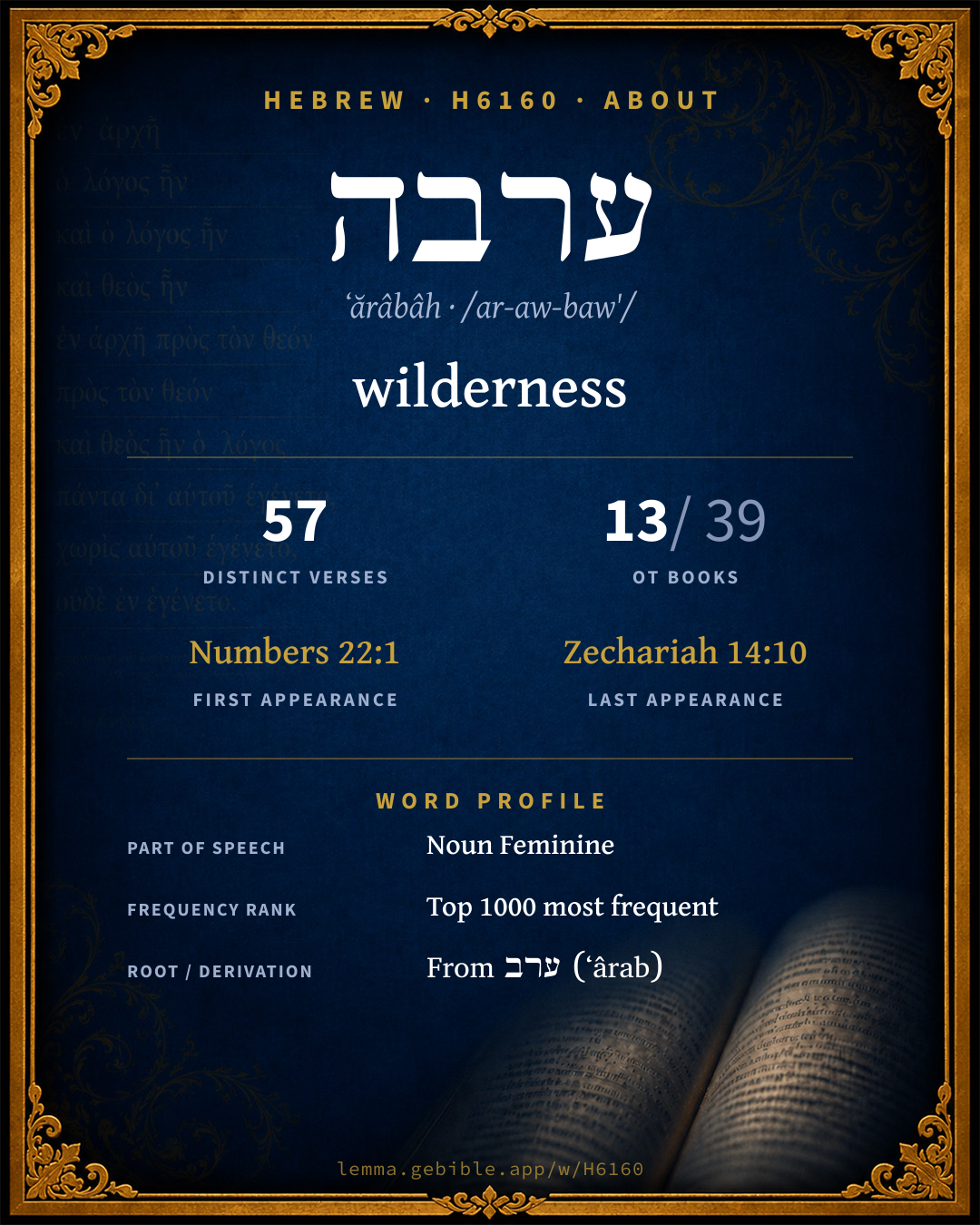
עֲרָבָה
wilderness
Full lexicon entry — Brown-Driver-Briggs (BDB)
From Brown-Driver-Briggs (BDB)
Where this word appears
See every Absolute-state word in the Hebrew Bible →
Grammar key — what these labels mean
Part of speech
- Noun
- A naming word — a person, place, thing, or idea.
Noun type
- Common
- A common noun — a general class of person, place, or thing (“king,” “city,” “water”), not a specific name.
State
- Construct
- A noun bound to a following noun in a possessive / “of” relationship (the construct chain).
- Absolute
- The independent form of a noun, not bound to a following word.
Gender
- Feminine
- Grammatically feminine.
Number
- Plural
- More than one (in Hebrew, generally three or more).
- Singular
- One.
5 verses where H6160 appears in the Absolute state in the Book of Isaiah. Filtered view — show all forms. Click any verse to open its interlinear word-by-word view. Verse text shown in the World English Bible for context — . Each verse’s Hebrew form is shown with its reference; the English is not keyword-highlighted, since the data carries no word-level English alignment. Use “Compare translations” on any verse to read it across multiple English versions. This concordance covers the Hebrew Bible; Septuagint (Greek Old Testament) occurrences are not indexed here.
Isaiah
- Isaiah 33:9 כָּֽ/עֲרָבָ֔ה prep det + n c fs The land mourns and languishes; Lebanon is confounded and withers away; Sharon is like a desert; and Bashan and Carmel shake off [their leaves].
- Isaiah 35:1 עֲרָבָ֛ה n c fs The wilderness and the dry land shall be glad; and the desert shall rejoice, and blossom as the rose.
- Isaiah 35:6 בָּ/עֲרָבָֽה prep det + n c fs Then shall the lame man leap as a hart, and the tongue of the mute shall sing; for in the wilderness shall waters break out, and streams in the desert.
- Isaiah 40:3 בָּ/עֲרָבָ֔ה prep det + n c fs The voice of one who cries, Prepare you in the wilderness the way of Yahweh; make level in the desert a highway for our God.
- Isaiah 41:19 בָּ/עֲרָבָ֗ה prep det + n c fs I will put in the wilderness the cedar, the acacia, and the myrtle, and the oil tree; I will set in the desert the fir tree, the pine, and the box tree together:
About this entry
At a glance — auto-summarized from this page’s data, not written by a person. Every figure links to its source below. This summary describes the numbers; it doesn’t interpret them.
ערבה — transliterated ʻărâbâh — is a Hebrew noun carrying the sense “wilderness.” The King James Version usually renders it “plains,” while modern versions prefer “arabah” (Berean Standard Bible) — see the renderings breakdown. With 57 verses in 13 books, it is a moderately common word in the Hebrew Bible. Debuting at Numbers 22:1, it then recurs through the corpus. Sharing its root, it stands alongside ערב, מערב and ערב. See the sense tree, 57-verse concordance, and the renderings breakdown below.
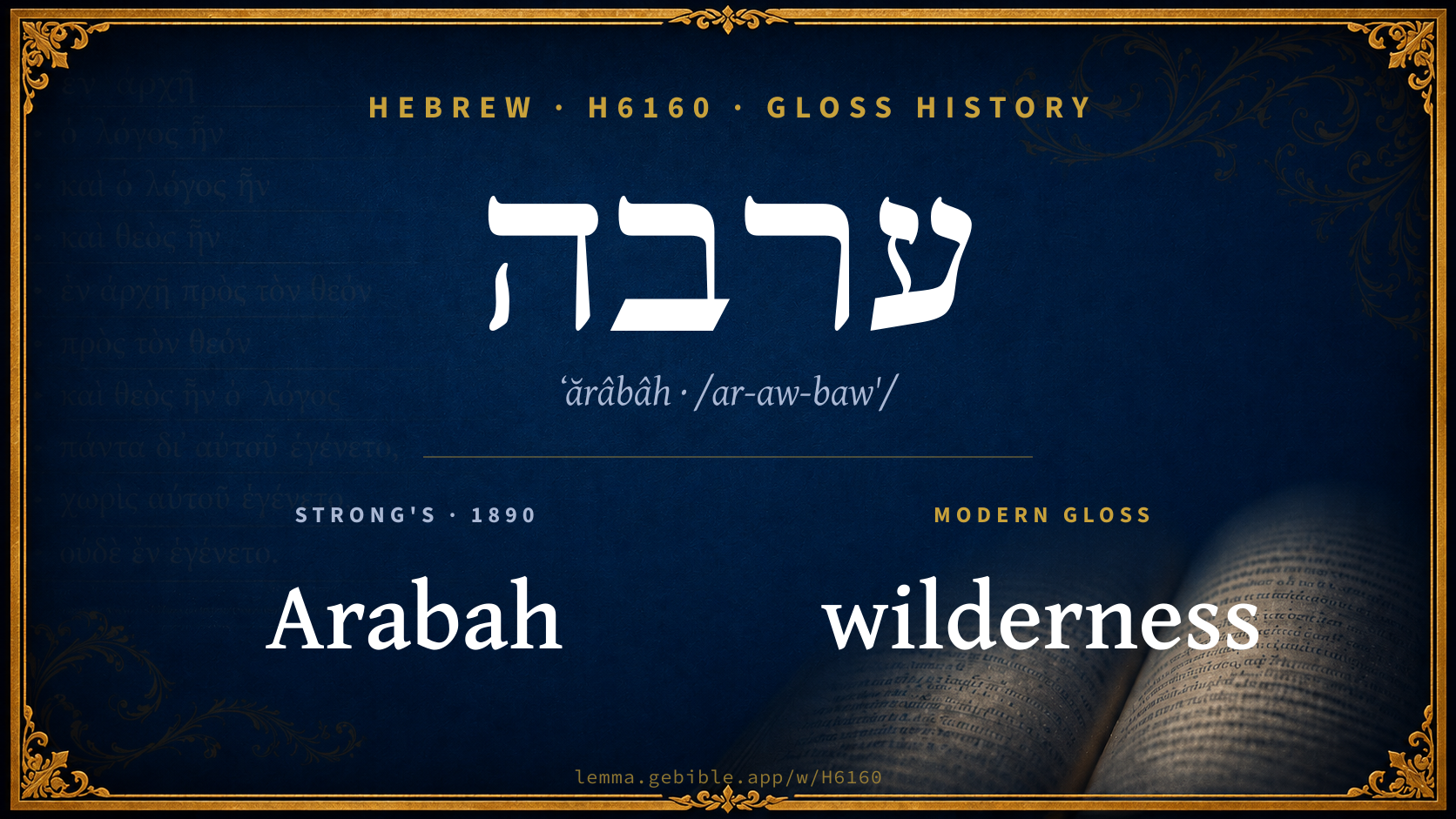
Gloss history
Strong's 1890 vs modern scholarship
About this word
Strong's H6160 catalogs a Hebrew word from the Hebrew Old Testament.
These counts are not copied from any lexicon or concordance. They are computed here, from the morphology-tagged Hebrew Old Testament. What Lemma adds →
- 57
- distinct verses
- The word appears in 57 distinct verses.
- 13 / 39
- OT books
- The word appears in 13 of 39 Old Testament books.
- #629
- by frequency
- Top 1000 most frequent Hebrew words (rank 629 of 8,640 Hebrew words by occurrence).
View all 57 occurrences in the concordance →
By section of the Old Testament
By traditional corpus
Conventional, traditional groupings — biblical authorship is debated, so this is a traditional corpus grouping, not an authorship claim. Each share is this word’s portion of its verses in that division of the Hebrew canon. Each figure is a share of the word’s 57 distinct verses.
- Prophets (Nevi'im) 37 verses · 65%
- Torah (Pentateuch) 17 verses · 30%
- Writings (Ketuvim) 3 verses · 5%
How translations render this word
Counts come from each version’s own published word-to-Strong’s tagging or interlinear alignment — an approximate guide to how each version renders this word, not a word-level alignment the data otherwise carries. Because each total is that version’s own tagged count, the per-version totals vary from one another and need not match the appearance or distinct-verse counts above. These counts may also differ from a printed concordance because Lemma counts each distinctly tagged rendering and does not collapse phrase taggings into a single head-word total. This is a fixed set of word-tagged versions (KJV, ASV, BSB, ULT) and does not change with the reading translation you choose elsewhere. Each version’s license is shown beside its name below (and on Sources).
BDB lists this Strong’s number as 2 distinct words (homographs). Each count above pools all of them and is not split by sense — see the Senses section below. A low-frequency rendering may belong to a different one of those words, not the primary meaning.
- King James Version†: Plains 20×, Plain 17×, Desert 8×
- American Standard Version†: Arabah 21×, Plains 16×, Desert 8×
- Berean Standard Bible†: Arabah 23×, Plains 17×, Desert 8×
- unfoldingWord Literal Text†: Arabah 31×, Plains of 15×, Desert 2×
King James Version Public Domain
Renders H6160 across 61† tagged occurrences — most commonly:
Plus 8 renderings that appear only once — usually multi-word phrases or single function words the recovered tagging swept in, not distinct renderings.
American Standard Version Public Domain
Renders H6160 across 61† tagged occurrences — most commonly:
Plus 8 renderings that appear only once — usually multi-word phrases or single function words the recovered tagging swept in, not distinct renderings.
Berean Standard Bible Public Domain
Renders H6160 across 60† tagged occurrences — most commonly:
Plus 12 renderings that appear only once — usually multi-word phrases or single function words the recovered tagging swept in, not distinct renderings.
unfoldingWord Literal Text CC BY-SA 4.0
Renders H6160 across 54† tagged occurrences — most commonly:
Plus 6 renderings that appear only once — usually multi-word phrases or single function words the recovered tagging swept in, not distinct renderings.
8 senses and sub-senses in the full BDB
What do BDB’s symbols mean?
BDB uses these scholarly abbreviations:
| Symbol | Meaning |
|---|---|
| 𝔊 | the Septuagint (the ancient Greek translation, LXX) |
| 𝔙 | the Vulgate (the Latin translation) |
| 𝔖 | the Syriac version (the Peshitta) |
| 𝔗 | the Targum (the Aramaic translation) |
| ψ | the Psalms |
| √ | root (the underlying root or stem) |
| ‖ | parallel passage (a synonymous or contrasted parallel) |
| † | the dagger: every passage where the word occurs is cited |
The 8 senses and sub-senses the full Brown-Driver-Briggs lexicon distinguishes for this word, in lexicon order (not ranked by frequency), with BDB’s own verbatim wording and sub-sense lettering. Shown in Hebrew script with BDB’s own scholarly abbreviations. The condensed entry is in the Lexicon Entry tab. See also the Forms in the corpus table below.
ערבה I desert-plain, steppe
- 1. earliest use:
- a. arid steppe W. of Dead Sea (in S. Judah) 1 S 23:24, also Ez 47:8; Is 51:3, whence name יָם הָע׳ Jos 3:16 (JE ‖ יָם הַמֶּלַח), also 2 K 14:25; Dt 4:49, and (‖ id.) 3:17 Jos 12:3 (D); נַחַל הָעֲרָבָה Am 6:14 must be E. of Dead Sea, si vera l., but read prob. נ׳ מִצְרַיִם v. נַחַל. e.g. 1 Samuel 23:24
- b. Jordan-valley W. of river + adjacent plain; near ford (opp. Jericho) 2 S 2:29, cf. Jos 8:14 (JE); also Dt 11:30; 2 K 25:4 = Je 39:4 = 52:7;—2 S 15:28; 17:16 v. עֲבָרָה. e.g. 2 Samuel 2:29
- c. Jordan-valley E. of river 2 S 4:7. e.g. 2 Samuel 4:7
- 2. in D: a. especially of E. Jordan plain Dt 1:1 (prob.) Jos 12:1, 3, E. half of Jordan-valley Dt 3:17; 4:49; of entire Jordan-valley (between כִּנֶּרֶת and Dead Sea, mod. El-Ghôr, the Depression) Dt 1:7; Jos 11:2, 16; W. Jordan plain only Jos 12:8; depression S. of Dead Sea (mod. Wady el-ʿArabah) Dt 2:8. e.g. Deuteronomy 1:1
- 3. in P always pl. cstr. עַרְבוֹת מוֹאָב (E. Jordan) Nu 22:1 + 11 times (v. מוֹאָב); ע׳ יְרֵחוֹ (W. Jordan) Jos 4:13; 5:10, also 2 K 25:5 = Je 39:5 = 52:8. e.g. Numbers 22:1
- 4. appar. N. Arabian desert Is 40:3; 41:19. e.g. Isaiah 40:3
- 5. in gen. the steppe (often ‖ מִדְבָּר), Je 17:6; 50:12 Is 33:9; 35:1, 6; Jb 24:5; 39:6 ψ 68:5; זְאֵב עֲרָבוֹת Je 5:6 (fig. of invader); cf. description of Exodus אֶרֶץ עֲרָבָה וְשׁוּחָה Je 2:6; in sim., of a plain, of future land of Judah Zc 14:10.—Vid. Dr Dt 1:1 and reff. BuhlGeogr. 111. e.g. Jeremiah 17:6
ערבה II [f.] poplar (populus Euphratica = Arabic غَرَبٌ We in De Gn (4), 568 KerstenZPV ii. 209 De Is (4) 44, 4 Löw p. 300 Anm.
Senses from the full Brown-Driver-Briggs lexicon (Brown, Driver, Briggs; Oxford 1906 — public domain), digitized via Sefaria, supplemented by the OpenScriptures HebrewLexicon (CC BY 4.0). Full attribution on Sources.
Word origin
I. n.f. desert-plain, steppe; abs. ע׳ 2 S 4:7 +, sf. עַרְבָתָהּ Is 51:3; pl. עֲרָבוֹת Je 5:6 ψ 68:5, cstr. עַרְבוֹת 2 K 25:5 +, עַרְבֹת Je 52:8;—
II. n.[f.] poplar (populus Euphratica = Arabic غَرَبٌ We in De Gn (4), 568 KerstenZPV ii. 209 De Is (4) 44, 4 Löw p. 300 Anm.; NH עֲרָבָה; √ obscure);—pl. abs. עֲרָבִים עַל־יִבְלֵי־מָ֑יִם Is 44:4, cf. ψ 137:2; cstr. עַרְבֵי־נָ֑חַל Lv 23:40 (H); Jb 40:22; נַחַל־הָעֲרָבִים Is 15:7 (a wady in Moab; identification dub., v. conjectures in BuhlGeogr. 124).
— Brown-Driver-Briggs (Oxford 1906, public domain), digitized via Sefaria, supplemented by the OpenScriptures HebrewLexicon (CC BY 4.0). See Sources.
Derived from ערב (ʻârab) (H6150) — to become evening.
Jastrow Dictionary
A second Hebrew/Aramaic lexicon for comparison, covering Aramaic and post-biblical (Talmudic, Targumic, Midrashic) usage that the biblical-Hebrew BDB does not. Matched by lemma rather than by Strong’s number, so a lemma may carry more than one Jastrow headword (shown separately below), and the entries cover usage well beyond the Bible.
עֲרָבָה I
- עֲרָבִים pl.; עָרַב I, v. אֲרַבְתָּא) willow, willow-branch, esp. the boughs of the willow attached to the Lulab, and the willow branch used in the Temple in procession around the altar during the Succoth festival. Sifra Emor, Par. 12, ch. XVI, a. e. (ref. to Lev. XXIII, 40) ערבי נחל שתים ע׳ ללולב וע׳ למקדש ‘willows of the brook’ alludes to two, one willow for the Lulab, and one for the Temple procession. Succ. 34ᵃ עשר נטיעות ע׳ ניסוך וכ׳ the law concerning ten young trees (Shebi. I, 6), the custom of the procession with the willow branch, and that of the water libation are Sinaitic traditions (v. הֲלָכָה). Ib. ע׳ קנה שלה וכ׳ the willow (fit for the religious ceremony) has a red stem, its leaves are elongated, and their outlines plain (not curved or serried). Ib. IV, 1 לולב וע׳ וכ׳ for the ceremony of the Lulab and of the willow branch there are six or eventually seven days. Ib. 3 יום שביעי של ע׳ the seventh day of Succoth which is the special day for the ʿĂrabah (= יום הושענא, v. הוֹשַׁעְנָא); a. fr.—Pl. עֲרָבוֹת. Ib. III, 4 שלשה הדסים ושתי ע׳ in the Lulab there must be three myrtle boughs and two willow boughs; a. e. e.g. Leviticus 23:40
עֲרָבָה II
- [confusion,] deserts. Sifré Deut. 20 אם כשהייתם בארץ ע׳ ושוחה וכ׳ you wanted no spies when you were in the land of deserts and pits, and now that you enter a good and open land …, you ask for spies?
עֲרָבָה III
- = הַעֲרָבָה. Lev. R. s. 19, beg. some ed.
עֲרֵבָה
- , v. עֲרֵיבָה
A Dictionary of the Targumim, the Talmud Babli and Yerushalmi, and the Midrashic Literature (Marcus Jastrow; London, Luzac, 1903) — Public Domain. Digitized via Sefaria. Digitized via Sefaria. Full attribution on Sources.
Forms in the corpus
The 43 distinct written forms H6160 takes in the Hebrew Bible, most frequent first — each parse links to that state’s occurrences in the concordance. Hebrew forms include their vowel points and cantillation, so a single lemma takes many written forms.
Same root — word family
Other BDB entries built from the same root as H6160, grouped by Strong’s listed origin. These share a root / origin per the lexicon — not necessarily a shared meaning. Each links to that word’s own entry.
Derives from
Shares the same root
Proper names from this root
People and places named from this root — a name, not an additional meaning of the word.
Compare all same-root words → Showing 4 of 6 — not the complete family. 1 of the same-root words is a proper name (a person or place). They share a root, not necessarily a meaning.
Septuagint verse parallels
This word appears in 56 verses that also exist in the Greek Old Testament (Septuagint), out of the 57 Hebrew verses it occurs in. You can read those verses in Greek by switching the Old Testament edition to the Septuagint.
Read these verses in the Septuagint
- Numbers 22:1
- Deuteronomy 1:1
- Joshua 3:16
- 1 Samuel 23:24
- 2 Samuel 2:29
- 2 Kings 14:25
- Job 24:5
- Psalms 68:4
- Isaiah 33:9
- Jeremiah 2:6
- Ezekiel 47:8
- Amos 6:14
This is a verse-level parallel only — the same verses exist in both the Hebrew and Greek Old Testaments. No word-level Hebrew↔Greek correspondence is claimed: the data carries no such alignment, so no Greek word is shown as this Hebrew word’s translation. Coverage is not total — the Septuagint omits the deuterocanon and renumbers the Psalms, so some Hebrew verses have no direct Greek parallel.