2 Samuel 15:28

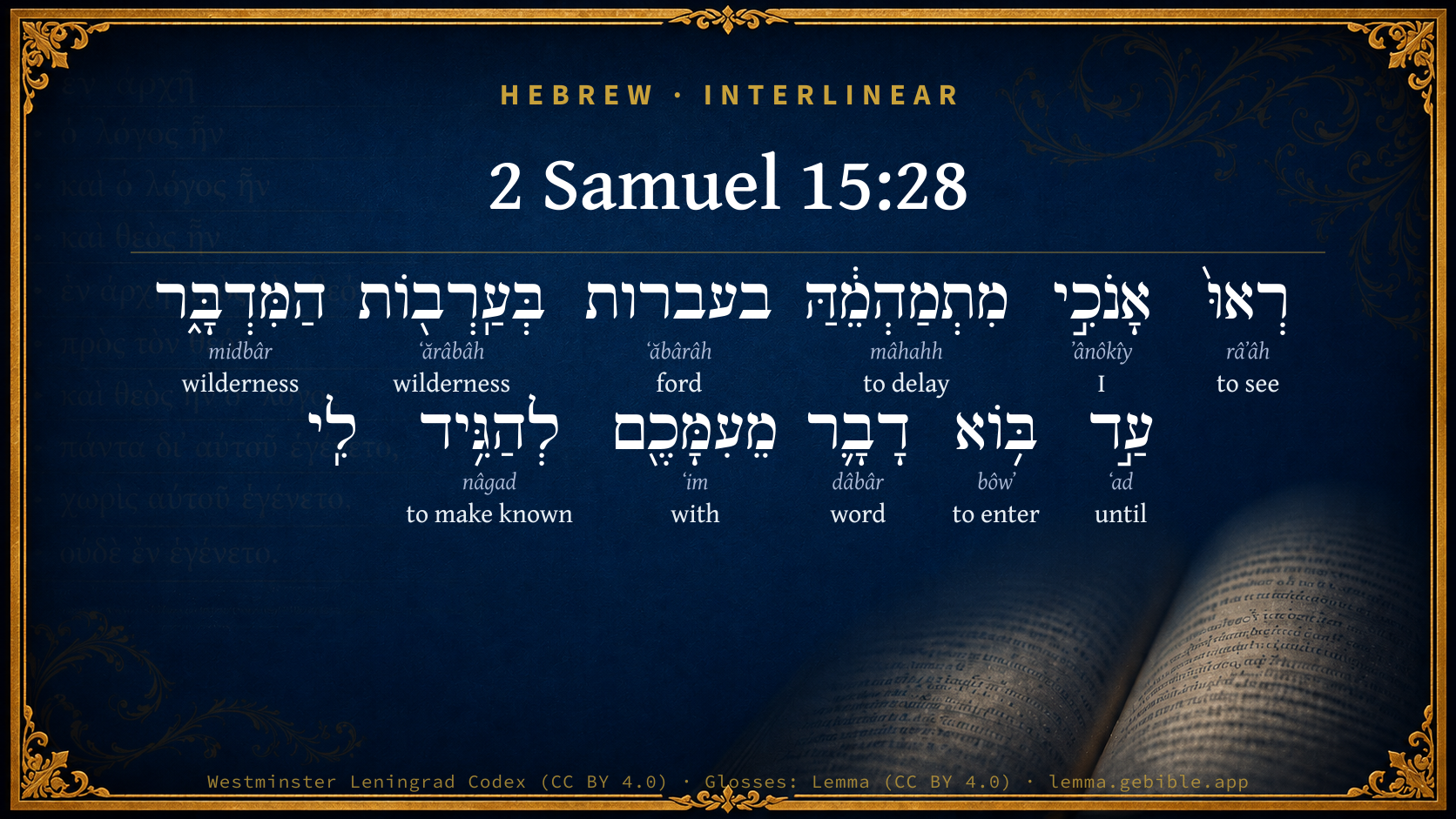
Hebrew (Westminster Leningrad Codex) 2 Samuel 15:28 appears in the Hebrew Old Testament. The text above is from the Westminster Leningrad Codex. Each word links to its Strong’s number, a concise gloss, and parsing drawn from the Open Scriptures Hebrew Bible morphology. Click any word for its full Brown-Driver-Briggs (BDB) entry.
Download image
Cite this verse

2 Samuel 15:28 (World English Bible). Public Domain. Lemma interlinear Bible study tool, https://lemma.gebible.app/v/2-samuel/15/28.

Show BibTeX & RIS
BibTeX
RIS
English Translation
Behold, I will stay at the fords of the wilderness, until word comes from you to inform me."
World English Bible · Public Domain
Highlights
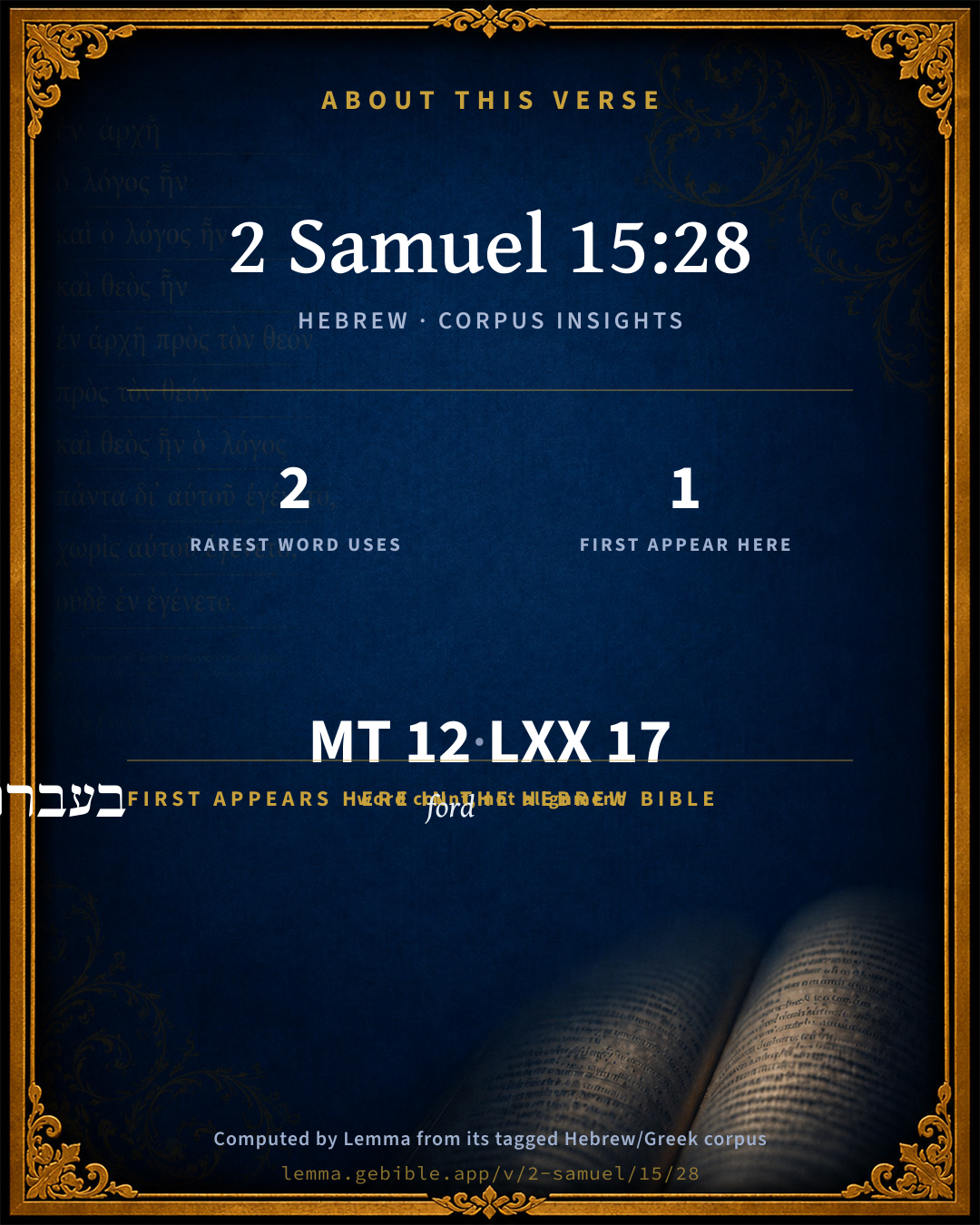
  • 1 first appearance in the Hebrew Bible
Full analysis ↓
Download a study sheet

One document with this verse’s original text, its word-by-word gloss line, the meaning frame, cross-references with their text, attributed commentary, and full source and license credits — printable, and it pastes into notes with its structure intact.

This verse Autodidact and up

Study sheet (.html) Plain text (.txt)

A passage Seminary Student

Up to 50 verses in one chapter. A passage sheet keeps up to 6 commentary sources and 12 cross-references per verse, in the order this page ranks them, and says so on the sheet whenever that leaves anything out. Ask for a single verse and you get the Autodidact verse sheet above.

Everything on this page stays free to read, with no account — the sheet is a download of what is already on screen, not access to it.

Want to remove ads? Support Godless Engineer
Compare translations 3

The same verse in 3 English versions, stacked beneath the original-language interlinear above. Click any original word for its lexicon entry.

Each is an independent rendering of the whole verse — the interlinear is not word-aligned to these translations.

Highlighted words mark where these versions differ — a whole-verse word diff, not a word-by-word alignment.

  • World English Bible Public Domain
    Behold, I will stay at the fords of the wilderness, until word comes from you to inform me."
  • King James Version Public Domain
    See, I will tarry in the plain of the wilderness, until there come word from you to certify me.
  • unfoldingWord Literal Text CC BY-SA 4.0
    See, I will be waiting at the fords of the wilderness until word comes from you to declare to me.”

unfoldingWord Literal Text — © unfoldingWord, licensed CC BY-SA 4.0. Word-aligned USFM3 via Door43 (git.door43.org/unfoldingWord/en_ult).

Versions to compare (up to 4)

3 of 4 selected

Show all 18 translations

Every available English version of this verse, each an independent rendering of the whole verse.

  • World English Bible Public Domain
    Behold, I will stay at the fords of the wilderness, until word comes from you to inform me."
  • Berean Standard Bible Public Domain
    See, I will wait at the fords of the wilderness until word comes from you to inform me.”
  • Majority Standard Bible Public Domain
    See, I will wait at the fords of the wilderness until word comes from you to inform me.”
  • King James Version Public Domain
    See, I will tarry in the plain of the wilderness, until there come word from you to certify me.
  • American Standard Version (1901) Public Domain
    See, I will tarry at the fords of the wilderness, until there come word from you to certify me.
  • Revised Version (1885) Public Domain
    See, I will tarry at the fords of the wilderness, until there come word from you to certify me.
  • Geneva Bible (1599) Public Domain
    Behold, I wil tarie in the fieldes of the wildernesse, vntill there come some worde from you to be tolde me.
  • Douay-Rheims (1899) Public Domain
    Behold I will lie hid in the plains of the wilderness, till there come word from you to certify me.
  • Young's Literal Translation Public Domain
    see ye, I am tarrying in the plains of the wilderness till the coming in of a word from you to declare to me.'
  • Literal Standard Version CC BY-SA 4.0
    see, I am lingering in the plains of the wilderness until the coming in of a word from you to declare to me.”
  • Unlocked Literal Bible CC BY-SA 4.0
    See, I will wait at the fords of the Arabah until word comes from you to inform me.”
  • unfoldingWord Literal Text CC BY-SA 4.0
    See, I will be waiting at the fords of the wilderness until word comes from you to declare to me.”
  • Darby Bible Public Domain
    See, I will stop in the plains of the desert, until there come word from you to inform me.
  • World Messianic Bible Public Domain
    Behold, I will stay at the fords of the wilderness until word comes from you to inform me.”
  • Webster's Bible Public Domain
    See, I will tarry in the plain of the wilderness, until word shall come from you to certify me.
  • Free Bible Version CC BY-SA 4.0
    I'll wait at the fords of the wilderness until I hear from you.”
  • Bible in Basic English Public Domain
    See, I will be waiting at the way across the river, in the waste land, till I get news from you.
  • JPS Tanakh (1917) Public Domain
    See, I will tarry in the plains of the wilderness, until there come word from you to announce unto me.'

Literal Standard Version (2020), Covenant Press — licensed CC BY-SA 4.0. Text via the HelloAO Bible API (eBible.org). Unlocked Literal Bible (unfoldingWord) — licensed CC BY-SA 4.0. Text via the HelloAO Bible API (eBible.org). unfoldingWord Literal Text — © unfoldingWord, licensed CC BY-SA 4.0. Word-aligned USFM3 via Door43 (git.door43.org/unfoldingWord/en_ult). Free Bible Version, Dr. Jonathan Gallagher — licensed CC BY-SA 4.0. Text via the HelloAO Bible API (eBible.org).

Word by word

More ways to search: Search by grammar → Find every occurrence → Compare this word →

Practice this passage: Drill this verse → Learn its vocabulary →

בעברות
ʻăbârâh
H5679
“in/at · fords of”
Preposition + Noun, Common, Feminine, Plural, Construct
Part of Speech
Preposition + Noun
Type
Common
Gender
Feminine
Number
Plural
State
Construct
Full BDB Definition

Origin: from H5674

TWOT: 1556c

ford
  1. רְאוּ֙ râʼâh H7200 “see” Verb, Qal, Imperative, 2nd Person, Masculine, Plural
  2. אָנֹכִ֣י ʼânôkîy H595 “I” Pronoun, Personal, 1st Person, Common, Singular
  3. מִתְמַהְמֵ֔הַּ mâhahh H4102 “delaying” Verb, Hithpalpel, Participle Active, Masculine, Singular, Absolute
  4. בְּעַֽרְב֖וֹת ʻărâbâh H6160 “in/at · wildernesses of” Preposition + Noun, Common, Feminine, Plural, Construct
  5. הַמִּדְבָּ֑ר midbâr H4057 “the · wilderness” Particle, Definite Article + Noun, Common, Masculine, Singular, Absolute
  6. עַ֣ד ʻad H5704 “until” Preposition
  7. בּ֥וֹא bôwʼ H935 “to enter” Verb, Qal, Infinitive Construct
  8. דָבָ֛ר dâbâr H1697 “word” Noun, Common, Masculine, Singular, Absolute
  9. מֵעִמָּכֶ֖ם ʻim H5973 “from · with · you” Preposition + Preposition + Suffix, Personal, 2nd Person, Masculine, Plural
  10. לְהַגִּ֥יד nâgad H5046 “to make known” Preposition + Verb, Hiphil, Infinitive Construct

About this verse

These counts appear in no published source. They are computed here, from the morphology-tagged text and Lemma’s own curated glosses. What Lemma adds →

12
words
11
distinct lemmas
Historical
section

Notable vocabulary

The rarest word here is בעברות ford H5679 — appearing just 2 times in the whole Hebrew Bible.

First appearance in Scripture

This word makes its first canonical appearance in the Hebrew Bible here:

  • בעברות ford H5679

Shared distinctive vocabulary

בעברות ford H5679 occurs in 2 verses of the Hebrew Bible. Also found in:

Grammatical profile

  • 4 verbs
  • 4 nouns
  • 1 pronoun
  • 3 prepositions

Verb forms

  • רְאוּ֙ Qal · Imperative
  • מִתְמַהְמֵ֔הַּ Hithpalpel · Participle Active
  • בּ֥וֹא Qal · Infinitive Construct
  • לְהַגִּ֥יד Hiphil · Infinitive Construct

Hebrew & Septuagint length

In English translation the verse runs 18 words from the Hebrew and 20 from the Septuagint (LXX English) — closely comparable.

A rough comparison of the two English renderings, which tokenize alike — not a word-level alignment.

Word counts can differ between the Hebrew and the Greek without any difference in meaning — e.g. the Hebrew direct-object marker אֵת has no separate Greek word, and Greek often adds the article ὁ.

In the original languages it is 12 Hebrew tokens and 17 Greek tokens — but the two are counted differently (Hebrew bundles its prefixes and suffixes into one token; the Greek is in lemma form), so that isn’t a like-for-like length.

Cross-references

4

Topical passages linked to 2 Samuel 15:28 in the Treasury of Scripture Knowledge — connected by theme and wording, ordered by reader-vote popularity; previews shown in the World English Bible.

  • 2 Samuel 17:16 Now therefore send quickly, and tell David, saying, Don't lodge this night at the fords of the wilderness, but by all means pass over; lest the king be swallowed up, and all the people who are with him.
  • 2 Samuel 15:23 All the country wept with a loud voice, and all the people passed over: the king also himself passed over the brook Kidron, and all the people passed over, toward the way of the wilderness.
  • 2 Samuel 16:2 The king said to Ziba, What do you mean by these? Ziba said, The donkeys are for the king's household to ride on; and the bread and summer fruit for the young men to eat; and the wine, that such as are faint in the wilderness may drink.
  • 2 Samuel 17:1 Moreover Ahithophel said to Absalom, Let me now choose out twelve thousand men, and I will arise and pursue after David this night:

Cross-references courtesy of OpenBible.info (CC BY 4.0).

Hebrew and Greek witnesses Masoretic Hebrew ↔ Greek Septuagint

The same verse in the two great witnesses to the Old Testament, shown verse-for-verse.

These are two independent witnesses, not word-aligned to each other, and the Septuagint is shown in lemma (dictionary) form.

Hebrew 2 Samuel 15:28 Masoretic · Westminster Leningrad Codex

רְאוּ֙ אָנֹכִ֣י מִתְמַהְמֵ֔הַּ בעברות בְּעַֽרְב֖וֹת הַמִּדְבָּ֑ר עַ֣ד בּ֥וֹא דָבָ֛ר מֵעִמָּכֶ֖ם לְהַגִּ֥יד לִֽי

Behold, I will stay at the fords of the wilderness, until word comes from you to inform me."

World English Bible · Public Domain

Greek LXX 2 Samuel 15:28 Septuagint · lemma form

ὁράω ἐγώ εἰμί στρατεύω ἐν ἀραβώθ ὁ ἐρῆμος ἕως ὁ ἔρχομαι ῥῆμα παρά σύ ὁ ἀποἀγγέλλω ἐγώ

Behold, I continue in arms in Araboth of the desert, until there come tidings from you to report to me.

LXX2012 (modern English Septuagint) · Public Domain

Hebrew: Westminster Leningrad Codex (CC BY 4.0). Greek: Septuagint (public domain); English from LXX2012 (modern English Septuagint) (Public Domain). How the Septuagint differs from the Hebrew →

Targum (Aramaic paraphrase)

1

The Targum is the ancient Jewish Aramaic paraphrase of the Hebrew Scriptures — an interpretive translation, not the Hebrew text itself. Onkelos (literal) and Pseudo-Jonathan (expansive) render the Torah, and Jonathan the Prophets. Coverage is partial: where no permissively-licensed English translation exists for a verse, only the Aramaic is shown. This is verse-level text, not a word-by-word alignment to the Hebrew.

  1. Targum Jonathan Prophets (Joshua–Malachi)
    חֲזוֹ דַאֲנָא מִתְעַכֵּב בְּמֵישְׁרֵי מַדְבְּרָא עַד דְיִמְטֵי פִּתְגָמָא מִנְכוֹן לְחַוָאָה לִי:

    (no public-domain English translation for this verse)

    Targum Jonathan — Aramaic: “Mikraot Gedolot” (public domain). English: “Sefaria Community Translation” (CC0 1.0 (public-domain dedication)); “London "Chaldee Paraphrase," 1871” (public domain). Text via Sefaria.

Commentary

Notes on 2 Samuel 15:28 from classic Christian and Jewish commentators (each source and its license shown beneath its notes). The classic Christian expositions comment on the surrounding passage and are grouped to its opening verse, so a note may address several verses; the Jewish commentaries on the Tanakh (Rashi and others) are per-verse, so they appear only where the commentator wrote on this verse.

Lemma curates 59 commentaries, every one of them public domain or Creative Commons licensed, each selected and text-cleaned for this edition rather than reprinted as found. About our sources →

Trapp's Complete Commentary

John Trapp

2Sa 15:28 See, I will tarry in the plain of the wilderness, until there come word from you to certify me.

Ver. 28. See, I will tarry in the plain of the wilderness.] Where in times past he had lived, when he fled from Saul, and had found that God was not "a wilderness unto him, or a land of darkness." {Jer 2:31}

John Trapp, A Commentary or Exposition upon All the Books of the Old and New Testament (1647–1656) — public domain. Text from a community e-Sword module.

Ellicott's Commentary for English Readers

(28) The plain of the wilderness.—This is the reading of the Hebrew margin here and at 2Sa_17:16, and is followed by the ancient versions. It is used for the wide valley of the Jordan in which Jericho is situated; but in both places the Hebrew text is better, the fords, both as a more definite place where messengers would find David, and also as a place of strategic importance where a retreat across the Jordan was open at any moment.

A Bible Commentary for English Readers, edited by Charles John Ellicott (1878–1897) — public domain. Text from a community e-Sword module.

The Cambridge Bible for Schools and Colleges

gen. ed. J. J. S. Perowne

28. in the plain of the wilderness] The level district of the Jordan valley near Jericho, called elsewhere “the plains of Jericho.” Cp. Jos_5:10; 2Ki_25:5; and note on ch. 2Sa_2:29. Instead however of plains which is the traditional reading (Qrî), the written text (Kthîbh) has fords. This certainly seems the more probable reading both here and in ch. 2Sa_17:16, where there is the same variation, for a definite place must have been named at which the messenger was to find David, and the ford, as a critical point, would be a most natural halting place.

to certify me] To tell me how matters are going in the city.

The Cambridge Bible for Schools and Colleges (gen. ed. J. J. S. Perowne; Cambridge University Press, 1878–1918) — public domain. Text from a community e-Sword module.

John Gill's Exposition

See, I will tarry in the plain of the wilderness,.... Towards the way of which David and the people went when they came over Kidron, Sa2 15:23,

until there come word from you to certify me; of the truth of the conspiracy, of the number of the conspirators, and who they are, what progress they have made, whether come to Jerusalem, and how they behave there, if come; or of anything relative hereunto he could get intelligence of.

John Gill's Exposition of the Whole Bible (1746–1763) — public domain (CC PDM 1.0). Text via the HelloAO Bible API.

Whedon's Commentary on the Bible

Daniel D. Whedon

28. I will tarry in the plain of the wilderness — This could be none other than the plain of Jericho. 2Ki_25:5. But the text reads עברית, which in the singular is rendered, 2Sa_19:18, a ferry-boat; and it is best to regard the plural, both here and in 2Sa_17:16, as equivalent to מעברות, crossing places, or fords. The crossing places of the desert would be the fords of the Jordan, which were on the eastern border of the desert. Furst renders it, in the outermost sides of the steppe.

Daniel D. Whedon (gen. ed.), Commentary on the Old and New Testaments (1874–1909) — public domain. Text from a community e-Sword module.

The Pulpit Commentary

In the plain of the wilderness. The Revised Version has "at the fords of the wilderness," that is, it rightly keeps to the written Hebrew text (the K"tib), while the Authorized Version adopts a conjecture of the Massorites (the K"ri). This conjecture is the substitution of arboth for abroth, and they have made the same alteration at, 2Sa_17:16. But the substitution is uncalled for and mischievous; for David would not halt indefinitely in the plain, the Arabah (of which Arboth is the plural) but would press on to the fords, where some delay must take place, and where the king"s presence would be important in giving instructions for what was by no means an easy operation. (comp. 2Sa_19:18) At the river, moreover, David could be assailed only in front, where his "mighties" would make a strong defence, while in the Arabah they might be surrounded; and, encumbered as they were with women, their line must be so extended as to be weakened. We find, too, in Jud_1:3:28 that the fords of the Jordan formed a good military position. In 2Sa_17:22 it is expressly said that the fording of the river did not take place until Jonathan and Ahimaaz came with their reports; and their words there, in ver, 21, show that David was on the bank when they arrived, with his preparations so complete, that, in the next few hours, all his company were safely carried over to the other side. Ahimaaz was a famous runner, (see 2Sa_18:27) and, if David was ready, the time gained by him upon any body of troops leaving Jerusalem at the same hour, would have enabled the king to get his people across; but if he had still some miles to march, with a number of women and children, Ahimaaz"s fleetness would have been rendered useless.

The Pulpit Commentary (1880–1919), ed. H.D.M. Spence-Jones & Joseph S. Exell — public domain. Text from a community e-Sword module.

Lesson kit

Teaching starters — assembled from the data on this page, not authored interpretation. Every prompt links to the verse data it draws on. Edit before teaching.

2 Samuel, in the Historical, opens this verse with 12 words (11 distinct Hebrew lemmas). Its most distinctive word is ʻăbârâh (“ford”). A historical commentator’s framing appears above. Read the whole chapter for the surrounding context.

Discussion questions

  1. What does “ford” (ʻăbârâh) contribute to the verse as a whole?
  2. This is the first place “ford” appears in Scripture (first appears here). What does its debut here establish?
  3. How does 2 Samuel 19:18, which shares the word «ford», read alongside this verse?
  4. The translations on this page render this verse differently — a whole-verse word diff, not a word-by-word alignment. What might account for the different wordings?
  5. «רְאוּ֙» is a Qal Imperative verb. How does that grammatical form shape the action described?
  6. Compare how Trapp's Complete Commentary and Ellicott's Commentary for English Readers read this verse. Where do they agree or differ?

Things to notice

Reading settings

Reading text

Shown beneath each verse's original-language words.

Old Testament
Old Testament edition

Read the OT as the Masoretic Hebrew (MT) or the Greek Septuagint (LXX).

English shown for the Greek Septuagint (in the Hebrew ↔ Greek comparison).

Comparing translations? Open the Compare panel on any verse page to stack up to four side by side.