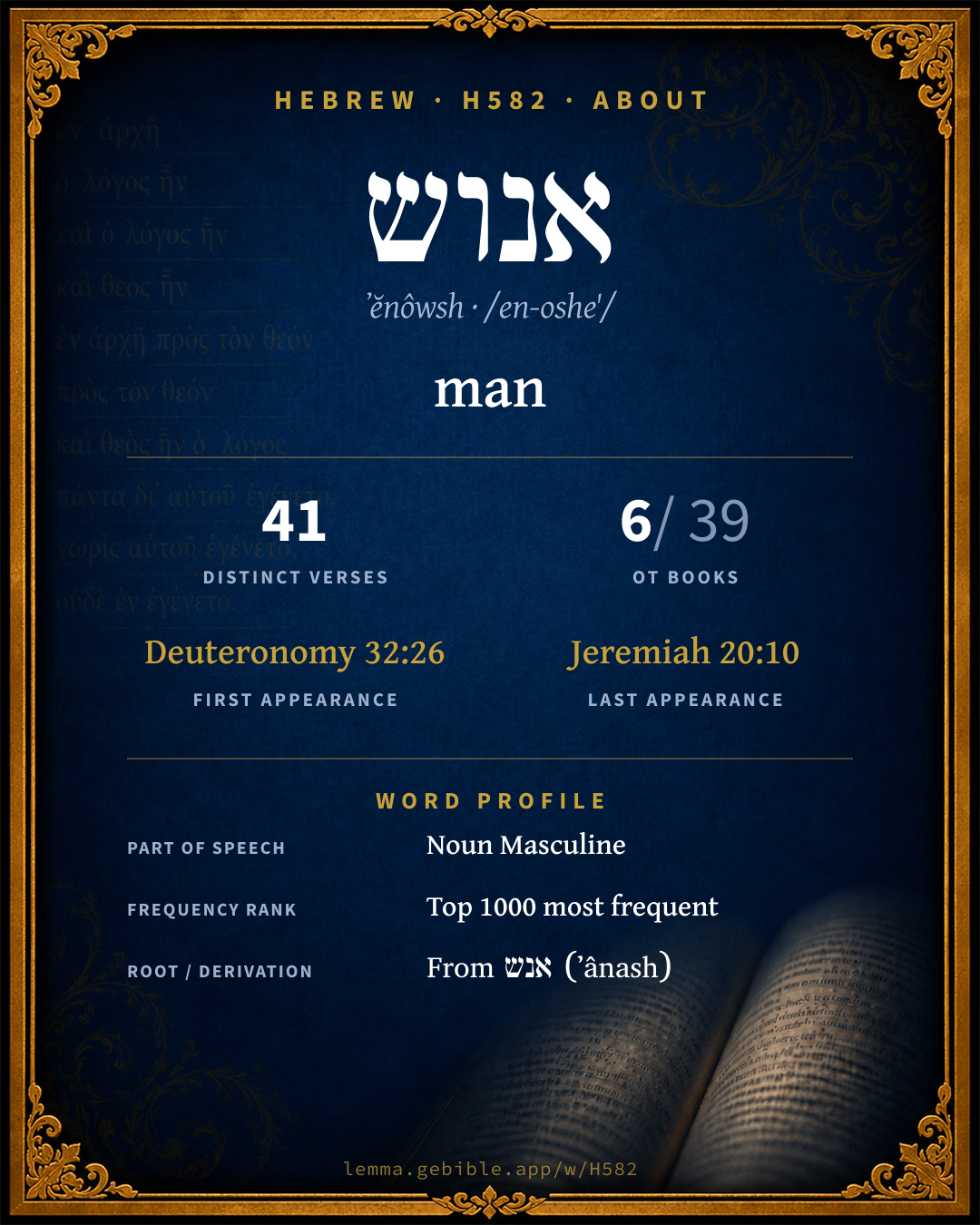
אֱנוֹשׁ
man
also: mortal man, person, mankind fuller range ↓
Full lexicon entry — Brown-Driver-Briggs (BDB)
From Brown-Driver-Briggs (BDB)
Where this word appears
See every Absolute-state word in the Hebrew Bible →
Grammar key — what these labels mean
Part of speech
- Noun
- A naming word — a person, place, thing, or idea.
Noun type
- Common
- A common noun — a general class of person, place, or thing (“king,” “city,” “water”), not a specific name.
State
- Absolute
- The independent form of a noun, not bound to a following word.
- Construct
- A noun bound to a following noun in a possessive / “of” relationship (the construct chain).
Gender
- Masculine
- Grammatically masculine.
Number
- Singular
- One.
39 distinct verses where H582 appears in the Absolute state, across 5 books. Filtered view — show all forms. Click any verse to open its interlinear word-by-word view. Verse text shown in the World English Bible for context — . Each verse’s Hebrew form is shown with its reference; the English is not keyword-highlighted, since the data carries no word-level English alignment. Use “Compare translations” on any verse to read it across multiple English versions. This concordance covers the Hebrew Bible; Septuagint (Greek Old Testament) occurrences are not indexed here.
Deuteronomy 1 verse
2 Chronicles 1 verse
Job 18 verses
- Job 4:17 הַֽ֭/אֱנוֹשׁ ptcl inter + n c ms 'Shall mortal man be more just than God? Shall a man be more pure than his Maker?
- Job 5:17 אֱ֭נוֹשׁ n c ms "Behold, happy is the man whom God corrects: Therefore do not despise the chastening of the Almighty.
- Job 7:1 לֶ/אֱנ֣וֹשׁ prep + n c ms "Isn't a man forced to labor on earth? Aren't his days like the days of a hired hand?
- Job 7:17 אֱ֭נוֹשׁ n c ms What is man, that you should magnify him, That you should set your mind on him,
- Job 9:2 אֱנ֣וֹשׁ n c ms "Truly I know that it is so, But how can man be just with God?
- Job 10:4 אֱנ֣וֹשׁ n c ms Do you have eyes of flesh? Or do you see as man sees?
- Job 10:5 אֱנ֣וֹשׁ n c ms Are your days as the days of mortals, Or your years as man's years,
- Job 13:9 בֶּ֝/אֱנ֗וֹשׁ prep + n c ms Is it good that he should search you out? Or as one deceives a man, will you deceive him?
- Job 14:19 אֱנ֣וֹשׁ n c ms The waters wear the stones; The torrents of it wash away the dust of the earth: So you destroy the hope of man.
- Job 15:14 אֱנ֥וֹשׁ n c ms What is man, that he should be clean? He who is born of a woman, that he should be righteous?
- Job 25:4 אֱנ֣וֹשׁ n c ms How then can man be just with God? Or how can he who is born of a woman be clean?
- Job 25:6 אֱנ֣וֹשׁ n c ms How much less man, who is a worm! The son of man, who is a worm!"
- Job 28:4 מֵ/אֱנ֣וֹשׁ prep + n c ms He breaks open a shaft away from where people live. They are forgotten by the foot. They hang far from men, they swing back and forth.
- Job 28:13 אֱנ֣וֹשׁ n c ms Man doesn't know its price; Neither is it found in the land of the living.
- Job 32:8 בֶ/אֱנ֑וֹשׁ prep + n c ms But there is a spirit in man, And the breath of the Almighty gives them understanding.
- Job 33:12 מֵ/אֱנֽוֹשׁ prep + n c ms "Behold, I will answer you. In this you are not just; For God is greater than man.
- Job 33:26 לֶ֝/אֱנ֗וֹשׁ prep + n c ms He prays to God, and he is favorable to him, So that he sees his face with joy: He restores to man his righteousness.
- Job 36:25 אֱ֝נ֗וֹשׁ n c ms All men have looked thereon. Man sees it afar off.
Psalms 12 verses
- Psalms 8:4 אֱנ֥וֹשׁ n c ms What is man, that you think of him? The son of man, that you care for him?
- Psalms 9:19 אֱנ֑וֹשׁ n c ms Arise, Yahweh! Don't let man prevail. Let the nations be judged in your sight.
- Psalms 9:20 אֱנ֖וֹשׁ n c ms Put them in fear, Yahweh. Let the nations know that they are only men. Selah.
- Psalms 10:18 אֱ֝נ֗וֹשׁ n c ms To judge the fatherless and the oppressed, That man who is of the earth may terrify no more.
- Psalms 55:13 אֱנ֣וֹשׁ n c ms But it was you, a man like me, My companion, and my familiar friend.
- Psalms 56:1 אֱנ֑וֹשׁ n c ms Be merciful to me, God, for man wants to swallow me up. All day long, he attacks and oppresses me.
- Psalms 66:12 אֱנ֗וֹשׁ n c ms You allowed men to ride over our heads. We went through fire and through water, But you brought us to the place of abundance.
- Psalms 73:5 אֱנ֣וֹשׁ n c ms They are free from burdens of men, Neither are they plagued like other men.
- Psalms 90:3 אֱ֭נוֹשׁ n c ms You turn man to destruction, saying, "Return, you children of men."
- Psalms 103:15 אֱ֭נוֹשׁ n c ms As for man, his days are like grass. As a flower of the field, so he flourishes.
- Psalms 104:15 אֱנ֗וֹשׁ אֱנ֥וֹשׁ n c ms n c ms Wine that makes glad the heart of man, Oil to make his face to shine, And bread that strengthens man's heart.
- Psalms 144:3 אֱ֝נ֗וֹשׁ n c ms Yahweh, what is man, that you care for him? Or the son of man, that you think of him?
Isaiah 7 verses
- Isaiah 8:1 אֱנ֔וֹשׁ n c ms Yahweh said to me, "Take a large tablet, and write on it with a man's pen, 'For Maher Shalal Hash Baz;'
- Isaiah 13:7 אֱנ֖וֹשׁ n c ms Therefore shall all hands be feeble, and every heart of man shall melt:
- Isaiah 13:12 אֱנ֖וֹשׁ n c ms I will make a man more rare than fine gold, even a man than the pure gold of Ophir.
- Isaiah 33:8 אֱנֽוֹשׁ n c ms The highways lie waste, the wayfaring man ceases: [the enemy] has broken the covenant, he has despised the cities, he doesn't regard man.
- Isaiah 51:7 אֱנ֔וֹשׁ n c ms Listen to me, you who know righteousness, the people in whose heart is my law; don't you fear the reproach of men, neither be you dismayed at their insults.
- Isaiah 51:12 מֵ/אֱנ֣וֹשׁ prep + n c ms I, even I, am he who comforts you: who are you, that you are afraid of man who shall die, and of the son of man who shall be made as grass;
- Isaiah 56:2 אֱנוֹשׁ֙ n c ms Blessed is the man who does this, and the son of man who holds it fast; who keeps the Sabbath from profaning it, and keeps his hand from doing any evil.
About this entry
At a glance — auto-summarized from this page’s data, not written by a person. Every figure links to its source below. This summary describes the numbers; it doesn’t interpret them.
אנוש (ʼĕnôwsh) is a Hebrew noun most often rendered “man.” Translators differ — “men” in the King James Version, then “man” (unfoldingWord Literal Text), as the renderings breakdown shows. It turns up in 41 verses across 6 books, a moderately common footprint. It concentrates in Job, which alone accounts for 44% of its uses. It also covers “mortal man”, “person”, and “mankind”, alongside “man” — see its full sense range. The sections below give every sense, occurrence, and version rendering.
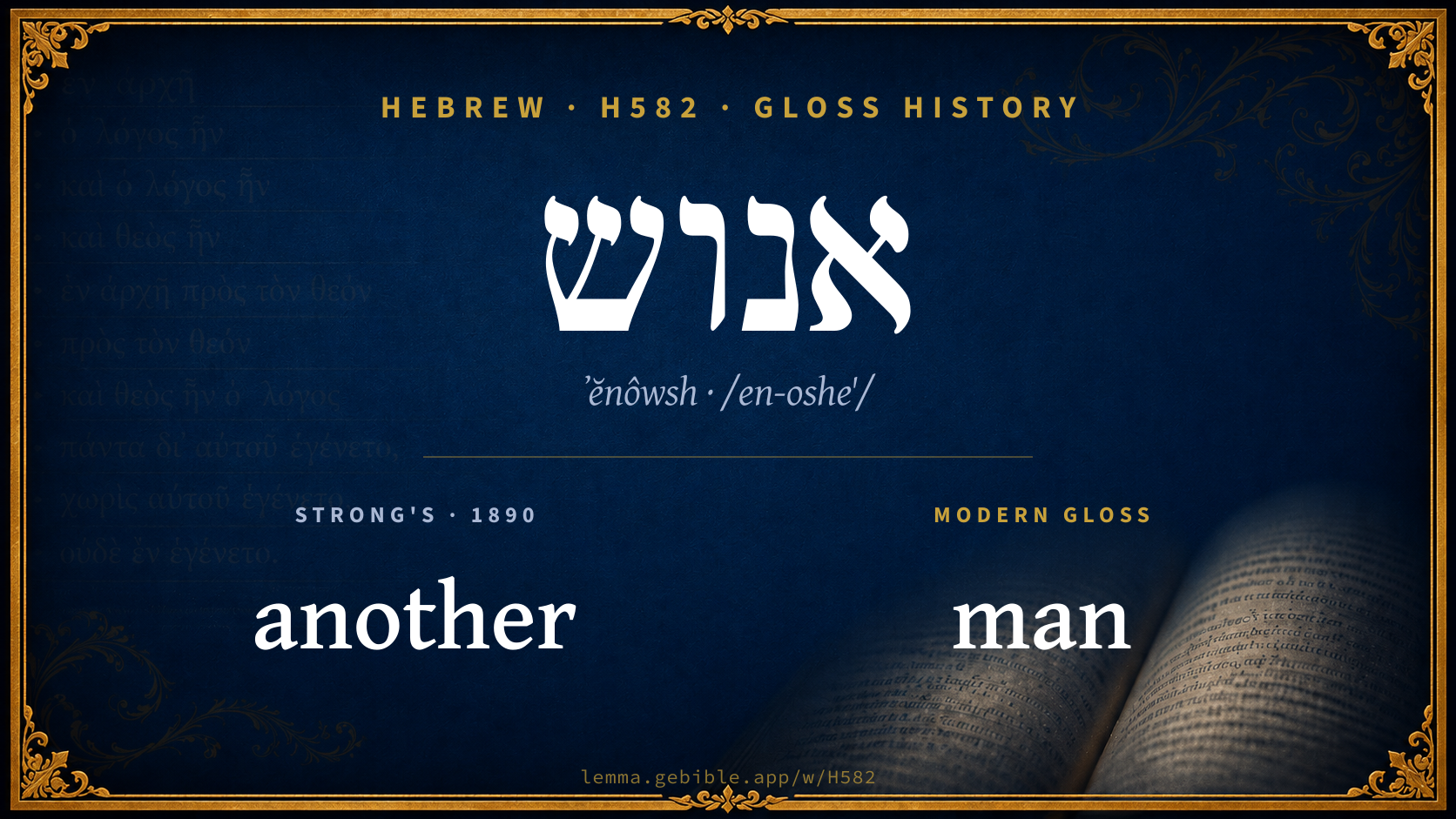
Gloss history
Strong's 1890 vs modern scholarship
About this word
Strong's H582 catalogs a Hebrew word from the Hebrew Old Testament.
These counts are not copied from any lexicon or concordance. They are computed here, from the morphology-tagged Hebrew Old Testament. What Lemma adds →
- 41
- distinct verses
- The word appears in 41 distinct verses.
- 6 / 39
- OT books
- The word appears in 6 of 39 Old Testament books.
- #864
- by frequency
- Top 1000 most frequent Hebrew words (rank 864 of 8,640 Hebrew words by occurrence).
View all 41 occurrences in the concordance →
By section of the Old Testament
By traditional corpus
Conventional, traditional groupings — biblical authorship is debated, so this is a traditional corpus grouping, not an authorship claim. Each share is this word’s portion of its verses in that division of the Hebrew canon. Each figure is a share of the word’s 41 distinct verses.
- Writings (Ketuvim) 31 verses · 76%
- Prophets (Nevi'im) 9 verses · 22%
- Torah (Pentateuch) 1 verse · 2%
How translations render this word
Counts come from each version’s own published word-to-Strong’s tagging or interlinear alignment — an approximate guide to how each version renders this word, not a word-level alignment the data otherwise carries. Because each total is that version’s own tagged count, the per-version totals vary from one another and need not match the appearance or distinct-verse counts above. These counts may also differ from a printed concordance because Lemma counts each distinctly tagged rendering and does not collapse phrase taggings into a single head-word total. This is a fixed set of word-tagged versions (KJV, ASV, BSB, ULT) and does not change with the reading translation you choose elsewhere. Each version’s license is shown beside its name below (and on Sources).
BDB lists this Strong’s number as 2 distinct words (homographs). Each count above pools all of them and is not split by sense — see the Senses section below. A low-frequency rendering may belong to a different one of those words, not the primary meaning.
- King James Version†: Men 370×, All the men 25×, Man 18×
- American Standard Version†: Men 324×, All the men 24×, Man 15×
- Berean Standard Bible†: Men 354×, Man 17×, Warriors 4×
- unfoldingWord Literal Text†: Man 32×, Man of 2×, Mankind 2×
King James Version Public Domain
Renders H582 across 559† tagged occurrences — most commonly:
Plus other, less common renderings. Plus 77 renderings that appear only once — usually multi-word phrases or single function words the recovered tagging swept in, not distinct renderings. Not rendered by a distinct English word in 5 further occurrences.
American Standard Version Public Domain
Renders H582 across 564† tagged occurrences — most commonly:
Plus other, less common renderings. Plus 129 renderings that appear only once — usually multi-word phrases or single function words the recovered tagging swept in, not distinct renderings. Not rendered by a distinct English word in 1 further occurrence.
Berean Standard Bible Public Domain
Renders H582 across 469† tagged occurrences — most commonly:
Plus other, less common renderings. Plus 61 renderings that appear only once — usually multi-word phrases or single function words the recovered tagging swept in, not distinct renderings. Not rendered by a distinct English word in 66 further occurrences.
unfoldingWord Literal Text CC BY-SA 4.0
Renders H582 across 42† tagged occurrences — most commonly:
Plus 6 renderings that appear only once — usually multi-word phrases or single function words the recovered tagging swept in, not distinct renderings.
Senses in the full BDB
What do BDB’s symbols mean?
BDB uses these scholarly abbreviations:
| Symbol | Meaning |
|---|---|
| 𝔊 | the Septuagint (the ancient Greek translation, LXX) |
| 𝔙 | the Vulgate (the Latin translation) |
| 𝔖 | the Syriac version (the Peshitta) |
| 𝔗 | the Targum (the Aramaic translation) |
| ψ | the Psalms |
| √ | root (the underlying root or stem) |
| ‖ | parallel passage (a synonymous or contrasted parallel) |
| † | the dagger: every passage where the word occurs is cited |
The 3 senses and sub-senses the full Brown-Driver-Briggs lexicon distinguishes for this word, in lexicon order (not ranked by frequency), with BDB’s own verbatim wording and sub-sense lettering. Shown in Hebrew script with BDB’s own scholarly abbreviations. The condensed entry is in the Lexicon Entry tab. See also the Forms in the corpus table below.
אנוש I
- 1. of individ. Jb 5:17; 13:9 ψ 55:14, cf. Is 13:12 (‖ אָדָם) 56:2 (‖ בֶּן־אדם); Je 20:10 א׳ שְׁלֹמִי man of my peace, i.e. my friend. e.g. Job 5:17
- 2. coll. men Is 24:6; 33:8; 51:7 ψ 66:12; = men in general, ordinary men ψ 73:5 cf. חֶרֶט א׳ i.e. a common stylus Is 8:1 (v. אַמַּת אִישׁ Dt 3:11). e.g. Isaiah 24:6
- 3. man, mankind Dt 32:26; Jb 7:1; 14:19; 28:4, 13; 32:8; 33:26; 36:25 (‖ אָדָם & אֲנָשִׁים v 24) ψ 56:2; especially opp. God Jb 4:17 (‖ גֶּבֶר) 7:17; 9:2; 10:4, 5; 15:14; 25:4; 33:12; 2 Ch 14:10; ψ 8:5 (‖ בֶּן־אָדָם) so Is 51:12; ψ 9:20, 21, 90:3 (‖ בְּנֵי־אָדָם); 103:15; בֶּן־א׳ 144:3 (‖ אָדָם); cf. כִּי־א׳ רִמָּה וּבֶן־אָדָם תּוֹלֵעָה Jb 25:6; א׳ מִן־הָאָרֶץ ψ 10:18; כָּל־לְבַב א׳ Is 13:7 cf. ψ 104:15(×2). אֲנָשִׁים v. אִושׁ (p. 35). e.g. Deuteronomy 32:26
אנוש II m. son of Seth Gn 4
Senses from the full Brown-Driver-Briggs lexicon (Brown, Driver, Briggs; Oxford 1906 — public domain), digitized via Sefaria, supplemented by the OpenScriptures HebrewLexicon (CC BY 4.0). Full attribution on Sources.
Word origin
I. n.m. Jb 15:14 man, mankind, mostly poet. (18 times Jb, 13 times ψ, etc.) (Arabic أُنَاسٌ (coll.), Aramaic אֱנָשׁ, ܐ݈݇ܢܳܫܳܐ (coll.), Nab. אנוש, Palm. אנש, Sab. אנס DHMZMG 1883, 330, also Arabic نَاسٌ, Assyrian nišu, people, & cf. tenišêtu, humanity, human race, v. COTGloss. sub אנשׁ & נשׁ & HptKAT 2 497)—abs. Is 8:1 +; cstr. Je 20:10;—
II. n.pr.m. son of Seth Gn 4:26; 5:6, 7, 9, 10, 11; 1 Ch 1:1.
— Brown-Driver-Briggs (Oxford 1906, public domain), digitized via Sefaria, supplemented by the OpenScriptures HebrewLexicon (CC BY 4.0). See Sources.
Derived from אנש (ʼânash) (H605) — to be sick.
Jastrow Dictionary
A second Hebrew/Aramaic lexicon for comparison, covering Aramaic and post-biblical (Talmudic, Targumic, Midrashic) usage that the biblical-Hebrew BDB does not. Matched by lemma rather than by Strong’s number, so a lemma may carry more than one Jastrow headword (shown separately below), and the entries cover usage well beyond the Bible.
אֱנוֹשׁ
- v. אינש) [being], man. — Pl. (of אִישׁ) אֲנָשִׁים, const. אַנְשֵׁי. Ex. R. s. 25; a. fr.—א׳ כנסת הגדולה (abbr. אכה"ג) the Men. of the Great Assembly, Synagoga Magna, a religious and judicial authority said to have been established by Ezra. Aboth I, 1; a. fr.; cmp. כְּנֶסֶת.—(ות) א׳ בית אב the division on duty of priests having charge of the services of the day; א׳ משמר the division of priests alternately on duty during one week; א׳ מעמד the division (of Israelites) assisting the priests on duty, by prayers &c. on the platform (מעמד) and divided in parties corresponding to the priestly divisions. Taan. II, 6; 7; a. fr.
*אָנוּשׁ
- v. preced. a. strong, severe, overwhelming. Num. R. s. 7 (ref. to Is. XVII, 11) א׳ לשון גבר anush has the meaning of strong; Lev. R. s. 18. e.g. Isaiah 17:11
A Dictionary of the Targumim, the Talmud Babli and Yerushalmi, and the Midrashic Literature (Marcus Jastrow; London, Luzac, 1903) — Public Domain. Digitized via Sefaria. Digitized via Sefaria. Full attribution on Sources.
Forms in the corpus
The 18 distinct written forms H582 takes in the Hebrew Bible, most frequent first — each parse links to that state’s occurrences in the concordance. Hebrew forms include their vowel points and cantillation, so a single lemma takes many written forms.
Same root — word family
Other BDB entries built from the same root as H582, grouped by Strong’s listed origin. These share a root / origin per the lexicon — not necessarily a shared meaning. Each links to that word’s own entry.
Derives from
Derived from this word
Proper names from this root
People and places named from this root — a name, not an additional meaning of the word.
Compare all same-root words → Showing 4 of 5 — not the complete family. 1 of the same-root words is a proper name (a person or place). They share a root, not necessarily a meaning.
Septuagint verse parallels
This word appears in 39 verses that also exist in the Greek Old Testament (Septuagint), out of the 41 Hebrew verses it occurs in. You can read those verses in Greek by switching the Old Testament edition to the Septuagint.
Read these verses in the Septuagint
This is a verse-level parallel only — the same verses exist in both the Hebrew and Greek Old Testaments. No word-level Hebrew↔Greek correspondence is claimed: the data carries no such alignment, so no Greek word is shown as this Hebrew word’s translation. Coverage is not total — the Septuagint omits the deuterocanon and renumbers the Psalms, so some Hebrew verses have no direct Greek parallel.