
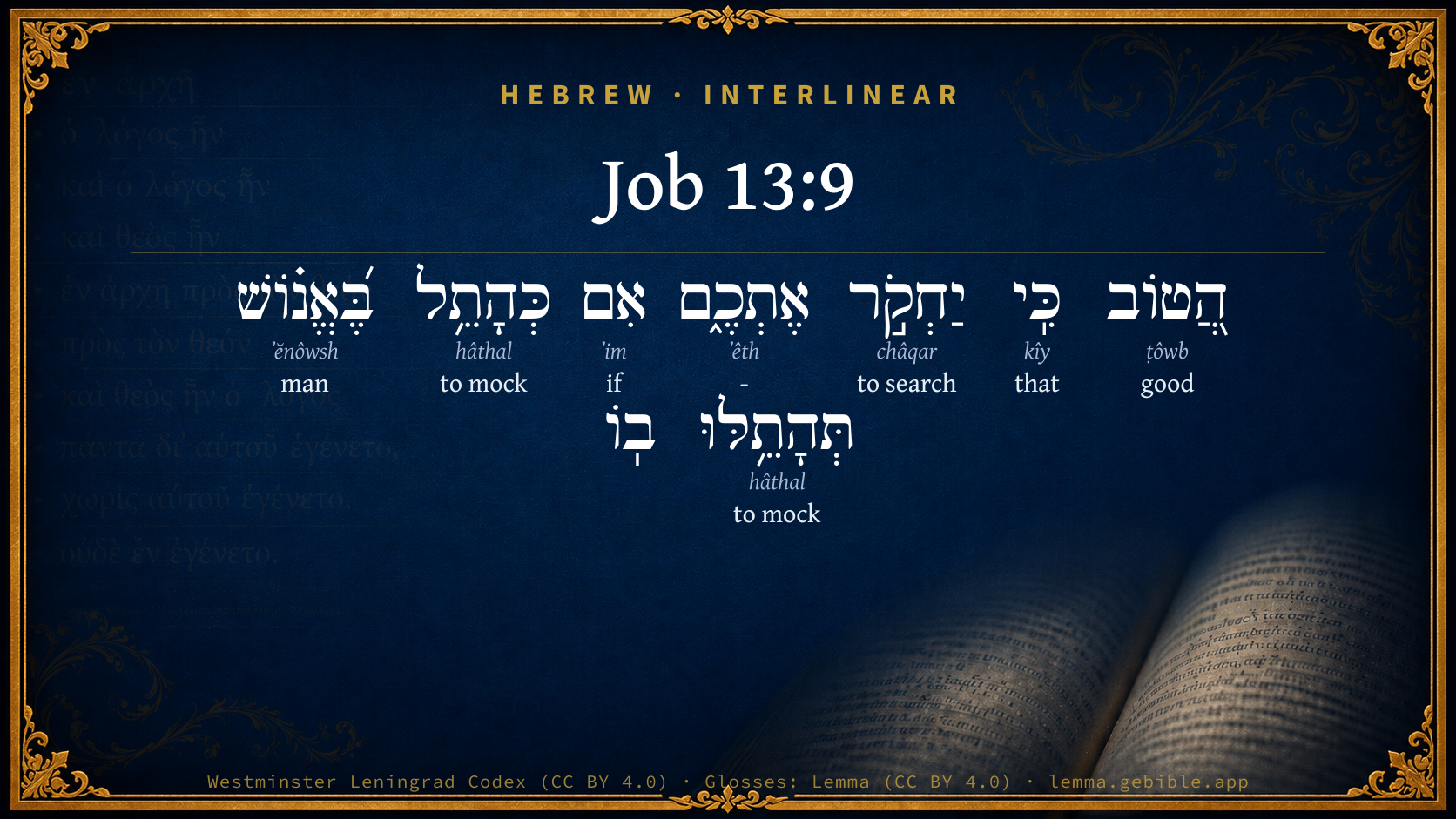
Job 13:9

Hebrew (Westminster Leningrad Codex) Job 13:9 appears in the Hebrew Old Testament. The text above is from the Westminster Leningrad Codex. Each word links to its Strong’s number, a concise gloss, and parsing drawn from the Open Scriptures Hebrew Bible morphology. Click any word for its full Brown-Driver-Briggs (BDB) entry.
Download image
Cite this verse

Job 13:9 (World English Bible). Public Domain. Lemma interlinear Bible study tool, https://lemma.gebible.app/v/job/13/9.

Show BibTeX & RIS
BibTeX
RIS
English Translation
Is it good that he should search you out? Or as one deceives a man, will you deceive him?
World English Bible · Public Domain
Download a study sheet

One document with this verse’s original text, its word-by-word gloss line, the meaning frame, cross-references with their text, attributed commentary, and full source and license credits — printable, and it pastes into notes with its structure intact.

This verse Autodidact and up

Study sheet (.html) Plain text (.txt)

A passage Seminary Student

Up to 50 verses in one chapter. A passage sheet keeps up to 6 commentary sources and 12 cross-references per verse, in the order this page ranks them, and says so on the sheet whenever that leaves anything out. Ask for a single verse and you get the Autodidact verse sheet above.

Everything on this page stays free to read, with no account — the sheet is a download of what is already on screen, not access to it.

Want to remove ads? Support Godless Engineer
Compare translations 3

The same verse in 3 English versions, stacked beneath the original-language interlinear above. Click any original word for its lexicon entry.

Each is an independent rendering of the whole verse — the interlinear is not word-aligned to these translations.

Highlighted words mark where these versions differ — a whole-verse word diff, not a word-by-word alignment.

  • World English Bible Public Domain
    Is it good that he should search you out? Or as one deceives a man, will you deceive him?
  • King James Version Public Domain
    Is it good that he should search you out? or as one man mocketh another, do ye so mock him?
  • unfoldingWord Literal Text CC BY-SA 4.0
    good that he will examine you? Or will you deceive him as deceiving a man?

unfoldingWord Literal Text — © unfoldingWord, licensed CC BY-SA 4.0. Word-aligned USFM3 via Door43 (git.door43.org/unfoldingWord/en_ult).

Versions to compare (up to 4)

3 of 4 selected

Show all 18 translations

Every available English version of this verse, each an independent rendering of the whole verse.

  • World English Bible Public Domain
    Is it good that he should search you out? Or as one deceives a man, will you deceive him?
  • Berean Standard Bible Public Domain
    Would it be well when He examined you? Could you deceive Him like a man?
  • Majority Standard Bible Public Domain
    Would it be well when He examined you? Could you deceive Him as you would deceive a man?
  • King James Version Public Domain
    Is it good that he should search you out? or as one man mocketh another, do ye so mock him?
  • American Standard Version (1901) Public Domain
    Is it good that he should search you out? Or as one deceiveth a man, will ye deceive him?
  • Revised Version (1885) Public Domain
    Is it good that he should search you out? or as one deceiveth a man, will ye deceive him?
  • Geneva Bible (1599) Public Domain
    Is it well that he shoulde seeke of you? will you make a lye for him, as one lyeth for a man?
  • Douay-Rheims (1899) Public Domain
    Or shall it please him, from whom nothing can be concealed? or shall he be deceived as a man, with your deceitful dealings?
  • Young's Literal Translation Public Domain
    Is `it' good that He doth search you, If, as one mocketh at a man, ye mock at Him?
  • Literal Standard Version CC BY-SA 4.0
    Is [it] good that He searches you, || If, as one mocks at a man, you mock at Him?
  • Unlocked Literal Bible CC BY-SA 4.0
    Will it be good for you when he searches you out? Could you deceive him as you might deceive men?
  • unfoldingWord Literal Text CC BY-SA 4.0
    good that he will examine you? Or will you deceive him as deceiving a man?
  • Darby Bible Public Domain
    Will it be well if he should search you out? or as one mocketh at a man, will ye mock at him?
  • World Messianic Bible Public Domain
    Is it good that he should search you out? Or as one deceives a man, will you deceive him?
  • Webster's Bible Public Domain
    Is it good that he should search you out? or as one man mocketh another, do ye so mock him?
  • Free Bible Version CC BY-SA 4.0
    Will you be found to be doing good when God examines you? Can you fool him as if he's a human being?
  • Bible in Basic English Public Domain
    Will it be good for you to be searched out by him, or have you the thought that he may be guided into error like a man?
  • JPS Tanakh (1917) Public Domain
    Would it be good that He should search you out? Or as one mocketh a man, will ye mock Him?

Literal Standard Version (2020), Covenant Press — licensed CC BY-SA 4.0. Text via the HelloAO Bible API (eBible.org). Unlocked Literal Bible (unfoldingWord) — licensed CC BY-SA 4.0. Text via the HelloAO Bible API (eBible.org). unfoldingWord Literal Text — © unfoldingWord, licensed CC BY-SA 4.0. Word-aligned USFM3 via Door43 (git.door43.org/unfoldingWord/en_ult). Free Bible Version, Dr. Jonathan Gallagher — licensed CC BY-SA 4.0. Text via the HelloAO Bible API (eBible.org).

Word by word

More ways to search: Search by grammar → Find every occurrence → Compare this word →

Practice this passage: Drill this verse → Learn its vocabulary →

About this verse

These counts appear in no published source. They are computed here, from the morphology-tagged text and Lemma’s own curated glosses. What Lemma adds →

9
words
7
distinct lemmas
Wisdom
section

Notable vocabulary

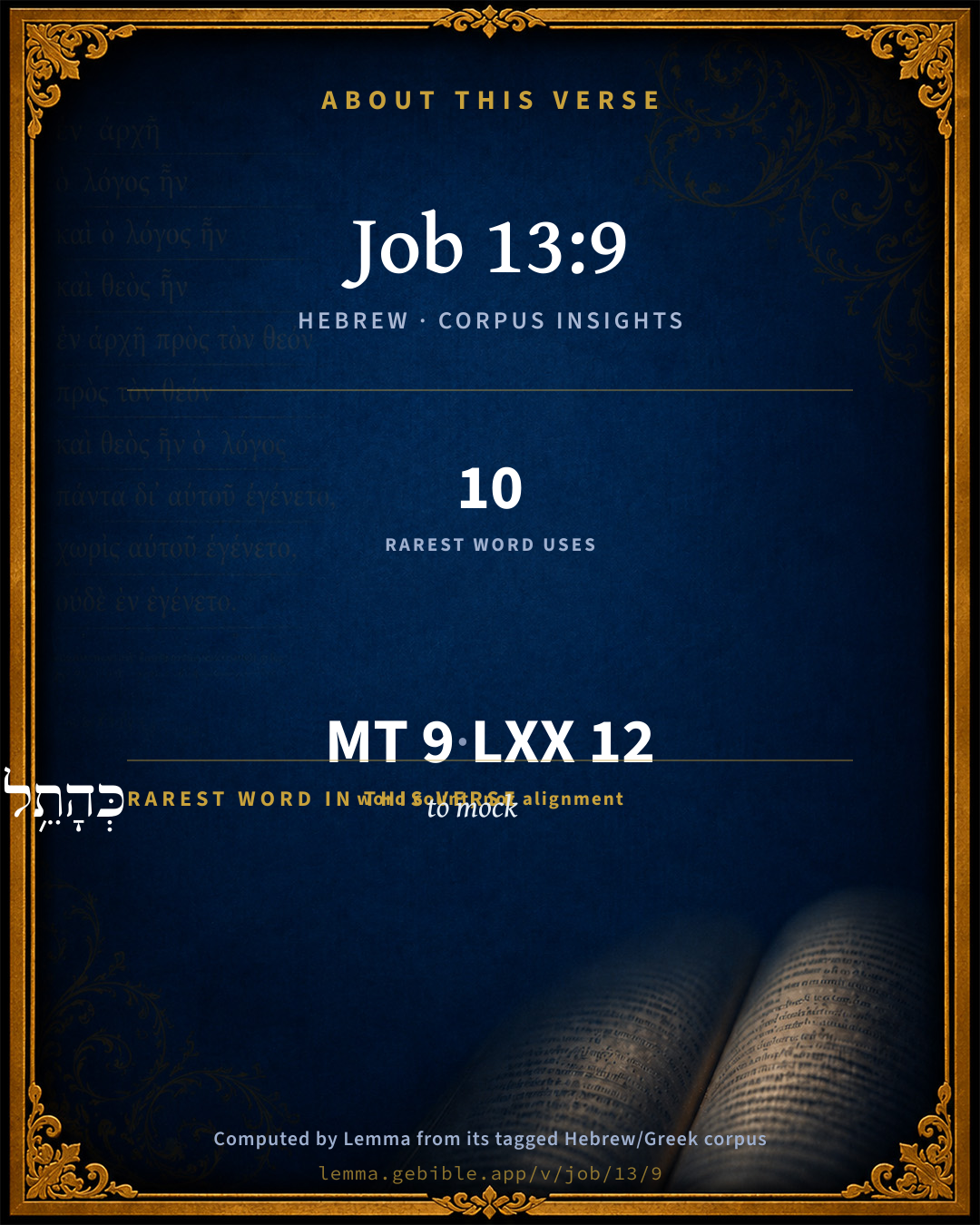
The rarest word here is כְּהָתֵ֥ל to mock H2048 — appearing just 10 times in the whole Hebrew Bible.

Shared distinctive vocabulary

כְּהָתֵ֥ל to mock H2048 occurs in 9 verses of the Hebrew Bible. Also found in:

Grammatical profile

  • 3 verbs
  • 1 noun
  • 1 adjective
  • 1 preposition
  • 2 conjunctions
  • 1 particle

Verb forms

  • יַחְקֹ֣ר Qal · Imperfect
  • כְּהָתֵ֥ל Hiphil · Infinitive Construct
  • תְּהָתֵ֥לּוּ Hiphil · Imperfect

Repetition

A word recurs within this verse — often emphatic in Hebrew:

  • כְּהָתֵ֥ל to mock H2048 ×2

Hebrew & Septuagint length

In English translation the verse runs 19 words from the Hebrew and 24 from the Septuagint (LXX English) — closely comparable.

A rough comparison of the two English renderings, which tokenize alike — not a word-level alignment.

Word counts can differ between the Hebrew and the Greek without any difference in meaning — e.g. the Hebrew direct-object marker אֵת has no separate Greek word, and Greek often adds the article ὁ.

In the original languages it is 9 Hebrew tokens and 12 Greek tokens — but the two are counted differently (Hebrew bundles its prefixes and suffixes into one token; the Greek is in lemma form), so that isn’t a like-for-like length.

Cross-references

8

Topical passages linked to Job 13:9 in the Treasury of Scripture Knowledge — connected by theme and wording, ordered by reader-vote popularity; previews shown in the World English Bible.

  • Galatians 6:7–8 Don't be deceived. God is not mocked, for whatever a man sows, that will he also reap.
  • Jeremiah 17:10 I, Yahweh, search the mind, I try the heart, even to give every man according to his ways, according to the fruit of his doings.
  • Psalms 44:21 Won't God search this out? For he knows the secrets of the heart.
  • Job 12:16 With him is strength and wisdom; The deceived and the deceiver are his.
  • Job 17:2 Surely there are mockers with me, My eye dwells on their provocation.
  • Job 34:36 I wish that Job were tried to the end, Because of his answering like wicked men.
  • Psalms 139:23 Search me, God, and know my heart. Try me, and know my thoughts.
  • Isaiah 28:22 Now therefore don't you be scoffers, lest your bonds be made strong; for a decree of destruction have I heard from the Lord, Yahweh of Hosts, on the whole earth.

Cross-references courtesy of OpenBible.info (CC BY 4.0).

Hebrew and Greek witnesses Masoretic Hebrew ↔ Greek Septuagint

The same verse in the two great witnesses to the Old Testament, shown verse-for-verse.

These are two independent witnesses, not word-aligned to each other, and the Septuagint is shown in lemma (dictionary) form.

Hebrew Job 13:9 Masoretic · Westminster Leningrad Codex

הֲ֭טוֹב כִּֽי יַחְקֹ֣ר אֶתְכֶ֑ם אִם כְּהָתֵ֥ל בֶּ֝אֱנ֗וֹשׁ תְּהָתֵ֥לּוּ בֽוֹ

Is it good that he should search you out? Or as one deceives a man, will you deceive him?

World English Bible · Public Domain

Greek LXX Job 13:9 Septuagint · lemma form

καλός γέ ἐάν ἐκἰχνιάζω σύ εἰ γάρ ὁ πᾶς ποιέω προςτίθημι αὐτός

For it were well if he would thoroughly search you: for though doing all things in your power you⌃ should attach yourselves to him,

LXX2012 (modern English Septuagint) · Public Domain

Hebrew: Westminster Leningrad Codex (CC BY 4.0). Greek: Septuagint (public domain); English from LXX2012 (modern English Septuagint) (Public Domain). How the Septuagint differs from the Hebrew →

Commentary

Notes on Job 13:9 from classic Christian and Jewish commentators (each source and its license shown beneath its notes). The classic Christian expositions comment on the surrounding passage and are grouped to its opening verse, so a note may address several verses; the Jewish commentaries on the Tanakh (Rashi and others) are per-verse, so they appear only where the commentator wrote on this verse.

Lemma curates 59 commentaries, every one of them public domain or Creative Commons licensed, each selected and text-cleaned for this edition rather than reprinted as found. About our sources →

Trapp's Complete Commentary

John Trapp

Job 13:9 Is it good that he should search you out? or as one man mocketh another, do ye [so] mock him?

Ver. 9. Is it good that he should search you out &c.] q.d. Could you have any joy from such a search? Will not all your warpings and partialities, your colloguing and sinisterity, be laid open to your loss and shame? Will not God reprove instead of approving you in that which ye have said for him, but all against me? The time will come when God will surely search out all controversies, that they all may be ashamed who, under a pretext of religion and right, have spoken false things, and subverted the faith of some. See 1Co 3:17.

Or as one man mocketh another, do ye so mock him?] Be not deceived; God is not mocked, deluded, beguiled, as clients are by their corrupt lawyers; as patients are by their cogging quack healers. Sorry man may be mocked, and made to believe lies, as 2Sa 15:11 Act 8:9-10 Rev 13:3 : all the world wondered after the beast. Judges, and other wise men, are shamefully out in other ways deceiving, and being deceived. Not so the all wise God. They that would mock him, imposturam faciunt et patiuntur, as the emperor said of him that sold glass for pearls, they deceive not God, but themselves. Neither may their conceit that their good intentions will bear them out (as Merlin here noteth) any more than it did these contenders for God, who little thought of mocking him. A bad aim maketh a good action bad, as we see in Jehu; but a good aim maketh not a bad action good, as we see in Uzzah, and here.

John Trapp, A Commentary or Exposition upon All the Books of the Old and New Testament (1647–1656) — public domain. Text from a community e-Sword module.

Joseph Benson's Commentary

Job 13:9-10. Is it good that he should search you out? — Will it be to your credit and comfort, that he should narrowly examine your hearts and discourses, whether you have uttered truth or falsehood, and whether your speeches have proceeded from true zeal for the glory of God, or from your own prejudices and passions? Do ye so mock him? — By covering your uncharitableness and corrupt affections with pretences of piety, as if God could not discern your artifices; or, by pleading his cause with weak and foolish arguments, which is a kind of mockery of him, and an injury to his cause; or, by seeking to flatter him with false praises, as if he distributed the things of this world with exact justice, prospering only the good, and severely afflicting none but wicked men. He will surely reprove you — Hebrew, הוכח יוכח, hocheach, jocheach, redarguendo redarguet, in confuting, he will confute you; that is, he will surely confute, or punish you, as the word often means. “He will severely chastise you, for designing to gratify him by condemning me.” — Bishop Patrick. If ye do secretly accept persons — Though it be concealed in your own breasts, and no eye see it; yea, though your own minds and consciences, through ignorance or inadvertency, do not perceive it; yet he, who is greater than your consciences, sees and knows it.

Joseph Benson's Commentary on the Old and New Testaments (1811–1818) — public domain. Text from a community e-Sword module.

Jamieson, Fausset & Brown

Robert Jamieson, A. R. Fausset & David Brown

Will the issue to you be good, when He searches out you and your arguments? Will you be regarded by Him as pure and disinterested?

mock-- (Gal 6:7). Rather, "Can you deceive Him as one man?" &c.

Jamieson, Fausset & Brown — Commentary Critical and Explanatory on the Whole Bible (1871) — public domain (CC PDM 1.0). Text via the HelloAO Bible API.

Adam Clarke's Commentary

Verse 9. Is it good that he should search you out?] Would it be to your credit if God should try your hearts, and uncover the motives of your conduct? Were you tried as I am, how would you appear?

Do ye so mock him?] Do ye think that you can deceive him; and by flattering speeches bring him to your terms, as you would bring an undiscerning, empty mortal, like yourselves?

Adam Clarke's Commentary on the Bible (1810–1826) — public domain. Text from a community e-Sword/MySword module.

Ellicott's Commentary for English Readers

(9) As one man mocketh another.—As one man, with mingled flattery and deception, seeks to impose upon another.

A Bible Commentary for English Readers, edited by Charles John Ellicott (1878–1897) — public domain. Text from a community e-Sword module.

The Cambridge Bible for Schools and Colleges

gen. ed. J. J. S. Perowne

9. Is it good] The words may mean, will it be well (for you) that He should search (or, when He shall search)? or as ch. Job_10:3, do you like that He should search you out? The second clause should read,

Or as one deceiveth a man will ye deceive Him?

When God searches you out and looks into the secret springs of your actions do you expect to be able to deceive Him by representations or demeanour or look as one imposes on a man, who cannot “read the mind’s construction in the face”?

The Cambridge Bible for Schools and Colleges (gen. ed. J. J. S. Perowne; Cambridge University Press, 1878–1918) — public domain. Text from a community e-Sword module.

John Gill's Exposition

Is it good that he should search you out?.... That is, God; searching is ascribed to him after the manner of men; not that he is ignorant of persons or things he searches after, or exercises that application, diligence, and industry, and takes those pains which are necessary in men to find out anything; when he makes search, it is not on his own account, but others; at least it is only to show his knowledge of persons and things, and to make men known to others, or things to them themselves; and is here to be understood in a judicial sense, as it frequently is the case, so it was here, a man that is "first in his own cause", as the wise man says, Pro 18:17, "seemeth just"; to himself and others; it looks upon the representation he makes of things as if he was in the right: "but his neighbour cometh and searcheth him"; traverses his arguments in his own vindication, and shows the fallacy of them; so Job's friends, making the worst of his cause, and the best of their own, seemed right in their own eyes; but God, who is the searcher of hearts, and who knows all things, could see through their coverings of things, and could not be deceived by them, but would find them out, and expose them; as he did afterwards, when he gave judgment against them, and declared they had not said that which was right, as his servant Job had, Job 42:7; and therefore it was not to their profit and advantage, and to their honour and credit, to be searched out by him, or to run the risk of it, as they did, which is the amount of this question:

or as one mocketh another, do ye so mock him? men may be mocked by their fellow creatures, either by words or gestures, as good men usually are in all ages, especially the prophets of the Lord, and the ministers of his word; or they may he deceived and imposed upon by the false glosses and colourings of artful men, as simple men are deceived by the fair speeches of false teachers, which is no other than an illusion of them, or mocking them: in the first sense God may be mocked, though he should not; there have been and will be such bold and daring creatures as to mock at his promises and his providence, to mock at his word, ordinances, and ministers, which is interpreted by him a mocking and despising himself; but in the latter sense he cannot be mocked, and it is a vain thing to attempt it; "be not deceived, God is not mocked", Gal 6:7; he sees through all the fallacious reasonings of men; he judges not according to outward appearance; he sees and knows the heart, and all the views and designs of men, and can detect all their sophisms and false glosses; he is not to be deceived by specious pretences of doing such and such actions for his glory, as casting out good men, and their names, or traducing their characters that he may be glorified, or killing them to do him service, Isa 66:5; he is not to be flattered as one man may flatter another; to do this with him, is to mock him, he is not to be mocked in this way.

John Gill's Exposition of the Whole Bible (1746–1763) — public domain (CC PDM 1.0). Text via the HelloAO Bible API.

Albert Barnes' Notes on the Bible

Is it good that he should search you out? - Would it be well for you if he should go into an investigation of your character, and of the arguments which you adduce? The idea is, that if God should make such an investigation, the result would be highly unfavorable to them. Perhaps Job means to intimate that, if they were subjected to the kind of trial that he had been, it would be seen that they could not bear it. “Or as one man mocketh another.” The idea here is, “it is possible to delude or deceive man, but God cannot be deceived. You may conceal your thoughts and motives from man, but you cannot from God. You may use arguments that may impose upon man - you may employ fallacies and sophisms which he cannot detect, but every such effort is vain with God;” compare Gal 6:7.

Albert Barnes' Notes on the Bible (1834–1885) — public domain. Text from a community e-Sword/MySword module.

Haydock's Catholic Bible Commentary

Or. Hebrew, "Is it good that he should examine you, would you escape?" (Calmet)

George Leo Haydock (1774–1849), Haydock's Catholic Family Bible and Commentary, 1859 edition — public domain. Excludes Psalms (Douay-Rheims chapter numbering differs from Protestant) and Deuterocanonical books (Catholic canon only).

Matthew Poole's English Annotations

Is it good? will it be to your credit and comfort?

Search you out, i.e. narrowly examine your hearts and discourses, whether you have uttered truth or falsehood, and whether your speeches proceed from true zeal for God, or from your own prejudices and passions, and from a desire to curry favour with him.

Do ye so mock him, to wit, by covering your uncharitableness and corrupt affections with pretences of piety, as if God could not discern your artifices; or by pleading his cause with weak and foolish arguments, which is a kind of mockery to him, and an injury to his cause; or by seeking to flatter him with false praises, as if he did distribute the things of this world with exact justice, prospering only the good, and severely afflicting none but wicked men?

Matthew Poole's English Annotations on the Holy Bible (1683–1685) — public domain. Text from a community e-Sword/MySword module.

Whedon's Commentary on the Bible

Daniel D. Whedon

9. Search you out — Better, Search you through — to the bottom. The natural heart, like birds of the night, abhors the light. It closes its every avenue against God. Its “chambers of imagery” are so filled with deceit, passion, lust, pride, envy — its idolatrous walls so traced with every form of creeping thing, (Eze_8:12,) — as to render God’s searching presence the greatest of conceivable evils. A good man, on the other hand, desires to know the worst of himself. His prayer is: “Search me, O God, and know my heart.”

Daniel D. Whedon (gen. ed.), Commentary on the Old and New Testaments (1874–1909) — public domain. Text from a community e-Sword module.

The Pulpit Commentary

Is it good that he should search you out? "Are your motives in thus acting," Job asks his opponents, "so pure that they will stand the severity of God"s judgment when he turns his scrutiny upon you"and searches out the grounds of your proceedings? Is not your real motive to carry favour with him because he is so great and powerful?" Or as one man mocketh another, do ye so meek him? You may impose on a man by so acting, but you will not impose on God.

The Pulpit Commentary (1880–1919), ed. H.D.M. Spence-Jones & Joseph S. Exell — public domain. Text from a community e-Sword module.

unfoldingWord translationNotes

Door43 World Missions Community

Connecting Statement:

Job continues to speak to his friends.

Will it be good for you when he searches you out?

Here "searches you out" is a metaphor meaning "examines you." Job uses this question to warn his friends that if God were to examine them, he would say that what they are doing is wrong. AT: "When God examines you, it will not be good for you." (See: Rhetorical Question)

Could you deceive him as you might deceive men?

Job uses this question to warn his friends that God knows the truth about them. AT: "You might be able to deceive men, but you cannot deceive God." (See: Rhetorical Question)

reprove you

"rebuke you"

if in secret you showed partiality

"if you secretly show favor to another." Showing partiality refers to saying only good things about someone so that the judge will say that the person is good. Doing this in secret means pretending to speak fairly, but really favoring one person over another.

translationWords

judge, judges

favor

unfoldingWord translationNotes — © Distant Shores Media and the Door43 World Missions Community, licensed CC BY-SA 4.0. Source: git.door43.org/Door43/en_tn.

Rashi

Rabbi Shlomo Yitzchaki (Rashi)

Will it be good when He searches you out and you are found to be liars?

Will you mock him as one mocks a mortal by saying, “We made liars of ourselves for Your honor”?

Rashi on the Tanakh — English translations: “The Judaica Press complete Tanach with Rashi, translated by A. J. Rosenberg” (CC BY 4.0); “Pentateuch with Rashi's commentary by M. Rosenbaum and A.M. Silbermann, 1929-1934” (public domain); “The Metsudah Tanach series, Lakewood, N.J” (CC BY 4.0); and “The Book of Joshua, Metsudah Publications, 1997” (CC BY 4.0). Text via Sefaria.

Lesson kit

Teaching starters — assembled from the data on this page, not authored interpretation. Every prompt links to the verse data it draws on. Edit before teaching.

Job, in the Wisdom, opens this verse with 9 words (7 distinct Hebrew lemmas). Its most distinctive word is hâthal (“to mock”). A historical commentator’s framing appears above. Read the whole chapter for the surrounding context.

Discussion questions

  1. What does “to mock” (hâthal) contribute to the verse as a whole?
  2. Genesis 31:7 shares the word «to mock» with this verse. How do the two illuminate each other?
  3. “to mock” occurs 2× in this one verse. What is the effect of the repetition?
  4. These translations render this verse differently; the difference is in the English rendering, not the original. What questions does that raise?
  5. The verb «יַחְקֹ֣ר» is Qal Imperfect. How does its form color the action?
  6. Reading how Trapp's Complete Commentary and Joseph Benson's Commentary read this verse, where do the two commentators agree and where do they part?

Things to notice

Reading settings

Reading text

Shown beneath each verse's original-language words.

Old Testament
Old Testament edition

Read the OT as the Masoretic Hebrew (MT) or the Greek Septuagint (LXX).

English shown for the Greek Septuagint (in the Hebrew ↔ Greek comparison).

Comparing translations? Open the Compare panel on any verse page to stack up to four side by side.