
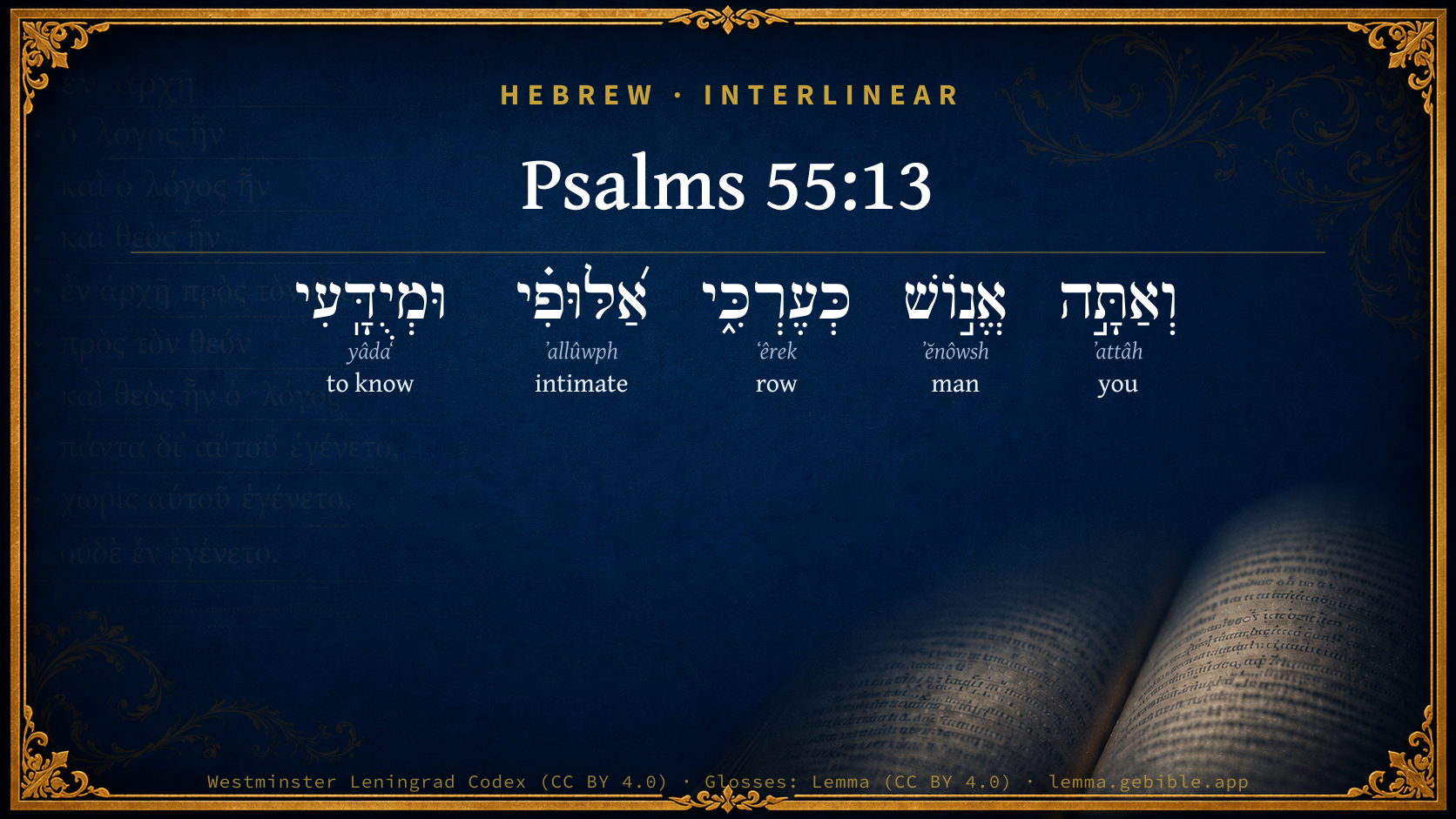
Psalms 55:13

Hebrew (Westminster Leningrad Codex) Psalms 55:13 appears in the Hebrew Old Testament. The text above is from the Westminster Leningrad Codex. Each word links to its Strong’s number, a concise gloss, and parsing drawn from the Open Scriptures Hebrew Bible morphology. Click any word for its full Brown-Driver-Briggs (BDB) entry.
Download image
Cite this verse

Psalms 55:13 (World English Bible). Public Domain. Lemma interlinear Bible study tool, https://lemma.gebible.app/v/psalms/55/13.

Show BibTeX & RIS
BibTeX
RIS
English Translation
But it was you, a man like me, My companion, and my familiar friend.
World English Bible · Public Domain
Download a study sheet

One document with this verse’s original text, its word-by-word gloss line, the meaning frame, cross-references with their text, attributed commentary, and full source and license credits — printable, and it pastes into notes with its structure intact.

This verse Autodidact and up

Study sheet (.html) Plain text (.txt)

A passage Seminary Student

Up to 50 verses in one chapter. A passage sheet keeps up to 6 commentary sources and 12 cross-references per verse, in the order this page ranks them, and says so on the sheet whenever that leaves anything out. Ask for a single verse and you get the Autodidact verse sheet above.

Everything on this page stays free to read, with no account — the sheet is a download of what is already on screen, not access to it.

Want to remove ads? Support Godless Engineer
Compare translations 3

The same verse in 3 English versions, stacked beneath the original-language interlinear above. Click any original word for its lexicon entry.

Each is an independent rendering of the whole verse — the interlinear is not word-aligned to these translations.

Highlighted words mark where these versions differ — a whole-verse word diff, not a word-by-word alignment.

  • World English Bible Public Domain
    But it was you, a man like me, My companion, and my familiar friend.
  • King James Version Public Domain
    But it was thou, a man mine equal, my guide, and mine acquaintance.
  • unfoldingWord Literal Text CC BY-SA 4.0
    But you, a man according to my valuation, my companion and my acquaintance,

unfoldingWord Literal Text — © unfoldingWord, licensed CC BY-SA 4.0. Word-aligned USFM3 via Door43 (git.door43.org/unfoldingWord/en_ult).

Versions to compare (up to 4)

3 of 4 selected

Show all 18 translations

Every available English version of this verse, each an independent rendering of the whole verse.

  • World English Bible Public Domain
    But it was you, a man like me, My companion, and my familiar friend.
  • Berean Standard Bible Public Domain
    But it is you, a man like myself, my companion and close friend.
  • Majority Standard Bible Public Domain
    But it is you, a man like myself, my companion and close friend.
  • King James Version Public Domain
    But it was thou, a man mine equal, my guide, and mine acquaintance.
  • American Standard Version (1901) Public Domain
    But it was thou, a man mine equal, My companion, and my familiar friend.
  • Revised Version (1885) Public Domain
    But it was thou, a man mine equal, my companion, and my familiar friend.
  • Geneva Bible (1599) Public Domain
    But it was thou, O man, euen my companion, my guide and my familiar:
  • Douay-Rheims (1899) Public Domain
    Day and night shall iniquity surround it upon its walls: and in the midst thereof are labour,
  • Young's Literal Translation Public Domain
    But thou, a man -- as mine equal, My familiar friend, and mine acquaintance.
  • Literal Standard Version CC BY-SA 4.0
    But you, a man—as my equal, || My familiar friend, and my acquaintance.
  • Unlocked Literal Bible CC BY-SA 4.0
    But it was you, a man equal to myself, my companion and my close friend.
  • unfoldingWord Literal Text CC BY-SA 4.0
    But you, a man according to my valuation, my companion and my acquaintance,
  • Darby Bible Public Domain
    But it was thou, a man mine equal, mine intimate, my familiar friend....
  • World Messianic Bible Public Domain
    But it was you, a man like me, my companion, and my familiar friend.
  • Webster's Bible Public Domain
    \\55:12\\For it was not an enemy that reproached me; then I could have borne it: neither was it he that hated me that magnified himself against me; then I would have hid myself from him:
  • Free Bible Version CC BY-SA 4.0
    No, it's you, a man just like me, my best friend who I know so well!
  • Bible in Basic English Public Domain
    But it was you, my equal, my guide, my well-loved friend.
  • JPS Tanakh (1917) Public Domain
    (55-14) But it was thou, a man mine equal, my companion, and my familiar friend;

Literal Standard Version (2020), Covenant Press — licensed CC BY-SA 4.0. Text via the HelloAO Bible API (eBible.org). Unlocked Literal Bible (unfoldingWord) — licensed CC BY-SA 4.0. Text via the HelloAO Bible API (eBible.org). unfoldingWord Literal Text — © unfoldingWord, licensed CC BY-SA 4.0. Word-aligned USFM3 via Door43 (git.door43.org/unfoldingWord/en_ult). Free Bible Version, Dr. Jonathan Gallagher — licensed CC BY-SA 4.0. Text via the HelloAO Bible API (eBible.org).

Word by word

More ways to search: Search by grammar → Find every occurrence → Compare this word →

Practice this passage: Drill this verse → Learn its vocabulary →

About this verse

These counts appear in no published source. They are computed here, from the morphology-tagged text and Lemma’s own curated glosses. What Lemma adds →

5
words
5
distinct lemmas
Wisdom
section

Shared distinctive vocabulary

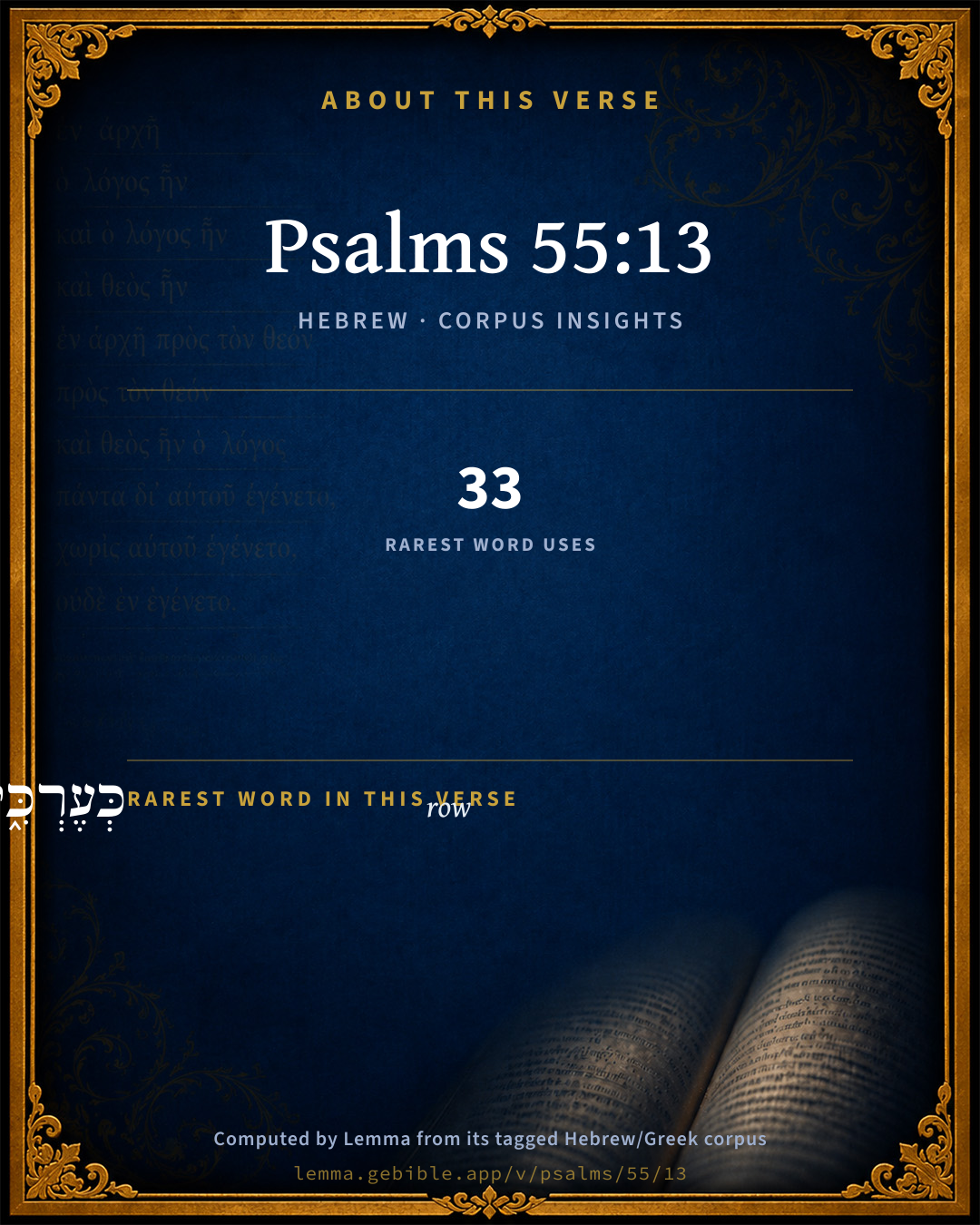
כְּעֶרְכִּ֑י row H6187 occurs in 29 verses of the Hebrew Bible. Also found in:

Grammatical profile

  • 1 verb
  • 3 nouns
  • 1 pronoun

Verb forms

  • וּמְיֻדָּֽעִי Pual · Participle Passive

Hebrew & Septuagint length

In English translation the verse runs 14 words from the Hebrew and 11 from the Septuagint (LXX English) — closely comparable.

A rough comparison of the two English renderings, which tokenize alike — not a word-level alignment.

Word counts can differ between the Hebrew and the Greek without any difference in meaning — e.g. the Hebrew direct-object marker אֵת has no separate Greek word, and Greek often adds the article ὁ.

Cross-references

10

Topical passages linked to Psalms 55:13 in the Treasury of Scripture Knowledge — connected by theme and wording, ordered by reader-vote popularity; previews shown in the World English Bible.

  • Micah 7:5 Don't trust in a neighbor. Don't put confidence in a friend. With the woman lying in your embrace, Be careful of the words of your mouth!
  • 2 Samuel 15:12 Absalom sent for Ahithophel the Gilonite, David's counselor, from his city, even from Giloh, while he was offering the sacrifices. The conspiracy was strong; for the people increased continually with Absalom.
  • Jeremiah 9:4 Take you heed everyone of his neighbor, and don't you trust in any brother; for every brother will utterly supplant, and every neighbor will go about with slanders.
  • Mark 14:44–45 Now he who betrayed him had given them a sign, saying, "Whoever I will kiss, that is he. Seize him, and lead him away safely."
  • 2 Samuel 16:23 The counsel of Ahithophel, which he gave in those days, was as if a man inquired at the oracle of God: so was all the counsel of Ahithophel both with David and with Absalom.
  • Psalms 41:9 Yes, my own familiar friend, in whom I trusted, Who ate bread with me, Has lifted up his heel against me.
  • Luke 22:47–48 While he was still speaking, behold, a multitude, and he who was called Judas, one of the twelve, was leading them. He came near to Jesus to kiss him.
  • Luke 22:21 But behold, the hand of him who betrays me is with me on the table.
  • Matthew 26:47–50 While he was still speaking, behold, Judas, one of the twelve, came, and with him a great multitude with swords and clubs, from the chief priest and elders of the people.
  • John 19:13 When Pilate therefore heard these words, he brought Jesus out, and sat down on the judgment seat at a place called "The Pavement," but in Hebrew, "Gabbatha."

Cross-references courtesy of OpenBible.info (CC BY 4.0).

Hebrew and Greek witnesses Masoretic Hebrew ↔ Greek Septuagint

The same verse in the two great witnesses to the Old Testament, shown verse-for-verse.

You’re reading Greek Psalm 54 (Hebrew Psalm 55). The Septuagint counts the superscription, so verse numbers can differ from the Hebrew — chapter-level alignment, not verse-by-verse. Numbering follows Rahlfs.

These are two independent witnesses, not word-aligned to each other, and the Septuagint is shown in lemma (dictionary) form.

Hebrew Psalms 55:13 Masoretic · Westminster Leningrad Codex

וְאַתָּ֣ה אֱנ֣וֹשׁ כְּעֶרְכִּ֑י אַ֝לּוּפִ֗י וּמְיֻדָּֽעִי

But it was you, a man like me, My companion, and my familiar friend.

World English Bible · Public Domain

Greek LXX Greek Psalm 54:13 Septuagint · lemma form

ὅτι εἰ ἐχθρός ὀνειδίζω ἐγώ ὑποφέρω ἄν καί εἰ ὁ μισέω ἐγώ ἐπί ἐγώ μεγαλορρημονέω κρύπτω ἄν ἀπό αὐτός

But you, O man like minded, my guide, and my acquaintance,

LXX2012 (modern English Septuagint) · Public Domain

On this verse, Ellicott's Commentary for English Readers discusses the Septuagint’s reading. Read the note in Commentary ↓

Hebrew: Westminster Leningrad Codex (CC BY 4.0). Greek: Septuagint (public domain); English from LXX2012 (modern English Septuagint) (Public Domain). How the Septuagint differs from the Hebrew →

Commentary

Notes on Psalms 55:13 from classic Christian and Jewish commentators (each source and its license shown beneath its notes). The classic Christian expositions comment on the surrounding passage and are grouped to its opening verse, so a note may address several verses; the Jewish commentaries on the Tanakh (Rashi and others) are per-verse, so they appear only where the commentator wrote on this verse.

Lemma curates 59 commentaries, every one of them public domain or Creative Commons licensed, each selected and text-cleaned for this edition rather than reprinted as found. About our sources →

Trapp's Complete Commentary

John Trapp

Psa 55:13 But [it was] thou, a man mine equal, my guide, and mine acquaintance.

Ver. 13. But it was thou, a man mine equal] Heb. according to my rank, my compeer, my colleague, mine Alter-ego, my bosom friend, one that stood even with me, and upon the same ground, as it were.

My guide] In all mine affairs and actions; so that I thought nothing well done that I did not by his advice and counsel; my duke, my doctor, my Rabbi Davidis, as Rabbi David hath it, out of Kabuenaki.

John Trapp, A Commentary or Exposition upon All the Books of the Old and New Testament (1647–1656) — public domain. Text from a community e-Sword module.

J. A. Alexander on Psalms

Joseph Addison Alexander

14. (Psa 55:13). But thou, a man mine equal, my associate, my acquaintance. It is a striking illustration of the difference between the Hebrew and English idiom, that the former uses and at the beginning of this sentence, where in English but is absolutely indispensable. The word for man is that denoting frailty and mortality. See above, on Psa 8:4; Psa 9:19-20; Psa 10:18. But it seems to be used here without any emphasis, in simple apposition with what follows, or as a vocative, thou, O man, mine equal. This last expression is in Hebrew, according to my valuation, the noun being a technical term of the Mosaic Law, denoting the official estimation of the priest, in certain cases of redemption or pecuniary penalty. See Lev 5:15; Lev 5:18; Lev 27:12. The whole phrase here employed is understood by some to mean one whom I value, i. e. highly, or more specifically, one whom I value as myself. More probably, however, it means one who is (or may be) estimated at the same rate with myself, which is precisely the idea conveyed by the common version, my equal, one of my own rank and circle, my associate. This last is the sense put by the modern interpreters on the next word in Hebrew. The old translation (guide) rests on a doubtful etymology, and the authority of the ancient versions. Acquaintance seems to be a weaker expression than the others; but the Hebrew word always implies very intimate association. See above, Psa 31:11, and below, Psa 88:8; Psa 88:18.

Joseph Addison Alexander, The Psalms Translated and Explained (1850) — public domain. Text from a community e-Sword module.

Geneva Bible (1599)

Geneva Bible translators

Which was not only joined to me in friendship and counsel in worldly matters, but also in religion.

Geneva Bible (1599) marginal notes — public domain. Text via Bolls.life.

Jamieson, Fausset & Brown

Robert Jamieson, A. R. Fausset & David Brown

guide--literally, "friend" (Pro 16:28; Pro 17:9).

acquaintance--in Hebrew, a yet more intimate associate.

Jamieson, Fausset & Brown — Commentary Critical and Explanatory on the Whole Bible (1871) — public domain (CC PDM 1.0). Text via the HelloAO Bible API.

Ellicott's Commentary for English Readers

(13) But it was . . .—Better, But thou art a man of my own standing. The word erek is used (Exo_40:23) of the row of loaves constituting the shewbread, and the cognate verb means “to arrange.” Here it may denote rank, but more probably the expression is man of my assessment, and so of the same importance in society. (Comp. Lev_5:15; 2Ki_12:4.) The LXX. and Vulgate have “of one soul with me.” Symmachus, “of like disposition.” This sense may be implied, though not expressed in the Hebrew.

Guide.—So the old versions: the Hebrew word does denote the head of a tribe or family (Gen_36:15, &c, “duke”), but that meaning seems excluded here by the previous description. Render, companion.

A Bible Commentary for English Readers, edited by Charles John Ellicott (1878–1897) — public domain. Text from a community e-Sword module.

The Cambridge Bible for Schools and Colleges

gen. ed. J. J. S. Perowne

13. Mine equal in rank and position; my associate or companion (as in Pro_16:28, chief friends; Mic_7:5, where R.V. marg. familiar friend is right); my close acquaintance or familiar friend (Psa_31:11). Cp. Jer_9:4 f.

The Cambridge Bible for Schools and Colleges (gen. ed. J. J. S. Perowne; Cambridge University Press, 1878–1918) — public domain. Text from a community e-Sword module.

John Gill's Exposition

We took sweet counsel together,.... Not in religious matters; for in these the testimonies of the Lord were David's counsellors, Psa 119:24; but in civil things: hearty counsel is one branch of friendship, and which greatly sweetens it, Pro 27:9; as this may be applied to Christ and Judas, it may denote the mutual delight and pleasure they had, the one in communicating, the other in receiving a notional knowledge of the Gospel, and the mysteries of it, which are the counsel of God, Act 20:27; for if hearers may hear the word gladly, as Herod did, and receive it with joy, as did the stony ground hearers, and yet be destitute of the grace of God; why may not Judas, and other preachers devoid of true grace, be thought to receive and preach the doctrines of the Gospel in a speculative way, with some kind of delight and pleasure? so professors of religion take sweet counsel together, when they communicate to each other what light and knowledge they have in the mysteries of the Gospel, and converse about experience, and the mysteries and secrets of internal godliness, and give and take advice in spiritual things; and sad it is when anyone of these drop their profession, and reproachers, scoffers, or persecutors;

and walked unto the house of God in company: David with his royal family and courtiers, and Ahithophel among the rest; where he delighted to go, and that with a multitude. So Christ and Judas often went to the temple together, with the rest of the disciples, who heard many an excellent sermon from his mouth: all which are further aggravations of sin and guilt. And so such persons, who have walked together to the house of God and in it, have attended together on public worship, and walked together in holy fellowship; when any of these forsake the assembling of themselves together, scoff at religion, speak evil of ordinances, reproach the saints, or persecute them, it is very shocking, cutting, and grieving indeed.

John Gill's Exposition of the Whole Bible (1746–1763) — public domain (CC PDM 1.0). Text via the HelloAO Bible API.

Albert Barnes' Notes on the Bible

But it was thou, a man mine equal - Margin, “a man according to my rank.” Septuagint, ἰσόψυχε isopsuche, equal-souled, like-souled, “second self” (Thompson); Vulgate, “unanimus,” of the same mind; Luther, “Geselle,” companion. The Hebrew word used here - ערך ‛êrek - means properly a row or pile, as of the showbread piled one loaf on another, Exo 40:23; then it would naturally mean one of the same row or pile; of the same rank or condition. The word also means price, estimation, or value, Job 28:13; Lev 5:15, Lev 5:18; Lev 6:6. Here the expression may mean a man “according to my estimation, value, or price;” that is, of the same value as myself (Gesenius, Lexicon); or more probably it means a man of my own rank; according to my condition; that is, a man whom I esteemed as my equal, or whom I regarded and treated as a friend.

My guide - The word used here properly denotes one who is familiar - a friend - from the verb אלף 'âlaph - to be associated with; to be familiar; to be accustomed to. The noun is frequently used to denote a military leader - the head of a tribe - a chieftain; and is, in this sense, several times employed in Gen. 36 to denote the leaders or princes of the Edomites, where it is rendered duke. But here it seems to be used, not in the sense of a leader or a guide, but of a familiar friend.

And mine acquaintance - The word used here is derived from the verb to know - ידע yâda‛ - and the proper idea is that of “one well known” by us; that is, one who keeps no secrets from us, but who permits us to understand him thoroughly. The phrase “mine acquaintance” is a feeble expression, and does not convey the full force of the original, which denotes a more intimate friend than would be suggested by the word “acquaintance.” It is language applied to one whom we thoroughly “know,” and who “knows us;” and this exists only in the case of very intimate friends. All the expressions used in this verse would probably be applicable to Ahithophel, and to the intimacy between him and David.

Albert Barnes' Notes on the Bible (1834–1885) — public domain. Text from a community e-Sword/MySword module.

Matthew Poole's English Annotations

Mine equal; not in power and dignity, which could not be, but in reputation for his deep wisdom and excellent conduct, and the great influence which he had upon me, and upon all my people.

My guide; whose counsel I highly prized, and constantly sought and followed: all which agrees very well to Ahithophel. See 2Sa 15:12,31; 16:23.

Matthew Poole's English Annotations on the Holy Bible (1683–1685) — public domain. Text from a community e-Sword/MySword module.

The Treasury of David

Charles H. Spurgeon

Ver. 13. But it was thou. He sees him. The poetic fury is upon him, he sees the traitor as though he stood before him in flesh and blood. He singles him out, he points his finger at him, he challenges him to his face.

But thou. Et tu, Brute. And thou, Ahithophel, art thou here? Judas, betrayest thou the Son of Man?

A man mine equal. Treated by me as one of my own rank, never looked upon as an inferior, but as a trusted friend.

My guide, a counsellor so sage that I trusted thine advice and found it prudent to do so.

And mine acquaintance, with whom I was on most intimate terms, who knew me even as I knew him by mutual disclosures of heart. No stranger occasionally conversed with, but a near and dear friend admitted to my secret fellowship. It was fiendish treason for such a one to prove false hearted. There was no excuse for such villainy. Judas stood very much in this relation to our Lord, he was treated as an equal, trusted as treasurer, and in that capacity often consulted with. He knew the place where the Master was wont to spend his solitude; in fact, he knew all the Master's movements, and yet he betrayed him to his remorseless adversaries. How justly might the Lord have pointed at him and said,

But thou; but his gentler spirit warned the son of perdition in the mildest manner, and had not Iscariot been tenfold a child of hell he would have relinquished his detestable purpose.

Ver. 13. A man mine equal. The LXX here not badly, isoquce (of equal soul), Jerome, unanimus mens (of one mind). Hermann Venema.

None.

Psalms 55:14*

Charles H. Spurgeon's The Treasury of David (1869–1885) — public domain. Psalms only. Text from a community e-Sword/MySword module.

Whedon's Commentary on the Bible

Daniel D. Whedon

13. A man mine equal—A man of my rank.

Guide—A word indicating at once his princely rank and his familiar friendship with the king.

Daniel D. Whedon (gen. ed.), Commentary on the Old and New Testaments (1874–1909) — public domain. Text from a community e-Sword module.

The Pulpit Commentary

But it was thou, a man mine equal; literally, a man according to my valuing; i.e. one of my social rank, with whom I was on familiar terms. My guide; or, "my companion." But the LXX have hgemwn . And mine acquaintance. "My confidant" (Kay); "my familiar friend" (Cheyne, and Revised Version).

The Pulpit Commentary (1880–1919), ed. H.D.M. Spence-Jones & Joseph S. Exell — public domain. Text from a community e-Sword module.

John Wesley's Explanatory Notes

Equal - Not in power, but in reputation, for wisdom, and influence upon my people. Guide - Whose counsel I highly prized, and constantly followed. All which agrees to Achitophel.

John Wesley, Explanatory Notes Upon the Whole Bible (1754–1765) — public domain. Text via the GEBible commentary corpus.

Rashi

Rabbi Shlomo Yitzchaki (Rashi)

For no enemy reviled me all my life that I should bear my vilification, but I rose up against him and slew him.

my enemy did not open his mouth that I should flee and hide from him, but now I bear the abuse with which you reviled me because you are a man who is great in Torah.

Rashi on the Tanakh — English translations: “The Judaica Press complete Tanach with Rashi, translated by A. J. Rosenberg” (CC BY 4.0); “Pentateuch with Rashi's commentary by M. Rosenbaum and A.M. Silbermann, 1929-1934” (public domain); “The Metsudah Tanach series, Lakewood, N.J” (CC BY 4.0); and “The Book of Joshua, Metsudah Publications, 1997” (CC BY 4.0). Text via Sefaria.

Lesson kit

Teaching starters — assembled from the data on this page, not authored interpretation. Every prompt links to the verse data it draws on. Edit before teaching.

Psalms, in the Wisdom, opens this verse with 5 words (5 distinct Hebrew lemmas). Its most distinctive word is ʻêrek (“row”). A historical commentator’s framing appears above. Read the whole chapter for the surrounding context.

Discussion questions

  1. How does “row” (ʻêrek) shape what this verse is saying?
  2. Exodus 40:4 shares the word «row» with this verse. How do the two illuminate each other?
  3. These translations render this verse differently; the difference is in the English rendering, not the original. What questions does that raise?
  4. The verb «וּמְיֻדָּֽעִי» is Pual Participle Passive. How does its form color the action?
  5. Reading how Trapp's Complete Commentary and J. A. Alexander on Psalms read this verse, where do the two commentators agree and where do they part?

Things to notice

Reading settings

Reading text

Shown beneath each verse's original-language words.

Old Testament
Old Testament edition

Read the OT as the Masoretic Hebrew (MT) or the Greek Septuagint (LXX).

English shown for the Greek Septuagint (in the Hebrew ↔ Greek comparison).

Comparing translations? Open the Compare panel on any verse page to stack up to four side by side.