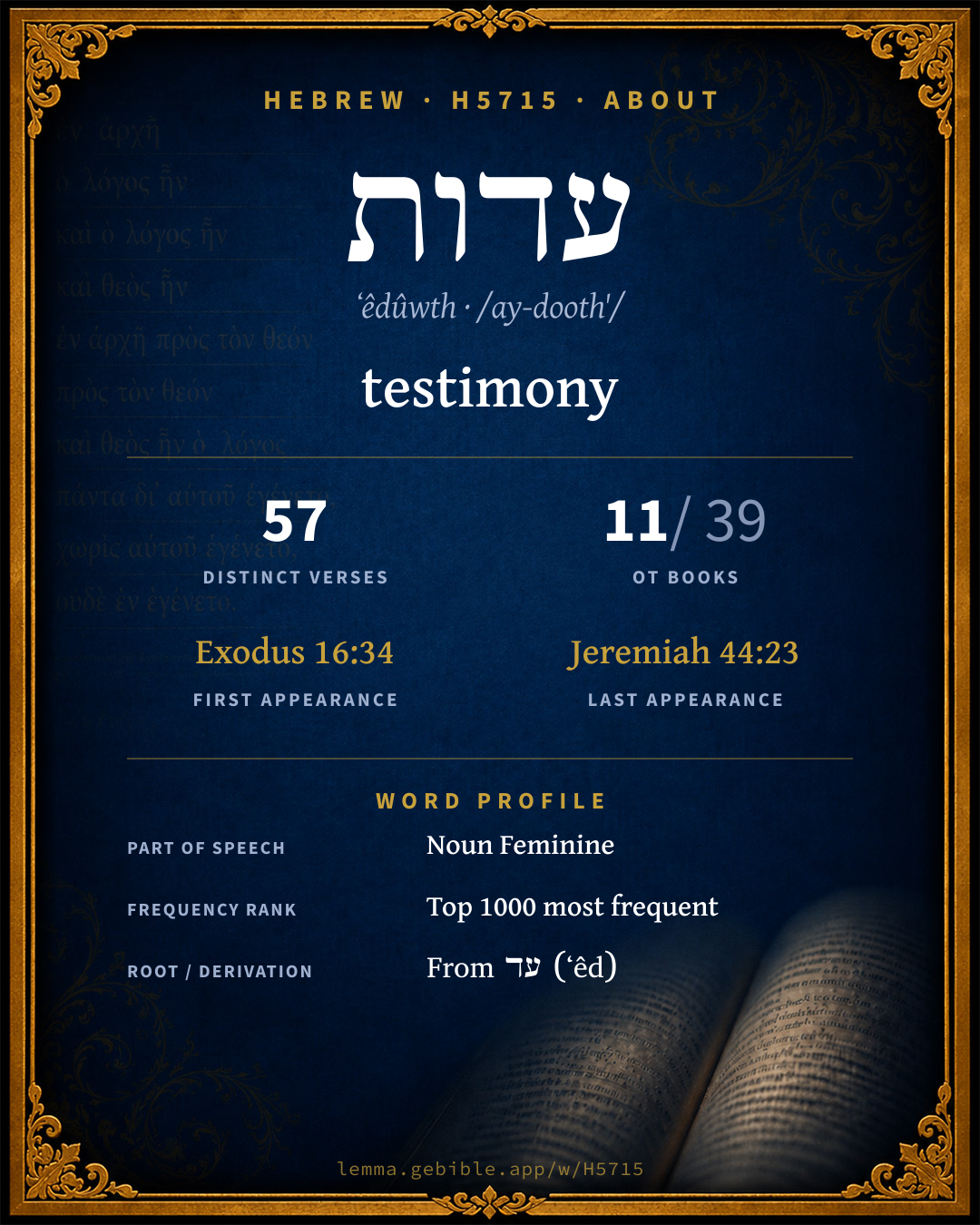
עֵדוּת
testimony
Full lexicon entry — Brown-Driver-Briggs (BDB)
From Brown-Driver-Briggs (BDB)
Where this word appears
Grammar key — what these labels mean
Part of speech
- Noun
- A naming word — a person, place, thing, or idea.
Noun type
- Common
- A common noun — a general class of person, place, or thing (“king,” “city,” “water”), not a specific name.
State
- Absolute
- The independent form of a noun, not bound to a following word.
- Construct
- A noun bound to a following noun in a possessive / “of” relationship (the construct chain).
Gender
- Feminine
- Grammatically feminine.
Number
- Singular
- One.
- Plural
- More than one (in Hebrew, generally three or more).
Every verse where H5715 appears in the Book of Numbers — 11 distinct verses. Click any verse to open its interlinear word-by-word view. Verse text shown in the World English Bible for context — . Each verse’s Hebrew form is shown with its reference; the English is not keyword-highlighted, since the data carries no word-level English alignment. Use “Compare translations” on any verse to read it across multiple English versions. This concordance covers the Hebrew Bible; Septuagint (Greek Old Testament) occurrences are not indexed here.
Numbers
- Numbers 1:50 הָ/עֵדֻ֜ת ptcl def.art + n c fs but appoint the Levites over the Tabernacle of the Testimony, and over all its furnishings, and over all that belongs to it. They shall carry the tabernacle, and all its furnishings; and they shall take care of it, and shall encamp around it.
- Numbers 1:53 הָ/עֵדֻ֔ת הָ/עֵדֽוּת ptcl def.art + n c fs ptcl def.art + n c fs But the Levites shall encamp around the Tabernacle of the Testimony, that there may be no wrath on the congregation of the children of Israel: and the Levites shall be responsible for the Tabernacle of the Testimony."
- Numbers 4:5 הָ/עֵדֻֽת ptcl def.art + n c fs When the camp moves forward, Aaron shall go in, and his sons, and they shall take down the veil of the screen, and cover the ark of the Testimony with it,
- Numbers 7:89 הָ/עֵדֻ֔ת ptcl def.art + n c fs When Moses went into the Tent of Meeting to speak with Yahweh, he heard his voice speaking to him from above the mercy seat that was on the ark of the Testimony, from between the two cherubim: and he spoke to him.
- Numbers 9:15 הָ/עֵדֻ֑ת ptcl def.art + n c fs On the day that the tabernacle was raised up, the cloud covered the tabernacle, even the Tent of the Testimony: and at evening it was over the tabernacle as it were the appearance of fire, until morning.
- Numbers 10:11 הָ/עֵדֻֽת ptcl def.art + n c fs It happened in the second year, in the second month, on the twentieth day of the month, that the cloud was taken up from over the tent of the testimony.
- Numbers 17:4 הָֽ/עֵד֔וּת ptcl def.art + n c fs You shall lay them up in the tent of meeting before the testimony, where I meet with you.
- Numbers 17:7 הָ/עֵדֻֽת ptcl def.art + n c fs Moses laid up the rods before Yahweh in the tent of the testimony.
- Numbers 17:8 הָ/עֵד֔וּת ptcl def.art + n c fs It happened on the next day, that Moses went into the tent of the testimony; and, behold, the rod of Aaron for the house of Levi was budded, and put forth buds, and produced blossoms, and bore ripe almonds.
- Numbers 17:10 הָ/עֵד֔וּת ptcl def.art + n c fs Yahweh said to Moses, Put back the rod of Aaron before the testimony, to be kept for a token against the children of rebellion; that you may make an end of their murmurings against me, that they not die.
- Numbers 18:2 הָ/עֵדֻֽת ptcl def.art + n c fs Your brothers also, the tribe of Levi, the tribe of your father, bring you near with you, that they may be joined to you, and minister to you: but you and your sons with you shall be before the tent of the testimony.
About this entry
At a glance — auto-summarized from this page’s data, not written by a person. Every figure links to its source below. This summary describes the numbers; it doesn’t interpret them.
“testimony” is the headline sense of the Hebrew noun עדות (ʻêdûwth). First canonically at Exodus 16:34, it enters the text early. With 57 verses in 11 books, it is a moderately common word in the Hebrew Bible. It concentrates in Exodus, which alone accounts for 35% of its uses. It clusters with עד, עדה and עדה under a shared root. The sections below give every sense, occurrence, and version rendering.
Gloss history
Strong's 1890 vs modern scholarship
About this word
Strong's H5715 catalogs a Hebrew word from the Hebrew Old Testament.
These counts are not copied from any lexicon or concordance. They are computed here, from the morphology-tagged Hebrew Old Testament. What Lemma adds →
- 57
- distinct verses
- The word appears in 57 distinct verses.
- 11 / 39
- OT books
- The word appears in 11 of 39 Old Testament books.
- #647
- by frequency
- Top 1000 most frequent Hebrew words (rank 647 of 8,640 Hebrew words by occurrence).
View all 57 occurrences in the concordance →
By section of the Old Testament
By traditional corpus
Conventional, traditional groupings — biblical authorship is debated, so this is a traditional corpus grouping, not an authorship claim. Each share is this word’s portion of its verses in that division of the Hebrew canon. Each figure is a share of the word’s 57 distinct verses.
- Torah (Pentateuch) 33 verses · 58%
- Writings (Ketuvim) 18 verses · 32%
- Prophets (Nevi'im) 6 verses · 11%
How translations render this word
Counts come from each version’s own published word-to-Strong’s tagging or interlinear alignment — an approximate guide to how each version renders this word, not a word-level alignment the data otherwise carries. Because each total is that version’s own tagged count, the per-version totals vary from one another and need not match the appearance or distinct-verse counts above. These counts may also differ from a printed concordance because Lemma counts each distinctly tagged rendering and does not collapse phrase taggings into a single head-word total. This is a fixed set of word-tagged versions (KJV, ASV, BSB, ULT) and does not change with the reading translation you choose elsewhere. Each version’s license is shown beside its name below (and on Sources).
- King James Version: Testimony 35×, Testimonies 14×, Witness 4×
- American Standard Version: Testimony 37×, Testimonies 14×, Him 2×
- Berean Standard Bible: Testimony 42×, Testimonies 9×, Decrees 4×
- unfoldingWord Literal Text: Testimony 40×, Testimonies 12×, Testimony of 2×
King James Version Public Domain
Renders H5715 across 59 tagged occurrences — most commonly:
Plus 4 renderings that appear only once — usually multi-word phrases or single function words the recovered tagging swept in, not distinct renderings.
American Standard Version Public Domain
Renders H5715 across 59 tagged occurrences — most commonly:
Plus 6 renderings that appear only once — usually multi-word phrases or single function words the recovered tagging swept in, not distinct renderings.
Berean Standard Bible Public Domain
Renders H5715 across 61 tagged occurrences — most commonly:
Plus 2 renderings that appear only once — usually multi-word phrases or single function words the recovered tagging swept in, not distinct renderings.
unfoldingWord Literal Text CC BY-SA 4.0
Renders H5715 across 60 tagged occurrences — most commonly:
Plus 6 renderings that appear only once — usually multi-word phrases or single function words the recovered tagging swept in, not distinct renderings.
Senses in the full BDB
What do BDB’s symbols mean?
BDB uses these scholarly abbreviations:
| Symbol | Meaning |
|---|---|
| 𝔊 | the Septuagint (the ancient Greek translation, LXX) |
| 𝔙 | the Vulgate (the Latin translation) |
| 𝔖 | the Syriac version (the Peshitta) |
| 𝔗 | the Targum (the Aramaic translation) |
| ψ | the Psalms |
| √ | root (the underlying root or stem) |
| ‖ | parallel passage (a synonymous or contrasted parallel) |
| † | the dagger: every passage where the word occurs is cited |
The 2 senses and sub-senses the full Brown-Driver-Briggs lexicon distinguishes for this word, in lexicon order (not ranked by frequency), with BDB’s own verbatim wording and sub-sense lettering. Shown in Hebrew script with BDB’s own scholarly abbreviations. The condensed entry is in the Lexicon Entry tab. See also the Forms in the corpus table below.
- 1. testimony of the Ten Words on the tablets as a solemn divine charge, לֻחֹת הע׳ Ex 31:18; 32:15; 34:29 (P), הע׳ 25:16, 21; 40:20 (P); ark as containing tables, אֲרוֹן הע׳ 25:22; 26:33, 34; 30:6, 26; 39:35; 40:3, 5, 21 Nu 4:5; 7:89 (all P), Jos 4:16 (JE; Kue הברית [ag. him Di], so Benn Steuernag), הארן לע׳ Ex 31:7 (P); abbrev. לִפְנֵי הע׳ 16:34; 30:36 Nu 17:19, 25 (P); עַל הע׳ Ex 27:21 (= הע׳ Lv 24:3), 30:6 Lv 16:13 (P); tabernacle as containing ark of testimony, משׁכן הע׳ tabernacle of the testimony Ex 38:21 Nu 1:50, 53(×2); 10:11 (P); so אֹהֶל הע׳ 9:15; 17:22, 23; 18:2 (P) 2 Ch 24:6. e.g. Exodus 31:18
- 2. the code of law in gen. (late), as a testimony of God: ψ 19:8 119:88; 122:4; ‖ תּוֹרָה 78:5; ‖ חֹק 81:6. In titles, עַל־ שׁוּשַׁן ע׳ ψ 60:1, אֶל־שֹׁשַׁנּ֑ים ע׳ 80:1 = melody whose first line cp. law as testimony to a choice flower. Special laws of the code are denoted by pl.; + חֻקּוֹת etc. 1 K 2:3 2 K 23:3 = 2 Ch 34:31 (+ חקים etc.), Je 44:23; חֻקִּים etc. 1 Ch 29:19; מִצְוֹת Ne 9:34; pl. of contents of covenant 2 K 17:15; pl. elsewhere ψ 119:14, 31, 36, 99, 111, 129, 144, 157. Vid. also iii. [עֵדָה].—For הָעֵדוּת 2 K 11:12 = 2 Ch 23:11 read prob. הַצְּעָדוֹת (cf. 2 S 1:10 We al.). e.g. Psalms 19:8
Senses from the full Brown-Driver-Briggs lexicon (Brown, Driver, Briggs; Oxford 1906 — public domain), digitized via Sefaria, supplemented by the OpenScriptures HebrewLexicon (CC BY 4.0). Full attribution on Sources.
Word origin
and עֵדֻת27 n.f. testimony;—ע׳ abs. Ex 16:34 +, cstr. ψ 19:8 +; pl. sf. עֵדְוֹתֶיךָ 119:14 +, עֵדְוֹתָיו Je 44:23 + 4 times;—
— Brown-Driver-Briggs (Oxford 1906, public domain), digitized via Sefaria, supplemented by the OpenScriptures HebrewLexicon (CC BY 4.0). See Sources.
Derived from עד (ʻêd) (H5707) — witness.
Jastrow Dictionary
A second Hebrew/Aramaic lexicon for comparison, covering Aramaic and post-biblical (Talmudic, Targumic, Midrashic) usage that the biblical-Hebrew BDB does not. Matched by lemma rather than by Strong’s number, so a lemma may carry more than one Jastrow headword (shown separately below), and the entries cover usage well beyond the Bible.
*עֵדָה II
- = עֵדוּת, testimony. Tosef. Bekh. III, 8 שכר עֵדָתוֹ ed. Zuck. (oth. ed. עדותו) pay for his testimony.—Pl. עֵדוֹת. Bekh. IV, 6 (29ᵃ) עֵדוֹתָיו בטילין masc. (Var. in Mish. ed. עדותו בטילה) his testimonies are void; (Kidd. 58ᵇ עדותו בטילה).
עֵדוּת
- v. עֵד) testimony, evidence. Ber. 14ᵇ כאילו מעיד ע׳ וכ׳ as if offering evidence of falsehood against himself. Succ. 29ᵃ מעידי ע׳ שקר those who give false witness. Sabb. 22ᵇ (ref. to Lev. XXIV, 3) ע׳ היא לבאי עולם וכ׳ it (the light in the Temple) is an evidence to mankind that the Divine Presence dwells in Israel; Men. 86ᵇ. Ib. מאי עֵדוּתָהּ how did it give evidence (of the Divine Presence)?; Sabb. l. c. מאי עדות (corr. acc., as Ms. M.). Macc. 5ᵃ גופה של ע׳ (not עדיות) the testimony to the fact itself, v. סָרָה. Ib. I, 7 אם מתקיימת הע׳ בשנים וכ׳ if an evidence is legally established by two witnesses, why does the Scripture mention three? Ib. 8 מה שנים … עֵדוּתָן בטלה וכ׳ as in the case of two witnesses, if one of them is found out to be a relative or a disqualified witness, their testimony is void, so in the case of three &c.—Ex. R. s. 41 מה כלה … כל מי שיודע לי ע׳ וכ׳ as the bride … on entering her chamber (in procession) uncovers her face, as if saying, whoever knows any evidence against me, let him come …, so must the scholar &c.; Yalk. ib. 391; Cant. R. to IV, 11 וזו עֵדוּתִי מעידה עלי and this (procession) is my testimonial testifying for me; a. v. fr.—Trnsf. (v. סַהֲדוּ) tokens of virginity. Gen. R. s. 60 ממקום עֵדוּתָן Ar. (ed. ערותן) at the seat of virginity. Gen. R. s. 45; s. 51 הוציאו עדותן Ar. (ed.; Yalk. ib. 79 ערותן).—Pl. עֵדָיוֹת. Macc. I, 9 הרי אלו שתי ע׳ these are two testimonies (two independent sets of witnesses); a. fr.—‘Eduyoth, name of a treatise, of the Order of N’ziḳin, of the Mishnah and Tosefta, containing statements of traditional deliveries and rules. Ber. 28ᵃ ע׳ בו ביום נשנית on that day ‘Eduyoth was taught. e.g. Leviticus 24:3
A Dictionary of the Targumim, the Talmud Babli and Yerushalmi, and the Midrashic Literature (Marcus Jastrow; London, Luzac, 1903) — Public Domain. Digitized via Sefaria. Digitized via Sefaria. Full attribution on Sources.
Forms in the corpus
The 34 distinct written forms H5715 takes in the Hebrew Bible, most frequent first — each parse links to that state’s occurrences in the concordance. Hebrew forms include their vowel points and cantillation, so a single lemma takes many written forms.
Same root — word family
Other BDB entries built from the same root as H5715, grouped by Strong’s listed origin. These share a root / origin per the lexicon — not necessarily a shared meaning. Each links to that word’s own entry.
Derives from
Shares the same root
Compare all same-root words → They share a root, not necessarily a meaning.
Septuagint verse parallels
This word appears in 45 verses that also exist in the Greek Old Testament (Septuagint), out of the 57 Hebrew verses it occurs in. You can read those verses in Greek by switching the Old Testament edition to the Septuagint.
Read these verses in the Septuagint
- Exodus 16:34
- Leviticus 16:13
- Numbers 1:50
- Joshua 4:16
- 1 Kings 2:3
- 2 Kings 11:12
- 1 Chronicles 29:19
- 2 Chronicles 23:11
- Psalms 19:7
This is a verse-level parallel only — the same verses exist in both the Hebrew and Greek Old Testaments. No word-level Hebrew↔Greek correspondence is claimed: the data carries no such alignment, so no Greek word is shown as this Hebrew word’s translation. Coverage is not total — the Septuagint omits the deuterocanon and renumbers the Psalms, so some Hebrew verses have no direct Greek parallel.