
Psalms 119:31

Hebrew (Westminster Leningrad Codex) Psalms 119:31 appears in the Hebrew Old Testament. The text above is from the Westminster Leningrad Codex. Each word links to its Strong’s number, a concise gloss, and parsing drawn from the Open Scriptures Hebrew Bible morphology. Click any word for its full Brown-Driver-Briggs (BDB) entry.
Download image
Cite this verse

Psalms 119:31 (World English Bible). Public Domain. Lemma interlinear Bible study tool, https://lemma.gebible.app/v/psalms/119/31.

Show BibTeX & RIS
BibTeX
RIS
English Translation
I cling to your statutes, Yahweh. Don't let me be disappointed.
World English Bible · Public Domain
Download a study sheet

One document with this verse’s original text, its word-by-word gloss line, the meaning frame, cross-references with their text, attributed commentary, and full source and license credits — printable, and it pastes into notes with its structure intact.

This verse Autodidact and up

Study sheet (.html) Plain text (.txt)

A passage Seminary Student

Up to 50 verses in one chapter. A passage sheet keeps up to 6 commentary sources and 12 cross-references per verse, in the order this page ranks them, and says so on the sheet whenever that leaves anything out. Ask for a single verse and you get the Autodidact verse sheet above.

Everything on this page stays free to read, with no account — the sheet is a download of what is already on screen, not access to it.

Want to remove ads? Support Godless Engineer
Compare translations 3

The same verse in 3 English versions, stacked beneath the original-language interlinear above. Click any original word for its lexicon entry.

Each is an independent rendering of the whole verse — the interlinear is not word-aligned to these translations.

Highlighted words mark where these versions differ — a whole-verse word diff, not a word-by-word alignment.

  • World English Bible Public Domain
    I cling to your statutes, Yahweh. Don't let me be disappointed.
  • King James Version Public Domain
    I have stuck unto thy testimonies: O LORD, put me not to shame.
  • unfoldingWord Literal Text CC BY-SA 4.0
    I cling to your testimonies; Yahweh, do not let me be shamed.

unfoldingWord Literal Text — © unfoldingWord, licensed CC BY-SA 4.0. Word-aligned USFM3 via Door43 (git.door43.org/unfoldingWord/en_ult).

Versions to compare (up to 4)

3 of 4 selected

Show all 17 translations

Every available English version of this verse, each an independent rendering of the whole verse.

  • World English Bible Public Domain
    I cling to your statutes, Yahweh. Don't let me be disappointed.
  • Berean Standard Bible Public Domain
    I cling to Your testimonies, O LORD; let me not be put to shame.
  • Majority Standard Bible Public Domain
    I cling to Your testimonies, O LORD; let me not be put to shame.
  • King James Version Public Domain
    I have stuck unto thy testimonies: O LORD, put me not to shame.
  • American Standard Version (1901) Public Domain
    I cleave unto thy testimonies: O Jehovah, put me not to shame.
  • Revised Version (1885) Public Domain
    I cleave unto thy testimonies: O LORD, put me not to shame.
  • Geneva Bible (1599) Public Domain
    I haue cleaued to thy testimonies, O Lord: confound me not.
  • Young's Literal Translation Public Domain
    I have adhered to Thy testimonies, O Jehovah, put me not to shame.
  • Literal Standard Version CC BY-SA 4.0
    I have adhered to Your testimonies, || O YHWH, do not put me to shame.
  • Unlocked Literal Bible CC BY-SA 4.0
    I cling to your covenant decrees; Yahweh, do not let me be shamed.
  • unfoldingWord Literal Text CC BY-SA 4.0
    I cling to your testimonies; Yahweh, do not let me be shamed.
  • Darby Bible Public Domain
    I cleave unto thy testimonies; Jehovah, let me not be ashamed.
  • World Messianic Bible Public Domain
    I cling to your statutes, LORD. Don’t let me be disappointed.
  • Webster's Bible Public Domain
    I have adhered to thy testimonies: O LORD, put me not to shame.
  • Free Bible Version CC BY-SA 4.0
    I hold on to your teachings, Lord. Don't let me be ridiculed.
  • Bible in Basic English Public Domain
    I have been true to your unchanging word; O Lord, do not put me to shame.
  • JPS Tanakh (1917) Public Domain
    I cleave unto Thy testimonies; O LORD, put me not to shame.

Literal Standard Version (2020), Covenant Press — licensed CC BY-SA 4.0. Text via the HelloAO Bible API (eBible.org). Unlocked Literal Bible (unfoldingWord) — licensed CC BY-SA 4.0. Text via the HelloAO Bible API (eBible.org). unfoldingWord Literal Text — © unfoldingWord, licensed CC BY-SA 4.0. Word-aligned USFM3 via Door43 (git.door43.org/unfoldingWord/en_ult). Free Bible Version, Dr. Jonathan Gallagher — licensed CC BY-SA 4.0. Text via the HelloAO Bible API (eBible.org).

Word by word

More ways to search: Search by grammar → Find every occurrence → Compare this word →

Practice this passage: Drill this verse → Learn its vocabulary →

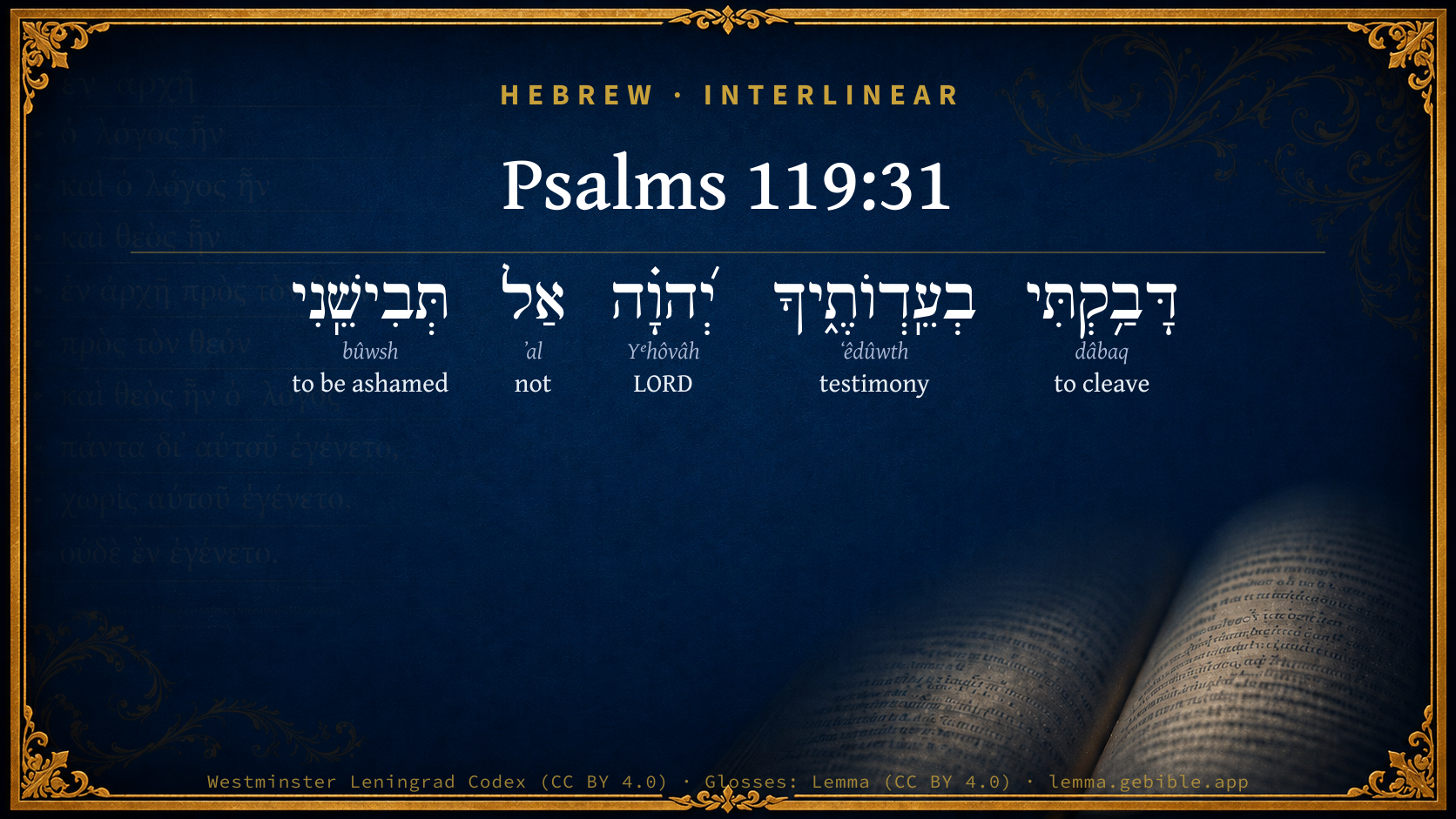
דָּבַ֥קְתִּי
dâbaq
H1692
“to cleave”
Verb, Qal, Perfect, 1st Person, Common, Singular
Part of Speech
Verb
Stem
Qal
Form
Perfect
Person
1st Person
Gender
Common
Number
Singular
Full BDB Definition

Origin: a primitive root

TWOT: 398

to cling, stick, stay close, cleave, keep close, stick to, stick with, follow closely, join to, overtake, catch - (Qal) - to cling, cleave to - to stay with - (Pual) to be joined together - (Hiphil) - to cause to cleave to - to pursue closely - to overtake - (Hophal) to be made to cleave
  1. בְעֵֽדְוֺתֶ֑יךָ ʻêdûwth H5715 “in/at · testimonies · your” Preposition + Noun, Common, Feminine, Plural, Construct + Suffix, Personal, 2nd Person, Masculine, Singular
  2. יְ֝הוָ֗ה Yᵉhôvâh H3068 “LORD” Noun, Proper
  3. אַל ʼal H408 “not” Particle, Negative
  4. תְּבִישֵֽׁנִי bûwsh H954 “to be ashamed · me” Verb, Hiphil, Jussive, 2nd Person, Masculine, Singular + Suffix, Personal, 1st Person, Common, Singular

About this verse

These counts appear in no published source. They are computed here, from the morphology-tagged text and Lemma’s own curated glosses. What Lemma adds →

5
words
5
distinct lemmas
Wisdom
section

Shared distinctive vocabulary

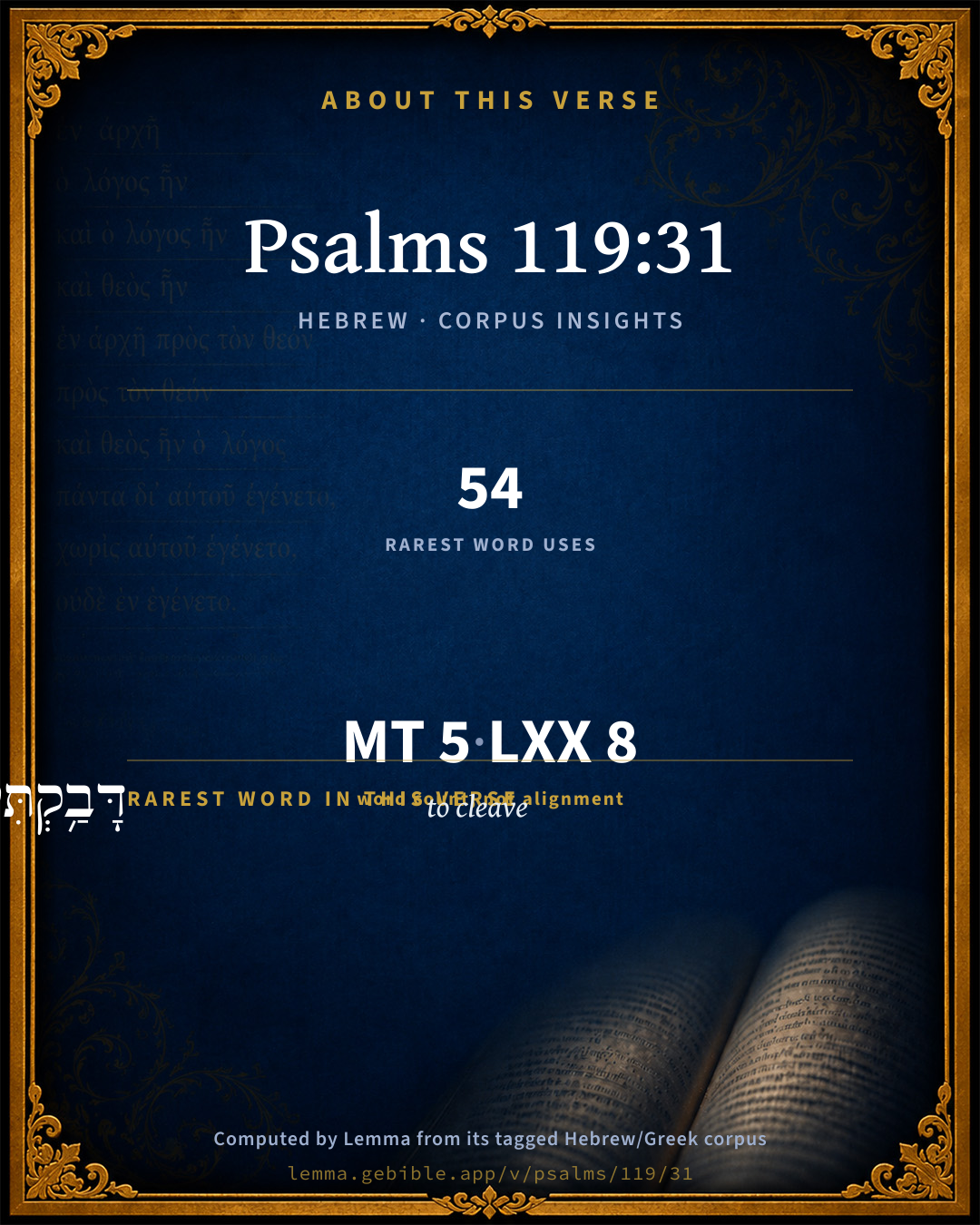
דָּבַ֥קְתִּי to cleave H1692 occurs in 52 verses of the Hebrew Bible. Also found in:

Grammatical profile

  • 2 verbs
  • 2 nouns
  • 1 particle

Verb forms

  • דָּבַ֥קְתִּי Qal · Perfect
  • תְּבִישֵֽׁנִי Hiphil · Jussive

Hebrew & Septuagint length

In English translation the verse runs 11 words from the Hebrew and 13 from the Septuagint (LXX English) — closely comparable.

A rough comparison of the two English renderings, which tokenize alike — not a word-level alignment.

Word counts can differ between the Hebrew and the Greek without any difference in meaning — e.g. the Hebrew direct-object marker אֵת has no separate Greek word, and Greek often adds the article ὁ.

In the original languages it is 5 Hebrew tokens and 8 Greek tokens — but the two are counted differently (Hebrew bundles its prefixes and suffixes into one token; the Greek is in lemma form), so that isn’t a like-for-like length.

Cross-references

17

Topical passages linked to Psalms 119:31 in the Treasury of Scripture Knowledge — connected by theme and wording, ordered by reader-vote popularity; previews shown in the World English Bible.

  • Proverbs 23:23 Buy the truth, and don't sell it: Get wisdom, discipline, and understanding.
  • John 8:31 Jesus therefore said to those Jews who had believed him, "If you remain in my word, then you are truly my disciples.
  • Romans 5:5 and hope doesn't disappoint us, because God's love has been poured out into our hearts through the Holy Spirit who was given to us.
  • Acts 11:23 who, when he had come, and had seen the grace of God, was glad. He exhorted them all, that with purpose of heart they should remain near to the Lord.
  • Isaiah 45:17 [But] Israel shall be saved by Yahweh with an everlasting salvation: you shall not be disappointed nor confounded world without end.
  • Psalms 25:2 My God, I have trusted in you, Don't let me be shamed. Don't let my enemies triumph over me.
  • Psalms 25:20 Oh keep my soul, and deliver me. Let me not be disappointed, for I take refuge in you.
  • 1 John 2:28 Now, little children, remain in him, that when he appears, we may have boldness, and not be ashamed before him at his coming.
  • Deuteronomy 4:4 But you who did cleave to Yahweh your God are alive everyone of you this day.
  • Deuteronomy 10:20 You shall fear Yahweh your God; him shall you serve; and to him shall you cleave, and by his name shall you swear.
  • Deuteronomy 11:22 For if you shall diligently keep all this commandment which I command you, to do it, to love Yahweh your God, to walk in all his ways, and to cleave to him;
  • Psalms 119:6 Then I wouldn't be disappointed, When I consider all of your commandments.
  • Psalms 119:48 I reach out my hands for your commandments, which I love. I will meditate on your statutes.
  • Psalms 119:80 Let my heart be blameless toward your decrees, That I may not be disappointed.
  • Psalms 119:115 Depart from me, you evildoers, That I may keep the commandments of my God.
  • Isaiah 49:23 Kings shall be your nursing fathers, and their queens your nursing mothers: they shall bow down to you with their faces to the earth, and lick the dust of your feet; and you shall know that I am Yahweh; and those who wait for me shall not be disappointed.
  • Jeremiah 17:18 Let them be disappointed who persecute me, but let not me be disappointed; let them be dismayed, but don't let me be dismayed; bring on them the day of evil, and destroy them with double destruction.

Cross-references courtesy of OpenBible.info (CC BY 4.0).

Hebrew and Greek witnesses Masoretic Hebrew ↔ Greek Septuagint

The same verse in the two great witnesses to the Old Testament, shown verse-for-verse.

You’re reading Greek Psalm 118 (Hebrew Psalm 119). The Septuagint counts the superscription, so verse numbers can differ from the Hebrew — chapter-level alignment, not verse-by-verse. Numbering follows Rahlfs.

These are two independent witnesses, not word-aligned to each other, and the Septuagint is shown in lemma (dictionary) form.

Hebrew Psalms 119:31 Masoretic · Westminster Leningrad Codex

דָּבַ֥קְתִּי בְעֵֽדְוֺתֶ֑יךָ יְ֝הוָ֗ה אַל תְּבִישֵֽׁנִי

I cling to your statutes, Yahweh. Don't let me be disappointed.

World English Bible · Public Domain

Greek LXX Greek Psalm 118:31 Septuagint · lemma form

κολλάω ὁ μαρτύριον σύ κύριος μή ἐγώ κατααἰσχύνω

I have cleaved to your testimonies, O Lord; put me not to shame.

LXX2012 (modern English Septuagint) · Public Domain

Hebrew: Westminster Leningrad Codex (CC BY 4.0). Greek: Septuagint (public domain); English from LXX2012 (modern English Septuagint) (Public Domain). How the Septuagint differs from the Hebrew →

Commentary

Notes on Psalms 119:31 from classic Christian and Jewish commentators (each source and its license shown beneath its notes). The classic Christian expositions comment on the surrounding passage and are grouped to its opening verse, so a note may address several verses; the Jewish commentaries on the Tanakh (Rashi and others) are per-verse, so they appear only where the commentator wrote on this verse.

Lemma curates 59 commentaries, every one of them public domain or Creative Commons licensed, each selected and text-cleaned for this edition rather than reprinted as found. About our sources →

Trapp's Complete Commentary

John Trapp

Psa 119:31 I have stuck unto thy testimonies: O LORD, put me not to shame.

Ver. 31. I have stuck unto thy testimonies] Hitherto I have done so; let me now shrink from them, or hang loose to them, lest I lose the things that I have wrought, and shame myself for ever by my backsliding.

John Trapp, A Commentary or Exposition upon All the Books of the Old and New Testament (1647–1656) — public domain. Text from a community e-Sword module.

The Biblical Illustrator

Joseph S. Exell

Psa_119:31

I have stuck unto Thy testimonies: O Lord, put me not to shame.

The sticking to Gods testimonies

I. What the psalmist means by Gods testimonies.

1. The children of God do not cleave to the bare letter of the Word--the mere vowels and consonants and syllables of Scripture, but to such testimonies as the Lord Himself is pleased to drop into their heart and conscience through the medium of the Scriptures of truth. Now, before we can receive the Scriptures as a revelation from God, it must be shown to us by the Holy Spirit that they were inspired by Himself.

2. But we come to the particular testimonies which God reveals to His chosen.

(1) One of the first testimonies that God seals upon the heart and conscience of His children is a manifestation of His own being--I mean His spiritual being; some discovery of Himself as He really is, some manifestation of Himself as He has revealed Himself in the Scriptures of truth.

(2) But when we come to a more particular description of these testimonies, we may divide them into two grand classes, testimonies against us, and testimonies for us, that is, in the way of experience.

(3) But there are other testimonies of another nature--not so much testimonies against, or testimonies for our interest in covenant mercies, as testimonies of Divine instruction. The Lord has said, for instance, in His Word, that the heart is deceitful above all things, and desperately wicked. That is a testimony from the mouth of God; and how does the soul first receive, and then stick to that testimony? By the opening up of the depths of corruption in our heart, by the breaking up of the secret fountains of iniquity, that great deep that coucheth beneath. Again, God has said in His Word, I, the Lord, hate evil. Now, this testimony the Lord speaks out of the Word into the hearts of His chosen. He writes it as with a sunbeam upon the consciences of His living family that He abhors evil; and this He transfers from the Word, and stamps upon a mans conscience; and he who has never had that solemn truth stamped upon his conscience is destitute of the knowledge of the only true God.

II. He who sticks to Gods testimonies will not be put to shame.

1. Sometimes the child of God is afraid that he will be put to shame in the hour of death; lest his religion in that solemn moment should be sifted clean away, and his hope should prove a delusion; and therefore he says, I have stuck unto Thy testimonies; O Lord, put me not to shame in that solemn hour when I must stand before Thee, without any one to help, or anything to hope in, except Thyself. Now, he that sticks to Gods testimonies will not be then put to shame. He will not die in despair, but he will die in the fear and love of God; or, at any rate, will die with a good hope through grace in His mercy, with some rest of soul, and some sweet confidence that he is His.

2. Sometimes the child of God is afraid of being put to shame openly before men, by being overcome by some sin; but he says, I have stuck to Thy testimonies. Thou hast said, I hate evil--I believe it, Lord. Thou hast shown me my ignorance, and inability to keep myself--I believe it, Lord. Thou hast warned me by solemn rebukes; Thou hast hedged me up by inward reproofs; Thou hast shown me what I am, and what there is in my heart;--I believe it, Lord. Let no sin entangle me, no disgrace overtake me, no corruption prevail against me. Let not the enemies of truth shout, Ah, ah! Ah, ah! against me. O Lord, put me not to shame.

3. The soul is sometimes afraid lest a furnace will come, when all his religion shall be proved to be untrue, when Satan shall say, It is all a deception; it was not the manifestation of God to thy soul; mercy never was received; it was but excited imagination; it was but the heated working of thy carnal mind. The soul says, I have stuck unto Thy testimonies; O Lord, put me not to shame. I cleave to Thy work, I hang upon it, I have nothing else to cleave to. O Lord, put me not to shame. (J. C. Philpot.)

The Biblical Illustrator, edited by Joseph S. Exell (c. 1880s–1900s) — public domain. Text from a community e-Sword module.

Joseph Benson's Commentary

Psa 119:31. I have stuck, &c. — I have resolutely persisted in the practice of thy precepts, in spite of all temptations to the contrary, whether from prosperity or adversity, from honour or dishonour, from health or sickness, from pleasure or pain; whether from visible or invisible foes. “The psalmist does not say only, I have followed, but, I have stuck unto thy testimonies — That is, I have adhered so closely and firmly to them, that temptation has in vain essayed to allure, and persecution as vainly attempted to force me from them.” In this the psalmist is an example for our imitation. “Having once chosen our road, we must persevere in it; since better had it been for us never to have known the way of truth, than to forsake it when known.” We must therefore pray with him, O Lord, put me not to shame — By giving me over to apostacy or transgression, which would bring shame: but so continue thy grace and favour to me, that I may never, by falling from my steadfastness, disgrace my heavenly Master, his cause, my brethren, myself, nor be put to shame at the last day.

Joseph Benson's Commentary on the Old and New Testaments (1811–1818) — public domain. Text from a community e-Sword module.

J. A. Alexander on Psalms

Joseph Addison Alexander

31. (Psa 119:31) I have cleaved unto thy testimonies, 0 Jehovah, put me not to shame. The first verb is the same with that in Psa 119:25. Unto, literally in, as if implying a complete absorption in the object. See above, on Psa 1:2. Testimonies, precepts, as in Psa 119:2. Shame me not, suffer not my hopes to be disappointed and confounded. The Hebrew verb is a causative of that in Psa 119:6.

Joseph Addison Alexander, The Psalms Translated and Explained (1850) — public domain. Text from a community e-Sword module.

Adam Clarke's Commentary

Verse 31. I have stuck] דבקתי dabakti, I have cleaved to, been glued to, them: the same word as in Ps 119:25. My soul cleaves as much to thy testimonies, as my life has cleaved to the dust.

O Lord, put me not to shame.] Let my sins and follies be blotted out by thy mercy; and so hide and cover them that they shall never appear, either in this or the coming world, to my shame and confusion! How many need to be importunate with God in this prayer!

Adam Clarke's Commentary on the Bible (1810–1826) — public domain. Text from a community e-Sword/MySword module.

The Cambridge Bible for Schools and Colleges

gen. ed. J. J. S. Perowne

31. The protestation of a good conscience is continued. I cleave unto thy testimonies (cp. Deu_10:20; Deu_11:22; Deu_13:4; Deu_30:20); put me not to shame; let me not be disappointed of the blessings promised to faithful obedience.

The Cambridge Bible for Schools and Colleges (gen. ed. J. J. S. Perowne; Cambridge University Press, 1878–1918) — public domain. Text from a community e-Sword module.

John Gill's Exposition

HE.--The Fifth Part.

HE. Teach me, O Lord, the way of thy statutes,.... Which they point unto, and direct to walk in; not only the statutes and ordinances themselves, the theory of them, but the practice of them. This is taught in the word, and by the ministers of it; but none so effectually teach as the Lord himself, Isa 2:3;

and I shall keep it unto the end; keep the way unto the end of it: or rather to the end of life, all my days, and never depart out of it, or turn to the right hand or the left; but walk on in it as long as I live: or, "I shall observe it, even the end" (c); the end of the way of thy statutes or commandments. Now the end of the commandment is charity or love, which is the fulfilling of it: though that is perfectly fulfilled by none but by Christ, the end of the law for righteousness, Th1 1:5. The word for "end" signifies a "reward"; so Aben Ezra interprets it, and refers to Psa 19:11; but Kimchi denies the law is to be kept for the sake of reward; which is right: rather the sense is, I will keep it by way of retribution, or in gratitude for teaching the way. The Targum is,

"and I will keep unto perfection;''

which cannot be done by sinful man.

(c) "et custodiam finem"; so some in Gejerus.

John Gill's Exposition of the Whole Bible (1746–1763) — public domain (CC PDM 1.0). Text via the HelloAO Bible API.

Albert Barnes' Notes on the Bible

I have stuck unto thy testimonies - The word here rendered “stuck” is the same which in Psa 119:25 is rendered “cleave:” - “My soul cleaveth unto the dust.” It means here that he had adhered to the testimonies of God as if he had been glued to them, or as if he and they were firmly united together. He had so adhered to them that he could not be detached from them.

O Lord, put me not to shame - Let me not be disappointed or confounded; let all my anticipations of the good effects of obeying thy law be realized; let me find all that I have hoped for; let me partake of thy friendship and favor as I desire. See the notes at Psa 119:6.

Albert Barnes' Notes on the Bible (1834–1885) — public domain. Text from a community e-Sword/MySword module.

Matthew Poole's English Annotations

I have stuck unto thy testimonies; I have resolutely persisted in the practice of thy precepts, in spite of all temptations, reproaches, persecutions, and discouragements, to which I was exposed in and for so doing.

Put me not to shame; either,

1. By giving me over to apostacy or transgression, which will bring shame; or rather,

2. By the disappointment of my hopes and confidence in those promises of the blessings of this life. as well as of the next, which thou hast made to the obedient, of which I have made in boast.

Matthew Poole's English Annotations on the Holy Bible (1683–1685) — public domain. Text from a community e-Sword/MySword module.

The Treasury of David

Charles H. Spurgeon

Ver. 31. I have stuck unto thy testimonies, or I have cleaved, for the word is the same as in Ps 119:25. Though cleaving to the dust of sorrow and of death, yet he kept fast hold of the divine word. This was his comfort, and his faith stuck to it, his love and his obedience held on to it, his heart and his mind abode in meditation upon it. His choice was so heartily and deliberately made that he stuck to it for life, and could not be removed from it by the reproaches of those who despised the way of the Lord. What could he have gained by quitting the sacred testimony? Say rather, what would he not have lost if he had ceased to cleave to the divine word? It is pleasant to look back upon past perseverance and to expect grace to continue equally steadfast in the future. He who has enabled us to stick to him will surely stick to us.

O LORD, put me not to shame. This would happen if God's promises were unfulfilled, and if the heart of God's servant were suffered to fail. This we have no reason to fear, since the Lord is faithful to his word. But it might also happen though the believer's acting in an inconsistent manner, as David had himself once done, when he fell into the way of lying, and pretended to be a madman. If we are not true to our profession we may be left to reap the fruit of our folly, and that will be the bitter thing called "shame." It is evident from this that a believer ought never to be ashamed, but act the part of a grave man who has done nothing to be ashamed of in believing his God, and does not mean to adopt a craven tone in the presence of the Lord's enemies. If we beseech the Lord not to put us to shame, surely we ought not ourselves to be ashamed without cause.

The prayer of this verse is found in the parallel verse of the next section (Ps 119:39): "Turn away my reproach which I fear." It is evidently a petition which was often on the Psalmist's heart. A brave heart is more wounded by shame than by any weapon which a soldier's hand can wield.

Ver. 31. I have stuck unto thy testimonies. It is not a little remarkable, that while the Psalmist says (Ps 119:25), "My soul cleaveth to the dust, "he should say here, "I have cleaved unto thy testimonies"; for it is the same original word in both verses. The thing is altogether compatible with the experience of the believer. Within there is the body of indwelling sin, and within there is the undying principle of divine grace. There is the contest between them "the flesh lusteth a against the spirit and the spirit against the flesh" (Ga 5:17), and the believer is constrained to cry out, "O wretched man that I am" (Ro 7:24). It is the case; and all believers find it so. While the soul is many times felt cleaving to the dust, the spirit strives to cleave unto God's testimonies. So the believer prays, Cause that I be not put to shame. And keeping close to Christ, brethren, you shall not be put to shame, world without end. John Stephen.

Ver. 31. I have stuck unto thy testimonies. He adhered to them when momentary interests might have dictated a different line of conduct, when unbelief would have been ready to shrink from the path of duty, when outward appearances were greatly discouraging to fidelity, when all were ready to deride his preposterous determination. John Morison.

Ver. 31. I have stuck. True godliness evermore wears upon her head the garland of perseverance. William Cowper.

Ver. 31. Put me not to shame. Forasmuch as David, in a good conscience, endeavoured to serve God, he craves that the Lord would not confound him. This is two ways done; either when the Lord forsakes his children, so that in their trouble they feel not his promised comforts, and great confusion of mind and perturbation is upon them; or otherwise when he leaves them as a prey to their enemies, who scorn them for their godly and sincere life, and exult over them in their time of trouble; when they see that all their prayer and other exercises of religion cannot keep them out of their enemies' hands. "He trusted in God: let him deliver him." From this shame and contempt he desires the Lord would keep him, and that he should never be like unto them, who, being disappointed of that wherein they trusted, are ashamed. William Cowper.

Ver. 31. Reasons for sticking to the Divine testimonies.

Ver. 31. A wholesome mixture.

1. Sturdy fidelity.

2. Self distrust,

3. Importunate prayer. C.A.D.

Psalms 119:32*

Charles H. Spurgeon's The Treasury of David (1869–1885) — public domain. Psalms only. Text from a community e-Sword/MySword module.

The Pulpit Commentary

I have stuck unto thy testimonies; or, "cleaved" (ver. 25); i.e. kept firm and steadfast to them. The writer does not mean to assert sinlessness, but only sincerity of intention, and a general endeavor to do right. O Lord, put me not to shame. Suffer me not to fall from thee in such sort that I am put to an open shame.

Tenacity.

I WE HAVE HERE AN ILLUSTRATION OF IT. "I have stuck unto," etc. If, as we believe, this psalm is the production of one who in the days of Israel"s exile was pressed upon by all manner of inducements to renounce his faith in God, but who, like Daniel and his companions, stuck unto God"s testimonies, then his history would justify the assertion here made. And there have been many such.

II TENACITY WILL ALWAYS BE TRIED.

1. It could not else be known. It might be professed, but could never be proved. Hence:

2. Our Lord was wont to test the sincerity of all who came to him. And he does so still. See the history of the Syro-phoenician woman. How terrible was the strain and test to which she was subjected, but which, as the Lord knew she would, she triumphantly endured!

III IT Is A VERY BLESSED GIFT. For, as this verse suggests:

1. It delivers from shame. The shame of a rebuking conscience; of men"s contempt; of God"s being ashamed of us; and of our dishonoring God. The want of such tenacity involves all this shame; and a terrible thing it is.

2. It secures great blessing. Inward peace and confidence towards God; the respect and admiration of our fellow men; they cannot help themselves; they must admire such steadfastness; they ever have done so, and thus the blood of the martyrs has become the seed of the Church. It receives also God"s great reward, (Mat_10:32) and brings glory to him now.

IV IT IS ATTAINABLE BY ALL. This may seem an exaggerated, if not an untrue, statement, but it is neither. No doubt there are men, who by their temperament and physical constitution, their sound health and well-balanced and not too susceptible nervous organization, seem incapable of fear; but there are others, and these the majority, who seem constitutionally weak. But, nevertheless, this blessed endowment of strength all may have. See St. Peter giving way and cowardly denying his Lord at the challenge of a servant-girl; and that same man, when emptied of his self-confidence and baptized with the Holy Spirit, dauntless and firm as a rock. Out of weakness he, as myriads more, was made strong. God is able to strengthen us with all might by his Spirit in the inner man. Let self-trust go, his love come in, and the Spirit fill us, and so this great gift shall be ours. S.C.

The Pulpit Commentary (1880–1919), ed. H.D.M. Spence-Jones & Joseph S. Exell — public domain. Text from a community e-Sword module.

unfoldingWord translationNotes

Door43 World Missions Community

I cling to your covenant decrees

Holding tightly to them refers to being committed to obeying them. AT: "I hold tightly to your covenant decrees" or "I am committed to obeying your covenant decrees" (See: Metaphor)

covenant decrees

This refers to the Law of Moses.

I will run in the path of your commandments

The writer speaks of being focused or committed to obeying God's commands as if one is running on a path. AT: "I will be committed to obey your commands" (See: Metaphor)

you enlarge my heart

This is an idiom. Possible meanings are 1) "you help me gain greater understanding of your commands" or 2) "you give me greater desire to obey your commands" (See: Idiom)

translationWords

covenant

Yahweh

shame

command

heart

unfoldingWord translationNotes — © Distant Shores Media and the Door43 World Missions Community, licensed CC BY-SA 4.0. Source: git.door43.org/Door43/en_tn.

Lesson kit

Teaching starters — assembled from the data on this page, not authored interpretation. Every prompt links to the verse data it draws on. Edit before teaching.

Psalms, in the Wisdom, opens this verse with 5 words (5 distinct Hebrew lemmas). Its most distinctive word is dâbaq (“to cleave”). A historical commentator’s framing appears above. Read the whole chapter for the surrounding context.

Discussion questions

  1. What does “to cleave” (dâbaq) contribute to the verse as a whole?
  2. How does Genesis 2:24, which shares the word «to cleave», read alongside this verse?
  3. These translations render this verse differently; the difference is in the English rendering, not the original. What questions does that raise?
  4. «דָּבַ֥קְתִּי» is a Qal Perfect verb. How does that grammatical form shape the action described?
  5. Compare how Trapp's Complete Commentary and The Biblical Illustrator read this verse. Where do they agree or differ?

Things to notice

Reading settings

Reading text

Shown beneath each verse's original-language words.

Old Testament
Old Testament edition

Read the OT as the Masoretic Hebrew (MT) or the Greek Septuagint (LXX).

English shown for the Greek Septuagint (in the Hebrew ↔ Greek comparison).

Comparing translations? Open the Compare panel on any verse page to stack up to four side by side.