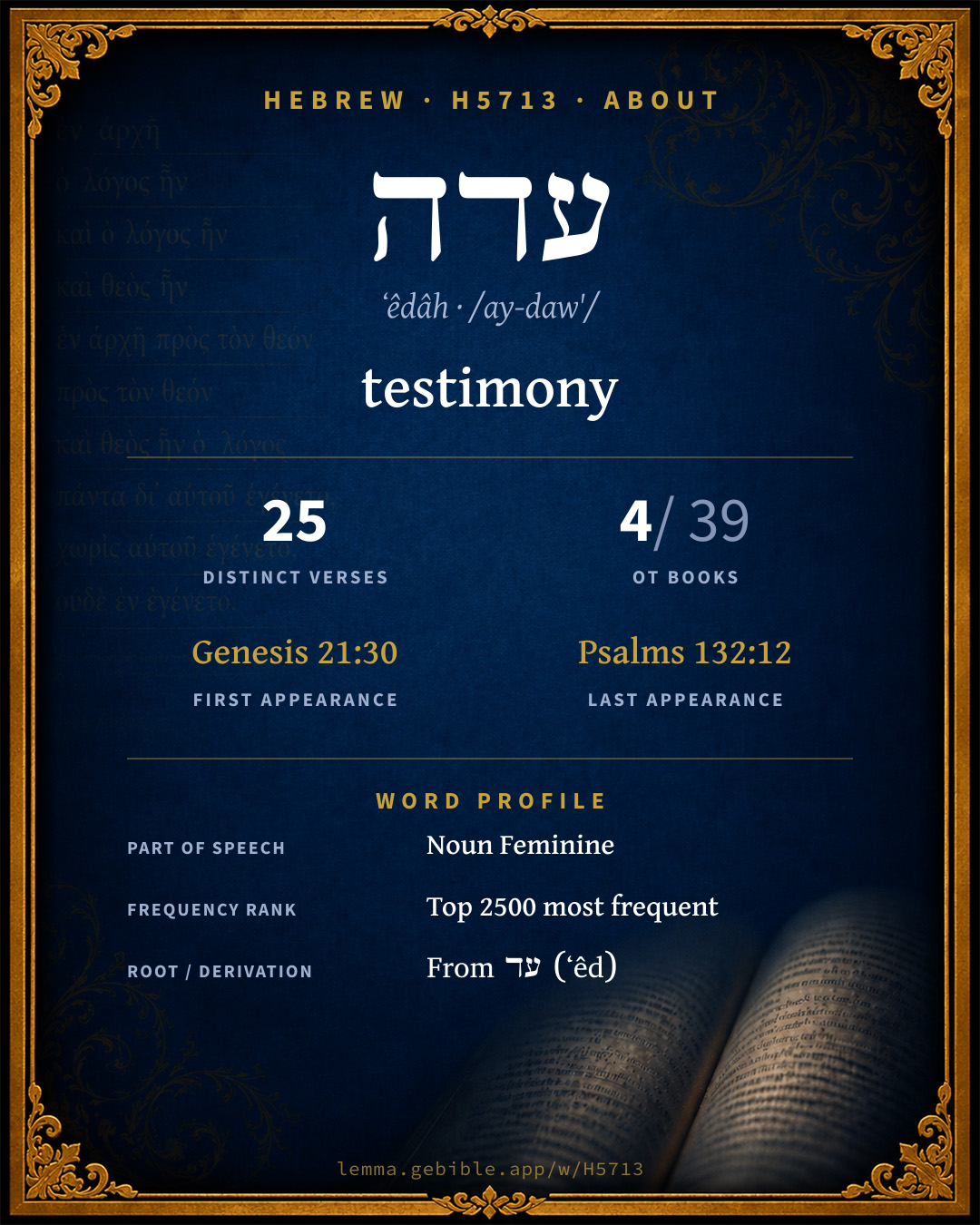
עֵדָה
testimony
‘testimony’ is one of 2 main senses fuller range ↓
Full lexicon entry — Brown-Driver-Briggs (BDB)
From Brown-Driver-Briggs (BDB)
Where this word appears
See every Construct-state word in the Hebrew Bible →
Grammar key — what these labels mean
Part of speech
- Noun
- A naming word — a person, place, thing, or idea.
Noun type
- Common
- A common noun — a general class of person, place, or thing (“king,” “city,” “water”), not a specific name.
State
- Construct
- A noun bound to a following noun in a possessive / “of” relationship (the construct chain).
- Absolute
- The independent form of a noun, not bound to a following word.
Gender
- Feminine
- Grammatically feminine.
Number
- Plural
- More than one (in Hebrew, generally three or more).
- Singular
- One.
Grammatical forms
- Noun, Common, Feminine, Plural, Construct 20 times (77%)
- Noun, Common, Feminine, Singular, Absolute 4 times (15%)
- Noun, Common, Feminine, Plural, Absolute 2 times (8%)
Parsed forms decoded from the imported morphology (morphhb / Westminster Leningrad Codex — WLC text public domain, morphhb tagging CC BY 4.0), counted across 26 parsed occurrences — not distinct verses.
Every verse where H5713 appears — 25 distinct verses across 4 books. Click any verse to open its interlinear word-by-word view. Verse text shown in the World English Bible for context — . Each verse’s Hebrew form is shown with its reference; the English is not keyword-highlighted, since the data carries no word-level English alignment. Use “Compare translations” on any verse to read it across multiple English versions. This concordance covers the Hebrew Bible; Septuagint (Greek Old Testament) occurrences are not indexed here.
Genesis 2 verses
- Genesis 21:30 לְ/עֵדָ֔ה prep + n c fs He said, "You shall take these seven ewe lambs from my hand, that it may be a witness to me, that I have dug this well."
- Genesis 31:52 וְ/עֵדָ֖ה conj + n c fs May this heap be a witness, and the pillar be a witness, that I will not pass over this heap to you, and that you will not pass over this heap and this pillar to me, for harm.
Deuteronomy 3 verses
- Deuteronomy 4:45 הָֽ/עֵדֹ֔ת ptcl def.art + n c fp these are the testimonies, and the statutes, and the ordinances, which Moses spoke to the children of Israel, when they came forth out of Egypt,
- Deuteronomy 6:17 וְ/עֵדֹתָ֥י/ו conj + n c fp cs + sfx pers 3ms You shall diligently keep the commandments of Yahweh your God, and his testimonies, and his statutes, which he has commanded you.
- Deuteronomy 6:20 הָ/עֵדֹ֗ת ptcl def.art + n c fp When your son asks you in time to come, saying, What mean the testimonies, and the statutes, and the ordinances, which Yahweh our God has commanded you?
Joshua 1 verse
Psalms 19 verses
- Psalms 25:10 וְ/עֵדֹתָֽי/ו conj + n c fp cs + sfx pers 3ms All the paths of Yahweh are loving kindness and truth To such as keep his covenant and his testimonies.
- Psalms 78:56 וְ֝/עֵדוֹתָ֗י/ו conj + n c fp cs + sfx pers 3ms Yet they tempted and rebelled against the Most High God, And didn't keep his testimonies;
- Psalms 93:5 עֵֽדֹתֶ֨י/ךָ n c fp cs + sfx pers 2ms Your statutes stand firm. Holiness adorns your house, Yahweh, forevermore.
- Psalms 99:7 עֵ֝דֹתָ֗י/ו n c fp cs + sfx pers 3ms He spoke to them in the pillar of cloud. They kept his testimonies, The statute that he gave them.
- Psalms 119:2 עֵדֹתָ֗י/ו n c fp cs + sfx pers 3ms Blessed are those who keep his statutes, Who seek him with their whole heart.
- Psalms 119:22 עֵדֹתֶ֣י/ךָ n c fp cs + sfx pers 2ms Take reproach and contempt away from me, For I have kept your statutes.
- Psalms 119:24 עֵ֭דֹתֶי/ךָ n c fp cs + sfx pers 2ms Indeed your statutes are my delight, And my counselors.
- Psalms 119:46 בְ֭/עֵדֹתֶי/ךָ prep + n c fp cs + sfx pers 2ms I will also speak of your statutes before kings, And will not be disappointed.
- Psalms 119:59 עֵדֹתֶֽי/ךָ n c fp cs + sfx pers 2ms I considered my ways, And turned my steps to your statutes.
- Psalms 119:79 עֵדֹתֶֽי/ךָ n c fp cs + sfx pers 2ms Let those who fear you turn to me. They will know your statutes.
- Psalms 119:95 עֵ֝דֹתֶ֗י/ךָ n c fp cs + sfx pers 2ms The wicked have waited for me, to destroy me. I will consider your statutes.
- Psalms 119:119 עֵדֹתֶֽי/ךָ n c fp cs + sfx pers 2ms You put away all the wicked of the earth like dross. Therefore I love your testimonies.
- Psalms 119:125 עֵדֹתֶֽי/ךָ n c fp cs + sfx pers 2ms I am your servant. Give me understanding, That I may know your testimonies.
- Psalms 119:138 עֵדֹתֶ֑י/ךָ n c fp cs + sfx pers 2ms You have commanded your statutes in righteousness. They are fully trustworthy.
- Psalms 119:146 עֵדֹתֶֽי/ךָ n c fp cs + sfx pers 2ms I have called to you. Save me! I will obey your statutes.
- Psalms 119:152 מֵ/עֵדֹתֶ֑י/ךָ prep + n c fp cs + sfx pers 2ms Of old I have known from your testimonies, That you have founded them forever.
- Psalms 119:167 עֵדֹתֶ֑י/ךָ n c fp cs + sfx pers 2ms My soul has observed your testimonies. I love them exceedingly.
- Psalms 119:168 וְ/עֵדֹתֶ֑י/ךָ conj + n c fp cs + sfx pers 2ms I have obeyed your precepts and your testimonies, For all my ways are before you.
- Psalms 132:12 וְ/עֵדֹתִ֥/י conj + n c fp cs + sfx pers 1cs If your children will keep my covenant, My testimony that I will teach them, Their children also will sit on your throne forevermore."
About this entry
At a glance — auto-summarized from this page’s data, not written by a person. Every figure links to its source below. This summary describes the numbers; it doesn’t interpret them.
עדה (ʻêdâh) is a Hebrew noun most often rendered “testimony.” It clusters heavily in Psalms, which alone accounts for 76% of its uses. With 25 verses in 4 books, it is an uncommon word in the Hebrew Bible. Debuting at Genesis 21:30, it then recurs through the corpus. It is not a single-sense word — see its full sense range. For the data behind this summary, explore the sense tree and the renderings breakdown below.
Gloss history
Strong's 1890 vs modern scholarship
About this word
Strong's H5713 catalogs a Hebrew word from the Hebrew Old Testament.
These counts are not copied from any lexicon or concordance. They are computed here, from the morphology-tagged Hebrew Old Testament. What Lemma adds →
- 25
- distinct verses
- The word appears in 25 distinct verses.
- 4 / 39
- OT books
- The word appears in 4 of 39 Old Testament books.
- #1,251
- by frequency
- Top 2500 most frequent Hebrew words (rank 1,251 of 8,640 Hebrew words by occurrence).
View all 25 occurrences in the concordance →
Most concentrated in
- Psalms 19 verses 76%
- Deuteronomy 3 verses 12%
- Genesis 2 verses 8%
By section of the Old Testament
By traditional corpus
Conventional, traditional groupings — biblical authorship is debated, so this is a traditional corpus grouping, not an authorship claim. Each share is this word’s portion of its verses in that division of the Hebrew canon. Each figure is a share of the word’s 25 distinct verses.
- Writings (Ketuvim) 19 verses · 76%
- Torah (Pentateuch) 5 verses · 20%
- Prophets (Nevi'im) 1 verse · 4%
How translations render this word
Counts come from each version’s own published word-to-Strong’s tagging or interlinear alignment — an approximate guide to how each version renders this word, not a word-level alignment the data otherwise carries. Because each total is that version’s own tagged count, the per-version totals vary from one another and need not match the appearance or distinct-verse counts above. These counts may also differ from a printed concordance because Lemma counts each distinctly tagged rendering and does not collapse phrase taggings into a single head-word total. This is a fixed set of word-tagged versions (KJV, ASV, BSB, ULT) and does not change with the reading translation you choose elsewhere. Each version’s license is shown beside its name below (and on Sources).
BDB lists this Strong’s number as 3 distinct words (homographs). Each count above pools all of them and is not split by sense — see the Senses section below. A low-frequency rendering may belong to a different one of those words, not the primary meaning.
- King James Version†: Testimonies 18×
- American Standard Version†: Testimonies 16×
- Berean Standard Bible†: Testimonies 17×, Decrees 3×, Witness 3×
- unfoldingWord Literal Text†: Testimonies 20×, Witness 3×
King James Version Public Domain
Renders H5713 across 26† tagged occurrences — most commonly:
Plus 8 renderings that appear only once — usually multi-word phrases or single function words the recovered tagging swept in, not distinct renderings.
American Standard Version Public Domain
Renders H5713 across 26† tagged occurrences — most commonly:
Plus 10 renderings that appear only once — usually multi-word phrases or single function words the recovered tagging swept in, not distinct renderings.
Berean Standard Bible Public Domain
Renders H5713 across 26† tagged occurrences — most commonly:
Plus 3 renderings that appear only once — usually multi-word phrases or single function words the recovered tagging swept in, not distinct renderings.
unfoldingWord Literal Text CC BY-SA 4.0
Renders H5713 across 29† tagged occurrences — most commonly:
Plus 6 renderings that appear only once — usually multi-word phrases or single function words the recovered tagging swept in, not distinct renderings.
Senses in the full BDB
What do BDB’s symbols mean?
BDB uses these scholarly abbreviations:
| Symbol | Meaning |
|---|---|
| 𝔊 | the Septuagint (the ancient Greek translation, LXX) |
| 𝔙 | the Vulgate (the Latin translation) |
| 𝔖 | the Syriac version (the Peshitta) |
| 𝔗 | the Targum (the Aramaic translation) |
| ψ | the Psalms |
| √ | root (the underlying root or stem) |
| ‖ | parallel passage (a synonymous or contrasted parallel) |
| † | the dagger: every passage where the word occurs is cited |
The 3 senses and sub-senses the full Brown-Driver-Briggs lexicon distinguishes for this word, in lexicon order (not ranked by frequency), with BDB’s own verbatim wording and sub-sense lettering. Shown in Hebrew script with BDB’s own scholarly abbreviations. The condensed entry is in the Lexicon Entry tab. See also the Forms in the corpus table below.
עדה I congregation (proposes company assembled together by appointment, or acting concertedly)
- 1. עֲדַת־אֵל ψ 82:1 congregation of Ēl, of company of angels (‖ בקרב אלהים); ע׳ לְאֻמִּים 7:8 congregation of peoples; ע׳ צַדִּיקִים 1:5 congregation of the righteous; ‖ סוֹד יְשָׁרִים 111:1; ‖ קהל Pr 5:14; כָּל־עֲדָתִי Jb 16:7 (of Job’s circle of dependents); in a bad sense, ע׳ מְרֵעִים company of evil doers ψ 22:17; ע׳ עריצים 86:14; ע׳ חנף Jb 15:34; ע׳ קֹרַח company of Korah Nu 26:9; 27:3 (P), so עֲדָתוֹ, עֲדָֽתְךָ 16:5, 6, 11, 16; 17:5 (P), and הָעֵדָה 26:10; 27:3 (P); ע׳ אֲבִירָם ψ 106:17, cf. v 18. e.g. Psalms 82:1
- 2. pack of animals ע׳ אַבִּירִים ψ 68:31 (fig. of nobles); ע׳ דְּבֹרִים Ju 14:8 a swarm of bees. e.g. Psalms 68:31
- 3. elsewhere of Israel Ho 7:12 עֲדָתָם i.e. the whole assemblage of them; 1 K 8:5 (= 2 Ch 5:6) כל עדת ישׂ׳ of those gathered to Sol.; 12:20 העדה of assembly at Shechem; Je 6:18 (text very dub.); עֲדָתוֹ 30:20 of restored people; עֲדָֽתְךָ ψ 74:2 (‖ שׁכט נחלתך); elsewhere in P, except possibly Nu 20:11 (R), in technical sense, of the company of Israel of the Exodus, the congregation (115 times), especially in the phrases †ע׳ יהוה Nu 27:17; 31:16 Jos 22:16, 17; †ע׳ ישׂראל Ex 12:3, 6, 19, 47 Lv 4:13 Nu 16:9; 32:4 Jos 22:18, 20; †ע׳ בני ישׂראל Ex 16:1, 2, 9, 10; 17:1; 35:1, 4, 20 Lv 16:5; 19:2 (H), Nu 1:2, 53; 8:9, 20; 13:26; 14:5, 7; 15:25, 26; 17:6; 19:9; 25:6; 26:2; 27:20; 31:12 Jos 18:1; 22:12; הָעֵדָה Lv 8:4 + 29 times (cf. Ju 20:1; 21:10); כל־הע׳ Lv 8:3 + 33 times (cf. Ju 21:13); †נְשִׂיאֵי (ה)ע׳ princes of the congregation Ex 16:22; Nu 4:34; 16:2; 31:13; 32:2; Jos 9:15, 18; 22:30; כָּל־הַנְּשִׂאִים בָּע׳ Ex 34:31; זִקְנֵי הע׳ elders of the congregation Lv 4:15 (cf. Ju 21:16); ראשׁי אבות הע׳ Nu 31:26. ii & iii עֵדָה v. עוד. e.g. Hosea 7:12
עדה II testimony, witness, of things (only E)
עדה III only pl. MT testimonies (always of laws as divine testimonies or solemn charges)
Senses from the full Brown-Driver-Briggs lexicon (Brown, Driver, Briggs; Oxford 1906 — public domain), digitized via Sefaria, supplemented by the OpenScriptures HebrewLexicon (CC BY 4.0). Full attribution on Sources.
Word origin
I. n.f. congregation (proposes company assembled together by appointment, or acting concertedly)—ע׳ Nu 16:2 + 85 times; cstr. עֲדַת Ex 12:3 + 52 times; sf. עֲדָתִי Jb 16:7 + 9 times sfs.;—
IV. n.f. testimony, witness, of things (only E);—Gn 21:30; 31:52; Jos 24:27(×2) (J uses עֵד for feminine things).—i. עֵדָה v. יעד.
V. n.f. only pl. MT testimonies (always of laws as divine testimonies or solemn charges);—pl. abs. עֵדֹת Dt 4:45; 6:20; sf. (of י׳), עֵדֹתִי ψ 132:12 (Ges§ 91 n.), עֵדֹתָיו Dt 6:17 ψ 25:10; 99:7; 119:2, עֵדוֹתָיו 78:56; עֵדֹתֶיךָ 93:5; 119:22, 24, 46, 59, 79, 95, 119, 125, 138, 146, 152, 167, 168 (MT pointing artificial, der. prob. from עֵדוּת, reading עֵדֻת for עֵדֹת, or regarding עֵדֹת as contr. from עֵדְוֹת, pl. of עֵדוּת [Sta§ 320 b SS Buhl]; v. also Dr Dt 4:45; Dt 4:45; 6:17, 20 are redactional).
— Brown-Driver-Briggs (Oxford 1906, public domain), digitized via Sefaria, supplemented by the OpenScriptures HebrewLexicon (CC BY 4.0). See Sources.
Derived from עד (ʻêd) (H5707) — witness.
Jastrow Dictionary
A second Hebrew/Aramaic lexicon for comparison, covering Aramaic and post-biblical (Talmudic, Targumic, Midrashic) usage that the biblical-Hebrew BDB does not. Matched by lemma rather than by Strong’s number, so a lemma may carry more than one Jastrow headword (shown separately below), and the entries cover usage well beyond the Bible.
עֵדָה I
- [appointed meeting,] assembly, congregation; court; prayer meeting. Tosef. Snh. XII, 3 (ref. to Ex. XXI, 18) מה אגרוף הידוע לע׳ ילעדים וכ׳ as the fist (of the slayer) is ascertained before court and witnesses, so must the stone (weapon) be &c.; B. Kam. 90ᵇ; ib. 91ᵃ. Snh. I, 6 (ref. to Num. XXXV, 24, sq.) ע׳ שופטת וע׳ מצלת there must be a possibility of an incriminating assembly (of ten persons), and of a saving assembly, which makes twenty persons; ומנין לע׳ שהיא וכ׳ and where do we find an intimation that an ‘edah consists of ten?; Y. Ber. IV, 11ᶜ top; a. fr.—Y. Maas. Sh. II, end, 53ᵈ; Koh. R. to IX, 9; Yalk. ib. 989 ע׳ קדושה the holy brotherhood. e.g. Exodus 21:18
*עֵדָה II
- = עֵדוּת, testimony. Tosef. Bekh. III, 8 שכר עֵדָתוֹ ed. Zuck. (oth. ed. עדותו) pay for his testimony.—Pl. עֵדוֹת. Bekh. IV, 6 (29ᵃ) עֵדוֹתָיו בטילין masc. (Var. in Mish. ed. עדותו בטילה) his testimonies are void; (Kidd. 58ᵇ עדותו בטילה).
עדי
- [to turn, pass; cmp. סוּר and חוּל,] to pass by; to pass away, v. next w.
- to be passed, be caught in passing. Lev. R. s. 26 (ref. to I Sam. XXIV, 11, a. XXVI, 14) בכנף אמרת בסירה ה׳ … בסירה הוּעֲדוּ as to the skirt (of Saul’s cloak) thou saidst, it was caught in a bush: have the spear and the cruise also been caught in the bush?; Num. R. s. 19 הוּעֲדַת (read the second time הועדו); Midr. Till. to Ps. VII; Yalk. Sam. 133, a. e.; (Y. Peah I, 16ᵃ bot.; Y. Sot. I, 17ᵇ הוערת, הוערו, הערת, v. עָרָה). e.g. 1 Samuel 24:11
עדי ²
- to strip.
- same, to take off. Lam. R. introd. (R. Ḥan. 1) יום … ה׳ מהן וכ׳ on the day Nebuchadnezzar came in conflict with Israel, he deprived them of two garments, the garment of priesthood and the garment of royalty.
A Dictionary of the Targumim, the Talmud Babli and Yerushalmi, and the Midrashic Literature (Marcus Jastrow; London, Luzac, 1903) — Public Domain. Digitized via Sefaria. Digitized via Sefaria. Full attribution on Sources.
Forms in the corpus
The 19 distinct written forms H5713 takes in the Hebrew Bible, most frequent first — each parse links to that state’s occurrences in the concordance. Hebrew forms include their vowel points and cantillation, so a single lemma takes many written forms.
Same root — word family
Other BDB entries built from the same root as H5713, grouped by Strong’s listed origin. These share a root / origin per the lexicon — not necessarily a shared meaning. Each links to that word’s own entry.
Derives from
Shares the same root
Compare all same-root words → They share a root, not necessarily a meaning.
Septuagint verse parallels
This word appears in 9 verses that also exist in the Greek Old Testament (Septuagint), out of the 25 Hebrew verses it occurs in. You can read those verses in Greek by switching the Old Testament edition to the Septuagint.
Read these verses in the Septuagint
This is a verse-level parallel only — the same verses exist in both the Hebrew and Greek Old Testaments. No word-level Hebrew↔Greek correspondence is claimed: the data carries no such alignment, so no Greek word is shown as this Hebrew word’s translation. Coverage is not total — the Septuagint omits the deuterocanon and renumbers the Psalms, so some Hebrew verses have no direct Greek parallel.