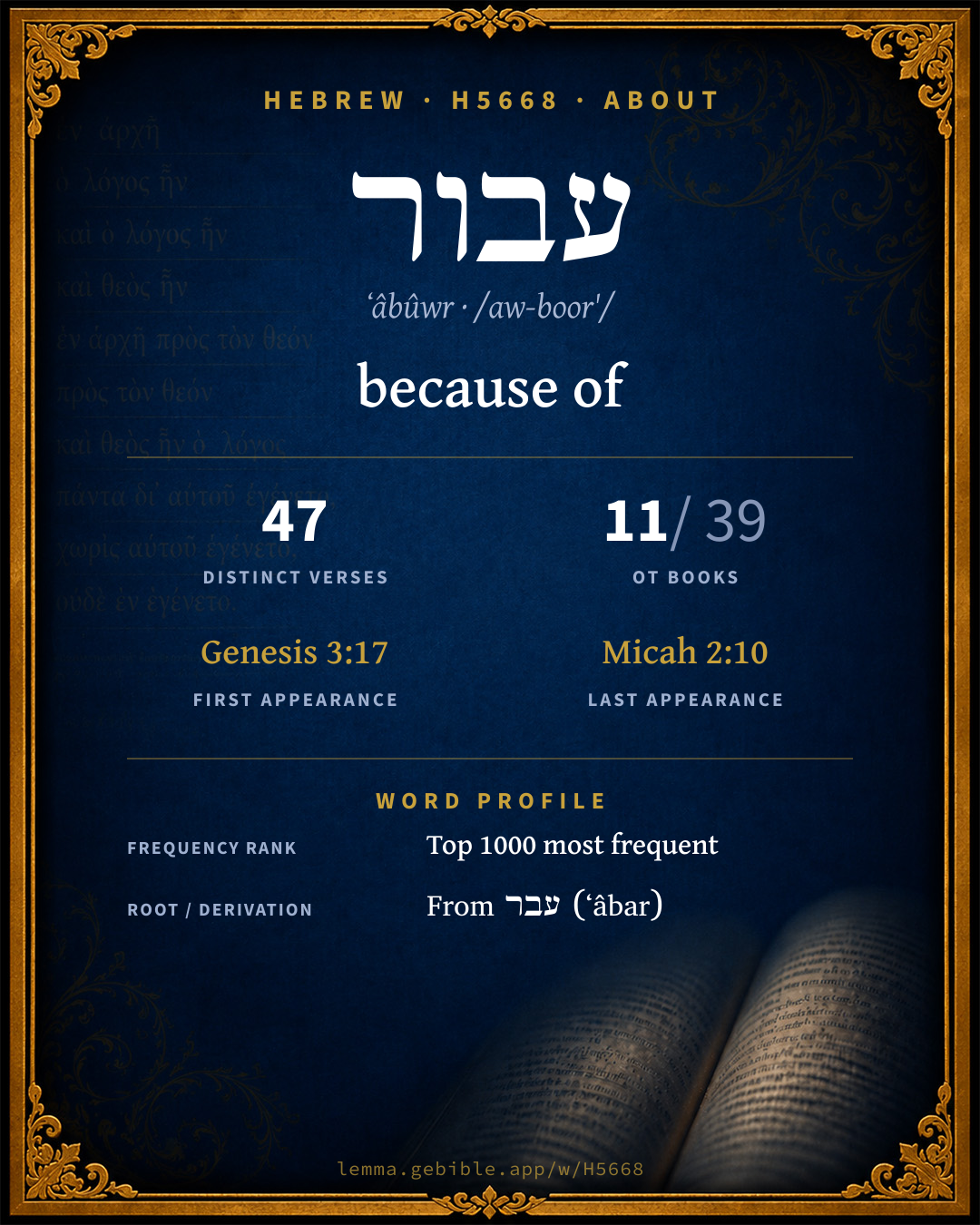
עָבוּר
because of
also: on account of, in order to fuller range ↓
Full lexicon entry — Brown-Driver-Briggs (BDB)
From Brown-Driver-Briggs (BDB)
Where this word appears
Grammar key — what these labels mean
Noun type
- Common
- A common noun — a general class of person, place, or thing (“king,” “city,” “water”), not a specific name.
State
- Construct
- A noun bound to a following noun in a possessive / “of” relationship (the construct chain).
Gender
- Masculine
- Grammatically masculine.
Number
- Singular
- One.
Every verse where H5668 appears in the Book of Genesis — 15 distinct verses. Click any verse to open its interlinear word-by-word view. Verse text shown in the World English Bible for context — . Each verse’s Hebrew form is shown with its reference; the English is not keyword-highlighted, since the data carries no word-level English alignment. Use “Compare translations” on any verse to read it across multiple English versions. This concordance covers the Hebrew Bible; Septuagint (Greek Old Testament) occurrences are not indexed here.
Genesis
- Genesis 3:17 בַּֽ/עֲבוּרֶ֔/ךָ prep + n c ms cs + sfx pers 2ms To Adam he said, "Because you have listened to your wife's voice, and have eaten of the tree, of which I commanded you, saying, 'You shall not eat of it,' cursed is the ground for your sake. In toil you will eat of it all the days of your life.
- Genesis 8:21 בַּ/עֲב֣וּר prep + n c ms cs Yahweh smelled the sweet savor. Yahweh said in his heart, "I will not again curse the ground any more for man's sake, because the imagination of man's heart is evil from his youth; neither will I ever again strike everything living, as I have done.
- Genesis 12:13 בַ/עֲבוּרֵ֔/ךְ prep + n c ms cs + sfx pers 2fs Please say that you are my sister, that it may be well with me for your sake, and that my soul may live because of you."
- Genesis 12:16 בַּ/עֲבוּרָ֑/הּ prep + n c ms cs + sfx pers 3fs He dealt well with Abram for her sake. He had sheep, and oxen, and male donkeys, and men-servants, and maid-servants, and female donkeys, and camels.
- Genesis 18:26 בַּ/עֲבוּרָֽ/ם prep + n c ms cs + sfx pers 3mp Yahweh said, "If I find in Sodom fifty righteous within the city, then I will spare all the place for their sake."
- Genesis 18:29 בַּ/עֲב֖וּר prep + n c ms cs He spoke to him yet again, and said, "What if there are forty found there?" He said, "I will not do it for the forty's sake."
- Genesis 18:31 בַּ/עֲב֖וּר prep + n c ms cs He said, "See now, I have taken it on myself to speak to the Lord. What if there are twenty found there?" He said, "I will not destroy it for the twenty's sake."
- Genesis 18:32 בַּ/עֲב֖וּר prep + n c ms cs He said, "Oh don't let the Lord be angry, and I will speak yet but this once. What if ten are found there?" He said, "I will not destroy it for the ten's sake."
- Genesis 21:30 בַּ/עֲבוּר֙ prep + n c ms cs He said, "You shall take these seven ewe lambs from my hand, that it may be a witness to me, that I have dug this well."
- Genesis 26:24 בַּ/עֲב֖וּר prep + n c ms cs Yahweh appeared to him the same night, and said, "I am the God of Abraham your father. Don't be afraid, for I am with you, and will bless you, and multiply your seed for my servant Abraham's sake."
- Genesis 27:4 בַּ/עֲב֛וּר prep + n c ms cs Make me savory food, such as I love, and bring it to me, that I may eat, and that my soul may bless you before I die."
- Genesis 27:10 בַּ/עֲבֻ֛ר prep + n c ms cs You shall bring it to your father, that he may eat, so that he may bless you before his death."
- Genesis 27:19 בַּ/עֲב֖וּר prep + n c ms cs Jacob said to his father, "I am Esau your firstborn. I have done what you asked me to do. Please arise, sit and eat of my venison, that your soul may bless me."
- Genesis 27:31 בַּ/עֲב֖וּר prep + n c ms cs He also made savory food, and brought it to his father. He said to his father, "Let my father arise, and eat of his son's venison, that your soul may bless me."
- Genesis 46:34 בַּ/עֲב֗וּר prep + n c ms cs that you shall say, 'Your servants have been keepers of cattle from our youth even until now, both we, and our fathers:' that you may dwell in the land of Goshen; for every shepherd is an abomination to the Egyptians."
About this entry
At a glance — auto-summarized from this page’s data, not written by a person. Every figure links to its source below. This summary describes the numbers; it doesn’t interpret them.
The Hebrew word עבור centers on the idea of “because of.” Its earliest occurrence is Genesis 3:17. It appears 47 verses across 11 books of the Hebrew Bible, among its moderately common vocabulary. The word gravitates to Genesis (32%), then 2 Samuel and Exodus. Lexicons map it across 2 senses — beyond “because of” it also covers “on account of” and “in order to”. Dig into 47-verse concordance and the renderings breakdown below.
Gloss history
Strong's 1890 vs modern scholarship
About this word
Strong's H5668 catalogs a Hebrew word from the Hebrew Old Testament.
These counts are not copied from any lexicon or concordance. They are computed here, from the morphology-tagged Hebrew Old Testament. What Lemma adds →
- 47
- distinct verses
- The word appears in 47 distinct verses.
- 11 / 39
- OT books
- The word appears in 11 of 39 Old Testament books.
- #752
- by frequency
- Top 1000 most frequent Hebrew words (rank 752 of 8,640 Hebrew words by occurrence).
View all 47 occurrences in the concordance →
By section of the Old Testament
By traditional corpus
Conventional, traditional groupings — biblical authorship is debated, so this is a traditional corpus grouping, not an authorship claim. Each share is this word’s portion of its verses in that division of the Hebrew canon. Each figure is a share of the word’s 47 distinct verses.
- Torah (Pentateuch) 20 verses · 43%
- Prophets (Nevi'im) 19 verses · 40%
- Writings (Ketuvim) 8 verses · 17%
How translations render this word
Counts come from each version’s own published word-to-Strong’s tagging or interlinear alignment — an approximate guide to how each version renders this word, not a word-level alignment the data otherwise carries. Because each total is that version’s own tagged count, the per-version totals vary from one another and need not match the appearance or distinct-verse counts above. These counts may also differ from a printed concordance because Lemma counts each distinctly tagged rendering and does not collapse phrase taggings into a single head-word total. This is a fixed set of word-tagged versions (KJV, ASV, BSB, ULT) and does not change with the reading translation you choose elsewhere. Each version’s license is shown beside its name below (and on Sources).
- King James Version: To 2×
- American Standard Version: To 2×
- Berean Standard Bible: Sake 9×, That 8×, Account 6×
- unfoldingWord Literal Text: Sake of 14×, That 9×, Of 6×
King James Version Public Domain
Renders H5668 across 8 tagged occurrences — most commonly:
Plus 6 renderings that appear only once — usually multi-word phrases or single function words the recovered tagging swept in, not distinct renderings.
American Standard Version Public Domain
Renders H5668 across 8 tagged occurrences — most commonly:
Plus 6 renderings that appear only once — usually multi-word phrases or single function words the recovered tagging swept in, not distinct renderings.
Berean Standard Bible Public Domain
Renders H5668 across 43 tagged occurrences — most commonly:
Plus 9 renderings that appear only once — usually multi-word phrases or single function words the recovered tagging swept in, not distinct renderings. Not rendered by a distinct English word in 4 further occurrences.
unfoldingWord Literal Text CC BY-SA 4.0
Renders H5668 across 51 tagged occurrences — most commonly:
Plus 11 renderings that appear only once — usually multi-word phrases or single function words the recovered tagging swept in, not distinct renderings.
Senses in BDB
The 2 senses BDB distinguishes for this word, in lexicon order (not ranked by frequency or importance). The full entry — with sub-senses — is in the Lexicon Entry tab.
- for the sake of, on account of, because of, in order to (preposition)
- in order that (conjunction)
Word origin
[ עָבוּר ] n. only in בַּעֲבוּר 47, בַּעֲבֻר, prep. and conj. for the sake of, on account of, in order that
— Brown-Driver-Briggs (Oxford 1906, public domain), digitized via Sefaria, supplemented by the OpenScriptures HebrewLexicon (CC BY 4.0). See Sources.
Derived from עבר (ʻâbar) (H5674) — to pass over.
Jastrow Dictionary
A second Hebrew/Aramaic lexicon for comparison, covering Aramaic and post-biblical (Talmudic, Targumic, Midrashic) usage that the biblical-Hebrew BDB does not. Matched by lemma rather than by Strong’s number, so a lemma may carry more than one Jastrow headword (shown separately below), and the entries cover usage well beyond the Bible.
עִבּוּר
- , v. sub עיבּ׳.
עֲבוּר
- , בַּעֲ׳ for the sake of. Taan. 20ᵃ נקררה חמה בַּעֲבוּרוֹ the sun was made to break forth for his sake. Ib. בַּעֲבוּרָן for their sake; a. fr.—[Pesik. Haḥod., p. 45ᵃ sq. הרגיש בעבורה, read. בעֲבֵירָה.]
A Dictionary of the Targumim, the Talmud Babli and Yerushalmi, and the Midrashic Literature (Marcus Jastrow; London, Luzac, 1903) — Public Domain. Digitized via Sefaria. Digitized via Sefaria. Full attribution on Sources.
Forms in the corpus
The 22 distinct written forms H5668 takes in the Hebrew Bible, most frequent first — each parse links to that state’s occurrences in the concordance. Hebrew forms include their vowel points and cantillation, so a single lemma takes many written forms.
| Form | Parsing | Example | Uses |
|---|---|---|---|
| בַּ/עֲב֖וּר | Noun, Common, Masculine, Singular, Construct | Exodus 9:16 | 16 |
| בַּ/עֲב֣וּר | Noun, Common, Masculine, Singular, Construct | Amos 8:6 | 4 |
| בַּ/עֲב֤וּר | Noun, Common, Masculine, Singular, Construct | 1 Chronicles 17:19 | 4 |
| בַּ/עֲב֞וּר | Noun, Common, Masculine, Singular, Construct | Exodus 19:9 | 3 |
| בַּ/עֲב֥וּר | Noun, Common, Masculine, Singular, Construct | Amos 2:6 | 3 |
| בַּ/עֲבוּרָֽ/ם | Noun, Common, Masculine, Singular, Construct | Genesis 18:26 | 2 |
| בַּֽ/עֲבוּר֙ | Noun, Common, Masculine, Singular, Construct | 2 Samuel 9:7 | 2 |
| בַ/עֲבוּרֵ֔/ךְ | Noun, Common, Masculine, Singular, Construct | Genesis 12:13 | 1 |
| בַּ/עֲב֗וּר | Noun, Common, Masculine, Singular, Construct | Genesis 46:34 | 1 |
| בַּ/עֲב֛וּר | Noun, Common, Masculine, Singular, Construct | Genesis 27:4 | 1 |
| בַּ/עֲבֻ֛ר | Noun, Common, Masculine, Singular, Construct | Genesis 27:10 | 1 |
| בַּ/עֲבוּר֙ | Noun, Common, Masculine, Singular, Construct | Genesis 21:30 | 1 |
| בַּ/עֲבוּרִֽ/י | Noun, Common, Masculine, Singular, Construct | 1 Samuel 23:10 | 1 |
| בַּ/עֲבוּרָ֑/הּ | Noun, Common, Masculine, Singular, Construct | Genesis 12:16 | 1 |
| בַּ֠/עֲבוּר | Noun, Common, Masculine, Singular, Construct | 1 Chronicles 19:3 | 1 |
| בַּ֭/עֲבוּר | Noun, Common, Masculine, Singular, Construct | Psalms 132:10 | 1 |
| בַּֽ/עֲבוּרֶ֔/ךָ | Noun, Common, Masculine, Singular, Construct | Genesis 3:17 | 1 |
| וּ/בַ/עֲב֗וּר | Preposition | Exodus 20:20 | 1 |
| וּ֝/בַ/עֲב֗וּר | Preposition | Job 20:2 | 1 |
| לְ/בַ/עֲב֗וּר | Conjunction | 2 Samuel 17:14 | 1 |
| לְ/בַ/עֲב֤וּר | Preposition | 2 Samuel 14:20 | 1 |
| לְ/בַֽ/עֲבוּר֙ | Preposition | Exodus 20:20 | 1 |
Same root — word family
Other BDB entries built from the same root as H5668, grouped by Strong’s listed origin. These share a root / origin per the lexicon — not necessarily a shared meaning. Each links to that word’s own entry.
Derives from
Shares the same root
Derived from this word
Compare all same-root words → Showing 4 of 6 — not the complete family. They share a root, not necessarily a meaning.
Septuagint verse parallels
This word appears in 46 verses that also exist in the Greek Old Testament (Septuagint), out of the 47 Hebrew verses it occurs in. You can read those verses in Greek by switching the Old Testament edition to the Septuagint.
Read these verses in the Septuagint
- Genesis 3:17
- Exodus 9:14
- 1 Samuel 1:6
- 2 Samuel 5:12
- 1 Chronicles 14:2
- 2 Chronicles 28:19
- Job 20:2
- Psalms 105:45
- Jeremiah 14:4
- Amos 2:6
- Micah 2:10
This is a verse-level parallel only — the same verses exist in both the Hebrew and Greek Old Testaments. No word-level Hebrew↔Greek correspondence is claimed: the data carries no such alignment, so no Greek word is shown as this Hebrew word’s translation. Coverage is not total — the Septuagint omits the deuterocanon and renumbers the Psalms, so some Hebrew verses have no direct Greek parallel.