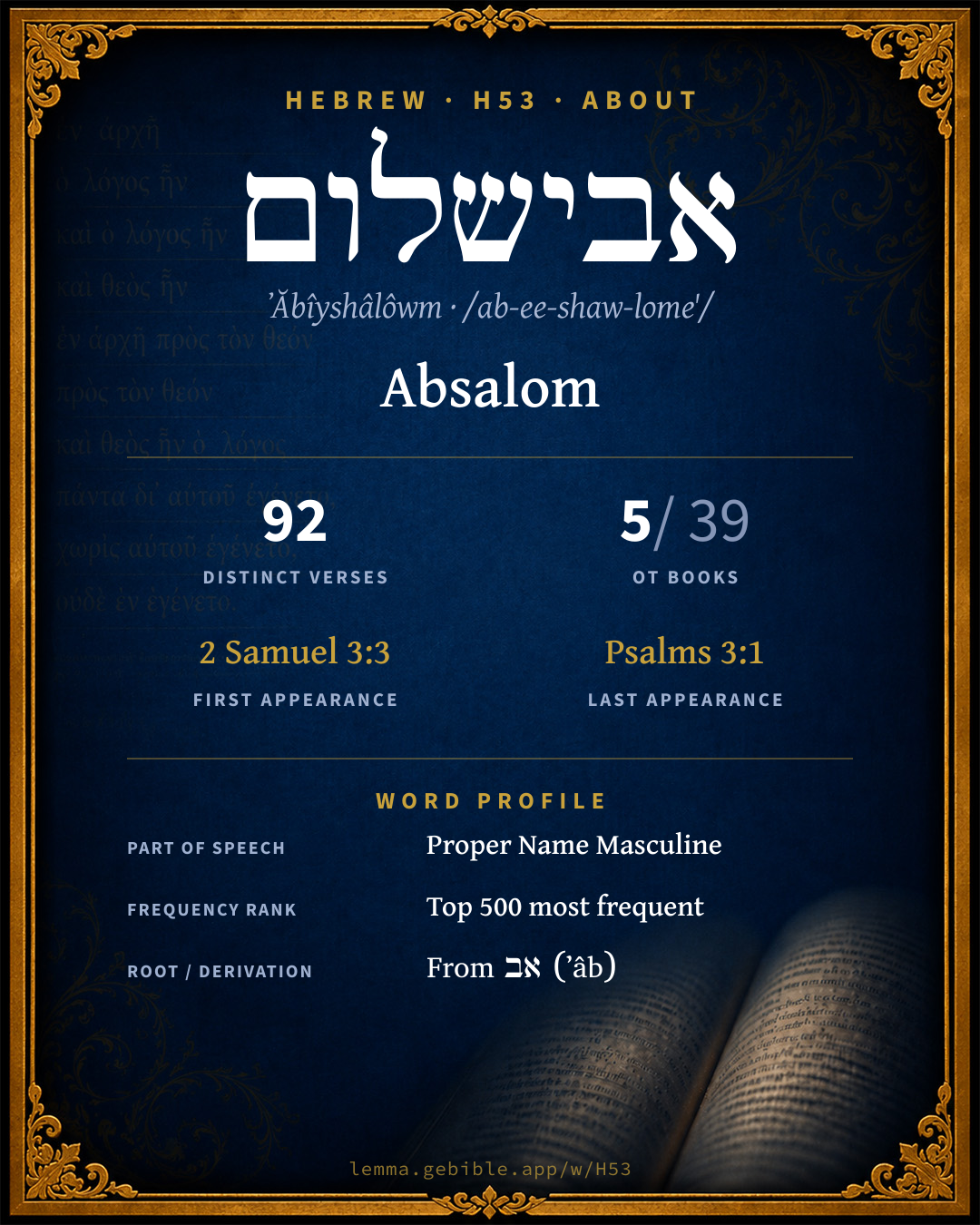
אֲבִישָׁלוֹם
Absalom
BDB lists 3 entries for ‘Absalom’ fuller range ↓
Full lexicon entry — Brown-Driver-Briggs (BDB)
From Brown-Driver-Briggs (BDB)
Where this word appears
Grammar key — what these labels mean
Part of speech
- Noun
- A naming word — a person, place, thing, or idea.
Noun type
- Proper
- A name of a specific person, place, or people (e.g. Abraham, Zion, Israel).
Every verse where H53 appears in the Book of 1 Kings — 5 distinct verses. Click any verse to open its interlinear word-by-word view. Verse text shown in the World English Bible for context — . Each verse’s Hebrew form is shown with its reference; the English is not keyword-highlighted, since the data carries no word-level English alignment. Use “Compare translations” on any verse to read it across multiple English versions. This concordance covers the Hebrew Bible; Septuagint (Greek Old Testament) occurrences are not indexed here.
1 Kings
- 1 Kings 1:6 אַבְשָׁלֽוֹם n Proper His father had not displeased him at any time in saying, Why have you done so? and he was also a very goodly man; and he was born after Absalom.
- 1 Kings 2:7 אַבְשָׁל֥וֹם n Proper But show kindness to the sons of Barzillai the Gileadite, and let them be of those who eat at your table; for so they came to me when I fled from Absalom your brother.
- 1 Kings 2:28 אַבְשָׁל֖וֹם n Proper The news came to Joab; for Joab had turned after Adonijah, though he didn't turn after Absalom. Joab fled to the Tent of Yahweh, and caught hold on the horns of the altar.
- 1 Kings 15:2 אֲבִישָׁלֽוֹם n Proper Three years reigned he in Jerusalem: and his mother's name was Maacah the daughter of Abishalom.
- 1 Kings 15:10 אֲבִישָׁלֽוֹם n Proper Forty-one years reigned he in Jerusalem: and his mother's name was Maacah the daughter of Abishalom.
About this entry
At a glance — auto-summarized from this page’s data, not written by a person. Every figure links to its source below. This summary describes the numbers; it doesn’t interpret them.
“Absalom” is the headline sense of the Hebrew name אבישלום (ʼĂbîyshâlôwm). More than three-quarters of its appearances fall in 2 Samuel. It appears 92 verses across 5 books of the Hebrew Bible, among its moderately common vocabulary. Scripture first uses it in 2 Samuel 3:3. The sections below give every occurrence and version rendering.
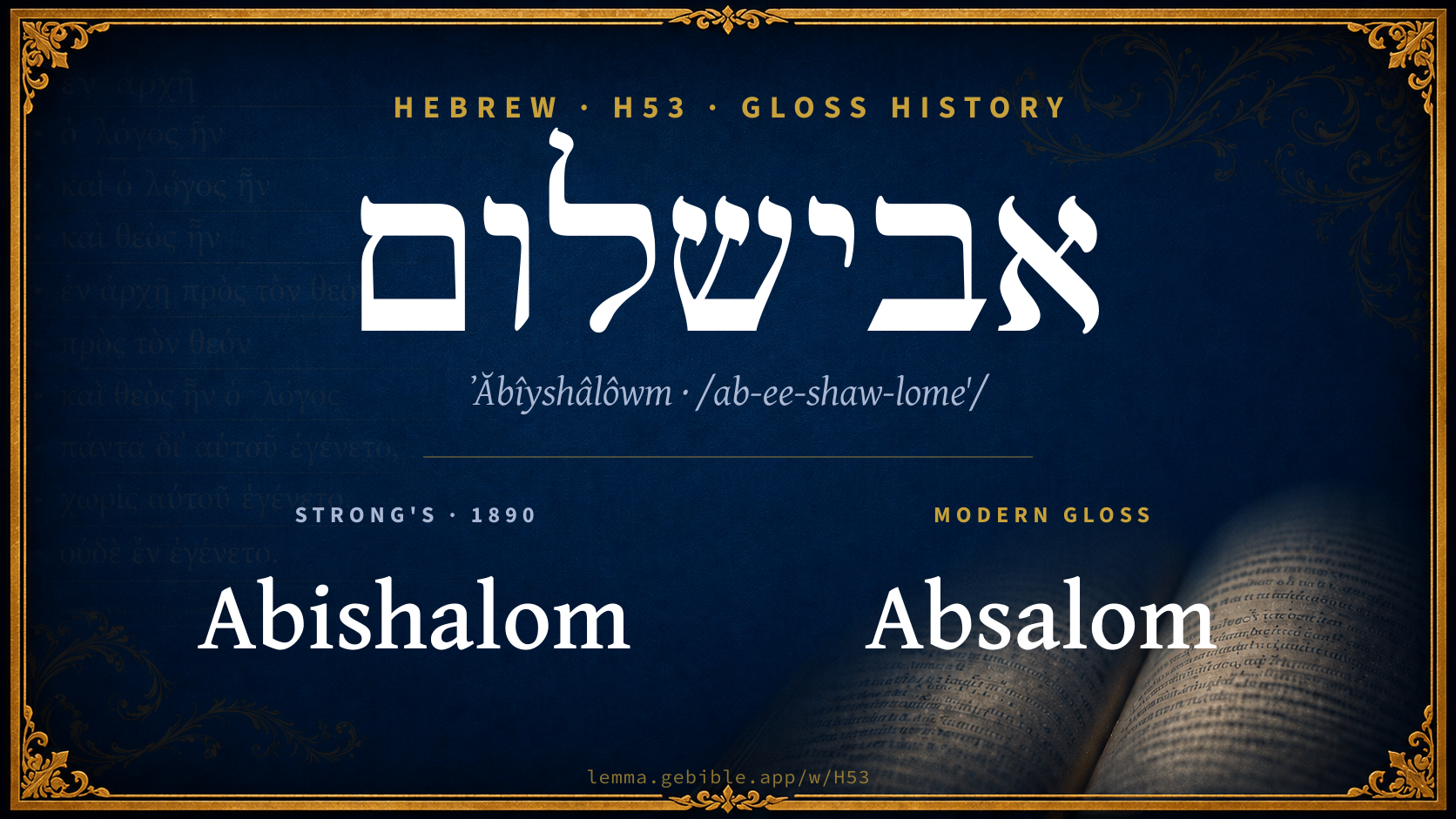
Gloss history
Strong's 1890 vs modern scholarship
About this word
Strong's H53 catalogs a Hebrew word from the Hebrew Old Testament.
These counts are not copied from any lexicon or concordance. They are computed here, from the morphology-tagged Hebrew Old Testament. What Lemma adds →
- 92
- distinct verses
- The word appears in 92 distinct verses.
- 5 / 39
- OT books
- The word appears in 5 of 39 Old Testament books.
- #390
- by frequency
- Top 500 most frequent Hebrew words (rank 390 of 8,640 Hebrew words by occurrence).
View all 92 occurrences in the concordance →
Most concentrated in
- 2 Samuel 83 verses 90%
- 1 Kings 5 verses 5%
- 2 Chronicles 2 verses 2%
By section of the Old Testament
By traditional corpus
Conventional, traditional groupings — biblical authorship is debated, so this is a traditional corpus grouping, not an authorship claim. Each share is this word’s portion of its verses in that division of the Hebrew canon. Each figure is a share of the word’s 92 distinct verses.
- Prophets (Nevi'im) 88 verses · 96%
- Writings (Ketuvim) 4 verses · 4%
How translations render this word
Counts come from each version’s own published word-to-Strong’s tagging or interlinear alignment — an approximate guide to how each version renders this word, not a word-level alignment the data otherwise carries. Because each total is that version’s own tagged count, the per-version totals vary from one another and need not match the appearance or distinct-verse counts above. These counts may also differ from a printed concordance because Lemma counts each distinctly tagged rendering and does not collapse phrase taggings into a single head-word total. This is a fixed set of word-tagged versions (KJV, ASV, BSB, ULT) and does not change with the reading translation you choose elsewhere. Each version’s license is shown beside its name below (and on Sources).
BDB lists this Strong’s number as 2 distinct words (homographs). Each count above pools all of them and is not split by sense — see the Senses section below. A low-frequency rendering may belong to a different one of those words, not the primary meaning.
- King James Version†: Absalom 99×, Absalom's 5×, Abishalom 2×
- American Standard Version†: Absalom 101×, Abishalom 2×
- Berean Standard Bible†: Absalom 77×, Absalom’s 8×, He 5×
- unfoldingWord Literal Text†: Absalom 104×, Abishalom 2×, Now 2×
King James Version Public Domain
Renders H53 across 111† tagged occurrences — most commonly:
Plus 3 renderings that appear only once — usually multi-word phrases or single function words the recovered tagging swept in, not distinct renderings.
American Standard Version Public Domain
Renders H53 across 110† tagged occurrences — most commonly:
Plus 7 renderings that appear only once — usually multi-word phrases or single function words the recovered tagging swept in, not distinct renderings.
Berean Standard Bible Public Domain
Renders H53 across 103† tagged occurrences — most commonly:
Plus 7 renderings that appear only once — usually multi-word phrases or single function words the recovered tagging swept in, not distinct renderings. Not rendered by a distinct English word in 8 further occurrences.
unfoldingWord Literal Text CC BY-SA 4.0
Renders H53 across 112† tagged occurrences — most commonly:
Plus 4 renderings that appear only once — usually multi-word phrases or single function words the recovered tagging swept in, not distinct renderings.
Senses in the full BDB
What do BDB’s symbols mean?
BDB uses these scholarly abbreviations:
| Symbol | Meaning |
|---|---|
| 𝔊 | the Septuagint (the ancient Greek translation, LXX) |
| 𝔙 | the Vulgate (the Latin translation) |
| 𝔖 | the Syriac version (the Peshitta) |
| 𝔗 | the Targum (the Aramaic translation) |
| ψ | the Psalms |
| √ | root (the underlying root or stem) |
| ‖ | parallel passage (a synonymous or contrasted parallel) |
| † | the dagger: every passage where the word occurs is cited |
The 2 senses and sub-senses the full Brown-Driver-Briggs lexicon distinguishes for this word, in lexicon order (not ranked by frequency), with BDB’s own verbatim wording and sub-sense lettering. Shown in Hebrew script with BDB’s own scholarly abbreviations. The condensed entry is in the Lexicon Entry tab. See also the Forms in the corpus table below.
- 1. Rehob.’s father-in-law †1 K 15:2, 10 2 Ch 11:20, 21. e.g. 1 Kings 15:2
- 2. 3rd son of Dvd 2 S 3:3; 13:1 + 90 times 2 S (insert 2 S 13:27 𝔊 Th We cf. Dr; del. v 38 Dr cf. We), + †1 K 1:6; 2:7, 2 1 Ch 3:2 ψ 3:1. e.g. 2 Samuel 3:3
Senses from the full Brown-Driver-Briggs lexicon (Brown, Driver, Briggs; Oxford 1906 — public domain), digitized via Sefaria, supplemented by the OpenScriptures HebrewLexicon (CC BY 4.0). Full attribution on Sources.
Word origin
I. n.pr.m. (my father is peace; according to LagBN 75 = (בֶּן)אֲבֶן + שָׁלֹם, cf. 𝔊 Ἀβεσσαλωμ)—א׳ †1 K 15:2, 10 = אַבְשָׁלוֹם 2 S 3:3 +, 2 Ch 11:20, 21, אַבְשָׁלֹם 2 S 13:4 +—
I. v. אֲבִישָׁלוֹם sub II. אבה.
— Brown-Driver-Briggs (Oxford 1906, public domain), digitized via Sefaria, supplemented by the OpenScriptures HebrewLexicon (CC BY 4.0). See Sources.
Derived from אב (ʼâb) (H1) — father.
Forms in the corpus
The 41 distinct written forms H53 takes in the Hebrew Bible, most frequent first — each parse links to that state’s occurrences in the concordance. Hebrew forms include their vowel points and cantillation, so a single lemma takes many written forms.
| Form | Parsing | Example | Uses |
|---|---|---|---|
| אַבְשָׁלוֹם֙ | Noun, Proper | 2 Samuel 13:22 | 13 |
| אַבְשָׁל֔וֹם | Noun, Proper | 2 Samuel 13:26 | 11 |
| אַבְשָׁל֑וֹם | Noun, Proper | 2 Chronicles 11:20 | 10 |
| אַבְשָׁל֖וֹם | Noun, Proper | 1 Kings 2:28 | 10 |
| אַבְשָׁלֽוֹם | Noun, Proper | 1 Kings 1:6 | 7 |
| אַבְשָׁלֹ֔ם | Noun, Proper | 2 Samuel 16:16 | 5 |
| אַבְשָׁל֗וֹם | Noun, Proper | 2 Chronicles 11:21 | 4 |
| אַבְשָׁל֣וֹם | Noun, Proper | 2 Samuel 3:3 | 4 |
| אַבְשָׁל֛וֹם | Noun, Proper | 2 Samuel 13:22 | 3 |
| אַבְשָׁל֥וֹם | Noun, Proper | 1 Kings 2:7 | 3 |
| אַבְשָׁל֨וֹם | Noun, Proper | 2 Samuel 13:28 | 3 |
| לְ/אַבְשָׁל֑וֹם | Noun, Proper | 2 Samuel 18:5 | 3 |
| אֲבִישָׁלֽוֹם | Noun, Proper | 1 Kings 15:2 | 2 |
| אַבְשָׁל֜וֹם | Noun, Proper | 2 Samuel 14:29 | 2 |
| אַבְשָׁלֹ֑ם | Noun, Proper | 2 Samuel 17:1 | 2 |
| אַבְשָׁלֹֽם | Noun, Proper | 2 Samuel 17:9 | 2 |
| וְ/אַבְשָׁלֹ֔ם | Noun, Proper | 2 Samuel 15:37 | 2 |
| לְ/אַבְשָׁלוֹם֙ | Noun, Proper | 2 Samuel 14:27 | 2 |
| אַ֠בְשָׁלוֹם | Noun, Proper | 2 Samuel 15:12 | 1 |
| אַבְשָׁל֤וֹם | Noun, Proper | 2 Samuel 15:2 | 1 |
| אַבְשָׁל֬וֹם | Noun, Proper | Psalms 3:1 | 1 |
| אַבְשָׁלֹ֛ם | Noun, Proper | 2 Samuel 17:25 | 1 |
| אַבְשָׁלֹ֥ם | Noun, Proper | 2 Samuel 13:4 | 1 |
| אַבְשָׁלֹם֒ | Noun, Proper | 2 Samuel 16:18 | 1 |
| אַבְשָׁלוֹם֒ | Noun, Proper | 2 Samuel 17:6 | 1 |
| בְּ/אַבְשָׁלֽוֹם | Noun, Proper | 2 Samuel 18:12 | 1 |
| וְ/אַבְשָׁל֗וֹם | Noun, Proper | 2 Samuel 16:15 | 1 |
| וְ/אַבְשָׁל֞וֹם | Noun, Proper | 2 Samuel 18:9 | 1 |
| וְ/אַבְשָׁל֣וֹם | Noun, Proper | 2 Samuel 13:37 | 1 |
| וְ/אַבְשָׁל֥וֹם | Noun, Proper | 2 Samuel 13:38 | 1 |
| וְ/אַבְשָׁלֹ֗ם | Noun, Proper | 2 Samuel 17:24 | 1 |
| וְ/אַבְשָׁלֹ֣ם | Noun, Proper | 2 Samuel 18:18 | 1 |
| וְ/אַבְשָׁלוֹם֙ | Noun, Proper | 2 Samuel 19:10 | 1 |
| וּ/כְ/אַבְשָׁל֗וֹם | Noun, Proper | 2 Samuel 14:25 | 1 |
| וּ/לְ/אַבְשָׁל֧וֹם | Noun, Proper | 2 Samuel 13:1 | 1 |
| לְ/אַבְשָׁל֔וֹם | Noun, Proper | 2 Samuel 13:23 | 1 |
| לְ/אַבְשָׁל֛וֹם | Noun, Proper | 2 Samuel 16:22 | 1 |
| לְ/אַבְשָׁל֣וֹם | Noun, Proper | 1 Chronicles 3:2 | 1 |
| לְ/אַבְשָׁלֹ֑ם | Noun, Proper | 2 Samuel 17:18 | 1 |
| לְ/אַבְשָׁלֹֽם | Noun, Proper | 2 Samuel 16:23 | 1 |
| לְ/אַבְשָׁלֽוֹם | Noun, Proper | 2 Samuel 14:33 | 1 |
Same root — word family
Other BDB entries built from the same root as H53, grouped by Strong’s listed origin. These share a root / origin per the lexicon — not necessarily a shared meaning. Each links to that word’s own entry.
Derives from
Shares the same root
Proper names from this root
People and places named from this root — a name, not an additional meaning of the word.
- אבי ʼĂbîy H21 Abi
- אביאל ʼĂbîyʼêl H22 Abiel
- אביאסף ʼĂbîyʼâçâph H23 Abiasaph
- אבי גבעון ʼĂbîy Gibʻôwn H25 father of Gibeon
- אביגיל ʼĂbîygayil H26 Abigail
- אבידן ʼĂbîydân H27 Abidan
- אבידע ʼĂbîydâʻ H28 Abida
- אביה ʼĂbîyâh H29 Abijah
- אביהוא ʼĂbîyhûwʼ H30 Abihu
- אביהוד ʼĂbîyhûwd H31 Ahihud
- אביהיל ʼĂbîyhayil H32 Abihail
- אביטוב ʼĂbîyṭûwb H36 Abitub
- אביטל ʼĂbîyṭâl H37 Abital
- אבים ʼĂbîyâm H38 Abijam
- אבימאל ʼĂbîymâʼêl H39 Abimael
- אבימלך ʼĂbîymelek H40 Abimelech
- אבינדב ʼĂbîynâdâb H41 Abinadab
- אבינעם ʼĂbîynôʻam H42 Abinoam
- אביעזר ʼĂbîyʻezer H44 Abiezer
- אביעלבון ʼĂbîy-ʻalbôwn H45 Abialbon
- אבירם ʼĂbîyrâm H48 Abiram
- אבישג ʼĂbîyshag H49 Abishag
- אבישוע ʼĂbîyshûwaʻ H50 Abishua
- אבישור ʼĂbîyshûwr H51 Abishur
+6 more proper names from this root (not shown).
Compare all same-root words → Showing 4 of 34 — not the complete family. 30 of the same-root words are proper names (people or places). They share a root, not necessarily a meaning.
Bible dictionary
Public-domain dictionary articles matched to this entry by name (Absalom). A biblical name can be shared by more than one person or place, so an article may treat several.
Easton's Bible Dictionary · M. G. Easton, 1897
Father of peace; i.e., "peaceful" David's son by Maacah (2 Sam. 3:3; comp. 1 Kings 1:6). He was noted for his personal beauty and for the extra-ordinary profusion of the hair of his head (2 Sam. 14:25,26). The first public act of his life was the blood-revenge he executed against Amnon, David's eldest son, who had basely wronged Absalom's sister Tamar. This revenge was executed at the time of the festivities connected with a great sheep-shearing at Baal-hazor. David's other sons fled from the place in horror, and brought the tidings of the death of Amnon to Jerusalem. Alarmed for the consequences of the act, Absalom fled to his grandfather at Geshur, and there abode for three years (2 Sam. 3:3; 13:23-38).
David mourned his absent son, now branded with the guilt of fratricide. As the result of a stratagem carried out by a woman of Tekoah, Joab received David's sanction to invite Absalom back to Jerusalem. He returned accordingly, but two years elapsed before his father admitted him into his presence (2 Sam. 14:28). Absalom was now probably the oldest surviving son of David, and as he was of royal descent by his mother as well as by his father, he began to aspire to the throne. His pretensions were favoured by the people. By many arts he gained their affection; and after his return from Geshur (2 Sam. 15:7; marg., R.V.) he went up to Hebron, the old capital of Judah, along with a great body of the people, and there proclaimed himself king. The revolt was so successful that David found it necessary to quit Jerusalem and flee to Mahanaim, beyond Jordan; where upon Absalom returned to Jerusalem and took possession of the throne without opposition. Ahithophel, who had been David's chief counsellor, deserted him and joined Absalom, whose chief counsellor he now became. Hushai also joined Absalom, but only for the purpose of trying to counteract the counsels of Ahithophel, and so to advantage David's cause. He was so far successful that by his advice, which was preferred to that of Ahithophel, Absalom delayed to march an army against his father, who thus gained time to prepare for the defence.
Absalom at length marched out against his father, whose army, under the command of Joab, he encountered on the borders of the forest of Ephraim. Twenty thousand of Absalom's army were slain in that fatal battle, and the rest fled. Absalom fled on a swift mule; but his long flowing hair, or more probably his head, was caught in the bough of an oak, and there he was left suspended till Joab came up and pierced him through with three darts. His body was then taken down and cast into a pit dug in the forest, and a heap of stones was raised over his grave. When the tidings of the result of that battle were brought to David, as he sat impatiently at the gate of Mahanaim, and he was told that Absalom had been slain, he gave way to the bitter lamentation: "O my son Absalom, my son, my son Absalom! would God I had died for thee, O Absalom, my son, my son!" (2 Sam. 18:33. Comp. Ex. 32:32; Rom. 9:3).
Absalom's three sons (2 Sam. 14:27; comp. 18:18) had all died before him, so that he left only a daughter, Tamar, who became the grandmother of Abijah.
Smith's Bible Dictionary · William Smith, 1863
(father of peace), third son of David by Maachah, daughter of Tamai king of Geshur, a Syrian district adjoining the northeast frontier of the Holy Land. (Born B.C. 1050.) Absalom had a sister, Tamar, who was violated by her half-brother Amnon. The natural avenger of such an outrage would be Tamar's full brother Absalom. He brooded over the wrong for two years, and then invited all the princes to a sheep-shearing feast at his estate in Baalhazor, on the borders of Ephraim and Benjamin. Here he ordered his servants to murder Amnon, and then fled for safety to his grandfather's court at Geshur, where he remained for three years. At the end of that time he was brought back by an artifice of Joab. David, however, would not see Absalom for two more years; but at length Joab brought about a reconciliation. Absalom now began at once to prepare for rebellion. He tried to supplant his father by courting popularity, standing in the gate, conversing with every suitor, and lamenting the difficulty which he would find in getting a hearing. He also maintained a splendid retinue, (2 Samuel 15:1) and was admired for his personal beauty. It is probable too that the great tribe of Judah had taken some offence at David's government. Absalom raised the standard of revolt at Hebron, the old capital of Judah, now supplanted by Jerusalem. The revolt was at first completely successful; David fled from his capital over the Jordan to Mahanaim in Gilead, and Absalom occupied Jerusalem. At last, after being solemnly anointed king at Jerusalem, (2 Samuel 19:10) Absalom crossed the Jordan to attack his father, who by this time had rallied round him a considerable force. A decisive battle was fought in Gilead, in the wood of Ephraim. Here Absalom's forces were totally defeated, and as he himself was escaping his long hair was entangled in the branches of a terebinth, where he was left hanging while the mule on which he was riding ran away from under him. He was dispatched by Joab in spite of the prohibition of David, who, loving him to the last, had desired that his life might be spared. He was buried in a great pit in the forest, and the conquerors threw stones over his grave, an old proof of bitter hostility. (Joshua 7:26)
Hitchcock's Bible Names Dictionary · Roswell D. Hitchcock, 1869
father of peace
Classic public-domain reference works; full attribution on Sources.
Septuagint verse parallels
This word appears in 91 verses that also exist in the Greek Old Testament (Septuagint), out of the 92 Hebrew verses it occurs in. You can read those verses in Greek by switching the Old Testament edition to the Septuagint.
Read these verses in the Septuagint
This is a verse-level parallel only — the same verses exist in both the Hebrew and Greek Old Testaments. No word-level Hebrew↔Greek correspondence is claimed: the data carries no such alignment, so no Greek word is shown as this Hebrew word’s translation. Coverage is not total — the Septuagint omits the deuterocanon and renumbers the Psalms, so some Hebrew verses have no direct Greek parallel.