2 Chronicles 11:20

Hebrew (Westminster Leningrad Codex) 2 Chronicles 11:20 appears in the Hebrew Old Testament. The text above is from the Westminster Leningrad Codex. Each word links to its Strong’s number, a concise gloss, and parsing drawn from the Open Scriptures Hebrew Bible morphology. Click any word for its full Brown-Driver-Briggs (BDB) entry.
Download image
Cite this verse

2 Chronicles 11:20 (World English Bible). Public Domain. Lemma interlinear Bible study tool, https://lemma.gebible.app/v/2-chronicles/11/20.

Show BibTeX & RIS
BibTeX
RIS
English Translation
After her he took Maacah the daughter of Absalom; and she bore him Abijah, and Attai, and Ziza, and Shelomith.
World English Bible · Public Domain
Download a study sheet

One document with this verse’s original text, its word-by-word gloss line, the meaning frame, cross-references with their text, attributed commentary, and full source and license credits — printable, and it pastes into notes with its structure intact.

This verse Autodidact and up

Study sheet (.html) Plain text (.txt)

A passage Seminary Student

Up to 50 verses in one chapter. A passage sheet keeps up to 6 commentary sources and 12 cross-references per verse, in the order this page ranks them, and says so on the sheet whenever that leaves anything out. Ask for a single verse and you get the Autodidact verse sheet above.

Everything on this page stays free to read, with no account — the sheet is a download of what is already on screen, not access to it.

Want to remove ads? Support Godless Engineer
Compare translations 3

The same verse in 3 English versions, stacked beneath the original-language interlinear above. Click any original word for its lexicon entry.

Each is an independent rendering of the whole verse — the interlinear is not word-aligned to these translations.

Highlighted words mark where these versions differ — a whole-verse word diff, not a word-by-word alignment.

  • World English Bible Public Domain
    After her he took Maacah the daughter of Absalom; and she bore him Abijah, and Attai, and Ziza, and Shelomith.
  • King James Version Public Domain
    And after her he took Maachah the daughter of Absalom; which bare him Abijah, and Attai, and Ziza, and Shelomith.
  • unfoldingWord Literal Text CC BY-SA 4.0
    And after her, he took Maacah, the daughter of Absalom; and she bore to him Abijah, and Attai, and Ziza, and Shelomith.

unfoldingWord Literal Text — © unfoldingWord, licensed CC BY-SA 4.0. Word-aligned USFM3 via Door43 (git.door43.org/unfoldingWord/en_ult).

Versions to compare (up to 4)

3 of 4 selected

Show all 18 translations

Every available English version of this verse, each an independent rendering of the whole verse.

  • World English Bible Public Domain
    After her he took Maacah the daughter of Absalom; and she bore him Abijah, and Attai, and Ziza, and Shelomith.
  • Berean Standard Bible Public Domain
    After her, he married Maacah daughter of Absalom, and she bore to him Abijah, Attai, Ziza, and Shelomith.
  • Majority Standard Bible Public Domain
    After her, he married Maacah daughter of Absalom, and she bore to him Abijah, Attai, Ziza, and Shelomith.
  • King James Version Public Domain
    And after her he took Maachah the daughter of Absalom; which bare him Abijah, and Attai, and Ziza, and Shelomith.
  • American Standard Version (1901) Public Domain
    And after her he took Maacah the daughter of Absalom; and she bare him Abijah, and Attai, and Ziza, and Shelomith.
  • Revised Version (1885) Public Domain
    And after her he took Maacah the daughter of Absalom; and she bare him Abijah, and Attai, and Ziza, and Shelomith.
  • Geneva Bible (1599) Public Domain
    And after her he tooke Maakah ye daughter of Absalom which bare him Abiiah, and Atthai, and Ziza, and Shelomith.
  • Douay-Rheims (1899) Public Domain
    And after her he married Maacha the daughter of Absalom, who bore him Abia and Ethai, and Ziza, and Salomith.
  • Young's Literal Translation Public Domain
    And after her he hath taken Maachah daughter of Absalom, and she beareth to him Abijah, and Attai, and Ziza, and Shelomith.
  • Literal Standard Version CC BY-SA 4.0
    And after her he has taken Maachah daughter of Absalom, and she bears to him Abijah, and Attai, and Ziza, and Shelomith.
  • Unlocked Literal Bible CC BY-SA 4.0
    After Mahalath, Rehoboam took Maacah, Absalom's daughter; she bore him Abijah, Attai, Ziza, and Shelomith.
  • unfoldingWord Literal Text CC BY-SA 4.0
    And after her, he took Maacah, the daughter of Absalom; and she bore to him Abijah, and Attai, and Ziza, and Shelomith.
  • Darby Bible Public Domain
    And after her he took Maachah the daughter of Absalom; and she bore him Abijah, and Attai, and Ziza, and Shelomith.
  • World Messianic Bible Public Domain
    After her, he took Maacah the granddaughter of Absalom; and she bore him Abijah, Attai, Ziza, and Shelomith.
  • Webster's Bible Public Domain
    And after her he took Maachah the daughter of Absalom; who bore him Abijah, and Attai, and Ziza, and Shelomith.
  • Free Bible Version CC BY-SA 4.0
    After her he married Maacah Absalom's daughter, and she was the mother of his sons Abijah, Attai, Ziza, and Shelomith.
  • Bible in Basic English Public Domain
    And after her he took Maacah, the daughter of Absalom; and she had Abijah and Attai and Ziza and Shelomith by him.
  • JPS Tanakh (1917) Public Domain
    And after her he took Maacah the daughter of Absalom; and she bore him Abijah, and Attai, and Ziza, and Shelomith.

Literal Standard Version (2020), Covenant Press — licensed CC BY-SA 4.0. Text via the HelloAO Bible API (eBible.org). Unlocked Literal Bible (unfoldingWord) — licensed CC BY-SA 4.0. Text via the HelloAO Bible API (eBible.org). unfoldingWord Literal Text — © unfoldingWord, licensed CC BY-SA 4.0. Word-aligned USFM3 via Door43 (git.door43.org/unfoldingWord/en_ult). Free Bible Version, Dr. Jonathan Gallagher — licensed CC BY-SA 4.0. Text via the HelloAO Bible API (eBible.org).

Word by word

More ways to search: Search by grammar → Find every occurrence → Compare this word →

Practice this passage: Drill this verse → Learn its vocabulary →

זִיזָ֖א
Zîyzâʼ
H2124
“Ziza”
Noun, Proper
Part of Speech
Noun
Type
Proper
Full BDB Definition

Origin: apparently from the same as H2123

TWOT: None

Ziza = "shining" - son of Shiphi, a chief of the Simeonites in the reign of Hezekiah - son of Rehoboam by Maachah the granddaughter of Absalom
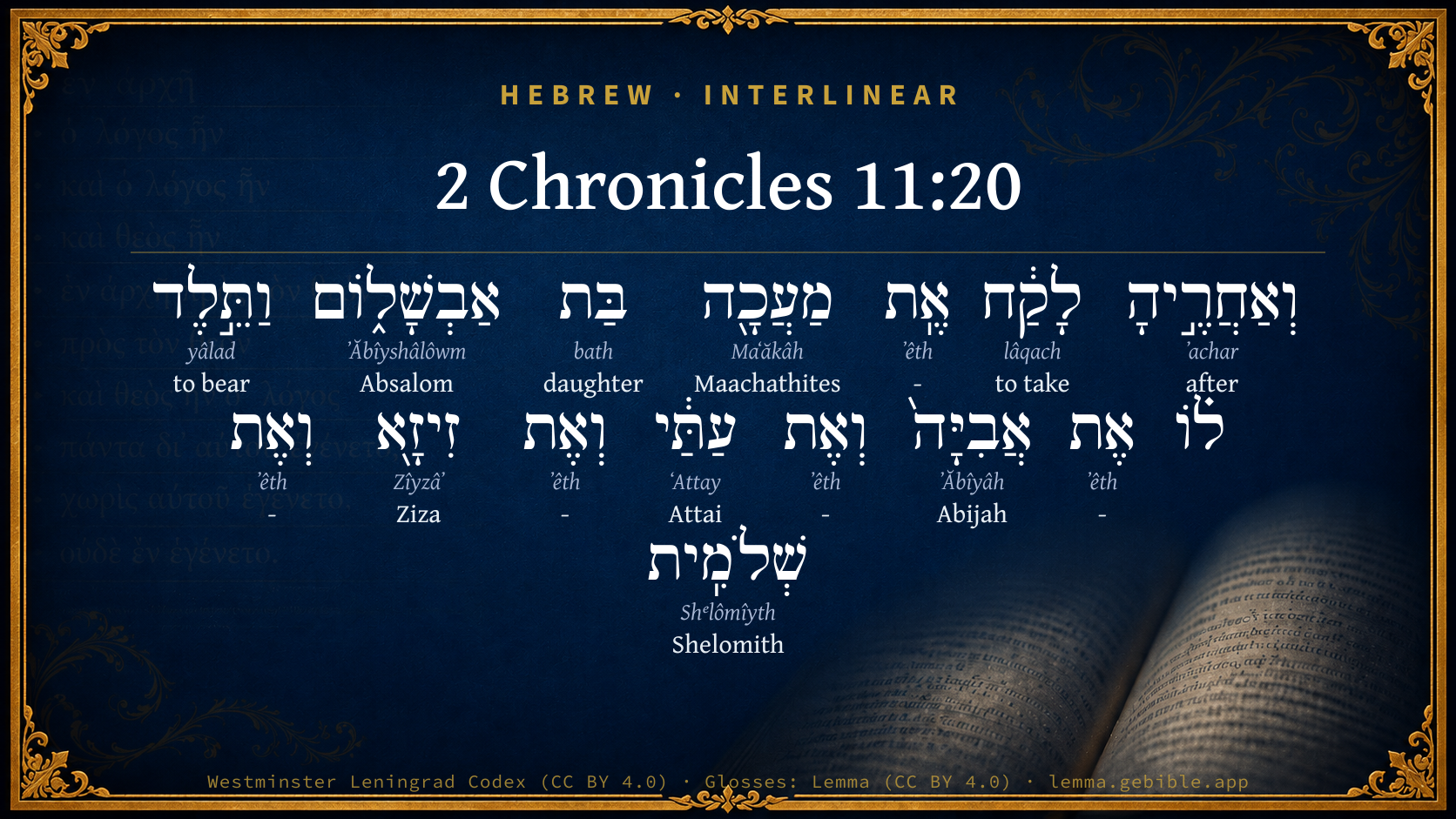
  1. וְאַחֲרֶ֣יהָ ʼachar H310 “and · after · her” Conjunction + Preposition + Suffix, Personal, 3rd Person, Feminine, Singular
  2. לָקַ֔ח lâqach H3947 “to take” Verb, Qal, Perfect, 3rd Person, Masculine, Singular
  3. אֶֽת ʼêth H853 “-” Particle, Direct Object
  4. מַעֲכָ֖ה Maʻăkâh H4601 “Maachathites” Noun, Proper
  5. בַּת bath H1323 “daughter of” Noun, Common, Feminine, Singular, Construct
  6. אַבְשָׁל֑וֹם ʼĂbîyshâlôwm H53 “Absalom” Noun, Proper
  7. וַתֵּ֣לֶד yâlad H3205 “and · to bear” Conjunction + Verb, Qal, Sequential Imperfect, 3rd Person, Feminine, Singular
  8. אֶת ʼêth H853 “-” Particle, Direct Object
  9. אֲבִיָּה֙ ʼĂbîyâh H29 “Abijah” Noun, Proper
  10. וְאֶת ʼêth H853 “and · -” Conjunction + Particle, Direct Object
  11. עַתַּ֔י ʻAttay H6262 “Attai” Noun, Proper
  12. וְאֶת ʼêth H853 “and · -” Conjunction + Particle, Direct Object
  13. וְאֶת ʼêth H853 “and · -” Conjunction + Particle, Direct Object
  14. שְׁלֹמִֽית Shᵉlômîyth H8019 “Shelomith” Noun, Proper

About this verse

These counts appear in no published source. They are computed here, from the morphology-tagged text and Lemma’s own curated glosses. What Lemma adds →

16
words
11
distinct lemmas
Historical
section

Notable vocabulary

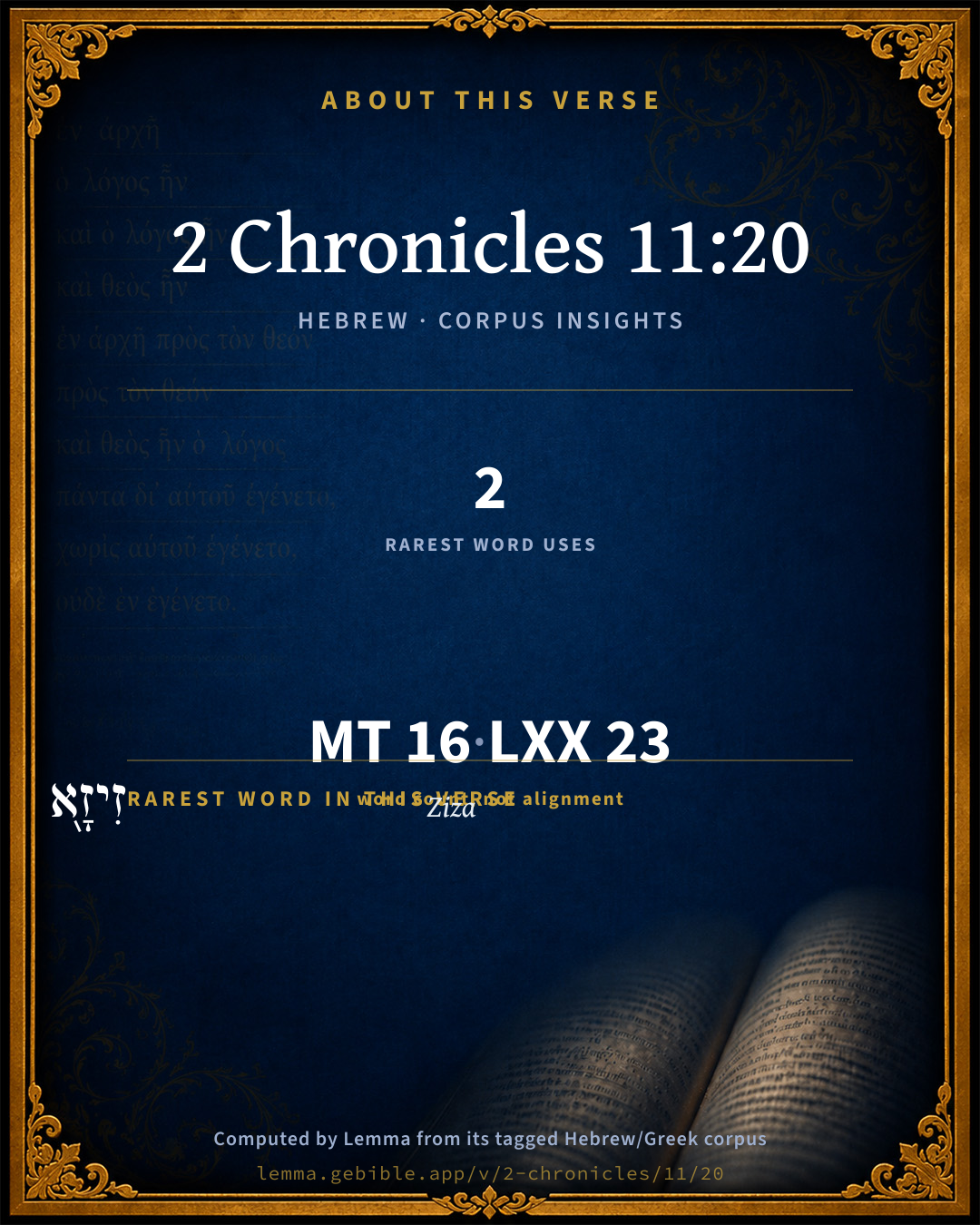
The rarest word here is זִיזָ֖א Ziza H2124 — appearing just 2 times in the whole Hebrew Bible.

Shared distinctive vocabulary

זִיזָ֖א Ziza H2124 occurs in 2 verses of the Hebrew Bible. Also found in:

Grammatical profile

  • 2 verbs
  • 7 nouns
  • 2 prepositions
  • 5 particles

Verb forms

  • לָקַ֔ח Qal · Perfect
  • וַתֵּ֣לֶד Qal · Sequential Imperfect

Hebrew & Septuagint length

In English translation the verse runs 20 words from the Hebrew and 22 from the Septuagint (LXX English) — closely comparable.

A rough comparison of the two English renderings, which tokenize alike — not a word-level alignment.

Word counts can differ between the Hebrew and the Greek without any difference in meaning — e.g. the Hebrew direct-object marker אֵת has no separate Greek word, and Greek often adds the article ὁ.

In the original languages it is 16 Hebrew tokens and 23 Greek tokens — but the two are counted differently (Hebrew bundles its prefixes and suffixes into one token; the Greek is in lemma form), so that isn’t a like-for-like length.

Cross-references

5

Topical passages linked to 2 Chronicles 11:20 in the Treasury of Scripture Knowledge — connected by theme and wording, ordered by reader-vote popularity; previews shown in the World English Bible.

  • 2 Chronicles 13:2 Three years reigned he in Jerusalem: and his mother's name was Micaiah the daughter of Uriel of Gibeah. There was war between Abijah and Jeroboam.
  • 1 Kings 15:1–2 Now in the eighteenth year of king Jeroboam the son of Nebat began Abijam to reign over Judah.
  • 2 Chronicles 11:21 Rehoboam loved Maacah the daughter of Absalom above all his wives and his concubines: (for he took eighteen wives, and sixty concubines, and became the father of twenty-eight sons and sixty daughters.)
  • 2 Chronicles 12:16 Rehoboam slept with his fathers, and was buried in the city of David: and Abijah his son reigned in his place.
  • Matthew 1:7 Solomon became the father of Rehoboam. Rehoboam became the father of Abijah. Abijah became the father of Asa.

Cross-references courtesy of OpenBible.info (CC BY 4.0).

Hebrew and Greek witnesses Masoretic Hebrew ↔ Greek Septuagint

The same verse in the two great witnesses to the Old Testament, shown verse-for-verse.

These are two independent witnesses, not word-aligned to each other, and the Septuagint is shown in lemma (dictionary) form.

Hebrew 2 Chronicles 11:20 Masoretic · Westminster Leningrad Codex

וְאַחֲרֶ֣יהָ לָקַ֔ח אֶֽת מַעֲכָ֖ה בַּת אַבְשָׁל֑וֹם וַתֵּ֣לֶד ל֗וֹ אֶת אֲבִיָּה֙ וְאֶת עַתַּ֔י וְאֶת זִיזָ֖א וְאֶת שְׁלֹמִֽית

After her he took Maacah the daughter of Absalom; and she bore him Abijah, and Attai, and Ziza, and Shelomith.

World English Bible · Public Domain

Greek LXX 2 Chronicles 11:20 Septuagint · lemma form

καί μετά οὗτος λαμβάνω ἑαυτοῦ ὁ μααχα θυγάτηρ αβεσσαλωμ καί τίκτω αὐτός ὁ αβια καί ὁ ιεθθι καί ὁ ζιζα καί ὁ εμμωθ

And afterwards he took to himself Maacha the daughter of Abessalom; and she bore him Abia, and Jetthi, and Zeza, and Salemoth.

LXX2012 (modern English Septuagint) · Public Domain

On this verse, The Cambridge Bible for Schools and Colleges discusses the Septuagint’s reading. Read the note in Commentary ↓

Hebrew: Westminster Leningrad Codex (CC BY 4.0). Greek: Septuagint (public domain); English from LXX2012 (modern English Septuagint) (Public Domain). How the Septuagint differs from the Hebrew →

Commentary

Notes on 2 Chronicles 11:20 from classic Christian and Jewish commentators (each source and its license shown beneath its notes). The classic Christian expositions comment on the surrounding passage and are grouped to its opening verse, so a note may address several verses; the Jewish commentaries on the Tanakh (Rashi and others) are per-verse, so they appear only where the commentator wrote on this verse.

Lemma curates 59 commentaries, every one of them public domain or Creative Commons licensed, each selected and text-cleaned for this edition rather than reprinted as found. About our sources →

Jamieson, Fausset & Brown

Robert Jamieson, A. R. Fausset & David Brown

after her he took Maachah . . . daughter--that is, granddaughter (Sa2 14:27) of Absalom, Tamar being, according to JOSEPHUS, her mother. (Compare Sa2 18:18).

Jamieson, Fausset & Brown — Commentary Critical and Explanatory on the Whole Bible (1871) — public domain (CC PDM 1.0). Text via the HelloAO Bible API.

Adam Clarke's Commentary

Verse 20. Maachah the daughter of Absalom] 1Kg 15:10. She is called Michaiah, the daughter of Uriel, 2Ch 13:2. For this the Targum gives the following reason: "Abijah reigned three years in Jerusalem; and his mother's name was Michaiah, daughter of Uriel of Gibeatha. She is the same as Michah, the daughter of Absalom; but, because she was an upright woman, her name was changed into the more excellent name Michaiah, and her fathers name into that of Uriel of Gibeatha, that the name of Absalom might not be remembered."

Adam Clarke's Commentary on the Bible (1810–1826) — public domain. Text from a community e-Sword/MySword module.

Ellicott's Commentary for English Readers

(20) Maachah the daughter of Absalom—i.e., granddaughter, as appears from 2Sa_14:27, where Tamar is named as the “one daughter” of Absalom Josephus says Maachah was daughter of Tamar (Ant 8:10, 1). (Comp. 2Sa_18:18; 2Ch_13:2; 1Ki_15:10.)

Which bare him Abijah.—Rehoboam’s successor, called “Abijam” in Kings. The other three are unknown.

A Bible Commentary for English Readers, edited by Charles John Ellicott (1878–1897) — public domain. Text from a community e-Sword module.

The Cambridge Bible for Schools and Colleges

gen. ed. J. J. S. Perowne

20. Maacah] Perhaps the grand-daughter of Absalom, since she is called the daughter of Uriel of Gibeah in 2Ch_13:2 (where “Maacah” should be read with the LXX. for “Michaiah”). Absalom had no son (2Sa_18:18), but he may have had a daughter who married Uriel and became the mother of this Maacah.

Abijah] Called “Abijam” 1Ki_15:1.

The Cambridge Bible for Schools and Colleges (gen. ed. J. J. S. Perowne; Cambridge University Press, 1878–1918) — public domain. Text from a community e-Sword module.

John Gill's Exposition

And Rehoboam made Abijah the son of Maacah the chief,.... The chief of all his sons, head over them, being the son of his most beloved wife, and her firstborn however, and perhaps might be of a greater capacity than the rest of his children:

to be ruler among his brethren; or over them; gave him greater authority, and intrusted him with more power, set him above them, and treated him as heir apparent to the crown: for he thought

to make him king; either to take him into partnership in the throne with him in his lifetime, or to appoint and declare him to be his successor.

John Gill's Exposition of the Whole Bible (1746–1763) — public domain (CC PDM 1.0). Text via the HelloAO Bible API.

Albert Barnes' Notes on the Bible

Maachah the daughter of Absalom - Rather, “grand-daughter” (see the 1Ki 15:2 note).

Albert Barnes' Notes on the Bible (1834–1885) — public domain. Text from a community e-Sword/MySword module.

Haydock's Catholic Bible Commentary

Daughter, or grand-daughter, by Thamar, 3 Kings xv. 2. (Calmet)

George Leo Haydock (1774–1849), Haydock's Catholic Family Bible and Commentary, 1859 edition — public domain. Excludes Psalms (Douay-Rheims chapter numbering differs from Protestant) and Deuterocanonical books (Catholic canon only).

The Pulpit Commentary

Maachah was the granddaughter of Absalom by his daughter Tamar, wife of Uriel (2Ch_13:21; 1Ki_15:2)

The Pulpit Commentary (1880–1919), ed. H.D.M. Spence-Jones & Joseph S. Exell — public domain. Text from a community e-Sword module.

unfoldingWord translationNotes

Door43 World Missions Community

Mahalath ... Maacah

These are the names of women. (See: How to Translate Names)

Rehoboam took Maacah

This idiom means that he married her. AT: "Rehoboam married Maacah" (See: Idiom)

Abijah, Attai, Ziza, and Shelomith

These are the names of men. (See: How to Translate Names)

eighteen wives and sixty concubines ... twenty-eight sons and sixty daughters

"18 wives and 60 concubines ... 28 sons and 60 daughters" (See: Numbers)

translationWords

Absalom

love

concubine

unfoldingWord translationNotes — © Distant Shores Media and the Door43 World Missions Community, licensed CC BY-SA 4.0. Source: git.door43.org/Door43/en_tn.

Lesson kit

Teaching starters — assembled from the data on this page, not authored interpretation. Every prompt links to the verse data it draws on. Edit before teaching.

2 Chronicles, in the Historical, opens this verse with 16 words (11 distinct Hebrew lemmas). Its most distinctive word is Zîyzâʼ (“Ziza”). A historical commentator’s framing appears above. Read the whole chapter for the surrounding context.

Discussion questions

  1. What does “Ziza” (Zîyzâʼ) contribute to the verse as a whole?
  2. 1 Chronicles 4:37 shares the word «Ziza» with this verse. How do the two illuminate each other?
  3. These translations render this verse differently; the difference is in the English rendering, not the original. What questions does that raise?
  4. The verb «לָקַ֔ח» is Qal Perfect. How does its form color the action?
  5. Reading how Jamieson, Fausset & Brown and Adam Clarke's Commentary read this verse, where do the two commentators agree and where do they part?

Things to notice

Reading settings

Reading text

Shown beneath each verse's original-language words.

Old Testament
Old Testament edition

Read the OT as the Masoretic Hebrew (MT) or the Greek Septuagint (LXX).

English shown for the Greek Septuagint (in the Hebrew ↔ Greek comparison).

Comparing translations? Open the Compare panel on any verse page to stack up to four side by side.