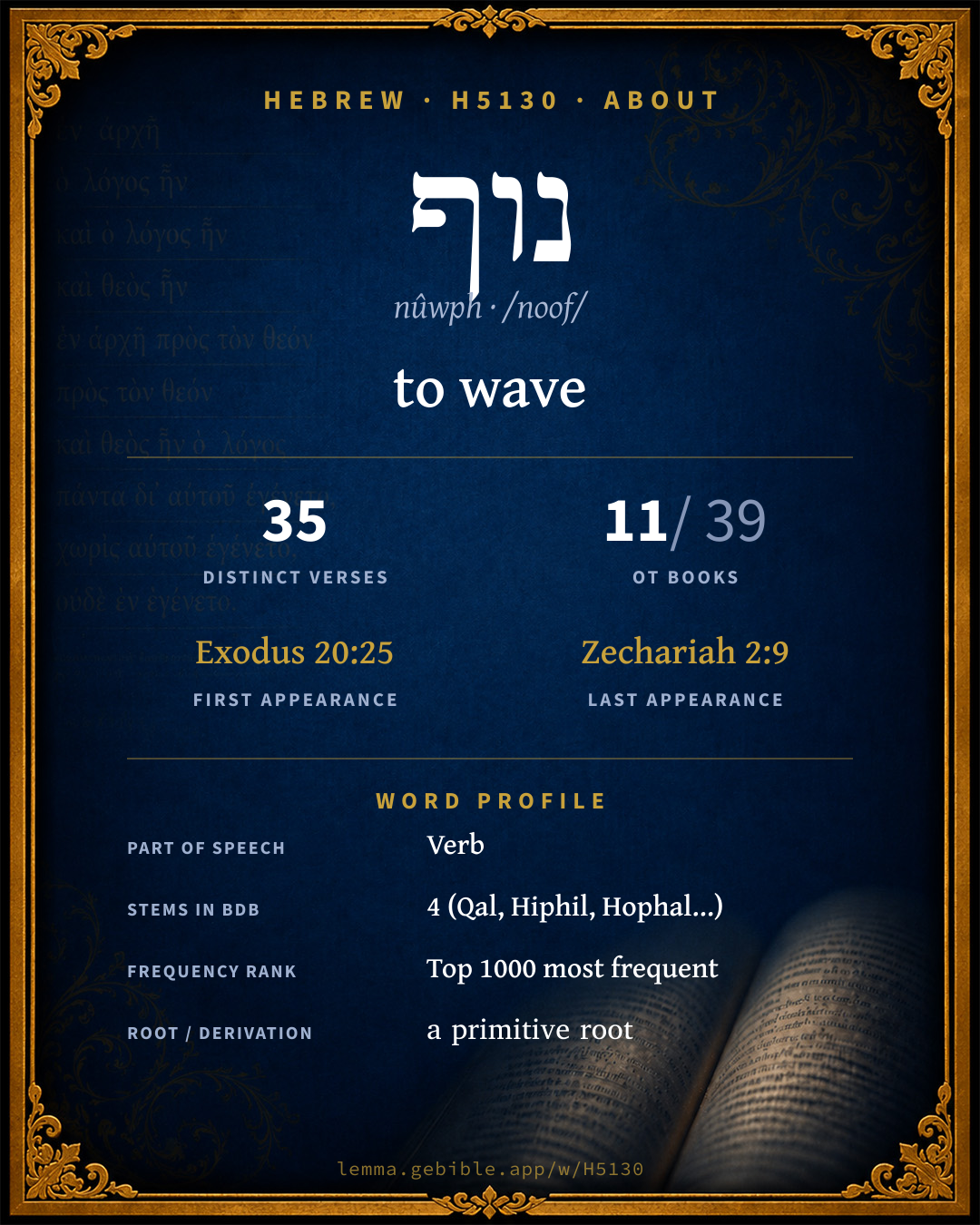
נוּף
to wave
‘to wave’ is one of 5 main senses fuller range ↓
Full lexicon entry — Brown-Driver-Briggs (BDB)
From Brown-Driver-Briggs (BDB)
Where this word appears
See every Hiphil verb in the Hebrew Bible →
Grammar key — what these labels mean
Part of speech
- Verb
- An action or state-of-being word.
Noun type
- Common
- A common noun — a general class of person, place, or thing (“king,” “city,” “water”), not a specific name.
Stem
- Hiphil
- The causative active stem (“he caused / brought about”). Here: ‘wield’
- Hophal
- The passive counterpart of the Hiphil (“he was caused to…”).
- Polel
- A stem of hollow/geminate roots functioning like the Piel — intensive active. Here: ‘he brandisheth his hand toward the mt.’
- Qal
- The basic, simple active stem — the plain form of the verb (“he wrote”).
Form
- Sequential Perfect
- A perfect with prefixed waw continuing a preceding imperfect or command (waw-consecutive perfect).
- Infinitive Construct
- A bound verbal noun, frequently with prepositions (“to write / in writing”).
- Imperfect
- An incomplete, ongoing, or future action (“he will / would write”).
- Perfect
- A completed action or state — Hebrew marks aspect (completeness) more than strict tense (“he wrote”).
- Sequential Imperfect
- An imperfect with prefixed waw — the standard past-narrative form (waw-consecutive imperfect).
- Participle Active
- A verbal adjective expressing ongoing or characteristic action (“writing / one who writes”).
- Imperative
- A direct command (“write!”).
State
- Absolute
- The independent form of a noun, not bound to a following word.
- Construct
- A noun bound to a following noun in a possessive / “of” relationship (the construct chain).
Person
- 3rd Person
- The one spoken about (“he / she / it / they”).
- 2nd Person
- The one addressed (“you”).
- 1st Person
- The speaker (“I / we”).
Gender
- Masculine
- Grammatically masculine.
- Feminine
- Grammatically feminine.
- Common
- Either gender — not distinguished for this form.
Number
- Singular
- One.
- Plural
- More than one (in Hebrew, generally three or more).
Grammatical forms 16 distinct
- Verb, Hiphil, Sequential Perfect, 3rd Person, Masculine, Singular 9 times (24%)
- Verb, Hiphil, Sequential Perfect, 2nd Person, Masculine, Singular 4 times (11%)
- Verb, Hiphil, Infinitive Construct 4 times (11%)
- Verb, Hiphil, Imperfect, 2nd Person, Masculine, Singular 3 times (8%)
- Verb, Hiphil, Perfect, 3rd Person, Masculine, Singular 3 times (8%)
- Verb, Hiphil, Sequential Imperfect, 3rd Person, Masculine, Singular 3 times (8%)
- Verb, Hiphil, Participle Active, Masculine, Singular, Absolute 2 times (5%)
- Noun, Common, Feminine, Singular, Absolute 1 time (3%)
+8 more forms (8 occurrences)
Parsed forms decoded from the imported morphology (morphhb / Westminster Leningrad Codex — WLC text public domain, morphhb tagging CC BY 4.0), counted across 37 parsed occurrences — not distinct verses.
Every verse where H5130 appears — 35 distinct verses across 11 books. Click any verse to open its interlinear word-by-word view. Verse text shown in the World English Bible for context — . Each verse’s Hebrew form is shown with its reference; the English is not keyword-highlighted, since the data carries no word-level English alignment. Use “Compare translations” on any verse to read it across multiple English versions. This concordance covers the Hebrew Bible; Septuagint (Greek Old Testament) occurrences are not indexed here.
Exodus 5 verses
- Exodus 20:25 הֵנַ֥פְתָּ Hiphil pf 2ms If you make me an altar of stone, you shall not build it of hewn stones; for if you lift up your tool on it, you have polluted it.
- Exodus 29:24 וְ/הֵנַפְתָּ֥ conj + Hiphil wpf 2ms You shall put all of this in Aaron's hands, and in his sons' hands, and shall wave them for a wave-offering before Yahweh.
- Exodus 29:26 וְ/הֵנַפְתָּ֥ conj + Hiphil wpf 2ms "You shall take the breast of Aaron's ram of consecration, and wave it for a wave-offering before Yahweh: and it shall be your portion.
- Exodus 29:27 הוּנַ֖ף Hophal pf 3ms You shall sanctify the breast of the wave-offering, and the thigh of the heave-offering, which is waved, and which is heaved up, of the ram of consecration, even of that which is for Aaron, and of that which is for his sons:
- Exodus 35:22 הֵנִ֛יף Hiphil pf 3ms They came, both men and women, as many as were willing-hearted, and brought brooches, ear-rings, signet-rings, and armlets, all jewels of gold; even every man who offered an offering of gold to Yahweh.
Leviticus 10 verses
- Leviticus 7:30 לְ/הָנִ֥יף prep + Hiphil inf.cs With his own hands he shall bring the offerings of Yahweh made by fire. He shall bring the fat with the breast, that the breast may be waved for a wave offering before Yahweh.
- Leviticus 8:27 וַ/יָּ֧נֶף conj + Hiphil wimpf 3ms He put all these in Aaron's hands and in his sons' hands, and waved them for a wave offering before Yahweh.
- Leviticus 8:29 וַ/יְנִיפֵ֥/הוּ conj + Hiphil wimpf 3ms + sfx pers 3ms Moses took the breast, and waved it for a wave offering before Yahweh. It was Moses' portion of the ram of consecration, as Yahweh commanded Moses.
- Leviticus 9:21 הֵנִ֧יף Hiphil pf 3ms and the breasts and the right thigh Aaron waved for a wave offering before Yahweh, as Moses commanded.
- Leviticus 10:15 לְ/הָנִ֥יף prep + Hiphil inf.cs The heaved thigh and the waved breast they shall bring with the offerings made by fire of the fat, to wave it for a wave offering before Yahweh: and it shall be yours, and your sons' with you, as a portion forever; as Yahweh has commanded."
- Leviticus 14:12 וְ/הֵנִ֥יף conj + Hiphil wpf 3ms "The priest shall take one of the male lambs, and offer him for a trespass offering, with the log of oil, and wave them for a wave offering before Yahweh.
- Leviticus 14:24 וְ/הֵנִ֨יף conj + Hiphil wpf 3ms The priest shall take the lamb of the trespass offering, and the log of oil, and the priest shall wave them for a wave offering before Yahweh.
- Leviticus 23:11 וְ/הֵנִ֧יף יְנִיפֶ֖/נּוּ conj + Hiphil wpf 3ms Hiphil impf 3ms + sfx pers 3ms and he shall wave the sheaf before Yahweh, to be accepted for you. On the next day after the Sabbath the priest shall wave it.
- Leviticus 23:12 הֲנִֽיפְ/כֶ֖ם Hiphil inf.cs + sfx pers 2mp On the day when you wave the sheaf, you shall offer a male lamb without blemish a year old for a burnt offering to Yahweh.
- Leviticus 23:20 וְ/הֵנִ֣יף conj + Hiphil wpf 3ms The priest shall wave them with the bread of the first fruits for a wave offering before Yahweh, with the two lambs. They shall be holy to Yahweh for the priest.
Numbers 6 verses
- Numbers 5:25 וְ/הֵנִ֤יף conj + Hiphil wpf 3ms The priest shall take the meal offering of jealousy out of the woman's hand, and shall wave the meal offering before Yahweh, and bring it to the altar.
- Numbers 6:20 וְ/הֵנִיף֩ conj + Hiphil wpf 3ms and the priest shall wave them for a wave offering before Yahweh. This is holy for the priest, together with the breast that is waved and the thigh that is offered. After that the Nazirite may drink wine.
- Numbers 8:11 וְ/הֵנִיף֩ conj + Hiphil wpf 3ms and Aaron shall offer the Levites before Yahweh for a wave offering, on the behalf of the children of Israel, that it may be theirs to do the service of Yahweh.
- Numbers 8:13 וְ/הֵנַפְתָּ֥ conj + Hiphil wpf 2ms You shall set the Levites before Aaron, and before his sons, and offer them as a wave offering to Yahweh.
- Numbers 8:15 וְ/הֵנַפְתָּ֥ conj + Hiphil wpf 2ms "After that, the Levites shall go in to do the service of the Tent of Meeting: and you shall cleanse them, and offer them as a wave offering.
- Numbers 8:21 וַ/יָּ֨נֶף conj + Hiphil wimpf 3ms The Levites purified themselves from sin, and they washed their clothes; and Aaron offered them for a wave offering before Yahweh; and Aaron made atonement for them to cleanse them.
Deuteronomy 2 verses
- Deuteronomy 23:25 תָנִ֔יף Hiphil impf 2ms When you come into your neighbor's standing grain, then you may pluck the ears with your hand; but you shall not move a sickle to your neighbor's standing grain.
- Deuteronomy 27:5 תָנִ֥יף Hiphil impf 2ms There shall you build an altar to Yahweh your God, an altar of stones: you shall lift up no iron [tool] on them.
Joshua 1 verse
2 Kings 1 verse
Job 1 verse
Psalms 1 verse
Proverbs 1 verse
Isaiah 6 verses
- Isaiah 10:15 מְנִיפ֔/וֹ כְּ/הָנִ֥יף Hiphil ptcp.act ms cs + sfx pers 3ms prep + Hiphil inf.cs Shall the axe boast itself against him who hews therewith? Shall the saw magnify itself against him who wields it? as if a rod should wield those who lift it up, [or] as if a staff should lift up [him who is] not wood.
- Isaiah 10:32 יְנֹפֵ֤ף Polel impf 3ms This very day shall he halt at Nob: he shakes his hand at the mountain of the daughter of Zion, the hill of Jerusalem.
- Isaiah 11:15 וְ/הֵנִ֥יף conj + Hiphil wpf 3ms Yahweh will utterly destroy the tongue of the Egyptian sea; and with his scorching wind will he wave his hand over the River, and will strike it into seven streams, and cause men to march over in sandals.
- Isaiah 13:2 הָנִ֣יפוּ Hiphil impv 2mp Set up an ensign on the bare mountain, lift up the voice to them, wave the hand, that they may go into the gates of the nobles.
- Isaiah 19:16 מֵנִ֥יף Hiphil ptcp.act ms In that day shall the Egyptians be like women; and they shall tremble and fear because of the shaking of the hand of Yahweh of Hosts, which he shakes over them.
- Isaiah 30:28 לַ/הֲנָפָ֥ה prep + n c fs and his breath is as an overflowing stream, that reaches even to the neck, to sift the nations with the sieve of destruction: and a bridle that causes to err [shall be] in the jaws of the peoples.
Zechariah 1 verse
About this entry
At a glance — auto-summarized from this page’s data, not written by a person. Every figure links to its source below. This summary describes the numbers; it doesn’t interpret them.
The Hebrew verb נוף centers on the idea of “to wave.” Older and newer Bibles part ways — “shall wave” in the King James Version, “and” (unfoldingWord Literal Text) in modern versions. See the renderings breakdown. It appears 35 verses across 11 books of the Hebrew Bible, among its moderately common vocabulary. The word gravitates to Leviticus (29%), then Numbers and Isaiah. Different stems carry different senses — BDB groups them under 4 stems, among them Qal and Hiphil. For the data behind this summary, explore the sense tree and the renderings breakdown below.
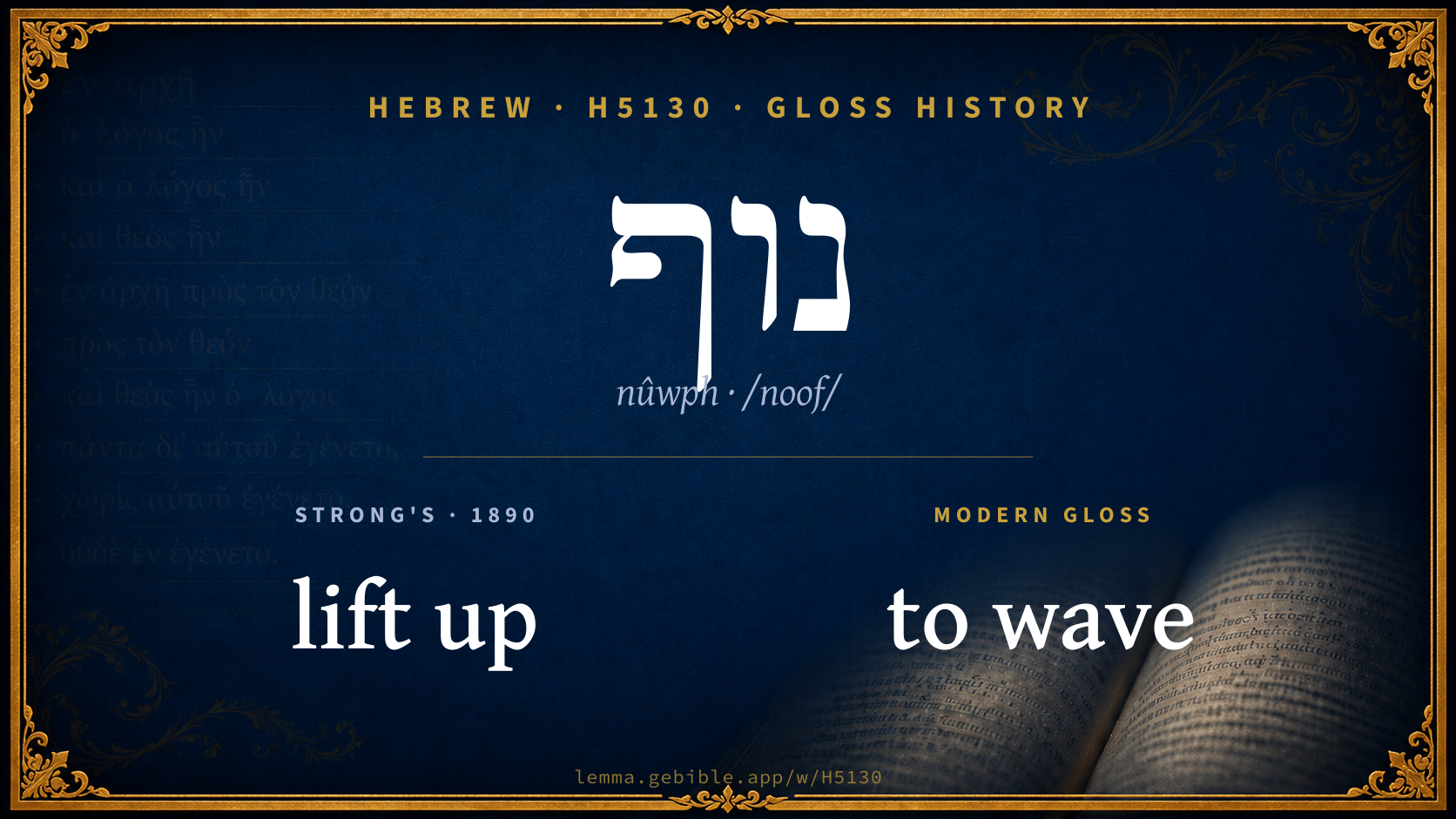
Gloss history
Strong's 1890 vs modern scholarship
About this word
Strong's H5130 catalogs a Hebrew word from the Hebrew Old Testament.
These counts are not copied from any lexicon or concordance. They are computed here, from the morphology-tagged Hebrew Old Testament. What Lemma adds →
- 35
- distinct verses
- The word appears in 35 distinct verses.
- 11 / 39
- OT books
- The word appears in 11 of 39 Old Testament books.
- #967
- by frequency
- Top 1000 most frequent Hebrew words (rank 967 of 8,640 Hebrew words by occurrence).
View all 35 occurrences in the concordance →
By section of the Old Testament
By traditional corpus
Conventional, traditional groupings — biblical authorship is debated, so this is a traditional corpus grouping, not an authorship claim. Each share is this word’s portion of its verses in that division of the Hebrew canon. Each figure is a share of the word’s 35 distinct verses.
- Torah (Pentateuch) 23 verses · 66%
- Prophets (Nevi'im) 9 verses · 26%
- Writings (Ketuvim) 3 verses · 9%
How translations render this word
Counts come from each version’s own published word-to-Strong’s tagging or interlinear alignment — an approximate guide to how each version renders this word, not a word-level alignment the data otherwise carries. Because each total is that version’s own tagged count, the per-version totals vary from one another and need not match the appearance or distinct-verse counts above. These counts may also differ from a printed concordance because Lemma counts each distinctly tagged rendering and does not collapse phrase taggings into a single head-word total. This is a fixed set of word-tagged versions (KJV, ASV, BSB, ULT) and does not change with the reading translation you choose elsewhere. Each version’s license is shown beside its name below (and on Sources).
- King James Version: Shall wave 5×, Wave 3×, Waved 3×
- American Standard Version: Shall wave 4×, Wave 4×, Waved 3×
- Berean Standard Bible: Wave 9×, Presented 3×, Waved 3×
- unfoldingWord Literal Text: And 5×, Raise 4×, Shall raise 4×
King James Version Public Domain
Renders H5130 across 37 tagged occurrences — most commonly:
Plus 22 renderings that appear only once — usually multi-word phrases or single function words the recovered tagging swept in, not distinct renderings.
American Standard Version Public Domain
Renders H5130 across 37 tagged occurrences — most commonly:
Plus 22 renderings that appear only once — usually multi-word phrases or single function words the recovered tagging swept in, not distinct renderings.
Berean Standard Bible Public Domain
Renders H5130 across 37 tagged occurrences — most commonly:
Plus 22 renderings that appear only once — usually multi-word phrases or single function words the recovered tagging swept in, not distinct renderings.
unfoldingWord Literal Text CC BY-SA 4.0
Renders H5130 across 47 tagged occurrences — most commonly:
Plus 20 renderings that appear only once — usually multi-word phrases or single function words the recovered tagging swept in, not distinct renderings.
8 senses and sub-senses in the full BDB
Hebrew verbs can shift meaning by stem (binyan): Qal is the basic action, Niphal is often passive or reflexive, Piel often intensifies or makes it factitive, and Hiphil is typically causative. The senses below are grouped under the stem BDB assigns to each. This entry also uses Hophal (the passive of Hiphil) and one or more reduplicated stems (the Pōlēl/Pilpēl type), which for hollow or geminate roots behave much like Piel — often intensive or iterative.
What do BDB’s symbols mean?
BDB uses these scholarly abbreviations:
| Symbol | Meaning |
|---|---|
| 𝔊 | the Septuagint (the ancient Greek translation, LXX) |
| 𝔙 | the Vulgate (the Latin translation) |
| 𝔖 | the Syriac version (the Peshitta) |
| 𝔗 | the Targum (the Aramaic translation) |
| ψ | the Psalms |
| √ | root (the underlying root or stem) |
| ‖ | parallel passage (a synonymous or contrasted parallel) |
| † | the dagger: every passage where the word occurs is cited |
The 8 senses and sub-senses the full Brown-Driver-Briggs lexicon distinguishes for this word, in lexicon order (not ranked by frequency), with BDB’s own verbatim wording and sub-sense lettering. Shown in Hebrew script with BDB’s own scholarly abbreviations. The condensed entry is in the Lexicon Entry tab. See also the Forms in the corpus table below.
Qal
- I have besprinkled my couch with myrrh
Po‛lel
- he brandisheth his hand toward the mt.
Hiphil
- 1. wield, move to and fro in using it
- 2. Shake or wave the hand
- 3. swing to and fro, as a signal
- 4. Oft. term. techn. in P (H), of rite in which originally the priest lifted his share of offering and waved it, i.e. moved it toward altar and back, in token of its presentation to God and its return by him to priest
- 5. Shed abroad
Hophal
- . be waved
Senses from the full Brown-Driver-Briggs lexicon (Brown, Driver, Briggs; Oxford 1906 — public domain), digitized via Sefaria, supplemented by the OpenScriptures HebrewLexicon (CC BY 4.0). Full attribution on Sources.
Word origin
[ נוּף ] vb. move to and fro, wave, besprinkle
— Brown-Driver-Briggs (Oxford 1906, public domain), digitized via Sefaria, supplemented by the OpenScriptures HebrewLexicon (CC BY 4.0). See Sources.
Origin: a primitive root
Jastrow Dictionary
A second Hebrew/Aramaic lexicon for comparison, covering Aramaic and post-biblical (Talmudic, Targumic, Midrashic) usage that the biblical-Hebrew BDB does not. Matched by lemma rather than by Strong’s number, so a lemma may carry more than one Jastrow headword (shown separately below), and the entries cover usage well beyond the Bible.
נוּף
- (b. h.) to move in the air, to soar. [Yalk. Ps. 676 שהוא נפה, read: שהיא צפה, v. צוּף.]
- 1. to swing, wave. Men. 61ᵇ כהן מניח … ומֵנִיף the priest places his hand under those of the owner of the offering and waves. Ib. אין העכ"ום מְנִיפִין gentiles are not permitted to wave their offerings; אין הנשים מְנִיפוֹת women are not permitted &c. Ib.ᵃ וכול יָנִיף ויחזור ויניף I might think that he must wave twice. Snh. VI, 1 מֵנִיף בסודרין gave the signal by waving a cloth; Succ. 51ᵇ. Pesik. R. s. 41 (ref. to יפה נוף, Ps. XLVIII, 3) היפה שהיא עתידה להָנִיף את וכ׳ the beautiful one (Israel) who is destined to swing (rule) the nations; Yalk. Ps. 755; Yalk. Ex. 417 שהיא מְנִיפָה לאו"ה (ref. to Is. XXX, 28); a. fr. e.g. Psalms 48:3
- 2. to fan. B. Mets. 86ᵃ הָנִיפִי עלי, v. מְנִיפָא. Y. Yoma I, 38ᶜ ומניפין לרבוניהם and fan their masters. Pesik. R. l. c.; Yalk. Ps. l. c. והכל מניפין עליה and all fan her (are subservient to her); a. e.
- to swing, fan. Y. Ber. I, 2ᵈ והיתה רוח … ומְנַפְנֶפֶת בו and the northern wind blew and set the harp swinging. Yalk. Ps. l. c. שיוצא ומְנַפְנֵף את דגניה (not רגליה) (the dew) which goes forth and makes her grain in the ear wave (bend with its weight); Pesik. R. l. c. ומְנַפֵּף את הדגנים. Ohol. VIII, 5 טלית המְנַפְנֶפֶת a sheet suspended as a banner (cmp. מַפָּה).
- 1. to be winnowed. Yeb. 63ᵃ (addressing the ears in the field, in Chald. dict.) אֵי במנפה תִתְנוֹפְפִי Ar., eh! thou desirest to be winnowed with the fan; [oth. vers. in Ar.: כמנפה תתנופפי (not במנ׳) thou swingest thyself like a swing, v. infra]; ed. v. next w.
- 2. to swing one’s self; to soar; to be proud. Ab. Zar. 24ᵇ הִתְנוֹפְפִי וכ׳ rise (O Ark) in the &c., v. הָדָר; Gen. R. s. 54. Yeb. l. c., v. supra.
נוּף ²
- ch. same; part. נָיֵיף. Yeb. 63ᵃ חזנהו דקא נַיְיפָן he saw them (the ears in the field) waving.
- to swing, wave, winnow. Targ. Is. XIII, 2. Targ. Y. II, Lev. VII, 30.—M. Kat. 16ᵇ מְנִיפָה, v. חוּשְׁלָא.
- , Ithp. אִתְנִיף, אִתְנוֹף to swing one’s self; to be proud. Yeb. l. c. (addressing the standing grain) אִתְנִיפָא אִיתְנוֹפְפִי וכ׳ Ar. (not תניפא) swing thyself (be as proud as thou wilt): trading in business brings more profit than thou dost; ed. אי נַיְיפַת אִיתְנוֹפִי how thou wavest! swing thyself &c.; (Rashi אי תנפינו, read: אִיתְנוֹפוּ or אִיתְנִיפוּ).
נוֹף I
- Nof, Memphis in Egypt. Pesik. R. s. 17; Pesik. Vayhi, p. 63ᵇ, v. מִנְפִּיס.
נוֹף II
- boughs of a tree, swinging branches, summit. Y. Ber. I, 2ᶜ bot. לא סוף דבר נוֹפוֹ וכ׳ (not טפו) after all, not only its boughs in swinging, but even its main branches (extended over an area of &c.). Macc. II, 7 אילן … ונופו נוטה וכ׳ a tree which stands within the limits (of the place of refuge), but whose branches spread beyond &c. Ib.; Maasr. III, 10 הכל הולך אחר הנ׳ the location of the branches decides the nature of the territory; Tosef. Arakh. V, 14 הנִיף. Kidd. 40ᵇ; a. e.—Pl. נוֹפִים, נוֹפִין, נוֹפוֹת. Num. R. s. 20 מי שאינו בקי קוצץ את הנ׳ וכ׳ he who is no expert (in felling trees) lops off the branches, each branch separately, and gets tired. Yalk. Ps. 755 (ref. to יפה נוף, Ps. XLVIII, 3) [read:] יפה בנ׳ שלה בהקפת וכ׳ she (Israel) is beautiful with her waving boughs when marching around the altar (on the Feast of Booths); Pesik. R. s. 41 יפה שלה (corr. acc.; Friedm. emends יָפֶה נוף שלה). e.g. Psalms 48:3
A Dictionary of the Targumim, the Talmud Babli and Yerushalmi, and the Midrashic Literature (Marcus Jastrow; London, Luzac, 1903) — Public Domain. Digitized via Sefaria. Digitized via Sefaria. Full attribution on Sources.
Forms in the corpus
The 30 distinct written forms H5130 takes in the Hebrew Bible, most frequent first — each parse links to that stem’s occurrences in the concordance. Hebrew forms include their vowel points and cantillation, so a single lemma takes many written forms.
Same root — word family
Other BDB entries built from the same root as H5130, grouped by Strong’s listed origin. These share a root / origin per the lexicon — not necessarily a shared meaning. Each links to that word’s own entry.
Derived from this word
- נוף nôwph H5131 height
- נפה nâphâh H5299 height
- נפת nôpheth H5317 honey
- תנופה tᵉnûwphâh H8573 wave offering
Proper names from this root
People and places named from this root — a name, not an additional meaning of the word.
Compare all same-root words → Showing 4 of 6 — not the complete family. 1 of the same-root words is a proper name (a person or place). They share a root, not necessarily a meaning.
Septuagint verse parallels
This word appears in 34 verses that also exist in the Greek Old Testament (Septuagint), out of the 35 Hebrew verses it occurs in. You can read those verses in Greek by switching the Old Testament edition to the Septuagint.
Read these verses in the Septuagint
- Exodus 20:25
- Leviticus 7:30
- Numbers 5:25
- Deuteronomy 23:25
- 2 Kings 5:11
- Job 31:21
- Psalms 68:9
- Proverbs 7:17
- Isaiah 10:15
- Zechariah 2:9
This is a verse-level parallel only — the same verses exist in both the Hebrew and Greek Old Testaments. No word-level Hebrew↔Greek correspondence is claimed: the data carries no such alignment, so no Greek word is shown as this Hebrew word’s translation. Coverage is not total — the Septuagint omits the deuterocanon and renumbers the Psalms, so some Hebrew verses have no direct Greek parallel.