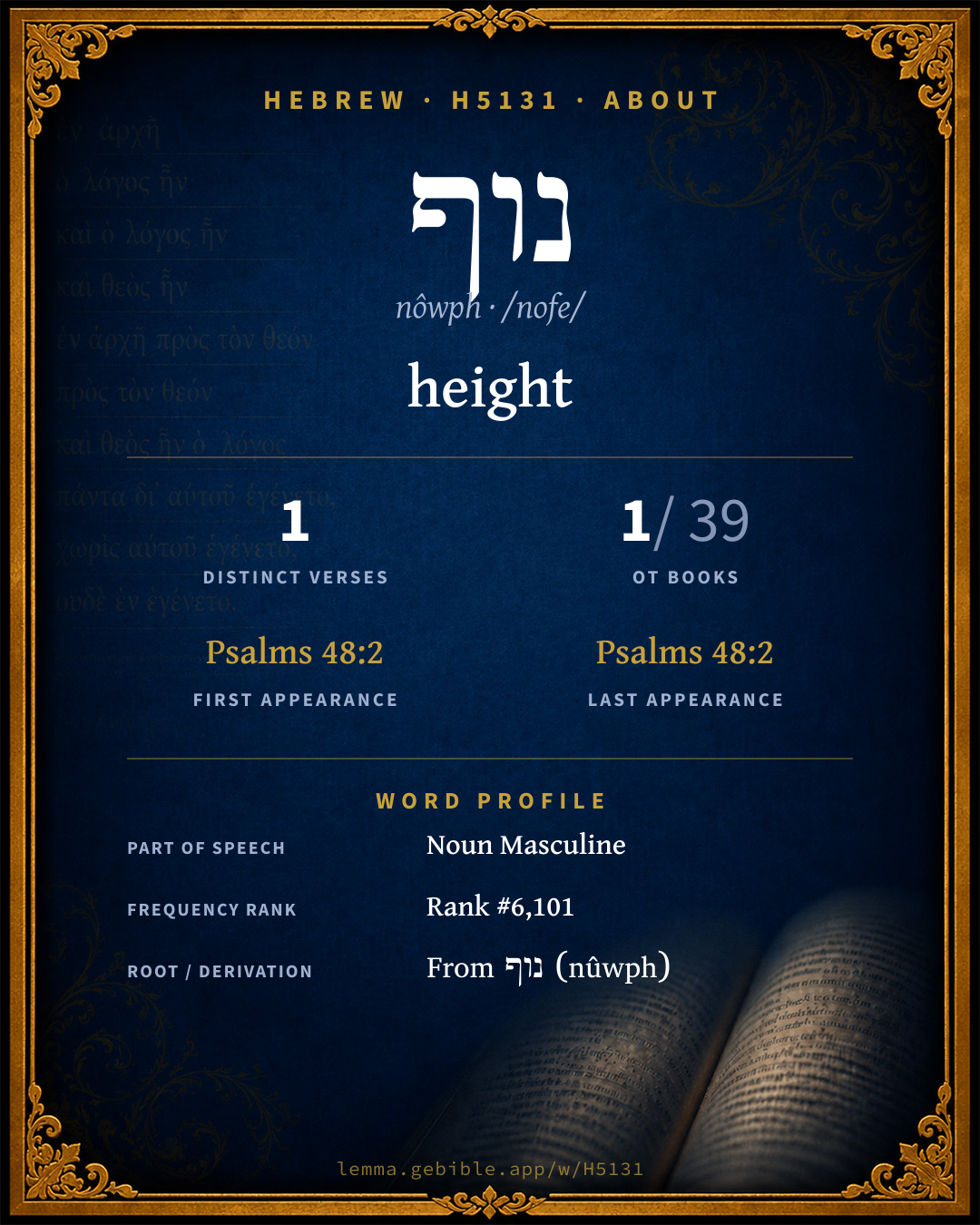
נוֹף
height
Full lexicon entry — Brown-Driver-Briggs (BDB)
From Brown-Driver-Briggs (BDB)
Where this word appears
Grammar key — what these labels mean
Part of speech
- Noun
- A naming word — a person, place, thing, or idea.
Noun type
- Common
- A common noun — a general class of person, place, or thing (“king,” “city,” “water”), not a specific name.
State
- Absolute
- The independent form of a noun, not bound to a following word.
Gender
- Masculine
- Grammatically masculine.
Number
- Singular
- One.
Every verse where H5131 appears — 1 distinct verse across 1 book. Click any verse to open its interlinear word-by-word view. Verse text shown in the World English Bible for context — . Each verse’s Hebrew form is shown with its reference; the English is not keyword-highlighted, since the data carries no word-level English alignment. Use “Compare translations” on any verse to read it across multiple English versions. This concordance covers the Hebrew Bible; Septuagint (Greek Old Testament) occurrences are not indexed here.
Psalms 1 verse
About this entry
At a glance — auto-summarized from this page’s data, not written by a person. Every figure links to its source below. This summary describes the numbers; it doesn’t interpret them.
At its core, נוף (nôwph) means “height.” A scarce word — 1 verse in all of the Hebrew Bible. Its uses cluster heavily in Psalms (100% of all occurrences). Scripture uses it exactly once, at Psalms 48:2. From the same root come נוף, נפה and נפת. Each statement above links to its evidence; the full detail follows below.
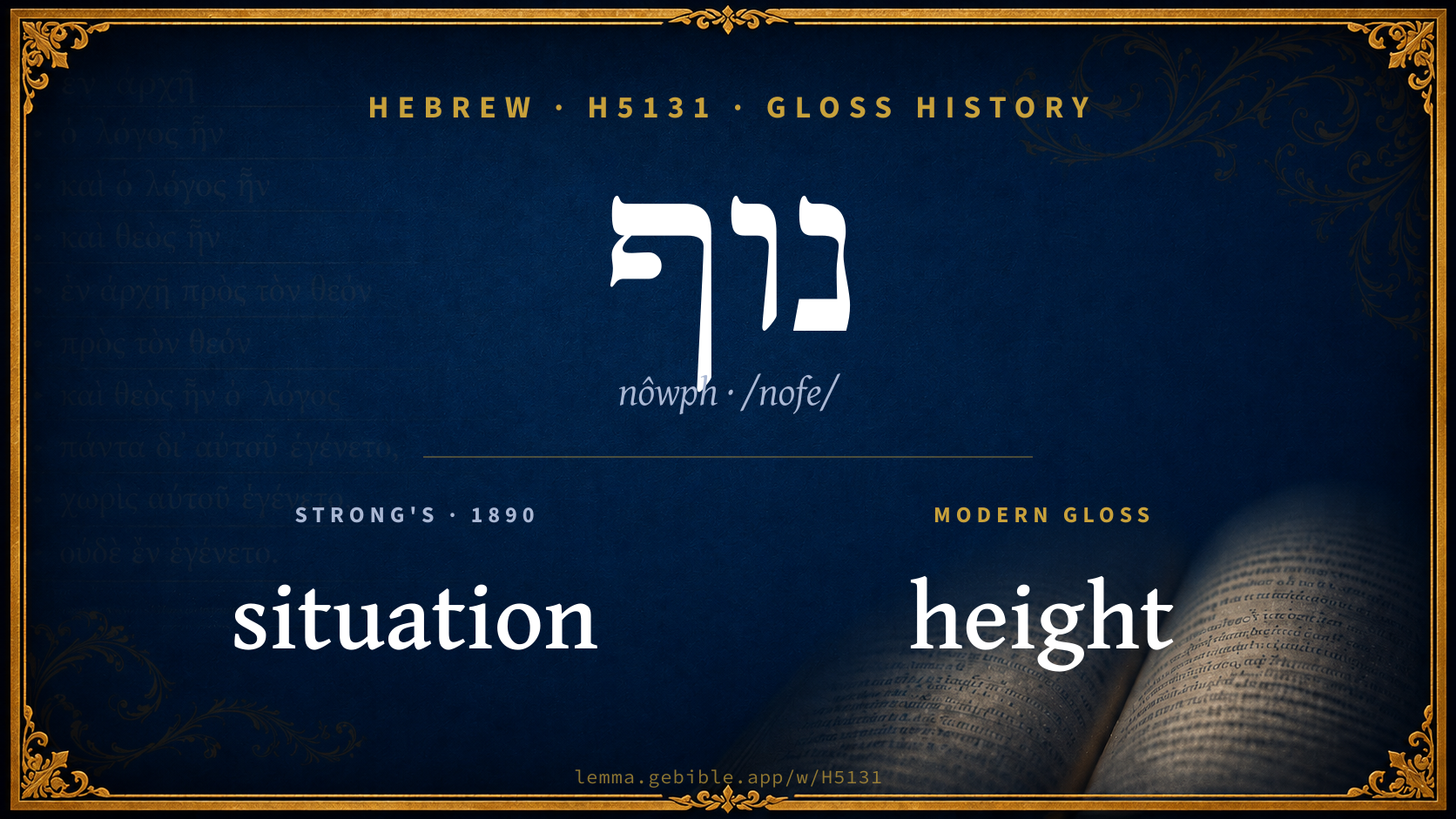
Gloss history
Strong's 1890 vs modern scholarship
About this word
Strong's H5131 catalogs a Hebrew word from the Hebrew Old Testament.
These counts are not copied from any lexicon or concordance. They are computed here, from the morphology-tagged Hebrew Old Testament. What Lemma adds →
- 1
- distinct verses
- The word appears in 1 distinct verse.
- 1 / 39
- OT books
- The word appears in 1 of 39 Old Testament books.
- #6,101
- by frequency
- Rank #6,101 (rank 6,101 of 8,640 Hebrew words by occurrence).
View all 1 occurrence in the concordance →
Most concentrated in
- Psalms 1 verse 100%
By section of the Old Testament
By traditional corpus
Conventional, traditional groupings — biblical authorship is debated, so this is a traditional corpus grouping, not an authorship claim. Each share is this word’s portion of its verses in that division of the Hebrew canon. Each figure is a share of the word’s 1 distinct verse.
- Writings (Ketuvim) 1 verse · 100%
How translations render this word
Counts come from each version’s own published word-to-Strong’s tagging or interlinear alignment — an approximate guide to how each version renders this word, not a word-level alignment the data otherwise carries. Because each total is that version’s own tagged count, the per-version totals vary from one another and need not match the appearance or distinct-verse counts above. These counts may also differ from a printed concordance because Lemma counts each distinctly tagged rendering and does not collapse phrase taggings into a single head-word total. This is a fixed set of word-tagged versions (KJV, ASV, BSB, ULT) and does not change with the reading translation you choose elsewhere. Each version’s license is shown beside its name below (and on Sources).
- King James Version: Situation 1×
- American Standard Version: Elevation 1×
- Berean Standard Bible: Loftiness 1×
- unfoldingWord Literal Text: Elevation 1×
King James Version Public Domain
Renders H5131 across 1 tagged occurrence — most commonly:
American Standard Version Public Domain
Renders H5131 across 1 tagged occurrence — most commonly:
Berean Standard Bible Public Domain
Renders H5131 across 1 tagged occurrence — most commonly:
unfoldingWord Literal Text CC BY-SA 4.0
Renders H5131 across 1 tagged occurrence — most commonly:
Senses in BDB
The 1 sense BDB distinguishes for this word, in lexicon order (not ranked by frequency or importance). The full entry — with sub-senses — is in the Lexicon Entry tab.
- elevation, height
Word origin
n.[m.] elevation, height (NH נוֹף is tree-top, bough, so 𝔗 נוֹפָא);—יְפֵה נ׳ ψ 48:3 beautiful in elevation (of Mount Zion).
— Brown-Driver-Briggs (Oxford 1906, public domain), digitized via Sefaria, supplemented by the OpenScriptures HebrewLexicon (CC BY 4.0). See Sources.
Derived from נוף (nûwph) (H5130) — to wave.
Jastrow Dictionary
A second Hebrew/Aramaic lexicon for comparison, covering Aramaic and post-biblical (Talmudic, Targumic, Midrashic) usage that the biblical-Hebrew BDB does not. Matched by lemma rather than by Strong’s number, so a lemma may carry more than one Jastrow headword (shown separately below), and the entries cover usage well beyond the Bible.
נוּף
- (b. h.) to move in the air, to soar. [Yalk. Ps. 676 שהוא נפה, read: שהיא צפה, v. צוּף.]
- 1. to swing, wave. Men. 61ᵇ כהן מניח … ומֵנִיף the priest places his hand under those of the owner of the offering and waves. Ib. אין העכ"ום מְנִיפִין gentiles are not permitted to wave their offerings; אין הנשים מְנִיפוֹת women are not permitted &c. Ib.ᵃ וכול יָנִיף ויחזור ויניף I might think that he must wave twice. Snh. VI, 1 מֵנִיף בסודרין gave the signal by waving a cloth; Succ. 51ᵇ. Pesik. R. s. 41 (ref. to יפה נוף, Ps. XLVIII, 3) היפה שהיא עתידה להָנִיף את וכ׳ the beautiful one (Israel) who is destined to swing (rule) the nations; Yalk. Ps. 755; Yalk. Ex. 417 שהיא מְנִיפָה לאו"ה (ref. to Is. XXX, 28); a. fr. e.g. Psalms 48:3
- 2. to fan. B. Mets. 86ᵃ הָנִיפִי עלי, v. מְנִיפָא. Y. Yoma I, 38ᶜ ומניפין לרבוניהם and fan their masters. Pesik. R. l. c.; Yalk. Ps. l. c. והכל מניפין עליה and all fan her (are subservient to her); a. e.
- to swing, fan. Y. Ber. I, 2ᵈ והיתה רוח … ומְנַפְנֶפֶת בו and the northern wind blew and set the harp swinging. Yalk. Ps. l. c. שיוצא ומְנַפְנֵף את דגניה (not רגליה) (the dew) which goes forth and makes her grain in the ear wave (bend with its weight); Pesik. R. l. c. ומְנַפֵּף את הדגנים. Ohol. VIII, 5 טלית המְנַפְנֶפֶת a sheet suspended as a banner (cmp. מַפָּה).
- 1. to be winnowed. Yeb. 63ᵃ (addressing the ears in the field, in Chald. dict.) אֵי במנפה תִתְנוֹפְפִי Ar., eh! thou desirest to be winnowed with the fan; [oth. vers. in Ar.: כמנפה תתנופפי (not במנ׳) thou swingest thyself like a swing, v. infra]; ed. v. next w.
- 2. to swing one’s self; to soar; to be proud. Ab. Zar. 24ᵇ הִתְנוֹפְפִי וכ׳ rise (O Ark) in the &c., v. הָדָר; Gen. R. s. 54. Yeb. l. c., v. supra.
נוּף ²
- ch. same; part. נָיֵיף. Yeb. 63ᵃ חזנהו דקא נַיְיפָן he saw them (the ears in the field) waving.
- to swing, wave, winnow. Targ. Is. XIII, 2. Targ. Y. II, Lev. VII, 30.—M. Kat. 16ᵇ מְנִיפָה, v. חוּשְׁלָא.
- , Ithp. אִתְנִיף, אִתְנוֹף to swing one’s self; to be proud. Yeb. l. c. (addressing the standing grain) אִתְנִיפָא אִיתְנוֹפְפִי וכ׳ Ar. (not תניפא) swing thyself (be as proud as thou wilt): trading in business brings more profit than thou dost; ed. אי נַיְיפַת אִיתְנוֹפִי how thou wavest! swing thyself &c.; (Rashi אי תנפינו, read: אִיתְנוֹפוּ or אִיתְנִיפוּ).
נוֹף I
- Nof, Memphis in Egypt. Pesik. R. s. 17; Pesik. Vayhi, p. 63ᵇ, v. מִנְפִּיס.
נוֹף II
- boughs of a tree, swinging branches, summit. Y. Ber. I, 2ᶜ bot. לא סוף דבר נוֹפוֹ וכ׳ (not טפו) after all, not only its boughs in swinging, but even its main branches (extended over an area of &c.). Macc. II, 7 אילן … ונופו נוטה וכ׳ a tree which stands within the limits (of the place of refuge), but whose branches spread beyond &c. Ib.; Maasr. III, 10 הכל הולך אחר הנ׳ the location of the branches decides the nature of the territory; Tosef. Arakh. V, 14 הנִיף. Kidd. 40ᵇ; a. e.—Pl. נוֹפִים, נוֹפִין, נוֹפוֹת. Num. R. s. 20 מי שאינו בקי קוצץ את הנ׳ וכ׳ he who is no expert (in felling trees) lops off the branches, each branch separately, and gets tired. Yalk. Ps. 755 (ref. to יפה נוף, Ps. XLVIII, 3) [read:] יפה בנ׳ שלה בהקפת וכ׳ she (Israel) is beautiful with her waving boughs when marching around the altar (on the Feast of Booths); Pesik. R. s. 41 יפה שלה (corr. acc.; Friedm. emends יָפֶה נוף שלה). e.g. Psalms 48:3
A Dictionary of the Targumim, the Talmud Babli and Yerushalmi, and the Midrashic Literature (Marcus Jastrow; London, Luzac, 1903) — Public Domain. Digitized via Sefaria. Digitized via Sefaria. Full attribution on Sources.
Same root — word family
Other BDB entries built from the same root as H5131, grouped by Strong’s listed origin. These share a root / origin per the lexicon — not necessarily a shared meaning. Each links to that word’s own entry.
Derives from
Shares the same root
Proper names from this root
People and places named from this root — a name, not an additional meaning of the word.
Compare all same-root words → Showing 4 of 6 — not the complete family. 1 of the same-root words is a proper name (a person or place). They share a root, not necessarily a meaning.
Septuagint verse parallels
This word appears in 1 verse that also exists in the Greek Old Testament (Septuagint), out of the 1 Hebrew verse it occurs in. You can read those verses in Greek by switching the Old Testament edition to the Septuagint.
Read these verses in the Septuagint
This is a verse-level parallel only — the same verses exist in both the Hebrew and Greek Old Testaments. No word-level Hebrew↔Greek correspondence is claimed: the data carries no such alignment, so no Greek word is shown as this Hebrew word’s translation. Coverage is not total — the Septuagint omits the deuterocanon and renumbers the Psalms, so some Hebrew verses have no direct Greek parallel.