Zechariah 2:9

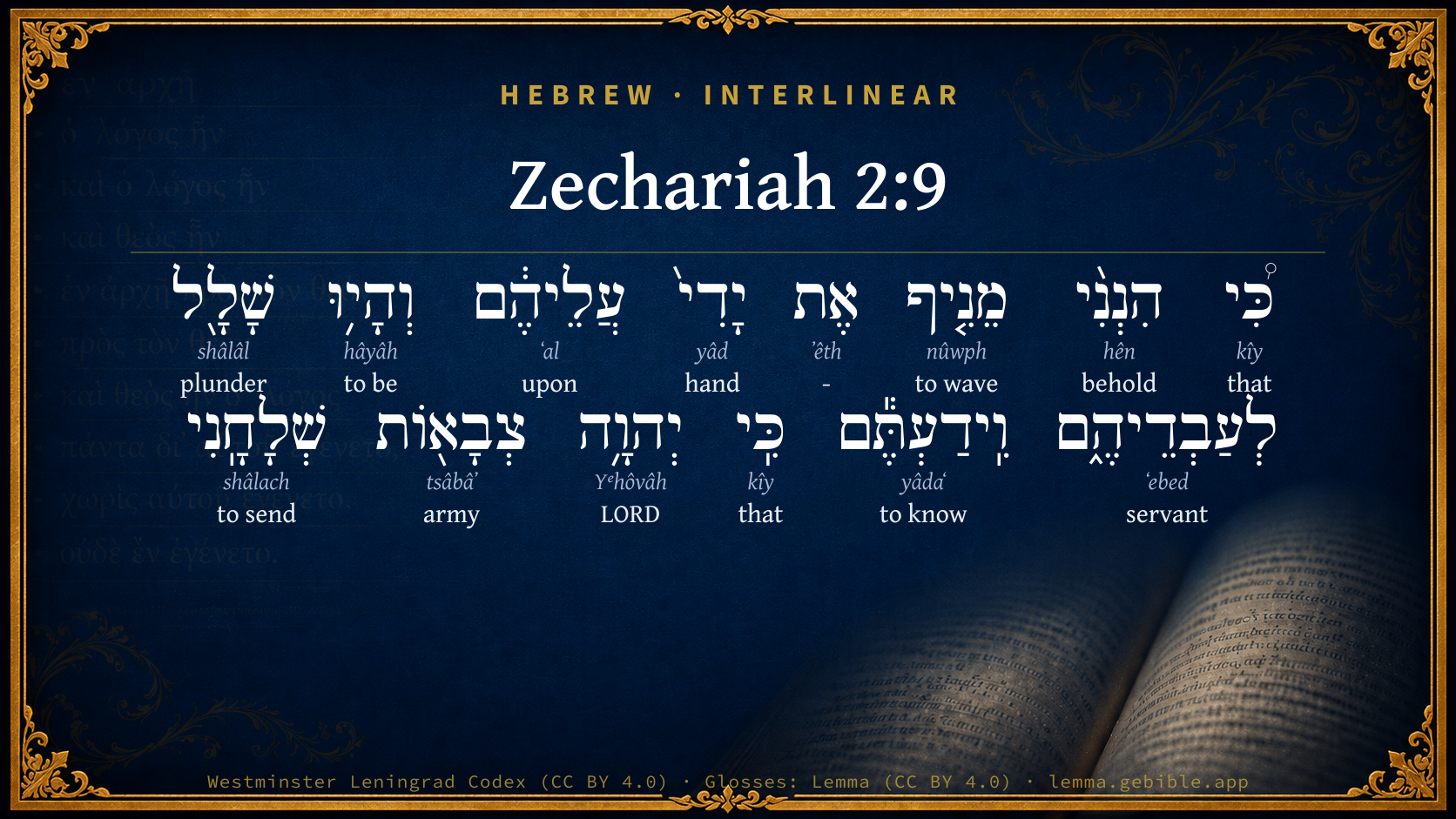
Hebrew (Westminster Leningrad Codex) Zechariah 2:9 appears in the Hebrew Old Testament. The text above is from the Westminster Leningrad Codex. Each word links to its Strong’s number, a concise gloss, and parsing drawn from the Open Scriptures Hebrew Bible morphology. Click any word for its full Brown-Driver-Briggs (BDB) entry.
Download image
Cite this verse

Zechariah 2:9 (World English Bible). Public Domain. Lemma interlinear Bible study tool, https://lemma.gebible.app/v/zechariah/2/9.

Show BibTeX & RIS
BibTeX
RIS
English Translation
For, behold, I will shake my hand over them, and they will be a spoil to those who served them; and you will know that Yahweh of Hosts has sent me.
World English Bible · Public Domain
Download a study sheet

One document with this verse’s original text, its word-by-word gloss line, the meaning frame, cross-references with their text, attributed commentary, and full source and license credits — printable, and it pastes into notes with its structure intact.

This verse Autodidact and up

Study sheet (.html) Plain text (.txt)

A passage Seminary Student

Up to 50 verses in one chapter. A passage sheet keeps up to 6 commentary sources and 12 cross-references per verse, in the order this page ranks them, and says so on the sheet whenever that leaves anything out. Ask for a single verse and you get the Autodidact verse sheet above.

Everything on this page stays free to read, with no account — the sheet is a download of what is already on screen, not access to it.

Want to remove ads? Support Godless Engineer
Compare translations 3

The same verse in 3 English versions, stacked beneath the original-language interlinear above. Click any original word for its lexicon entry.

Each is an independent rendering of the whole verse — the interlinear is not word-aligned to these translations.

Highlighted words mark where these versions differ — a whole-verse word diff, not a word-by-word alignment.

  • World English Bible Public Domain
    For, behold, I will shake my hand over them, and they will be a spoil to those who served them; and you will know that Yahweh of Hosts has sent me.
  • King James Version Public Domain
    For, behold, I will shake mine hand upon them, and they shall be a spoil to their servants: and ye shall know that the LORD of hosts hath sent me.
  • unfoldingWord Literal Text CC BY-SA 4.0
    “For behold, I am waving my hand over them, and they will be plunder for their slaves.” And you will know that Yahweh of Armies has sent me.

unfoldingWord Literal Text — © unfoldingWord, licensed CC BY-SA 4.0. Word-aligned USFM3 via Door43 (git.door43.org/unfoldingWord/en_ult).

Versions to compare (up to 4)

3 of 4 selected

Show all 18 translations

Every available English version of this verse, each an independent rendering of the whole verse.

  • World English Bible Public Domain
    For, behold, I will shake my hand over them, and they will be a spoil to those who served them; and you will know that Yahweh of Hosts has sent me.
  • Berean Standard Bible Public Domain
    I will surely wave My hand over them, so that they will become plunder for their own servants. Then you will know that the LORD of Hosts has sent Me.”
  • Majority Standard Bible Public Domain
    I will surely wave My hand over them, so that they will become plunder for their own servants. Then you will know that the LORD of Hosts has sent Me.”
  • King James Version Public Domain
    For, behold, I will shake mine hand upon them, and they shall be a spoil to their servants: and ye shall know that the LORD of hosts hath sent me.
  • American Standard Version (1901) Public Domain
    For, behold, I will shake my hand over them, and they shall be a spoil to those that served them; and ye shall know that Jehovah of hosts hath sent me.
  • Revised Version (1885) Public Domain
    For, behold, I will shake mine hand over them, and they shall be a spoil to those that served them: and ye shall know that the LORD of hosts hath sent me.
  • Geneva Bible (1599) Public Domain
    For beholde, I will lift vp mine hand vpon them: and they shalbe a spoyle to those that serued them, and ye shall knowe, that the Lord of hostes hath sent me.
  • Douay-Rheims (1899) Public Domain
    For behold I lift up my hand upon them, and they shall be a prey to those that served them: and you shall know that the Lord of hosts sent me.
  • Young's Literal Translation Public Domain
    For lo, I am waving my hand against them, And they have been a spoil to their servants. And ye have known that Jehovah of Hosts hath sent me.
  • Literal Standard Version CC BY-SA 4.0
    For behold, I am waving My hand against them, || And they have been a spoil to their servants. And you have known that YHWH of Hosts has sent Me.
  • Unlocked Literal Bible CC BY-SA 4.0
    “I myself will shake my hand over them, and they will be plunder for their slaves.” Then you will know that Yahweh of hosts has sent me.
  • unfoldingWord Literal Text CC BY-SA 4.0
    “For behold, I am waving my hand over them, and they will be plunder for their slaves.” And you will know that Yahweh of Armies has sent me.
  • Darby Bible Public Domain
    For behold, I will shake my hand upon them, and they shall become a spoil to those that served them: and ye shall know that Jehovah of hosts hath sent me.
  • World Messianic Bible Public Domain
    For, behold, I will shake my hand over them, and they will be a plunder to those who served them; and you will know that the LORD of Hosts has sent me.
  • Webster's Bible Public Domain
    \\2:5\\For I, saith the LORD, will be to her a wall of fire on every side, and will be the glory in the midst of her.
  • Free Bible Version CC BY-SA 4.0
    I will raise my hand against them and their former slaves will plunder them. Then you will know the Lord Almighty has sent me.
  • Bible in Basic English Public Domain
    For I, says the Lord, will be a wall of fire round about her, and I will be the glory inside her.
  • JPS Tanakh (1917) Public Domain
    (2-13) For, behold, I will shake My hand over them, and they shall be a spoil to those that served them'; and ye shall know that the LORD of hosts hath sent me.

Literal Standard Version (2020), Covenant Press — licensed CC BY-SA 4.0. Text via the HelloAO Bible API (eBible.org). Unlocked Literal Bible (unfoldingWord) — licensed CC BY-SA 4.0. Text via the HelloAO Bible API (eBible.org). unfoldingWord Literal Text — © unfoldingWord, licensed CC BY-SA 4.0. Word-aligned USFM3 via Door43 (git.door43.org/unfoldingWord/en_ult). Free Bible Version, Dr. Jonathan Gallagher — licensed CC BY-SA 4.0. Text via the HelloAO Bible API (eBible.org).

Word by word

More ways to search: Search by grammar → Find every occurrence → Compare this word →

Practice this passage: Drill this verse → Learn its vocabulary →

מֵנִ֤יף
nûwph
H5130
“waving”
Verb, Hiphil, Participle Active, Masculine, Singular, Absolute
Part of Speech
Verb
Stem
Hiphil
Form
Participle Active
Gender
Masculine
Number
Singular
State
Absolute
Full BDB Definition

Origin: a primitive root

TWOT: 1329 , 1330

to move to and fro, wave, besprinkle - (Qal) to besprinkle, sprinkle - (Polel) to wave, brandish (in threat) - (Hiphil) to swing, wield, wave - to wield - to wave or shake (the hand) - to wave (hand) - to shake or brandish against - to swing to and fro - to wave (an offering), offer - to shed abroad - (Hophal) to be waved
  1. כִּ֠י kîy H3588 “that” Conjunction
  2. הִנְנִ֨י hên H2005 “behold · me” Particle, Demonstrative + Suffix, Personal, 1st Person, Common, Singular
  3. אֶת ʼêth H853 “-” Particle, Direct Object
  4. יָדִי֙ yâd H3027 “hand · my” Noun, Common, Both, Singular, Construct + Suffix, Personal, 1st Person, Common, Singular
  5. עֲלֵיהֶ֔ם ʻal H5921 “upon · them” Preposition + Suffix, Personal, 3rd Person, Masculine, Plural
  6. וְהָי֥וּ hâyâh H1961 “and · to be” Conjunction + Verb, Qal, Sequential Perfect, 3rd Person, Common, Plural
  7. שָׁלָ֖ל shâlâl H7998 “plunder” Noun, Common, Masculine, Singular, Absolute
  8. לְעַבְדֵיהֶ֑ם ʻebed H5650 “to/for · servants · their” Preposition + Noun, Common, Masculine, Plural, Construct + Suffix, Personal, 3rd Person, Masculine, Plural
  9. וִֽידַעְתֶּ֕ם yâdaʻ H3045 “and · to know” Conjunction + Verb, Qal, Sequential Perfect, 2nd Person, Masculine, Plural
  10. כִּֽי kîy H3588 “that” Conjunction
  11. יְהוָ֥ה Yᵉhôvâh H3068 “LORD” Noun, Proper
  12. צְבָא֖וֹת tsâbâʼ H6635 “armies” Noun, Common, Both, Plural, Absolute
  13. שְׁלָחָֽנִי shâlach H7971 “to send · me” Verb, Qal, Perfect, 3rd Person, Masculine, Singular + Suffix, Personal, 1st Person, Common, Singular

About this verse

These counts appear in no published source. They are computed here, from the morphology-tagged text and Lemma’s own curated glosses. What Lemma adds →

14
words
13
distinct lemmas
Prophets
section

Shared distinctive vocabulary

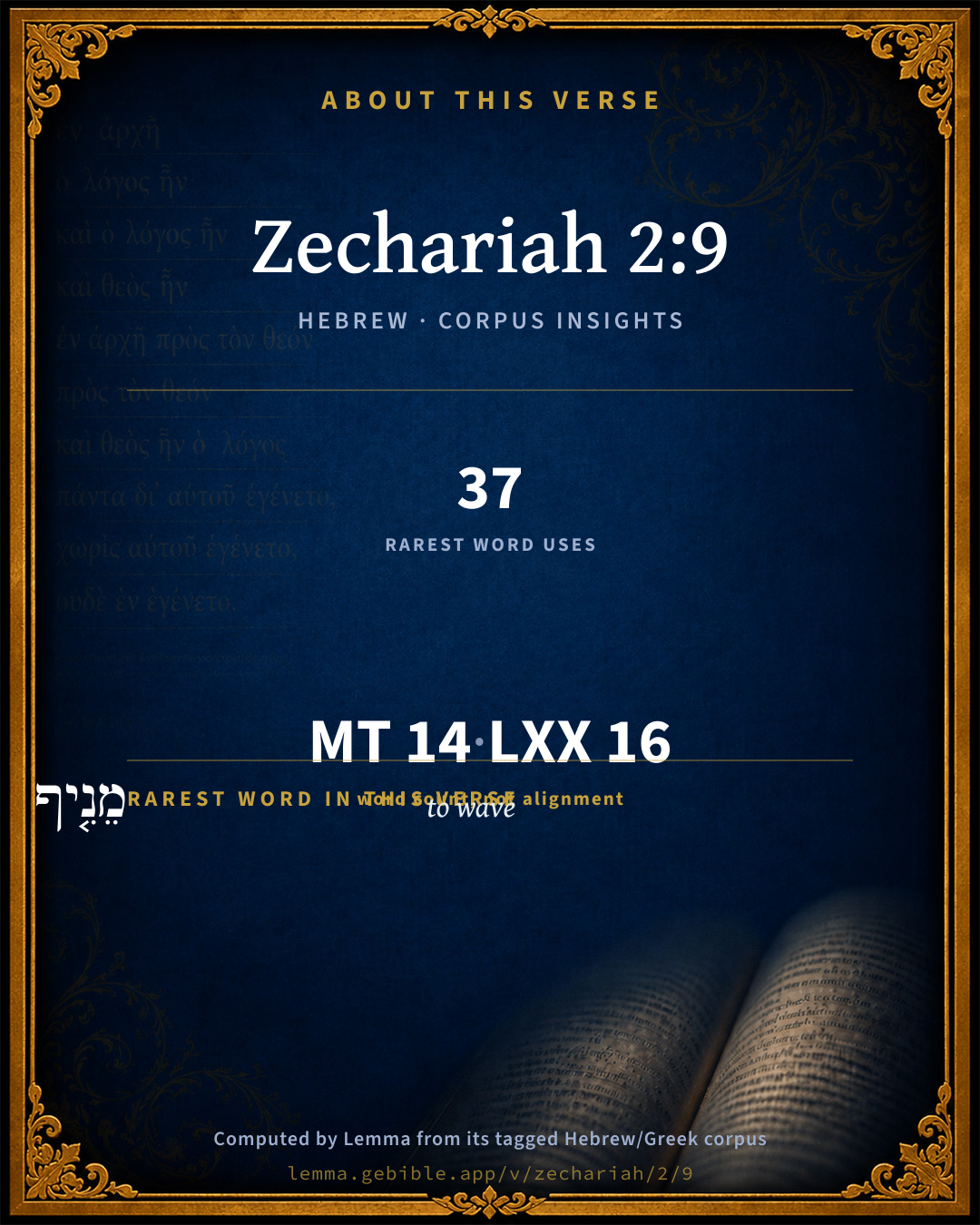
מֵנִ֤יף to wave H5130 occurs in 35 verses of the Hebrew Bible. Also found in:

Grammatical profile

  • 4 verbs
  • 5 nouns
  • 1 preposition
  • 2 conjunctions
  • 2 particles

Verb forms

  • מֵנִ֤יף Hiphil · Participle Active
  • וְהָי֥וּ Qal · Sequential Perfect
  • וִֽידַעְתֶּ֕ם Qal · Sequential Perfect
  • שְׁלָחָֽנִי Qal · Perfect

Repetition

A word recurs within this verse — often emphatic in Hebrew:

  • כִּ֠י that H3588 ×2

Hebrew & Septuagint length

In English translation the verse runs 31 words from the Hebrew and 30 from the Septuagint (LXX English) — closely comparable.

A rough comparison of the two English renderings, which tokenize alike — not a word-level alignment.

Word counts can differ between the Hebrew and the Greek without any difference in meaning — e.g. the Hebrew direct-object marker אֵת has no separate Greek word, and Greek often adds the article ὁ.

In the original languages it is 14 Hebrew tokens and 16 Greek tokens — but the two are counted differently (Hebrew bundles its prefixes and suffixes into one token; the Greek is in lemma form), so that isn’t a like-for-like length.

Cross-references

18

Topical passages linked to Zechariah 2:9 in the Treasury of Scripture Knowledge — connected by theme and wording, ordered by reader-vote popularity; previews shown in the World English Bible.

  • Isaiah 19:16 In that day shall the Egyptians be like women; and they shall tremble and fear because of the shaking of the hand of Yahweh of Hosts, which he shakes over them.
  • Isaiah 14:2 The peoples shall take them, and bring them to their place; and the house of Israel shall possess them in the land of Yahweh for servants and for handmaids: and they shall take them captive whose captives they were; and they shall rule over their oppressors.
  • Ezekiel 39:10 so that they shall take no wood out of the field, neither cut down any out of the forests; for they shall make fires of the weapons; and they shall plunder those who plundered them, and rob those who robbed them, says the Lord Yahweh.
  • Zechariah 4:9 "The hands of Zerubbabel have laid the foundation of this house. His hands shall also finish it; and you will know that Yahweh of Hosts has sent me to you.
  • Zechariah 6:15 Those who are far off shall come and build in the temple of Yahweh; and you shall know that Yahweh of hosts has sent me to you. This will happen, if you will diligently obey the voice of Yahweh your God."'"
  • Isaiah 11:15 Yahweh will utterly destroy the tongue of the Egyptian sea; and with his scorching wind will he wave his hand over the River, and will strike it into seven streams, and cause men to march over in sandals.
  • Isaiah 13:2 Set up an ensign on the bare mountain, lift up the voice to them, wave the hand, that they may go into the gates of the nobles.
  • Isaiah 10:32 This very day shall he halt at Nob: he shakes his hand at the mountain of the daughter of Zion, the hill of Jerusalem.
  • Isaiah 33:1 Woe to you who destroy, and you weren't destroyed; and deal treacherously, and they didn't deal treacherously with you! When you have ceased to destroy, you shall be destroyed; and when you have made an end of dealing treacherously, they shall deal treacherously with you.
  • Isaiah 33:23 Your rigging is untied; they could not strengthen the foot of their mast, they could not spread the sail: then was the prey of a great spoil divided; the lame took the prey.
  • Jeremiah 27:7 All the nations shall serve him, and his son, and his son's son, until the time of his own land come: and then many nations and great kings shall make him their bondservant.
  • Jeremiah 28:9 The prophet who prophesies of peace, when the word of the prophet shall happen, then shall the prophet be known, that Yahweh has truly sent him.
  • Habakkuk 2:8 Because you have plundered many nations, all the remnant of the peoples will plunder you, because of men's blood, and for the violence done to the land, to the city and to all who dwell in it.
  • Habakkuk 2:17 For the violence done to Lebanon will overwhelm you, and the destruction of the animals, which made them afraid; because of men's blood, and for the violence done to the land, to every city and to those who dwell in them.
  • Zephaniah 2:9 Therefore as I live, says Yahweh of Hosts, the God of Israel, surely Moab will be as Sodom, and the children of Ammon as Gomorrah, a possession of nettles, and salt pits, and a perpetual desolation. The remnant of my people will plunder them, and the survivors of my nation will inherit them.
  • Zechariah 2:8 For thus says Yahweh of hosts: 'For honor he has sent me to the nations which plundered you; for he who touches you touches the apple of his eye.
  • John 13:19 From now on, I tell you before it happens, that when it happens, you may believe that I AM.
  • John 16:4 But I have told you these things, so that when the time comes, you may remember that I told you about them. I didn't tell you these things from the beginning, because I was with you.

Cross-references courtesy of OpenBible.info (CC BY 4.0).

Hebrew and Greek witnesses Masoretic Hebrew ↔ Greek Septuagint

The same verse in the two great witnesses to the Old Testament, shown verse-for-verse.

These are two independent witnesses, not word-aligned to each other, and the Septuagint is shown in lemma (dictionary) form.

Hebrew Zechariah 2:9 Masoretic · Westminster Leningrad Codex

כִּ֠י הִנְנִ֨י מֵנִ֤יף אֶת יָדִי֙ עֲלֵיהֶ֔ם וְהָי֥וּ שָׁלָ֖ל לְעַבְדֵיהֶ֑ם וִֽידַעְתֶּ֕ם כִּֽי יְהוָ֥ה צְבָא֖וֹת שְׁלָחָֽנִי

For, behold, I will shake my hand over them, and they will be a spoil to those who served them; and you will know that Yahweh of Hosts has sent me.

World English Bible · Public Domain

Greek LXX Zechariah 2:9 Septuagint · lemma form

καί ἐγώ εἰμί αὐτός λέγω κύριος τεῖχος πῦρ κυκλόθεν καί εἰς δόξα εἰμί ἐν μέσος αὐτός

For, behold, I bring my hand upon them, and they shall be a spoil to them that serve them: and you⌃ shall know that the Lord Almighty has sent me.

LXX2012 (modern English Septuagint) · Public Domain

On this verse, The Pulpit Commentary discusses the Septuagint’s reading. Read the note in Commentary ↓

Hebrew: Westminster Leningrad Codex (CC BY 4.0). Greek: Septuagint (public domain); English from LXX2012 (modern English Septuagint) (Public Domain). How the Septuagint differs from the Hebrew →

Targum (Aramaic paraphrase)

1

The Targum is the ancient Jewish Aramaic paraphrase of the Hebrew Scriptures — an interpretive translation, not the Hebrew text itself. Onkelos (literal) and Pseudo-Jonathan (expansive) render the Torah, and Jonathan the Prophets. Coverage is partial: where no permissively-licensed English translation exists for a verse, only the Aramaic is shown. This is verse-level text, not a word-by-word alignment to the Hebrew.

  1. Targum Jonathan Prophets (Joshua–Malachi)
    וּמֵימְרִי יְהֵי לָהּ אֲמַר יְיָ כְּשׁוּר דְאָשָׁא מַקֵף לָהּ סְחוֹר סְחוֹר וּבִיקַר אַשְׁרֵי שְׁכִנְתִּי בְּגַוָהּ:

    (no public-domain English translation for this verse)

    Targum Jonathan — Aramaic: “Mikraot Gedolot” (public domain). English: “Sefaria Community Translation” (CC0 1.0 (public-domain dedication)); “London "Chaldee Paraphrase," 1871” (public domain). Text via Sefaria.

Commentary

Notes on Zechariah 2:9 from classic Christian and Jewish commentators (each source and its license shown beneath its notes). The classic Christian expositions comment on the surrounding passage and are grouped to its opening verse, so a note may address several verses; the Jewish commentaries on the Tanakh (Rashi and others) are per-verse, so they appear only where the commentator wrote on this verse.

Lemma curates 59 commentaries, every one of them public domain or Creative Commons licensed, each selected and text-cleaned for this edition rather than reprinted as found. About our sources →

Trapp's Complete Commentary

John Trapp

Zec 2:9 For, behold, I will shake mine hand upon them, and they shall be a spoil to their servants: and ye shall know that the LORD of hosts hath sent me.

Ver. 9. For, behold, I will shake mine hand upon them] Kings, they say, have long hands; and can easily reach those that are far distant. This is much more true of the King immortal; who can quickly crumble to crackle the mightiest monarchs; he cuts off the spirit of princes, Psa 76:12, he slips them off (so the Hebrew there imports), as one would slip off a flower between one’s fingers, or as one should slip off a bunch of grapes. If the Lord do no more but arise, his enemies shall be scattered, Psa 68:1. If he do but show himself in the field (as Xerxes used to pitch his tent on high, and stand looking on his army when in fight), the Philistines will be heard to cry out, "God is come into the camp. Woe unto us! who shall deliver us out of the hands of these mighty Gods?" 1Sa 4:8. But if he once shake his hand (that mighty hand, as St James calleth it, that spanneth the heavens and shaketh the foundations of the earth), how much more if he smite with the hand and stamp with the foot (as the prophet in another case, Eze 6:11; and as Pompey vainly vaunted, that with a stamp on the ground of Italy he could raise an army), the sinners against Zion are soon afraid; fearfulness surpriseth the hypocrites. Woe unto us, say they, for we are spoiled, Isa 33:14 Jer 4:13. The very shaking of his hand at them shall make their hearts ache, shake, and fall asunder in their bosoms, as drops of water.

And they shall be a spoil to their servants] i.e. To the Jews, whom they lately spoiled and enslaved. This was fulfilled in Esther’s days; and afterwards in the time of the Maccabees. Besides what is yet expected to be done by the nation of the Jews; when, at their glorious conversion, Christ shall dwell among them, Zec 2:10, and the multitude of nations shall join themselves to Christ, Zec 2:11, the Jews inhabiting in their own land, Zec 2:12, to the silencing, amusing, and amazing of all flesh, Zec 2:13; while the enemies of the Church by them subdued, Zec 10:11, and possessed, Isa 14:2 Oba 1:17; Oba 1:19, shall willingly, or perforce, come under Christ’s obedience. The conversion of the Gentiles (saith a learned author) is many times intimated by the Israelites mastering of them, spoiling them, possessing them for servants and for handmaids, as Isa 14:2 Amo 9:11 Oba 1:19, and here, which is not meant so much of a temporal subduing as of a spiritual joining with them in seeking of the Lord; yet so as the chief sovereignty and stroke of keeping men within the lists of their subjection and obedience unto Christ, shall remain among the Jews (The Calling of the Jews, by Sir H. Finch). And so St James teacheth us to expound those phrases, Act 15:17, where that which Amos saith, that the Israelites may possess the remnant of Edom, James rendereth, that the residue of men may seek after the Lord. The enemy whom, indeed, the Jews shall spoil, root out, and destroy, after they have groaned long under his hard yoke and bondage, is Gog and Magog, that is to say, the Turk, Eze 38:1-23 Eze 39:1-29, with whom they shall have a marvellous conflict, as it may seem in their own country, Eze 39:2; Eze 39:4 Dan 11:44-45, and over whom they shall obtain a noble victory (God from heaven miraculously fighting for them, Eze 38:18-19, &c.; Zec 14:3-5) at, or near Jerusalem, Joe 3:2 Eze 39:16. This enemy is not always represented by one and the same name; but sometimes he is called Moab, Edom, Rabbah, Ashur, Javan; haply because those that inhabit the seat of these people shall join hands with the Turk, and fall in the same destruction. Sometimes he is called leviathan, from his quality; sometimes Gog and Magog, from his country; sometimes the king of the north, from his territory, Isa 27:1 Eze 38:2 Dan 11:40. But by all these names one and the same enemy is understood, which marvellously cleareth the place in Ezekiel, Eze 38:17, where the Lord by his prophet speaketh to Gog in this wise: "Art thou he of whom I have spoken in ancient time by my servants the prophets of Israel, which prophesied in these days and years?" He cannot mean himself, nor Daniel, which was but his contemporary, much less Zechariah, that came after; but he meaneth the ancient prophets long before, who spake of the same person, though not by the same name.

And ye shall know that the Lord of hosts hath sent me] You shall subscribe to the truth of these promises, which now you can very hardly be brought to believe; when God shall have fulfilled with his hand that which he hath spoken with his mouth, as Solomon’s phrase is, 1Ki 8:15.

John Trapp, A Commentary or Exposition upon All the Books of the Old and New Testament (1647–1656) — public domain. Text from a community e-Sword module.

Tyndale Open Study Notes

Tyndale Open Resources

2:9 their own slaves will plunder them: At the Exodus, the Egyptians paid the Israelites to leave their land (see Exod 11:2-3; 12:35-36).

Tyndale Open Study Notes — © Tyndale Open Resources, licensed CC BY-SA 4.0. Text via the HelloAO Bible API.

Geneva Bible (1599)

Geneva Bible translators

Upon the heathen your enemies.

This must necessarily be understood of Christ, who being God equal with his Father, was sent as he was Mediator to dwell in his Church and to govern them.

They shall be your servants, as you have been theirs.

Geneva Bible (1599) marginal notes — public domain. Text via Bolls.life.

Jamieson, Fausset & Brown

Robert Jamieson, A. R. Fausset & David Brown

shake . . . hand--A mere wave of God's hand can prostrate all foes (compare Rut 1:13; Job 31:21; Isa 11:15; Isa 19:16; Act 13:11).

a spoil to their servants--to the Jews whom they had once as their slaves (compare Isa 14:2). As the Jews' state between the return from Babylon and Christ's coming was checkered with much adversity, this prophecy can only have its fulfilment under Christ.

sent me-- (Isa 48:16; Isa 61:1; Joh 10:36).

Jamieson, Fausset & Brown — Commentary Critical and Explanatory on the Whole Bible (1871) — public domain (CC PDM 1.0). Text via the HelloAO Bible API.

Adam Clarke's Commentary

Verse 9. I will shake mine hand upon them] I will threaten first, and then stretch out my hand of judgment against them.

A spoil to their servants] To those whom they had formerly subjected to their sway. As the Babylonians to the Medes and Persians; and so of the rest in the subversion of empires.

Adam Clarke's Commentary on the Bible (1810–1826) — public domain. Text from a community e-Sword/MySword module.

John Calvin's Commentaries

Christ continues to relate the commands of the Father: for he speaks in his person, when he says, Behold, I shake my hand over them, that is, enemies; and they shall be a prey to their own servants. He means, that however numerous and strong the enemies would be who would seek to injure the Jews, they would yet be safe; for they would be protected by the hand of God, and not only so, but that whatever their enemies would attempt to do would be in vain, for the Lord would degrade them, and render them a prey to the Jews themselves: for by servants he doubtless means the Jews, who, for a time, had been oppressed by the tyranny of their enemies.

It is certain that this prophecy was not fulfilled at the time when the Jews thought that they were in a flourishing state, and enjoying prosperity; for their condition was even then very wretched and degrading. For whence had they their kings? Certainly not from the tribe of Judah; and we all know how tyrannically they were governed, and also that the kingdom was filled with many abominable sins and cruelties. They were become parricides almost all; and whosoever will read their history will find, that brethren were oppressed by brethren, and that even parents were cruelly and wickedly treated. In short, not to say of other things, nothing could have been more abominable than the family of Herod. We cannot then apply this prophecy to that time which intervened between the return from the Babylonian exile, and the coming of Christ. It is then only under the kingdom of Christ that God accomplished what is here said, — that enemies became a prey to his spiritual people, that is, when they were subdued and brought under the yoke of Christ, for as we have said elsewhere, the government of the Church is vested in its Head. Hence where Christ shines, there the Church, which is his body, is said to reign; for Christ’s will is, that he should have nothing apart from his members.

We now see the intention of the Prophet: he wished to dispel the fear of the Jews, that they might not hesitate to return to their country; for not only a way was opened for them, but confirmed also and certain was their happiness under God’s protection; as he had not in vain begun a glorious work, but fully purposed to carry it on to the end.

He says, Behold, I shake my hand. The shaking of the hand shows that God has no need of many forces to put to flight his enemies, nor of a large expedition; for as soon as he raises up his hand, he lays them all prostrate. In short, the Prophet reminds us, that God has hands which extend far, for he can by mere shaking conquer all enemies, however distant they may be. And then we see that the facility with which God executes his purpose was mentioned, in order that the Jews might feel assured, that as soon as it would please God to put forth his strength, he would have no difficulty; for by the single motion of his finger he could destroy all the enemies who might rise up against them.

He afterwards adds, And ye shall know that Jehovah of hosts has sent me. To consider this as an address to the faithful, may not seem suitable; for faith is connected with knowledge, as we are taught by John,

“We know that we are the children of God,” (1 John 3:2;)

for the certainty which rests on God’s word exceeds all knowledge. Why then does the Prophet say, And we shall know that Jehovah has sent me? for the faithful ought to have been previously certain respecting the mission of Christ; otherwise an approach to God was closed up; for an access, we know, to his favor is opened by faith. The Jews must have then been assured from the beginning respecting the mission of Christ. But it is to be observed, that there are two kinds of knowledge, — the knowledge of faith, and what they call experimental knowledge. The knowledge of faith is that by which the godly feel assured that God is true — that what he has promised is indubitable; and this knowledge at the same time penetrates beyond the world, and goes far above the heavens, that it may know hidden things; for our salvation is concealed; things seen, says the Apostle, are not hoped for. (Romans 8:24.) It is then no wonder that the Prophet says, that the faithful shall then know that Christ has been sent by the Father, that is, by actual experience, or in reality: Ye shall then know that Jehovah has sent me. He afterwards adds —

John Calvin's Commentaries (1540-1563) — public domain. Text from the Calvin Translation Society English edition (1840s-50s) via the Christian Classics Ethereal Library (ccel.org). Calvin's coverage is partial (roughly two-thirds of the Bible); uncommented books and verses are honest gaps, never fabricated. The 19th-century editor's footnotes and remarks are omitted so the notes are faithfully Calvin's own voice.

Ellicott's Commentary for English Readers

(9) The troubles which overtook Babylon shortly after this time are sufficiently borne witness to by the inscription executed by Darius in the fifth year of his reign (Sir W. Rawlinson) on the great rock of Behistun, near the western frontier of Media. Thereon are recorded two great insurrections in Babylonia, and that Babylon itself was twice taken, once by Darius in person, and again by his general, Intaphres (Records of the Past, Vol. I., pp. 118-125). On the latter occasion, “says Darius the king, I made a decree that Arakha and his principal followers should be put to death in Babylon.”

A Bible Commentary for English Readers, edited by Charles John Ellicott (1878–1897) — public domain. Text from a community e-Sword module.

The Cambridge Bible for Schools and Colleges

gen. ed. J. J. S. Perowne

9. shake mine hand] Job_31:21; Isa_19:16.

a spoil to their servants] They “which spoiled you,” Zec_2:8, shall be themselves “a spoil,” and that to those whom they held in servitude, those that served them R. V.

hath sent me] The divine mission of the angel who foretells these things shall be attested by the event. Comp. Zec_2:11, Zec_4:9, Zec_6:15.

The Cambridge Bible for Schools and Colleges (gen. ed. J. J. S. Perowne; Cambridge University Press, 1878–1918) — public domain. Text from a community e-Sword module.

John Gill's Exposition

For, behold, I will shake mine hand upon them,.... The nations; either the Babylonian, or the antichristian states; meaning, that he would exert his power, and inflict punishment on them, and utterly destroy them; which would be done by the bare shaking of his hand:

and they shall be a spoil to their servants; as the Babylonians were to the Persians; not through Cyrus, which had been done; but through Darius, who took Babylon, after a siege of twenty months, and put great numbers to death; and all became a spoil to the Persians, who had been their servants: or the ten kings, that gave their kingdoms to the beast, and were subject to him; but now shall hate the whore, and eat her flesh; and all her riches and revenues shall be a spoil unto them, and be divided among them, Rev 17:12,

and ye shall know that the Lord of hosts hath sent me; either the Prophet Zechariah, that he was a true prophet, and had his mission from the Lord of hosts, as will appear by the accomplishment of these prophecies; or rather Christ, sent by God the Father; and who will be known and owned by the Jews, as well as by the Gentiles, to be the sent of God, when they shall be converted, and antichrist shall be destroyed. Kimchi refers this, and the following verse Zac 2:10, to the times of the Messiah.

John Gill's Exposition of the Whole Bible (1746–1763) — public domain (CC PDM 1.0). Text via the HelloAO Bible API.

Albert Barnes' Notes on the Bible

For behold I will shake My hand against them - As God promised of old against the enemies of His people , and they shall be a spoil to those who served them habitually.

And ye shall know that the Lord of hosts hath sent Me - Theodoret: “He was sent, not as God, but as Man. For as God He is equal to the Father. For He saith, “I am in the Father and the Father in Me, and, The Father who dwelleth in Me He doeth the works” Joh 14:10, and, “I and My Father are one” Joh 10:30, and “He who hath seen Me hath seen the Father” Joh 14:9. But He is sent, as man, fulfilling the dispensation for us, not lessening the divine nature. The prophet then intimated not the duality only, but the equality of the persons.”

Albert Barnes' Notes on the Bible (1834–1885) — public domain. Text from a community e-Sword/MySword module.

Haydock's Catholic Bible Commentary

Prey. Two years after this (Calmet) the Assyrians revolted, and seized Babylon. (Justin i.) --- They slew the useless women: but Zopyrus betrayed the place to Darius, who hung 3,000 of the principal inhabitants, and demolished the walls. (Herodotus iii. 150.; Usher, the year of the world 3489.)

George Leo Haydock (1774–1849), Haydock's Catholic Family Bible and Commentary, 1859 edition — public domain. Excludes Psalms (Douay-Rheims chapter numbering differs from Protestant) and Deuterocanonical books (Catholic canon only).

Matthew Poole's English Annotations

I will shake, or lift up, mine hand, my power and strength, upon them; against the nation and kingdom that doth violence to the people who are my glory, and I am theirs, saith the Lord.

They, those people who comply not with him whom God sendeth,

shall be a spoil, shall be overthrown and spoiled, and become a prey, unto their servants; the Jews, who were first spoiled by and then made servants to the nations who conquered, captivated, and hardly used the Jews; and indeed this was fulfilled in Esther’s days, and in the Maccabees’ times.

And ye, either Jews, or heathen, or both, shall know, be convinced and own it,

that the Lord of hosts, the great and faithful God,

hath sent me, hath commissioned Christ to inform them, who are to make their choice what to do herein.

Matthew Poole's English Annotations on the Holy Bible (1683–1685) — public domain. Text from a community e-Sword/MySword module.

The Pulpit Commentary

I will shake mine hand upon (over) them. The angel reports Jehovah"s message now in the first person, or speaks as the representative of Jehovah. The action of shaking the hand over a nation is one of menace. (Job_31:21 Isa_11:15 Isa_19:16) Shall be a spoil to their servants; to their slaves, those who once served them. This was true only in a spiritual sense, when the nations were won over to the true faith. (see ver. 11; and comp. Isa_14:2 Isa_49:22, etc.; Eze_16:61) Septuagint, toiv douleuousin autoiv , "to them that serve them." Ye shall know, etc. (Zec_4:9 Zec_6:15) When this comes to pass, the Israelites shall recognize and own the Divine mission of God"s messenger.

The Pulpit Commentary (1880–1919), ed. H.D.M. Spence-Jones & Joseph S. Exell — public domain. Text from a community e-Sword module.

John Wesley's Explanatory Notes

Upon them - Against the nation that doth violence to my people. Unto their servants - Unto the Jews, who were first spoiled by, and then made servants to them. Hath sent me - To inform them of my father's will.

John Wesley, Explanatory Notes Upon the Whole Bible (1754–1765) — public domain. Text via the GEBible commentary corpus.

Rashi

Rabbi Shlomo Yitzchaki (Rashi)

But I will be for it as a shield, as though a wall of fire surrounds it. Also, My Shechinah shall dwell in its midst for your glory.

Rashi on the Tanakh — English translations: “The Judaica Press complete Tanach with Rashi, translated by A. J. Rosenberg” (CC BY 4.0); “Pentateuch with Rashi's commentary by M. Rosenbaum and A.M. Silbermann, 1929-1934” (public domain); “The Metsudah Tanach series, Lakewood, N.J” (CC BY 4.0); and “The Book of Joshua, Metsudah Publications, 1997” (CC BY 4.0). Text via Sefaria.

Lesson kit

Teaching starters — assembled from the data on this page, not authored interpretation. Every prompt links to the verse data it draws on. Edit before teaching.

Zechariah, in the Prophets, opens this verse with 14 words (13 distinct Hebrew lemmas). Its most distinctive word is nûwph (“to wave”). A historical commentator’s framing appears above. Read the whole chapter for the surrounding context.

Discussion questions

  1. What does “to wave” (nûwph) contribute to the verse as a whole?
  2. Exodus 20:25 shares the word «to wave» with this verse. How do the two illuminate each other?
  3. “that” occurs 2× in this one verse. What is the effect of the repetition?
  4. These translations render this verse differently. What is at stake in choosing one wording over another?
  5. The verb «מֵנִ֤יף» is Hiphil Participle Active. How does its form color the action?
  6. Reading how Trapp's Complete Commentary and Tyndale Open Study Notes read this verse, where do the two commentators agree and where do they part?

Things to notice

Reading settings

Reading text

Shown beneath each verse's original-language words.

Old Testament
Old Testament edition

Read the OT as the Masoretic Hebrew (MT) or the Greek Septuagint (LXX).

English shown for the Greek Septuagint (in the Hebrew ↔ Greek comparison).

Comparing translations? Open the Compare panel on any verse page to stack up to four side by side.