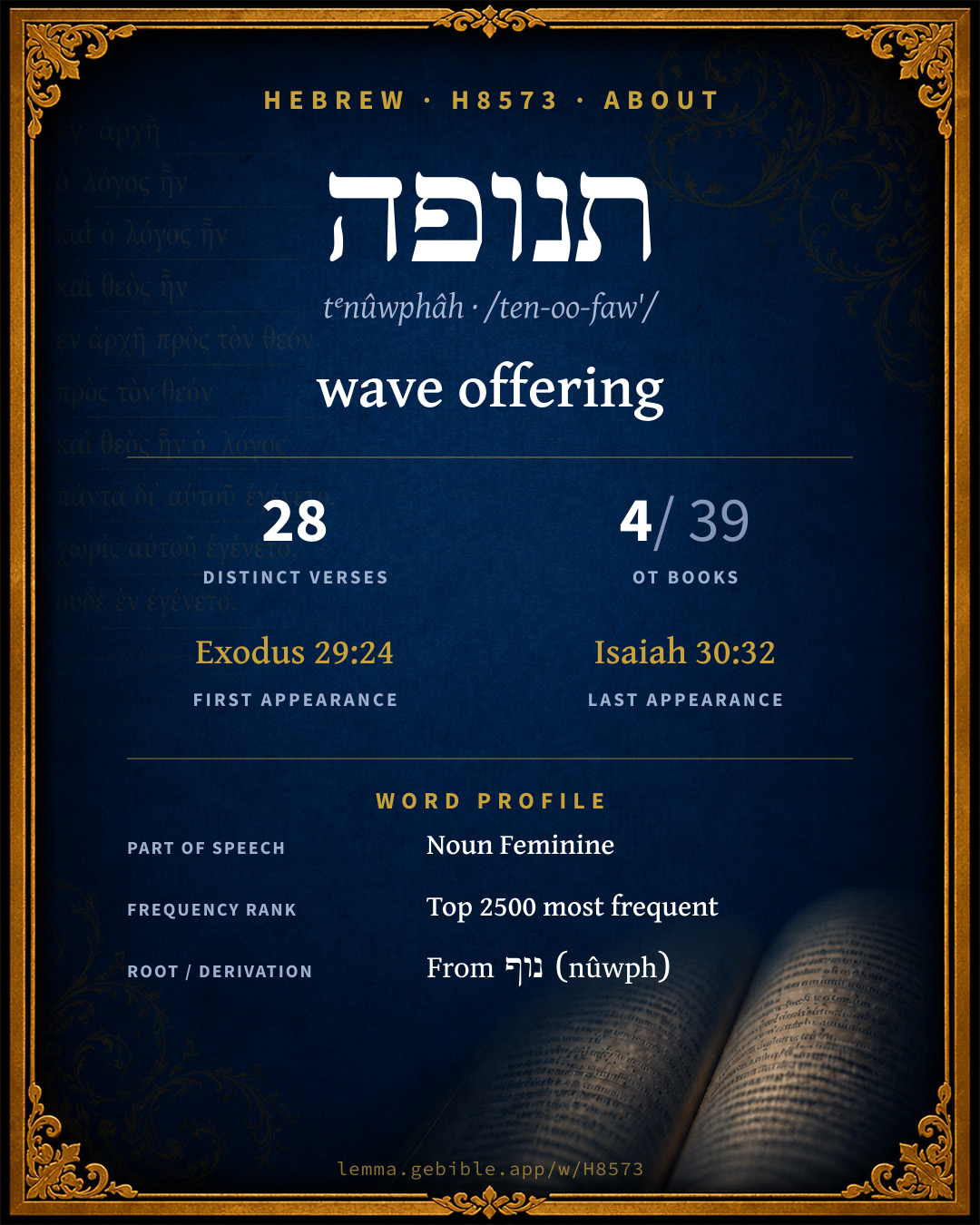
תְּנוּפָה
wave offering
also: swinging, waving, offering fuller range ↓
Full lexicon entry — Brown-Driver-Briggs (BDB)
From Brown-Driver-Briggs (BDB)
Where this word appears
See every Absolute-state word in the Hebrew Bible →
Grammar key — what these labels mean
Part of speech
- Noun
- A naming word — a person, place, thing, or idea.
Noun type
- Common
- A common noun — a general class of person, place, or thing (“king,” “city,” “water”), not a specific name.
State
- Absolute
- The independent form of a noun, not bound to a following word.
- Construct
- A noun bound to a following noun in a possessive / “of” relationship (the construct chain).
Gender
- Feminine
- Grammatically feminine.
Number
- Singular
- One.
- Plural
- More than one (in Hebrew, generally three or more).
Grammatical forms
- Noun, Common, Feminine, Singular, Absolute 27 times (90%)
- Noun, Common, Feminine, Singular, Construct 2 times (7%)
- Noun, Common, Feminine, Plural, Construct 1 time (3%)
Parsed forms decoded from the imported morphology (morphhb / Westminster Leningrad Codex — WLC text public domain, morphhb tagging CC BY 4.0), counted across 30 parsed occurrences — not distinct verses.
Every verse where H8573 appears — 28 distinct verses across 4 books. Click any verse to open its interlinear word-by-word view. Verse text shown in the World English Bible for context — . Each verse’s Hebrew form is shown with its reference; the English is not keyword-highlighted, since the data carries no word-level English alignment. Use “Compare translations” on any verse to read it across multiple English versions. This concordance covers the Hebrew Bible; Septuagint (Greek Old Testament) occurrences are not indexed here.
Exodus 6 verses
- Exodus 29:24 תְּנוּפָ֖ה n c fs You shall put all of this in Aaron's hands, and in his sons' hands, and shall wave them for a wave-offering before Yahweh.
- Exodus 29:26 תְּנוּפָ֖ה n c fs "You shall take the breast of Aaron's ram of consecration, and wave it for a wave-offering before Yahweh: and it shall be your portion.
- Exodus 29:27 הַ/תְּנוּפָ֗ה ptcl def.art + n c fs You shall sanctify the breast of the wave-offering, and the thigh of the heave-offering, which is waved, and which is heaved up, of the ram of consecration, even of that which is for Aaron, and of that which is for his sons:
- Exodus 35:22 תְּנוּפַ֥ת n c fs cs They came, both men and women, as many as were willing-hearted, and brought brooches, ear-rings, signet-rings, and armlets, all jewels of gold; even every man who offered an offering of gold to Yahweh.
- Exodus 38:24 הַ/תְּנוּפָ֗ה ptcl def.art + n c fs All the gold that was used for the work in all the work of the sanctuary, even the gold of the offering, was twenty-nine talents, and seven hundred thirty shekels, after the shekel of the sanctuary.
- Exodus 38:29 הַ/תְּנוּפָ֖ה ptcl def.art + n c fs The brass of the offering was seventy talents, and two thousand four hundred shekels.
Leviticus 13 verses
- Leviticus 7:30 תְּנוּפָ֖ה n c fs With his own hands he shall bring the offerings of Yahweh made by fire. He shall bring the fat with the breast, that the breast may be waved for a wave offering before Yahweh.
- Leviticus 7:34 הַ/תְּנוּפָ֜ה ptcl def.art + n c fs For the waved breast and the heaved thigh I have taken from the children of Israel out of the sacrifices of their peace offerings, and have given them to Aaron the priest and to his sons as their portion forever from the children of Israel.'"
- Leviticus 8:27 תְּנוּפָ֖ה n c fs He put all these in Aaron's hands and in his sons' hands, and waved them for a wave offering before Yahweh.
- Leviticus 8:29 תְנוּפָ֖ה n c fs Moses took the breast, and waved it for a wave offering before Yahweh. It was Moses' portion of the ram of consecration, as Yahweh commanded Moses.
- Leviticus 9:21 תְּנוּפָ֖ה n c fs and the breasts and the right thigh Aaron waved for a wave offering before Yahweh, as Moses commanded.
- Leviticus 10:14 הַ/תְּנוּפָ֜ה ptcl def.art + n c fs The waved breast and the heaved thigh you shall eat in a clean place, you, and your sons, and your daughters with you: for they are given as your portion, and your sons' portion, out of the sacrifices of the peace offerings of the children of Israel.
- Leviticus 10:15 הַ/תְּנוּפָ֗ה תְּנוּפָ֖ה ptcl def.art + n c fs n c fs The heaved thigh and the waved breast they shall bring with the offerings made by fire of the fat, to wave it for a wave offering before Yahweh: and it shall be yours, and your sons' with you, as a portion forever; as Yahweh has commanded."
- Leviticus 14:12 תְּנוּפָ֖ה n c fs "The priest shall take one of the male lambs, and offer him for a trespass offering, with the log of oil, and wave them for a wave offering before Yahweh.
- Leviticus 14:21 לִ/תְנוּפָ֖ה prep + n c fs "If he is poor, and can't afford so much, then he shall take one male lamb for a trespass offering to be waved, to make atonement for him, and one tenth of an ephah of fine flour mingled with oil for a meal offering, and a log of oil;
- Leviticus 14:24 תְּנוּפָ֖ה n c fs The priest shall take the lamb of the trespass offering, and the log of oil, and the priest shall wave them for a wave offering before Yahweh.
- Leviticus 23:15 הַ/תְּנוּפָ֑ה ptcl def.art + n c fs "'You shall count from the next day after the Sabbath, from the day that you brought the sheaf of the wave offering; seven Sabbaths shall be completed:
- Leviticus 23:17 תְּנוּפָ֗ה n c fs You shall bring out of your habitations two wave-loaves of two tenth parts of an ephah: they shall be of fine flour, they shall be baked with yeast, for first fruits to Yahweh.
- Leviticus 23:20 תְּנוּפָה֙ n c fs The priest shall wave them with the bread of the first fruits for a wave offering before Yahweh, with the two lambs. They shall be holy to Yahweh for the priest.
Numbers 7 verses
- Numbers 6:20 תְּנוּפָה֮ הַ/תְּנוּפָ֔ה n c fs ptcl def.art + n c fs and the priest shall wave them for a wave offering before Yahweh. This is holy for the priest, together with the breast that is waved and the thigh that is offered. After that the Nazirite may drink wine.
- Numbers 8:11 תְּנוּפָה֙ n c fs and Aaron shall offer the Levites before Yahweh for a wave offering, on the behalf of the children of Israel, that it may be theirs to do the service of Yahweh.
- Numbers 8:13 תְּנוּפָ֖ה n c fs You shall set the Levites before Aaron, and before his sons, and offer them as a wave offering to Yahweh.
- Numbers 8:15 תְּנוּפָֽה n c fs "After that, the Levites shall go in to do the service of the Tent of Meeting: and you shall cleanse them, and offer them as a wave offering.
- Numbers 8:21 תְּנוּפָ֖ה n c fs The Levites purified themselves from sin, and they washed their clothes; and Aaron offered them for a wave offering before Yahweh; and Aaron made atonement for them to cleanse them.
- Numbers 18:11 תְּנוּפֹת֮ n c fp cs This is your: the heave-offering of their gift, even all the wave-offerings of the children of Israel; I have given them to you, and to your sons and to your daughters with you, as a portion forever; everyone who is clean in your house shall eat of it.
- Numbers 18:18 הַ/תְּנוּפָ֛ה ptcl def.art + n c fs The flesh of them shall be your, as the wave-breast and as the right thigh, it shall be yours.
Isaiah 2 verses
- Isaiah 19:16 תְּנוּפַת֙ n c fs cs In that day shall the Egyptians be like women; and they shall tremble and fear because of the shaking of the hand of Yahweh of Hosts, which he shakes over them.
- Isaiah 30:32 תְּנוּפָ֖ה n c fs Every stroke of the appointed staff, which Yahweh shall lay on him, shall be with [the sound of] tambourines and harps; and in battles with the brandishing [of his arm] will he fight with them.
About this entry
At a glance — auto-summarized from this page’s data, not written by a person. Every figure links to its source below. This summary describes the numbers; it doesn’t interpret them.
תנופה — transliterated tᵉnûwphâh — is a Hebrew noun carrying the sense “wave offering.” Its English rendering has broadened — “wave offering” classically, “raised offering” (unfoldingWord Literal Text) in modern versions; see the renderings breakdown. The Hebrew Bible uses it across 28 verses — moderately common. More than a third of its appearances fall in Leviticus. It also covers “swinging”, “waving”, and “offering”, alongside “wave offering” — see its full sense range. Each statement above links to its evidence; the full detail follows below.
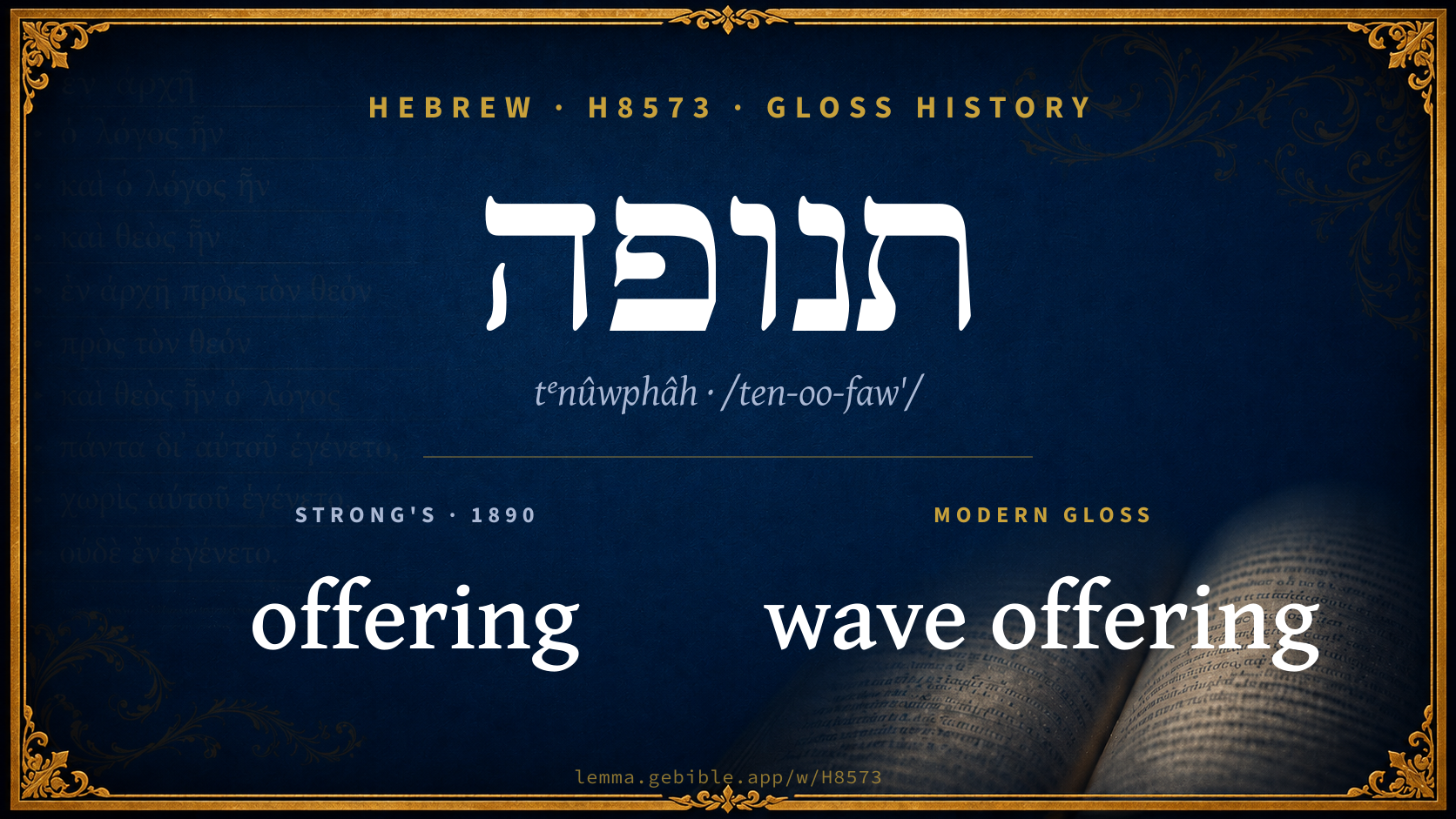
Gloss history
Strong's 1890 vs modern scholarship
About this word
Strong's H8573 catalogs a Hebrew word from the Hebrew Old Testament.
These counts are not copied from any lexicon or concordance. They are computed here, from the morphology-tagged Hebrew Old Testament. What Lemma adds →
- 28
- distinct verses
- The word appears in 28 distinct verses.
- 4 / 39
- OT books
- The word appears in 4 of 39 Old Testament books.
- #1,139
- by frequency
- Top 2500 most frequent Hebrew words (rank 1,139 of 8,640 Hebrew words by occurrence).
View all 28 occurrences in the concordance →
By section of the Old Testament
By traditional corpus
Conventional, traditional groupings — biblical authorship is debated, so this is a traditional corpus grouping, not an authorship claim. Each share is this word’s portion of its verses in that division of the Hebrew canon. Each figure is a share of the word’s 28 distinct verses.
- Torah (Pentateuch) 26 verses · 93%
- Prophets (Nevi'im) 2 verses · 7%
How translations render this word
Counts come from each version’s own published word-to-Strong’s tagging or interlinear alignment — an approximate guide to how each version renders this word, not a word-level alignment the data otherwise carries. Because each total is that version’s own tagged count, the per-version totals vary from one another and need not match the appearance or distinct-verse counts above. These counts may also differ from a printed concordance because Lemma counts each distinctly tagged rendering and does not collapse phrase taggings into a single head-word total. This is a fixed set of word-tagged versions (KJV, ASV, BSB, ULT) and does not change with the reading translation you choose elsewhere. Each version’s license is shown beside its name below (and on Sources).
- King James Version: Wave offering 13×, Offering 6×, Wave 5×
- American Standard Version: Wave-offering 16×, Offering 3×, The 2×
- Berean Standard Bible: Wave offering 26×
- unfoldingWord Literal Text: Raised offering 24×
King James Version Public Domain
Renders H8573 across 30 tagged occurrences — most commonly:
Plus 4 renderings that appear only once — usually multi-word phrases or single function words the recovered tagging swept in, not distinct renderings.
American Standard Version Public Domain
Renders H8573 across 30 tagged occurrences — most commonly:
Plus 9 renderings that appear only once — usually multi-word phrases or single function words the recovered tagging swept in, not distinct renderings.
Berean Standard Bible Public Domain
Renders H8573 across 30 tagged occurrences — most commonly:
Plus 4 renderings that appear only once — usually multi-word phrases or single function words the recovered tagging swept in, not distinct renderings.
unfoldingWord Literal Text CC BY-SA 4.0
Renders H8573 across 30 tagged occurrences — most commonly:
Plus 6 renderings that appear only once — usually multi-word phrases or single function words the recovered tagging swept in, not distinct renderings.
Senses in the full BDB
What do BDB’s symbols mean?
BDB uses these scholarly abbreviations:
| Symbol | Meaning |
|---|---|
| 𝔊 | the Septuagint (the ancient Greek translation, LXX) |
| 𝔙 | the Vulgate (the Latin translation) |
| 𝔖 | the Syriac version (the Peshitta) |
| 𝔗 | the Targum (the Aramaic translation) |
| ψ | the Psalms |
| √ | root (the underlying root or stem) |
| ‖ | parallel passage (a synonymous or contrasted parallel) |
| † | the dagger: every passage where the word occurs is cited |
The 3 senses and sub-senses the full Brown-Driver-Briggs lexicon distinguishes for this word, in lexicon order (not ranked by frequency), with BDB’s own verbatim wording and sub-sense lettering. Shown in Hebrew script with BDB’s own scholarly abbreviations. The condensed entry is in the Lexicon Entry tab. See also the Forms in the corpus table below.
- 1. a swinging, brandising, ת׳ יַד י׳ Is 19:16 the brandishing of י׳ ’s hand (in hostility); מִלְחֲמוֹת ת׳ 30:32 battles of brandishing (brandished weapons). e.g. Isaiah 19:16
- 2.
- a. waving, wave-offering, term. techn. in P (H), orig. of priest’s share of sacrifice (cf. נוף Hiph. 4), לְכָּל־תְּנוּפֹת בְּנֵי יִשׂ׳ לְךָ נְתַתִּים Nu 18:11 often as 2nd acc. after הֵנִיף Ex 29:26 + 5 times; even of Levites Nu 8:11, 13, 15, 20 (on all v. נוף Hiph. 4); חֲזֵה הַתְּ׳ Ex 29:27 the wave-breast, so Lv 7:34; 10:14, 15 Nu 6:20 (all + שׁוֹק הַתְּרוּמָה); 18:18 (+ שׁוֹק הַיָּמִין); עֹמֶר הַתְּ׳ Lv 23:15; לֶחֶם הַתְּ׳ v 17; ת׳ alone v 20 (all H); less accurately Ex 29:24 Lv 8:27; 14:12, 21, 24 (v. נוףl.c.). e.g. Numbers 18:11
- b. offering, of gold and brass for tabern., Ex 35:22; 38:24, 29.—On ת׳ v. Di Lv 7:30 BenzArch. 459 f. and especially NowArch. ii. 239 f.; also תְּרוּמָה. e.g. Exodus 35:22
Senses from the full Brown-Driver-Briggs lexicon (Brown, Driver, Briggs; Oxford 1906 — public domain), digitized via Sefaria, supplemented by the OpenScriptures HebrewLexicon (CC BY 4.0). Full attribution on Sources.
Word origin
n.f. a swinging, waving, wave-offering, offering;—abs. ת׳ Is 30:32 +; cstr. תְּנוּפַת Is 19:16 Ex 35:22; pl. cstr. תְּנוּפֹת Nu 18:11;—
— Brown-Driver-Briggs (Oxford 1906, public domain), digitized via Sefaria, supplemented by the OpenScriptures HebrewLexicon (CC BY 4.0). See Sources.
Derived from נוף (nûwph) (H5130) — to wave.
Jastrow Dictionary
A second Hebrew/Aramaic lexicon for comparison, covering Aramaic and post-biblical (Talmudic, Targumic, Midrashic) usage that the biblical-Hebrew BDB does not. Matched by lemma rather than by Strong’s number, so a lemma may carry more than one Jastrow headword (shown separately below), and the entries cover usage well beyond the Bible.
תְּנוּפָה
- swinging, shaking, waving. Succ. 38ᵃ ת׳ שירי וכ׳ swinging the ‘Omer is one of the dispensable acts (v. שְׁיָיר). Men. 93ᵇ (ref. to Lev. XIV, 21) וכי ת׳ מכפרת וכ׳ does the swinging of the sacrifice effect atonement? is it not the blood &c.? Ib. IX, 9. Num. R. s. 938; a. fr.—Pesik. Haʿomer, p. 71ᵃ (ref. to Is. XXX, 32) וכי יש מלחמות ת׳ באותו הדור וכ׳ will there be wars of swinging (weapons) in that generation? Say, it refers to the swinging of the ʿOmer; Pesik. R. s. 18; Yalk. Is. 302.—Pl. תְּנוּפוֹת. Men. 94ᵃ תנופה … ולא ת׳ the text has ‘swinging’ but not ‘swingings’; a. e. e.g. Leviticus 14:21
A Dictionary of the Targumim, the Talmud Babli and Yerushalmi, and the Midrashic Literature (Marcus Jastrow; London, Luzac, 1903) — Public Domain. Digitized via Sefaria. Digitized via Sefaria. Full attribution on Sources.
Forms in the corpus
The 16 distinct written forms H8573 takes in the Hebrew Bible, most frequent first — each parse links to that state’s occurrences in the concordance. Hebrew forms include their vowel points and cantillation, so a single lemma takes many written forms.
Same root — word family
Other BDB entries built from the same root as H8573, grouped by Strong’s listed origin. These share a root / origin per the lexicon — not necessarily a shared meaning. Each links to that word’s own entry.
Derives from
Shares the same root
Proper names from this root
People and places named from this root — a name, not an additional meaning of the word.
Compare all same-root words → Showing 4 of 6 — not the complete family. 1 of the same-root words is a proper name (a person or place). They share a root, not necessarily a meaning.
Septuagint verse parallels
This word appears in 27 verses that also exist in the Greek Old Testament (Septuagint), out of the 28 Hebrew verses it occurs in. You can read those verses in Greek by switching the Old Testament edition to the Septuagint.
Read these verses in the Septuagint
This is a verse-level parallel only — the same verses exist in both the Hebrew and Greek Old Testaments. No word-level Hebrew↔Greek correspondence is claimed: the data carries no such alignment, so no Greek word is shown as this Hebrew word’s translation. Coverage is not total — the Septuagint omits the deuterocanon and renumbers the Psalms, so some Hebrew verses have no direct Greek parallel.