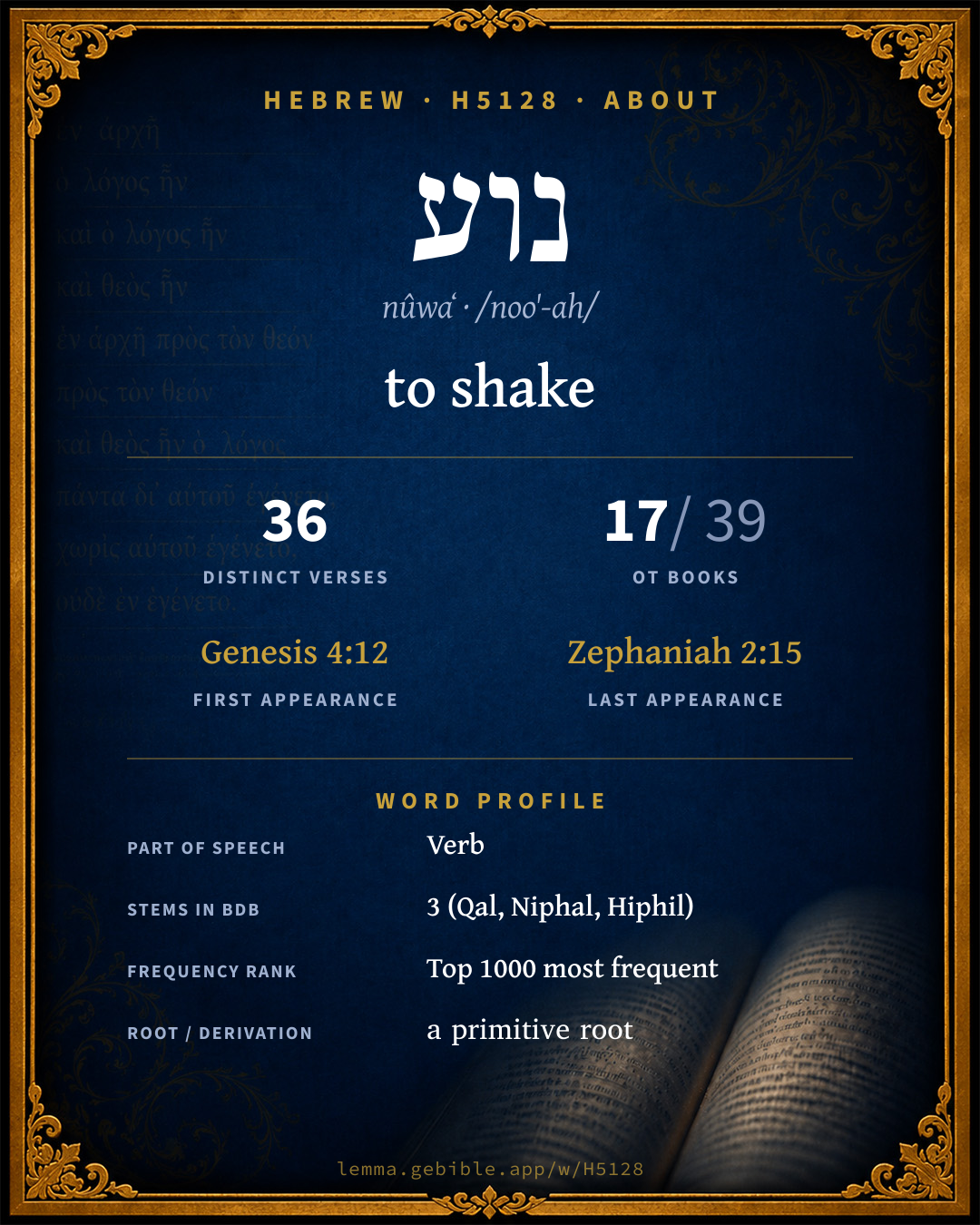
נוּעַ
to shake
‘to shake’ is one of 2 main senses fuller range ↓
Full lexicon entry — Brown-Driver-Briggs (BDB)
From Brown-Driver-Briggs (BDB)
Where this word appears
See every Qal verb in the Hebrew Bible →
Grammar key — what these labels mean
Part of speech
- Verb
- An action or state-of-being word.
Stem
- Qal
- The basic, simple active stem — the plain form of the verb (“he wrote”). Here: ‘wave’
- Hiphil
- The causative active stem (“he caused / brought about”). Here: ‘toss about Am 9’
- Niphal
- Usually the simple passive or reflexive of the Qal (“he was written”).
Form
- Infinitive Construct
- A bound verbal noun, frequently with prepositions (“to write / in writing”).
- Perfect
- A completed action or state — Hebrew marks aspect (completeness) more than strict tense (“he wrote”).
- Sequential Perfect
- A perfect with prefixed waw continuing a preceding imperfect or command (waw-consecutive perfect).
- Sequential Imperfect
- An imperfect with prefixed waw — the standard past-narrative form (waw-consecutive imperfect).
- Imperfect
- An incomplete, ongoing, or future action (“he will / would write”).
- Participle Active
- A verbal adjective expressing ongoing or characteristic action (“writing / one who writes”).
- Cohortative
- A first-person volitional form expressing wish or resolve (“let me / let us write”).
- Infinitive Absolute
- An unbound verbal noun, often intensifying or standing in for a finite verb.
- Jussive
- A third- or second-person volitional form expressing wish or command (“let him write”).
- Imperative
- A direct command (“write!”).
State
- Absolute
- The independent form of a noun, not bound to a following word.
Person
- 3rd Person
- The one spoken about (“he / she / it / they”).
- 1st Person
- The speaker (“I / we”).
- 2nd Person
- The one addressed (“you”).
Gender
- Common
- Either gender — not distinguished for this form.
- Masculine
- Grammatically masculine.
- Feminine
- Grammatically feminine.
Number
- Plural
- More than one (in Hebrew, generally three or more).
- Singular
- One.
Grammatical forms 24 distinct
- Verb, Qal, Infinitive Construct 5 times (12%)
- Verb, Qal, Perfect, 3rd Person, Common, Plural 5 times (12%)
- Verb, Qal, Sequential Perfect, 3rd Person, Common, Plural 3 times (7%)
- Verb, Hiphil, Imperfect, 3rd Person, Masculine, Plural 3 times (7%)
- Verb, Qal, Imperfect, 3rd Person, Masculine, Plural 3 times (7%)
- Verb, Qal, Sequential Imperfect, 3rd Person, Masculine, Plural 2 times (5%)
- Verb, Hiphil, Perfect, 3rd Person, Feminine, Singular 2 times (5%)
- Verb, Qal, Participle Active, Masculine, Singular, Absolute 2 times (5%)
+16 more forms (17 occurrences)
Parsed forms decoded from the imported morphology (morphhb / Westminster Leningrad Codex — WLC text public domain, morphhb tagging CC BY 4.0), counted across 42 parsed occurrences — not distinct verses.
Every verse where H5128 appears — 36 distinct verses across 17 books. Click any verse to open its interlinear word-by-word view. Verse text shown in the World English Bible for context — . Each verse’s Hebrew form is shown with its reference; the English is not keyword-highlighted, since the data carries no word-level English alignment. Use “Compare translations” on any verse to read it across multiple English versions. This concordance covers the Hebrew Bible; Septuagint (Greek Old Testament) occurrences are not indexed here.
Genesis 2 verses
- Genesis 4:12 נָ֥ע Qal ptcp.act ms From now on, when you till the ground, it won't yield its strength to you. You shall be a fugitive and a wanderer in the earth."
- Genesis 4:14 נָ֤ע Qal ptcp.act ms Behold, you have driven me out this day from the surface of the ground. I will be hidden from your face, and I will be a fugitive and a wanderer in the earth. It will happen that whoever finds me will kill me."
Exodus 1 verse
Numbers 1 verse
Judges 3 verses
- Judges 9:9 לָ/נ֖וּעַ prep + Qal inf.cs But the olive tree said to them, Should I leave my fatness, with which by me they honor God and man, and go to wave back and forth over the trees?
- Judges 9:11 לָ/נ֖וּעַ prep + Qal inf.cs But the fig tree said to them, Should I leave my sweetness, and my good fruit, and go to wave back and forth over the trees?
- Judges 9:13 לָ/נ֖וּעַ prep + Qal inf.cs The vine said to them, Should I leave my new wine, which cheers God and man, and go to wave back and forth over the trees?
1 Samuel 1 verse
2 Samuel 1 verse
2 Kings 2 verses
- 2 Kings 19:21 הֵנִ֔יעָה Hiphil pf 3fs This is the word that Yahweh has spoken concerning him: The virgin daughter of Zion has despised you and ridiculed you; the daughter of Jerusalem has shaken her head at you.
- 2 Kings 23:18 יָנַ֣ע Hiphil juss 3ms He said, Let him be; let no man move his bones. So they let his bones alone, with the bones of the prophet who came out of Samaria.
Job 2 verses
- Job 16:4 וְ/אָנִ֥יעָה conj + Hiphil coh 1cs I also could speak as you do. If your soul were in my soul's place, I could join words together against you, And shake my head at you.
- Job 28:4 נָֽעוּ Qal pf 3cp He breaks open a shaft away from where people live. They are forgotten by the foot. They hang far from men, they swing back and forth.
Psalms 6 verses
- Psalms 22:7 יָנִ֥יעוּ Hiphil impf 3mp All those who see me mock me. They insult me with their lips. They shake their heads, saying,
- Psalms 59:11 הֲנִיעֵ֣/מוֹ Hiphil impv 2ms + sfx pers 3mp Don't kill them, or my people may forget. Scatter them by your power, and bring them down, Lord our shield.
- Psalms 59:15 ינועו/ן יְנִיע֣וּ/ן Qal impf 3mp + sfx n Hiphil impf 3mp + sfx n They shall wander up and down for food, And wait all night if they aren't satisfied.
- Psalms 107:27 וְ֭/יָנוּעוּ conj + Qal impf 3mp They reel back and forth, and stagger like a drunken man, And are at their wits' end.
- Psalms 109:10 וְ/נ֤וֹעַ יָנ֣וּעוּ conj + Qal inf.abs Qal impf 3mp Let his children be wandering beggars. Let them be sought from their ruins.
- Psalms 109:25 יְנִיע֥וּ/ן Hiphil impf 3mp + sfx n I have also become a reproach to them. When they see me, they shake their head.
Proverbs 1 verse
Isaiah 6 verses
- Isaiah 6:4 וַ/יָּנֻ֨עוּ֙ conj + Qal wimpf 3mp The foundations of the thresholds shook at the voice of him who called, and the house was filled with smoke.
- Isaiah 7:2 וַ/יָּ֤נַע כְּ/נ֥וֹעַ conj + Qal wimpf 3ms prep + Qal inf.cs It was told the house of David, saying, "Syria is allied with Ephraim." His heart trembled, and the heart of his people, as the trees of the forest tremble with the wind.
- Isaiah 19:1 וְ/נָע֞וּ conj + Qal wpf 3cp The burden of Egypt. Behold, Yahweh rides on a swift cloud, and comes to Egypt: and the idols of Egypt shall tremble at his presence; and the heart of Egypt shall melt in the midst of it.
- Isaiah 24:20 נ֣וֹעַ תָּנ֤וּעַ Qal inf.abs Qal impf 3fs The earth shall stagger like a drunken man, and shall sway back and forth like a hammock; and the disobedience of it shall be heavy on it, and it shall fall, and not rise again.
- Isaiah 29:9 נָע֖וּ Qal pf 3cp Stay you and wonder; take your pleasure and be blind: they are drunken, but not with wine; they stagger, but not with strong drink.
- Isaiah 37:22 הֵנִ֔יעָה Hiphil pf 3fs this is the word which Yahweh has spoken concerning him: The virgin daughter of Zion has despised you and ridiculed you; the daughter of Jerusalem has shaken her head at you.
Jeremiah 1 verse
Lamentations 3 verses
- Lamentations 2:15 וַ/יָּנִ֣עוּ conj + Hiphil wimpf 3mp All that pass by clap their hands at you; They hiss and wag their head at the daughter of Jerusalem, [saying], Is this the city that men called The perfection of beauty, The joy of the whole earth?
- Lamentations 4:14 נָע֤וּ Qal pf 3cp They wander as blind men in the streets, they are polluted with blood, So that men can't touch their garments.
- Lamentations 4:15 נָ֑עוּ Qal pf 3cp Depart you, they cried to them, Unclean! depart, depart, don't touch! When they fled away and wandered, men said among the nations, They shall no more sojourn [here].
Daniel 1 verse
Amos 3 verses
- Amos 4:8 וְ/נָע֡וּ conj + Qal wpf 3cp So two or three cities staggered to one city to drink water, And were not satisfied: Yet you haven't returned to me," says Yahweh.
- Amos 8:12 וְ/נָעוּ֙ conj + Qal wpf 3cp They will wander from sea to sea, And from the north even to the east; They will run back and forth to seek the word of Yahweh, And will not find it.
- Amos 9:9 וַ/הֲנִע֥וֹתִי יִנּ֨וֹעַ֙ conj + Hiphil pf 1cs Niphal impf 3ms "For, behold, I will command, and I will sift the house of Israel among all the nations, as grain is sifted in a sieve, yet not the least kernel will fall on the earth.
Nahum 1 verse
Zephaniah 1 verse
About this entry
At a glance — auto-summarized from this page’s data, not written by a person. Every figure links to its source below. This summary describes the numbers; it doesn’t interpret them.
At its core, נוע (nûwaʻ) means “to shake.” It first appears in Genesis 4:12. It turns up in 36 verses across 17 books, a moderately common footprint. Different stems carry different senses — BDB groups them under 3 stems, among them Qal and Niphal. It clusters with מנענע, נעה and נעה under a shared root. Dig into 36-verse concordance and the renderings breakdown below.
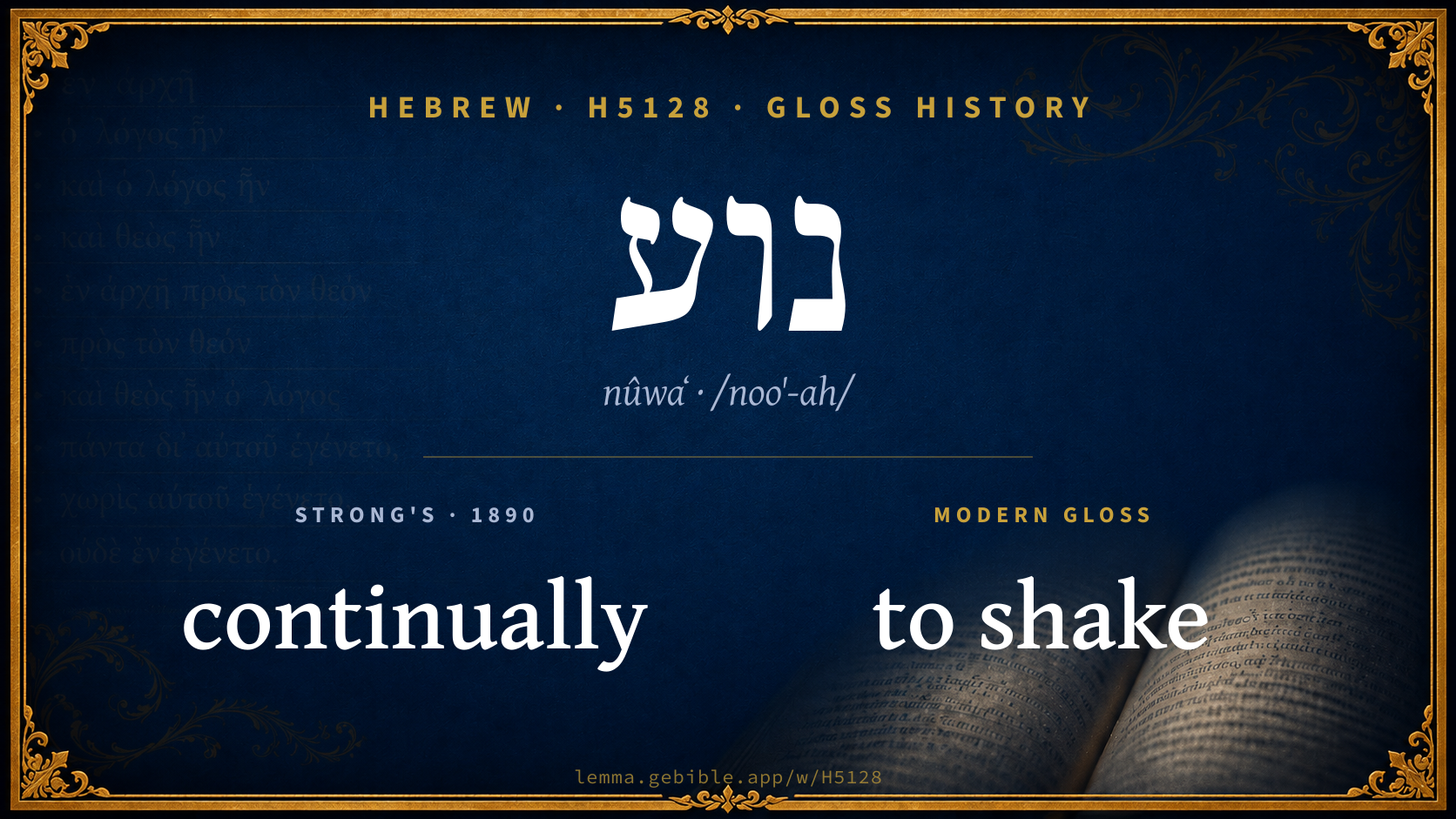
Gloss history
Strong's 1890 vs modern scholarship
About this word
Strong's H5128 catalogs a Hebrew word from the Hebrew Old Testament.
These counts are not copied from any lexicon or concordance. They are computed here, from the morphology-tagged Hebrew Old Testament. What Lemma adds →
- 36
- distinct verses
- The word appears in 36 distinct verses.
- 17 / 39
- OT books
- The word appears in 17 of 39 Old Testament books.
- #864
- by frequency
- Top 1000 most frequent Hebrew words (rank 864 of 8,640 Hebrew words by occurrence).
View all 36 occurrences in the concordance →
By section of the Old Testament
By traditional corpus
Conventional, traditional groupings — biblical authorship is debated, so this is a traditional corpus grouping, not an authorship claim. Each share is this word’s portion of its verses in that division of the Hebrew canon. Each figure is a share of the word’s 36 distinct verses.
- Prophets (Nevi'im) 19 verses · 53%
- Writings (Ketuvim) 13 verses · 36%
- Torah (Pentateuch) 4 verses · 11%
How translations render this word
Counts come from each version’s own published word-to-Strong’s tagging or interlinear alignment — an approximate guide to how each version renders this word, not a word-level alignment the data otherwise carries. Because each total is that version’s own tagged count, the per-version totals vary from one another and need not match the appearance or distinct-verse counts above. These counts may also differ from a printed concordance because Lemma counts each distinctly tagged rendering and does not collapse phrase taggings into a single head-word total. This is a fixed set of word-tagged versions (KJV, ASV, BSB, ULT) and does not change with the reading translation you choose elsewhere. Each version’s license is shown beside its name below (and on Sources).
- King James Version: Be promoted 3×, Hath shaken 2×, Moved 2×
- American Standard Version: Wave 3×, Hath shaken 2×, Wag 2×
- Berean Standard Bible: Shake 3×, Shakes 3×, Sway 3×
- unfoldingWord Literal Text: And 3×, Fugitive 2×, Shakes 2×
King James Version Public Domain
Renders H5128 across 40 tagged occurrences — most commonly:
Plus 29 renderings that appear only once — usually multi-word phrases or single function words the recovered tagging swept in, not distinct renderings. Not rendered by a distinct English word in 2 further occurrences.
American Standard Version Public Domain
Renders H5128 across 40 tagged occurrences — most commonly:
Plus 33 renderings that appear only once — usually multi-word phrases or single function words the recovered tagging swept in, not distinct renderings.
Berean Standard Bible Public Domain
Renders H5128 across 38 tagged occurrences — most commonly:
Plus 23 renderings that appear only once — usually multi-word phrases or single function words the recovered tagging swept in, not distinct renderings. Not rendered by a distinct English word in 2 further occurrences.
unfoldingWord Literal Text CC BY-SA 4.0
Renders H5128 across 46 tagged occurrences — most commonly:
Plus 29 renderings that appear only once — usually multi-word phrases or single function words the recovered tagging swept in, not distinct renderings.
9 senses and sub-senses in the full BDB
Hebrew verbs can shift meaning by stem (binyan): Qal is the basic action, Niphal is often passive or reflexive, Piel often intensifies or makes it factitive, and Hiphil is typically causative. The senses below are grouped under the stem BDB assigns to each.
What do BDB’s symbols mean?
BDB uses these scholarly abbreviations:
| Symbol | Meaning |
|---|---|
| 𝔊 | the Septuagint (the ancient Greek translation, LXX) |
| 𝔙 | the Vulgate (the Latin translation) |
| 𝔖 | the Syriac version (the Peshitta) |
| 𝔗 | the Targum (the Aramaic translation) |
| ψ | the Psalms |
| √ | root (the underlying root or stem) |
| ‖ | parallel passage (a synonymous or contrasted parallel) |
| † | the dagger: every passage where the word occurs is cited |
The 9 senses and sub-senses the full Brown-Driver-Briggs lexicon distinguishes for this word, in lexicon order (not ranked by frequency), with BDB’s own verbatim wording and sub-sense lettering. Shown in Hebrew script with BDB’s own scholarly abbreviations. The condensed entry is in the Lexicon Entry tab. See also the Forms in the corpus table below.
Qal
- Pf. נָ֫עוּ Jb 28:4 +; וְנָע֫וּ Am 4:8 + 2 times; Impf. וַיָּ֫נַע Is 7:2; 3 fs. תָּנוּעַ Is 24:20; אֲנוּעֲךָ 2 S 15:20 Kt (but read Qr Hiph. q.v.); יָנ֫וּעוּ ψ 109:10; יְנוּע֑וּן ψ 59:16 Kt (so read; not Qr Hiph.), etc.; Inf. abs. נוֹעַ Is 24:20 ψ 109:10; cstr. נוּעַ Ju 9:9 + 3 times; נוֹעַ Is 7:2; Pt. נָע Gn 4:12, 14; נָעִים Pr 22:19; נָעוֹת 1 S 1:13:— e.g. Job 28:4
- 1. wave, of trees, sq. עַל Ju 9:9, 11, 13; sq. מִפְּנֵי of cause Is 7:2; quiver, vibrate, of lips 1 S 1:13; swing (to and fro) of miners Jb 28:4 (‖ דלל); stagger like drunkard, of mariners in storm ψ 107:27 (‖ חגג), cf. Is 29:9 (‖ שׁכר); hence be unstable, fig. of ways of harlot Pr 5:6; tremble, of doorposts, Is 6:4 (sq. מִן caus.), idols 19:1 (sq. מִפְּנֵי), earth Is 24:20 (‖ התנודד), people Ex 20:18 (E); fig. of heart Is 7:2. e.g. Judges 9:9
- 2. totter, go tottering (faint and uncertain) La 4:14 v 15 (‖ נוּץ), Am 8:12 (‖ שׁוטט); as beggars ψ 109:10 (‖ שִׁאֵל), cf. 59:16; Am 4:8 sq. אֶל־; pt. vagabond Gn 4:12, 14 (both ‖ נָד); fig. = err, sin, Je 14:10. e.g. Lamentations 4:14
Niphal
- Impf. יִנּוֹעַ Am 9:9 be tossed about (of corn) in a sieve; יִנּוֹעוּ id., of bulwarks as fig-trees Na 3:12 (‖ נפל). e.g. Amos 9:9
Hiphil
- Pf. 3 fs. הֵנִ֫יעָה 2 K 19:21 = Is 37:22; וַהֲנִֽעוֹתִ֫י Am 9:9; Impf. יָנִיעַ Zp 2:15; juss. יָ֫נַע 2 K 23:18; אֲנִיעֲךָ 2 S 15:20 Qr (cf. Qal); יְנִיעוּן ψ 109:25 + 59:16 Qr (read Kt Qal q.v.), etc.; Imv. sf. הֲנִיעֵ֫מוֹ ψ 59:12;— e.g. 2 Kings 19:21
- 1. toss about Am 9:9 subj. י׳, obj. Isr. sq. בַּגּוֹיִם (cf. Niph.). e.g. Amos 9:9
- 2. shake, cause to totter: = set me tottering Dn 10:10 on my knees and hands; especially shake or wag the head, in mockery 2 K 19:21 = Is 37:22 (‖ בוז, לעג) cf. ψ 22:8; 109:25; sq. עַל־ Jb 16:4 (בְּמוֹ ר׳ [Ges§ 119 q]), also La 2:15 (‖ שׁרק), Zp 2:15 יָדוֹ (‖ id., [v. also Ecclus 12:18; 13:7 (בְּר׳)]. e.g. Daniel 10:10
- 3. (shake), disturb, bones of dead 2 K 23:18. e.g. 2 Kings 23:18
- 4. cause to wander Nu 32:13 (J); 2 S 15:20 (sq. ללכת); ψ 59:12 (‖ הוריד, for which Lag Proph. Chald. xlviii. proposes הניד). e.g. Numbers 32:13
Senses from the full Brown-Driver-Briggs lexicon (Brown, Driver, Briggs; Oxford 1906 — public domain), digitized via Sefaria, supplemented by the OpenScriptures HebrewLexicon (CC BY 4.0). Full attribution on Sources.
Word origin
vb. quiver, wave, waver, tremble, totter (NH Pilp. נִעְנַע shake, Aramaic נוּעַ waver, stagger (rare); Arabic نوع, نَاعَ bend (of boughs), v. commotus fuit (of id.), so Kam. Frey also change, نَوْعٌ kind, species, variety; Di cp. Ethiopic ነዐወ hunt);—
— Brown-Driver-Briggs (Oxford 1906, public domain), digitized via Sefaria, supplemented by the OpenScriptures HebrewLexicon (CC BY 4.0). See Sources.
Origin: a primitive root
Jastrow Dictionary
A second Hebrew/Aramaic lexicon for comparison, covering Aramaic and post-biblical (Talmudic, Targumic, Midrashic) usage that the biblical-Hebrew BDB does not. Matched by lemma rather than by Strong’s number, so a lemma may carry more than one Jastrow headword (shown separately below), and the entries cover usage well beyond the Bible.
נוּעַ
- (b. h.) to shake, move; to be tender.
- 1. to shake; to stir up, scare. Tosef. Bets. I, 8 עד שיְנַעֲנֵעַ unless he stirred the bird up (the day before, by which act he made it his property and designated it for slaughtering); Y. ib. I, 60ᶜ top. אלא אם כן ני׳ מבעוד יום. Succ. III, 1 כדי לנַעֲנֵעַ בו large enough to (hold it in his hand and) shake. Ib. 9 והיכן היו מְנַעְנְעִים and at what passages of the Hallel did they shake (the Lulab)? Sabb. XX, 5 (141ᵃ) הקש … לא יְנַעְנְעוֹ וכ׳ (Bab. a. Y. ed. יְנַעְנְעֶנּוּ) must not stir up with his hand the straw &c.; a. fr.—נ׳ (ב)ראש to (shake) bow the head. Ber. 28ᵇ כיון שנ׳ ראשו וכ׳ if he only bows his head (in prayer), it is sufficient. Yeb. 121ᵃ וכל גל … נִעְנַעְתִּי לו ראשי and as each wave came, I dipped my head under (to let it pass over me). Ib. אם … יְנַעֲנֵעַ לו ראשו if wicked people come over man, let him bow his head. Pesik. R. s. 37 ומנענעים בראשיהם and shook their heads (in derision, ref. to Ps. XXII, 8).—Yalk. Prov. 953 ומנענע בו בקולו and sings it with a tremulous voice; Snh. 101ᵃ מנענע בקולו Ms. K. (v. Rabb. D. S. a. l. note 2); Tosef. ib. XII, 10 מנ׳ קולו.—Part. pass. מְנוּעֲנָע, pl. מְנוּעֲנָעִין. Bets. 25ᵃ המקושרים והמ׳ the birds designated a day before the Holy Day by being tied or by being stirred up; ib. והמקושרין והמ׳ בכ"מ אסורין birds found anywhere tied or stirred up are forbidden to be taken up (because somebody has taken possession of them); Tosef. ib. I, 10 והמְנוּעָנִין (Var. והמנענין, corr. acc.).—2) to move in different directions, to introduce a surgical instrument. Nidd. 25ᵇ, v. סִכְסֵךְ I. e.g. Psalms 22:8
נוּעַ ²
- , to totter. Targ. Ps. CVII, 27.
- to shake. Gen. R. s. 75, beg. דמְנַעְנָה (= דמנענעה), v. נְעַר.
A Dictionary of the Targumim, the Talmud Babli and Yerushalmi, and the Midrashic Literature (Marcus Jastrow; London, Luzac, 1903) — Public Domain. Digitized via Sefaria. Digitized via Sefaria. Full attribution on Sources.
Forms in the corpus
The 39 distinct written forms H5128 takes in the Hebrew Bible, most frequent first — each parse links to that stem’s occurrences in the concordance. Hebrew forms include their vowel points and cantillation, so a single lemma takes many written forms.
Same root — word family
Other BDB entries built from the same root as H5128, grouped by Strong’s listed origin. These share a root / origin per the lexicon — not necessarily a shared meaning. Each links to that word’s own entry.
Derived from this word
Proper names from this root
People and places named from this root — a name, not an additional meaning of the word.
Compare all same-root words → Showing 4 of 5 — not the complete family. 3 of the same-root words are proper names (people or places). They share a root, not necessarily a meaning.
Septuagint verse parallels
This word appears in 31 verses that also exist in the Greek Old Testament (Septuagint), out of the 36 Hebrew verses it occurs in. You can read those verses in Greek by switching the Old Testament edition to the Septuagint.
Read these verses in the Septuagint
- Genesis 4:12
- Exodus 20:18
- Numbers 32:13
- Judges 9:9
- 1 Samuel 1:13
- 2 Samuel 15:20
- 2 Kings 19:21
- Job 16:4
- Psalms 59:11
- Proverbs 5:6
- Isaiah 6:4
- Jeremiah 14:10
This is a verse-level parallel only — the same verses exist in both the Hebrew and Greek Old Testaments. No word-level Hebrew↔Greek correspondence is claimed: the data carries no such alignment, so no Greek word is shown as this Hebrew word’s translation. Coverage is not total — the Septuagint omits the deuterocanon and renumbers the Psalms, so some Hebrew verses have no direct Greek parallel.