
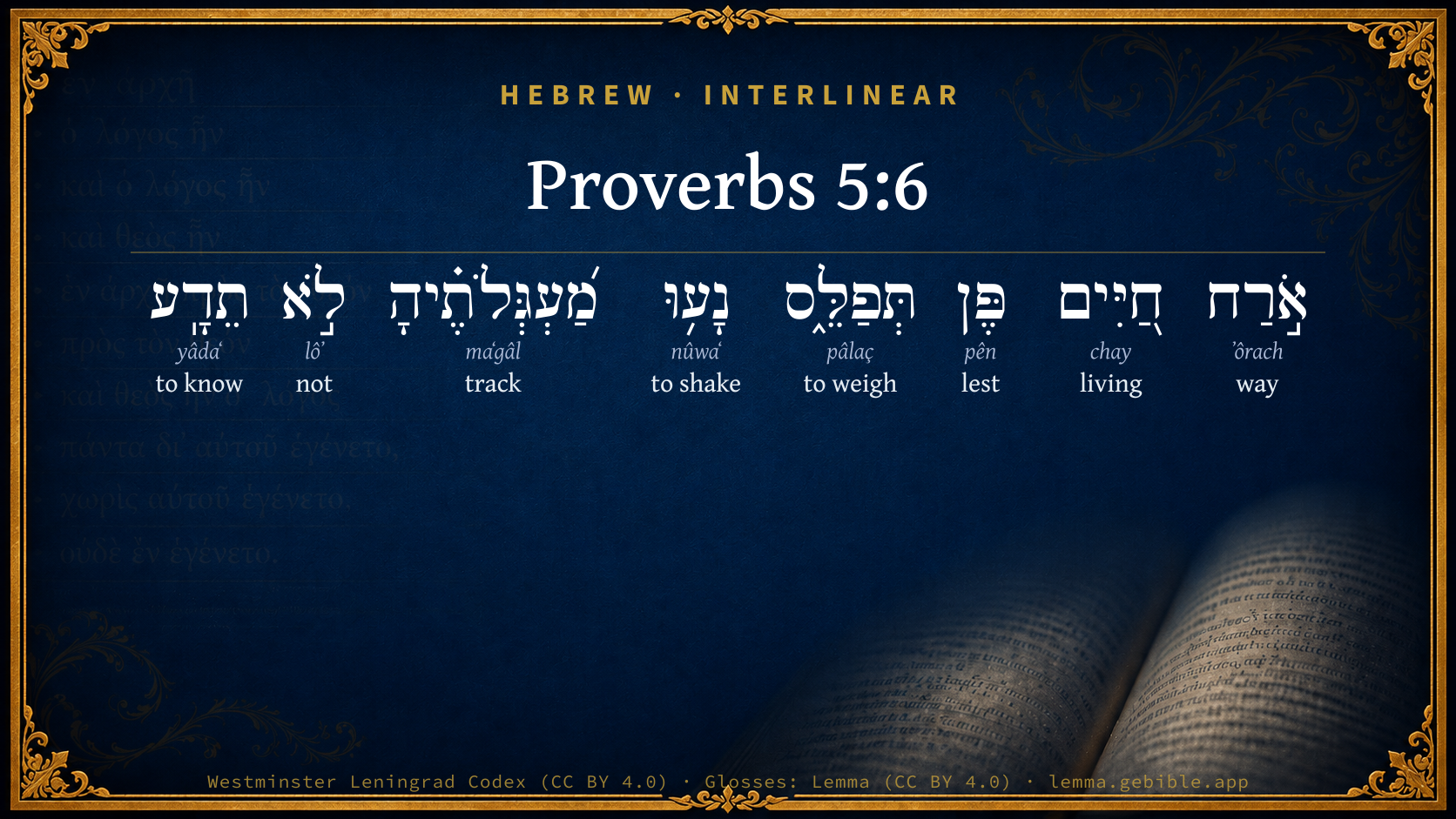
Proverbs 5:6

Hebrew (Westminster Leningrad Codex) Proverbs 5:6 appears in the Hebrew Old Testament. The text above is from the Westminster Leningrad Codex. Each word links to its Strong’s number, a concise gloss, and parsing drawn from the Open Scriptures Hebrew Bible morphology. Click any word for its full Brown-Driver-Briggs (BDB) entry.
Download image
Cite this verse

Proverbs 5:6 (World English Bible). Public Domain. Lemma interlinear Bible study tool, https://lemma.gebible.app/v/proverbs/5/6.

Show BibTeX & RIS
BibTeX
RIS
English Translation
She gives no thought to the way of life. Her ways are crooked, and she doesn't know it.
World English Bible · Public Domain
Download a study sheet

One document with this verse’s original text, its word-by-word gloss line, the meaning frame, cross-references with their text, attributed commentary, and full source and license credits — printable, and it pastes into notes with its structure intact.

This verse Autodidact and up

Study sheet (.html) Plain text (.txt)

A passage Seminary Student

Up to 50 verses in one chapter. A passage sheet keeps up to 6 commentary sources and 12 cross-references per verse, in the order this page ranks them, and says so on the sheet whenever that leaves anything out. Ask for a single verse and you get the Autodidact verse sheet above.

Everything on this page stays free to read, with no account — the sheet is a download of what is already on screen, not access to it.

Want to remove ads? Support Godless Engineer
Compare translations 3

The same verse in 3 English versions, stacked beneath the original-language interlinear above. Click any original word for its lexicon entry.

Each is an independent rendering of the whole verse — the interlinear is not word-aligned to these translations.

Highlighted words mark where these versions differ — a whole-verse word diff, not a word-by-word alignment.

  • World English Bible Public Domain
    She gives no thought to the way of life. Her ways are crooked, and she doesn't know it.
  • King James Version Public Domain
    Lest thou shouldest ponder the path of life, her ways are moveable, that thou canst not know them.
  • unfoldingWord Literal Text CC BY-SA 4.0
    lest she observe the path of life; she does not know her tracks unstable.

unfoldingWord Literal Text — © unfoldingWord, licensed CC BY-SA 4.0. Word-aligned USFM3 via Door43 (git.door43.org/unfoldingWord/en_ult).

Versions to compare (up to 4)

3 of 4 selected

Show all 18 translations

Every available English version of this verse, each an independent rendering of the whole verse.

  • World English Bible Public Domain
    She gives no thought to the way of life. Her ways are crooked, and she doesn't know it.
  • Berean Standard Bible Public Domain
    She does not consider the path of life; she does not know that her ways are unstable.
  • Majority Standard Bible Public Domain
    She does not consider the path of life; she does not know that her ways are unstable.
  • King James Version Public Domain
    Lest thou shouldest ponder the path of life, her ways are moveable, that thou canst not know them.
  • American Standard Version (1901) Public Domain
    So that she findeth not the level path of life: Her ways are unstable, `and' she knoweth `it' not.
  • Revised Version (1885) Public Domain
    So that she findeth not the level path of life: her ways are unstable and she knoweth it not.
  • Geneva Bible (1599) Public Domain
    She weigheth not the way of life: her paths are moueable: thou canst not knowe them.
  • Douay-Rheims (1899) Public Domain
    They walk not by the path of life, her steps are wandering, and unaccountable.
  • Young's Literal Translation Public Domain
    The path of life -- lest thou ponder, Moved have her paths -- thou knowest not.
  • Literal Standard Version CC BY-SA 4.0
    The path of life—lest you ponder, || Her paths have moved—you do not know.
  • Unlocked Literal Bible CC BY-SA 4.0
    She gives no thought to the path of life. Her footsteps wander; she does not know where she is going.
  • unfoldingWord Literal Text CC BY-SA 4.0
    lest she observe the path of life; she does not know her tracks unstable.
  • Darby Bible Public Domain
    Lest she should ponder the path of life, her ways wander, she knoweth not [whither].
  • World Messianic Bible Public Domain
    She gives no thought to the way of life. Her ways are crooked, and she doesn’t know it.
  • Webster's Bible Public Domain
    Lest thou shouldst ponder the path of life, her ways are movable, that thou canst not know them.
  • Free Bible Version CC BY-SA 4.0
    She doesn't follow the path that leads to life—she wanders away and doesn't even know she's lost.
  • Bible in Basic English Public Domain
    She never keeps her mind on the road of life; her ways are uncertain, she has no knowledge.
  • JPS Tanakh (1917) Public Domain
    Lest she should walk the even path of life, her ways wander, but she knoweth it not.

Literal Standard Version (2020), Covenant Press — licensed CC BY-SA 4.0. Text via the HelloAO Bible API (eBible.org). Unlocked Literal Bible (unfoldingWord) — licensed CC BY-SA 4.0. Text via the HelloAO Bible API (eBible.org). unfoldingWord Literal Text — © unfoldingWord, licensed CC BY-SA 4.0. Word-aligned USFM3 via Door43 (git.door43.org/unfoldingWord/en_ult). Free Bible Version, Dr. Jonathan Gallagher — licensed CC BY-SA 4.0. Text via the HelloAO Bible API (eBible.org).

Word by word

More ways to search: Search by grammar → Find every occurrence → Compare this word →

Practice this passage: Drill this verse → Learn its vocabulary →

About this verse

These counts appear in no published source. They are computed here, from the morphology-tagged text and Lemma’s own curated glosses. What Lemma adds →

8
words
8
distinct lemmas
Wisdom
section

Notable vocabulary

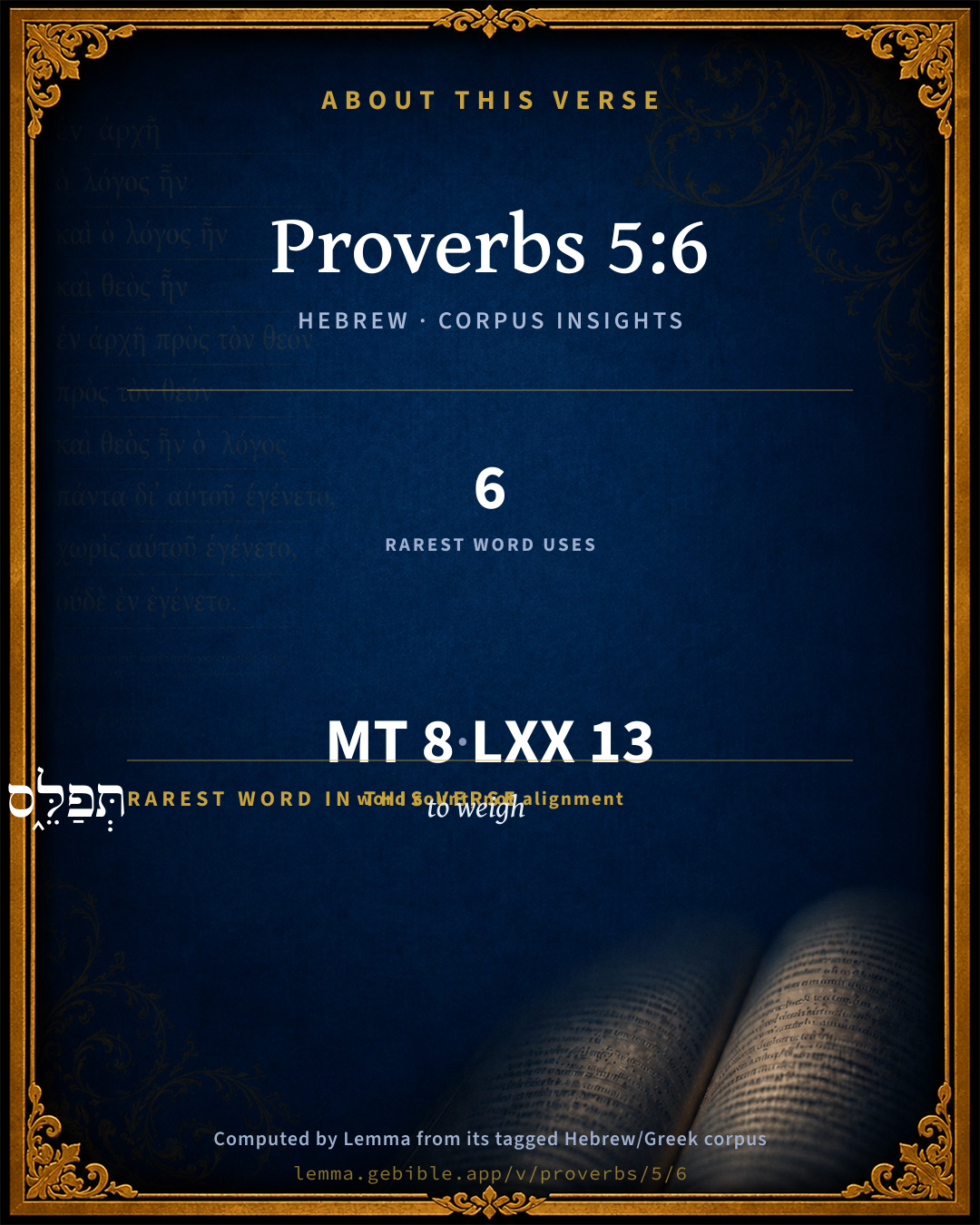
The rarest word here is תְּפַלֵּ֑ס to weigh H6424 — appearing just 6 times in the whole Hebrew Bible.

Shared distinctive vocabulary

תְּפַלֵּ֑ס to weigh H6424 occurs in 6 verses of the Hebrew Bible. Also found in:

Grammatical profile

  • 3 verbs
  • 3 nouns
  • 1 conjunction
  • 1 particle

Verb forms

  • תְּפַלֵּ֑ס Piel · Imperfect
  • נָע֥וּ Qal · Perfect
  • תֵדָֽע Qal · Imperfect

Hebrew & Septuagint length

In English translation the verse runs 18 words from the Hebrew and 18 from the Septuagint (LXX English) — the same length.

A rough comparison of the two English renderings, which tokenize alike — not a word-level alignment.

Word counts can differ between the Hebrew and the Greek without any difference in meaning — e.g. the Hebrew direct-object marker אֵת has no separate Greek word, and Greek often adds the article ὁ.

In the original languages it is 8 Hebrew tokens and 13 Greek tokens — but the two are counted differently (Hebrew bundles its prefixes and suffixes into one token; the Greek is in lemma form), so that isn’t a like-for-like length.

Cross-references

9

Topical passages linked to Proverbs 5:6 in the Treasury of Scripture Knowledge — connected by theme and wording, ordered by reader-vote popularity; previews shown in the World English Bible.

  • Proverbs 4:26 Make the path of your feet level. Let all of your ways be established.
  • Psalms 16:11 You will show me the path of life. In your presence is fullness of joy. In your right hand there are pleasures forevermore.
  • Proverbs 5:21 For the ways of man are before the eyes of Yahweh. He examines all his paths.
  • Psalms 119:59 I considered my ways, And turned my steps to your statutes.
  • Proverbs 6:12–13 A worthless person, a man of iniquity, Is he who walks with a perverse mouth;
  • Proverbs 30:20 So is the way of an adulterous woman: She eats and wipes her mouth, And says, 'I have done nothing wrong.'
  • Proverbs 7:10–21 Behold, there a woman met him with the attire of a prostitute, And with crafty intent.
  • Proverbs 11:19 He who is truly righteous gets life. He who pursues evil gets death.
  • 2 Thessalonians 2:9–10 even he whose coming is according to the working of Satan with all power and signs and lying wonders,

Cross-references courtesy of OpenBible.info (CC BY 4.0).

Hebrew and Greek witnesses Masoretic Hebrew ↔ Greek Septuagint

The same verse in the two great witnesses to the Old Testament, shown verse-for-verse.

These are two independent witnesses, not word-aligned to each other, and the Septuagint is shown in lemma (dictionary) form.

Hebrew Proverbs 5:6 Masoretic · Westminster Leningrad Codex

אֹ֣רַח חַ֭יִּים פֶּן תְּפַלֵּ֑ס נָע֥וּ מַ֝עְגְּלֹתֶ֗יהָ לֹ֣א תֵדָֽע

She gives no thought to the way of life. Her ways are crooked, and she doesn't know it.

World English Bible · Public Domain

Greek LXX Proverbs 5:6 Septuagint · lemma form

ὁδός γάρ ζωή οὐ ἐπιἔρχομαι σφαλερός δέ ὁ τροχιός αὐτός καί οὐ εὔγνωστος

For she goes not upon the paths of life; but her ways are slippery, and not easily known.

LXX2012 (modern English Septuagint) · Public Domain

On this verse, Albert Barnes' Notes on the Bible discusses the Septuagint’s reading. Read the note in Commentary ↓

Hebrew: Westminster Leningrad Codex (CC BY 4.0). Greek: Septuagint (public domain); English from LXX2012 (modern English Septuagint) (Public Domain). How the Septuagint differs from the Hebrew →

Commentary

Notes on Proverbs 5:6 from classic Christian and Jewish commentators (each source and its license shown beneath its notes). The classic Christian expositions comment on the surrounding passage and are grouped to its opening verse, so a note may address several verses; the Jewish commentaries on the Tanakh (Rashi and others) are per-verse, so they appear only where the commentator wrote on this verse.

Lemma curates 59 commentaries, every one of them public domain or Creative Commons licensed, each selected and text-cleaned for this edition rather than reprinted as found. About our sources →

Trapp's Complete Commentary

John Trapp

Pro 5:6 Lest thou shouldest ponder the path of life, her ways are moveable, [that] thou canst not know [them].

Ver. 6. Lest thou shouldest ponder,] q.d., Lest thou shouldest persuade thyself that thou mayest embrace the bosom of a stranger, and yet lay hold upon the paths of life by repenting thee of thy folly - this was Solomon’s error sometimes {Ecc 1:17; Ecc 2:3} - thou art utterly deceived herein, for her ways are moveable, so that thou observest not whither she tendeth; she wanders here and there (and thou with her), yet not so wide as to miss hell; lo, that is the centre whereunto she is rolling, that is the rendezvous for all her associates in sin.

John Trapp, A Commentary or Exposition upon All the Books of the Old and New Testament (1647–1656) — public domain. Text from a community e-Sword module.

The Biblical Illustrator

Joseph S. Exell

Pro_5:6

Her ways are moveable, that thou canst not know them.

The movable ways of the tempter

The wiseman lets us know how foolish it is for men to flatter themselves with the hope that they shall by and by be truly disposed and enabled to repent of their sin. The temptress can form her mode of behaviour into a hundred shapes to entangle the heart of the lover. She spreads a thousand snares, and if you escape one of them, you will find yourself held fast by another. She knows well how to suit her words and behaviour to your present humour, to lull conscience asleep, and to spread before your eyes such a mist as shall prevent you from being able to descry the paths of life. If you ever think of the danger of your course, and feel the necessity of changing it, she will urge you to spend a little time longer in the pleasures of sin. If her solicitations prevail, if you linger within the precincts of guilt, your resolutions are weakened, and your passions gain new strength. What is the awful result? The devil obtains more influence; conscience, forcibly repressed, ceases to reclaim with so loud a voice; God gives you up to the lusts of your own heart, and leaves you to choose your own delusions. Attend, then, to the wisest of men, who instructs you to keep free of these dangerous temptations. (G. Lawson, D. D.)

Movableness

The text refers to a sinful character who endeavours to keep her companion in vice by her movable ways. Few can say with Paul, None of these things move me. We are liable to be acted upon by influences within and without us. It is a grave weakness to be easily movable to bad and faulty ways. Movableness is the prevalent fault of probably every one of us. How easily we are moved to speak in haste. How difficult to keep our eye from being moved to look on evil. We are urged to fix our affections on things above, but who can do this in his own strength? Are we not movable in our friendships? Perhaps movable Christians love only themselves; and if this be so, it needs but a short time and a slight ruffle against their feathers to move them. Some are easily movable from their work for God and for humanity. Some, perhaps all of us, at times, are movable in our faith. Do not allow yourself to be moved from trusting in the love of Jesus, and never be ashamed of being His faithful disciple. Some are moved from the comfort of prayer. (William Birch.)

The Biblical Illustrator, edited by Joseph S. Exell (c. 1880s–1900s) — public domain. Text from a community e-Sword module.

Geneva Bible (1599)

Geneva Bible translators

She hath ever new means to allure to wickedness.

Geneva Bible (1599) marginal notes — public domain. Text via Bolls.life.

Jamieson, Fausset & Brown

Robert Jamieson, A. R. Fausset & David Brown

her ways . . . know--Some prefer, "that she may not ponder the path of life," &c.; but perhaps a better sense is, "her ways are varied, so as to prevent your knowledge of her true character, and so of true happiness."

Jamieson, Fausset & Brown — Commentary Critical and Explanatory on the Whole Bible (1871) — public domain (CC PDM 1.0). Text via the HelloAO Bible API.

Adam Clarke's Commentary

Verse 6. Lest thou shouldest ponder] To prevent thee from reflecting on thy present conduct, and its consequences, her ways are moveable - she continually varies her allurements.

Thou canst not know them.] It is impossible to conceive all her tricks and wiles: to learn these in all their varieties, is a part of the science first taught in that infernal trade.

Adam Clarke's Commentary on the Bible (1810–1826) — public domain. Text from a community e-Sword/MySword module.

Ellicott's Commentary for English Readers

(6) Lest thou shouldest ponder . . .—The meaning of the English version appears to be, “To prevent thy choosing the path of life, she leads thee by devious paths that thou knowest not where thou art.” It may also be rendered, “Far from smoothing for herself the path of life, her steps wander without her observing it.” By these words is described the reckless career of a vicious woman, who at last dares not think whither her steps are leading her, but as it were with eyes shut, totters on till she falls to rise no more.

A Bible Commentary for English Readers, edited by Charles John Ellicott (1878–1897) — public domain. Text from a community e-Sword module.

The Cambridge Bible for Schools and Colleges

gen. ed. J. J. S. Perowne

6. Lest thou shouldest ponder] The rendering of A.V. or of R.V. marg. (Lest thou find the level path, or, Lest thou weigh carefully the path) is to be preferred to R.V. text which connects the words with the preceding verse and makes them refer to the strange woman: so that she findeth not the level path of life. Having described in Pro_5:5 the end to which her ways lead, the wise Teacher in this verse unveils the artful versatility with which she allures her victims from the plain path of life, and keeps them from the reflection which might lead them to return to it.

thou canst not know them] So R.V. marg., but R.V. text, making the strange woman still the subject, she knoweth it not, Comp. Psa_35:8, where the same Heb. expression is rendered “at unawares.” See for the sentiment ch. Pro_7:22-23.

The Cambridge Bible for Schools and Colleges (gen. ed. J. J. S. Perowne; Cambridge University Press, 1878–1918) — public domain. Text from a community e-Sword module.

John Gill's Exposition

Lest thou shouldest ponder the path of life,.... Consider and meditate which is the way to get out of her hands and ways, and escape death, and obtain eternal life; lest those she has drawn into her wicked course of life should be religiously inclined, and think of quitting such a course, and inquire after the way of life and salvation; and be weighing in their minds which is most eligible, to continue with her whose feet lead to death, or to take the path of life: to prevent all this, if possible,

her ways are movable: she appears in different shapes; changes her dress and habitation; makes use of a thousand arts to ensnare men, to entangle their affections, and retain them in her nets; she first puts them upon one thing, and then on another; she leads them into various mazes and labyrinths of sin, till they have lost all sense of religion, and sight of the path of life;

that thou canst not know them; her ways, arts, and devices. Or, "thou canst not know" (k); that is, the way of life, or how to get out of her ways into that. Or, "thou knowest not"; where she goes, whither she leads thee, and what will be the end and issue of such a course of life. The Targum understands it, and so some other interpreters, of the harlot herself, paraphrasing the whole thus;

"in the way of life she walks not; her ways are unstable, and she knows not''

the way of life, nor where her ways will end; or, "cares not" (l) what becomes of her. And so, in like manner, the former part of the verse is understood and interpreted, "lest she ponder the path of life" (m); or as others, "she does not ponder the path of life" (n); The ways of the antichristian harlot are with all deceivableness of unrighteousness; and her chief care is to keep persons in ignorance, and from pondering the path of life or true religion, and to retain them in her idolatry, Th2 2:9.

(k) "non scires", Cocceius; "non cognosces", Baynus. (l) "Haud curat", Schultens. (m) "iter vitae ne forte libraverit", Schultens. (n) "Viam vitae non appendit, vel ponderat", Gejerus; so Luther; "iter vitae non expandit", Noldius, p. 249. No. 2008.

John Gill's Exposition of the Whole Bible (1746–1763) — public domain (CC PDM 1.0). Text via the HelloAO Bible API.

Albert Barnes' Notes on the Bible

Or (with the Septuagint and Vulgate), Lest she should ponder (or “She ponders not”) the way of life, her paths move to and fro (unsteady as an earthquake); she knows not. The words describe with a terrible vividness the state of heart and soul which prostitution brings upon its victims; the reckless blindness that will not think, tottering on the abyss, yet loud in its defiant mirth, ignoring the dreadful future.

Albert Barnes' Notes on the Bible (1834–1885) — public domain. Text from a community e-Sword/MySword module.

Haydock's Catholic Bible Commentary

They. Hebrew, "if perhaps thou ponder the path of life." (Pagnin) (Haydock) --- Or "she ponders not," &c. She walks inconsiderately, and consults only her passions, chap. vii. 10. (Calmet) --- No one can depend on her love. (Menochius)

George Leo Haydock (1774–1849), Haydock's Catholic Family Bible and Commentary, 1859 edition — public domain. Excludes Psalms (Douay-Rheims chapter numbering differs from Protestant) and Deuterocanonical books (Catholic canon only).

Matthew Poole's English Annotations

Lest thou shouldest ponder the path of life, to prevent thy serious consideration of the way and manner of rescuing thyself from this deadly course of life.

Movable; various and changeable. She transforms herself into several shapes, to accommodate herself to the humours of her lovers, and hath a thousand arts and deceits to ensnare them, and hold them fast.

Thou canst not know them; thou canst not discover all her subtle practices, and much less deliver thyself from them.

Matthew Poole's English Annotations on the Holy Bible (1683–1685) — public domain. Text from a community e-Sword/MySword module.

Whedon's Commentary on the Bible

Daniel D. Whedon

6. Her ways are movable — She continually varies her allurements.

Thou canst not — Or dost not.

Know them — It is impossible to conceive all the tricks and arts of her infernal trade. Beware of them. The verse is obscure, owing to the fact that in the Hebrew verb the form of the third person singular feminine and the second person singular masculine are the same, and it is difficult in this case to determine whether to translate she or thou. Zockler renders, “The path of life she never treadeth; her steps stray, she knows not whither.” Stuart, “That she may not ponder the path of life, her ways are become unsteady while she regards it not.” To the same purpose others. Conant, “That thou mayest not ponder, etc., her paths waver ere thou knowest.” “She weigheth not the way of life; her paths are movable; thou canst not know them.” — Geneva Bible. “For she goes not upon the paths of life; but her ways are slippery, and not easily known.” — Sept. The words describe with a terrible vividness the state of heart and soul which prostitution brings upon its victim; the reckless blindness that will not think, tottering to the abyss, yet loud in defiant mirth, ignoring the dreadful future. Our English version, however, is supported by some good authorities.

Daniel D. Whedon (gen. ed.), Commentary on the Old and New Testaments (1874–1909) — public domain. Text from a community e-Sword module.

The Pulpit Commentary

Lest thou shouldest ponder the path of life, her ways are movable, that thou canst not know them. This verse should be rather rendered, she walks not in the path of life, her ways fiuctuate, she knows not. It consists of a series of independent propositions or statements, all of which are descriptive of the singularly fatuous conduct of "the strange woman." In the previous verse the teacher has said that her conduct leads to ruin; he here further emphasizes the idea by putting forward the same truth from the opposite, or, as we may say, from the negative point of view, and so completes the picture. "The words," as Plumptre remarks, "describe with terrible vividness the state of heart and soul which prostitution brings on its victims." Her course is one of persistent, wilful, headstrong, blind folly and wickedness. Lest; pen; here "not," equivalent to al (lo). So the LXX, Vulgate, Targum, Syriac. The use of pen, in this sense is, however, unique (Gesenius). Delitzsch and Zockler, following Luther, Geier, Holden, etc., assign to it an emphatic negative force, as, "She is far removed from entering," or, "she never treadeth." Others take pen as a dependent prohibitive particle, equivalent to the Latin ne forte, "lest," as in the Authorized Version, and employed to connect the sentence which it introduces either with the preceding verse (as Schultens) or with the second hemistich, on which it is made dependent (Holden, Wordsworth, Aben Ezra, loc., Michaelis, etc.). Thou shouldest ponder; t"phalles, connected by makkeph with pen, as usual (Lee), is either second person masculine or third person feminine. The latter is required here, the subject of the sentence being "the strange woman," as appears clearly from the second hemistich, her ways," etc. The verb patas (cf. Pro_14:26) here means "to prepare," i.e. to walk in, or to travel over. Thus Gesenius renders, "She (the adulteress) prepareth not (for herself) the way of life:" i.e. she does not walk in the way of life; cf. the LXX eisercetai , Vulgate ambulant (sc. gressus ejus), and other ancient versions, all of which understand the verb in this sense. The meaning of the phrase, pen t"phalles, is, therefore, "she walks not" in the way of life the way that has life for its object, and which in itself is full of life and safety. Far from doing this, the teacher goes on to say, her ways are movable; literally, go to and fro, or fluctuate; i.e. they wilfully stagger hither and thither, like the steps of a drunkard, or like the uncertain steps of the blind, for the verb nua is so used in the former sense in Isa_24:20 Isa_29:9 Psa_107:27; and in the latter in Lam_4:14. Her steps are slippery (LXX, sfalerai ), or wander (Vulgate, vagi); they are without any definite aim; she is always straying in the vagrancy of sin (Wordsworth); cf. Pro_7:12. That thou canst not know them (lo theda); literally, she knows not. The elliptical form of this sentence in the original leaves it open to various interpretations. It seems to refer to the way of life; she knows not the way of life, i.e. she does not regard or perceive the way of life. The verb yada often has this meaning. The meaning may be obtained by supplying mah, equivalent to quicquam, "anything," as in Pro_9:13, "She knows not anything," i.e. she knows nothing. The objection to this is that it travels unnecessarily out of the sentence to find the object which ought rather to be supplied from the context. The object may possibly be the staggering of her feet: she staggers hither and thither without her perceiving it (Delitzsch); or it may, lastly, be indefinite: she knows not whittler her steps conduct her (Wordsworth and Zockler).

The Pulpit Commentary (1880–1919), ed. H.D.M. Spence-Jones & Joseph S. Exell — public domain. Text from a community e-Sword module.

John Wesley's Explanatory Notes

Lest - To prevent thy serious consideration. Moveable - She transforms herself into several shapes, and has a thousand arts to ensnare. Know - Thou canst not discover all her practice.

John Wesley, Explanatory Notes Upon the Whole Bible (1754–1765) — public domain. Text via the GEBible commentary corpus.

Rashi

Rabbi Shlomo Yitzchaki (Rashi)

Lest you weigh the path of life So did the Sages (Tanhuma Ekev 2) expound it: The Holy One, blessed be He, moved away (טלטל) the reward for the commandments and did not explain it [the reward], so that a person should not see a commandment for which the reward is great and cling to it and leave over the other commandments. This is the interpretation: Lest you weigh the ways of the Torah, which one to take and which one to leave, therefore its paths wandered off—God caused them to wander off and He did not make them known. This is the Midrash Aggadah, but according to the sequence of the verses, since after it is written: “And now, children, hearken to me and do not turn away from the sayings of my mouth. Distance your way from her,” it appears that he has not yet ended the section dealing with the harlot, and it should be interpreted as follows: Lest you weigh the path of life Do not weigh the path of life in conjunction with that strange one, saying what to do, whether this one or this one [i.e., whether to follow the path of life or the path of the strange woman], for the paths of the harlot have wandered off to the grave, and you will not know how to beware until you wander off and fall.

Rashi on the Tanakh — English translations: “The Judaica Press complete Tanach with Rashi, translated by A. J. Rosenberg” (CC BY 4.0); “Pentateuch with Rashi's commentary by M. Rosenbaum and A.M. Silbermann, 1929-1934” (public domain); “The Metsudah Tanach series, Lakewood, N.J” (CC BY 4.0); and “The Book of Joshua, Metsudah Publications, 1997” (CC BY 4.0). Text via Sefaria.

Lesson kit

Teaching starters — assembled from the data on this page, not authored interpretation. Every prompt links to the verse data it draws on. Edit before teaching.

Proverbs, in the Wisdom, opens this verse with 8 words (8 distinct Hebrew lemmas). Its most distinctive word is pâlaç (“to weigh”). A historical commentator’s framing appears above. Read the whole chapter for the surrounding context.

Discussion questions

  1. The word pâlaç carries the sense “to weigh.” How does it shape the verse?
  2. Psalms 58:2 shares the word «to weigh» with this verse. How do the two illuminate each other?
  3. These translations render this verse differently. What is at stake in choosing one wording over another?
  4. The verb «תְּפַלֵּ֑ס» is Piel Imperfect. How does its form color the action?
  5. Reading how Trapp's Complete Commentary and The Biblical Illustrator read this verse, where do the two commentators agree and where do they part?

Things to notice

Reading settings

Reading text

Shown beneath each verse's original-language words.

Old Testament
Old Testament edition

Read the OT as the Masoretic Hebrew (MT) or the Greek Septuagint (LXX).

English shown for the Greek Septuagint (in the Hebrew ↔ Greek comparison).

Comparing translations? Open the Compare panel on any verse page to stack up to four side by side.