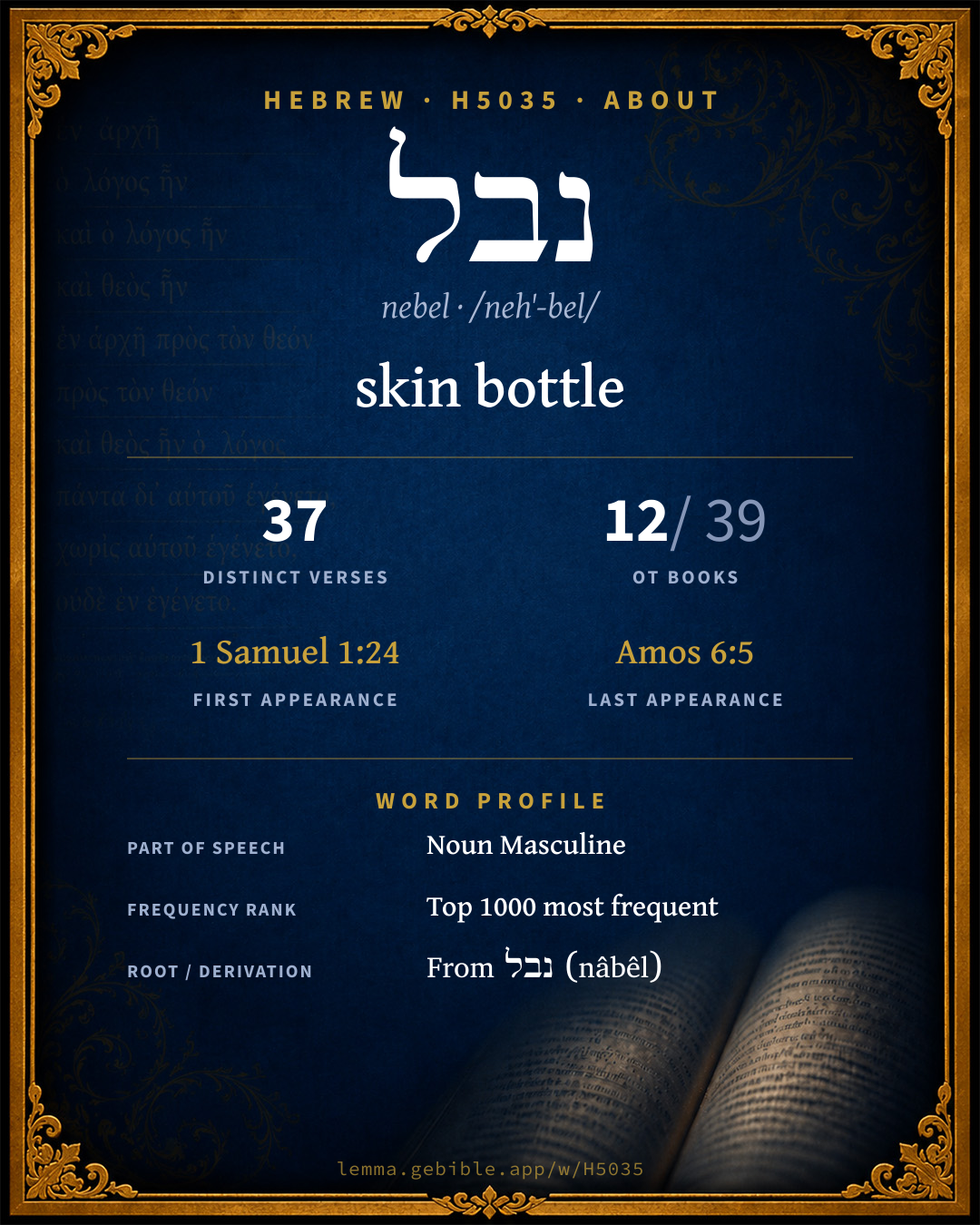
נֵ֫בֶל
skin bottle
‘skin bottle’ is one of 2 main senses fuller range ↓
Full lexicon entry — Brown-Driver-Briggs (BDB)
From Brown-Driver-Briggs (BDB)
Where this word appears
See every Absolute-state word in the Hebrew Bible →
Grammar key — what these labels mean
Part of speech
- Noun
- A naming word — a person, place, thing, or idea.
Noun type
- Common
- A common noun — a general class of person, place, or thing (“king,” “city,” “water”), not a specific name.
State
- Absolute
- The independent form of a noun, not bound to a following word.
- Construct
- A noun bound to a following noun in a possessive / “of” relationship (the construct chain).
Gender
- Masculine
- Grammatically masculine.
Number
- Singular
- One.
- Plural
- More than one (in Hebrew, generally three or more).
Every verse where H5035 appears in the Book of Psalms — 8 distinct verses. Click any verse to open its interlinear word-by-word view. Verse text shown in the World English Bible for context — . Each verse’s Hebrew form is shown with its reference; the English is not keyword-highlighted, since the data carries no word-level English alignment. Use “Compare translations” on any verse to read it across multiple English versions. This concordance covers the Hebrew Bible; Septuagint (Greek Old Testament) occurrences are not indexed here.
Psalms
- Psalms 33:2 בְּ/נֵ֥בֶל prep + n c ms cs Give thanks to Yahweh with the lyre. Sing praises to him with the harp of ten strings.
- Psalms 57:8 הַ/נֵּ֥בֶל ptcl def.art + n c ms Wake up, my glory! Wake up, psaltery and harp! I will wake up the dawn.
- Psalms 71:22 נֶבֶל֮ n c ms I will also praise you with the harp for your faithfulness, my God. I sing praises to you with the lyre, Holy One of Israel.
- Psalms 81:2 נָֽבֶל n c ms Raise a song, and bring here the tambourine, The pleasant lyre with the harp.
- Psalms 92:3 נָ֑בֶל n c ms With the ten-stringed lute, with the harp, And with the melody of the lyre.
- Psalms 108:2 הַ/נֵּ֥בֶל ptcl def.art + n c ms Wake up, harp and lyre! I will wake up the dawn.
- Psalms 144:9 בְּ/נֵ֥בֶל prep + n c ms cs I will sing a new song to you, God. On a ten-stringed lyre, I will sing praises to you.
- Psalms 150:3 בְּ/נֵ֣בֶל prep + n c ms Praise him with the sounding of the trumpet! Praise him with harp and lyre!
About this entry
At a glance — auto-summarized from this page’s data, not written by a person. Every figure links to its source below. This summary describes the numbers; it doesn’t interpret them.
At its core, נבל (nebel) means “skin bottle.” Translators differ — “psalteries” in the King James Version, then “harps” (Berean Standard Bible), as the renderings breakdown shows. With 37 verses in 12 books, it is a moderately common word in the Hebrew Bible. First canonically at 1 Samuel 1:24, it enters the text early. Carrying more than one sense, it rewards its full sense range. Each statement above links to its evidence; the full detail follows below.
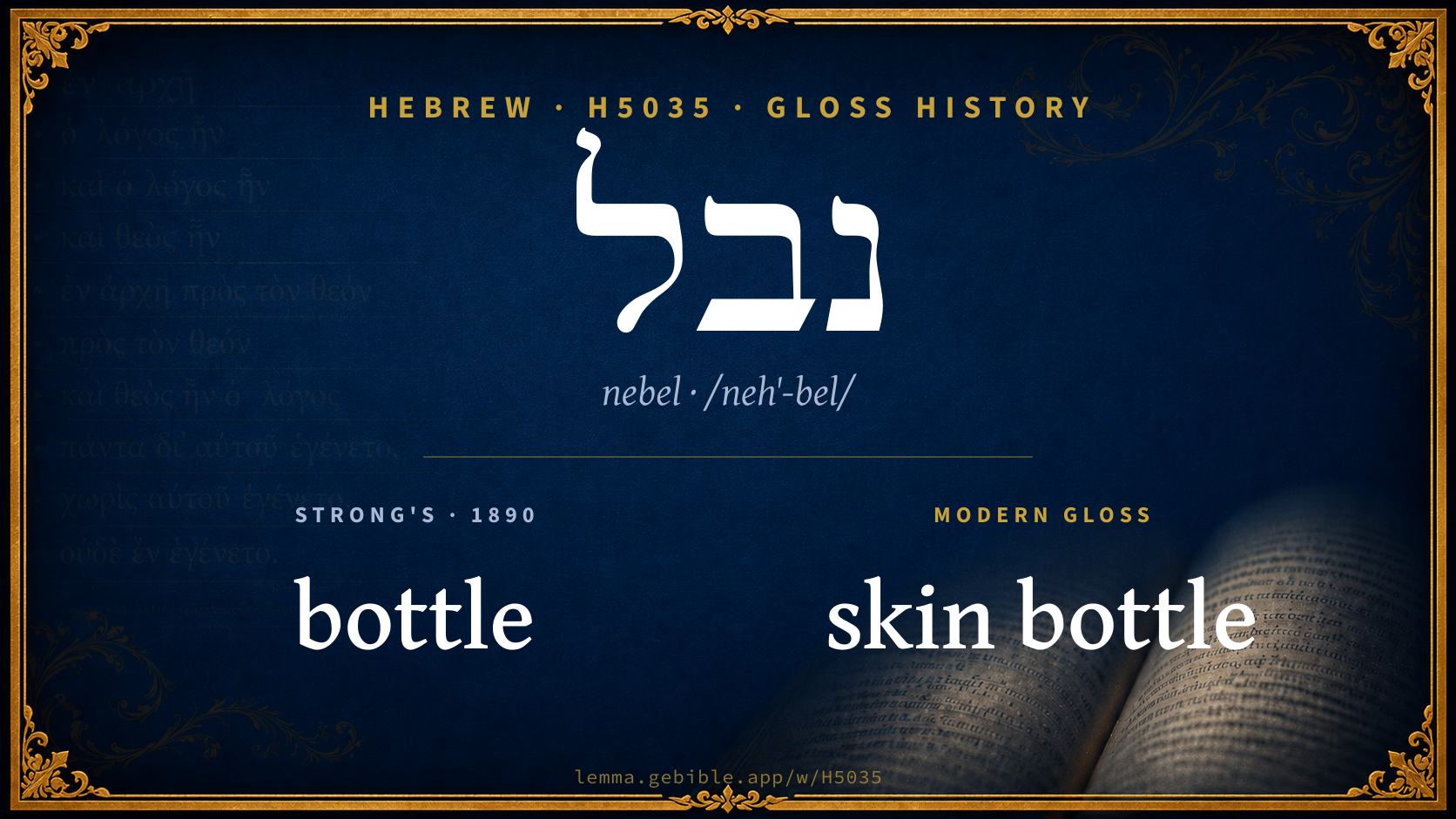
Gloss history
Strong's 1890 vs modern scholarship
About this word
Strong's H5035 catalogs a Hebrew word from the Hebrew Old Testament.
These counts are not copied from any lexicon or concordance. They are computed here, from the morphology-tagged Hebrew Old Testament. What Lemma adds →
- 37
- distinct verses
- The word appears in 37 distinct verses.
- 12 / 39
- OT books
- The word appears in 12 of 39 Old Testament books.
- #947
- by frequency
- Top 1000 most frequent Hebrew words (rank 947 of 8,640 Hebrew words by occurrence).
View all 37 occurrences in the concordance →
Most concentrated in
- Psalms 8 verses 22%
- 1 Chronicles 7 verses 19%
- 1 Samuel 4 verses 11%
By section of the Old Testament
By traditional corpus
Conventional, traditional groupings — biblical authorship is debated, so this is a traditional corpus grouping, not an authorship claim. Each share is this word’s portion of its verses in that division of the Hebrew canon. Each figure is a share of the word’s 37 distinct verses.
- Writings (Ketuvim) 22 verses · 59%
- Prophets (Nevi'im) 15 verses · 41%
How translations render this word
Counts come from each version’s own published word-to-Strong’s tagging or interlinear alignment — an approximate guide to how each version renders this word, not a word-level alignment the data otherwise carries. Because each total is that version’s own tagged count, the per-version totals vary from one another and need not match the appearance or distinct-verse counts above. These counts may also differ from a printed concordance because Lemma counts each distinctly tagged rendering and does not collapse phrase taggings into a single head-word total. This is a fixed set of word-tagged versions (KJV, ASV, BSB, ULT) and does not change with the reading translation you choose elsewhere. Each version’s license is shown beside its name below (and on Sources).
BDB lists this Strong’s number as 2 distinct words (homographs). Each count above pools all of them and is not split by sense — see the Senses section below. A low-frequency rendering may belong to a different one of those words, not the primary meaning.
- King James Version†: Psalteries 14×, Psaltery 8×, Bottle 3×
- American Standard Version†: Psalteries 14×, Psaltery 6×, Bottle 3×
- Berean Standard Bible†: Harps 13×, Harp 8×, Skin 3×
- unfoldingWord Literal Text†: Harps 8×, Lyres 8×, Lyre 7×
King James Version Public Domain
Renders H5035 across 37† tagged occurrences — most commonly:
Plus 3 renderings that appear only once — usually multi-word phrases or single function words the recovered tagging swept in, not distinct renderings. Not rendered by a distinct English word in 1 further occurrence.
American Standard Version Public Domain
Renders H5035 across 38† tagged occurrences — most commonly:
Plus 9 renderings that appear only once — usually multi-word phrases or single function words the recovered tagging swept in, not distinct renderings.
Berean Standard Bible Public Domain
Renders H5035 across 36† tagged occurrences — most commonly:
Plus 6 renderings that appear only once — usually multi-word phrases or single function words the recovered tagging swept in, not distinct renderings. Not rendered by a distinct English word in 2 further occurrences.
unfoldingWord Literal Text CC BY-SA 4.0
Renders H5035 across 37† tagged occurrences — most commonly:
Plus 9 renderings that appear only once — usually multi-word phrases or single function words the recovered tagging swept in, not distinct renderings.
Senses in the full BDB
What do BDB’s symbols mean?
BDB uses these scholarly abbreviations:
| Symbol | Meaning |
|---|---|
| 𝔊 | the Septuagint (the ancient Greek translation, LXX) |
| 𝔙 | the Vulgate (the Latin translation) |
| 𝔖 | the Syriac version (the Peshitta) |
| 𝔗 | the Targum (the Aramaic translation) |
| ψ | the Psalms |
| √ | root (the underlying root or stem) |
| ‖ | parallel passage (a synonymous or contrasted parallel) |
| † | the dagger: every passage where the word occurs is cited |
The 2 senses and sub-senses the full Brown-Driver-Briggs lexicon distinguishes for this word, in lexicon order (not ranked by frequency), with BDB’s own verbatim wording and sub-sense lettering. Shown in Hebrew script with BDB’s own scholarly abbreviations. The condensed entry is in the Lexicon Entry tab. See also the Forms in the corpus table below.
- 1. skin of wine, נֵ֫בֶל יַיִן 1 S 1:24; 10:3 2 S 16:1, cf. also Je 13:12(×2); pl. נִבְלֵי יַיִן 1 S 25:18: fig. נִבְלֵי שָׁמַיִם Jb 38:37 i.e. clouds (‖ שְׁחָקִים). e.g. 1 Samuel 1:24
- 2. earthen jar, pitcher: fig. of connexions of Eliakim כְּלֵי נְבָלִים Is 22:24; נִבְלֵיהֶם יְנַפֵּ֑צוּ Je 48:12 (‖ כֵּלִים יָרִוקוּ) in fig. of Moab (cf. ψ 2:9); נִבְלֵי־חֶרֶשׂ La 4:2 sim. of men of Judah (‖ מַעֲשֵׂה יְדֵי יוֹצֵר); sim. of destruction of Judah, שֵׁבֶר נֵ֫בֶל יוֹצְרִים Is 30:14. e.g. Isaiah 22:24
Senses from the full Brown-Driver-Briggs lexicon (Brown, Driver, Briggs; Oxford 1906 — public domain), digitized via Sefaria, supplemented by the OpenScriptures HebrewLexicon (CC BY 4.0). Full attribution on Sources.
Word origin
I. n.m. Je 13:12 1. skin-bottle, skin; 2. jar, pitcher;—נֵ֫בֶל abs. 1 S 10:5 +; cstr. v 3 + (on נֶבֶל v. Baer 1 S 1, 24);—
II. n.m. ψ 57:9 a musical instrument, either a portable harp, or a lute, guitar (with bulging resonance-body at lower end); (perhaps = i. נֵבֶל, and then shape seems to favour lute; perhaps independent word, e.g. Egyptian loan-word, cf. nfr, lute, WeHpt 222);—abs. נֵ֫בֶל 1 S 10:5 + 3 times, נֶ֫בֶל ψ 71:22 + 3 times; נָ֑בֶל Am 6:5 + 2 times; pl. נְבָלִים 2 S 6:5 + 4 times; sf. נְבָלֶיךָ Am 5:23 Is 14:11;—harp (or lute), played at feasts and religious ceremonies, probably less simple, cheap and common than כִּנּוֹר (q.v.; often named with נ׳):— as mark of luxury, revelry Am 5:23; 6:5 Is 14:11, so 5:12 (כִּנּוֹר נ׳ תֹּף חָלִיל, also (not in bad sense) 1 K 10:12; played by wandering band of prophets 1 S 10:5 (list as Is 5:12); in worship 2 S 6:5; elsewhere only ψψ Chr. always in worship: ψ 57:9; 81:3; 92:4; 108:3; 150:3; כְּלִי נֶבֶל 71:22; נ׳ עָשׂוֹר a harp with ten strings 33:2; 144:9; 1 Ch 13:8; 15:16, 20, 28; 16:5 (כְּלֵי נְבָלִים), 25:1, 6 2 Ch 5:12; 9:11; 20:28; 29:25 Ne 12:27.—Cf. further BenzArch. 273 ff. NowArch. i. 273 ff. Dr Amos 234 ff. WeHpt 222 ff.
— Brown-Driver-Briggs (Oxford 1906, public domain), digitized via Sefaria, supplemented by the OpenScriptures HebrewLexicon (CC BY 4.0). See Sources.
Derived from נבל (nâbêl) (H5034) — to be foolish.
Jastrow Dictionary
A second Hebrew/Aramaic lexicon for comparison, covering Aramaic and post-biblical (Talmudic, Targumic, Midrashic) usage that the biblical-Hebrew BDB does not. Matched by lemma rather than by Strong’s number, so a lemma may carry more than one Jastrow headword (shown separately below), and the entries cover usage well beyond the Bible.
נָבֵל
- to fade, shrivel, decay. Y. R. Hash. I, 56ᵈ bot. הֶעָלֶה נוֹבֵל, v. בּוּל III. Erub. 54ᵃ הללו נוֹבְלִין, v. הָלָה. Gen. R. s. 53 (ref. to Is. XL, 7) יבש חצירו … ונ׳ ציצו וכ׳ Abimelech’s grass is dried up and his flower has faded, but &c.; a. e.—V. נוֹבֶלֶת. e.g. Isaiah 40:7
- 1. to cause fading; to ruin, deface; to disgrace. Y. Shebi. I, beg. 33ᵃ מיכן ואילך הוא מְנַבֵּל פירותיו after that time (by ploughing an orchard field after the Feast of Weeks) he causes deterioration of his fruits. Ib. IV, 35ᵇ bot.; Y. Maas. Sh. V, beg. 55ᵈ אילן שהוא מנבל פירותיו a tree which fails to mature its fruits; (Ḥull. 77ᵇ; Sabb. 67ᵃ שמַשִּׁיר, v. נָשַׁר). Y. Sabb. IX, 11ᵈ; Y. Ab. Zar. III, 43ᵃ bot. צאהו נַבְּלֵיהוּ treat him (the idol) like excrements, make him abominable (change his name cacophemistically). Cant. R. to V, 16 מנבל את עצמו בטיט he begrimes himself by working in clay. Ib. אל תְּנַבְּלוּ וכ׳ do not degrade yourselves by any evil thing (ref. to Lev. XI, 43; XIX, 28); Num. R. s. 10, beg. Ib. (ed. Amst. p. 240ᵇ) המְנַבֶּלֶת עצמה who neglects her appearance, opp. מקשטת. Ber. 63ᵇ (ref. to Prov. XXX, 32 נָבַלְתָּ) כל המנבל עצמו על וכ׳ he who lowers himself (exposes his ignorance) for the sake of learning, shall finally be raised; Midr. Prov. to ch. XXX אם נִבֵּל וכ׳; Gen. R. s. 81 אם נִבַּלְתָּ עצמך; Ab. d’R. N. ch. XI אם מנבל אדם עצמו וכ׳ if a man makes himself look offensive (through privations) &c.—Midr. Prov. l. c. (ref. to Prov. l. c.) זו יון שגזרו לנַבֵּל נשותיהן וכ׳ (not לבטל) that means the Greeks who decreed to disgrace Israel’s women; a. fr.—נ׳ פיו to make one’s mouth turpid, to talk obscenely. Sabb. 33ᵃ; Keth. 8ᵇ; a. e. e.g. Leviticus 11:43
- 2. (denom. of נְבֵלָה) to make an animal ritually forbidden by unskillful slaughtering. Tosef. B. Kam. X, 10 המוסר … ונִיבְּלָהּ if one entrusts his animal to a slaughterer, and he makes it unfit, v. infra.
- 1. to be defaced, degraded, disgraced. Y. Yeb. XII, end, 13ᵃ מי גרם לך להִתְנַבֵּל וכ׳ what was the cause of thy disgrace (exposure of thy ignorance) in the Law?; Gen. R. l. c. Y. Keth. IV, 28ᵈ top. יִתְנַבְּלוּ הן וכ׳ they and their offspring shall be disgraced; a. e.
- 2. to become ritually forbidden (נְבֵלָה) by unskillful slaughtering. Ḥull. VI, 2 השוחט ונִתְנַבְּלָה בידו if one cuts an animal and it becomes unfit under his hand; ib. V, 3; Tosef. ib. V (VI), 3; a. e.
נְבֵל
- , to be soiled. Y. Kil. IX, 32ᵃ bot. דלא יִנְבְּלוּן מאנוי that his garments may not be soiled.
- to disgrace, make vile. Targ. Am. VI, 8. Targ. Nah. III, 6; a. e.
נָבָל I
- (b. h.) pr. n. m. Nabal the Carmelite. Gen. R. s. 85. Koh. R. to VII, 1, end; a. fr.
נָבָל II
- (נבל) Nabal (Filth), name of the genius of poverty. Pes. 111ᵇ, v. אִיסְרָא II.
נֶבֶל
- 1. leather bottle. Lev. R. s. 5 (ref. to Am. VI, 5) שהיו פורטים … אלא בנ׳ they opened their mouths with words of levity, saying, David recited his songs only with the bottle (wine). e.g. Amos 6:5
- 2. a hollow musical instrument, lyre (with a leather body). Y. Succ. V, 55ᶜ bot. היא נ׳ היא כנור וכ׳ nebel and kinnor (cithern) are the same, with the only difference of more strings (for the former). Ib. למה נקרא נ̇ב̇ל̇ שהוא מ̇ל̇ב̇ין וכ׳, v. לָבַן II; ע"י עור שאינו עבוד וכ׳ on account of the untanned skin and the larger number of strings it shames &c. Arakh. II, 6 לא היו אומרים בנ׳ וכ׳ they (the Levite boys) sang without accompaniment of nebel or kinnor; ib. 13ᵇ למימרא דנ׳ לחוד וכ׳ does this intimate that nebel and kinnor are not the same?; a. e.
- 3. a leather wind-instrument, a sort of bellows. Ib. (ref. to Ps. XXXIII, 2 sq.) לעוה"ב איידי דנפישי נימין דידיה נפיש קליה כי נ׳ קרי ליה נ׳ because the kinnor of the future will have numerous strings (ten strings), and its sound will be loud like that of the nebel, it is called nebel.—Pl. נְבָלִים. Ib. II, 3. Kel. XV, 6 נִבְלֵי השרה the instruments for secular music; נ׳ בני לוי those of the Levites (in the Temple). Ib. XXIV, 14, v. מִטְפַּחַת. e.g. Psalms 33:2
נֵבֶל
- 1. lyre, nebel. Targ. Is. V, 12. Targ. O. Gen. IV, 21; a. e.—Pl. נִבְלִין, נִבְלַיָּא, נִי׳. Targ. I Sam. X, 5. Targ. Is. XXII, 24; a. e.
- 2. (from its shape, cmp. Sm. Dict. Ant. s. v. Tela, Amer. ed. 1858, p. 955, explaining pecten and jugum) the upright loom. Y. Kil. IX, 32ᵃ top דלא מוקמה נ׳ דעמר וכ׳ not to put up a loom for wool in front of a loom for linen, on account of the fringes (which may become mixed).
A Dictionary of the Targumim, the Talmud Babli and Yerushalmi, and the Midrashic Literature (Marcus Jastrow; London, Luzac, 1903) — Public Domain. Digitized via Sefaria. Digitized via Sefaria. Full attribution on Sources.
Forms in the corpus
The 30 distinct written forms H5035 takes in the Hebrew Bible, most frequent first — each parse links to that state’s occurrences in the concordance. Hebrew forms include their vowel points and cantillation, so a single lemma takes many written forms.
Same root — word family
Other BDB entries built from the same root as H5035, grouped by Strong’s listed origin. These share a root / origin per the lexicon — not necessarily a shared meaning. Each links to that word’s own entry.
Derives from
Shares the same root
Compare all same-root words → They share a root, not necessarily a meaning.
Septuagint verse parallels
This word appears in 35 verses that also exist in the Greek Old Testament (Septuagint), out of the 37 Hebrew verses it occurs in. You can read those verses in Greek by switching the Old Testament edition to the Septuagint.
Read these verses in the Septuagint
- 1 Samuel 1:24
- 2 Samuel 6:5
- 1 Kings 10:12
- 1 Chronicles 13:8
- 2 Chronicles 5:12
- Job 38:37
- Psalms 33:2
- Isaiah 5:12
- Jeremiah 13:12
- Lamentations 4:2
- Amos 5:23
This is a verse-level parallel only — the same verses exist in both the Hebrew and Greek Old Testaments. No word-level Hebrew↔Greek correspondence is claimed: the data carries no such alignment, so no Greek word is shown as this Hebrew word’s translation. Coverage is not total — the Septuagint omits the deuterocanon and renumbers the Psalms, so some Hebrew verses have no direct Greek parallel.