
Jeremiah 13:12

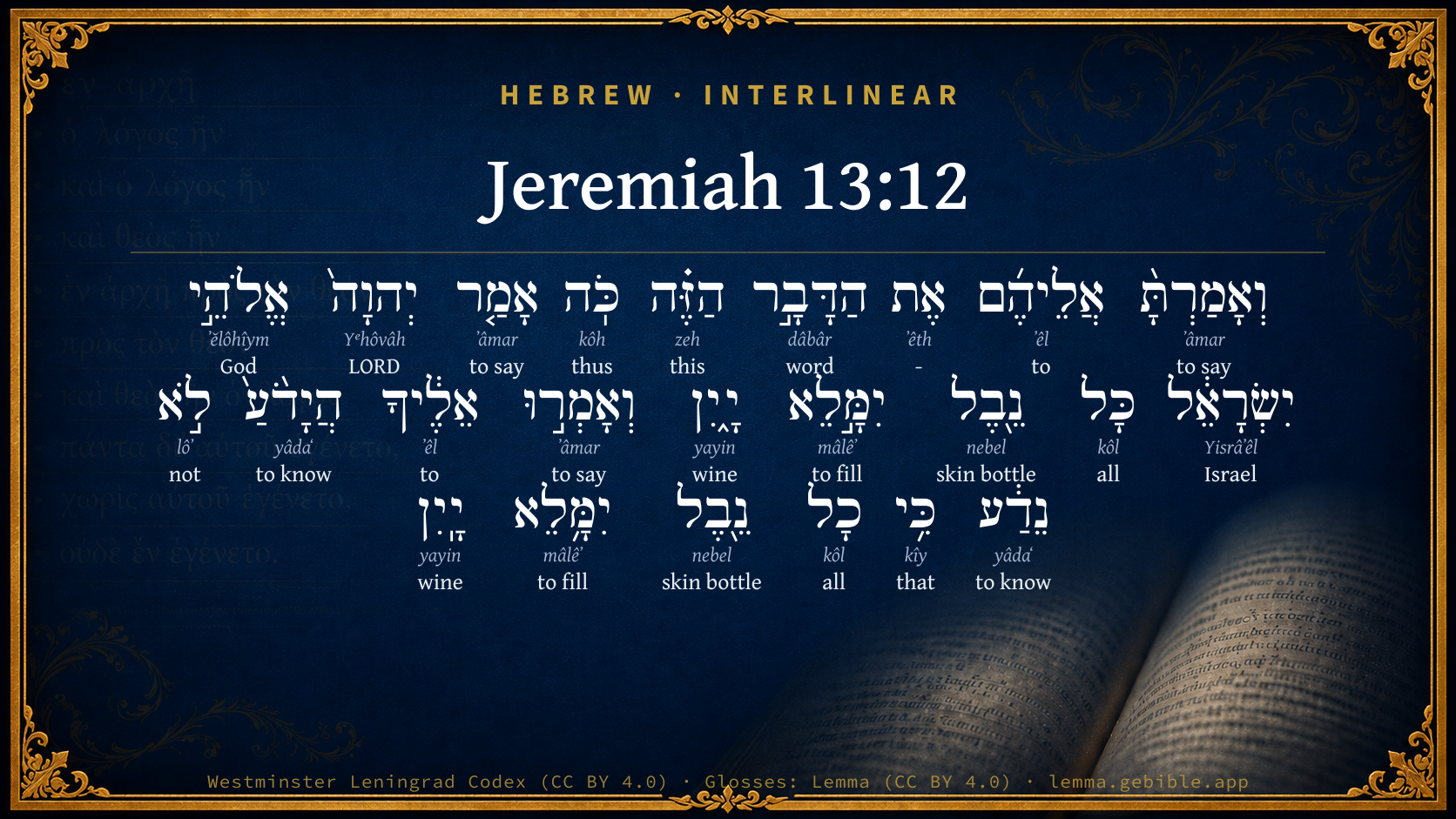
Hebrew (Westminster Leningrad Codex) Jeremiah 13:12 appears in the Hebrew Old Testament. The text above is from the Westminster Leningrad Codex. Each word links to its Strong’s number, a concise gloss, and parsing drawn from the Open Scriptures Hebrew Bible morphology. Click any word for its full Brown-Driver-Briggs (BDB) entry.
Download image
Cite this verse

Jeremiah 13:12 (World English Bible). Public Domain. Lemma interlinear Bible study tool, https://lemma.gebible.app/v/jeremiah/13/12.

Show BibTeX & RIS
BibTeX
RIS
English Translation
Therefore you shall speak to them this word: Thus says Yahweh, the God of Israel, Every bottle shall be filled with wine: and they shall tell you, Do we not certainly know that every bottle shall be filled with wine?
World English Bible · Public Domain
Download a study sheet

One document with this verse’s original text, its word-by-word gloss line, the meaning frame, cross-references with their text, attributed commentary, and full source and license credits — printable, and it pastes into notes with its structure intact.

This verse Autodidact and up

Study sheet (.html) Plain text (.txt)

A passage Seminary Student

Up to 50 verses in one chapter. A passage sheet keeps up to 6 commentary sources and 12 cross-references per verse, in the order this page ranks them, and says so on the sheet whenever that leaves anything out. Ask for a single verse and you get the Autodidact verse sheet above.

Everything on this page stays free to read, with no account — the sheet is a download of what is already on screen, not access to it.

Want to remove ads? Support Godless Engineer
Compare translations 3

The same verse in 3 English versions, stacked beneath the original-language interlinear above. Click any original word for its lexicon entry.

Each is an independent rendering of the whole verse — the interlinear is not word-aligned to these translations.

Highlighted words mark where these versions differ — a whole-verse word diff, not a word-by-word alignment.

  • World English Bible Public Domain
    Therefore you shall speak to them this word: Thus says Yahweh, the God of Israel, Every bottle shall be filled with wine: and they shall tell you, Do we not certainly know that every bottle shall be filled with wine?
  • King James Version Public Domain
    Therefore thou shalt speak unto them this word; Thus saith the LORD God of Israel, Every bottle shall be filled with wine: and they shall say unto thee, Do we not certainly know that every bottle shall be filled with wine?
  • unfoldingWord Literal Text CC BY-SA 4.0
    Therefore you shall speak this word to them, ‘Thus says Yahweh, the God of Israel: “Every jar shall be filled with wine.”’ And they will say to you, ‘Knowing do we not know that every jar will be filled with wine?’

unfoldingWord Literal Text — © unfoldingWord, licensed CC BY-SA 4.0. Word-aligned USFM3 via Door43 (git.door43.org/unfoldingWord/en_ult).

Versions to compare (up to 4)

3 of 4 selected

Show all 18 translations

Every available English version of this verse, each an independent rendering of the whole verse.

  • World English Bible Public Domain
    Therefore you shall speak to them this word: Thus says Yahweh, the God of Israel, Every bottle shall be filled with wine: and they shall tell you, Do we not certainly know that every bottle shall be filled with wine?
  • Berean Standard Bible Public Domain
    Therefore you are to tell them that this is what the LORD, the God of Israel, says: ‘Every wineskin shall be filled with wine.’ And when they reply, ‘Don’t we surely know that every wineskin should be filled with wine?’
  • Majority Standard Bible Public Domain
    Therefore you are to tell them that this is what the LORD, the God of Israel, says: ‘Every wineskin shall be filled with wine.’ And when they reply, ‘Don’t we surely know that every wineskin should be filled with wine?’
  • King James Version Public Domain
    Therefore thou shalt speak unto them this word; Thus saith the LORD God of Israel, Every bottle shall be filled with wine: and they shall say unto thee, Do we not certainly know that every bottle shall be filled with wine?
  • American Standard Version (1901) Public Domain
    Therefore thou shalt speak unto them this word: Thus saith Jehovah, the God of Israel, Every bottle shall be filled with wine: and they shall say unto thee, Do we not certainly know that every bottle shall be filled with wine?
  • Revised Version (1885) Public Domain
    Therefore thou shalt speak unto them this word: Thus saith the LORD, the God of Israel, Every bottle shall be filled with wine: and they shall say unto thee, Do we not know that every bottle shall be filled with wine?
  • Geneva Bible (1599) Public Domain
    Therefore thou shalt saye vnto them this word, Thus sayth the Lord God of Israel, Euery bottell shalbe filled with wine, and they shall say vnto thee, Doe we not knowe that euery bottell shalbe filled with wine?
  • Douay-Rheims (1899) Public Domain
    Thou shalt speak therefore to them this word: Thus saith the Lord God of Israel: Every bottle shall be filled with wine, and they shall say to thee: Do we not know that every bottle shall be filled with wine?
  • Young's Literal Translation Public Domain
    And thou hast said unto them this word, Thus said Jehovah, God of Israel, `Every bottle is full of wine,' And they have said unto thee: `Do we not certainly know that every bottle is full of wine?'
  • Literal Standard Version CC BY-SA 4.0
    And you have said this word to them, || Thus said YHWH, God of Israel: Every bottle is full of wine, || And they have said to you: Do we not certainly know that every bottle is full of wine?
  • Unlocked Literal Bible CC BY-SA 4.0
    So you must speak this word to them, 'Yahweh, the God of Israel, says this: Every jar will be filled with wine.' They will say to you, 'Do we not indeed know that every jar will be filled with wine?'
  • unfoldingWord Literal Text CC BY-SA 4.0
    Therefore you shall speak this word to them, ‘Thus says Yahweh, the God of Israel: “Every jar shall be filled with wine.”’ And they will say to you, ‘Knowing do we not know that every jar will be filled with wine?’
  • Darby Bible Public Domain
    And thou shalt speak unto them this word: Thus saith Jehovah, the God of Israel, Every skin shall be filled with wine. And they will say unto thee, Do we not very well know that every skin shall be filled with wine?
  • World Messianic Bible Public Domain
    “Therefore you shall speak to them this word: ‘The LORD, the God of Israel says, “Every container should be filled with wine.”’ They will tell you, ‘Do we not certainly know that every container should be filled with wine?’
  • Webster's Bible Public Domain
    Therefore thou shalt speak to them this word; Thus saith the LORD God of Israel, Every bottle shall be filled with wine: and they shall say to thee, Do we not certainly know that every bottle shall be filled with wine?
  • Free Bible Version CC BY-SA 4.0
    So tell them this is what the Lord, the God of Israel, says: Every wine jar shall be filled with wine. When they reply, “Don't we know that already? Of course every wine jar should be filled with wine!”
  • Bible in Basic English Public Domain
    So you are to say this word to them: This is the word of the Lord, the God of Israel: Every skin bottle will be full of wine; and they will say to you, Is it not quite clear to us that every skin bottle will be full of wine?
  • JPS Tanakh (1917) Public Domain
    Moreover thou shalt speak unto them this word: Thus saith the LORD, the God of Israel: 'Every bottle is filled with wine'; and when they shall say unto thee: 'Do we not know that every bottle is filled with wine?'

Literal Standard Version (2020), Covenant Press — licensed CC BY-SA 4.0. Text via the HelloAO Bible API (eBible.org). Unlocked Literal Bible (unfoldingWord) — licensed CC BY-SA 4.0. Text via the HelloAO Bible API (eBible.org). unfoldingWord Literal Text — © unfoldingWord, licensed CC BY-SA 4.0. Word-aligned USFM3 via Door43 (git.door43.org/unfoldingWord/en_ult). Free Bible Version, Dr. Jonathan Gallagher — licensed CC BY-SA 4.0. Text via the HelloAO Bible API (eBible.org).

Word by word

More ways to search: Search by grammar → Find every occurrence → Compare this word →

Practice this passage: Drill this verse → Learn its vocabulary →

נֵ֖בֶל
nebel
H5035
“skin bottle”
Noun, Common, Masculine, Singular, Absolute
Part of Speech
Noun
Type
Common
Gender
Masculine
Number
Singular
State
Absolute
Full BDB Definition

Origin: from H5034

TWOT: 1284a , 1284b

a skin-bag, jar, pitcher - skin-bottle, skin - jar, pitcher (earthen) - harp, lute, guitar, musical instrument
  1. וְאָמַרְתָּ֨ ʼâmar H559 “and · to say” Conjunction + Verb, Qal, Sequential Perfect, 2nd Person, Masculine, Singular
  2. אֲלֵיהֶ֜ם ʼêl H413 “to · them” Preposition + Suffix, Personal, 3rd Person, Masculine, Plural
  3. אֶת ʼêth H853 “-” Particle, Direct Object
  4. הַדָּבָ֣ר dâbâr H1697 “the · word” Particle, Definite Article + Noun, Common, Masculine, Singular, Absolute
  5. הַזֶּ֗ה zeh H2088 “the · this” Particle, Definite Article + Pronoun, Demonstrative, Masculine, Singular
  6. כֹּֽה kôh H3541 “thus” Adverb
  7. אָמַ֤ר ʼâmar H559 “to say” Verb, Qal, Perfect, 3rd Person, Masculine, Singular
  8. יְהוָה֙ Yᵉhôvâh H3068 “LORD” Noun, Proper
  9. אֱלֹהֵ֣י ʼĕlôhîym H430 “God(s) of” Noun, Common, Masculine, Plural, Construct
  10. יִשְׂרָאֵ֔ל Yisrâʼêl H3478 “Israel” Noun, Proper
  11. כָּל kôl H3605 “all of” Noun, Common, Masculine, Singular, Construct
  12. יִמָּ֣לֵא mâlêʼ H4390 “to fill” Verb, Niphal, Imperfect, 3rd Person, Masculine, Singular
  13. יָ֑יִן yayin H3196 “wine” Noun, Common, Masculine, Singular, Absolute
  14. וְאָמְר֣וּ ʼâmar H559 “and · to say” Conjunction + Verb, Qal, Sequential Perfect, 3rd Person, Common, Plural
  15. אֵלֶ֔יךָ ʼêl H413 “to · you” Preposition + Suffix, Personal, 2nd Person, Masculine, Singular
  16. הֲיָדֹ֨עַ֙ yâdaʻ H3045 “to know” Particle, Interrogative + Verb, Qal, Infinitive Absolute
  17. לֹ֣א lôʼ H3808 “not” Particle, Negative
  18. נֵדַ֔ע yâdaʻ H3045 “to know” Verb, Qal, Imperfect, 1st Person, Common, Plural
  19. כִּ֥י kîy H3588 “that” Conjunction
  20. כָל kôl H3605 “all of” Noun, Common, Masculine, Singular, Construct
  21. נֵ֖בֶל nebel H5035 “skin bottle” Noun, Common, Masculine, Singular, Absolute
  22. יִמָּ֥לֵא mâlêʼ H4390 “to fill” Verb, Niphal, Imperfect, 3rd Person, Masculine, Singular
  23. יָֽיִן yayin H3196 “wine” Noun, Common, Masculine, Singular, Absolute

About this verse

These counts appear in no published source. They are computed here, from the morphology-tagged text and Lemma’s own curated glosses. What Lemma adds →

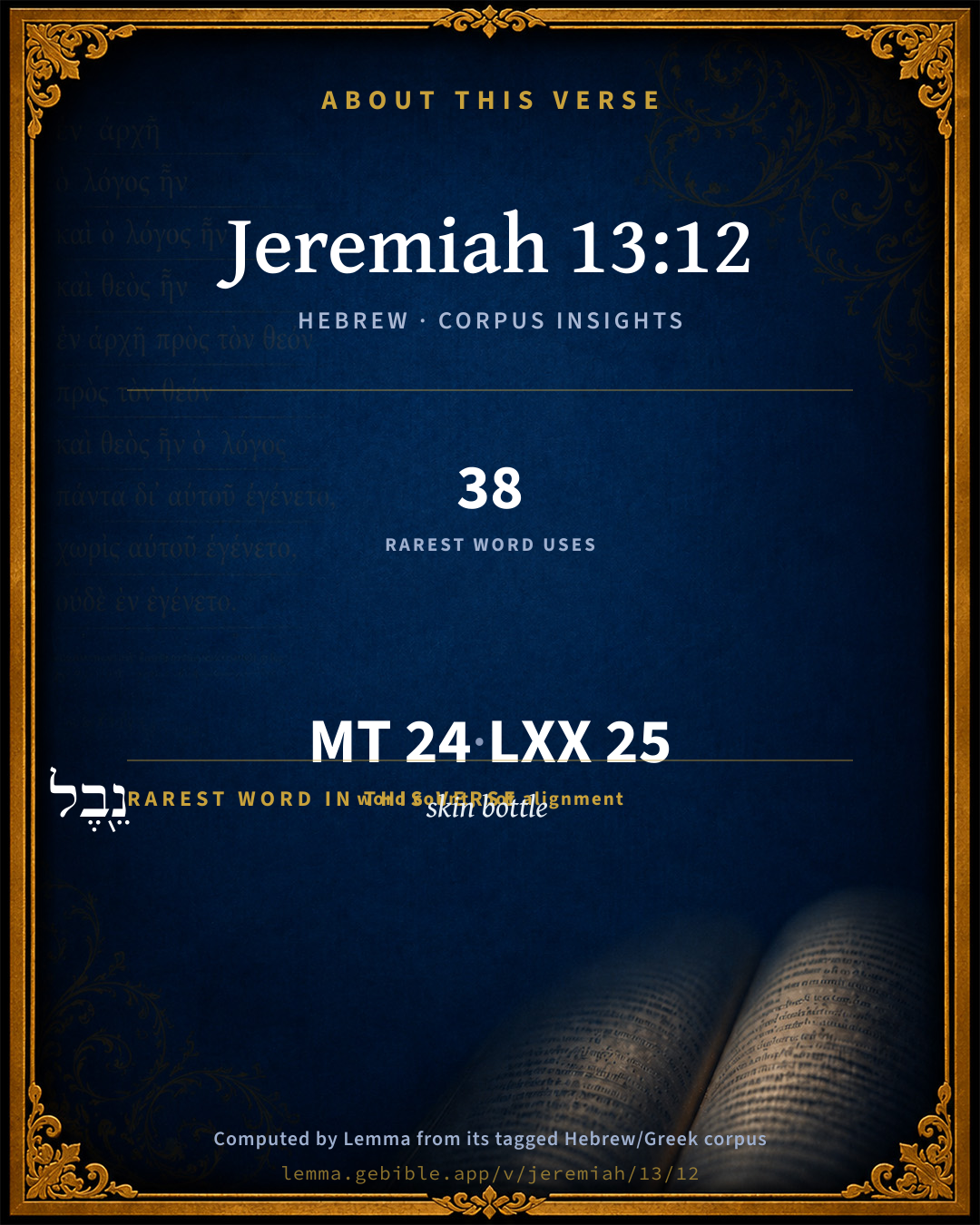
24
words
16
distinct lemmas
Prophets
section

Shared distinctive vocabulary

נֵ֖בֶל skin bottle H5035 occurs in 37 verses of the Hebrew Bible. Also found in:

Grammatical profile

  • 7 verbs
  • 10 nouns
  • 1 pronoun
  • 2 prepositions
  • 1 conjunction
  • 1 adverb
  • 2 particles

Verb forms

  • וְאָמַרְתָּ֨ Qal · Sequential Perfect
  • אָמַ֤ר Qal · Perfect
  • יִמָּ֣לֵא Niphal · Imperfect
  • וְאָמְר֣וּ Qal · Sequential Perfect
  • הֲיָדֹ֨עַ֙ Qal · Infinitive Absolute
  • נֵדַ֔ע Qal · Imperfect
  • יִמָּ֥לֵא Niphal · Imperfect

Repetition

Words recur within this verse — often emphatic in Hebrew:

  • וְאָמַרְתָּ֨ to say H559 ×3
  • כָּל all H3605 ×2
  • נֵ֖בֶל skin bottle H5035 ×2
  • יִמָּ֣לֵא to fill H4390 ×2
  • יָ֑יִן wine H3196 ×2
  • הֲיָדֹ֨עַ֙ to know H3045 ×2
  • אֲלֵיהֶ֜ם to H413 ×2

Hebrew & Septuagint length

In the original languages it is 24 Hebrew tokens and 25 Greek tokens — but the two are counted differently (Hebrew bundles its prefixes and suffixes into one token; the Greek is in lemma form), so that isn’t a like-for-like length.

Cross-references

1

Topical passages linked to Jeremiah 13:12 in the Treasury of Scripture Knowledge — connected by theme and wording, ordered by reader-vote popularity; previews shown in the World English Bible.

  • Ezekiel 24:19 The people said to me, Won't you tell us what these things are to us, that you do so?

Cross-references courtesy of OpenBible.info (CC BY 4.0).

Hebrew and Greek witnesses Masoretic Hebrew ↔ Greek Septuagint

The same verse in the two great witnesses to the Old Testament, shown verse-for-verse.

These are two independent witnesses, not word-aligned to each other, and the Septuagint is shown in lemma (dictionary) form.

Hebrew Jeremiah 13:12 Masoretic · Westminster Leningrad Codex

וְאָמַרְתָּ֨ אֲלֵיהֶ֜ם אֶת הַדָּבָ֣ר הַזֶּ֗ה כֹּֽה אָמַ֤ר יְהוָה֙ אֱלֹהֵ֣י יִשְׂרָאֵ֔ל כָּל נֵ֖בֶל יִמָּ֣לֵא יָ֑יִן וְאָמְר֣וּ אֵלֶ֔יךָ הֲיָדֹ֨עַ֙ לֹ֣א נֵדַ֔ע כִּ֥י כָל נֵ֖בֶל יִמָּ֥לֵא יָֽיִן

Therefore you shall speak to them this word: Thus says Yahweh, the God of Israel, Every bottle shall be filled with wine: and they shall tell you, Do we not certainly know that every bottle shall be filled with wine?

World English Bible · Public Domain

Greek LXX Structure differs

In the Septuagint, Jeremiah is about an eighth shorter than the Hebrew and arranges its material differently — the Oracles Against the Nations (Hebrew chapters 46–51) appear in the middle of the Greek book, after 25:13. Because the chapter and verse boundaries do not line up, a verse-for-verse comparison with the Hebrew is not shown.

A verse-for-verse comparison isn’t shown here because the chapters and verses don’t line up. Switch to the LXX edition with the MT / LXX toggle above to read the Greek directly.

On this verse, The Pulpit Commentary discusses the Septuagint’s reading. Read the note in Commentary ↓

Hebrew: Westminster Leningrad Codex (CC BY 4.0). Greek: Septuagint (public domain); English from a public-domain English Septuagint. How the Septuagint differs from the Hebrew →

Targum (Aramaic paraphrase)

1

The Targum is the ancient Jewish Aramaic paraphrase of the Hebrew Scriptures — an interpretive translation, not the Hebrew text itself. Onkelos (literal) and Pseudo-Jonathan (expansive) render the Torah, and Jonathan the Prophets. Coverage is partial: where no permissively-licensed English translation exists for a verse, only the Aramaic is shown. This is verse-level text, not a word-by-word alignment to the Hebrew.

  1. Targum Jonathan Prophets (Joshua–Malachi)
    וְתֵימַר לְהוֹן יַת פִּתְגָמָא הָדֵין כִּדְנַן אֲמַר יְיָ אֱלָהָא דְיִשְׂרָאֵל כָּל גְרַב יִתְמְלֵי חֲמַר וְיֵימְרוּן לָךְ הֲמִידַע לָא הֲוֵינָא יָדְעִין אֲרֵי כָּל גְרַב יִתְמְלֵי חֲמָר:

    (no public-domain English translation for this verse)

    Targum Jonathan — Aramaic: “Mikraot Gedolot” (public domain). English: “Sefaria Community Translation” (CC0 1.0 (public-domain dedication)); “London "Chaldee Paraphrase," 1871” (public domain). Text via Sefaria.

Commentary

Notes on Jeremiah 13:12 from classic Christian and Jewish commentators (each source and its license shown beneath its notes). The classic Christian expositions comment on the surrounding passage and are grouped to its opening verse, so a note may address several verses; the Jewish commentaries on the Tanakh (Rashi and others) are per-verse, so they appear only where the commentator wrote on this verse.

Lemma curates 59 commentaries, every one of them public domain or Creative Commons licensed, each selected and text-cleaned for this edition rather than reprinted as found. About our sources →

Matthew Henry's Commentary

Here is, I. A judgment threatened against this people that would quite intoxicate them. This doom is pronounced against them in a figure, to make it the more taken notice of and the more affecting (Jer 13:12): Thus saith the Lord God of Israel, every bottle shall be filled with wine; that is, those that by their sins have made themselves vessels of wrath fitted to destruction shall be filled with the wrath of God as a bottle is with wine; and, as every vessel of mercy prepared for glory shall be filled with mercy and glory, so they shall be full of the fury of the Lord (Isa 51:20); and they shall be brittle as bottles; and, like old bottles into which new wine is put, they shall burst and be broken to pieces, Mat 9:17. Or, They shall have their heads as full of wine as bottle are; for so it is explained, Jer 13:13, They shall be filled with drunkenness; compare Isa 51:17. It is probable that this was a common proverb among them, applied in various ways; but they, not being aware of the prophet's meaning in it, ridiculed him for it: "Do we not certainly know that every bottle shall be filled with wine? What strange thing is there in that? Tell us something that we did not know before." Perhaps they were thus touchy with the prophet because they apprehended this to be a reflection upon them for their drunkenness, and probably it was in part so intended. They loved flagons of wine, Hos 3:1. Their watchmen were all for wine, Isa 56:12. They loved their false prophets that prophesied to them of wine (Mic 2:11), that bade them be merry, for that they should never want their bottle to make them so. "Well," says the prophet, "you shall have your bottles full of wine, but not such wine as you desire." They suspected that he had some mystical meaning in it which prophesied no good concerning them, but evil; and he owns that so he had. What he meant was this,

1. That they should be a giddy as men in drink. A drunken man is fitly compared to a bottle or cask full of wine; for, when the wine is in, the wit, and wisdom, and virtue, and all that is good for any thing, are out. Now God threatens (Jer 13:13) that shall they shall all be filled with drunkenness; they shall be full of confusion in their counsels, shall falter in all their talk and stagger in all their motions; they shall not know what they say or do, much less what they should say or do. They shall be sick of all their enjoyments and throw them up as drunken men do, Job 20:15. They shall fall into a slumber, and be utterly unable to help themselves, and, like men that have drunk away their reason, shall lie at the mercy and expose themselves to the contempt of all about them. And this shall be the condition not of some among them (if any had been sober, they might have helped the rest), but even the kings that sit upon the throne of David, that should have been like their father David, who was wise as an angel of God, shall be thus intoxicated. Their priests and prophets too, their false prophets, that pretended to guide them, were as indulgent of their lusts, and therefore were justly as much deprived of their senses, as any other. Nay, all the inhabitants, both of the land and of Jerusalem were as far gone as they. Whom God will destroy he infatuates.

2. That, being giddy, they should run upon one another. The cup of the wine of the Lord's fury shall throw them not only into a lethargy, so that they shall not be able to help themselves or one another, but into a perfect frenzy, so that they shall do mischief to themselves and one another (Jer 13:14): I will dash a man against his brother. Not only their drunken follies, but their drunken frays, shall help to ruin them. Drunken men are often quarrelsome, and upon that account they have woe and sorrow (Pro 23:29, Pro 23:30); so their sin is their punishment; it was so here. God sent an evil spirit into families and neighbourhoods (as Jdg 9:23), which made them jealous of, and spiteful towards, one another; so that the fathers and sons went together by the ears, and were ready to pull one another to pieces, which made them all an easy prey to the common enemy. This decree against them having gone forth, God says, I will not pity, nor spare, nor have mercy, but destroy them; for they will not pity, nor spare, nor have mercy, but destroy one another; see Hab 2:15, Hab 2:16.

II. Here is good counsel given, which, if taken, would prevent this desolation. It is, in short, to humble themselves under the mighty hand of God. If they will hearken and give ear, this is that which God has to say to them, Be not proud, Jer 13:15. This was one of the sins for which God had a controversy with them (Jer 13:9); let them mortify and forsake this sin, and God will let fall his controversy. "Be not proud.; when God speaks to you by his prophets do not think yourselves too good to be taught; be not scornful, be not wilful, let not your hearts rise against the word, nor slight the messengers that bring it to you. When God is coming forth against you in his providence (and by them he speaks) be not secure when he threatens, be not impatient when he strikes, for pride is at the bottom of both." It is the great God that has spoken, whose authority is incontestable, whose power is irresistible; therefore bow to what he says, and be not proud, as you have been. They must not be proud, for,

1. They must advance God, and study how to do him honour: "Give glory to the Lord your God, and not to your idols, not to other gods. Give him glory by confessing your sins, owning yourselves guilty before him, and accepting the punishment of your iniquity, Jer 13:16. Give him glory by confessing your sins, owning yourselves guilty before him, and accepting the punishment of your iniquity, Jer 13:16. Give him glory by a sincere repentance and reformation." The and not till then, we begin to live as we should, and to some good purpose, when we begin to give glory to the Lord our God, to make his honour our chief end and to seek it accordingly. "Do this quickly, while your space to repent is continued to you; before he cause darkness, before you will see no way of escaping." Note, Darkness will be the portion of those that will not repent to give glory to God. When those that by the fourth vial were scorched with heat repented not, to give glory to God. When those that by the fourth vial were scorched with heat repented not, to give glory to God, the next vial filled them with darkness, Rev 16:9, Rev 16:10. The aggravation of the darkness here threatened is, (1.) That their attempts to escape shall hasten their ruin: Their feet shall stumble when they are making all the haste they can over the dark mountains, and they shall fall, and be unable to get up again. Note, Those that think to out-run the judgments of God will find their road impassable; let them make the best of their way, they can make nothing of it, the judgments that pursue them will overtake them; their way is dark and slippery, Psa 35:6. And therefore, before it comes to that extremity, it is our wisdom to give glory to him, and so make our peace with him, to fly to his mercy, and then there will be no occasion to fly from his justice. (2.) That their hopes of a better state of things will be disappointed: While you look for light, for comfort and relief, he will turn it into the shadow of death, which is very dismal and terrible, and make it gross darkness, like that of Egypt, when Pharaoh continued to harden his heart, which was darkness that might be felt. The expectation of impenitent sinners perishes when they die and think to have it satisfied.

2. They must abase themselves, and take shame to themselves; the prerogative of the king and queen will not exempt them from this (Jer 13:18): "Say to the king and queen, that, great as they are, they must humble themselves by true repentance, and so give both glory to God and a good example to their subjects." Note, Those that are exalted above others in the world must humble themselves before God, who is higher than the highest, and to whom kings and queens are accountable. They must humble themselves, and sit down - sit down, and consider what is coming - sit down in the dust, and lament themselves. Let them humble themselves, for God will otherwise take an effectual course to humble them: "Your principalities shall come down, the honour and power on which you value yourselves and in which you confide, even the crown of your glory, your goodly or glorious crown: when you are led away captives, where will your principality and all the badges of it be then?" Blessed be God there is a crown of glory, which those shall inherit who do humble themselves, that shall never come down.

III. This counsel is enforced by some arguments if they continue proud and unhumbled.

1. It will be the prophet's unspeakable grief (Jer 13:17): "If you will not hear it, will not submit to the word, but continue refractory, not only my eye, but my soul shall weep in secret places." Note, The obstinacy of people, in refusing to hear the word of God, will be heart-breaking to the poor ministers, who know something of the terrors of the Lord and the worth of souls, and are so far from desiring that they tremble at the thoughts of the death of sinners. His grief for it was undissembled (his soul wept) and void of affectation, for he chose to weep in secret places, where no eye saw him but his who is all eye. He would mingle his tears not only with his public preaching, but with his private devotions. Nay, thoughts of their case would make him melancholy, and he would become a perfect recluse. It would grieve him, (1.) To see their sins unrepented of: "My soul shall weep for your pride, your haughtiness, and stubbornness, and vain confidence." Note, The sins of others should be matter of sorrow to us. We must mourn for that which we cannot mend, and mourn the more for it because we cannot mend it. (2.) To see their calamity past redress and remedy: "My eyes shall weep sorely, not so much because my relations, friends, and neighbours are in distress, but because the Lord's flock, his people and the sheep of his pasture, are carried away captive." That should always grieve us most by which God's honour suffers and the interest of his kingdom is weakened.

2. It will be their own inevitable ruin, Jer 13:19-21. (1.) The land shall be laid waste: The cities of the south shall be shut up. The cities of Judah lay in the southern part of the land of Canaan; these shall be straitly besieged by the enemy, so that there shall be no going in or out, or they shall be deserted by the inhabitants, that there shall be none to go in and out. Some understand it of the cities of Egypt, which was south from Judah; the places there whence they expected succours shall fail them, and they shall find no access to them. (2.) The inhabitants shall be hurried away into a foreign country, there to live in slavery: Judah shall be carried away captive. Some were already carried off, which they hoped might serve to answer the prediction, and that the residue should still be left; but no: It shall be carried away all of it. God will make a full end with them: It shall be wholly carried away. So it was in the last captivity under Zedekiah, because they repented not. (3.) The enemy was now at hand that should do this (Jer 13:20): "Lift up your eyes. I see upon their march, and you may if you will behold, those that come from the north, from the land of the Chaldeans; see how fast they advance, how fierce they appear." Upon this he addresses himself to the king, or rather (because the pronouns are feminine) to the city or state. [1.] "What will you do now with the people who are committed to your charge, and whom you ought to protect? Where is the flock that was given thee, thy beautiful flock? Whither canst thou take them now for shelter? How can they escape these ravening wolves?" Magistrates must look upon themselves as shepherds, and those that are under their charge as their flock, which they are entrusted with the care of and must give an account of; they must take delight in them as their beautiful flock, and consider what to do for their safety in times of public danger. Masters of families, who neglect their children and suffer them to perish for want of a good education, and ministers who neglect their people, should think they hear God putting this question to them: Where is the flock that was given thee to feed, that beauteous flock? It is starved; it is left exposed to the beasts of prey. What account wilt thou give of them when the chief shepherd shall appear? [2.] "What have you to object against the equity of God's proceedings? What will thou say when he shall visit upon thee the former days? Jer 13:21. Thou canst say nothing, but that God is just in all that is brought upon thee." Those that flatter themselves with hopes of impunity, what will they say? What confusion will cover their faces when they shall find themselves deceived and that God punishes them! [3.] "What thoughts will you now have of your own folly, in giving the Chaldeans such power over you, by seeking to them for assistance, and joining in league with them? Thus thou hast taught them against thyself to be captains and to become the head." Hezekiah began when he showed his treasures to the ambassadors of the king of Babylon, tempting him thereby to come and plunder him. Those who, having a God to trust to, court foreign alliances and confide in them, do but make rods for themselves and teach their neighbours how to become their masters. [4.] "How will you bear the trouble that is at the door? Shall not sorrows take thee as a woman in travail? Sorrows which thou canst not escape nor put off, extremity of sorrows; and in these respects more grievous than those of a woman in travail that they were not expected before, and that there is no manchild to be born, the joy of which shall make them afterwards to be forgotten."

Matthew Henry's Commentary on the Whole Bible (1708–1710) — public domain (CC PDM 1.0). Text via the HelloAO Bible API.

Trapp's Complete Commentary

John Trapp

Jer 13:12 Therefore thou shalt speak unto them this word; Thus saith the LORD God of Israel, Every bottle shall be filled with wine: and they shall say unto thee, Do we not certainly know that every bottle shall be filled with wine?

Ver. 12. Therefore.] Or, Moreover.

Thou shalt speak unto them this word.] This other paradigm or parable; an excellent way of teaching, and much used in both Testaments.

Every bottle shall be filled with wine.] Wine they loved well, and a great vintage they now expected. They shall have it, saith God; but of another nature than they look for. Their heads (not altogether unlike bottles for roundness and emptiness of all good) shall be filled with a dry drunkenness, even with errors and terrors, a spirit of giddiness, &c.

Do we not certainly know? &c.] This they seem to speak insolently and jeeringly - q.d., you should tell us some news.

John Trapp, A Commentary or Exposition upon All the Books of the Old and New Testament (1647–1656) — public domain. Text from a community e-Sword module.

The Biblical Illustrator

Joseph S. Exell

Jer_13:12-14

Do we not certainly know that every bottle shall be filled with wine?

Drunk with evil

They are supposed to think that the prophet is merely stating what was the plain meaning of the words, and, under that impression, to reply, What great matter is this, to tell us that bottles which are made to be filled with wine should be filled with wine?--not seeking for any deeper meaning in the Lords Word. But, thus saith the Lord, Behold I will fill all the inhabitants of this land. These were the bottles truly spoken of, even the kings that sit upon Davids throne, etc. Now the drunkenness wherewith they were to be filled was not drunkenness with wine, but drunkenness with an evil spirit, with a mad spirit, with a spirit of discontent, a breaking up of all the bonds of society, a spirit of contempt of God, and of all Gods ordinances. This was the drunkenness wherewith they were to be filled--in consequence of which they were to be falling against, and crushing each other, as happens to a nation in which all subordination disappears, and all is anarchy and confusion, and the people are, as it were, dashed against each other. And this is said to be the Lords judgment upon them. It is after the manner of God that, when men refuse the Spirit of God, they should be given up to the spirit of Satan; that, when men refuse to be dwelt in of the Holy Spirit, they should be dwelt in by the spirit of madness and of fury; and this was the judgment threatened upon the Jews, that they should be dashed one against another, even the fathers and the sons together; and then, as if he would say, Do not think that I am not in earnest; do not think that, because judgment is my strange work, it is a work in which I will not engage: be assured that it shall be as I say, I will not pity, nor spare, nor have mercy, but destroy. Three times God declares that He will not show mercy, but, on the contrary, destroy; because there is a voice which God has put within us to testify that God is merciful; and because there is a bad use which men are apt to make of the suggestions of that voice; and they are apt to feel as if a good and merciful God could not find it in His heart to put forth His hand to judgment. Oh, if men but knew Gods tender mercy, they would indeed feel that that must be a strong reason which could move Him to pluck His hand from His bosom and rise up to wrath. It is as if God were saying--I have so proved My love to you, My unwillingness that you should perish, that ye may be slow to believe that I, even I, will punish. But be not deceived; there are reasons strong enough to prevail--to shut up even My compassions. I will not pity, nor spare, nor have compassion, but destroy. (J. M. Campbell.)

The wine of the wrath of God

1. Every man is being fitted a vessel to honour or dishonour, to good or evil.

2. Every man will ultimately be filled to his utmost capacity by good or evil, according to his spiritual state.

3. The process of adaptation is being carried on by loyalty or disobedience to truth and God.

4. Where all are evil, everyone will be injurious to the others. This will make a hell. The reverse of this is true also.

5. God, who is love, has a time for severity as well as a time for mercy.

6. If God help not, none can aid effectually. (W. Whale.)

I will dash them one against another, even the fathers and the sons together, saith the Lord.--

Divine punishments

These words should be spoken with tears. It is a great mistake in doctrine as well as in practice to imagine that the imprecations of Holy Scripture should be spoken ruthlessly. When Jesus came near the city He wept over it.

I. Divine punishments are possible. If we are not destroyed, it is not for want of power on the part of the offended Creator. The universe is very sensitively put together in this matter; everywhere there are lying resources which under one touch or breath would spring up and avenge an outraged law. Now and then God does bring us to see how near death is to every life. We do not escape the rod because there is no rod. It is of the Lords mercies that we are not consumed. Think of that. Do let it enter into our minds and make us sober, sedate--if not religious and contrite.

II. Divine punishments are humiliating (Jer_13:13). Some punishments have a kind of dignity about them: sometimes a man dies almost heroically, and turns death itself into a kind of victory; and we cannot but consent that the time is well chosen, and the method the best for giving to the mans reputation completeness, and to his influence stability and progress. God can bring us to our latter end, as it were, nobly: we may die like princes; death may be turned into a kind of coronation; our deathbed may be the picture of our life--the most consummately beautiful and exquisite revelation of character--or the Lord can drive us down like mad beasts to an unconsecrated grave. How contemptuous He can be! How bitter, how intolerable the sarcasm of God! I also will laugh at your calamity; I will mock when your fear cometh. The Lord seems now and again to take a kind of delight in showing how utterly our pride can be broken up and trampled underfoot. He will send a worm to eat up the harvest: would He but send an angel with a gleaming sickle to cut it down we might see somewhat of glory in the disaster. Thus God comes into our life along a line that may be designated as a line of contempt and humiliation. Oh, that men were wise, that they would hold themselves as Gods and not their own, as Divine property rather than personal possession! Then would they walk soberly and recruit themselves in many a prayer, and bring back their youth because they trust in God.

III. Divine punishments when they come are complete. I will destroy them. We cannot tell the meaning of this word; we do not know what is meant by destruction; we use the term as if we knew its meaning,--and possibly we do know its meaning according to the breadth of our own intention and purpose; but the word as used by God has Divine meanings upon which we can lay no measuring line. We cannot destroy anything: we can destroy its form, its immediate relation, its temporary value; but the thing itself in its substance or in its essence we can never destroy. When the Lord says He will take up this matter of destruction we cannot tell what He means; we dare not think of it. We use the word nothing, but cannot tell what He means by the nothingness of nothing, by the negativeness of negation, by the sevenfold darkness, by the heaped-up midnight of gloom. My soul, come not thou into that secret:

IV. Divine punishments are avoidable (Jer_13:16). The door of hope is set open, even in this midnight of threatening; still we are on praying ground and on pleading terms with God; even now we can escape the bolt that gleams in the thundercloud. What say you, men, brethren, and fathers? Why be hard? why attempt the impossible? why think we can run away from God? and why, remembering that our days are but a handful, will we not be wise and act as souls that have been instructed? (J. Parker, D. D.)

The Biblical Illustrator, edited by Joseph S. Exell (c. 1880s–1900s) — public domain. Text from a community e-Sword module.

Joseph Benson's Commentary

Jer 13:12. Therefore — Because the end intended by my goodness has not been answered upon them; thou shall speak unto them this word — Thou shall show them the destruction coming upon them by another emblem. Thus saith the Lord, Every bottle shall be filled with wine — God’s judgments are often represented under the figure of a cup full of intoxicating liquor: see this metaphor pursued at large, Jer 25:15, &c. To the same purpose God tells them here that as they have all sinned, so should every one have his share in the punishment. And they shall say unto thee, &c. — “God, who knew the profaneness of their hearts, foretels the reply they would make to this threatening, that, taking it in a literal sense, they would make a jest of it, as if the words were intended to encourage intemperance, for either they did not or would not understand the drift of them.” Thus Lowth. But Blaney thinks their answer, Do we not know, &c., implies that, by a wilful mistake, they construed his words as “meant to tell them of a plentiful vintage that was coming on, which would fill all their wine-vessels; and of this they claimed to be as good judges as he, from the promising appearance of the vineyards. As if they said, Do you tell us this as a piece of news, or a supernatural discovery? Is it not evident to us as well as to you? The prophet is therefore directed to deal more plainly with them, and to tell them that the wine he meant was not such as would exhilarate, but such as would intoxicate; being no other than what would be poured out of the wine-cup of God’s fury, to the subversion of all ranks and orders of men among them.”

Joseph Benson's Commentary on the Old and New Testaments (1811–1818) — public domain. Text from a community e-Sword module.

Keil & Delitzsch

C. F. Keil & F. Delitzsch

How the Lord will destroy His degenerate people, and how they may yet escape the impending ruin. - Jer 13:12. "And speak unto them this word: Thus hath Jahveh the God of Israel said, Every jar is filled with wine. And when they say to thee, Know we not that every jar is filled with wine? Jer 13:13. Then say to them: Thus hath Jahve said: Behold, I fill all inhabitants of this land - the kings that sit for David upon his throne, and the priests, and the prophets, and all inhabitants of Jerusalem - with drunkenness, Jer 13:14. And dash them one against another, the fathers and the sons together, saith Jahve; I will not spare, nor pity, nor have mercy, not to destroy them. - Jer 13:15. Hear ye and give ear! Be not proud, for Jahveh speaketh. Jer 13:16. Give to Jahveh, your God, honour, ere He bring darkness, and before your feet stumble upon the mountains of dusk, and ye look for light, but He turn it into the shadow of death and make it darkness. Jer 13:17. But if ye hear it not, then in concealment shall my soul weep for the pride, and weep and run down shall mine eye with tears, because the flock of Jahve is carried away captive."

To give emphasis to the threatening conveyed in the symbolical action, the kind and manner of the destruction awaiting them is forcibly set before the various ranks in Judah and Jerusalem by the interpretation, in Jer 13:12-14, of a proverbial saying and the application of it to them. The circumstantial way in which the figurative saying is brought in in Jer 13:12, is designed to call attention to its import. נבל, an earthenware vessel, especially the wine jar (cf. Isa 30:24; Lam 4:2), is here the emblem of man; cf. Jer 18:6; Isa 29:16. We must not, as Ng. does, suppose the similar to be used because such jars are an excellent emblem of that carnal aristocratic pride which lacked all substantial merit, by reason of their being of bulging shape, hollow within and without solidity, and of fragile material besides. No stress is laid on the bulging form and hollowness of the jars, but only on their fulness with wine and their brittleness. Nor can aristocratic haughtiness be predicated of all the inhabitants of the land. The saying: Every jar is filled with wine, seemed so plain and natural, that those addressed answer: Of that we are well aware. "The answer is that of the psychical man, who dreams of no deeper sense" (Hitz.). Just this very answer gives the prophet occasion to expound the deeper meaning of this word of God's. As one fills all wine jars, so must all inhabitants of the land be filled by God with wine of intoxication. Drunkenness is the effect of the intoxicating wine of God's wrath, Psa 60:5. This wine Jahveh will give them (cf. Jer 25:15; Isa 51:17, etc.), so that, filled with drunken frenzy, they shall helplessly destroy one another. This spirit will seize upon all ranks: upon the kings who sit upon the throne of David, not merely him who was reigning at the time; upon the priests and prophets as leaders of the people; and upon all inhabitants of Jerusalem, the metropolis, the spirit and temper of which exercises an unlimited influence upon the temper and destiny of the kingdom at large. I dash them one against the other, as jars are shivered when knocked together. Here Hitz. finds a foreshadowing of civil war, by which they should exterminate one another. Jeremiah was indeed thinking of the staggering against one another of drunken men, but in "dash them," etc., adhered simply to the figure of jars or pots. But what can be meant by the shivering of pots knocked together, other than mutual destruction? The kingdom of Judah did not indeed fall by civil war; but who can deny that the fury of the various factions in Judah and Jerusalem did really contribute to the fall of the realm? The shattering of the pots does not mean directly civil war; it is given as the result of the drunkenness of the inhabitants, under which they, no longer capable of self-control, dash against and so destroy one another. But besides, the breaking of jars reminds us of the stratagem of Gideon and his 300 warriors, who, by the sound of trumpets and the smashing of jars, threw the whole Midianite camp into such panic, that these foes turned their swords against one another and fled in wild confusion: Jdg 7:19., cf. too Sa1 14:20. Thus shall Judah be broken without mercy or pity. To increase the emphasis, there is a cumulation of expressions, as in Jer 21:7; Jer 15:5, cf. Eze 5:11; Eze 7:4, Eze 7:9, etc.

Keil & Delitzsch — Biblical Commentary on the Old Testament (1861–1891) — public domain (CC PDM 1.0). Text via the HelloAO Bible API. (Old Testament only.)

Tyndale Open Study Notes

Tyndale Open Resources

13:12-14 Of course! The people assumed that the Lord would continue to bless them as he had in the past (Ps 104:15; Prov 9:2-5). However, the wine was not a symbol of blessing; in this case, drunkenness symbolized God’s wrath (cp. Rev 14:10).

Tyndale Open Study Notes — © Tyndale Open Resources, licensed CC BY-SA 4.0. Text via the HelloAO Bible API.

Geneva Bible (1599)

Geneva Bible translators

Every one of you shall be filled with spiritual drunkenness, and be without all knowledge to seek how to help yourselves.

Geneva Bible (1599) marginal notes — public domain. Text via Bolls.life.

Jamieson, Fausset & Brown

Robert Jamieson, A. R. Fausset & David Brown

A new image.

Do we not . . . know . . . wine--The "bottles" are those used in the East, made of skins; our word "hogshead," originally "oxhide," alludes to the same custom. As they were used to hold water, milk, and other liquids, what the prophet said (namely, that they should be all filled with wine) was not, as the Jews' taunting reply implied, a truism even literally. The figurative sense which is what Jeremiah chiefly meant, they affected not to understand. As wine intoxicates, so God's wrath and judgments shall reduce them to that state of helpless distraction that they shall rush on to their own ruin (Jer 25:15; Jer 49:12; Isa 51:17, Isa 51:21-22; Isa 63:6).

Jamieson, Fausset & Brown — Commentary Critical and Explanatory on the Whole Bible (1871) — public domain (CC PDM 1.0). Text via the HelloAO Bible API.

Adam Clarke's Commentary

Verse 12. Every bottle shall be filled with wine?] The bottles were made for the purpose of being filled with wine; and it is likely, from the promising appearance of the season and the grapes, that there was a great likelihood of a copious vintage; and this made them say, "Do we not certainly know that every bottle shall be filled with wine? Have we not every prospect that it will be so? Do we need a revelation to inform us of this?"

Adam Clarke's Commentary on the Bible (1810–1826) — public domain. Text from a community e-Sword/MySword module.

John Calvin's Commentaries

The Prophet denounces here by another similitude the vengeance of God, for he says that all would be filled with drunkenness: but he is bidden at first simply to set before them the metaphor, Every bottle, or flagon, he says, shall be filled with wine The word רבל, ubel, means a bladder; but the word bottle is more suitable here. Bladders were wont in those countries to be filled with water and with wine, as the custom is still in the east; as we see at this day that oil is put in bladders and thus carried, so bladders are commonly used there to carry water and wine; but as it is added, I will dash them against one another, it is better to use the word bottles, or flagons.

This general statement might have appeared to be of no weight; for what instruction does this contain, “Every bottle shall be filled with wine?” It is like what one might say, — that a tankard is made to carry wine, and that bowls are made for drinking: this is well known, even to children. And then it might have been said that this was unworthy of a prophet. “Eh! what dost thou say? Thou sayest that bottles are the receptacles of wine, even as a hat is made to cover the head, or clothes to keep off the cold; but thou seemest to mock us with childish trifles.” We also find that the Prophet’s address was thus objected to, for they contemptuously and proudly answered, “What! do we not know that bottles are prepared for the purpose of preserving wine? But what dost thou mean? Thou boastest of the inspiration of the Holy Spirit: how strange is this? Thou art, like an angel come down from heaven; thou pretendest the name of God, and professest to have the authority of a prophet; now, what does this mean, that bottles are filled with wine?” But it was God’s particular object thus to rouse the people, who were asleep in their delusions, and who were also by no means attentive to spiritual instruction. It was then his purpose to shew, by the most trifling, and as it were by frivolous things, that they were not possessed of so much clear-sightedness as to perceive even that which was most evident. They indeed, all knew that bottles were made for wine; but they did not understand that they were the bottles, or were like bottles. We have indeed said that they were inflated with so much arrogance that they seemed like hard rocks; and hence was their contempt of all threatenings, because they did not consider what they were. The Prophet then says that they were like bottles; though God had indeed chosen them for an excellent use, yet, forgetful of their frailty, they had marred their own excellency, so that they were no longer of any use, except that God would inebriate them with giddiness and also with calamities.

We hence see why God had commanded a general truth to be here announced which was received with indifference and contempt; it was, that an opportunity might be given to the Prophet to touch to the quick those stupid men to whom their own state was wholly unknown. It had been said that they were like mountains, because they had as their foundation the free election of God; but as they had in them no firmness and no constancy of faith, but had decayed, their glory had as it were melted away; and though they still retained an outward appearance, yet they were like brittle vessels; and so their fragility is here better expressed by the Prophet than if, in a plain sentence, he had said, “As a bottle is filled with wine, so will the Lord fill you with drunkenness.” Had he thus spoken, there would not have been so much force in the prediction; but when they answered with disdain, “This is known even to children,” they were then told what more sensibly touched them, — that they were like bottles.

John Calvin's Commentaries (1540-1563) — public domain. Text from the Calvin Translation Society English edition (1840s-50s) via the Christian Classics Ethereal Library (ccel.org). Calvin's coverage is partial (roughly two-thirds of the Bible); uncommented books and verses are honest gaps, never fabricated. The 19th-century editor's footnotes and remarks are omitted so the notes are faithfully Calvin's own voice.

Ellicott's Commentary for English Readers

(12) Every bottle shall be filled with wine.—Another parable follows on that of the girdle. The germ is found in the phrase “drunken, but not with wine” (Isa_29:9), and the thought rising out of that germ that the effect of the wrath of Jehovah is to cause an impotence and confusion like that of drunkenness (Psa_60:3; Isa_51:17). The “bottle” in this case is not the “skin” commonly used for that purpose, but the earthen jar or flagon, the “potter’s vessel” of Isa_30:14, the “pitcher” of Lam_4:2. So taken we find an anticipation of the imagery of Jer_19:1; Jer_19:10; Jer_25:15. The prophet is bidden to go and proclaim to the people a dark saying, which in its literal sense would seem to them the idlest of all truisms. They would not understand that the “wine” of which he spoke was the wrath of Jehovah, and therefore they would simply repeat his words half in astonishment, half in mockery, “Do we not know this? What need to hear it from a prophet’s lips?”

A Bible Commentary for English Readers, edited by Charles John Ellicott (1878–1897) — public domain. Text from a community e-Sword module.

The Cambridge Bible for Schools and Colleges

gen. ed. J. J. S. Perowne

12. bottle] rather, as mg. jar. As surely as bottles are used for wine, so surely will drunkenness in the above sense enter into the people.

Do we not know …] What need is there of telling us such a truism?

12–14. The spoken symbol of the bottles

12–14. A parable to indicate approaching overthrow. For intoxication as expressive of bewildered confusion and helplessness in the presence of calamity, cp. Jer_25:15 f., Jer_48:26; Psa_60:3; Isa_51:17; Isa_51:21-23. Through Jehovah’s judicial action they are paralysed mentally, as with strong drink, and thus made to collide to their destruction. Cp. Psa_2:9. The date is uncertain, but a connexion in point of time with Nebuchadnezzar’s victory at Carchemish (b.c. 605) is not improbable.

The Cambridge Bible for Schools and Colleges (gen. ed. J. J. S. Perowne; Cambridge University Press, 1878–1918) — public domain. Text from a community e-Sword module.

John Gill's Exposition

Then shall thou say unto them,.... Explaining the above words:

thus saith the Lord, behold, I will fill all the inhabitants of this land; this is the application of the parable, and shows that by every bottle is meant every inhabitant of Judea:

even the kings that sit upon David's throne; or, "that sit for David on his throne" (w); that succeed him one after another; more kings may be meant than one, as Jehoiakim and Zedekiah; or the present reigning king, and the princes of the brood, are designed; who, though of David's family, and on his throne, yet this could not secure them from the calamity threatened:

and the priests; who ministered in holy things; their sacred office and function would not preserve them from ruin:

and the prophets; the false prophets, as the Targum, that prophesied smooth things, and prophesied them peace and safety, these should be involved in the common destruction:

and all the inhabitants of Jerusalem with drunkenness; with tribulation, as the Targum interprets it; and adds,

"and shall be like a drunken man;''

giddy, stupid, unable to help themselves, or to advise one another.

(w) "sedentes Davidi", Montanus, Schmidt, Cocceius; "pro David", Pagninus, Calvin, Junius & Tremellius.

John Gill's Exposition of the Whole Bible (1746–1763) — public domain (CC PDM 1.0). Text via the HelloAO Bible API.

Albert Barnes' Notes on the Bible

Bottle - jar, the “potter’s vessel” of Isa 30:14 : a new symbol, but with the same meaning, the approaching destruction of Jerusalem Jer 13:14.

Albert Barnes' Notes on the Bible (1834–1885) — public domain. Text from a community e-Sword/MySword module.

Haydock's Catholic Bible Commentary

Bottle, of earthen ware, chap. xxv. 27. (Calmet) --- Every man shall suffer, ver. 13. (Haydock) --- This is another prophetical similitude denoting extreme perplexity. (Worthington) --- Do. They deride the prophet, as if he said nothing worthy of notice. (Menochius)

George Leo Haydock (1774–1849), Haydock's Catholic Family Bible and Commentary, 1859 edition — public domain. Excludes Psalms (Douay-Rheims chapter numbering differs from Protestant) and Deuterocanonical books (Catholic canon only).

Matthew Poole's English Annotations

God by his prophet showeth them their ruin in another glass, he bids the prophet tell them that

every bottle should be filled with wine. Wine was what they delighted in; Hos 3:1, they loved flagons of wine, and were for those prophets that would prophesy to them of wine and strong drink, Mic 2:11. God therefore sendeth them a prophesy about wine, bids the prophet tell them that

every bottle should be filled with wine. Glad news to the drunkard among them! but no very strange thing to them who often enough were wont both to fill and to empty bottles of wine: but they little understood the wine which God and his, prophet intended; God therefore openeth it to them.

Matthew Poole's English Annotations on the Holy Bible (1683–1685) — public domain. Text from a community e-Sword/MySword module.

Whedon's Commentary on the Bible

Daniel D. Whedon

12. Every bottle — Rather, jar. The same term is used in Isa_30:14, and is rendered potter’s vessel. This remark is in the form of a proverb, as if the more certainly to arrest attention.

Daniel D. Whedon (gen. ed.), Commentary on the Old and New Testaments (1874–1909) — public domain. Text from a community e-Sword module.

The Pulpit Commentary

Vers. 12-14. Here another symbol is introduced a symbolic phrase rather than a symbolic action. The first symbol referred to the people as a whole; the second represents the fate of the individual members of the people. The words, Thus saith the lord God of Israel, are omitted in the Septuagint, and certainly the form of the following phrase seems hardly worthy of so solemn an introduction. Every bottle. It is an earthenware bottle, or pitcher, which seems from Ver. 13 to be meant, (comp. Isa_30:14) though the Septuagint renders here askov . The kings that sit upon David"s throne; rather, that sit for David upon his throne; i.e. as David"s heirs and successors. The plural "kings" is to include all the kings who reigned during the final period of impending ruin. With drunkenness. The effect of the "wine-cup of the Divine fury". (Jer_25:15) Dash them one against another. This is merely the development of the figure of the pitchers; not a prediction of civil war. The pitchers, when cast down, must of course fall together into pieces.

Vers. 12-14. The parable of the wine-flagons.

I THE PROUD ARE LIKE WINE-FLAGONS. Jeremiah is thinking chiefly of the aristocracy of his nation (Ver. 13) and their pride (Ver. 17). The metaphor, therefore, specially designates the proud. These are swelled-out and pretentious, but not solid, and do not contain anything good of their own. They are brittle. Pride is itself a source of danger. (Pro_16:18)

II THE WRATH OF GOD IS LIKE FERMENTING WINE. It is a disturbing influence, breaking in upon the quiet of serf-complacency. The more its natural tendency to reduce us to repentance is suppressed by pride, the more terribly will its presence agitate us. The larger the flagon, the more wine will it contain; the greater the rank, the greater the trouble when universal retribution comes. The more empty the flagon, the more wine will it contain; so the less of real solid worth there is in a man"s life, the more room will there be for the exercise of Divine wrath against his wretched condition.

III THE EFFECT OF THE WRATH OF GOD ON THE PROUD IS LIKE THE ROLLING OF WINE-FLAGONS FILLED WITH FERMENTING WINE. The flagons are imagined to be drunken, and to behave as drunken men would behave. In this condition they exemplify the state of those into whom God has poured the vials of his wrath. This does not simply work in them, leaving their exterior undisturbed. Spiritual though it is, it affects the whole life. We cannot escape the effect of God"s anger by ignoring spiritual facts and living in the outside, worldly life alone. This and all our experience will be disturbed. The flagons strike one another. Companions in the pleasures of sin become mutual enemies in the punishment of it. Moral corruption leads to social discord. Civil war is one of the greatest calamities which can overtake a nation, and when this arises, not from any contention for right or liberty, but from the outburst of wild passions, selfish greed, etc., it is doubly destructive. In such an event wickedness becomes its own executioner.

Vers. 12, 15. Broken pitchers; or, worldly sufficiency and its punishment.

I THE SIGNS OF THIS DISPOSITION. The threatenings of God are interpreted as if they had been truisms of blessing justified by the unbelievers" own experience. The prophet is therefore despised, and his message wrested from its original meaning. The people were so oblivious to their own guilt that they looked forward without fear to the future, or they professed to do so. They had clothed themselves in triple armor of self-sufficiency against Divine warnings. So the worldly mind continually prophecies good for itself instead of evil, and inverts the messages of Divine grace. The sharpest experiences and most signal reverses are not enough to rid it of this folly, and thereby it condemns itself.

II HOW IT IS DEALT WITH BY GOD. That this is provoking to the Divine mind is evident. It is a fresh element added to the guilt already denounced. The insult to the messenger of God must be avenged, and this is accomplished:

1. By removing all ambiguity from his words. Their real meaning is explained so that no one can mistake it. In this pointed disillusion there is the greater emphasis imparted to the original message. God will not suffer any one to remain in ignorance of his final destiny, whether it be good or evil.

2. The doom already predicted is repeated with expressions of Divine determination and anger. Civil discord and national destruction are plainly set forth, and whilst these take place the ear of an offended God is turned away. He will "not pity, nor spare, nor have mercy, but destroy them.

III IT IS WELL, THEREFORE, FOR MEN TO GIVE REVERENT HEED TO DIVINE WARNINGS AND INSTRUCTIONS. Sometimes in the history of the Church omens, dreams, and visions have been given whose meaning was not clear, but on prayerful solicitation it has been revealed. Willful blindness cannot escape punishment, because it provokes the just anger of God. But to those who ask in humble inquiry what the will of the Lord may be, he will return a gracious answer, and declare how the evil may be averted. M.

Vers. 12-14. Vessels of wrath.

This is another similitude having the same general purpose as the former one. "Every earthen flagon (cf. Jer_48:12) the inhabitants of Jerusalem, her king, her priests, and prophets will be filled with the wine of the intoxicating beverage of God"s wrath (cf. Jer_25:15 Isa_28:7 Isa_51:17 Eze_23:31 Psa_60:3 Psa_75:8) given them as a punishment for the pride and cruelty and impiety which they drank greedily as wine; cf. Rev_14:8 Rev_18:3, where the harlot drinks the wine of her own fornication and gives it to others, and intoxicates herself and them with it, (Rev_17:2 Rev_18:6) and therefore God gives her the cup of his wrath, and she reels under it" (Wordsworth). The awful threatenings of these verses teach us much concerning the characteristics of those whom the Lord will not pity, nor spare, nor have mercy, but destroy" (Ver. 14).

I THEY GRADUALLY BECOME VESSELS OF WRATH. Not till they are filled with their intoxicating sin are they certainly to be so called. But this goes on day by day.

II THEY COME TO JEER AND MOCK AT BOTH THE MESSAGE AND THE MESSENGERS GOD SENDS TO WARN THEM. Ver. 12, "Do we not certainly know," etc., as if they would say, "Tell us something we do not know." It is an utterance of unbelieving and mocking contempt.

III THEY ARE AS DRUNKEN MEN: bereft of reason, unable to help themselves or their brethren, the sport of fools, and at the mercy of the most contemptible foe. Either torpid and insensible to all that concerns them, or else filled with fury and lost to all natural affection, hurting and destroying those nearest and dearest to them (Ver. 14).

IV ALL VESSELS, LARGE AND SMALL, ARE FILLED ALIKE. (Ver. 13) Not alone the common people were to be thus filled, but the magnates of the land king, priests, etc.

V THEY ARE MUTUALLY DESTRUCTIVE. (Ver. 14) Such is the doom of sin. CONCLUSION. We all are vessels. We all shall be filled. But what with? Pray that it may not be with the wine of the wrath of God, but "with the fullness of God" (Ephesians 3). C.

Vers. 12-14. The last results of sin.

I GOD AND HIS MESSAGE MOCKED.

II OUR ENTIRE NATURE UNDER ITS CONTROL.

III ALL RANKS AND ORDERS POSSESSED BY IT.

IV EVERY MAN"S HAND AGAINST HIS FELLOW.

V GOD KNOWN ONLY AS THE GOD OF WRATH. C

The Pulpit Commentary (1880–1919), ed. H.D.M. Spence-Jones & Joseph S. Exell — public domain. Text from a community e-Sword module.

John Wesley's Explanatory Notes

Do we not know - This is no strange thing.

John Wesley, Explanatory Notes Upon the Whole Bible (1754–1765) — public domain. Text via the GEBible commentary corpus.

Kretzmann's Popular Commentary

Paul E. Kretzmann

An Exhortation with Regard to the Impending Destruction

v. 12. Therefore thou shall speak unto them this word, Thus saith the Lord God of Israel, Every bottle shall be filled with wine, the point of comparison in this instance being the fact that the purpose of the pitchers was fulfilled when they were filled with wine, but that they at the same time were very fragile. And they shall say unto thee, Do we not certainly know that every bottle shall be filled with wine? This statement, as their surprised tone would suggest, offered no particularly new thing or an unusual phenomenon.

v. 13. Then shalt thou say unto them, in explaining to them what seemed so absolutely self-evident, Thus saith the Lord, Behold, I will fill all the inhabitants of this land, who in this case are regarded as the pitcher, even the kings that sit upon David’s throne, and the priests, and the prophets, and all the inhabitants of Jerusalem, the careful enumeration serving to increase the emphasis of the Lord’s statement, with drunkenness. As wine brings on a state of intoxication, so the effect of God’s wrath and judgments upon the entire nation would be to reduce all its members to a state of helpless distraction, which would cause them to rush to their own ruin.

v. 14. And I will dash them one against another, like a potter’s vessel, even the fathers and the sons together, saith the Lord, the older generation. perishing with the younger, since both are in the same condemnation; I will not pity, nor spare, nor have mercy, the synonyms again being heaped in this case to place the greater stress upon the warning of the Lord, since He will not draw back His hand once He has begun to punish, but destroy them. It is a historical fact that the internal disruption of the Jewish nation was an important factor in hastening the destruction of their kingdom.

v. 15. Hear ye and give ear, paying close attention to the Lord’s warning; be not proud, chiefly in disregarding the rebuke of Jehovah, for the Lord hath spoken.

v. 16. Give glory to the Lord, your God, to Him who has given abundant evidence of His godhead and of His loving-kindness to Judah, before He cause darkness, bringing misfortune upon His people, and before your feet stumble upon the dark mountains, literally, "mountains of gloom," where the traveler is in danger of losing his way and coming to grief, and, while ye look for light, He turn it into the shadow of death and make it gross darkness, into a cloudy night, with densest gloom, a picture of the most severe affliction. Moreover, the prophet adds:

v. 17. But if ye will not hear it, refusing him obedience in his appeal, my soul shall weep in secret places for your pride, such being the effect which their obstinacy would have upon him who was so sincerely concerned for their welfare; and mine eye shall weep sore and run down with tears, in an excess of grief, because the Lord’s flock, the members of the Church whom Jehovah loved, is carried away captive; for even the disobedient people are still considered the Lord’s people, since He has hopes of gaining them for the truth once more.

v. 18. Say unto the king and to the queen, in a prophecy foretelling the fall of the kingdom. Humble yourselves, sit down, taking a very low and humble seat instead of occupying a proud throne; for your principalities shall come down, even the crown of your glory, literally, "for fallen is the ornament of your head, the diadem of your glory," as a sign of the fact that the king has lost his power and his kingdom.

v. 19. The cities of the South shall be shut up, all the portals and roads filled with ruins, and none shall open them, no one being present to remove the debris left after the destruction of the cities. Judah shall be carried away captive, all of it, it shall be wholly carried away captive, so that not one inhabitant would be left behind.

v. 20. Lift up your eyes and behold them that come from the North, the reference being to Nebuchadnezzar and his Chaldean hordes; where is the flock that was given thee, thy beautiful flock? the daughter of Zion being held responsible for the flock of Jehovah, which, by virtue of His election, was a flock of glory.

v. 21. What wilt thou say when He shall punish thee? For thou hast taught them, the heathen rulers whom Zion herself had called as her friends, to be captains and as chief over thee, that is, the Lord Himself would punish Zion by giving her into the hands of these strangers. Shall not sorrows take thee as a woman in travail? the most severe pangs of affliction.

v. 22. And if thou say in thine heart, Wherefore come these things upon me? in an attempt to deny the blame and the guilt which attached to Judah’s many transgressions, then the Lord’s answer is: For the greatness of thine iniquity are thy skirts discovered and thy heels made bare, since she would be driven into exile in scanty clothing and with bare feet, a form of the deepest degradation. Furthermore, the Lord tells Judah that it will not escape this lot because wickedness had become a second nature with it, and it seemed practically impossible to effect a change of heart.

v. 23. Can the Ethiopian change his skin, turning it to a white color, or the leopard his spots, characteristic as they have become of him? Then may ye also do good that are accustomed to do evil. The one was practically as impossible as the other; they were entirely given over to wickedness.

v. 24. Therefore, on account of this sad state of affairs, will I scatter them as the stubble that passeth away by the wind of the wilderness, the violent east wind which carried away the stubble like chaff.

v. 25. This is thy lot, so the Lord says in concluding this message, the portion of thy measures from Me, saith the Lord, what Judah may expect from Jehovah, because thou hast forgotten Me and trusted in falsehood, in deceitful promises as well as in the help of vain idols.

v. 26. Therefore will I discover thy skirts upon thy face, from before, covering her with confusion and disgrace, that thy shame may appear.

v. 27. I have seen thine adulteries, in her idolatry and the adulterous customs connected with false worship, and thy neighings, the lewdness of thy whoredom, namely, in the enormity of her unchastity in yielding to idolatry, and thine abominations on the hills in the fields, where so many heathen altars were erected. Woe unto thee, O Jerusalem! Wilt thou not be made clean? When shall it once be? The Lord is still stretching out arms of mercy to an apostate nation, a proof of the greatness of His love for sinners.

Paul E. Kretzmann, Popular Commentary of the Bible (1921–1924) — public domain. Text from a community e-Sword module.

unfoldingWord translationNotes

Door43 World Missions Community

Every jar will be filled with wine ... every jar will be filled with wine

This can be stated in active form. AT: "Every wineskin should be full of wine ... every wineskin should be full of wine" or "Every wine jar should be full of wine ... every wine jar should be full of wine" (See: Active or Passive)

See

This word is used here to draw someone's attention to what is said next. AT: "Listen" or "Pay attention to what I am about to tell you"

fill with drunkenness every inhabitant of this land

"cause all the people of this land to be drunk"

the kings who sit on David's throne

Here the throne that the king of Judah sits on is represented as "David's throne." AT: "the kings who sit on Judah's throne" or "the kings of the nation of Judah" (See: Metonymy)

smash each man against the other, fathers and children together

Here the words "each man" refer to both men and women. AT: "Then I will cause the people to fight with each other, even parents and children will fight one another" (See: When Masculine Words Include Women)

fathers and children together

The understood information may be supplied. AT: "I will smash fathers and children together" (See: Ellipsis)

this is Yahweh's declaration

Yahweh speaks of himself by name to express the certainty of what he is declaring. See how you translated this in Jeremiah 1:8. AT: "this is what Yahweh has declared" or "this is what I, Yahweh, have declared" (See: First, Second, or Third Person)

I will not pity

"I will not feel sorry for"

will not spare them from destruction

"will not withhold punishment from them." This can be stated in positive form. AT: "will allow them to be destroyed"

translationWords

word

God

Israel

wine

drunk

king

David

throne

priest

prophet

compassion

unfoldingWord translationNotes — © Distant Shores Media and the Door43 World Missions Community, licensed CC BY-SA 4.0. Source: git.door43.org/Door43/en_tn.

Rashi

Rabbi Shlomo Yitzchaki (Rashi)

bottle Heb. נבל. This is an earthenware vessel, and it is used to hold wine.

Rashi on the Tanakh — English translations: “The Judaica Press complete Tanach with Rashi, translated by A. J. Rosenberg” (CC BY 4.0); “Pentateuch with Rashi's commentary by M. Rosenbaum and A.M. Silbermann, 1929-1934” (public domain); “The Metsudah Tanach series, Lakewood, N.J” (CC BY 4.0); and “The Book of Joshua, Metsudah Publications, 1997” (CC BY 4.0). Text via Sefaria.

Lesson kit

Teaching starters — assembled from the data on this page, not authored interpretation. Every prompt links to the verse data it draws on. Edit before teaching.

Jeremiah, in the Prophets, opens this verse with 24 words (16 distinct Hebrew lemmas). Its most distinctive word is nebel (“skin bottle”). A historical commentator’s framing appears above. Read the whole chapter for the surrounding context.

Discussion questions

  1. What does “skin bottle” (nebel) contribute to the verse as a whole?
  2. 1 Samuel 1:24 shares the word «skin bottle» with this verse. How do the two illuminate each other?
  3. “to say” occurs 3× in this one verse. What is the effect of the repetition?
  4. These translations render this verse differently; the difference is in the English rendering, not the original. What questions does that raise?
  5. The verb «וְאָמַרְתָּ֨» is Qal Sequential Perfect. How does its form color the action?
  6. Reading how Matthew Henry's Commentary and Trapp's Complete Commentary read this verse, where do the two commentators agree and where do they part?

Things to notice

Reading settings

Reading text

Shown beneath each verse's original-language words.

Old Testament
Old Testament edition

Read the OT as the Masoretic Hebrew (MT) or the Greek Septuagint (LXX).

English shown for the Greek Septuagint (in the Hebrew ↔ Greek comparison).

Comparing translations? Open the Compare panel on any verse page to stack up to four side by side.