1 Chronicles 15:20

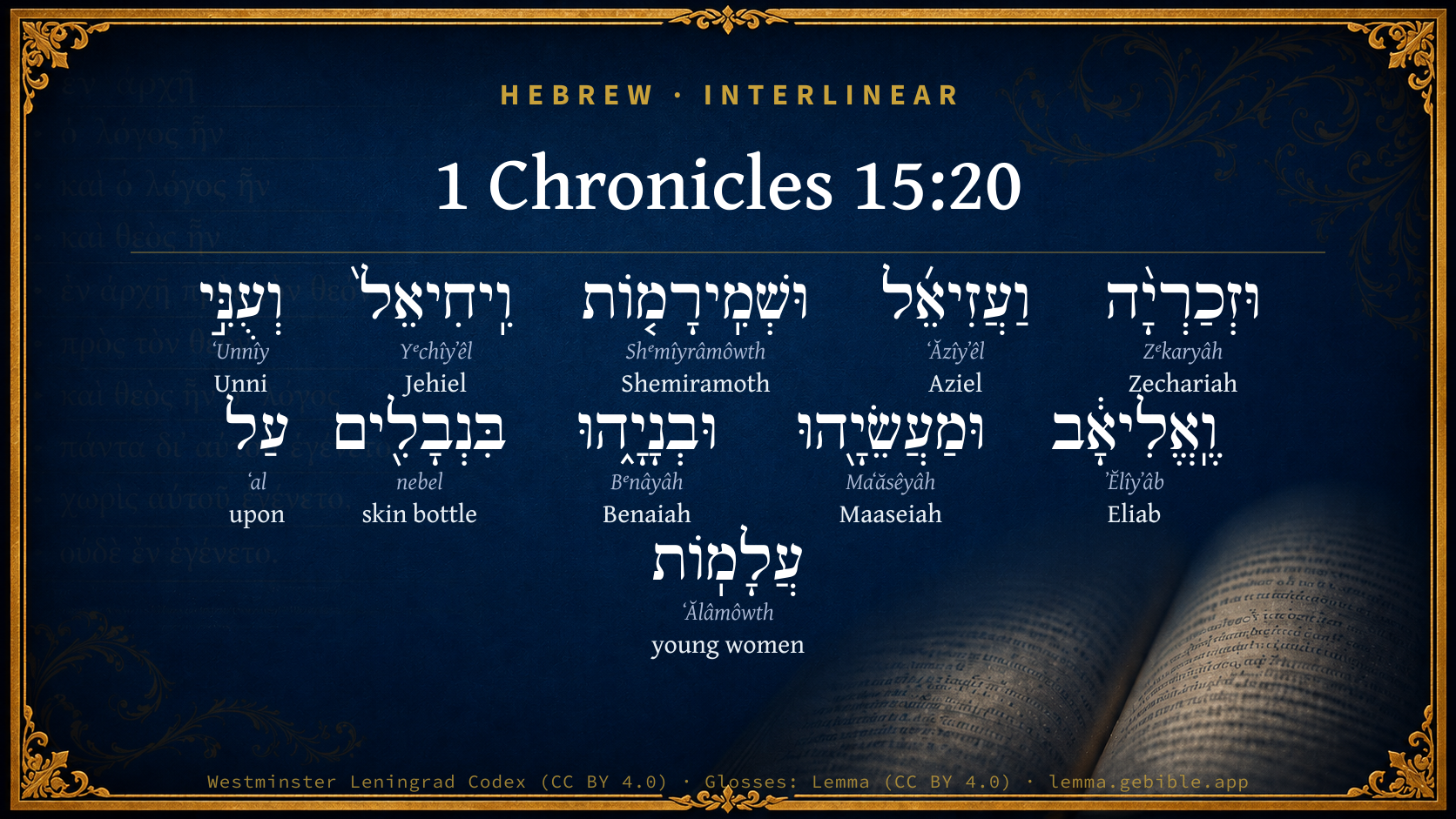
Hebrew (Westminster Leningrad Codex) 1 Chronicles 15:20 appears in the Hebrew Old Testament. The text above is from the Westminster Leningrad Codex. Each word links to its Strong’s number, a concise gloss, and parsing drawn from the Open Scriptures Hebrew Bible morphology. Click any word for its full Brown-Driver-Briggs (BDB) entry.
Download image
Cite this verse

1 Chronicles 15:20 (World English Bible). Public Domain. Lemma interlinear Bible study tool, https://lemma.gebible.app/v/1-chronicles/15/20.

Show BibTeX & RIS
BibTeX
RIS
English Translation
and Zechariah, and Aziel, and Shemiramoth, and Jehiel, and Unni, and Eliab, and Maaseiah, and Benaiah, with psalteries set to Alamoth;
World English Bible · Public Domain
Highlights Full analysis ↓
Download a study sheet

One document with this verse’s original text, its word-by-word gloss line, the meaning frame, cross-references with their text, attributed commentary, and full source and license credits — printable, and it pastes into notes with its structure intact.

This verse Autodidact and up

Study sheet (.html) Plain text (.txt)

A passage Seminary Student

Up to 50 verses in one chapter. A passage sheet keeps up to 6 commentary sources and 12 cross-references per verse, in the order this page ranks them, and says so on the sheet whenever that leaves anything out. Ask for a single verse and you get the Autodidact verse sheet above.

Everything on this page stays free to read, with no account — the sheet is a download of what is already on screen, not access to it.

Want to remove ads? Support Godless Engineer
Compare translations 3

The same verse in 3 English versions, stacked beneath the original-language interlinear above. Click any original word for its lexicon entry.

Each is an independent rendering of the whole verse — the interlinear is not word-aligned to these translations.

Highlighted words mark where these versions differ — a whole-verse word diff, not a word-by-word alignment.

  • World English Bible Public Domain
    and Zechariah, and Aziel, and Shemiramoth, and Jehiel, and Unni, and Eliab, and Maaseiah, and Benaiah, with psalteries set to Alamoth;
  • King James Version Public Domain
    And Zechariah, and Aziel, and Shemiramoth, and Jehiel, and Unni, and Eliab, and Maaseiah, and Benaiah, with psalteries on Alamoth;
  • unfoldingWord Literal Text CC BY-SA 4.0
    And Zechariah and Aziel and Shemiramoth and Jehiel and Unni and Eliab and Maaseiah and Benaiah with lyres, according to Alamoth.

unfoldingWord Literal Text — © unfoldingWord, licensed CC BY-SA 4.0. Word-aligned USFM3 via Door43 (git.door43.org/unfoldingWord/en_ult).

Versions to compare (up to 4)

3 of 4 selected

Show all 18 translations

Every available English version of this verse, each an independent rendering of the whole verse.

  • World English Bible Public Domain
    and Zechariah, and Aziel, and Shemiramoth, and Jehiel, and Unni, and Eliab, and Maaseiah, and Benaiah, with psalteries set to Alamoth;
  • Berean Standard Bible Public Domain
    Zechariah, Aziel, Shemiramoth, Jehiel, Unni, Eliab, Maaseiah, and Benaiah were to play the harps according to Alamoth.
  • Majority Standard Bible Public Domain
    Zechariah, Aziel, Shemiramoth, Jehiel, Unni, Eliab, Maaseiah, and Benaiah were to play the harps according to Alamoth.
  • King James Version Public Domain
    And Zechariah, and Aziel, and Shemiramoth, and Jehiel, and Unni, and Eliab, and Maaseiah, and Benaiah, with psalteries on Alamoth;
  • American Standard Version (1901) Public Domain
    and Zechariah, and Aziel, and Shemiramoth, and Jehiel, and Unni, and Eliab, and Maaseiah, and Benaiah, with psalteries set to Alamoth;
  • Revised Version (1885) Public Domain
    and Zechariah, and Aziel, and Shemiramoth, and Jehiel, and Unni, and Eliab, and Maaseiah, and Benaiah, with psalteries set to Alamoth;
  • Geneva Bible (1599) Public Domain
    And Zechariah, and Aziel, and Shemiramoth, and Iehiel, and Vnni, and Eliab, and Maaseiah, and Benaiah with violes on Alamoth,
  • Douay-Rheims (1899) Public Domain
    And Zacharias, and Oziel, and Semiramoth, and Jehiel, and Ani, and Eliab, and Maasias, and Banaias, sung mysteries upon psalteries.
  • Young's Literal Translation Public Domain
    and Zechariah, and Aziel, and Shemiramoth, and Jeheil, and Unni, and Eliab, and Maaseiah, and Benaiah, with psalteries besides virgins,
  • Literal Standard Version CC BY-SA 4.0
    and Zechariah, and Aziel, and Shemiramoth, and Jeheil, and Unni, and Eliab, and Maaseiah, and Benaiah, with psalteries over the girls’ [voices],
  • Unlocked Literal Bible CC BY-SA 4.0
    Zechariah, Aziel, Shemiramoth, Jehiel, Unni, Eliab, Maaseiah, and Benaiah played the stringed instruments, set to Alamoth.
  • unfoldingWord Literal Text CC BY-SA 4.0
    And Zechariah and Aziel and Shemiramoth and Jehiel and Unni and Eliab and Maaseiah and Benaiah with lyres, according to Alamoth.
  • Darby Bible Public Domain
    and Zechariah, and Aziel, and Shemiramoth, and Jehiel, and Unni, and Eliab, and Maaseiah, and Benaiah, with lutes on Alamoth;
  • World Messianic Bible Public Domain
    and Zechariah, Aziel, Shemiramoth, Jehiel, Unni, Eliab, Maaseiah, and Benaiah, with stringed instruments set to Alamoth;
  • Webster's Bible Public Domain
    And Zechariah, and Aziel, and Shemiramoth, and Jehiel, and Unni, and Eliab, and Maaseiah, and Benaiah, with psalteries on Alamoth;
  • Free Bible Version CC BY-SA 4.0
    Zechariah, Aziel, Shemiramoth, Jehiel, Unni, Eliab, Maaseiah, and Benaiah were to play harps “according to alamoth,”
  • Bible in Basic English Public Domain
    And Zechariah and Aziel and Shemiramoth and Jehiel, Unni and Eliab and Maaseiah and Benaiah, with corded instruments put to Alamoth.
  • JPS Tanakh (1917) Public Domain
    and Zechariah, and Aziel, and Shemiramoth, and Jehiel, and Unni, and Eliab, and Maaseiah, and Benaiah, with psalteries set to Alamoth;

Literal Standard Version (2020), Covenant Press — licensed CC BY-SA 4.0. Text via the HelloAO Bible API (eBible.org). Unlocked Literal Bible (unfoldingWord) — licensed CC BY-SA 4.0. Text via the HelloAO Bible API (eBible.org). unfoldingWord Literal Text — © unfoldingWord, licensed CC BY-SA 4.0. Word-aligned USFM3 via Door43 (git.door43.org/unfoldingWord/en_ult). Free Bible Version, Dr. Jonathan Gallagher — licensed CC BY-SA 4.0. Text via the HelloAO Bible API (eBible.org).

Word by word

More ways to search: Search by grammar → Find every occurrence → Compare this word →

Practice this passage: Drill this verse → Learn its vocabulary →

וַעֲזִיאֵ֜ל
ʻĂzîyʼêl
H5815
“and · Aziel”
Conjunction + Noun, Proper
Part of Speech
Conjunction + Noun
Type
Proper
Full BDB Definition

Origin: from H5756 and H410

TWOT: None

Aziel = "whom God comforts" - a Levite; also 'Jaaziel'
  1. וּזְכַרְיָ֨ה Zᵉkaryâh H2148 “and · Zechariah” Conjunction + Noun, Proper
  2. וּשְׁמִֽירָמ֤וֹת Shᵉmîyrâmôwth H8070 “and · Shemiramoth” Conjunction + Noun, Proper
  3. וִֽיחִיאֵל֙ Yᵉchîyʼêl H3171 “and · Jehiel” Conjunction + Noun, Proper
  4. וְעֻנִּ֣י ʻUnnîy H6042 “and · Unni” Conjunction + Noun, Proper
  5. וֶֽאֱלִיאָ֔ב ʼĔlîyʼâb H446 “and · Eliab” Conjunction + Noun, Proper
  6. וּמַעֲשֵׂיָ֖הוּ Maʻăsêyâh H4641 “and · Maaseiah” Conjunction + Noun, Proper
  7. וּבְנָיָ֑הוּ Bᵉnâyâh H1141 “and · Benaiah” Conjunction + Noun, Proper
  8. בִּנְבָלִ֖ים nebel H5035 “in/at · skin bottles” Preposition + Noun, Common, Masculine, Plural, Absolute
  9. עַל ʻal H5921 “upon” Preposition
  10. עֲלָמֽוֹת ʻĂlâmôwth H5961 “young women” Noun, Common, Feminine, Plural, Absolute

About this verse

These counts appear in no published source. They are computed here, from the morphology-tagged text and Lemma’s own curated glosses. What Lemma adds →

11
words
11
distinct lemmas
Historical
section

Notable vocabulary

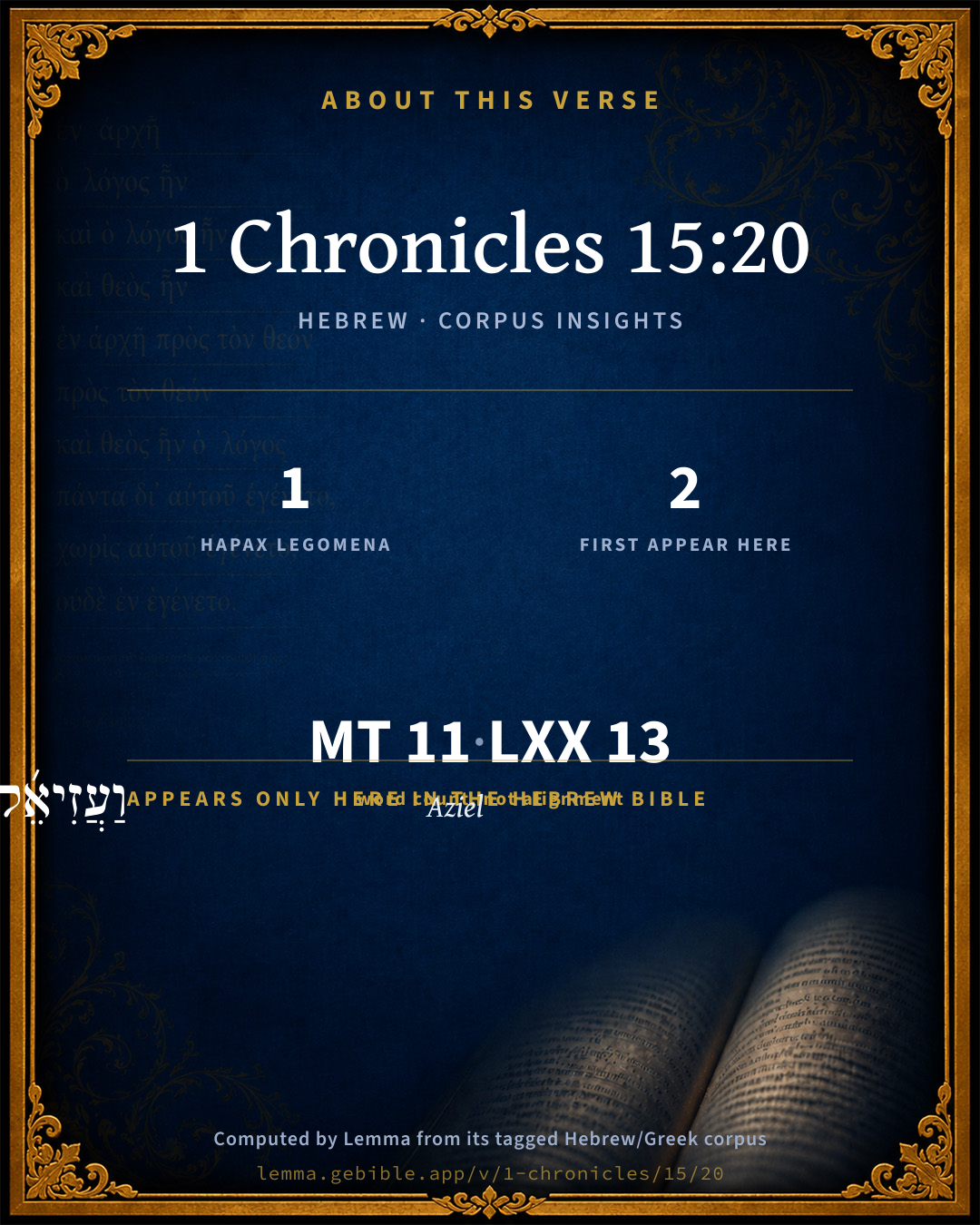
1 hapax legomenon — a word that appears only here in the entire Hebrew Bible:

  • וַעֲזִיאֵ֜ל Aziel H5815

First appearance in Scripture

These words make their first canonical appearance in the Hebrew Bible here:

  • וַעֲזִיאֵ֜ל Aziel H5815
  • עֲלָמֽוֹת young women H5961

Shared distinctive vocabulary

עֲלָמֽוֹת young women H5961 occurs in 2 verses of the Hebrew Bible. Also found in:

Grammatical profile

  • 10 nouns
  • 1 preposition

Hebrew & Septuagint length

In English translation the verse runs 21 words from the Hebrew and 13 from the Septuagint (LXX English) — the Septuagint runs noticeably shorter here. See the side-by-side →

A rough comparison of the two English renderings, which tokenize alike — not a word-level alignment.

Word counts can differ between the Hebrew and the Greek without any difference in meaning — e.g. the Hebrew direct-object marker אֵת has no separate Greek word, and Greek often adds the article ὁ.

In the original languages it is 11 Hebrew tokens and 13 Greek tokens — but the two are counted differently (Hebrew bundles its prefixes and suffixes into one token; the Greek is in lemma form), so that isn’t a like-for-like length.

Cross-references

1

Topical passages linked to 1 Chronicles 15:20 in the Treasury of Scripture Knowledge — connected by theme and wording, ordered by reader-vote popularity; previews shown in the World English Bible.

  • Psalms 46:1–11 God is our refuge and strength, A very present help in trouble.

Cross-references courtesy of OpenBible.info (CC BY 4.0).

Hebrew and Greek witnesses Masoretic Hebrew ↔ Greek Septuagint

The same verse in the two great witnesses to the Old Testament, shown verse-for-verse.

Here the Septuagint runs noticeably shorter than the Hebrew — LXX2012 (modern English Septuagint) 13 words vs World English Bible 21. A rough length comparison of the two English translations, not a word-level alignment — read both below.

These are two independent witnesses, not word-aligned to each other, and the Septuagint is shown in lemma (dictionary) form.

Hebrew 1 Chronicles 15:20 Masoretic · Westminster Leningrad Codex

וּזְכַרְיָ֨ה וַעֲזִיאֵ֜ל וּשְׁמִֽירָמ֤וֹת וִֽיחִיאֵל֙ וְעֻנִּ֣י וֶֽאֱלִיאָ֔ב וּמַעֲשֵׂיָ֖הוּ וּבְנָיָ֑הוּ בִּנְבָלִ֖ים עַל עֲלָמֽוֹת

and Zechariah, and Aziel, and Shemiramoth, and Jehiel, and Unni, and Eliab, and Maaseiah, and Benaiah, with psalteries set to Alamoth;

World English Bible · Public Domain

Greek LXX 1 Chronicles 15:20 Septuagint · lemma form

ζαχαριας καί οζιηλ σεμιραμωθ ιιηλ ωνι ελιαβ μασαιας βαναιας ἐν νάβλα ἐπί αλαιμωθ

Zacharias, and Oziel, Semiramoth, Jeiel, Oni, Eliab, Maasaeas, Banaeas, with lutes, on alaemoth.

LXX2012 (modern English Septuagint) · Public Domain

Hebrew: Westminster Leningrad Codex (CC BY 4.0). Greek: Septuagint (public domain); English from LXX2012 (modern English Septuagint) (Public Domain). How the Septuagint differs from the Hebrew →

Commentary

Notes on 1 Chronicles 15:20 from classic Christian and Jewish commentators (each source and its license shown beneath its notes). The classic Christian expositions comment on the surrounding passage and are grouped to its opening verse, so a note may address several verses; the Jewish commentaries on the Tanakh (Rashi and others) are per-verse, so they appear only where the commentator wrote on this verse.

Lemma curates 59 commentaries, every one of them public domain or Creative Commons licensed, each selected and text-cleaned for this edition rather than reprinted as found. About our sources →

Trapp's Complete Commentary

John Trapp

1Ch 15:20 And Zechariah, and Aziel, and Shemiramoth, and Jehiel, and Unni, and Eliab, and Maaseiah, and Benaiah, with psalteries on Alamoth;

Ver. 20. On Alamoth.] {See Trapp on "Psa 46:1" Title}

John Trapp, A Commentary or Exposition upon All the Books of the Old and New Testament (1647–1656) — public domain. Text from a community e-Sword module.

Joseph Benson's Commentary

1Ch 15:20. With psalteries on Alamoth — Or, with Alamoth, which is thought by many to be the name of an instrument of music; or of a certain tune, or note, or part in music. Houbigant renders the words with psalteries, of a deeper sound. The certain signification of the expression is not now known.

Joseph Benson's Commentary on the Old and New Testaments (1811–1818) — public domain. Text from a community e-Sword module.

Tyndale Open Study Notes

Tyndale Open Resources

15:20 harps: Hebrew adds according to Alamoth. Alamoth is probably a melody, believed to be sung in the soprano range (related to Hebrew ‘almah, “young woman”).

Tyndale Open Study Notes — © Tyndale Open Resources, licensed CC BY-SA 4.0. Text via the HelloAO Bible API.

Geneva Bible (1599)

Geneva Bible translators

This was an instrument of music, or a certain tune, whereunto they accustomed to sing Psalms.

Geneva Bible (1599) marginal notes — public domain. Text via Bolls.life.

Adam Clarke's Commentary

Verse 20. With psalteries on Alamoth] Some suppose that the word signifies virgins, or women singers, the persons mentioned here being appointed to accompany them with psalteries, and preside over them.

The Vulgate says arcana cantabant, they sang secret things or mysteries; probably prophetic hymns.

Adam Clarke's Commentary on the Bible (1810–1826) — public domain. Text from a community e-Sword/MySword module.

Ellicott's Commentary for English Readers

THE ARK.

V. Two warders of the Ark.

VI. The king, with the heads of the nation.

(20) The eight harpers. Perhaps Maaseiah or Benaiah belongs to the next verse. This would give seven (comp. 1Ch_15:24) in each band.

Aziel should be Jaaziel, as in 1Ch_15:18.

Jehiel.—God liveth. Jeiel=Jeuel (1Ch_9:6; 1Ch_9:35), Remembered of God.

With psalteries on Alamoth.—“With harps after the mode of maidens:” that is, probably, of soprano compass or pitch. The same expression occurs in the heading of Psalms 46

A Bible Commentary for English Readers, edited by Charles John Ellicott (1878–1897) — public domain. Text from a community e-Sword module.

The Cambridge Bible for Schools and Colleges

gen. ed. J. J. S. Perowne

20. on Alamoth] R.V. set to Alamoth; cp. Psalms 46 (title) R.V.

The Cambridge Bible for Schools and Colleges (gen. ed. J. J. S. Perowne; Cambridge University Press, 1878–1918) — public domain. Text from a community e-Sword module.

John Gill's Exposition

And Zechariah, and Aziel, and Shemiramoth, and Jehiel, and Unni, and Eliab, and Maaseiah, and Benaiah,.... Who were eight of the second degree; Aziel is the same with Jaaziel, Ch1 15:18 and Ben is left out, in whose room Azaziah, in the next verse, seems to be put; Ben is thought to be sick or dead before they came to execute their office, and whom the father of Kimchi takes to be the same with him who is expressed in the title of Psa 9:1 which title is, "on Muthlabben", or the death of Ben: these were appointed to sound

with psalteries on Alamoth; psalteries were another kind of instruments of music; and Alamoth was either the beginning of a song, to the tune of which those instruments played, or the tune itself, and the note of it; either the treble or counter tenor, a shrill sound, like that of organs, which this word sometimes signifies, see Psa 46:1.

John Gill's Exposition of the Whole Bible (1746–1763) — public domain (CC PDM 1.0). Text via the HelloAO Bible API.

Albert Barnes' Notes on the Bible

Psalteries on Alamoth - Probably, psalteries whose tone resembled the voices of girls (עלמות ‛ălâmôth). Compare the “female flutes” of the Lydians.

Albert Barnes' Notes on the Bible (1834–1885) — public domain. Text from a community e-Sword/MySword module.

Haydock's Catholic Bible Commentary

Zacharias, &c., presided over the second band, with nables, and Mathathias over the third, which had instruments of eight strings. The priests sounded the trumpets, (ver. 24.) which Chonenias directed all the music, in this solemn processions. (Calmet) --- Psalteries. Literally, "nables." (Haydock) --- The Vulgate sometimes renders it psalterion, at other times lyra, (Menochius) or symphonia. (St. Jerome, ad Dard.) (Tirinus) --- Some have supposed that the word denotes bagpipes; but it was a stringed instrument made of wood. (Calmet) --- Hebrew, "with nebalim over halamoth," concerted things, or virgins, (Psalm lxvii. 26.) who sung the mysterious words of God. (Haydock)

George Leo Haydock (1774–1849), Haydock's Catholic Family Bible and Commentary, 1859 edition — public domain. Excludes Psalms (Douay-Rheims chapter numbering differs from Protestant) and Deuterocanonical books (Catholic canon only).

Matthew Poole's English Annotations

In this catalogue Ben is omitted, who was mentioned 1Ch 15:18. Yet others think him to be the same who is called Azaziah, 1Ch 15:21. But Ben might be some other person, who was indeed appointed for this work, as is related, 1Ch 15:17,18; and yet he might be taken off by death or sickness, or some sudden and extraordinary accident which hindered his execution of the place and work allotted for him, which might force the chief of the Levites to appoint some other in his stead, when they came to put their institution in practice, as here they did.

On Alamoth, or, with (as that particle is elsewhere used) Alamoth, which is thought to be the name of an instrument of music; or of a certain tune, or note, or part in music. The certain signification of it is not now known, nor is it necessary for us to know it. And the like may be said of Sheminith, 1Ch 15:21.

Matthew Poole's English Annotations on the Holy Bible (1683–1685) — public domain. Text from a community e-Sword/MySword module.

John Wesley's Explanatory Notes

Alamoth - Or, with Alamoth which is thought to be the name of an instrument of musick; or of a certain tune, or note, or part in musick. The certain signification of it is not now known; and the like may be said of Sheminith, ver. 21.

John Wesley, Explanatory Notes Upon the Whole Bible (1754–1765) — public domain. Text via the GEBible commentary corpus.

Keil & Delitzsch

C. F. Keil & F. Delitzsch

And Zechariah, and Aziel, and Shemiramoth, and Jehiel, and Unni, and Eliab, and Maaseiah, and Benaiah,.... Who were eight of the second degree; Aziel is the same with Jaaziel, Ch1 15:18 and Ben is left out, in whose room Azaziah, in the next verse, seems to be put; Ben is thought to be sick or dead before they came to execute their office, and whom the father of Kimchi takes to be the same with him who is expressed in the title of Psa 9:1 which title is, "on Muthlabben", or the death of Ben: these were appointed to sound

with psalteries on Alamoth; psalteries were another kind of instruments of music; and Alamoth was either the beginning of a song, to the tune of which those instruments played, or the tune itself, and the note of it; either the treble or counter tenor, a shrill sound, like that of organs, which this word sometimes signifies, see Psa 46:1.

Keil & Delitzsch — Biblical Commentary on the Old Testament (1861–1891) — public domain (CC PDM 1.0). Text via the HelloAO Bible API. (Old Testament only.)

Rashi

Rabbi Shlomo Yitzchaki (Rashi)

And Zechariah and Aziel, etc. Those, mentioned in the preceding verse as being gate sentries, were here transferred to become singers.

over alamoth over those instruments with which they played those psalms, entitled: “To the conductor, on alamoth, etc.”

Rashi on the Tanakh — English translations: “The Judaica Press complete Tanach with Rashi, translated by A. J. Rosenberg” (CC BY 4.0); “Pentateuch with Rashi's commentary by M. Rosenbaum and A.M. Silbermann, 1929-1934” (public domain); “The Metsudah Tanach series, Lakewood, N.J” (CC BY 4.0); and “The Book of Joshua, Metsudah Publications, 1997” (CC BY 4.0). Text via Sefaria.

Lesson kit

Teaching starters — assembled from the data on this page, not authored interpretation. Every prompt links to the verse data it draws on. Edit before teaching.

1 Chronicles, in the Historical, opens this verse with 11 words (11 distinct Hebrew lemmas). Its most distinctive word is ʻĂzîyʼêl (“Aziel”). The Greek Septuagint runs shorter here. A historical commentator’s framing appears above. Read the whole chapter for the surrounding context.

Discussion questions

  1. The word ʻĂzîyʼêl carries the sense “Aziel.” How does it shape the verse?
  2. 1 word here appears nowhere else in the Hebrew Bible. Why might the author reach for such rare wording?
  3. 2 words make their first appearance in Scripture here. What does this debut establish?
  4. How does Psalms 46:1, which shares the word «young women», read alongside this verse?
  5. The Septuagint runs shorter here than the Hebrew. What might account for the difference?
  6. These translations render this verse differently; the difference is in the English rendering, not the original. What questions does that raise?
  7. Compare how Trapp's Complete Commentary and Joseph Benson's Commentary read this verse. Where do they agree or differ?

Things to notice

Reading settings

Reading text

Shown beneath each verse's original-language words.

Old Testament
Old Testament edition

Read the OT as the Masoretic Hebrew (MT) or the Greek Septuagint (LXX).

English shown for the Greek Septuagint (in the Hebrew ↔ Greek comparison).

Comparing translations? Open the Compare panel on any verse page to stack up to four side by side.