
Isaiah 22:24

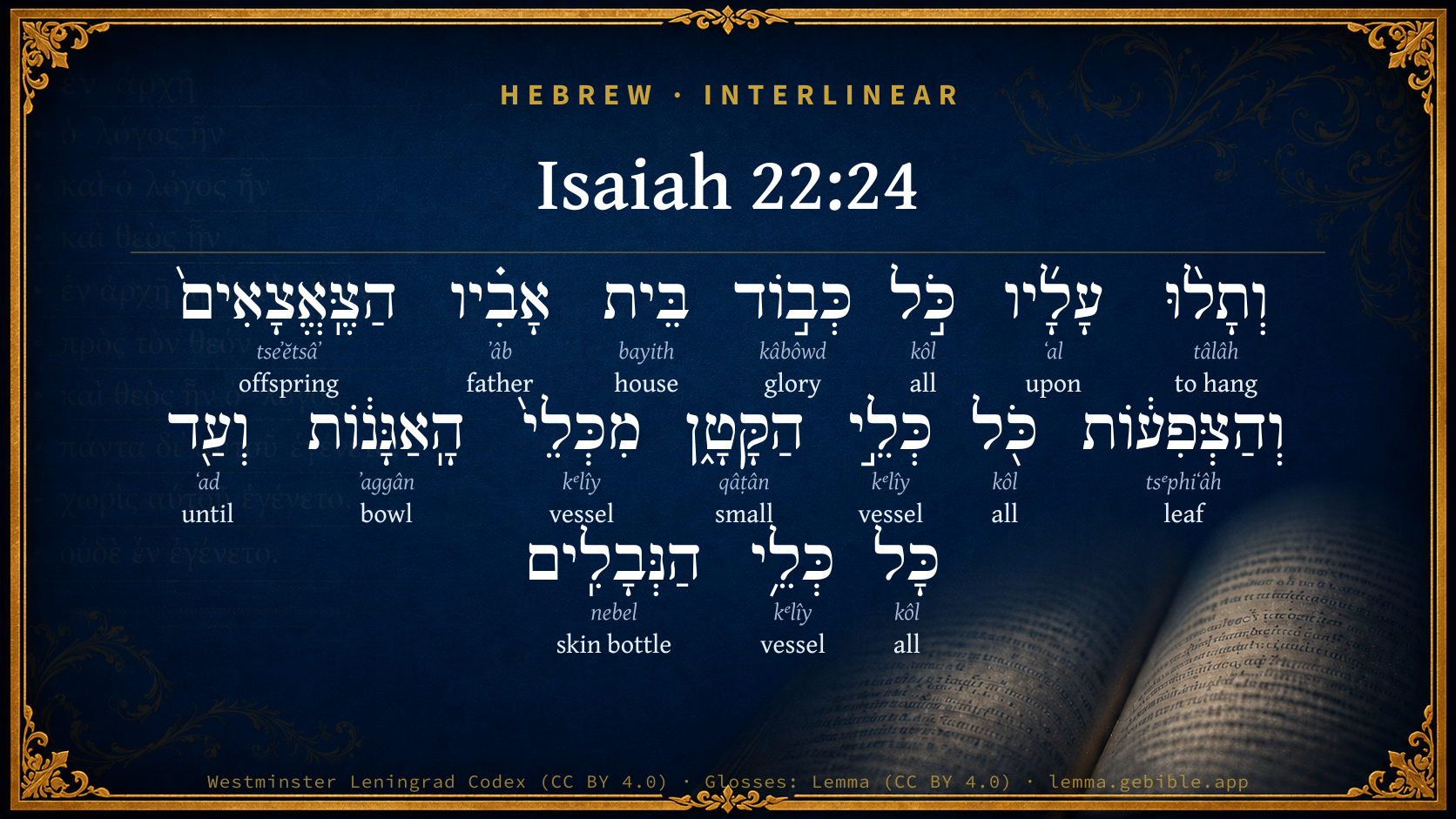
Hebrew (Westminster Leningrad Codex) Isaiah 22:24 appears in the Hebrew Old Testament. The text above is from the Westminster Leningrad Codex. Each word links to its Strong’s number, a concise gloss, and parsing drawn from the Open Scriptures Hebrew Bible morphology. Click any word for its full Brown-Driver-Briggs (BDB) entry.
Download image
Cite this verse

Isaiah 22:24 (World English Bible). Public Domain. Lemma interlinear Bible study tool, https://lemma.gebible.app/v/isaiah/22/24.

Show BibTeX & RIS
BibTeX
RIS
English Translation
They shall hang on him all the glory of his father's house, the offspring and the issue, every small vessel, from the cups even to all the pitchers.
World English Bible · Public Domain
Highlights
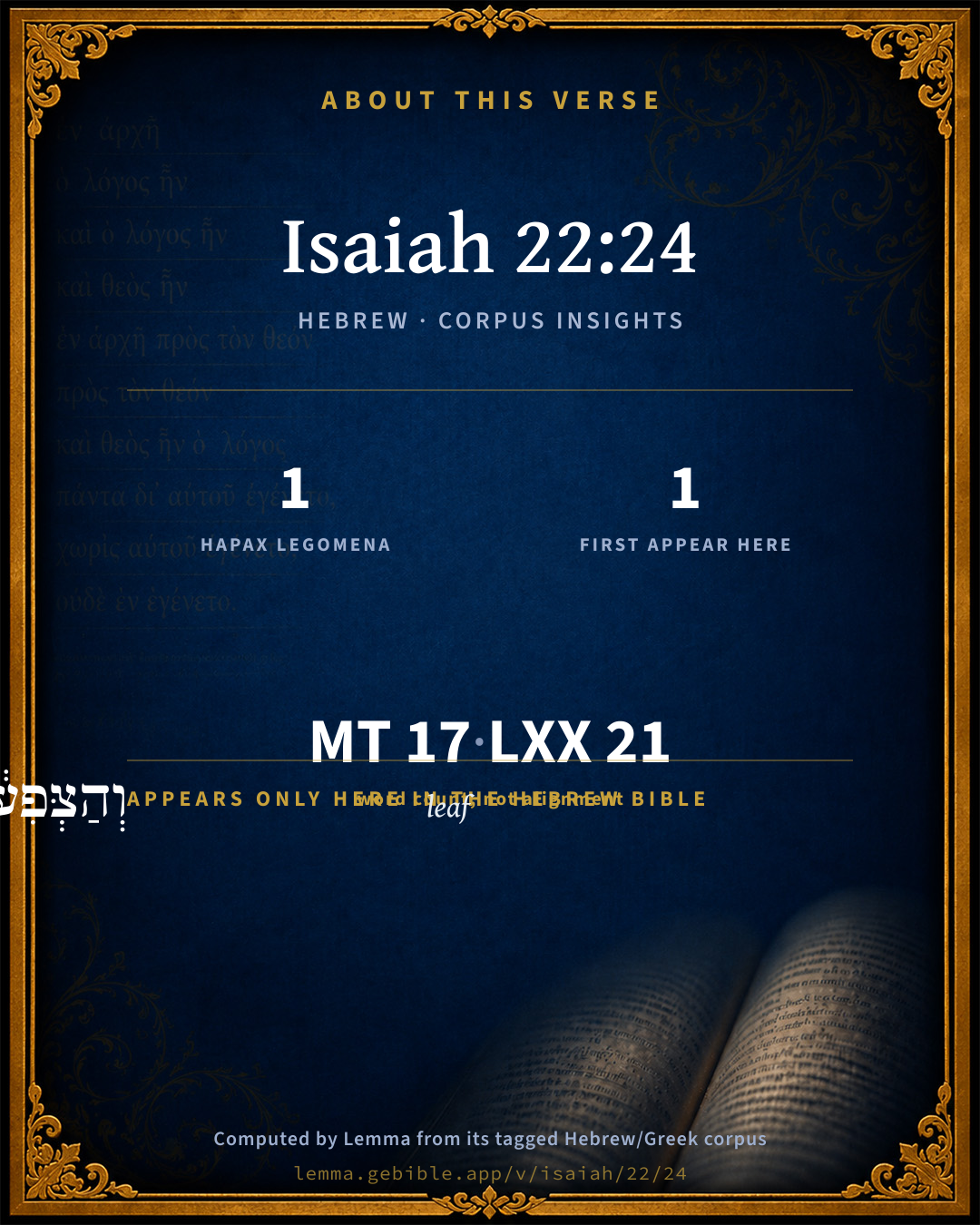
  • 1 hapax legomenon — only here in the Hebrew Bible
  • 1 first appearance in the Hebrew Bible
Full analysis ↓
Download a study sheet

One document with this verse’s original text, its word-by-word gloss line, the meaning frame, cross-references with their text, attributed commentary, and full source and license credits — printable, and it pastes into notes with its structure intact.

This verse Autodidact and up

Study sheet (.html) Plain text (.txt)

A passage Seminary Student

Up to 50 verses in one chapter. A passage sheet keeps up to 6 commentary sources and 12 cross-references per verse, in the order this page ranks them, and says so on the sheet whenever that leaves anything out. Ask for a single verse and you get the Autodidact verse sheet above.

Everything on this page stays free to read, with no account — the sheet is a download of what is already on screen, not access to it.

Want to remove ads? Support Godless Engineer
Compare translations 3

The same verse in 3 English versions, stacked beneath the original-language interlinear above. Click any original word for its lexicon entry.

Each is an independent rendering of the whole verse — the interlinear is not word-aligned to these translations.

Highlighted words mark where these versions differ — a whole-verse word diff, not a word-by-word alignment.

  • World English Bible Public Domain
    They shall hang on him all the glory of his father's house, the offspring and the issue, every small vessel, from the cups even to all the pitchers.
  • King James Version Public Domain
    And they shall hang upon him all the glory of his father's house, the offspring and the issue, all vessels of small quantity, from the vessels of cups, even to all the vessels of flagons.
  • unfoldingWord Literal Text CC BY-SA 4.0
    And they will hang on him all of the glory of the house of his father, the offspring and the descendants, all of the vessels of the small, from the vessels of the bowls and to all of the vessels of the jars.’”

unfoldingWord Literal Text — © unfoldingWord, licensed CC BY-SA 4.0. Word-aligned USFM3 via Door43 (git.door43.org/unfoldingWord/en_ult).

Versions to compare (up to 4)

3 of 4 selected

Show all 18 translations

Every available English version of this verse, each an independent rendering of the whole verse.

  • World English Bible Public Domain
    They shall hang on him all the glory of his father's house, the offspring and the issue, every small vessel, from the cups even to all the pitchers.
  • Berean Standard Bible Public Domain
    So they will hang on him the whole burden of his father’s house: the descendants and the offshoots—all the lesser vessels, from bowls to every kind of jar.
  • Majority Standard Bible Public Domain
    So they will hang on him all the glory of his father’s house: the descendants and the offshoots—all the lesser vessels, from bowls to every kind of jar.
  • King James Version Public Domain
    And they shall hang upon him all the glory of his father's house, the offspring and the issue, all vessels of small quantity, from the vessels of cups, even to all the vessels of flagons.
  • American Standard Version (1901) Public Domain
    And they shall hang upon him all the glory of his father's house, the offspring and the issue, every small vessel, from the cups even to all the flagons.
  • Revised Version (1885) Public Domain
    And they shall hang upon him all the glory of his father’s house, the offspring and the issue, every small vessel, from the vessels of cups even to all the vessels of flagons.
  • Geneva Bible (1599) Public Domain
    And they shall hang vpon him all the glorie of his fathers house, euen of the nephewes and posteritie all small vessels, from the vessels of the cuppes, euen to all the instruments of musike.
  • Douay-Rheims (1899) Public Domain
    And they shall hang upon him all the glory of his father's house, divers kinds of vessels, every little vessel, from the vessels of cups even to every instrument of music.
  • Young's Literal Translation Public Domain
    And they have hanged on him All the honour of the house of his father, The offspring and the issue, All vessels of small quality, From vessels of basins to all vessels of flagons.
  • Literal Standard Version CC BY-SA 4.0
    And they have hanged on him || All the glory of the house of his father, || The offspring and the issue, || All vessels of small quality, || From vessels of basins to all vessels of flagons.
  • Unlocked Literal Bible CC BY-SA 4.0
    They will hang on him all the glory of his father's house, the offspring and descendants, every small container from the cups to all the jugs.
  • unfoldingWord Literal Text CC BY-SA 4.0
    And they will hang on him all of the glory of the house of his father, the offspring and the descendants, all of the vessels of the small, from the vessels of the bowls and to all of the vessels of the jars.’”
  • Darby Bible Public Domain
    and they shall hang upon him all the glory of his father's house, the offspring and the issue, all the small vessels, as well the vessels of cups as all the vessels of flagons.
  • World Messianic Bible Public Domain
    They will hang on him all the glory of his father’s house, the offspring and the issue, every small vessel, from the cups even to all the pitchers.
  • Webster's Bible Public Domain
    And they shall hang upon him all the glory of his father's house, the offspring and the issue, all vessels of small quantity, from the vessels of cups, even to all the vessels of flagons.
  • Free Bible Version CC BY-SA 4.0
    The heavy burden of his father's family will hang on him—all the descendants and the inlaws—all the little containers, bowls and all kinds of jars.
  • Bible in Basic English Public Domain
    And all the glory of his father's family will be hanging on him, all their offspring, every small vessel, even the cups and the basins.
  • JPS Tanakh (1917) Public Domain
    And they shall hang upon him all the glory of his father's house, the offspring and the issue, all vessels of small quantity, from the vessels of cups even to all the vessels of flagons.

Literal Standard Version (2020), Covenant Press — licensed CC BY-SA 4.0. Text via the HelloAO Bible API (eBible.org). Unlocked Literal Bible (unfoldingWord) — licensed CC BY-SA 4.0. Text via the HelloAO Bible API (eBible.org). unfoldingWord Literal Text — © unfoldingWord, licensed CC BY-SA 4.0. Word-aligned USFM3 via Door43 (git.door43.org/unfoldingWord/en_ult). Free Bible Version, Dr. Jonathan Gallagher — licensed CC BY-SA 4.0. Text via the HelloAO Bible API (eBible.org).

Word by word

More ways to search: Search by grammar → Find every occurrence → Compare this word →

Practice this passage: Drill this verse → Learn its vocabulary →

וְהַצְּפִע֔וֹת
tsᵉphiʻâh
H6849
“and · the · leaves”
Conjunction + Particle, Definite Article + Noun, Common, Feminine, Plural, Absolute
Part of Speech
Conjunction + Particle + Noun
Type
Common
Gender
Feminine
Number
Plural
State
Absolute
Full BDB Definition

Origin: from the same as H6848

TWOT: 1953a

offshoot, leaf, shoot - meaning dubious
  1. וְתָל֨וּ tâlâh H8518 “and · to hang” Conjunction + Verb, Qal, Sequential Perfect, 3rd Person, Common, Plural
  2. עָלָ֜יו ʻal H5921 “upon · him” Preposition + Suffix, Personal, 3rd Person, Masculine, Singular
  3. כֹּ֣ל kôl H3605 “all of” Noun, Common, Masculine, Singular, Construct
  4. כְּב֣וֹד kâbôwd H3519 “glory of” Noun, Common, Both, Singular, Construct
  5. בֵּית bayith H1004 “house of” Noun, Common, Masculine, Singular, Construct
  6. אָבִ֗יו ʼâb H1 “father · his” Noun, Common, Masculine, Singular, Construct + Suffix, Personal, 3rd Person, Masculine, Singular
  7. הַצֶּֽאֱצָאִים֙ tseʼĕtsâʼ H6631 “the · offspring” Particle, Definite Article + Noun, Common, Masculine, Plural, Absolute
  8. כֹּ֖ל kôl H3605 “all of” Noun, Common, Masculine, Singular, Construct
  9. כְּלֵ֣י kᵉlîy H3627 “vessels of” Noun, Common, Masculine, Plural, Construct
  10. הַקָּטָ֑ן qâṭân H6996 “the · small” Particle, Definite Article + Adjective, Adjective, Masculine, Singular, Absolute
  11. מִכְּלֵי֙ kᵉlîy H3627 “from · vessels of” Preposition + Noun, Common, Masculine, Plural, Construct
  12. הָֽאַגָּנ֔וֹת ʼaggân H101 “the · bowls” Particle, Definite Article + Noun, Common, Masculine, Plural, Absolute
  13. וְעַ֖ד ʻad H5704 “and · until” Conjunction + Preposition
  14. כָּל kôl H3605 “all of” Noun, Common, Masculine, Singular, Construct
  15. כְּלֵ֥י kᵉlîy H3627 “vessels of” Noun, Common, Masculine, Plural, Construct
  16. הַנְּבָלִֽים nebel H5035 “the · skin bottles” Particle, Definite Article + Noun, Common, Masculine, Plural, Absolute

About this verse

These counts appear in no published source. They are computed here, from the morphology-tagged text and Lemma’s own curated glosses. What Lemma adds →

17
words
13
distinct lemmas
Prophets
section

Notable vocabulary

1 hapax legomenon — a word that appears only here in the entire Hebrew Bible:

  • וְהַצְּפִע֔וֹת leaf H6849

First appearance in Scripture

This word makes its first canonical appearance in the Hebrew Bible here:

  • וְהַצְּפִע֔וֹת leaf H6849

Shared distinctive vocabulary

הָֽאַגָּנ֔וֹת bowl H101 occurs in 3 verses of the Hebrew Bible. Also found in:

Grammatical profile

  • 1 verb
  • 13 nouns
  • 1 adjective
  • 2 prepositions

Verb forms

  • וְתָל֨וּ Qal · Sequential Perfect

Repetition

Words recur within this verse — often emphatic in Hebrew:

  • כֹּ֣ל all H3605 ×3
  • כְּלֵ֣י vessel H3627 ×3

Hebrew & Septuagint length

In English translation the verse runs 28 words from the Hebrew and 31 from the Septuagint (LXX English) — closely comparable.

A rough comparison of the two English renderings, which tokenize alike — not a word-level alignment.

Word counts can differ between the Hebrew and the Greek without any difference in meaning — e.g. the Hebrew direct-object marker אֵת has no separate Greek word, and Greek often adds the article ὁ.

In the original languages it is 17 Hebrew tokens and 21 Greek tokens — but the two are counted differently (Hebrew bundles its prefixes and suffixes into one token; the Greek is in lemma form), so that isn’t a like-for-like length.

Cross-references

9

Topical passages linked to Isaiah 22:24 in the Treasury of Scripture Knowledge — connected by theme and wording, ordered by reader-vote popularity; previews shown in the World English Bible.

  • Daniel 6:1–3 It pleased Darius to set over the kingdom one hundred twenty satraps, who should be throughout the whole kingdom;
  • Matthew 28:18 Jesus came to them and spoke to them, saying, "All authority has been given to me in heaven and on earth.
  • John 5:22–27 For the Father judges no one, but he has given all judgment to the Son,
  • John 20:21–23 Jesus therefore said to them again, "Peace be to you. As the Father has sent me, even so I send you."
  • 2 Timothy 2:20–21 Now in a great house there are not only vessels of gold and of silver, but also of wood and of clay. Some are for honor, and some for dishonor.
  • Genesis 41:44–45 Pharaoh said to Joseph, "I am Pharaoh, and without you shall no man lift up his hand or his foot in all the land of Egypt."
  • Genesis 47:11–25 Joseph placed his father and his brothers, and gave them a possession in the land of Egypt, in the best of the land, in the land of Rameses, as Pharaoh had commanded.
  • Ezekiel 15:3 Shall wood be taken of it to make any work? or will men take a pin of it to hang any vessel thereon?
  • Romans 9:22–23 What if God, willing to show his wrath, and to make his power known, endured with much patience vessels of wrath made for destruction,

Cross-references courtesy of OpenBible.info (CC BY 4.0).

Hebrew and Greek witnesses Masoretic Hebrew ↔ Greek Septuagint

The same verse in the two great witnesses to the Old Testament, shown verse-for-verse.

These are two independent witnesses, not word-aligned to each other, and the Septuagint is shown in lemma (dictionary) form.

Hebrew Isaiah 22:24 Masoretic · Westminster Leningrad Codex

וְתָל֨וּ עָלָ֜יו כֹּ֣ל כְּב֣וֹד בֵּית אָבִ֗יו הַצֶּֽאֱצָאִים֙ וְהַצְּפִע֔וֹת כֹּ֖ל כְּלֵ֣י הַקָּטָ֑ן מִכְּלֵי֙ הָֽאַגָּנ֔וֹת וְעַ֖ד כָּל כְּלֵ֥י הַנְּבָלִֽים

They shall hang on him all the glory of his father's house, the offspring and the issue, every small vessel, from the cups even to all the pitchers.

World English Bible · Public Domain

Greek LXX Isaiah 22:24 Septuagint · lemma form

καί εἰμί πείθω ἐπί αὐτός πᾶς ἔνδοξος ἐν ὁ οἶκος ὁ πατήρ αὐτός ἀπό μικρός ἕως μέγας καί εἰμί ἐπικρεμάννυμι αὐτός

And every one that is glorious in the house of his father shall trust in him, from the least to the greatest; and they shall depend upon him in that day.

LXX2012 (modern English Septuagint) · Public Domain

On this verse, Albert Barnes' Notes on the Bible discusses the Septuagint’s reading. Read the note in Commentary ↓

Hebrew: Westminster Leningrad Codex (CC BY 4.0). Greek: Septuagint (public domain); English from LXX2012 (modern English Septuagint) (Public Domain). How the Septuagint differs from the Hebrew →

Targum (Aramaic paraphrase)

1

The Targum is the ancient Jewish Aramaic paraphrase of the Hebrew Scriptures — an interpretive translation, not the Hebrew text itself. Onkelos (literal) and Pseudo-Jonathan (expansive) render the Torah, and Jonathan the Prophets. Coverage is partial: where no permissively-licensed English translation exists for a verse, only the Aramaic is shown. This is verse-level text, not a word-by-word alignment to the Hebrew.

  1. Targum Jonathan Prophets (Joshua–Malachi)
    וְיִסְתַּמְכוּן עֲלוֹהִי כָּל יַקִירֵי בֵית אָבוּהִי בְּנַיָא וּבְנֵי בְנַיָא מֵרַבְרְבַיָא וְעַד דְעַדְקַיָא מִכַּהֲנַיָא לָבְשֵׁי אֵפוֹדָא וְעַד בְּנֵי לֵוִי אֶחֲדֵי נִבְלַיָא:

    All the nobles of his father's house shall rest themselves upon him, children, and children's children, from young men to little ones, from the priests clothed with the ephod to the Levites that are holding the lyres.

    Targum Jonathan — Aramaic: “Mikraot Gedolot” (public domain). English: “Sefaria Community Translation” (CC0 1.0 (public-domain dedication)); “London "Chaldee Paraphrase," 1871” (public domain). Text via Sefaria.

Commentary

Notes on Isaiah 22:24 from classic Christian and Jewish commentators (each source and its license shown beneath its notes). The classic Christian expositions comment on the surrounding passage and are grouped to its opening verse, so a note may address several verses; the Jewish commentaries on the Tanakh (Rashi and others) are per-verse, so they appear only where the commentator wrote on this verse.

Lemma curates 59 commentaries, every one of them public domain or Creative Commons licensed, each selected and text-cleaned for this edition rather than reprinted as found. About our sources →

The Cambridge Bible for Schools and Colleges

gen. ed. J. J. S. Perowne

24. An under-current of satire seems unmistakeable.

all the glory] perhaps: the whole weight (see “burden” in next verse).

the offspring and the issue] the scions and the offshoots (Cheyne). The second expression is decidedly contemptuous, and so (more or less) are all that follow. It cannot be to Eliakim’s credit that the bulk of his relations are likened to the meanest kitchen utensils.

24, 25. If Isa_22:24 stood alone it might be barely possible to interpret it in a sense favourable to Eliakim. But taken in connexion with Isa_22:25 it seems to convey an imputation of the unworthy exercise of patronage on his part,—a filling of important offices with worthless relatives and dependents. Many commentators, it is true, hold that Isa_22:25 refers back to the fall of Shebna, but this is quite arbitrary. Shebna is not likened to a “nail in a sure place” and it is clearly implied that he had no “father’s house” in Jerusalem (Isa_22:16). It is hardly credible that Isaiah should have uttered such a threat along with the promises in Isa_22:20-23; but the last two verses may be an appendix written later, when abuses of trust in Eliakim’s family had begun to display themselves.

The Cambridge Bible for Schools and Colleges (gen. ed. J. J. S. Perowne; Cambridge University Press, 1878–1918) — public domain. Text from a community e-Sword module.

Trapp's Complete Commentary

John Trapp

Isa 22:24 And they shall hang upon him all the glory of his father’s house, the offspring and the issue, all vessels of small quantity, from the vessels of cups, even to all the vessels of flagons.

Ver. 24. And they shall hang upon him.] As upon a nail.

The offspring and the issue.] All his allies, both great and small, shall be the better for him. He shall employ and prefer them. And this Shebna is told, the more to spite him.

John Trapp, A Commentary or Exposition upon All the Books of the Old and New Testament (1647–1656) — public domain. Text from a community e-Sword module.

The Biblical Illustrator

Joseph S. Exell

Isa_22:24

And they shall hang upon him all the glory of his fathers house

Eliakims family

The vessels, large and small, are figures of the various members of Eliakims family.

As vessels of every kind are suspended upon a nail, so will Eliakims connections, rich and poor alike, support themselves upon his new dignity. (Prof. S. R. Driver, D. D.)

Oriental display of wealth

A large part of the wealth of the ancients consisted of gold and silver vessels, and in changes of showy raiment, of which they made an ostentatious display, by hanging them on the spikes along the walls. It was also common to suspend in houses and temples, suits of armour, swords, shields, and helmets; the spoils of war, or the heirlooms of honoured ancestors (Son_4:4). (J. N. Norton.)

Christ the sole Manager of the Church

I. THE CHURCH IS THE HOUSE OF GOD (Isa_2:2-3; Heb_3:6; 1Pe_2:5).

1. He is the Founder of the house.

2. The Purchaser.

3. The sole Proprietor.

4. Here He hath His abode.

Hence, it must be a very glorious structure. The plan of it was laid by infinite wisdom from all eternity (Pro_9:1).

(1) The foundation of the house is glorious.

(2) The form.

(3) The door (Joh_10:9).

(4) The pillars (Pro_9:1). These are the perfections of the Divine nature as they are manifested in Christ.

(5) The ordinances.

II. CHRIST IS CONSTITUTED THE GREAT MANAGER OF HIS FATHERS HOUSE.

1. In the council of peace, from eternity, He was chosen to be the Builder of the house (Zec_6:12-13).

2. He is the everlasting Father of the family (Isa_9:6).

3. The great Oracle and Counsellor (Isa_9:6).

4. The great Priest (Heb_10:21).

5. The great Lord-Treasurer, yea, the treasury (Col_1:19; Joh_1:16).

6. The great Lord-Steward or Dispenser.

7. The Lawgiver.

III. CHRIST IS FIXED IN THE MANAGEMENT OF THE HOUSE OF GOD, as a nail in a sure place.

1. There is an irreversible decree passed in heaven that He should be the sole Manager and Governor of the house (Psa_2:6-7).

2. He is fixed in the administration of the house with the solemnity of a covenant transaction (Psa_89:3).

3. With the solemnity of an oath taken by the great Jehovah.

4. In His oath He pledges the most dazzling perfection of His nature. He will as soon cease to be a holy God, as suffer His Sons authority in His house to be overturned.

5. He is fixed in the management by a solemn call and investiture.

6. By an actual possession of the throne (Php_2:9-11).

7. By a complete victory over all His and His Churchs enemies, so that none of them are capable to give Him the least disturbance.

IV. THE WHOLE HOUSE, WITH ALL ITS APPURTENANCES, HANGS OR DEPENDS UPON THIS BLESSED NAIL THAT IS FASTENED IN A SURE PLACE.

1. All the glory of the house hangs upon our Lord Jesus Christ.

(1) Gods presence in a Church makes her glorious. It is owing to Christ that the tabernacle of God is with men.

(2) The revelation of the mind and will of God in the Scriptures of truth, is the glory of the Church. Christ is the Alpha and Omega of the whole Scriptures.

(3) A faithful ministry is the glory of a Church. (See Eph_4:11-13.)

(4) The ordinances of the Gospel, dispensed in purity by faithful ministers of Christ, are the glory of a Church. Well, all hang upon the great Manager, such as word and sacrament, prayer and praise.

(5) The judicatories of a Church, higher and lower, constituted in His name, and moulded according to His appointment for the government and for the exercise of the keys of discipline, are the glory of a Church. All this glory hangs upon the nail fastened in a sure place, for He it is that gives the keys of the kingdom of heaven unto His office bearers, and promises that what they bind on earth, shall be bound in heaven; and what they loose on earth, shall be loosed in heaven; and where they assemble in courts for discipline, He will be in the midst of them.

(6) The covenants of a Church are her glory; Gods covenant of grace and promise, and their covenants of duty and gratitude. The covenant, and an the blessings and promises of it, hang upon this blessed nail; they are all in Him, and in Him yea and amen. Our covenants for duty, obedience, and gratitude, hang upon this blessed nail. When men engage to duty in a legal way, they do only make to themselves ropes of sand. All our funds of grace lie in Him.

(7) The multitude of real converts is the glory of a Church. Of His own will He begets us by the word of grace.

(8) The purity, holiness, and faithfulness of Church members are the glory of a Church. This glory hangs upon this blessed nail; for it is by virtue of their union with Him, that they derive sanctifying influence from Him.

2. The offspring and issue of the house are also said to hang upon Christ. By the offspring and issue I understand all true believers.

(1) Their very being, as they are new creatures, hangs upon Him Eph_2:10).

(2) Hence, their life hangs upon Christ. The second Adam is a quickening Spirit.

(3) Have the offspring and issue of the house anything of the light of saving knowledge of God? This hangs upon Christ; for He is the true Sun of Righteousness.

(4) The offspring and issue of the house of God enjoy a glorious liberty. This hangs upon Christ; for if the Son makes us free, then are we free indeed.

(5) They have all the best robe put upon them, when they return from the far country to their Father. Christ is the end of the law for righteousness to everyone that believeth.

(6) Have they anything of the beauty of holiness! Christ is made unto them sanctification.

(7) Have they strength for work or warfare! They are strong in the Lord.

(8) Am they heirs of God and of glory! They are joint-heirs with Jesus Christ.

8. The vessels of the house hang upon this nail fastened in a sure place, from vessels of cups to vessels of flagons.

(1) By the vessels of the house we are to understand believers (2Ti_2:20-21; Act_9:15).

(2) These vessels are of different sizes. In Gods family there are saints of different stature.

V. REASONS OF THE DOCTRINE. Why is Christ constituted sole Manager of His Fathers house? why doth He hang the offspring and issue, and all the vessels, upon Him, as upon a nail fastened in a sure place?

1. He only had ability for bearing such a weight.

2. Christ voluntarily undertook it.

3. Hereby a new revenue of glory is brought in to the God and Father of our Lord Jesus Christ.

4. Hereby all men are brought to honour the Son, as they honour the Father.

5. This was for the safety and comfort of the saints and children of God.

VI. THE APPLICATION OF THE DOCTRINE. (E. Erskine.)

Vessels of cups

A word to weak believers who are designated vessels of cups.

1. It is a high privilege to occupy the least room in the house of our God.

2. God has service for the least vessel of His house, as well as for the largest.

3. The least vessel is Gods property, and He will not disown, but maintain His property, and own it before men and angels, saying, They are Mine, in the day when He makes up His jewels.

4. The bands, by which you hang upon the nail fastened in a sure place, are as strong as those by which the vessels of flagons are secured; for He has said as to both, They shall never perish, neither shall any pluck them out of My hand.

5. The weakest measure of grace is a pledge of more; for to him that hath be given.

6. Although you are not to envy or grudge at Gods bounty liberality to others, in making them vessels of flagons, yet you may and ought earnestly to covet more grace than you have yet received. (E. Erskine.)

The vessels of flagons,

The vessels of flagons, i.e., believers of a higher stature.

1. Be not proud of grace received, but walk humbly with your God. What hast thou that thou hast not received?

2. Instead of despising others that are not come your length, study to be helpful and serviceable unto them. The vessels of cups are ordinarily filled out of the flagons; so study to impart and communicate of your grace, of your faith, love, hope, knowledge, and other graces, unto those that are weak ingrate. The strong children in a family are helpful to the young and weak.

3. Whatever grace you have received, be not confident therein, like Peter; but be strong in the that is in Christ Jesus, sad let the life you live be by faith in the Son of God. (E. Erskine.)

Christ the glory of His Fathers house

By Christs Fathers house is meant His Church.

I. ON CHRIST JESUS HANGS ALL THE GLORY OF THE REDEMPTION OF HIS FATHERS HOUSE.

II. ON THE LORD JESUS CHRIST HANGS ALL THE GLORY OF THE INSTRUCTION OF HIS FATHERS HOUSE. There is a two gold light which the Lord Jesus imparts to the members of His Fathers house. There is the light of His Word, those Scriptures which testify of Him as the Way, the Truth, and the Life. The Scriptures, however, are not, of themselves, sufficient for spiritual illumination. The light of the Spirit must accompany the truth revealed in the Word, that it may become effectual for salvation. The Holy Spirit is the fruit of the Redeemers purchase. It is His glorious office to take of the things of Christ and show these to the soul. It is in the light of the Divine Word and Spirit that we discern aright the way of acceptance and the path of duty.

III. ON THE LORD JESUS CHRIST HANGS ALL THE GLORY OF THE RENOVATION OF HIS FATHERS HOUSE. When He ascended on high, He received gifts for men; even the seven Spirits before the throne--the Holy Ghost, in His quickening, renewing, and sanctifying grace. These gifts are bestowed, let it be carefully noted, in virtue of the believers union with the Lord Jesus Christ, through the instrumentality of living faith.

IV. ON THE LORD JESUS CHRIST HANGS ALL THE GLORY OF THE GOVERNMENT OF HIS FATHERS HOUSE. They are under law to Christ as the sole Ruler of the house. We must take order from Him; for One is our Master, even Christ.

V. ON THE LORD JESUS CHRIST HANGS ALL THE GLORY OF THE VICTORIES OF HIS FATHERS HOUSE. The Christian Church, both collectively and in its individual members, is in an enemys country on this side heaven. It is the Christians solace to be assured that he has not been sent a warfare on his own charges. Apart from the clear and full revelations of Scripture, no subject of human contemplation is so saddening as death. He, on whom hangs all the glory of His Fathers house, is Himself the Resurrection and the Life. Conclusion--Let us seriously inquire whether we are members of that house. Mere external relationship to it will avail us nothing. We must be united in the bonds of faith and love to the Lord Jesus. (J. Smyth, D. D.)

The glory of the Mediator

The idea in the text seems to embrace this statement: That every attribute belonging to God is concentrated in the Saviour, as God manifest in the flesh, and that the Father is most glorified when we give in our services all the glory to His Son.

I. UPON HIM HANGS ALL THE GLORY OF HIS FATHERS HOUSE OF CREATION. By Him were all things made, and without Him was not anything made that was made.

II. UPON HIM HANGS ALL THE GLORY OF HIS FATHERS HOUSE OF PROVIDENCE. And what is providence but creation continued, in upholding, governing, and guiding all things to accomplish their predestined end? Jesus Christ is on the throne; every painful feeling is anticipated, every tear is bottled, every anxiety alleviated, every distress sanctified. He is our Saviour, our Friend, our Refuge and Strength.

III. UPON HIM HANGS ALL THE GLORY OF HIS FATHERS HOUSE OF GRACE. Christs kingdom is a spiritual one, set up within the believers soul.

IV. UPON HIM HANGS ALL THE GLORY OF HIS FATHERS HOUSE OF HEAVEN. I go to prepare a place for you. I will come again, and receive you to Myself; that where I am, there ye may be also. Worthy is the Lamb that was slain to receive power, and riches, and wisdom, and strength, and honour, and glory, and blessing; and thus the ransomed and renewed universe will hang upon Him all the glory of His Fathers house. (F. Newman, D. D.)

The Biblical Illustrator, edited by Joseph S. Exell (c. 1880s–1900s) — public domain. Text from a community e-Sword module.

Joseph Benson's Commentary

Isa 22:24-25. They shall hang upon him all the glory of his father’s house — Of his own kindred and family, who shall all depend upon him, and receive glory from him; the offspring and the issue — Great and small, the children and grand-children, of his father’s house. All vessels of small quantity — The meanest of them shall receive a lustre and advantage from their relation to him; from the vessels of cups, &c. — All sorts of vessels, great or small, mean or precious, may be hanged upon him, without any fear of falling. In that day shall the nail, &c. — This must be understood of Shebna, as a repetition and confirmation of the sentence above denounced against him; shall the nail that is fastened — That seemed to be so, both in his own eyes, and in the eyes of others; be removed and fall — As above described; and the burden that was upon it shall be cut off — All those wicked officers that were advanced and supported by his power.

Joseph Benson's Commentary on the Old and New Testaments (1811–1818) — public domain. Text from a community e-Sword module.

The Preacher's Complete Homiletical Commentary

Joseph S. Exell (gen. ed.)

THE GLORY OF THE MESSIAH

Isa_22:24. And they shall hang upon him all the glory of his father’s house—

As on the nails or spikes fixed in the walls of the ancient temples and palaces it was customary to hang suits of armour, shields, helmets, swords, &c., that had been taken in war as spoils of victory, or that had been used by illustrious ancestors. The declaration is made concerning Eliakim, and the meaning of it is, that all his relatives would connect with him all they deemed illustrious, and would rest upon him as their common support. Some of the expressions used concerning him are appropriated by our Redeemer to Himself (comp. Isa_22:22 and Rev_3:7); and, without adopting the view that Eliakim was a type of Christ, we may say that, true as this declaration was concerning Eliakim, it is still more eminently true of Him to whom “the key of David” belongs by right. Upon Him they shall hang all the glory of His Father’s house.”

I. THE GLORY THAT IS PLACED UPON CHRIST. Applying the text to Christ, the phrase “His father’s house” acquires a new and more glorious significance, even that of the Church of the living God, the one family in heaven and on earth. All the glory of that spiritual and eternal house depends upon and is justly ascribed to Christ.

1. All the glory of purchasing the Church. All the persons of whom it is composed were in circumstances of bondage and misery, yea, under sentence of death, from which He ransomed them at inconceivable cost (1Pe_1:18-19).

2. All the glory of redeeming the Church. This is not a mere repetition of what has just been said. We are the subjects of a twofold redemption—a redemption of price and a redemption of power. From the penalties of sin Christ redeemed us by His blood; from the power of sin, by His Spirit. A supremely difficult and an eternally glorious task is that which He thus undertook and has accomplished.

3. All the glory of preserving the Church. What a marvellous history of dangers and deliverances it has had!

4. All the glory of perfecting the Church. It shall be complete in number, complete and resplendent with every spiritual grace. Remember what marvellous symbols are employed to set forth the beauty and the preciousness of its component parts, what treasures of spiritual wisdom and grace are already included in it. Hereafter, when it shall stand in all its radiance, the wonder and the admiration of all heavenly intelligences, all the glory of it shall hang upon Christ.

II. THE PERSONS WHO UNITE IN PLACING THIS GLORY ON CHRIST. “They shall hang,” &c. The penitent sinner hangs upon Christ all the glory of his hope of acceptance with God.

2. The justified believer hangs upon Him all the glory of the favoured position in which he stands.

3. The spiritual veteran hangs upon Him all the glory of His triumphs.

4. The dying Christian hangs upon Him all the glory of the calmness and courage with which he advances to the final victory.

5. The glorified Church hangs upon Him all the glory of its perfected salvation.

6. Angels and archangels, though they were not the subjects of redemption, join in the song of salvation (Rev_5:11-13), and ascribe to Him all the splendour in which they shine.

7. GOD exalted Him to the right hand of power, and gave Him a Name above every name (Php_2:9-11).

“Oh that with yonder sacred throng

We at His feet may fall,

Join in the everlasting song,

And crown Him Lord of all!”

—George Smith, D.D.

The Preacher's Complete Homiletical Commentary (gen. ed. Joseph S. Exell; Funk & Wagnalls, c. 1892) — public domain (pre-1929). A full-Bible homiletical/sermon-outline anthology covering 65 of 66 books (2 John is absent from the source module). Text from a community e-Sword module.

Geneva Bible (1599)

Geneva Bible translators

Meaning that both small and great that shall come of Eliakim, shall have praise and glory by his faithful officer.

Geneva Bible (1599) marginal notes — public domain. Text via Bolls.life.

Jamieson, Fausset & Brown

Robert Jamieson, A. R. Fausset & David Brown

Same image as in Isa 22:23. It was customary to "hang" the valuables of a house on nails (Kg1 10:16-17, Kg1 10:21; Sol 4:4).

offspring and the issue--rather, "the offshoots of the family, high and low" [VITRINGA]. Eliakim would reflect honor even on the latter.

vessels of cups--of small capacity: answering to the low and humble offshoots.

vessels of flagons--larger vessels: answering to the high offshoots.

Jamieson, Fausset & Brown — Commentary Critical and Explanatory on the Whole Bible (1871) — public domain (CC PDM 1.0). Text via the HelloAO Bible API.

Adam Clarke's Commentary

Verse 24. All the glory] One considerable part of the magnificence of the eastern princes consisted in the great quantity of gold and silver vessels which they had for various uses. "Solomon's drinking vessels were of gold, and all the vessels of the house of the forest of Lebanon were of pure gold; none were of silver; it was nothing accounted of in Solomon's days;" 1Kg 10:21. "The vessels in the house of the forest of Lebanon," the armoury of Jerusalem so called, "were two hundred targets, and three hundred shields of beaten gold." Ibid. 1Kg 10:16-17. These were ranged in order upon the walls of the armoury, (see So 4:4,) upon pins worked into the walls on purpose, as above mentioned. Eliakim is considered as a principal stake of this sort, immovably fastened in the wall for the support of all vessels destined for common or sacred uses; that is, as the principal support of the whole civil and ecclesiastical polity. And the consequence of his continued power will be the promotion and flourishing condition of his family and dependents, from the highest to the lowest.

Vessels of flagons - "Meaner vessels"] נבלים nebalim seems to mean earthen vessels of common use, brittle, and of little value, (see La 4:2; Jer 48:12,) in opposition to אגנות aganoth, goblets of gold and silver used in the sacrifices. Ex 24:6.

Adam Clarke's Commentary on the Bible (1810–1826) — public domain. Text from a community e-Sword/MySword module.

Ellicott's Commentary for English Readers

(24) And they shall hang upon him all the glory of his father’s house . . .—The metaphor of the nail is resumed. Not without a touch of irony, as the sequel shows, the prophet paints the extent to which those who belong to Eliakim will hang upon his support. There will be the “glory” or the “weight” (the Hebrew word has both meanings) of his next-of-kin. Besides these there will be the remoter off-shoots and side-shoots of his family. But the number will increase, and upon that single nail, or peg, would hang the “vessels of small quantity,” cups such as were used by the priests for the blood of the victims in sacrificing (Exo_24:6), or for wine in common use (Song Son_7:2), flagons, or earthen pitchers, as in Isa_30:14; Lam_4:2, i.e., the whole crowd of the retainers of a great official. The prophet obviously paints the picture as a warning. There was the danger even for Eliakim, upright and religious as he was, as there has been for others like him, of giving way to nepotism, and the fault would not remain unpunished.

A Bible Commentary for English Readers, edited by Charles John Ellicott (1878–1897) — public domain. Text from a community e-Sword module.

John Gill's Exposition

And they shall hang upon him all the glory of his father's house,.... Which shows the reason of his being compared to a nail; not to one that fastens pieces of timber together, or to a nail or stake drove in the ground, to which the cords of tents are fastened, but to a nail in a wall, on which things are hung: and the meaning is, that all of his father's family would be dependent upon him, be supported by him, and receive honour and glory from him: and which also is true of Christ the antitype; the glory of building his Father's house, the church, and of saving it, and of making of it glorious, belongs to him, and is given to him; it is put upon him, and it is visible on him, and it is weighty, and will continue:

the offspring and the issue; all the descendants of his father's family, sons and daughters, children and grandchildren; so the Targum,

"and all the glorious or noble ones of his father's house shall lean upon him, children, and children's children:''

so all the children of God, and who are also Christ's spiritual seed and offspring, these depend upon him for grace, and all the supplies of it; they boast in him for righteousness and strength, and rely upon him for life and salvation:

all vessels of small quantity; from the vessels of cups, even to all the vessels of flagons; meaning those of his family, that were some of lesser, others of greater capacities, for whom he provided places and posts under him, suitable thereunto; none were forgotten or neglected by him: this simile, of vessels of various sorts and sizes, is made use of, in perfect agreement with Eliakim's being compared to a nail, on which vessels in a house are hung by their handles. The Targum is,

"from young men to little ones; from the priests clothed with the ephod, to the Levites that held the psalteries.''

In the typical sense, it is to be understood of the vessels of mercy; some of which are larger, and others lesser; some capable of receiving more grace and larger gifts, and others less; to whom Christ communicates, and whom he fills, according to their capacities; all whose wants he supplies, and whose persons he supports; he fills them with his grace, and he fits them for glory; see Rom 9:23.

John Gill's Exposition of the Whole Bible (1746–1763) — public domain (CC PDM 1.0). Text via the HelloAO Bible API.

Albert Barnes' Notes on the Bible

And they shall hang upon him - This figure is a continuation of that commenced in the previous verse; and is derived from the custom of “hanging” clothes or ornaments on the spikes that were fixed in the walls; and, perhaps, more particularly from the custom of suspending shields, swords, suits of armor, etc., taken in battle, around the walls of a temple. A great portion of the wealth of the ancients consisted in gold and silver vessels, and in changes of raiment. These would be hung around a house in no inconsiderable degree for ostentation and parade. ‘Solomon’s drinking vessels were of gold; and all the vessels of the forest of Lebanon were of pure gold; none were of silver’ 1Ki 10:21. ‘The vessels in the house of the forest of Lebanon were two hundred targets and three hundred shields of beaten gold’ 1Ki 10:16-17. That these were hung on spikes or pins around the house is apparent from Son 4:4 : ‘Thy neck is like the tower of David, builded for an armory, whereon there bans a thousand bucklers, all shields of mighty men.’ Eliakim is considered as a principal support like this, whereon would be suspended all the glory of his father’s family, and all the honor of his house; that is, he would be the principal support of the whole civil and ecclesiastical polity.

The offspring and the issue - All that proceeded from the family; all that were connected with it. Kimchi and Aben Ezra render it, ‘Sons and daughters.’ The Septuagint: ‘From the least to the greatest.’ The Chaldee, ‘Sons and grandsons, youth and children.’ The idea is, that all the prosperity, near and remote, would depend on him; and that his character would sustain and give dignity to them all. The word which is rendered ‘issue’ (הצפעות hatsepi‛ôt), according to Vitringa and Rosenmuller, denotes those that were of humble condition; and the passage means that honor would be conferred even on these by the virtues of Eliakim.

From the vessels of cups - literally, goblets, or bowls (אגנות 'āgânôt). The idea probably is, simply that of vessels of “small capacity,” whatever was the material of which they were composed; and hence, the reference here is to those of the family of Eliakim who were of humble rank, or who were poor.

To all the vessels of flagons - Margin, ‘Instruments of viols.’ Hebrew, נבלים nebâliym. This word is often applied to instruments of musica the נבל nebel, viol (see it described in the notes at Isa 5:12; Isa 14:11); but it properly denotes a bottle made of skin for holding wine, and which, being made of the whole skin of a goat or sheep, indicated the vessels of large dimensions. Here it refers to the members of the family of Eliakim who were more wealthy and influential than those denoted by the small vessels. The glory of the whole family would depend on him. His virtues, wisdom, integrity, and valor in defending and saving the Hebrew commonwealth, would diffuse honor over the whole family connection, and render the name illustrious.

Albert Barnes' Notes on the Bible (1834–1885) — public domain. Text from a community e-Sword/MySword module.

Haydock's Catholic Bible Commentary

House. He shall be the ornament of the priesthood. --- Music. All affairs in church and state shall be at his disposal.

George Leo Haydock (1774–1849), Haydock's Catholic Family Bible and Commentary, 1859 edition — public domain. Excludes Psalms (Douay-Rheims chapter numbering differs from Protestant) and Deuterocanonical books (Catholic canon only).

Matthew Poole's English Annotations

Of his father’s house; of his own kindred and family, who shall all depend upon him, and receive glory from him; of the house of David, which is called

his father’s house, either because kings are called the fathers of all their subjects, both in Scripture, as 1Sa 24:11; 2Ki 5:13; 16:7, and in other authors; or, as Calvin ingeniously conjectures, because he was of the blood royal. Otherwise this had been no great commendation to him, that he studied so much the advancement of his own private family. And this seems more probable, because this character is opposed to that of Shebna, who was the shame of his lord’s, to wit, the king’s, house or family, Isa 22:18. The offspring and the issue; great and small, the children and grandchildren of his father’s house.

All vessels of small quantity; the meanest of them shall receive a lustre and advantage from their relation to him.

From the vessels of cups, even to all the vessels of flagons; all sorts of vessels, great or small, mean or precious, may be hanged upon him, without any fear of falling; whereas ordinary nails or pins, if they be oppressed with too great weight, are easily broken down, and the vessels fall with them.

Matthew Poole's English Annotations on the Holy Bible (1683–1685) — public domain. Text from a community e-Sword/MySword module.

Whedon's Commentary on the Bible

Daniel D. Whedon

24. I will fasten… as a nail — As a peg or spike fastened in the wall in Oriental houses, on which family ornaments were suspended. The sense is, all that is valuable to the nation rests on him.

Glorious throne to his father’s house — It seems idle to suppose, with Delitzsch, that here begins an intimation of Eliakim’s gradual fall from his integrity to the government by observing nepotism in appointing his relatives only to offices. The expression rather indicates fidelity. He is to the government as the tentpin in a strong setting, or nail firmly fixed in the wall. He is the faithful prefect of the house, the palace; the seat whence issue all government advices.

Daniel D. Whedon (gen. ed.), Commentary on the Old and New Testaments (1874–1909) — public domain. Text from a community e-Sword module.

The Pulpit Commentary

All the glory. According to scriptural notions, the "glory" of a family consists very much in its size. (Gen_15:5 Psa_127:5, etc.) And Christ"s glory in his final kingdom will consist greatly in the number of the saved. (Rev_7:4-9) The offspring and the issue; i.e. the flourishing scions, and the despised seedlings alike. The word translated "issue" is a term of contempt. (see Eze_4:15) From the vessels of cups; rather, of bowls. (comp. Exo_24:6) To all the vessels of flagons; rather, of pitchers. "A numerous, undistinguished, family connection" seems to be intended (Delitzsch).

The Pulpit Commentary (1880–1919), ed. H.D.M. Spence-Jones & Joseph S. Exell — public domain. Text from a community e-Sword module.

John Wesley's Explanatory Notes

The glory - Of his own kindred and family, who shall all depend upon him, and receive glory from him; of the house of David, which is called his father's house, because he was of the blood-royal. The offspring - Great and small, the children and grand-children of his father's house, the meanest of them shall receive a lustre from their relation to him. All vessels - All sorts of vessels, great or small, mean or precious, may be hanged upon him, without any fear of falling.

John Wesley, Explanatory Notes Upon the Whole Bible (1754–1765) — public domain. Text via the GEBible commentary corpus.

J. A. Alexander on Isaiah

Joseph Addison Alexander

“And they shall hang upon him all the honor of his father’s house, the offspring and the issue all vessels of small quantity from vessels of cups even to all vessels of flagons.” Here the figure of a nail is resumed. The dependents of Eliakim are represented as suspended on him as their sole support. The words translated offspring and issue, are expressions borrowed from the vegetable world. It is commonly assumed by interpreters that the two words are in antithesis, denoting either different sexes (sons and daughters), or different generations (sons and grandsons), or different ranks, which last is the usual explanation. The next phrase is designed to show that even the least are not to be excepted. The two expressions in the last clause may be taken either as equivalent or as contrasting the gold and silver vessels of the altar (Exo 24:6) with common earthen utensils (Jer 48:12; Lam 4:2).

Joseph Addison Alexander, The Prophecies of Isaiah (1846–1847; New York: Scribner, 1870–1878) — public domain. Text from a community e-Sword module.

Rashi

Rabbi Shlomo Yitzchaki (Rashi)

the children and the grandchildren (צֶאֱצָאִים וּצְפִיעוֹת). Jonathan renders: the children and the children’s children. Menachem (Machbereth p. 151) associates it with, (Ezekiel 4:15) “Cattle dung (צְפִיעֵי).” This teaches us that it is an expression of tiny infants that issue forth from their mother’s womb. making צְפִיעוֹת an expression of coming out, i.e., a thing that comes out.

all the small vessels the smallest of their families shall take pride in him and rely on him.

from the vessels of basins to the vessels of the lyres Jonathan paraphrases: From the priests who wear the ephod to the Levites who hold the lyres. Accordingly, it is an expression of the ministration vessels with which the priests perform the service in the Temple.

the lyres with which the Levites recite the song during the offering of the sacrifices.

Rashi on the Tanakh — English translations: “The Judaica Press complete Tanach with Rashi, translated by A. J. Rosenberg” (CC BY 4.0); “Pentateuch with Rashi's commentary by M. Rosenbaum and A.M. Silbermann, 1929-1934” (public domain); “The Metsudah Tanach series, Lakewood, N.J” (CC BY 4.0); and “The Book of Joshua, Metsudah Publications, 1997” (CC BY 4.0). Text via Sefaria.

Ibn Ezra

Rabbi Abraham ibn Ezra

And they shall hang, etc. Having compared Eliakim with a nail, the prophet continues, they shall hang upon it, etc.

הצאצאים The offspring. The children that will come out of him.

והצפיעות And the issue. The female children are perhaps meant; comp. יצא צפע shall come forth a cockatrice (14:29). Since he is said to be the father, the men of Judah are as it were his sons, and the women his daughters. All vessels of small quantity. The children are compared to small vessels.

האגנות The cups. (Comp. 24:6). The gold was perhaps kept in those vessels.

כלי הנבלים. The vessels of psalteries. Musical instruments. Nothing will remain in the royal palace, that should not be placed under his authority.

Ibn Ezra on the Tanakh — English translations: “Sefaria Community Translation” (CC0 1.0 (public-domain dedication)); “Yalkut, Sifsei Chachomim Chumash, Metsudah Publications, 2009” (CC BY 4.0); and “Commentary of Ibn Ezra on Isaiah - trans. by M. Friedlander, 1873” (public domain). Text via Sefaria.

Lesson kit

Teaching starters — assembled from the data on this page, not authored interpretation. Every prompt links to the verse data it draws on. Edit before teaching.

Isaiah, in the Prophets, opens this verse with 17 words (13 distinct Hebrew lemmas). Its most distinctive word is tsᵉphiʻâh (“leaf”). A historical commentator’s framing appears above. Read the whole chapter for the surrounding context.

Discussion questions

  1. How does “leaf” (tsᵉphiʻâh) shape what this verse is saying?
  2. 1 word here appears nowhere else in the Hebrew Bible. Why might the author reach for such rare wording?
  3. This is the first place “leaf” appears in Scripture (first appears here). What does its debut here establish?
  4. How does Exodus 24:6, which shares the word «bowl», read alongside this verse?
  5. What does the repetition of “all” (3× in this one verse) do in this verse?
  6. These translations render this verse differently. What is at stake in choosing one wording over another?
  7. «וְתָל֨וּ» is a Qal Sequential Perfect verb. How does that grammatical form shape the action described?
  8. Compare how The Cambridge Bible for Schools and Colleges and Trapp's Complete Commentary read this verse. Where do they agree or differ?

Things to notice

  • 1 word in this verse appears nowhere else in the Hebrew Bible.
  • 1 word makes its first canonical appearance in Scripture here.
  • This verse counts 17 Hebrew ↔ 21 Greek words.
  • These translations choose different wording for 17 words in this verse.
  • “all” occurs 3× in this single verse.

Reading settings

Reading text

Shown beneath each verse's original-language words.

Old Testament
Old Testament edition

Read the OT as the Masoretic Hebrew (MT) or the Greek Septuagint (LXX).

English shown for the Greek Septuagint (in the Hebrew ↔ Greek comparison).

Comparing translations? Open the Compare panel on any verse page to stack up to four side by side.