
2 Samuel 6:5

Hebrew (Westminster Leningrad Codex) 2 Samuel 6:5 appears in the Hebrew Old Testament. The text above is from the Westminster Leningrad Codex. Each word links to its Strong’s number, a concise gloss, and parsing drawn from the Open Scriptures Hebrew Bible morphology. Click any word for its full Brown-Driver-Briggs (BDB) entry.
Download image
Cite this verse

2 Samuel 6:5 (World English Bible). Public Domain. Lemma interlinear Bible study tool, https://lemma.gebible.app/v/2-samuel/6/5.

Show BibTeX & RIS
BibTeX
RIS
English Translation
David and all the house of Israel played before Yahweh with all manner of [instruments made of] fir-wood, and with harps, and with psalteries, and with tambourines, and with castanets, and with cymbals.
World English Bible · Public Domain
Highlights
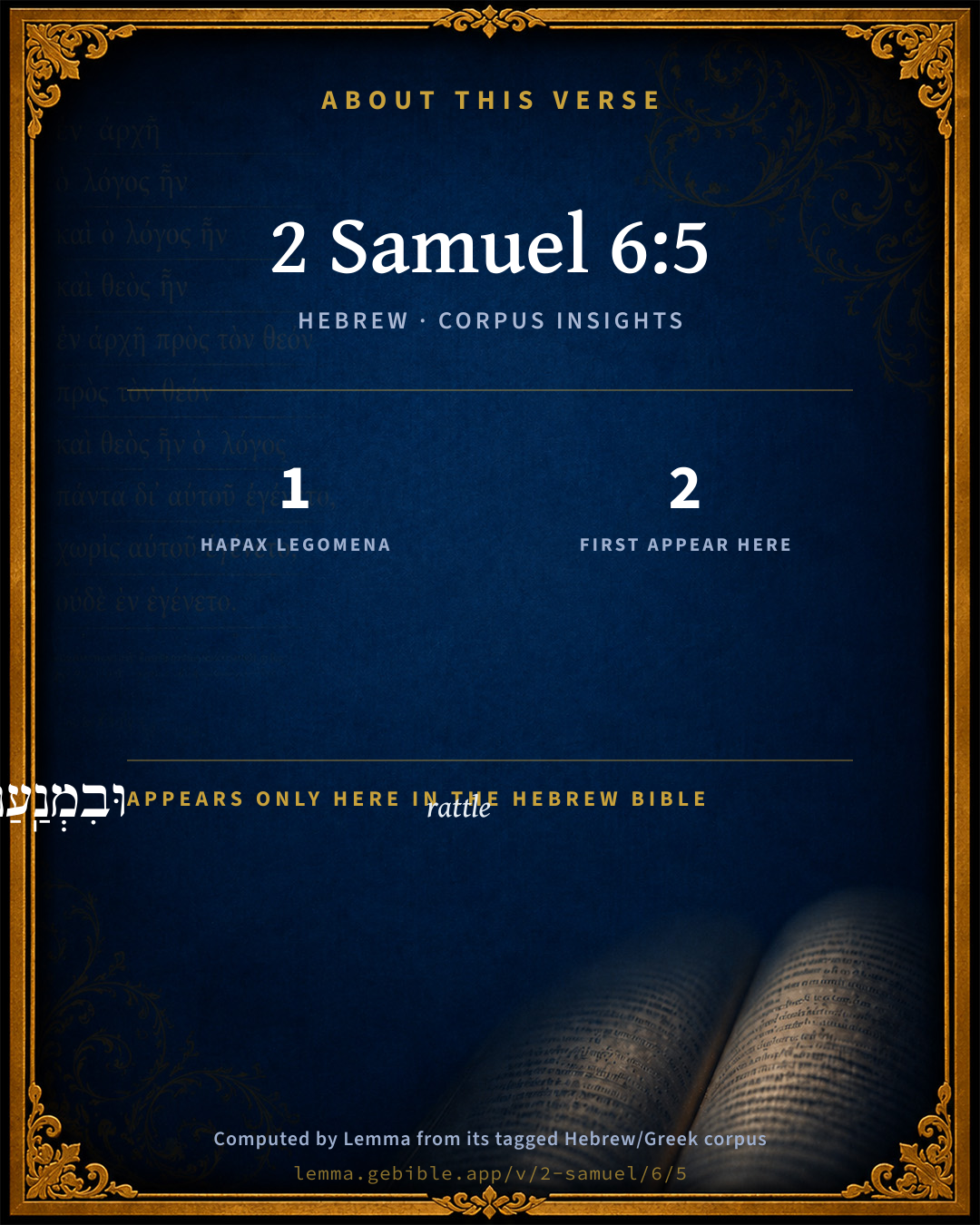
  • 1 hapax legomenon — only here in the Hebrew Bible
  • 2 first appearances in the Hebrew Bible
Full analysis ↓
Download a study sheet

One document with this verse’s original text, its word-by-word gloss line, the meaning frame, cross-references with their text, attributed commentary, and full source and license credits — printable, and it pastes into notes with its structure intact.

This verse Autodidact and up

Study sheet (.html) Plain text (.txt)

A passage Seminary Student

Up to 50 verses in one chapter. A passage sheet keeps up to 6 commentary sources and 12 cross-references per verse, in the order this page ranks them, and says so on the sheet whenever that leaves anything out. Ask for a single verse and you get the Autodidact verse sheet above.

Everything on this page stays free to read, with no account — the sheet is a download of what is already on screen, not access to it.

Want to remove ads? Support Godless Engineer
Compare translations 3

The same verse in 3 English versions, stacked beneath the original-language interlinear above. Click any original word for its lexicon entry.

Each is an independent rendering of the whole verse — the interlinear is not word-aligned to these translations.

Highlighted words mark where these versions differ — a whole-verse word diff, not a word-by-word alignment.

  • World English Bible Public Domain
    David and all the house of Israel played before Yahweh with all manner of [instruments made of] fir-wood, and with harps, and with psalteries, and with tambourines, and with castanets, and with cymbals.
  • King James Version Public Domain
    And David and all the house of Israel played before the LORD on all manner of instruments made of fir wood, even on harps, and on psalteries, and on timbrels, and on cornets, and on cymbals.
  • unfoldingWord Literal Text CC BY-SA 4.0
    And David and all of the house of Israel were celebrating to the face of Yahweh with all woods of cypress and with lyres and with harps and with tambourines and with sistrums and with cymbals.

unfoldingWord Literal Text — © unfoldingWord, licensed CC BY-SA 4.0. Word-aligned USFM3 via Door43 (git.door43.org/unfoldingWord/en_ult).

Versions to compare (up to 4)

3 of 4 selected

Show all 18 translations

Every available English version of this verse, each an independent rendering of the whole verse.

  • World English Bible Public Domain
    David and all the house of Israel played before Yahweh with all manner of [instruments made of] fir-wood, and with harps, and with psalteries, and with tambourines, and with castanets, and with cymbals.
  • Berean Standard Bible Public Domain
    David and all the house of Israel were celebrating before the LORD with all kinds of wood instruments, harps, stringed instruments, tambourines, sistrums, and cymbals.
  • Majority Standard Bible Public Domain
    David and all the house of Israel were celebrating before the LORD with all kinds of wood instruments, harps, stringed instruments, tambourines, sistrums, and cymbals.
  • King James Version Public Domain
    And David and all the house of Israel played before the LORD on all manner of instruments made of fir wood, even on harps, and on psalteries, and on timbrels, and on cornets, and on cymbals.
  • American Standard Version (1901) Public Domain
    And David and all the house of Israel played before Jehovah with all manner of `instruments made of' fir-wood, and with harps, and with psalteries, and with timbrels, and with castanets, and with cymbals.
  • Revised Version (1885) Public Domain
    And David and all the house of Israel played before the LORD with all manner of instruments made of fir wood, and with harps, and with psalteries, and with timbrels, and with castanets, and with cymbals.
  • Geneva Bible (1599) Public Domain
    And Dauid and al the house of Israel played before the Lord on all instruments made of firre, and on harpes, and on Psalteries, and on timbrels, and on cornets, and on cymbals.
  • Douay-Rheims (1899) Public Domain
    But David and all Israel played before the Lord on all manner of instruments made of wood, on harps and lutes and timbrels and cornets and cymbals.
  • Young's Literal Translation Public Domain
    and David and all the house of Israel are playing before Jehovah, with all kinds of `instruments' of fir-wood, even with harps, and with psalteries, and with timbrels, and with cornets, and with cymbals.
  • Literal Standard Version CC BY-SA 4.0
    and David and all the house of Israel are playing before YHWH, with all kinds of [instruments] of fir-wood, even with harps, and with psalteries, and with timbrels, and with horns, and with cymbals.
  • Unlocked Literal Bible CC BY-SA 4.0
    Then David and all the house of Israel began to play before Yahweh, celebrating with wooden instruments, harps, lyres, tambourines, rattles, and cymbals.
  • unfoldingWord Literal Text CC BY-SA 4.0
    And David and all of the house of Israel were celebrating to the face of Yahweh with all woods of cypress and with lyres and with harps and with tambourines and with sistrums and with cymbals.
  • Darby Bible Public Domain
    And David and all the house of Israel played before Jehovah on all manner of [instruments made of] cypress wood, with harps, and with lutes, and with tambours, and with sistra, and with cymbals.
  • World Messianic Bible Public Domain
    David and all the house of Israel played before the LORD with all kinds of instruments made of cypress wood, with harps, with stringed instruments, with tambourines, with castanets, and with cymbals.
  • Webster's Bible Public Domain
    And David and all the house of Israel played before the LORD on all manner of instruments made of fir wood, even on harps, and on psalteries, and on timbrels, and on cornets, and on cymbals.
  • Free Bible Version CC BY-SA 4.0
    David and all the Israelites were celebrating in the Lord's presence, singing songs accompanied by zithers, harps, tambourines, rattles, and cymbals.
  • Bible in Basic English Public Domain
    And David and all the men of Israel made melody before the Lord with all their power, with songs and with corded instruments and instruments of brass.
  • JPS Tanakh (1917) Public Domain
    And David and all the house of Israel played before the LORD with all manner of instruments made of cypress-wood, and with harps, and with psalteries, and with timbrels, and with sistra, and with cymbals.

Literal Standard Version (2020), Covenant Press — licensed CC BY-SA 4.0. Text via the HelloAO Bible API (eBible.org). Unlocked Literal Bible (unfoldingWord) — licensed CC BY-SA 4.0. Text via the HelloAO Bible API (eBible.org). unfoldingWord Literal Text — © unfoldingWord, licensed CC BY-SA 4.0. Word-aligned USFM3 via Door43 (git.door43.org/unfoldingWord/en_ult). Free Bible Version, Dr. Jonathan Gallagher — licensed CC BY-SA 4.0. Text via the HelloAO Bible API (eBible.org).

Word by word

More ways to search: Search by grammar → Find every occurrence → Compare this word →

Practice this passage: Drill this verse → Learn its vocabulary →

וּבִמְנַֽעַנְעִ֖ים
mᵉnaʻnaʻ
H4517
“and · in/at · rattles”
Conjunction + Preposition + Noun, Common, Masculine, Plural, Absolute
Part of Speech
Conjunction + Preposition + Noun
Type
Common
Gender
Masculine
Number
Plural
State
Absolute
Full BDB Definition

Origin: from H5128

TWOT: 1328a

a kind of rattle - a kind of rattle used as a musical instrument
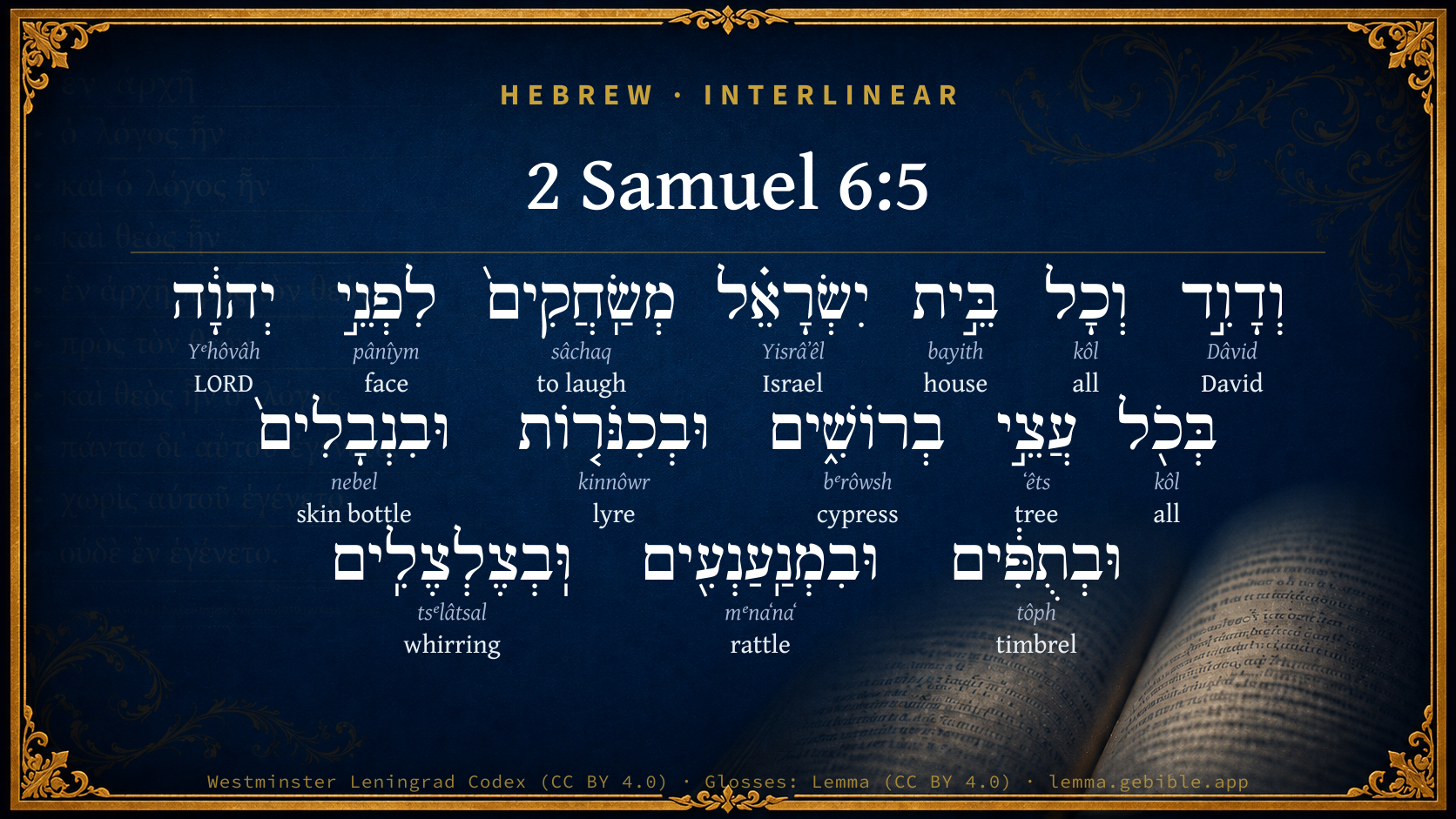
  1. וְדָוִ֣ד Dâvid H1732 “and · David” Conjunction + Noun, Proper
  2. וְכָל kôl H3605 “and · all of” Conjunction + Noun, Common, Masculine, Singular, Construct
  3. בֵּ֣ית bayith H1004 “house of” Noun, Common, Masculine, Singular, Construct
  4. יִשְׂרָאֵ֗ל Yisrâʼêl H3478 “Israel” Noun, Proper
  5. מְשַֽׂחֲקִים֙ sâchaq H7832 “laughing” Verb, Piel, Participle Active, Masculine, Plural, Absolute
  6. לִפְנֵ֣י pânîym H6440 “to/for · face(s) of” Preposition + Noun, Common, Both, Plural, Construct
  7. יְהוָ֔ה Yᵉhôvâh H3068 “LORD” Noun, Proper
  8. בְּכֹ֖ל kôl H3605 “in/at · all of” Preposition + Noun, Common, Masculine, Singular, Construct
  9. עֲצֵ֣י ʻêts H6086 “trees of” Noun, Common, Masculine, Plural, Construct
  10. בְרוֹשִׁ֑ים bᵉrôwsh H1265 “cypresses” Noun, Common, Masculine, Plural, Absolute
  11. וּבְכִנֹּר֤וֹת kinnôwr H3658 “and · in/at · lyres” Conjunction + Preposition + Noun, Common, Masculine, Plural, Absolute
  12. וּבִנְבָלִים֙ nebel H5035 “and · in/at · skin bottles” Conjunction + Preposition + Noun, Common, Masculine, Plural, Absolute
  13. וּבְתֻפִּ֔ים tôph H8596 “and · in/at · timbrels” Conjunction + Preposition + Noun, Common, Masculine, Plural, Absolute
  14. וּֽבְצֶלְצֶלִֽים tsᵉlâtsal H6767 “and · in/at · cymbals” Conjunction + Preposition + Noun, Common, Masculine, Plural, Absolute

About this verse

These counts appear in no published source. They are computed here, from the morphology-tagged text and Lemma’s own curated glosses. What Lemma adds →

15
words
14
distinct lemmas
Historical
section

Notable vocabulary

1 hapax legomenon — a word that appears only here in the entire Hebrew Bible:

  • וּבִמְנַֽעַנְעִ֖ים rattle H4517

First appearance in Scripture

These words make their first canonical appearance in the Hebrew Bible here:

  • בְרוֹשִׁ֑ים cypress H1265
  • וּבִמְנַֽעַנְעִ֖ים rattle H4517

Shared distinctive vocabulary

וּֽבְצֶלְצֶלִֽים whirring H6767 occurs in 5 verses of the Hebrew Bible. Also found in:

Grammatical profile

  • 1 verb
  • 14 nouns

Verb forms

  • מְשַֽׂחֲקִים֙ Piel · Participle Active

Repetition

A word recurs within this verse — often emphatic in Hebrew:

  • וְכָל all H3605 ×2

Hebrew & Septuagint length

In English translation the verse runs 33 words from the Hebrew and 34 from the Septuagint (LXX English) — closely comparable.

A rough comparison of the two English renderings, which tokenize alike — not a word-level alignment.

Word counts can differ between the Hebrew and the Greek without any difference in meaning — e.g. the Hebrew direct-object marker אֵת has no separate Greek word, and Greek often adds the article ὁ.

Cross-references

15

Topical passages linked to 2 Samuel 6:5 in the Treasury of Scripture Knowledge — connected by theme and wording, ordered by reader-vote popularity; previews shown in the World English Bible.

  • 1 Chronicles 13:8 David and all Israel played before God with all their might, even with songs, and with harps, and with psalteries, and with tambourines, and with cymbals, and with trumpets.
  • Psalms 150:3–5 Praise him with the sounding of the trumpet! Praise him with harp and lyre!
  • Amos 5:23 Take away from me the noise of your songs! I will not listen to the music of your harps.
  • 1 Samuel 10:5 After that you shall come to the hill of God, where is the garrison of the Philistines: and it shall happen, when you are come there to the city, that you shall meet a band of prophets coming down from the high place with a psaltery, and a tambourine, and a pipe, and a harp, before them; and they will be prophesying:
  • 1 Samuel 16:16 Let our lord now command your servants who are before you, to seek out a man who is a skillful player on the harp: and it shall happen, when the evil spirit from God is on you, that he shall play with his hand, and you shall be well.
  • 1 Samuel 18:6–7 It happened as they came, when David returned from the slaughter of the Philistine, that the women came out of all the cities of Israel, singing and dancing, to meet king Saul, with tambourines, with joy, and with instruments of music.
  • 2 Kings 3:15 But now bring me a minstrel. It happened, when the minstrel played, that the hand of Yahweh came on him.
  • 1 Chronicles 15:10–24 of the sons of Uzziel, Amminadab the chief, and his brothers one hundred twelve.
  • Psalms 47:5 God has gone up with a shout, Yahweh with the sound of a trumpet.
  • Psalms 68:25–27 The singers went before, the minstrels followed after, In the midst of the ladies playing with tambourines,
  • Daniel 3:5 that whenever you hear the sound of the horn, flute, zither, lyre, harp, pipe, and all kinds of music, you fall down and worship the golden image that Nebuchadnezzar the king has set up;
  • Daniel 3:7 Therefore at that time, when all the peoples heard the sound of the horn, flute, zither, lyre, harp, pipe, and all kinds of music, all the peoples, the nations, and the languages, fell down and worshiped the golden image that Nebuchadnezzar the king had set up.
  • Daniel 3:10 You, O king, have made a decree, that every man that shall hear the sound of the horn, flute, zither, lyre, harp, pipe, and all kinds of music, shall fall down and worship the golden image;
  • Daniel 3:15 Now if you are ready whenever you hear the sound of the horn, flute, zither, lyre, harp, pipe, and all kinds of music to you fall down and worship the image which I have made, [well]: but if you don't worship, you shall be cast the same hour into the midst of a burning fiery furnace; and who is that god that shall deliver you out of my hands?
  • Amos 6:5 Who strum on the strings of a harp; Who invent for themselves instruments of music, like David;

Cross-references courtesy of OpenBible.info (CC BY 4.0).

Hebrew and Greek witnesses Masoretic Hebrew ↔ Greek Septuagint

The same verse in the two great witnesses to the Old Testament, shown verse-for-verse.

These are two independent witnesses, not word-aligned to each other, and the Septuagint is shown in lemma (dictionary) form.

Hebrew 2 Samuel 6:5 Masoretic · Westminster Leningrad Codex

וְדָוִ֣ד וְכָל בֵּ֣ית יִשְׂרָאֵ֗ל מְשַֽׂחֲקִים֙ לִפְנֵ֣י יְהוָ֔ה בְּכֹ֖ל עֲצֵ֣י בְרוֹשִׁ֑ים וּבְכִנֹּר֤וֹת וּבִנְבָלִים֙ וּבְתֻפִּ֔ים וּבִמְנַֽעַנְעִ֖ים וּֽבְצֶלְצֶלִֽים

David and all the house of Israel played before Yahweh with all manner of [instruments made of] fir-wood, and with harps, and with psalteries, and with tambourines, and with castanets, and with cymbals.

World English Bible · Public Domain

Greek LXX 2 Samuel 6:5 Septuagint · lemma form

καί δαυίδ καί ὁ υἱός ἰσραήλ παίζω ἐνώπιον κύριος ἐν ὄργανον ἁρμόζω ἐν ἰσχύς καί ἐν ᾠδή καί ἐν κινύρα καί ἐν νάβλα καί ἐν τύμπανον καί ἐν κύμβαλον καί ἐν αὐλός

And David and the children of Israel were playing before the Lord on well-tuned instruments mightily, and with songs, and with harps, and with lutes, and with drums, and with cymbals, and with pipes.

LXX2012 (modern English Septuagint) · Public Domain

On this verse, Adam Clarke's Commentary discusses the Septuagint’s reading. Read the note in Commentary ↓

Hebrew: Westminster Leningrad Codex (CC BY 4.0). Greek: Septuagint (public domain); English from LXX2012 (modern English Septuagint) (Public Domain). How the Septuagint differs from the Hebrew →

Targum (Aramaic paraphrase)

1

The Targum is the ancient Jewish Aramaic paraphrase of the Hebrew Scriptures — an interpretive translation, not the Hebrew text itself. Onkelos (literal) and Pseudo-Jonathan (expansive) render the Torah, and Jonathan the Prophets. Coverage is partial: where no permissively-licensed English translation exists for a verse, only the Aramaic is shown. This is verse-level text, not a word-by-word alignment to the Hebrew.

  1. Targum Jonathan Prophets (Joshua–Malachi)
    וְדָוִד וְכָל בֵּית יִשְׂרָאֵל מְשַׁבְּחִין קֳדָם יְיָ בְּכָל אָעֵי בִּרְוַון וּבְכִינָרִין וּבִנְבָלִין וּבְתֻפִּין וּבִרְבִיעִין וּבְצֶלְצְלִין:

    (no public-domain English translation for this verse)

    Targum Jonathan — Aramaic: “Mikraot Gedolot” (public domain). English: “Sefaria Community Translation” (CC0 1.0 (public-domain dedication)); “London "Chaldee Paraphrase," 1871” (public domain). Text via Sefaria.

Commentary

Notes on 2 Samuel 6:5 from classic Christian and Jewish commentators (each source and its license shown beneath its notes). The classic Christian expositions comment on the surrounding passage and are grouped to its opening verse, so a note may address several verses; the Jewish commentaries on the Tanakh (Rashi and others) are per-verse, so they appear only where the commentator wrote on this verse.

Lemma curates 59 commentaries, every one of them public domain or Creative Commons licensed, each selected and text-cleaned for this edition rather than reprinted as found. About our sources →

Trapp's Complete Commentary

John Trapp

2Sa 6:5 And David and all the house of Israel played before the LORD on all manner of [instruments made of] fir wood, even on harps, and on psalteries, and on timbrels, and on cornets, and on cymbals.

Ver. 5. Played before the Lord.] According to the custom of that country, and the condition of those times.

Before the Lord,] i.e., Before the ark, which is called God’s face; {Psa 105:4} yea, God himself. {Psa 132:5}

John Trapp, A Commentary or Exposition upon All the Books of the Old and New Testament (1647–1656) — public domain. Text from a community e-Sword module.

The Biblical Illustrator

Joseph S. Exell

2Sa_6:5

David and all the house of Israel played before the Lord.

Joy in religion

The orchestra was probably as rustic and rude as the procession. Instruments made of fir-wood sounds strange, and probably the text should be emended from the account in 1 Chronicles, which reads, with all their might, even with songs. The instruments specified are two-stringed, and three of percussion. Castanets should be sistra, which were much used in religious ceremonies, and consisted of rings hung on iron or other metal rods, which made a harsh noise when shaken. Like Eastern music in general, it would have struck our ears as being a joyful noise, rather than a concord of sweet sounds. But it meant gladness and praise, and that was the main thing. His felt nearness should be, as the Psalmist says, the gladness of my joy. Much of our modern religion is far too gloomy, and it is thought to be a sign of devotion and spiritual-mindedness to be sad and of a mortified countenance. Unquestionably, Christianity brings men into the continual presence of very solemn truths about themselves and the world which may well sober them, and make what the world calls mirth incongruous.

There is no music in the life

That rings with idiot laughter solely.

But the Man of Sorrows said that His purpose for us was that His joy might remain in us, and that our joy might be full; and we but imperfectly apprehend the Gospel if we do not feel that its joys much more abound than its sorrows, and that they even burn brightest, like the lights on safety-buoys, when drenched by stormy seas. (A. Maclaren, D. D.)

The Biblical Illustrator, edited by Joseph S. Exell (c. 1880s–1900s) — public domain. Text from a community e-Sword module.

Tyndale Open Study Notes

Tyndale Open Resources

6:5 The musical instruments were played by Levites (1 Chr 16:4-6).

Tyndale Open Study Notes — © Tyndale Open Resources, licensed CC BY-SA 4.0. Text via the HelloAO Bible API.

Geneva Bible (1599)

Geneva Bible translators

Praised God, and sang Psalms.

Geneva Bible (1599) marginal notes — public domain. Text via Bolls.life.

Adam Clarke's Commentary

Verse 5. On all manner of instruments made of fir wood] This place should be corrected from the parallel place, 1Ch 13:8: "All Israel played before God, with all their might, and with singing, and with harps, and with psalteries," c. Instead of בכל עז bechol atsey, "with all woods" or "trees" the parallel place is bechol oz. "with all their strength:" this makes a good sense, the first makes none. The Septuagint, in this place, has the verse reading; εν ισχυΐ, with might.

Adam Clarke's Commentary on the Bible (1810–1826) — public domain. Text from a community e-Sword/MySword module.

Ellicott's Commentary for English Readers

(5) Played.—This word means dancing accompanied by music. (See 1Sa_18:7; 1Sa_21:11, 1Ch_13:8; 1Ch_15:29, &c.)

On all manner of instruments made of fir wood.—Instead of this strange expression, the parallel passage in 1Ch_13:8 has “with all their might and with songs.” The difference between the two is very slight in the Hebrew, and it is generally thought that the latter is the correct reading. The variation, however, mast have been ancient, since the LXX. combines the two.

Cornets.—This word occurs only here, and is thought from its etymology to mean some kind of metal instrument with bells or rings, which gave forth its sound on being shaken. The Vulg. translates sistra. Instead of it Chronicles has “trumpets.”

A Bible Commentary for English Readers, edited by Charles John Ellicott (1878–1897) — public domain. Text from a community e-Sword module.

The Cambridge Bible for Schools and Colleges

gen. ed. J. J. S. Perowne

5. played] The word denotes a dance accompanied by music, such as frequently formed part of a religious festival. Cp. 1Sa_18:7.

on all manner of instruments made of fir wood] The expression is a strange one, and the text seems to be corrupt. Probably we should adopt the reading of the parallel passage in 1 Chron., with all their might and with songs. The Hebrew words are very similar, and the Sept. text here, though interpolated in its present form, supports the change.

even on harps, &c.] The harp (Heb. kinnôr) and psaltery (Heb. nebel) were stringed instruments, the exact form of which is unknown; the timbrel, also called the tabret, (Heb. tôph) was a tambourine or hand drum. The etymology of the word translated cornet, which occurs here only, shews that it denotes some kind of instrument which was played by being shaken, perhaps similar to the sistrum of the Egyptians, which consisted of rings hung loosely on iron rods, so as to make a tinkling sound when shaken. See the engravings in Wilkinson’s Ancient Egyptians, Vol. 1. p. 497 ff. Chron. reads “trumpets” which probably suggested the misrendering of the E. V. Cymbals were plates of metal, held in each hand, and played by being clashed together.

The Cambridge Bible for Schools and Colleges (gen. ed. J. J. S. Perowne; Cambridge University Press, 1878–1918) — public domain. Text from a community e-Sword module.

John Gill's Exposition

And when they came to Nachon's threshingfloor,.... Who is called Chidon, Ch1 13:9; he seems to have had two names; or it was a place that had two names, as say the Jews (h); according to a tradition of theirs (i), Chidon is the name of the place where it was said to Joshua, stretch out the spear or shield in thine hand towards Ai, Jos 8:18; so indeed the word signifies, nor was it unusual to stretch out the shield as a signal on occasion. Thus Aeneas lifted up his shield in his left hand, as a token to his Trojans that he was come to relieve them (k): where this threshingfloor was is not said; some say (l) it was the threshingfloor of Araunah the Jebusite; it could not be far from Jerusalem, since Baalejudah or Kirjathjearim was but about a mile from it, according to Bunting (m), from whence they fetched the ark:

Uzzah put forth his hand to the ark of God, and took hold of it; to keep it from falling: the reason was:

for the oxen shook it; the same word is used in Ch1 13:9; and there it is rendered, "for the oxen stumbled"; and by their stumbling the cart was shaken, and the ark in it, and in danger of falling, as Uzzah thought: or "the oxen shook", for the word "it" is a supplement; they shook as if their members were plucking asunder and parting, as Kimchi expresses it, because of the holiness of the ark; as if they were sensible it was wrong for them to draw it, when it ought to have been carried on the shoulders of Levites; and by this way, as well as by the death of Uzzah the error committed was pointed out: but others render it, "for the oxen stuck in the clay" (n), and could not go on; which Uzzah observing, and fearing that in their struggle to get out the cart should be overturned, or that the procession would be retarded too much, took hold of the ark to take it out, and carry it the remainder of the way, it not being far from Jerusalem.

(h) T. Bab Sotah, fol. 35. 2. (i) Hieron. Trad. Heb. in lib. Paralipom. fol. 83. G. (k) Virgil. Aeneid. 10. ver. 261, 262. Vid. Diodor. Sic. l. 20. p. 787. (l) Gloss. in T. Bab. Sotah, fol. 35. 3. (m) Travels, &c. p. 138. (n) "nam luto haeserunt boves", Noldius, p. 396. No. 1343. so Bochart. Hierozoic. par. 1. l. 2. c. 37. col. 374. ex Arabica Lingua.

John Gill's Exposition of the Whole Bible (1746–1763) — public domain (CC PDM 1.0). Text via the HelloAO Bible API.

Albert Barnes' Notes on the Bible

Played - i. e. danced to music vocal and instrumental (see Jdg 16:25 note).

Cornets - Rather, from the etymology of the Hebrew word (to shake), and their being coupled with the cymbals, and being rendered sistra in the Vulgate, some kind of instrument with bells or rings, which gave a sound by being shaken.

Albert Barnes' Notes on the Bible (1834–1885) — public domain. Text from a community e-Sword/MySword module.

Haydock's Catholic Bible Commentary

Wood. Hebrew specifies "fir wood," of which the instruments were, perhaps, usually made.

George Leo Haydock (1774–1849), Haydock's Catholic Family Bible and Commentary, 1859 edition — public domain. Excludes Psalms (Douay-Rheims chapter numbering differs from Protestant) and Deuterocanonical books (Catholic canon only).

Whedon's Commentary on the Bible

Daniel D. Whedon

5. Played before the Lord — Danced, and sang, and played on the musical instruments here mentioned.

All manner of instruments… of fir wood — This is properly regarded by most commentators as a corruption of the more correct reading of 1Ch_13:8 : with all their might and with songs.

Harps… psalteries… timbrels — See note on 1Sa_10:5.

Cornets — Rather, sistra; for the original Hebrew word occurs here only, and seems clearly to mean the sistrum, an instrument of Egyptian origin, which was used by taking it in the right hand and shaking it. The cornet was a sort of horn.

Cymbals — Instruments consisting of two convex pieces of metal, which when struck together made a loud clanging sound.

Daniel D. Whedon (gen. ed.), Commentary on the Old and New Testaments (1874–1909) — public domain. Text from a community e-Sword module.

The Pulpit Commentary

Played. The word does not mean "played on a musical instrument," but "danced and rejoiced." On all manner of fir wood. The Hebrew literally is, with all cypress woods. In 1Ch_13:8 we find "with all their might, even with songs," etc. Gesenius, in his "History of the Hebrew Language," describes this as a mere guess at a misunderstood text, and Maurer ridicules it as a stupid emendation. More sensibly Thenius regards it as the right reading, and the words here as a corruption of it, caused by some scribe misspelling the words, which are nearly identical. In our version the ambiguous meaning of the word "played" makes the passage less startling. For "they danced with all cypress woods" is unintelligible. The musical instruments mentioned here are the harp, Hebrew chinnor, a guitar; the psaltery, Hebrew nebel, a kind of harp of a triangular shape, with the point downwards; the timbrel, Hebrew tof, a tambourine or small drum; the cornet, Hebrew mena"na", a bar on which were a number of loose metal rings, which were shaken in time to the music, but others think that "castanets" are meant, which are pieces of wood beaten in time. The Revised Version adopts this rendering. And finally cymbals. For "cornets" we find in the parallel place "trumpets," whence the translators of the Authorized Version took their rendering; but the Hebrew word means "things to shake."

The Pulpit Commentary (1880–1919), ed. H.D.M. Spence-Jones & Joseph S. Exell — public domain. Text from a community e-Sword module.

John Wesley's Explanatory Notes

Played before the Lord - Public joy should always be as before the Lord, with an eye to him, and terminating in him. Otherwise it is no better than public madness, and the source of all manner of wickedness.

John Wesley, Explanatory Notes Upon the Whole Bible (1754–1765) — public domain. Text via the GEBible commentary corpus.

Rashi

Rabbi Shlomo Yitzchaki (Rashi)

With all [instruments made of] cypress wood. Musical instruments manufactured from [cypress wood].

Rashi on the Tanakh — English translations: “The Judaica Press complete Tanach with Rashi, translated by A. J. Rosenberg” (CC BY 4.0); “Pentateuch with Rashi's commentary by M. Rosenbaum and A.M. Silbermann, 1929-1934” (public domain); “The Metsudah Tanach series, Lakewood, N.J” (CC BY 4.0); and “The Book of Joshua, Metsudah Publications, 1997” (CC BY 4.0). Text via Sefaria.

Lesson kit

Teaching starters — assembled from the data on this page, not authored interpretation. Every prompt links to the verse data it draws on. Edit before teaching.

2 Samuel, in the Historical, opens this verse with 15 words (14 distinct Hebrew lemmas). Its most distinctive word is mᵉnaʻnaʻ (“rattle”). A historical commentator’s framing appears above. Read the whole chapter for the surrounding context.

Discussion questions

  1. What does “rattle” (mᵉnaʻnaʻ) contribute to the verse as a whole?
  2. This verse holds 1 word here found nowhere else in the Hebrew Bible. What might the rare word draw attention to?
  3. 2 words here appear for the first time in Scripture. What is being introduced at this debut?
  4. Deuteronomy 28:42 shares the word «whirring» with this verse. How do the two illuminate each other?
  5. “all” occurs 2× in this one verse. What is the effect of the repetition?
  6. These translations render this verse differently. What is at stake in choosing one wording over another?
  7. The verb «מְשַֽׂחֲקִים֙» is Piel Participle Active. How does its form color the action?
  8. Reading how Trapp's Complete Commentary and The Biblical Illustrator read this verse, where do the two commentators agree and where do they part?

Things to notice

  • 1 word in this verse appears nowhere else in the Hebrew Bible.
  • 2 words make their first canonical appearance in Scripture here.
  • These translations choose different wording for 22 words in this verse.
  • “all” occurs 2× in this single verse.
  • 14 distinct Hebrew lemmas span 15 words in this verse.

Reading settings

Reading text

Shown beneath each verse's original-language words.

Old Testament
Old Testament edition

Read the OT as the Masoretic Hebrew (MT) or the Greek Septuagint (LXX).

English shown for the Greek Septuagint (in the Hebrew ↔ Greek comparison).

Comparing translations? Open the Compare panel on any verse page to stack up to four side by side.