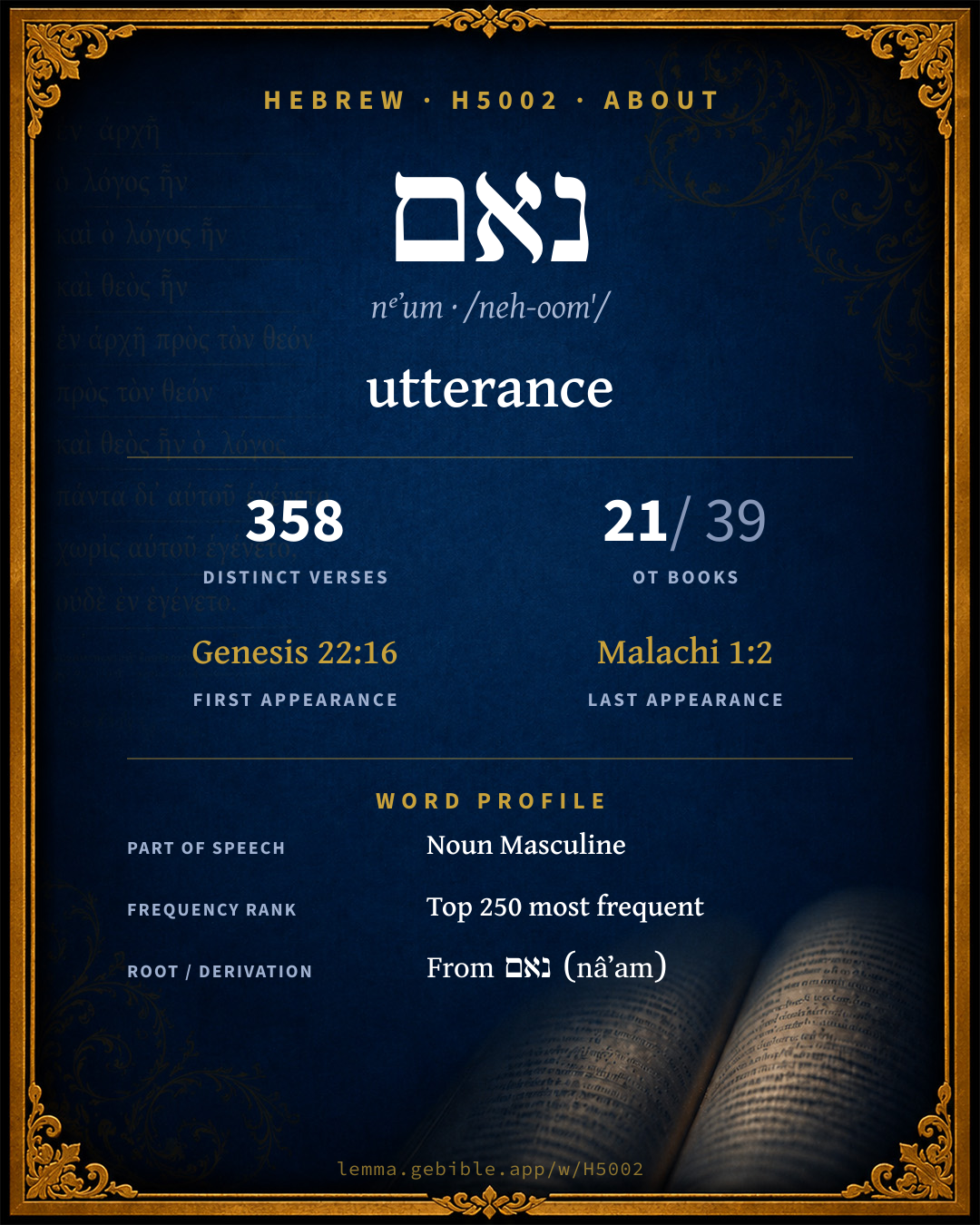
נְאֻם
utterance
‘utterance’ is one of 3 main senses fuller range ↓
Full lexicon entry — Brown-Driver-Briggs (BDB)
From Brown-Driver-Briggs (BDB)
Where this word appears
Grammar key — what these labels mean
Part of speech
- Noun
- A naming word — a person, place, thing, or idea.
Noun type
- Common
- A common noun — a general class of person, place, or thing (“king,” “city,” “water”), not a specific name.
State
- Construct
- A noun bound to a following noun in a possessive / “of” relationship (the construct chain).
- Absolute
- The independent form of a noun, not bound to a following word.
Gender
- Masculine
- Grammatically masculine.
Number
- Singular
- One.
Every verse where H5002 appears in the Book of Amos — 21 distinct verses. Click any verse to open its interlinear word-by-word view. Verse text shown in the World English Bible for context — . Each verse’s Hebrew form is shown with its reference; the English is not keyword-highlighted, since the data carries no word-level English alignment. Use “Compare translations” on any verse to read it across multiple English versions. This concordance covers the Hebrew Bible; Septuagint (Greek Old Testament) occurrences are not indexed here.
Amos
- Amos 2:11 נְאֻם n c ms cs I raised up some of your sons for prophets, And some of your young men for Nazirites. Isn't this true, You children of Israel?" says Yahweh.
- Amos 2:16 נְאֻם n c ms cs And he who is courageous among the mighty will flee away naked in that day," says Yahweh.
- Amos 3:10 נְאֻם n c ms cs "Indeed they don't know to do right," says Yahweh, "Who hoard plunder and loot in their palaces."
- Amos 3:13 נְאֻם n c ms cs "Listen, and testify against the house of Jacob," says the Lord Yahweh, the God of hosts.
- Amos 3:15 נְאֻם n c ms cs I will strike the winter house with the summer house; And the houses of ivory will perish, And the great houses will have an end," says Yahweh.
- Amos 4:3 נְאֻם n c ms cs You will go out at the breaks in the wall, Everyone straight before her; And you will cast yourselves into Harmon," says Yahweh.
- Amos 4:5 נְאֻ֖ם n c ms cs Offer a sacrifice of thanksgiving of that which is leavened, And proclaim free will offerings and brag about them: For this pleases you, you children of Israel," says the Lord Yahweh.
- Amos 4:6 נְאֻם n c ms cs "I also have given you cleanness of teeth in all your cities, And lack of bread in every town; Yet you haven't returned to me," says Yahweh.
- Amos 4:8 נְאֻם n c ms cs So two or three cities staggered to one city to drink water, And were not satisfied: Yet you haven't returned to me," says Yahweh.
- Amos 4:9 נְאֻם n c ms cs I struck you with blight and mildew many times in your gardens and your vineyards; And your fig trees and your olive trees have the swarming locust devoured: Yet you haven't returned to me," says Yahweh.
- Amos 4:10 נְאֻם n c ms cs I sent plagues among you like I did Egypt. I have slain your young men with the sword, And have carried away your horses; And I filled your nostrils with the stench of your camp Yet you haven't returned to me," says Yahweh.
- Amos 4:11 נְאֻם n c ms cs "I have overthrown some of you, As when God overthrew Sodom and Gomorrah, And you were like a burning stick plucked out of the fire; Yet you haven't returned to me," says Yahweh.
- Amos 6:8 נְאֻם n c ms cs "The Lord Yahweh has sworn by himself," says Yahweh, the God of hosts: "I abhor the pride of Jacob, And detest his fortresses. Therefore I will deliver up the city with all that is in it.
- Amos 6:14 נְאֻם n c ms cs For, behold, I will raise up against you a nation, house of Israel," Says Yahweh, the God of hosts; "And they will afflict you from the entrance of Hamath to the brook of the Arabah."
- Amos 8:3 נְאֻ֖ם n c ms cs The songs of the temple will be wailings in that day," says the Lord Yahweh. "The dead bodies will be many. In every place they will throw them out with silence.
- Amos 8:9 נְאֻם֙ n c ms cs "It will happen in that day," says the Lord Yahweh, "That I will cause the sun to go down at noon, And I will darken the earth in the clear day.
- Amos 8:11 נְאֻם֙ n c ms cs Behold, the days come," says the Lord Yahweh, "That I will send a famine in the land, Not a famine of bread, Nor a thirst for water, But of hearing the words of Yahweh.
- Amos 9:7 נְאֻם n c ms cs Are you not like the children of the Ethiopians to me, children of Israel?" says Yahweh. "Haven't I brought up Israel out of the land of Egypt, and the Philistines from Caphtor, and the Syrians from Kir?
- Amos 9:8 נְאֻם n c ms cs Behold, the eyes of the Lord Yahweh are on the sinful kingdom, and I will destroy it from off the surface of the earth; except that I will not utterly destroy the house of Jacob," says Yahweh.
- Amos 9:12 נְאֻם n c ms cs that they may possess the remnant of Edom, and all the nations who are called by my name," says Yahweh who does this.
- Amos 9:13 נְאֻם n c ms cs "Behold, the days come," says Yahweh, "That the plowman shall overtake the reaper, And the one treading grapes him who sows seed; And sweet wine will drip from the mountains, And flow from the hills.
About this entry
At a glance — auto-summarized from this page’s data, not written by a person. Every figure links to its source below. This summary describes the numbers; it doesn’t interpret them.
At its core, נאם (nᵉʼum) means “utterance.” Where the King James Version says “saith,” newer translations reach for “declares” (Berean Standard Bible) and “declaration of” (unfoldingWord Literal Text); the renderings breakdown has the detail. It appears 358 verses across 21 books of the Hebrew Bible, among its common vocabulary. The word gravitates to Jeremiah (47%), then Ezekiel and Isaiah. Carrying more than one sense, it rewards its full sense range. Dig into 358-verse concordance and the renderings breakdown below.
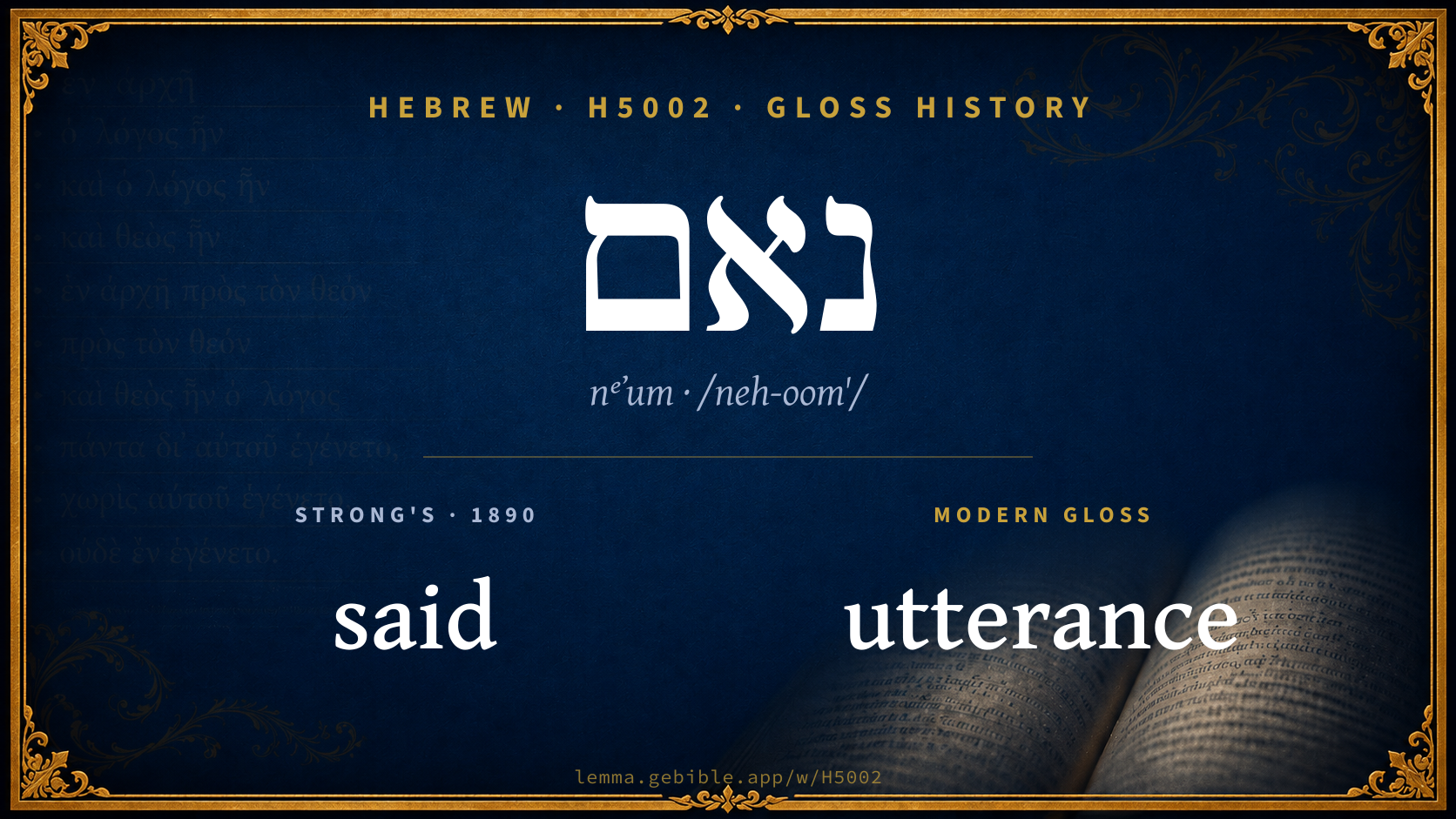
Gloss history
Strong's 1890 vs modern scholarship
About this word
Strong's H5002 catalogs a Hebrew word from the Hebrew Old Testament.
These counts are not copied from any lexicon or concordance. They are computed here, from the morphology-tagged Hebrew Old Testament. What Lemma adds →
- 358
- distinct verses
- The word appears in 358 distinct verses.
- 21 / 39
- OT books
- The word appears in 21 of 39 Old Testament books.
- #134
- by frequency
- Top 250 most frequent Hebrew words (rank 134 of 8,640 Hebrew words by occurrence).
View all 358 occurrences in the concordance →
By section of the Old Testament
By traditional corpus
Conventional, traditional groupings — biblical authorship is debated, so this is a traditional corpus grouping, not an authorship claim. Each share is this word’s portion of its verses in that division of the Hebrew canon. Each figure is a share of the word’s 358 distinct verses.
- Prophets (Nevi'im) 348 verses · 97%
- Torah (Pentateuch) 6 verses · 2%
- Writings (Ketuvim) 4 verses · 1%
How translations render this word
Counts come from each version’s own published word-to-Strong’s tagging or interlinear alignment — an approximate guide to how each version renders this word, not a word-level alignment the data otherwise carries. Because each total is that version’s own tagged count, the per-version totals vary from one another and need not match the appearance or distinct-verse counts above. These counts may also differ from a printed concordance because Lemma counts each distinctly tagged rendering and does not collapse phrase taggings into a single head-word total. This is a fixed set of word-tagged versions (KJV, ASV, BSB, ULT) and does not change with the reading translation you choose elsewhere. Each version’s license is shown beside its name below (and on Sources).
- King James Version: Saith 299×, Thee saith 11×, You saith 11×
- American Standard Version: Saith 236×, Me 23×, Them 12×
- Berean Standard Bible: Declares 362×, Prophecy 6×, Oracle 3×
- unfoldingWord Literal Text: Declaration of 172×, Declaration 103×, Is 14×
King James Version Public Domain
Renders H5002 across 376 tagged occurrences — most commonly:
Plus other, less common renderings. Plus 27 renderings that appear only once — usually multi-word phrases or single function words the recovered tagging swept in, not distinct renderings.
American Standard Version Public Domain
Renders H5002 across 376 tagged occurrences — most commonly:
Plus other, less common renderings. Plus 43 renderings that appear only once — usually multi-word phrases or single function words the recovered tagging swept in, not distinct renderings.
Berean Standard Bible Public Domain
Renders H5002 across 376 tagged occurrences — most commonly:
Plus 3 renderings that appear only once — usually multi-word phrases or single function words the recovered tagging swept in, not distinct renderings.
unfoldingWord Literal Text CC BY-SA 4.0
Renders H5002 across 307 tagged occurrences — most commonly:
Plus 2 renderings that appear only once — usually multi-word phrases or single function words the recovered tagging swept in, not distinct renderings.
Senses in the full BDB
What do BDB’s symbols mean?
BDB uses these scholarly abbreviations:
| Symbol | Meaning |
|---|---|
| 𝔊 | the Septuagint (the ancient Greek translation, LXX) |
| 𝔙 | the Vulgate (the Latin translation) |
| 𝔖 | the Syriac version (the Peshitta) |
| 𝔗 | the Targum (the Aramaic translation) |
| ψ | the Psalms |
| √ | root (the underlying root or stem) |
| ‖ | parallel passage (a synonymous or contrasted parallel) |
| † | the dagger: every passage where the word occurs is cited |
The 2 senses and sub-senses the full Brown-Driver-Briggs lexicon distinguishes for this word, in lexicon order (not ranked by frequency), with BDB’s own verbatim wording and sub-sense lettering. Shown in Hebrew script with BDB’s own scholarly abbreviations. The condensed entry is in the Lexicon Entry tab. See also the Forms in the corpus table below.
- 1. utterance, declaration, revelation, of prophet in ecstatic state נ׳ בלעם Nu 24:3, 15; נ׳ שֹׁמֵעַ אִמְרֵי אֵל v 4, 16; נ׳ הַגֶּבֶר v 3, 15 2 S 23:1 Pr 30:1; נ׳ דוד 2 S 23:1; נ׳ פֶּשַׁע ψ 36:2 (transgression personified, speaking with proph. voice בְּקֶרֶב לִבּוֹ); elsewhere always e.g. Numbers 24:3
- 2. before divine names (except Je 23:31 see vb.): נ׳ יהוה utterance, declaration of י׳ (prophet citing divine word given through him), Gn 22:16 (J), Nu 14:28 (P), 2 K 9:26(×2); 19:33 = Is 37:34, 2 K 22:19 = 2 Ch 34:27, Is 14:22; 30:1; 31:9 Ez 13:6, 7; 16:58; 37:14 Ho 2:15, 18, 23; 11:11 Jo 2:12 Ob 4; 8 Mi 4:6; 5:9 Zp 1:2, 3, 10; 3:8 Zc 8:17; 10:12; 11:6; 12:1, 4; 13:8 Mal 1:2 + Is 2 12 times, Je 162 times, Am 14 times, Hg 5 times, Zc 1 (1–8) 6 times; sq. אלהי ישׂראל 1 S 2:30 Is 17:6; י׳ אֱלֹהֵי (הַ)צְבָאוֹת Am 6:8, 14; נ׳ י׳ צְבָאוֹת Is 14:22, 23; 17:3; 22:25 Je 8:3; 25:29; 30:8; 49:26 Na 2:14; 3:5 Zc 13:2, 7 + Hg 5 times, Zc 1 (1–8) 7 times; sq. אלהי ישׂראל Zp 2:9; האדון י׳ צ׳ Is 1:24; 19:4; אֲדֹנָי י׳ אֶלֹהֵי הַצּ׳ Am 3:13; אדני י׳ צ׳ Is 3:15 Je 49:5; הַמֶּלֶךְ י׳ צ׳ 46:18; 48:15; 51:57; נ׳ אדני יהוה Is 56:8 Je 2:22 Am 4:5; 8:3, 9, 11 + Ez 82 times נְאֻם begins sentence only Is 56:8 ψ 110:1; often in middle Is 49:18 Am 3:10 +; most frequently at end Is 54:17 Am 2:11; 4:3 +; found in all proph. except Hab., Jon.; not in H D of Hex, Chr (except ‖ Kings), Dan., Job or the five Megilloth. e.g. Jeremiah 23:31
Senses from the full Brown-Driver-Briggs lexicon (Brown, Driver, Briggs; Oxford 1906 — public domain), digitized via Sefaria, supplemented by the OpenScriptures HebrewLexicon (CC BY 4.0). Full attribution on Sources.
Word origin
n.m. utterance (BaNB 82 e KöLgb ii. 501 > older expl. as Pt. pass.);—נ׳ always thus, as cstr.:—
— Brown-Driver-Briggs (Oxford 1906, public domain), digitized via Sefaria, supplemented by the OpenScriptures HebrewLexicon (CC BY 4.0). See Sources.
Derived from נאם (nâʼam) (H5001) — to prophesy.
Jastrow Dictionary
A second Hebrew/Aramaic lexicon for comparison, covering Aramaic and post-biblical (Talmudic, Targumic, Midrashic) usage that the biblical-Hebrew BDB does not. Matched by lemma rather than by Strong’s number, so a lemma may carry more than one Jastrow headword (shown separately below), and the entries cover usage well beyond the Bible.
נָאַם
- to speak, v. נוּם.
A Dictionary of the Targumim, the Talmud Babli and Yerushalmi, and the Midrashic Literature (Marcus Jastrow; London, Luzac, 1903) — Public Domain. Digitized via Sefaria. Digitized via Sefaria. Full attribution on Sources.
Forms in the corpus
The 17 distinct written forms H5002 takes in the Hebrew Bible, most frequent first — each parse links to that state’s occurrences in the concordance. Hebrew forms include their vowel points and cantillation, so a single lemma takes many written forms.
Septuagint verse parallels
This word appears in 317 verses that also exist in the Greek Old Testament (Septuagint), out of the 358 Hebrew verses it occurs in. You can read those verses in Greek by switching the Old Testament edition to the Septuagint.
Read these verses in the Septuagint
- Genesis 22:16
- Numbers 14:28
- 1 Samuel 2:30
- 2 Samuel 23:1
- 2 Kings 9:26
- 2 Chronicles 34:27
- Psalms 36:1
- Proverbs 30:1
- Isaiah 1:24
- Jeremiah 1:8
- Ezekiel 5:11
- Hosea 2:13
This is a verse-level parallel only — the same verses exist in both the Hebrew and Greek Old Testaments. No word-level Hebrew↔Greek correspondence is claimed: the data carries no such alignment, so no Greek word is shown as this Hebrew word’s translation. Coverage is not total — the Septuagint omits the deuterocanon and renumbers the Psalms, so some Hebrew verses have no direct Greek parallel.