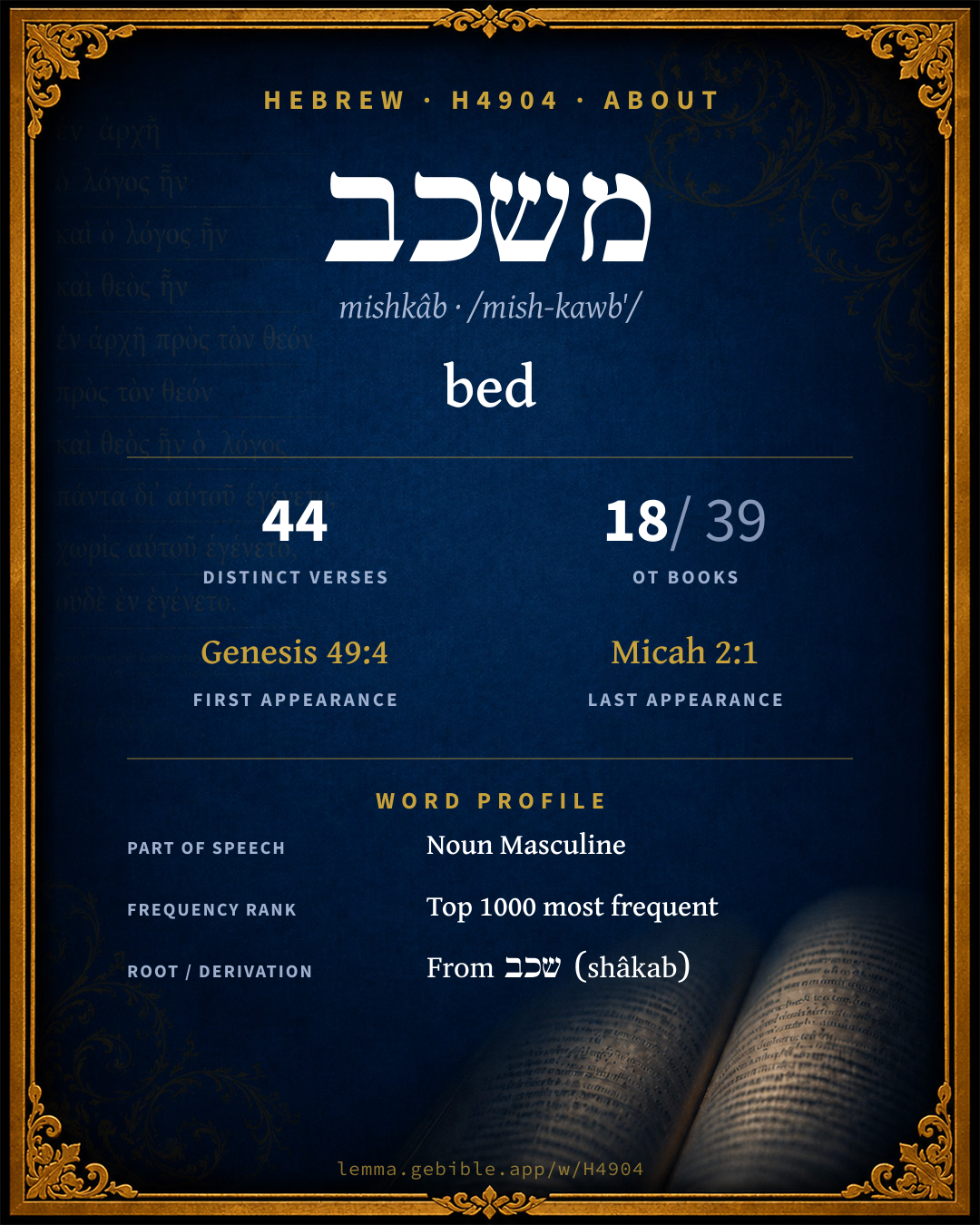
מִשְׁכָּב
bed
‘bed’ is one of 4 main senses fuller range ↓
Full lexicon entry — Brown-Driver-Briggs (BDB)
From Brown-Driver-Briggs (BDB)
Where this word appears
See every Construct-state word in the Hebrew Bible →
Grammar key — what these labels mean
Part of speech
- Noun
- A naming word — a person, place, thing, or idea.
Noun type
- Common
- A common noun — a general class of person, place, or thing (“king,” “city,” “water”), not a specific name.
State
- Construct
- A noun bound to a following noun in a possessive / “of” relationship (the construct chain).
- Absolute
- The independent form of a noun, not bound to a following word.
Gender
- Masculine
- Grammatically masculine.
Number
- Singular
- One.
- Plural
- More than one (in Hebrew, generally three or more).
35 distinct verses where H4904 appears in the Construct state, across 16 books. Filtered view — show all forms. Click any verse to open its interlinear word-by-word view. Verse text shown in the World English Bible for context — . Each verse’s Hebrew form is shown with its reference; the English is not keyword-highlighted, since the data carries no word-level English alignment. Use “Compare translations” on any verse to read it across multiple English versions. This concordance covers the Hebrew Bible; Septuagint (Greek Old Testament) occurrences are not indexed here.
Genesis 1 verse
Exodus 1 verse
Leviticus 5 verses
- Leviticus 15:5 בְּ/מִשְׁכָּב֑/וֹ prep + n c ms cs + sfx pers 3ms Whoever touches his bed shall wash his clothes, and bathe himself in water, and be unclean until the evening.
- Leviticus 15:21 בְּ/מִשְׁכָּבָ֑/הּ prep + n c ms cs + sfx pers 3fs Whoever touches her bed shall wash his clothes, and bathe himself in water, and be unclean until the evening.
- Leviticus 15:26 הַ/מִּשְׁכָּ֞ב כְּ/מִשְׁכַּ֥ב ptcl def.art + n c ms prep + n c ms cs Every bed whereon she lies all the days of her discharge shall be to her as the bed of her period: and everything whereon she sits shall be unclean, as the uncleanness of her period.
- Leviticus 18:22 מִשְׁכְּבֵ֣י n c mp cs "'You shall not lie with a man, as with a woman. That is detestible.
- Leviticus 20:13 מִשְׁכְּבֵ֣י n c mp cs If a man lies with a male, as with a woman, both of them have committed an abomination: they shall surely be put to death; their blood shall be upon them.
Numbers 3 verses
- Numbers 31:17 לְ/מִשְׁכַּ֥ב prep + n c ms cs Now therefore kill every male among the little ones, and kill every woman who has known man by lying with him.
- Numbers 31:18 מִשְׁכַּ֣ב n c ms cs But all the girls, who have not known man by lying with him, keep alive for yourselves.
- Numbers 31:35 מִשְׁכַּ֣ב n c ms cs and thirty-two thousand persons in all, of the women who had not known man by lying with him.
Judges 2 verses
- Judges 21:11 מִשְׁכַּב n c ms cs This is the thing that you shall do: you shall utterly destroy every male, and every woman who has lain by man.
- Judges 21:12 לְ/מִשְׁכַּ֣ב prep + n c ms cs They found among the inhabitants of Jabesh Gilead four hundred young virgins, who had not known man by lying with him; and they brought them to the camp to Shiloh, which is in the land of Canaan.
2 Samuel 6 verses
- 2 Samuel 4:5 מִשְׁכַּ֥ב n c ms cs The sons of Rimmon the Beerothite, Rechab and Baanah, went, and came about the heat of the day to the house of Ish-bosheth, as he took his rest at noon.
- 2 Samuel 4:7 מִשְׁכָּב֔/וֹ n c ms cs + sfx pers 3ms Now when they came into the house, as he lay on his bed in his bedchamber, they struck him, and killed him, and beheaded him, and took his head, and went by the way of the Arabah all night.
- 2 Samuel 4:11 מִשְׁכָּב֑/וֹ n c ms cs + sfx pers 3ms How much more, when wicked men have slain a righteous person in his own house on his bed, shall I not now require his blood of your hand, and take you away from the earth?
- 2 Samuel 11:2 מִשְׁכָּב/וֹ֙ n c ms cs + sfx pers 3ms It happened at evening, that David arose from off his bed, and walked on the roof of the king's house: and from the roof he saw a woman bathing; and the woman was very beautiful to look on.
- 2 Samuel 11:13 בְּ/מִשְׁכָּב/וֹ֙ prep + n c ms cs + sfx pers 3ms When David had called him, he ate and drink before him; and he made him drunk: and at even he went out to lie on his bed with the servants of his lord, but didn't go down to his house.
- 2 Samuel 13:5 מִשְׁכָּבְ/ךָ֖ n c ms cs + sfx pers 2ms Jonadab said to him, Lay you down on your bed, and feign yourself sick: and when your father comes to see you, tell him, Please let my sister Tamar come and give me bread to eat, and dress the food in my sight, that I may see it, and eat it from her hand.
2 Kings 1 verse
Job 2 verses
Psalms 4 verses
- Psalms 4:4 מִשְׁכַּבְ/כֶ֗ם n c ms cs + sfx pers 2mp Stand in awe, and don't sin. Search your own heart on your bed, and be still. Selah.
- Psalms 36:4 מִשְׁכָּ֫ב֥/וֹ n c ms cs + sfx pers 3ms He plots iniquity on his bed. He sets himself in a way that is not good; He doesn't abhor evil.
- Psalms 41:3 מִ֝שְׁכָּב֗/וֹ n c ms cs + sfx pers 3ms Yahweh will sustain him on his sickbed, And restore him from his bed of illness.
- Psalms 149:5 מִשְׁכְּבוֹתָֽ/ם n c mp cs + sfx pers 3mp Let the saints rejoice in honor. Let them sing for joy on their beds.
Proverbs 2 verses
Ecclesiastes 1 verse
Song of Solomon 1 verse
Isaiah 3 verses
- Isaiah 57:2 מִשְׁכְּבוֹתָ֑/ם n c mp cs + sfx pers 3mp He enters into peace; they rest in their beds, each one who walks in his uprightness.
- Isaiah 57:7 מִשְׁכָּבֵ֑/ךְ n c ms cs + sfx pers 2fs On a high and lofty mountain have you set your bed; there also you went up to offer sacrifice.
- Isaiah 57:8 מִשְׁכָּבֵ/ךְ֙ מִשְׁכָּבָ֖/ם n c ms cs + sfx pers 2fs n c ms cs + sfx pers 3mp Behind the doors and the posts have you set up your memorial: for you have uncovered [yourself] to another than me, and are gone up; you have enlarged your bed, and made you a covenant with them: you loved their bed where you saw it.
Ezekiel 1 verse
Hosea 1 verse
Micah 1 verse
About this entry
At a glance — auto-summarized from this page’s data, not written by a person. Every figure links to its source below. This summary describes the numbers; it doesn’t interpret them.
The Hebrew noun משכב centers on the idea of “bed.” The lexicon spreads it across several senses; see its full sense range. Spanning 44 verses in 18 books, it ranks among the moderately common words of the Hebrew Bible. Debuting at Genesis 49:4, it then recurs through the corpus. Sharing its root, it stands alongside שכב, שכבה and שכבת. For the data behind this summary, explore the sense tree and the renderings breakdown below.
Gloss history
Strong's 1890 vs modern scholarship
About this word
Strong's H4904 catalogs a Hebrew word from the Hebrew Old Testament.
These counts are not copied from any lexicon or concordance. They are computed here, from the morphology-tagged Hebrew Old Testament. What Lemma adds →
- 44
- distinct verses
- The word appears in 44 distinct verses.
- 18 / 39
- OT books
- The word appears in 18 of 39 Old Testament books.
- #796
- by frequency
- Top 1000 most frequent Hebrew words (rank 796 of 8,640 Hebrew words by occurrence).
View all 44 occurrences in the concordance →
By section of the Old Testament
By traditional corpus
Conventional, traditional groupings — biblical authorship is debated, so this is a traditional corpus grouping, not an authorship claim. Each share is this word’s portion of its verses in that division of the Hebrew canon. Each figure is a share of the word’s 44 distinct verses.
- Prophets (Nevi'im) 18 verses · 41%
- Torah (Pentateuch) 14 verses · 32%
- Writings (Ketuvim) 12 verses · 27%
How translations render this word
Counts come from each version’s own published word-to-Strong’s tagging or interlinear alignment — an approximate guide to how each version renders this word, not a word-level alignment the data otherwise carries. Because each total is that version’s own tagged count, the per-version totals vary from one another and need not match the appearance or distinct-verse counts above. These counts may also differ from a printed concordance because Lemma counts each distinctly tagged rendering and does not collapse phrase taggings into a single head-word total. This is a fixed set of word-tagged versions (KJV, ASV, BSB, ULT) and does not change with the reading translation you choose elsewhere. Each version’s license is shown beside its name below (and on Sources).
- King James Version: Bed 21×, Beds 5×, Lying 4×
- American Standard Version: Bed 15×, Beds 5×, Every bed 3×
- Berean Standard Bible: Bed 21×, Beds 5×
- unfoldingWord Literal Text: Bed 30×, Beds 5×, Bed of 3×
King James Version Public Domain
Renders H4904 across 42 tagged occurrences — most commonly:
Plus 10 renderings that appear only once — usually multi-word phrases or single function words the recovered tagging swept in, not distinct renderings. Not rendered by a distinct English word in 4 further occurrences.
American Standard Version Public Domain
Renders H4904 across 41 tagged occurrences — most commonly:
Plus 13 renderings that appear only once — usually multi-word phrases or single function words the recovered tagging swept in, not distinct renderings.
Berean Standard Bible Public Domain
Renders H4904 across 35 tagged occurrences — most commonly:
Plus 9 renderings that appear only once — usually multi-word phrases or single function words the recovered tagging swept in, not distinct renderings. Not rendered by a distinct English word in 11 further occurrences.
unfoldingWord Literal Text CC BY-SA 4.0
Renders H4904 across 47 tagged occurrences — most commonly:
Plus 7 renderings that appear only once — usually multi-word phrases or single function words the recovered tagging swept in, not distinct renderings.
Senses in the full BDB
What do BDB’s symbols mean?
BDB uses these scholarly abbreviations:
| Symbol | Meaning |
|---|---|
| 𝔊 | the Septuagint (the ancient Greek translation, LXX) |
| 𝔙 | the Vulgate (the Latin translation) |
| 𝔖 | the Syriac version (the Peshitta) |
| 𝔗 | the Targum (the Aramaic translation) |
| ψ | the Psalms |
| √ | root (the underlying root or stem) |
| ‖ | parallel passage (a synonymous or contrasted parallel) |
| † | the dagger: every passage where the word occurs is cited |
The 4 senses and sub-senses the full Brown-Driver-Briggs lexicon distinguishes for this word, in lexicon order (not ranked by frequency), with BDB’s own verbatim wording and sub-sense lettering. Shown in Hebrew script with BDB’s own scholarly abbreviations. The condensed entry is in the Lexicon Entry tab. See also the Forms in the corpus table below.
- 1. couch, bed (37 times), 2 S 4:11; Ho 7:14; Mi 2:1; 1 K 1:47; Ct 3:1 +; וְנָפַל לְמ׳ Ex 21:18 (E) he takes to his bed; מ׳ נִדָּתָהּ Lv 15:26 (P; v. sub I. נדד); מ׳ as place of copulation Gn 49:4 (poem in J), Is 57:7, 8(×2); Pr 7:17; as place of burial Is 57:2; Ez 32:25; 2 Ch 16:14 (v. מ׳ Inscr. Tabnit8 and perhaps Jewish inscr. Cooke341). e.g. 2 Samuel 4:11
- 2. act of lying:
- a. in gen., חֲדַר מ׳ chamber of lying down = bed-chamber, Ex 7:28 (E), 2 S 4:7; 2 K 6:12, בְּחַדְרֵי מִשְׁכָּֽבְךָ Ec 10:20; והוּא שֹׁכֵב אֵת מ׳ הַצָּהֳרַיִם 2 S 4:5 his noonday siesta; 17:28 read perhaps עַרְשׂת מ׳ couches for lying down Klo Bu HPS Now, cf. 𝔊. e.g. Exodus 7:28
- b. (from context) sexually: of woman מִשְׁכַּב (אִישׁ לְ) יֹּדַעַת זָכָר Ju 21:11, 12; Nu 31:17, 18, 35 (P); of man שׁכב מִשְׁכְּבֵי אִשָּׁה Lv 18:22; 20:13 (+ אֶת־זָכָר sodomy; H); מ׳ דֹּרִים Ez 23:17. e.g. Judges 21:11
Senses from the full Brown-Driver-Briggs lexicon (Brown, Driver, Briggs; Oxford 1906 — public domain), digitized via Sefaria, supplemented by the OpenScriptures HebrewLexicon (CC BY 4.0). Full attribution on Sources.
Word origin
n.m. Lv 15, 4 place of lying, couch; act of lying;—abs. מ׳ 1 K 1:47 +, cstr. מִשְׁכַּב 2 S 4:5 +; sf. מִשְׁכָּבִי Jb 7:13 +, מִשְׁכַּבְכֶם ψ 4:5; pl. cstr. מִשְׁכְּבֵי Gn 49:4 +, sf. מִשְׁכְּבוֹתָם Ho 7:14 +, etc.;—
— Brown-Driver-Briggs (Oxford 1906, public domain), digitized via Sefaria, supplemented by the OpenScriptures HebrewLexicon (CC BY 4.0). See Sources.
Derived from שכב (shâkab) (H7901) — to lie down.
Jastrow Dictionary
A second Hebrew/Aramaic lexicon for comparison, covering Aramaic and post-biblical (Talmudic, Targumic, Midrashic) usage that the biblical-Hebrew BDB does not. Matched by lemma rather than by Strong’s number, so a lemma may carry more than one Jastrow headword (shown separately below), and the entries cover usage well beyond the Bible.
מִשְׁכָּב
- 1. couch, bed; grave. Kidd. 31ᵇ כפרת מִשְׁכָּבוֹ, v. כַּפָּרָה. Keth. 104ᵃ; a. fr.—Esp. מ׳ (טומאת) the uncleanness caused by an unclean person lying on an object, v. מוֹשָׁב. Kel. I, 3; a. fr.—Pl. מִשְׁכָּבוֹת. Keth. l. c. Midr. Till. to Ps. CXLIX; a. e.
- 2. sexual connection. Snh. 55ᵃ; a. fr.—מִשְׁכַּב זכור (זכר) pederasty. Succ. 29ᵃ; a. fr.—Pl. as ab. Snh. l. c. שני מ׳ two ways (the natural and the unnatural way) of sexual gratification. Ib. 54ᵃ
A Dictionary of the Targumim, the Talmud Babli and Yerushalmi, and the Midrashic Literature (Marcus Jastrow; London, Luzac, 1903) — Public Domain. Digitized via Sefaria. Digitized via Sefaria. Full attribution on Sources.
Forms in the corpus
The 38 distinct written forms H4904 takes in the Hebrew Bible, most frequent first — each parse links to that state’s occurrences in the concordance. Hebrew forms include their vowel points and cantillation, so a single lemma takes many written forms.
Same root — word family
Other BDB entries built from the same root as H4904, grouped by Strong’s listed origin. These share a root / origin per the lexicon — not necessarily a shared meaning. Each links to that word’s own entry.
Derives from
Shares the same root
Derived from this word
Compare all same-root words → Showing 4 of 6 — not the complete family. They share a root, not necessarily a meaning.
Septuagint verse parallels
This word appears in 44 verses that also exist in the Greek Old Testament (Septuagint), out of the 44 Hebrew verses it occurs in. You can read those verses in Greek by switching the Old Testament edition to the Septuagint.
Read these verses in the Septuagint
- Genesis 49:4
- Exodus 8:3
- Leviticus 15:4
- Numbers 31:17
- Judges 21:11
- 2 Samuel 4:5
- 1 Kings 1:47
- 2 Kings 6:12
- 2 Chronicles 16:14
- Job 7:13
- Psalms 4:4
- Proverbs 7:17
This is a verse-level parallel only — the same verses exist in both the Hebrew and Greek Old Testaments. No word-level Hebrew↔Greek correspondence is claimed: the data carries no such alignment, so no Greek word is shown as this Hebrew word’s translation. Coverage is not total — the Septuagint omits the deuterocanon and renumbers the Psalms, so some Hebrew verses have no direct Greek parallel.