
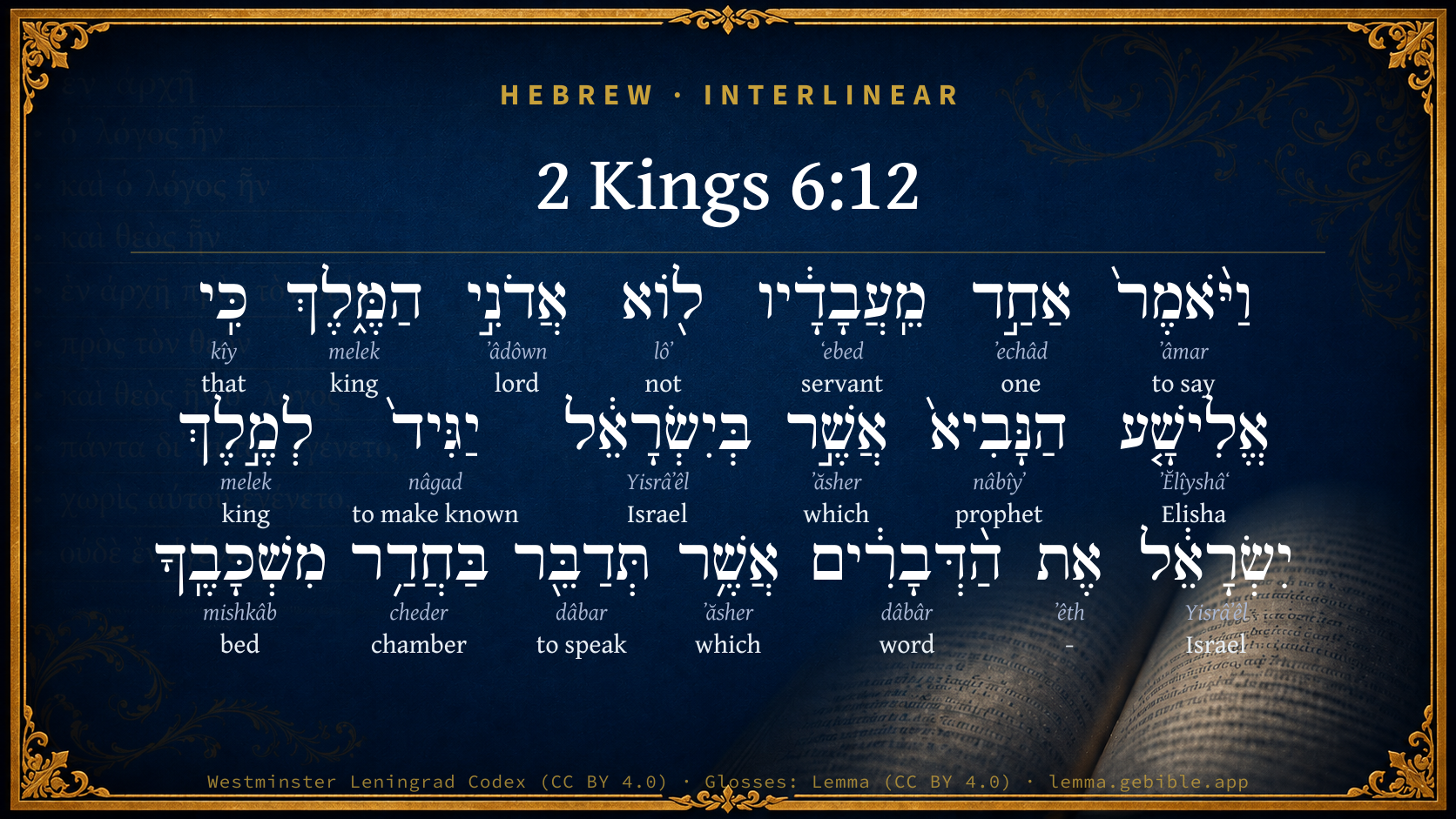
2 Kings 6:12

Hebrew (Westminster Leningrad Codex) 2 Kings 6:12 appears in the Hebrew Old Testament. The text above is from the Westminster Leningrad Codex. Each word links to its Strong’s number, a concise gloss, and parsing drawn from the Open Scriptures Hebrew Bible morphology. Click any word for its full Brown-Driver-Briggs (BDB) entry.
Download image
Cite this verse

2 Kings 6:12 (World English Bible). Public Domain. Lemma interlinear Bible study tool, https://lemma.gebible.app/v/2-kings/6/12.

Show BibTeX & RIS
BibTeX
RIS
English Translation
One of his servants said, No, my lord, O king; but Elisha, the prophet who is in Israel, tells the king of Israel the words that you speak in your bedchamber.
World English Bible · Public Domain
Download a study sheet

One document with this verse’s original text, its word-by-word gloss line, the meaning frame, cross-references with their text, attributed commentary, and full source and license credits — printable, and it pastes into notes with its structure intact.

This verse Autodidact and up

Study sheet (.html) Plain text (.txt)

A passage Seminary Student

Up to 50 verses in one chapter. A passage sheet keeps up to 6 commentary sources and 12 cross-references per verse, in the order this page ranks them, and says so on the sheet whenever that leaves anything out. Ask for a single verse and you get the Autodidact verse sheet above.

Everything on this page stays free to read, with no account — the sheet is a download of what is already on screen, not access to it.

Want to remove ads? Support Godless Engineer
Compare translations 3

The same verse in 3 English versions, stacked beneath the original-language interlinear above. Click any original word for its lexicon entry.

Each is an independent rendering of the whole verse — the interlinear is not word-aligned to these translations.

Highlighted words mark where these versions differ — a whole-verse word diff, not a word-by-word alignment.

  • World English Bible Public Domain
    One of his servants said, No, my lord, O king; but Elisha, the prophet who is in Israel, tells the king of Israel the words that you speak in your bedchamber.
  • King James Version Public Domain
    And one of his servants said, None, my lord, O king: but Elisha, the prophet that is in Israel, telleth the king of Israel the words that thou speakest in thy bedchamber.
  • unfoldingWord Literal Text CC BY-SA 4.0
    And one from his servants said, “No, my lord the king, but Elisha, the prophet who in Israel, declares to the king of Israel the things that you speak in the room of your bed.”

unfoldingWord Literal Text — © unfoldingWord, licensed CC BY-SA 4.0. Word-aligned USFM3 via Door43 (git.door43.org/unfoldingWord/en_ult).

Versions to compare (up to 4)

3 of 4 selected

Show all 18 translations

Every available English version of this verse, each an independent rendering of the whole verse.

  • World English Bible Public Domain
    One of his servants said, No, my lord, O king; but Elisha, the prophet who is in Israel, tells the king of Israel the words that you speak in your bedchamber.
  • Berean Standard Bible Public Domain
    But one of his servants replied, “No one, my lord the king. For Elisha, the prophet in Israel, tells the king of Israel the very words you speak in your bedroom.”
  • Majority Standard Bible Public Domain
    But one of his servants replied, “No one, my lord the king. For Elisha, the prophet in Israel, tells the king of Israel the very words you speak in your bedroom.”
  • King James Version Public Domain
    And one of his servants said, None, my lord, O king: but Elisha, the prophet that is in Israel, telleth the king of Israel the words that thou speakest in thy bedchamber.
  • American Standard Version (1901) Public Domain
    And one of his servants said, Nay, my lord, O king; but Elisha, the prophet that is in Israel, telleth the king of Israel the words that thou speakest in thy bedchamber.
  • Revised Version (1885) Public Domain
    And one of his servants said, Nay, my lord, O king: but Elisha, the prophet that is in Israel, telleth the king of Israel the words that thou speakest in thy bedchamber.
  • Geneva Bible (1599) Public Domain
    Then one of his seruants saide, None, my lorde, O King, but Elisha the Prophet that is in Israel, telleth the King of Israel, euen the wordes that thou speakest in thy priuie chamber.
  • Douay-Rheims (1899) Public Domain
    And one of his servants said: No one, my lord O king: but Eliseus the prophet, that is in Israel, telleth the king of Israel all the words, that thou speakest in thy privy chamber.
  • Young's Literal Translation Public Domain
    And one of his servants saith, `Nay, my lord, O king, for Elisha the prophet, who `is' in Israel, declareth to the king of Israel the words that thou speakest in the inner part of thy bed-chamber.'
  • Literal Standard Version CC BY-SA 4.0
    And one of his servants says, “No, my lord, O king, for Elisha the prophet, who [is] in Israel, declares to the king of Israel the words that you speak in the inner part of your bed-chamber.”
  • Unlocked Literal Bible CC BY-SA 4.0
    So one of his servants said, “No, my master, king, for Elisha the prophet in Israel tells the king of Israel the words that you speak in your own bedroom!”
  • unfoldingWord Literal Text CC BY-SA 4.0
    And one from his servants said, “No, my lord the king, but Elisha, the prophet who in Israel, declares to the king of Israel the things that you speak in the room of your bed.”
  • Darby Bible Public Domain
    And one of his servants said, None, my lord, O king; but Elisha, the prophet that is in Israel, tells the king of Israel the words that thou speakest in thy bedchamber.
  • World Messianic Bible Public Domain
    One of his servants said, “No, my lord, O king; but Elisha, the prophet who is in Israel, tells the king of Israel the words that you speak in your bedroom.”
  • Webster's Bible Public Domain
    And one of his servants said, None, my lord, O king: but Elisha, the prophet that is in Israel, telleth the king of Israel the words that thou speakest in thy bed-chamber.
  • Free Bible Version CC BY-SA 4.0
    “It's none of us, my lord the king,” one of his officers replied. “It's Elisha, the prophet who lives in Israel—he tells the king of Israel even what you say in your bedroom.”
  • Bible in Basic English Public Domain
    And one of them said, Not one of us, my lord king; but Elisha, the prophet in Israel, gives the king of Israel news of the words you say even in your bedroom.
  • JPS Tanakh (1917) Public Domain
    And one of his servants said: 'Nay, my lord, O king; but Elisha, the prophet that is in Israel, telleth the king of Israel the words that thou speakest in thy bed-chamber.'

Literal Standard Version (2020), Covenant Press — licensed CC BY-SA 4.0. Text via the HelloAO Bible API (eBible.org). Unlocked Literal Bible (unfoldingWord) — licensed CC BY-SA 4.0. Text via the HelloAO Bible API (eBible.org). unfoldingWord Literal Text — © unfoldingWord, licensed CC BY-SA 4.0. Word-aligned USFM3 via Door43 (git.door43.org/unfoldingWord/en_ult). Free Bible Version, Dr. Jonathan Gallagher — licensed CC BY-SA 4.0. Text via the HelloAO Bible API (eBible.org).

Word by word

More ways to search: Search by grammar → Find every occurrence → Compare this word →

Practice this passage: Drill this verse → Learn its vocabulary →

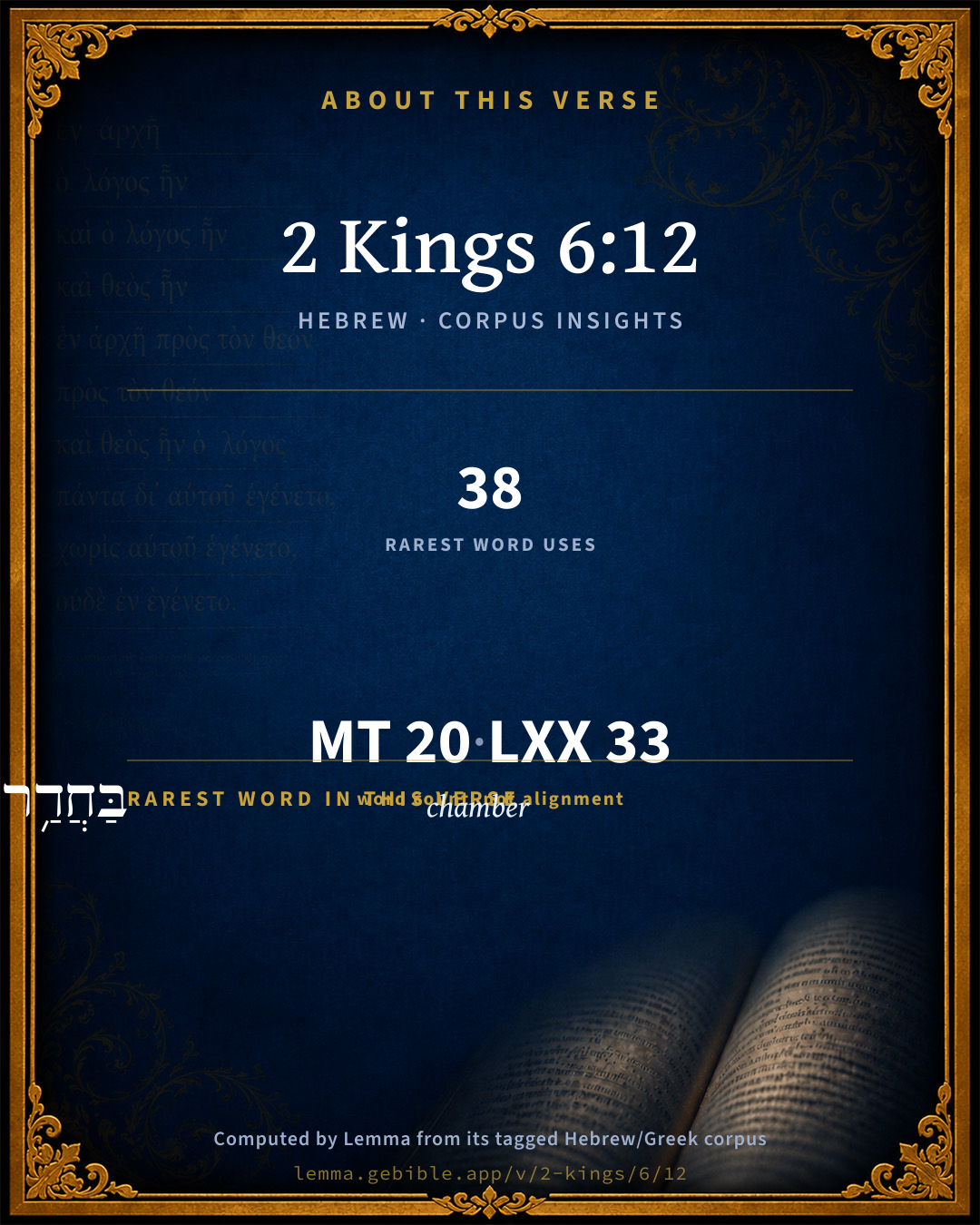
בַּחֲדַ֥ר
cheder
H2315
“in/at · chamber of”
Preposition + Noun, Common, Masculine, Singular, Construct
Part of Speech
Preposition + Noun
Type
Common
Gender
Masculine
Number
Singular
State
Construct
Full BDB Definition

Origin: from H2314

TWOT: 612a

chamber, room, parlour, innermost or inward part, within
  1. וַיֹּ֨אמֶר֙ ʼâmar H559 “and · to say” Conjunction + Verb, Qal, Sequential Imperfect, 3rd Person, Masculine, Singular
  2. אַחַ֣ד ʼechâd H259 “one” Adjective, Cardinal number, Masculine, Singular, Absolute
  3. מֵֽעֲבָדָ֔יו ʻebed H5650 “from · servants · his” Preposition + Noun, Common, Masculine, Plural, Construct + Suffix, Personal, 3rd Person, Masculine, Singular
  4. ל֖וֹא lôʼ H3808 “not” Particle, Negative
  5. אֲדֹנִ֣י ʼâdôwn H113 “lord · my” Noun, Common, Masculine, Singular, Construct + Suffix, Personal, 1st Person, Common, Singular
  6. הַמֶּ֑לֶךְ melek H4428 “the · king” Particle, Definite Article + Noun, Common, Masculine, Singular, Absolute
  7. כִּֽי kîy H3588 “that” Conjunction
  8. אֱלִישָׁ֤ע ʼĔlîyshâʻ H477 “Elisha” Noun, Proper
  9. הַנָּבִיא֙ nâbîyʼ H5030 “the · prophet” Particle, Definite Article + Noun, Common, Masculine, Singular, Absolute
  10. אֲשֶׁ֣ר ʼăsher H834 “which” Particle, Relative
  11. בְּיִשְׂרָאֵ֔ל Yisrâʼêl H3478 “in/at · Israel” Preposition + Noun, Proper
  12. יַגִּיד֙ nâgad H5046 “to make known” Verb, Hiphil, Imperfect, 3rd Person, Masculine, Singular
  13. לְמֶ֣לֶךְ melek H4428 “to/for · king of” Preposition + Noun, Common, Masculine, Singular, Construct
  14. יִשְׂרָאֵ֔ל Yisrâʼêl H3478 “Israel” Noun, Proper
  15. אֶת ʼêth H853 “-” Particle, Direct Object
  16. הַ֨דְּבָרִ֔ים dâbâr H1697 “the · words” Particle, Definite Article + Noun, Common, Masculine, Plural, Absolute
  17. אֲשֶׁ֥ר ʼăsher H834 “which” Particle, Relative
  18. תְּדַבֵּ֖ר dâbar H1696 “to speak” Verb, Piel, Imperfect, 2nd Person, Masculine, Singular
  19. מִשְׁכָּבֶֽךָ mishkâb H4904 “bed · your” Noun, Common, Masculine, Singular, Construct + Suffix, Personal, 2nd Person, Masculine, Singular

About this verse

These counts appear in no published source. They are computed here, from the morphology-tagged text and Lemma’s own curated glosses. What Lemma adds →

20
words
17
distinct lemmas
Historical
section

Shared distinctive vocabulary

בַּחֲדַ֥ר chamber H2315 occurs in 33 verses of the Hebrew Bible. Also found in:

Grammatical profile

  • 3 verbs
  • 11 nouns
  • 1 adjective
  • 1 conjunction
  • 4 particles

Verb forms

  • וַיֹּ֨אמֶר֙ Qal · Sequential Imperfect
  • יַגִּיד֙ Hiphil · Imperfect
  • תְּדַבֵּ֖ר Piel · Imperfect

Repetition

Words recur within this verse — often emphatic in Hebrew:

  • הַמֶּ֑לֶךְ king H4428 ×2
  • בְּיִשְׂרָאֵ֔ל Israel H3478 ×2
  • אֲשֶׁ֣ר which H834 ×2

Hebrew & Septuagint length

In English translation the verse runs 31 words from the Hebrew and 35 from the Septuagint (LXX English) — closely comparable.

A rough comparison of the two English renderings, which tokenize alike — not a word-level alignment.

Word counts can differ between the Hebrew and the Greek without any difference in meaning — e.g. the Hebrew direct-object marker אֵת has no separate Greek word, and Greek often adds the article ὁ.

In the original languages it is 20 Hebrew tokens and 33 Greek tokens — but the two are counted differently (Hebrew bundles its prefixes and suffixes into one token; the Greek is in lemma form), so that isn’t a like-for-like length.

Cross-references

13

Topical passages linked to 2 Kings 6:12 in the Treasury of Scripture Knowledge — connected by theme and wording, ordered by reader-vote popularity; previews shown in the World English Bible.

  • Daniel 2:28–30 but there is a God in heaven who reveals secrets, and he has made known to the king Nebuchadnezzar what shall be in the latter days. Your dream, and the visions of your head on your bed, are these:
  • Amos 3:7 Surely the Lord Yahweh will do nothing, Unless he reveals his secret to his servants the prophets.
  • 2 Kings 6:9–10 The man of God sent to the king of Israel, saying, Beware that you not pass such a place; for there the Syrians are coming down.
  • Ecclesiastes 10:20 Don't curse the king, no, not in your thoughts; And don't curse the rich in your bedchamber: For a bird of the sky may carry your voice, And that which has wings may tell the matter.
  • Daniel 2:22–23 he reveals the deep and secret things; he knows what is in the darkness, and the light dwells with him.
  • 2 Kings 5:3 She said to her mistress, Would that my lord were with the prophet who is in Samaria! then would he recover him of his leprosy.
  • 2 Kings 5:13–15 His servants came near, and spoke to him, and said, My father, if the prophet had bid you do some great thing, wouldn't you have done it? how much rather then, when he says to you, Wash, and be clean?
  • Psalms 139:1–4 Yahweh, you have searched me, And you know me.
  • Isaiah 29:15 Woe to those who hide deep their counsel from Yahweh, and whose works are in the dark, and who say, Who sees us? and who knows us?
  • Jeremiah 23:23–24 Am I a God at hand, says Yahweh, and not a God afar off?
  • Daniel 2:47 The king answered to Daniel, and said, Of a truth your God is the God of gods, and the Lord of kings, and a revealer of secrets, seeing you have been able to reveal this secret.
  • Daniel 4:9–18 Belteshazzar, master of the magicians, because I know that the spirit of the holy gods is in you, and no secret troubles you, tell me the visions of my dream that I have seen, and the interpretation of it.
  • 2 Kings 5:8 It was so, when Elisha the man of God heard that the king of Israel had torn his clothes, that he sent to the king, saying, Why have you torn your clothes? let him come now to me, and he shall know that there is a prophet in Israel.

Cross-references courtesy of OpenBible.info (CC BY 4.0).

Hebrew and Greek witnesses Masoretic Hebrew ↔ Greek Septuagint

The same verse in the two great witnesses to the Old Testament, shown verse-for-verse.

These are two independent witnesses, not word-aligned to each other, and the Septuagint is shown in lemma (dictionary) form.

Hebrew 2 Kings 6:12 Masoretic · Westminster Leningrad Codex

וַיֹּ֨אמֶר֙ אַחַ֣ד מֵֽעֲבָדָ֔יו ל֖וֹא אֲדֹנִ֣י הַמֶּ֑לֶךְ כִּֽי אֱלִישָׁ֤ע הַנָּבִיא֙ אֲשֶׁ֣ר בְּיִשְׂרָאֵ֔ל יַגִּיד֙ לְמֶ֣לֶךְ יִשְׂרָאֵ֔ל אֶת הַ֨דְּבָרִ֔ים אֲשֶׁ֥ר תְּדַבֵּ֖ר בַּחֲדַ֥ר מִשְׁכָּבֶֽךָ

One of his servants said, No, my lord, O king; but Elisha, the prophet who is in Israel, tells the king of Israel the words that you speak in your bedchamber.

World English Bible · Public Domain

Greek LXX 2 Kings 6:12 Septuagint · lemma form

καί εἶπον εἷς ὁ παῖς αὐτός οὐ κύριος ἐγώ βασιλεύς ὅτι ελισαιε ὁ προφήτης ὁ ἐν ἰσραήλ ἀναἀγγέλλω ὁ βασιλεύς ἰσραήλ πᾶς ὁ λόγος ὅς ἐάν λαλέω ἐν ὁ ταμιεῖον ὁ κοιτών σύ

And one of his servants said, Nay, my Lord, O king, for Elisaie the prophet that is in Israel reports to the king of Israel all the words whatever you may say in your bedchamber.

LXX2012 (modern English Septuagint) · Public Domain

On this verse, Ellicott's Commentary for English Readers discusses the Septuagint’s reading. Read the note in Commentary ↓

Hebrew: Westminster Leningrad Codex (CC BY 4.0). Greek: Septuagint (public domain); English from LXX2012 (modern English Septuagint) (Public Domain). How the Septuagint differs from the Hebrew →

Targum (Aramaic paraphrase)

1

The Targum is the ancient Jewish Aramaic paraphrase of the Hebrew Scriptures — an interpretive translation, not the Hebrew text itself. Onkelos (literal) and Pseudo-Jonathan (expansive) render the Torah, and Jonathan the Prophets. Coverage is partial: where no permissively-licensed English translation exists for a verse, only the Aramaic is shown. This is verse-level text, not a word-by-word alignment to the Hebrew.

  1. Targum Jonathan Prophets (Joshua–Malachi)
    וַאֲמַר חַד מֵעַבְדוֹהִי לָא רִבּוֹנִי מַלְכָּא אֲרֵי אֱלִישָׁע נְבִיָא דִי בְּיִשְׂרָאֵל יְחַוֵי לְמַלְכָּא דְיִשְׂרָאֵל יַת פִּתְגָמַיָא דִי תְמַלֵיל בְּאִדְרוֹן בֵּית מִשְׁכְּבָךְ:

    (no public-domain English translation for this verse)

    Targum Jonathan — Aramaic: “Mikraot Gedolot” (public domain). English: “Sefaria Community Translation” (CC0 1.0 (public-domain dedication)); “London "Chaldee Paraphrase," 1871” (public domain). Text via Sefaria.

Commentary

Notes on 2 Kings 6:12 from classic Christian and Jewish commentators (each source and its license shown beneath its notes). The classic Christian expositions comment on the surrounding passage and are grouped to its opening verse, so a note may address several verses; the Jewish commentaries on the Tanakh (Rashi and others) are per-verse, so they appear only where the commentator wrote on this verse.

Lemma curates 59 commentaries, every one of them public domain or Creative Commons licensed, each selected and text-cleaned for this edition rather than reprinted as found. About our sources →

Trapp's Complete Commentary

John Trapp

2Ki 6:12 And one of his servants said, None, my lord, O king: but Elisha, the prophet that [is] in Israel, telleth the king of Israel the words that thou speakest in thy bedchamber.

Ver. 12. And one of his servants said.] This was Naaman, saith Abulensis; but that is not likely. Rather it was some one that had been with Naaman, or on some other occasion, in Israel.

The words that thou speakest in thy bedchamber.] State secrets, Areana imperil, should not be blabbed or blazed abroad. The Romans for this, built a temple to Consus, the god of their counsels, sub tecto in Circo, in an open place, but under much covert; to show that counsels must be kept secret. {a} Metellus Macedonicus was wont to say, that if he thought his shirt were privy to his designs, he would tear it off and cast it away. And Peter, king of Arragon, answered in like manner Pope Martin IV, who sent to him to ask what he meant by the navy he was then rigging forth. Benhadad suspected his counsellors of treachery; but Elisha it was who disclosed his designs and frustrated them, by his prophetical spirit.

{a} Servius.

John Trapp, A Commentary or Exposition upon All the Books of the Old and New Testament (1647–1656) — public domain. Text from a community e-Sword module.

Geneva Bible (1599)

Geneva Bible translators

There is nothing so secret that thou canst go about, but he knoweth it, and discovereth it unto his King.

Geneva Bible (1599) marginal notes — public domain. Text via Bolls.life.

Ellicott's Commentary for English Readers

(12) One of his servants.—The old interpreters thought of Naaman, but Elisha’s fame may have been otherwise known at Damascus.

None.—Nay.

The words.—The LXX. and Vulg.,”all the words.”

Telleth.—From time to time, as the Hebrew form denotes.

A Bible Commentary for English Readers, edited by Charles John Ellicott (1878–1897) — public domain. Text from a community e-Sword module.

The Cambridge Bible for Schools and Colleges

gen. ed. J. J. S. Perowne

12. Elisha, the prophet that is in Israel] This mention of Elisha points to such a knowledge of him as might have been gained through Naaman’s cure. It may however be that communications of other kinds passed between Syria and Israel, and that in some of these the precise nature of Elisha’s conduct was described. Nothing in the story of Naaman could suggest that Elisha gave information to the king of Israel.

The Cambridge Bible for Schools and Colleges (gen. ed. J. J. S. Perowne; Cambridge University Press, 1878–1918) — public domain. Text from a community e-Sword module.

John Gill's Exposition

And he said, go, and spy where he is, that I may send and fetch him,.... But how could he expect to take him, who could give the king of Israel such intelligence of his designs against him, that he might escape his snares?

and it was told him, saying, behold, he is in Dothan; a city in the tribe of Manasseh, not far from Shechem; see Gen 37:17.

John Gill's Exposition of the Whole Bible (1746–1763) — public domain (CC PDM 1.0). Text via the HelloAO Bible API.

Albert Barnes' Notes on the Bible

In thy bedchamber - literally, “in the secret place of thy bedchamber,” i. e.,” in the greatest possible secrecy.” The seclusion of the harem must be taken into account for the full appreciation of the force of the phrase. Probably the Syrian lord who answered Benhadad had received his intelligence from some of the Israelites.

Albert Barnes' Notes on the Bible (1834–1885) — public domain. Text from a community e-Sword/MySword module.

Haydock's Catholic Bible Commentary

Chamber. It is difficult therefore for the saints in heaven to hear our prayers? though they have not such long ears as Calvin ridicules. (Haydock)

George Leo Haydock (1774–1849), Haydock's Catholic Family Bible and Commentary, 1859 edition — public domain. Excludes Psalms (Douay-Rheims chapter numbering differs from Protestant) and Deuterocanonical books (Catholic canon only).

Whedon's Commentary on the Bible

Daniel D. Whedon

12. One of his servants said — How knew this servant that Elisha gave the information? The fact was probably well known and much talked of in Israel, and from some Israelite this Syrian obtained his knowledge.

In thy bedchamber — A proverbial expression meaning the most secret and confidential plans and counsels of the king.

Daniel D. Whedon (gen. ed.), Commentary on the Old and New Testaments (1874–1909) — public domain. Text from a community e-Sword module.

The Pulpit Commentary

And one of his servants saidi.e. one of those interrogated, answeredNone, my lord, O king; literally, Nay, my lord, the king meaning, Think not so; it is not as thou supposest; there is no traitor in thy camp or in thy court; we are all true men. The explanation of the circumstances that surprise thee is quite different." But Elisha, the prophet that is in Israel compare "the man of God" (ver. 9); so much above the others, that he is spoken of as if there were no othertelleth the King of Israel the words that thou speakest in thy bedchamber; literally, in the secret place of thy bedchamber. How the Syrian lord knew this, or whether he merely made a shrewd guess, we cannot say. Elisha"s miraculous gifts had, no doubt, become widely known to the Syrians through the cure of Naaman"s leprosy; and the lord, who may possibly have been Naaman himself, concluded that a man who could cure s leper could also read a king"s secret thoughts without difficulty.

The Pulpit Commentary (1880–1919), ed. H.D.M. Spence-Jones & Joseph S. Exell — public domain. Text from a community e-Sword module.

Keil & Delitzsch

C. F. Keil & F. Delitzsch

Then one of the servants answered, "No, my lord king," i.e., it is not we who disclose thy plans to the king of Israel, "but Elisha the prophet tells him what thou sayest in thy bed-chamber;" whereupon the king of Syria inquired where the prophet lived, and sent a powerful army to Dothan, with horses and chariots, to take him prisoner there. Dothan (see Gen 37:17), which according to the Onom. was twelve Roman miles to the north of Samaria, has been preserved under its old name in a Tell covered with ruins to the south-west of Jenin, on the caravan-road from Gilead to Egypt (see Rob. Bibl. Res. p. 158, and V. de Velde, Journey, i. pp. 273,274).

Keil & Delitzsch — Biblical Commentary on the Old Testament (1861–1891) — public domain (CC PDM 1.0). Text via the HelloAO Bible API. (Old Testament only.)

unfoldingWord translationNotes

Door43 World Missions Community

No

The servant is saying that none of the king's soldiers are giving information to the king of Israel. AT: "It is none of us" (See: Assumed Knowledge and Implicit Information)

my master, king

This refers to the king of Aram.

the words that you speak in your own bedroom

"what you say in the privacy of your own bedroom"

I may send men and capture him

The king plans to send the men to capture Elisha for him. The king does not plan to capture him himself. AT: "I may send men to capture him" (See: Metonymy)

See

This word is used here to draw the king's attention to what is said next. AT: "Listen"

he is in Dothan

"Elisha is in Dothan"

Dothan

This is the name of a city. (See: How to Translate Names)

translationWords

lord

Elisha

prophet

word

unfoldingWord translationNotes — © Distant Shores Media and the Door43 World Missions Community, licensed CC BY-SA 4.0. Source: git.door43.org/Door43/en_tn.

Lesson kit

Teaching starters — assembled from the data on this page, not authored interpretation. Every prompt links to the verse data it draws on. Edit before teaching.

2 Kings, in the Historical, opens this verse with 20 words (17 distinct Hebrew lemmas). Its most distinctive word is cheder (“chamber”). A historical commentator’s framing appears above. Read the whole chapter for the surrounding context.

Discussion questions

  1. How does “chamber” (cheder) shape what this verse is saying?
  2. How does Genesis 43:30, which shares the word «chamber», read alongside this verse?
  3. What does the repetition of “king” (2× in this one verse) do in this verse?
  4. These translations render this verse differently; the difference is in the English rendering, not the original. What questions does that raise?
  5. «וַיֹּ֨אמֶר֙» is a Qal Sequential Imperfect verb. How does that grammatical form shape the action described?
  6. Compare how Trapp's Complete Commentary and Geneva Bible (1599) read this verse. Where do they agree or differ?

Things to notice

Reading settings

Reading text

Shown beneath each verse's original-language words.

Old Testament
Old Testament edition

Read the OT as the Masoretic Hebrew (MT) or the Greek Septuagint (LXX).

English shown for the Greek Septuagint (in the Hebrew ↔ Greek comparison).

Comparing translations? Open the Compare panel on any verse page to stack up to four side by side.