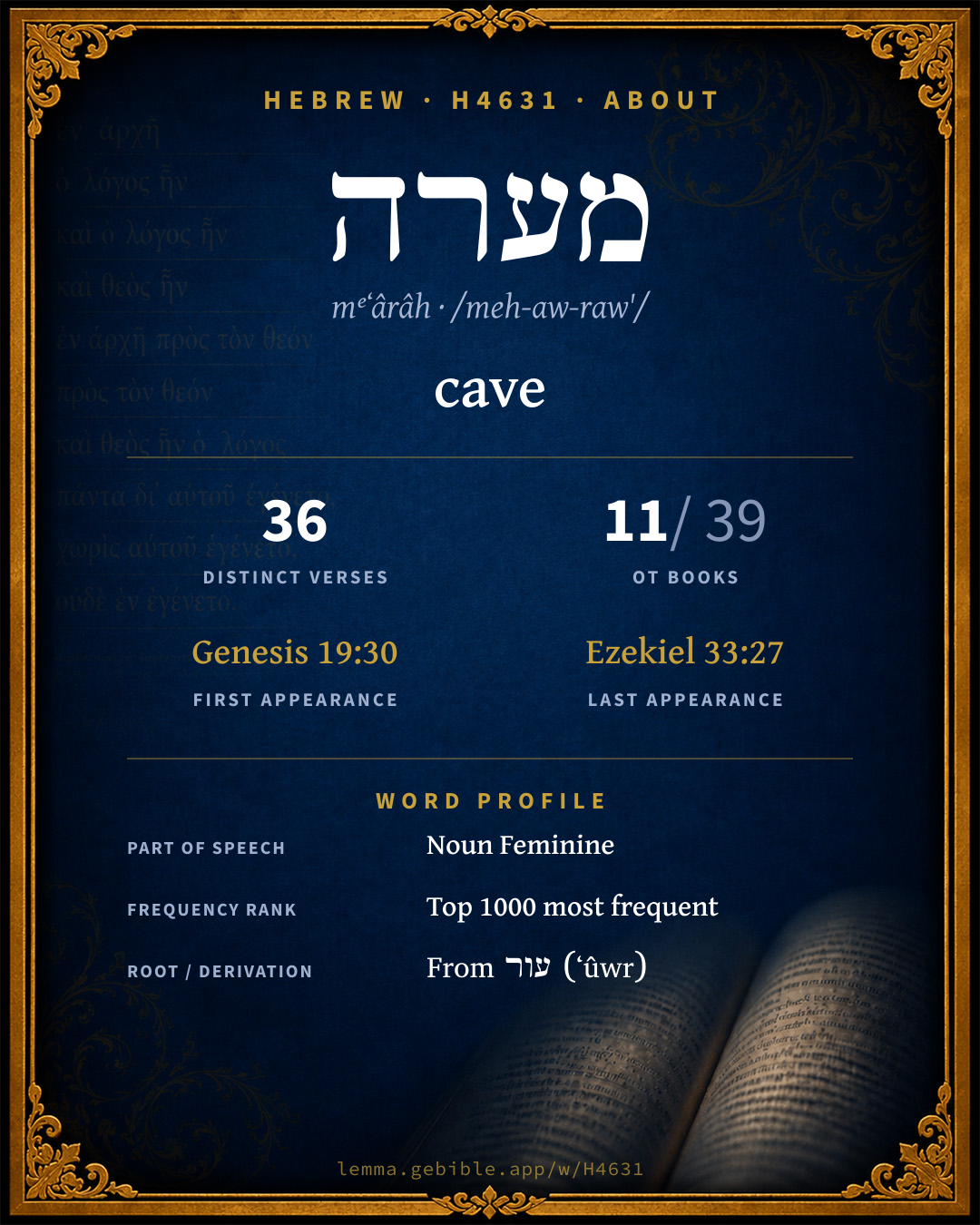
מְעָרָה
cave
Full lexicon entry — Brown-Driver-Briggs (BDB)
From Brown-Driver-Briggs (BDB)
Where this word appears
See every Absolute-state word in the Hebrew Bible →
Grammar key — what these labels mean
Part of speech
- Noun
- A naming word — a person, place, thing, or idea.
Noun type
- Common
- A common noun — a general class of person, place, or thing (“king,” “city,” “water”), not a specific name.
State
- Absolute
- The independent form of a noun, not bound to a following word.
- Construct
- A noun bound to a following noun in a possessive / “of” relationship (the construct chain).
Gender
- Feminine
- Grammatically feminine.
Number
- Singular
- One.
- Plural
- More than one (in Hebrew, generally three or more).
27 distinct verses where H4631 appears in the Absolute state, across 8 books. Filtered view — show all forms. Click any verse to open its interlinear word-by-word view. Verse text shown in the World English Bible for context — . Each verse’s Hebrew form is shown with its reference; the English is not keyword-highlighted, since the data carries no word-level English alignment. Use “Compare translations” on any verse to read it across multiple English versions. This concordance covers the Hebrew Bible; Septuagint (Greek Old Testament) occurrences are not indexed here.
Genesis 7 verses
- Genesis 19:30 בַּ/מְּעָרָ֔ה prep det + n c fs Lot went up out of Zoar, and lived in the mountain, and his two daughters with him; for he was afraid to live in Zoar. He lived in a cave with his two daughters.
- Genesis 23:11 וְ/הַ/מְּעָרָ֥ה conj + ptcl def.art + n c fs "No, my lord, hear me. I give you the field, and I give you the cave that is in it. In the presence of the children of my people I give it to you. Bury your dead."
- Genesis 23:17 וְ/הַ/מְּעָרָ֣ה conj + ptcl def.art + n c fs So the field of Ephron, which was in Machpelah, which was before Mamre, the field, the cave which was therein, and all the trees that were in the field, that were in all the border of it round about, were made sure
- Genesis 23:20 וְ/הַ/מְּעָרָ֧ה conj + ptcl def.art + n c fs The field, and the cave that is therein, were made sure to Abraham for a possession of a burying place by the children of Heth.
- Genesis 49:29 הַ֨/מְּעָרָ֔ה ptcl def.art + n c fs He charged them, and said to them, "I am to be gathered to my people. Bury me with my fathers in the cave that is in the field of Ephron the Hittite,
- Genesis 49:30 בַּ/מְּעָרָ֞ה prep det + n c fs in the cave that is in the field of Machpelah, which is before Mamre, in the land of Canaan, which Abraham bought with the field from Ephron the Hittite as a burial place.
- Genesis 49:32 וְ/הַ/מְּעָרָ֥ה conj + ptcl def.art + n c fs the field and the cave that is therein, which was purchased from the children of Heth."
Joshua 6 verses
- Joshua 10:16 בַ/מְּעָרָ֖ה prep det + n c fs These five kings fled, and hid themselves in the cave at Makkedah.
- Joshua 10:17 בַּ/מְּעָרָ֖ה prep det + n c fs It was told Joshua, saying, The five kings are found, hidden in the cave at Makkedah.
- Joshua 10:18 הַ/מְּעָרָ֑ה ptcl def.art + n c fs Joshua said, Roll great stones to the mouth of the cave, and set men by it to keep them:
- Joshua 10:22 הַ/מְּעָרָ֑ה הַ/מְּעָרָֽה ptcl def.art + n c fs ptcl def.art + n c fs Then said Joshua, Open the mouth of the cave, and bring forth those five kings to me out of the cave.
- Joshua 10:23 הַ/מְּעָרָ֑ה ptcl def.art + n c fs They did so, and brought forth those five kings to him out of the cave, the king of Jerusalem, the king of Hebron, the king of Jarmuth, the king of Lachish, the king of Eglon.
- Joshua 10:27 הַ/מְּעָרָ֖ה הַ/מְּעָרָ֔ה ptcl def.art + n c fs ptcl def.art + n c fs It happened at the time of the going down of the sun, that Joshua commanded, and they took them down off the trees, and cast them into the cave in which they had hidden themselves, and laid great stones on the mouth of the cave, to this very day.
Judges 1 verse
1 Samuel 5 verses
- 1 Samuel 13:6 בַּ/מְּעָר֤וֹת prep det + n c fp When the men of Israel saw that they were in a strait (for the people were distressed), then the people did hide themselves in caves, and in thickets, and in rocks, and in coverts, and in pits.
- 1 Samuel 24:3 מְעָרָ֔ה הַ/מְּעָרָ֖ה n c fs ptcl def.art + n c fs He came to the sheep pens by the way, where was a cave; and Saul went in to cover his feet. Now David and his men were abiding in the innermost parts of the cave.
- 1 Samuel 24:7 מֵ/הַ/מְּעָרָ֖ה prep + ptcl def.art + n c fs So David checked his men with these words, and didn't allow them to rise against Saul. Saul rose up out of the cave, and went on his way.
- 1 Samuel 24:8 ה/מערה מֵֽ/הַ/מְּעָרָ֔ה ptcl def.art + n c fs prep + ptcl def.art + n c fs David also arose afterward, and went out of the cave, and cried after Saul, saying, My lord the king. When Saul looked behind him, David bowed with his face to the earth, and did obeisance.
- 1 Samuel 24:10 בַּ/מְּעָרָ֔ה prep det + n c fs Behold, this day your eyes have seen how that Yahweh had delivered you today into my hand in the cave: and some bade me kill you; but [my eye] spared you; and I said, I will not put forth my hand against my lord; for he is Yahweh's anointed.
1 Kings 4 verses
- 1 Kings 18:4 בַּ/מְּעָרָ֔ה prep det + n c fs for it was so, when Jezebel cut off the prophets of Yahweh, that Obadiah took one hundred prophets, and hid them by fifty in a cave, and fed them with bread and water.)
- 1 Kings 18:13 בַּ/מְּעָרָ֔ה prep det + n c fs Wasn't it told my lord what I did when Jezebel killed the prophets of Yahweh, how I hid one hundred men of Yahweh's prophets by fifty in a cave, and fed them with bread and water?
- 1 Kings 19:9 הַ/מְּעָרָ֖ה ptcl def.art + n c fs He came there to a cave, and lodged there; and, behold, the word of Yahweh came to him, and he said to him, What are you doing here, Elijah?
- 1 Kings 19:13 הַ/מְּעָרָ֑ה ptcl def.art + n c fs It was so, when Elijah heard it, that he wrapped his face in his mantle, and went out, and stood in the entrance of the cave. Behold, there came a voice to him, and said, What are you doing here, Elijah?
Psalms 2 verses
- Psalms 57:1 בַּ/מְּעָרָֽה prep det + n c fs Be merciful to me, God, be merciful to me, For my soul takes refuge in you. Yes, in the shadow of your wings, I will take refuge, Until disaster has passed.
- Psalms 142:1 בַ/מְּעָרָ֣ה prep det + n c fs I cry with my voice to Yahweh. With my voice, I ask Yahweh for mercy.
Isaiah 1 verse
Ezekiel 1 verse
About this entry
At a glance — auto-summarized from this page’s data, not written by a person. Every figure links to its source below. This summary describes the numbers; it doesn’t interpret them.
At its core, מערה (mᵉʻârâh) means “cave.” Scripture first uses it in Genesis 19:30. Spanning 36 verses in 11 books, it ranks among the moderately common words of the Hebrew Bible. Its uses concentrate in Genesis (31% of all occurrences). From the same root come עור, מעור and עור. For the data behind this summary, explore the sense tree and the renderings breakdown below.
Gloss history
Strong's 1890 vs modern scholarship
About this word
Strong's H4631 catalogs a Hebrew word from the Hebrew Old Testament.
These counts are not copied from any lexicon or concordance. They are computed here, from the morphology-tagged Hebrew Old Testament. What Lemma adds →
- 36
- distinct verses
- The word appears in 36 distinct verses.
- 11 / 39
- OT books
- The word appears in 11 of 39 Old Testament books.
- #909
- by frequency
- Top 1000 most frequent Hebrew words (rank 909 of 8,640 Hebrew words by occurrence).
View all 36 occurrences in the concordance →
By section of the Old Testament
By traditional corpus
Conventional, traditional groupings — biblical authorship is debated, so this is a traditional corpus grouping, not an authorship claim. Each share is this word’s portion of its verses in that division of the Hebrew canon. Each figure is a share of the word’s 36 distinct verses.
- Prophets (Nevi'im) 22 verses · 61%
- Torah (Pentateuch) 11 verses · 31%
- Writings (Ketuvim) 3 verses · 8%
How translations render this word
Counts come from each version’s own published word-to-Strong’s tagging or interlinear alignment — an approximate guide to how each version renders this word, not a word-level alignment the data otherwise carries. Because each total is that version’s own tagged count, the per-version totals vary from one another and need not match the appearance or distinct-verse counts above. These counts may also differ from a printed concordance because Lemma counts each distinctly tagged rendering and does not collapse phrase taggings into a single head-word total. This is a fixed set of word-tagged versions (KJV, ASV, BSB, ULT) and does not change with the reading translation you choose elsewhere. Each version’s license is shown beside its name below (and on Sources).
- King James Version: Cave 27×, Caves 2×
- American Standard Version: Cave 24×, Caves 3×
- Berean Standard Bible: Cave 29×, Caves 5×, Per cave 2×
- unfoldingWord Literal Text: Cave 24×, Cave of 8×, Caves 4×
King James Version Public Domain
Renders H4631 across 39 tagged occurrences — most commonly:
Plus 10 renderings that appear only once — usually multi-word phrases or single function words the recovered tagging swept in, not distinct renderings.
American Standard Version Public Domain
Renders H4631 across 37 tagged occurrences — most commonly:
Plus 10 renderings that appear only once — usually multi-word phrases or single function words the recovered tagging swept in, not distinct renderings.
Berean Standard Bible Public Domain
Renders H4631 across 38 tagged occurrences — most commonly:
Plus 2 renderings that appear only once — usually multi-word phrases or single function words the recovered tagging swept in, not distinct renderings. Not rendered by a distinct English word in 1 further occurrence.
unfoldingWord Literal Text CC BY-SA 4.0
Renders H4631 across 39 tagged occurrences — most commonly:
Plus 3 renderings that appear only once — usually multi-word phrases or single function words the recovered tagging swept in, not distinct renderings.
Senses in BDB
The 1 sense BDB distinguishes for this word, in lexicon order (not ranked by frequency or importance). The full entry — with sub-senses — is in the Lexicon Entry tab.
- cave, den, hole
Word origin
n.f. cave;—abs. מ׳ Gn 19:30 +; cstr. מְעָרַת 23:19 +; pl. מְעָרוֹת Ju 6:2 +, cstr. id. Is 2:19;—cave, especially as place of sojourn or refuge Gn 19:30 (J), 1 S 24:3(×2), 7, 8, 10 (Ginsb v 4, 8, 9, 11 van d. H. Baer), 1 K 19:1; 13, Ez 33:27; Jos 10:16 (מ׳ בַמַּקֵּדָה) + 7 times Jos 10; Ju 6:2; 1 S 13:6; 1 K 18:4, 13; cf. ψ 57:1; 142:1; מְעָרוֹת צֻרִים Is 2:19, hence מ׳ פָּרִצִים Je 7:11 robbers’ cave; Is 32:14 den (of wild beasts);—מ׳ עֲדֻלָּם 1 S 22:1; 2 S 23:13, whence in ‖ 1 Ch 11:15, read prob. מְצֻדַת ע׳ or מְצָדַת We, cf. Dr, Bu Kit HPS;—as burial place, מ׳ הַמַּכְפֵּלָה Gn 23:9 + (v. מַכְפֵּלָה) = מ׳ alone 23:11, 17, 20; 49:29, 32 (all P). מ׳ אֲשֶׁר לַצִּידֹנִים Jos 13:4 (D), cave-region in Lebanon E. of Sidon, mod. Mughâr Ǧezzîn, according to most, but dub.; perhaps, rather, near Tyre BuhlMDPV 1895, 55.
— Brown-Driver-Briggs (Oxford 1906, public domain), digitized via Sefaria, supplemented by the OpenScriptures HebrewLexicon (CC BY 4.0). See Sources.
Derived from עור (ʻûwr) (H5783) — to be laid bare.
Jastrow Dictionary
A second Hebrew/Aramaic lexicon for comparison, covering Aramaic and post-biblical (Talmudic, Targumic, Midrashic) usage that the biblical-Hebrew BDB does not. Matched by lemma rather than by Strong’s number, so a lemma may carry more than one Jastrow headword (shown separately below), and the entries cover usage well beyond the Bible.
מְעָרָה
- cave. Y. Ber. IV, 7ᵈ top, v. מַזֶּה II. Sabb. 33ᵇ חיזרו למְעַרְתְּכֶם go back to your cave (hiding place). Yeb. 119ᵇ; a. fr.—מְעָרַת המכפלה, v. מַכְפֵּלָה.—Pl. מְעָרוֹת. M. Kat. 5ᵇ; a. fr.
A Dictionary of the Targumim, the Talmud Babli and Yerushalmi, and the Midrashic Literature (Marcus Jastrow; London, Luzac, 1903) — Public Domain. Digitized via Sefaria. Digitized via Sefaria. Full attribution on Sources.
Forms in the corpus
The 29 distinct written forms H4631 takes in the Hebrew Bible, most frequent first — each parse links to that state’s occurrences in the concordance. Hebrew forms include their vowel points and cantillation, so a single lemma takes many written forms.
Same root — word family
Other BDB entries built from the same root as H4631, grouped by Strong’s listed origin. These share a root / origin per the lexicon — not necessarily a shared meaning. Each links to that word’s own entry.
Derives from
Shares the same root
Proper names from this root
People and places named from this root — a name, not an additional meaning of the word.
Compare all same-root words → Showing 4 of 6 — not the complete family. 1 of the same-root words is a proper name (a person or place). They share a root, not necessarily a meaning.
Septuagint verse parallels
This word appears in 36 verses that also exist in the Greek Old Testament (Septuagint), out of the 36 Hebrew verses it occurs in. You can read those verses in Greek by switching the Old Testament edition to the Septuagint.
Read these verses in the Septuagint
- Genesis 19:30
- Joshua 10:16
- Judges 6:2
- 1 Samuel 13:6
- 2 Samuel 23:13
- 1 Kings 18:4
- 1 Chronicles 11:15
- Psalms 57:1
- Isaiah 2:19
- Jeremiah 7:11
- Ezekiel 33:27
This is a verse-level parallel only — the same verses exist in both the Hebrew and Greek Old Testaments. No word-level Hebrew↔Greek correspondence is claimed: the data carries no such alignment, so no Greek word is shown as this Hebrew word’s translation. Coverage is not total — the Septuagint omits the deuterocanon and renumbers the Psalms, so some Hebrew verses have no direct Greek parallel.