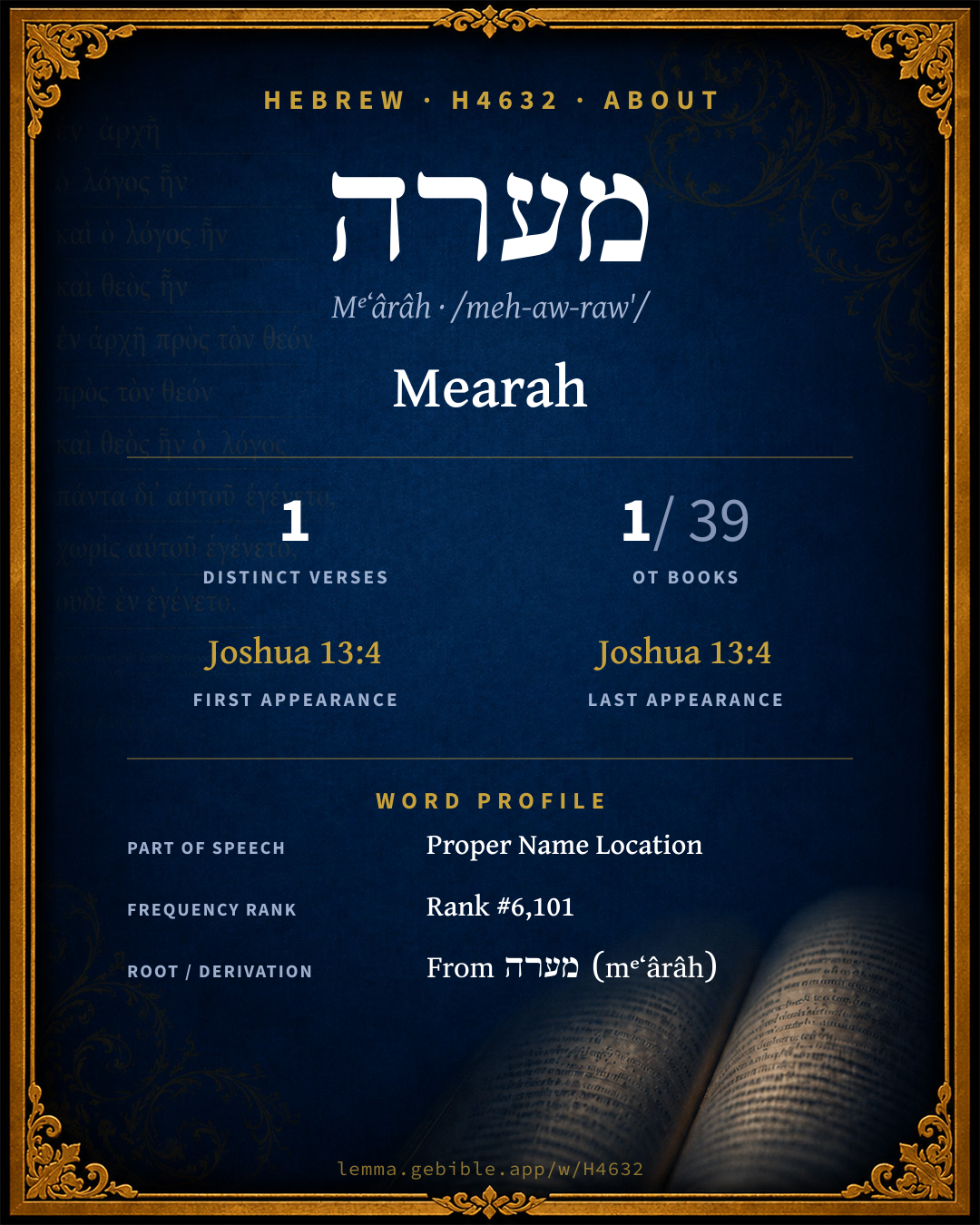
מְעָרָה
Mearah
BDB lists 2 entries for ‘Mearah’ fuller range ↓
Full lexicon entry — Brown-Driver-Briggs (BDB)
From Brown-Driver-Briggs (BDB)
Where this word appears
Grammar key — what these labels mean
Noun type
- Proper
- A name of a specific person, place, or people (e.g. Abraham, Zion, Israel).
Every verse where H4632 appears — 1 distinct verse across 1 book. Click any verse to open its interlinear word-by-word view. Verse text shown in the World English Bible for context — . Each verse’s Hebrew form is shown with its reference; the English is not keyword-highlighted, since the data carries no word-level English alignment. Use “Compare translations” on any verse to read it across multiple English versions. This concordance covers the Hebrew Bible; Septuagint (Greek Old Testament) occurrences are not indexed here.
Joshua 1 verse
About this entry
At a glance — auto-summarized from this page’s data, not written by a person. Every figure links to its source below. This summary describes the numbers; it doesn’t interpret them.
מערה — transliterated Mᵉʻârâh — is a Hebrew name carrying the sense “Mearah.” A scarce word — 1 verse in all of the Hebrew Bible. Its uses cluster heavily in Joshua (100% of all occurrences). Scripture uses it exactly once, at Joshua 13:4. Each statement above links to its evidence; the full detail follows below.
Gloss history
Strong's 1890 vs modern scholarship
About this word
Strong's H4632 catalogs a Hebrew word from the Hebrew Old Testament.
These counts are not copied from any lexicon or concordance. They are computed here, from the morphology-tagged Hebrew Old Testament. What Lemma adds →
- 1
- distinct verses
- The word appears in 1 distinct verse.
- 1 / 39
- OT books
- The word appears in 1 of 39 Old Testament books.
- #6,101
- by frequency
- Rank #6,101 (rank 6,101 of 8,640 Hebrew words by occurrence).
View all 1 occurrence in the concordance →
Most concentrated in
- Joshua 1 verse 100%
By section of the Old Testament
By traditional corpus
Conventional, traditional groupings — biblical authorship is debated, so this is a traditional corpus grouping, not an authorship claim. Each share is this word’s portion of its verses in that division of the Hebrew canon. Each figure is a share of the word’s 1 distinct verse.
- Prophets (Nevi'im) 1 verse · 100%
How translations render this word
Counts come from each version’s own published word-to-Strong’s tagging or interlinear alignment — an approximate guide to how each version renders this word, not a word-level alignment the data otherwise carries. Because each total is that version’s own tagged count, the per-version totals vary from one another and need not match the appearance or distinct-verse counts above. These counts may also differ from a printed concordance because Lemma counts each distinctly tagged rendering and does not collapse phrase taggings into a single head-word total. This is a fixed set of word-tagged versions (KJV, ASV, BSB, ULT) and does not change with the reading translation you choose elsewhere. Each version’s license is shown beside its name below (and on Sources).
BDB lists this Strong’s number as 3 distinct words (homographs). Each count above pools all of them and is not split by sense — see the Senses section below. A low-frequency rendering may belong to a different one of those words, not the primary meaning.
- King James Version†: Mearah 1×
- American Standard Version†: Mearah 1×
- Berean Standard Bible†: Mearah 1×
- unfoldingWord Literal Text†: Mearah 1×
King James Version Public Domain
Renders H4632 across 1† tagged occurrence — most commonly:
American Standard Version Public Domain
Renders H4632 across 1† tagged occurrence — most commonly:
Berean Standard Bible Public Domain
Renders H4632 across 1† tagged occurrence — most commonly:
unfoldingWord Literal Text CC BY-SA 4.0
Renders H4632 across 1† tagged occurrence — most commonly:
10 senses and sub-senses in the full BDB
Hebrew verbs can shift meaning by stem (binyan): Qal is the basic action, Niphal is often passive or reflexive, Piel often intensifies or makes it factitive, and Hiphil is typically causative. The senses below are grouped under the stem BDB assigns to each. This entry also uses Hithpael (reflexive or reciprocal).
What do BDB’s symbols mean?
BDB uses these scholarly abbreviations:
| Symbol | Meaning |
|---|---|
| 𝔊 | the Septuagint (the ancient Greek translation, LXX) |
| 𝔙 | the Vulgate (the Latin translation) |
| 𝔖 | the Syriac version (the Peshitta) |
| 𝔗 | the Targum (the Aramaic translation) |
| ψ | the Psalms |
| √ | root (the underlying root or stem) |
| ‖ | parallel passage (a synonymous or contrasted parallel) |
| † | the dagger: every passage where the word occurs is cited |
The 10 senses and sub-senses the full Brown-Driver-Briggs lexicon distinguishes for this word, in lexicon order (not ranked by frequency), with BDB’s own verbatim wording and sub-sense lettering. Shown in Hebrew script with BDB’s own scholarly abbreviations. The condensed entry is in the Lexicon Entry tab.
מערה I be naked, bare (Arabic عَرِىَ be naked
Piel
- Pf. 3 ms. עֵרָה Is 22:6 Zp 2:14; Impf. 3 ms. יְעָרֶה Is 3:17; 3 fs. וַתְּעַר Gn 24:20; 2 ms. juss. תְּעַר ψ 141:8; 3 mpl. וִיעָרוּ 2 Ch 24:11; Imv. mpl. עָ֫רוּ ψ 137:7(×2); Inf. abs. עָרוֹת Hb 3:13 (Ges§ 75 n);— e.g. Isaiah 22:6
- 1. lay bare Is 3:17; 22:6; Zp 2:14 (indef. subj.); of laying foundations bare, i.e. tearing down walls, etc. Hb 3:13 (yet on text v. Now), abs. עָ֫רוּ עָ֑רוּ ψ 137:7(×2). e.g. Isaiah 3:17
- 2. lay bare by removing contents, empty, water-jar Gn 24:20 (J; + אֶל loc.), chest 2 Ch 24:11. e.g. Genesis 24:20
- 3. pour out, אַל־תְּעַר נַפְשָׁי ψ 141:8 (i.e. slay). e.g. Psalms 141:8
Hiphil
- Pf. 3 ms. הֶעֱרָה:
- 1. make naked, of sexual offences Lv 20:18, 19 (both ‖ גִּלָּה). e.g. Leviticus 20:18
- 2. pour out, הֶע׳ לַמָּוֶת נַפְשׁוֹ Is 53:12 (fig. for slay, cf. Pi. 3). e.g. Isaiah 53:12
Niphal
- pass. of Hiph. 2: 3 ms. יֵעָרֶה עָלֵינוּ רוּחַ Is 32:15 (fig.) until there be poured upon us a spirit from on high. e.g. Isaiah 32:15
Hithpael
- 1. Impf. 2 fs. תִּתְעָרִ֑י La 4:21 thou shalt make thyself naked (of Edom under fig. of drunken woman). e.g. Lamentations 4:21
- 2. Pt. מִתְעָרֶה ψ 37:35 usually pouring himself, i.e. spreading himself out like a tree (Bae doubts; Du מִתְעַלֶּה lifting himself up, cf. 𝔊). e.g. Psalms 37:35
מערה II bare place
מערה III cave
Senses from the full Brown-Driver-Briggs lexicon (Brown, Driver, Briggs; Oxford 1906 — public domain), digitized via Sefaria, supplemented by the OpenScriptures HebrewLexicon (CC BY 4.0). Full attribution on Sources.
Word origin
I. vb. be naked, bare (Arabic عَرِىَ be naked; Ph. ערה [Pi.] lay bare (cf. Bloch Lzb); Assyrian ûru, nakedness, also desert waste (cf. [עָרָה] infr.) JägerBAS ii. 282 and reff.; NH עֶרְוָה = BH, 𝔗 עִירְיְתָא; Syriac ܥܪܳܝܽܘܬܳܐ in Lexx);—
II. n.f. bare place;—pl. עָרוֹת Is 19:7 (si vera interpr.; > 𝔊 ἄχ(ε)ι, Ki Saad reeds).
II. n.f. cave;—abs. מ׳ Gn 19:30 +; cstr. מְעָרַת 23:19 +; pl. מְעָרוֹת Ju 6:2 +, cstr. id. Is 2:19;—cave, especially as place of sojourn or refuge Gn 19:30 (J), 1 S 24:3(×2), 7, 8, 10 (Ginsb v 4, 8, 9, 11 van d. H. Baer), 1 K 19:1; 13, Ez 33:27; Jos 10:16 (מ׳ בַמַּקֵּדָה) + 7 times Jos 10; Ju 6:2; 1 S 13:6; 1 K 18:4, 13; cf. ψ 57:1; 142:1; מְעָרוֹת צֻרִים Is 2:19, hence מ׳ פָּרִצִים Je 7:11 robbers’ cave; Is 32:14 den (of wild beasts);—מ׳ עֲדֻלָּם 1 S 22:1; 2 S 23:13, whence in ‖ 1 Ch 11:15, read prob. מְצֻדַת ע׳ or מְצָדַת We, cf. Dr, Bu Kit HPS;—as burial place, מ׳ הַמַּכְפֵּלָה Gn 23:9 + (v. מַכְפֵּלָה) = מ׳ alone 23:11, 17, 20; 49:29, 32 (all P). מ׳ אֲשֶׁר לַצִּידֹנִים Jos 13:4 (D), cave-region in Lebanon E. of Sidon, mod. Mughâr Ǧezzîn, according to most, but dub.; perhaps, rather, near Tyre BuhlMDPV 1895, 55.
— Brown-Driver-Briggs (Oxford 1906, public domain), digitized via Sefaria, supplemented by the OpenScriptures HebrewLexicon (CC BY 4.0). See Sources.
Derived from מערה (mᵉʻârâh) (H4631) — cave.
Jastrow Dictionary
A second Hebrew/Aramaic lexicon for comparison, covering Aramaic and post-biblical (Talmudic, Targumic, Midrashic) usage that the biblical-Hebrew BDB does not. Matched by lemma rather than by Strong’s number, so a lemma may carry more than one Jastrow headword (shown separately below), and the entries cover usage well beyond the Bible.
מְעָרָה
- cave. Y. Ber. IV, 7ᵈ top, v. מַזֶּה II. Sabb. 33ᵇ חיזרו למְעַרְתְּכֶם go back to your cave (hiding place). Yeb. 119ᵇ; a. fr.—מְעָרַת המכפלה, v. מַכְפֵּלָה.—Pl. מְעָרוֹת. M. Kat. 5ᵇ; a. fr.
A Dictionary of the Targumim, the Talmud Babli and Yerushalmi, and the Midrashic Literature (Marcus Jastrow; London, Luzac, 1903) — Public Domain. Digitized via Sefaria. Digitized via Sefaria. Full attribution on Sources.
Bible dictionary
Public-domain dictionary articles matched to this entry by name (Mearah). A biblical name can be shared by more than one person or place, so an article may treat several.
Easton's Bible Dictionary · M. G. Easton, 1897
A cave, a place in the northern boundary of Palestine (Josh. 13:4). This may be the cave of Jezzin in Lebanon, 10 miles east of Sidon, on the Damascus road; or probably, as others think, Mogheirizeh, north-east of Sidon.
Smith's Bible Dictionary · William Smith, 1863
(a cave), a place named in (Joshua 13:4) only. The word means in Hebrew a cave, and it is commonly assumed that the reference is to some remarkable cavern in the neighborhood of Zidon.
Hitchcock's Bible Names Dictionary · Roswell D. Hitchcock, 1869
den; cave; making empty
Classic public-domain reference works; full attribution on Sources.
Septuagint verse parallels
This word appears in 1 verse that also exists in the Greek Old Testament (Septuagint), out of the 1 Hebrew verse it occurs in. You can read those verses in Greek by switching the Old Testament edition to the Septuagint.
Read these verses in the Septuagint
This is a verse-level parallel only — the same verses exist in both the Hebrew and Greek Old Testaments. No word-level Hebrew↔Greek correspondence is claimed: the data carries no such alignment, so no Greek word is shown as this Hebrew word’s translation. Coverage is not total — the Septuagint omits the deuterocanon and renumbers the Psalms, so some Hebrew verses have no direct Greek parallel.