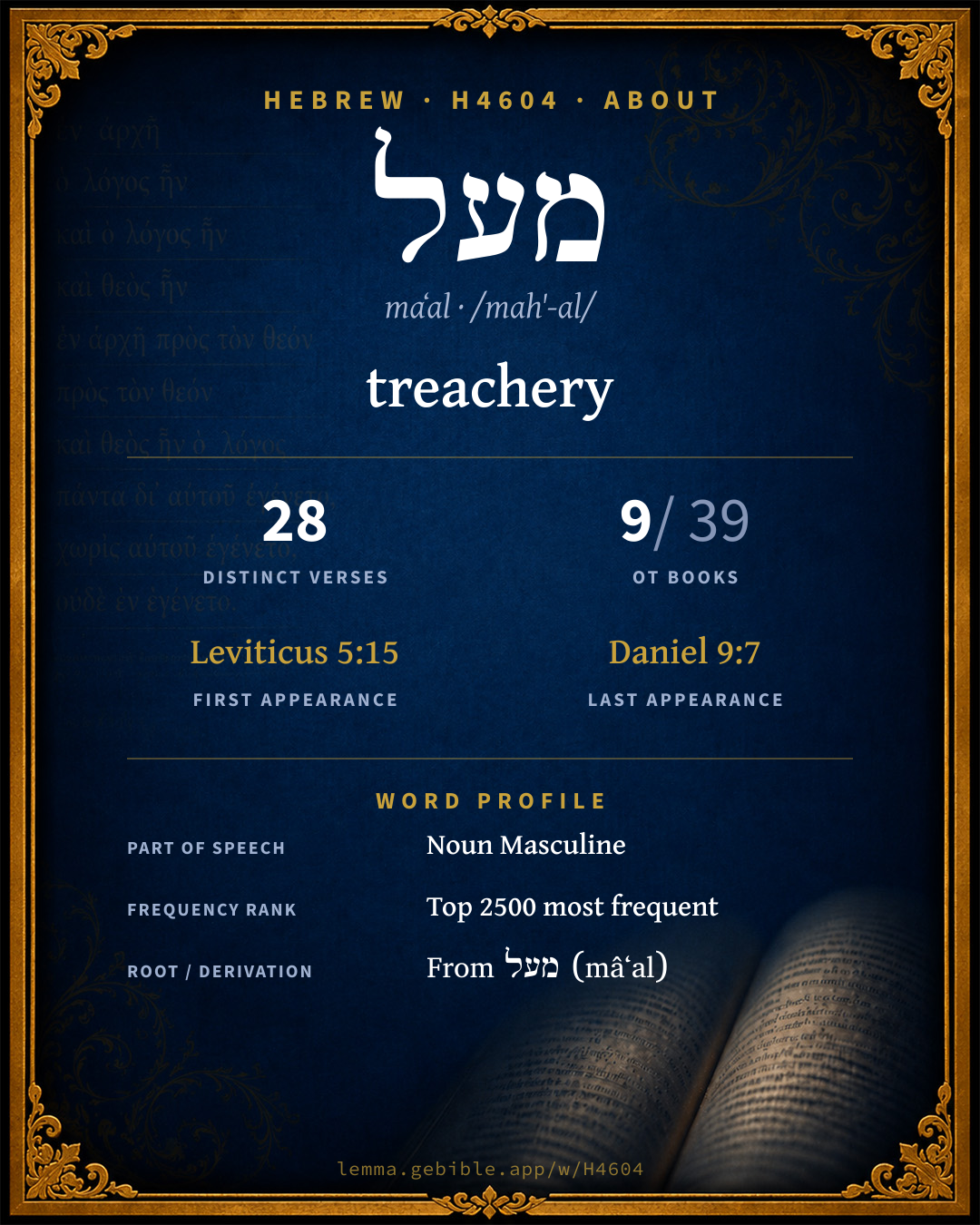
מַ֫עַל
treachery
‘treachery’ is one of 3 main senses fuller range ↓
Full lexicon entry — Brown-Driver-Briggs (BDB)
From Brown-Driver-Briggs (BDB)
Where this word appears
See every Absolute-state word in the Hebrew Bible →
Grammar key — what these labels mean
Part of speech
- Noun
- A naming word — a person, place, thing, or idea.
Noun type
- Common
- A common noun — a general class of person, place, or thing (“king,” “city,” “water”), not a specific name.
State
- Absolute
- The independent form of a noun, not bound to a following word.
- Construct
- A noun bound to a following noun in a possessive / “of” relationship (the construct chain).
Gender
- Masculine
- Grammatically masculine.
Number
- Singular
- One.
Grammatical forms
- Noun, Common, Masculine, Singular, Absolute 16 times (57%)
- Noun, Common, Masculine, Singular, Construct 11 times (39%)
- Preposition 1 time (4%)
Parsed forms decoded from the imported morphology (morphhb / Westminster Leningrad Codex — WLC text public domain, morphhb tagging CC BY 4.0), counted across 28 parsed occurrences — not distinct verses.
Every verse where H4604 appears — 28 distinct verses across 9 books. Click any verse to open its interlinear word-by-word view. Verse text shown in the World English Bible for context — . Each verse’s Hebrew form is shown with its reference; the English is not keyword-highlighted, since the data carries no word-level English alignment. Use “Compare translations” on any verse to read it across multiple English versions. This concordance covers the Hebrew Bible; Septuagint (Greek Old Testament) occurrences are not indexed here.
Leviticus 3 verses
- Leviticus 5:15 מַ֔עַל n c ms "If anyone commits a trespass, and sins unwittingly, in the holy things of Yahweh; then he shall bring his trespass offering to Yahweh, a ram without blemish from the flock, according to your estimation in silver by shekels, after the shekel of the sanctuary, for a trespass offering.
- Leviticus 6:2 מַ֖עַל n c ms "If anyone sins, and commits a trespass against Yahweh, and deals falsely with his neighbor in a matter of deposit, or of bargain, or of robbery, or has oppressed his neighbor,
- Leviticus 26:40 בְּ/מַעֲלָ֖/ם prep + n c ms cs + sfx pers 3mp "'If they confess their iniquity, and the iniquity of their fathers, in their trespass which they trespassed against me, and also that, because they walked contrary to me,
Numbers 4 verses
- Numbers 5:6 מַ֖עַל n c ms "Speak to the children of Israel: When a man or woman commits any sin that men commit, so as to trespass against Yahweh, and that soul is guilty;
- Numbers 5:12 מָֽעַל n c ms "Speak to the children of Israel, and tell them: If any man's wife goes astray, and is unfaithful to him,
- Numbers 5:27 מַ֣עַל n c ms When he has made her drink the water, then it shall happen, if she is defiled, and has committed a trespass against her husband, that the water that causes the curse will enter into her and become bitter, and her body will swell, and her thigh will fall away: and the woman will be a curse among her people.
- Numbers 31:16 מַ֥עַל n c ms Behold, these caused the children of Israel, through the counsel of Balaam, to commit trespass against Yahweh in the matter of Peor, and so the plague was among the congregation of Yahweh.
Joshua 5 verses
- Joshua 7:1 מַ֖עַל n c ms But the children of Israel committed a trespass in the devoted thing; for Achan, the son of Carmi, the son of Zabdi, the son of Zerah, of the tribe of Judah, took of the devoted thing: and the anger of Yahweh was kindled against the children of Israel.
- Joshua 22:16 הַ/מַּ֤עַל ptcl def.art + n c ms Thus says the whole congregation of Yahweh, What trespass is this that you have committed against the God of Israel, to turn away this day from following Yahweh, in that you have built you an altar, to rebel this day against Yahweh?
- Joshua 22:20 מַ֨עַל֙ n c ms Didn't Achan the son of Zerah commit a trespass in the devoted thing, and wrath fell on all the congregation of Israel? and that man didn't perish alone in his iniquity.
- Joshua 22:22 בְּ/מַ֨עַל֙ prep + n c ms The Mighty One, God, Yahweh, the Mighty One, God, Yahweh, he knows; and Israel he shall know: if it be in rebellion, or if in trespass against Yahweh (don't save us this day),
- Joshua 22:31 הַ/מַּ֣עַל ptcl def.art + n c ms Phinehas the son of Eleazar the priest said to the children of Reuben, and to the children of Gad, and to the children of Manasseh, This day we know that Yahweh is in the midst of us, because you have not committed this trespass against Yahweh: now have you delivered the children of Israel out of the hand of Yahweh.
1 Chronicles 2 verses
- 1 Chronicles 9:1 בְּ/מַעֲלָֽ/ם prep + n c ms cs + sfx pers 3mp So all Israel were reckoned by genealogies; and, behold, they are written in the book of the kings of Israel: and Judah was carried away captive to Babylon for their disobedience.
- 1 Chronicles 10:13 בְּ/מַֽעֲל/וֹ֙ prep + n c ms cs + sfx pers 3ms So Saul died for his trespass which he committed against Yahweh, because of the word of Yahweh, which he didn't keep; and also because he asked counsel of one who had a familiar spirit, to inquire [thereby],
2 Chronicles 3 verses
- 2 Chronicles 28:19 מַ֖עַל n c ms For Yahweh brought Judah low because of Ahaz king of Israel; for he had dealt wantonly in Judah, and trespassed severely against Yahweh.
- 2 Chronicles 29:19 בְּ/מַעֲל֖/וֹ prep + n c ms cs + sfx pers 3ms Moreover all the vessels, which king Ahaz in his reign did cast away when he trespassed, have we prepared and sanctified; and, behold, they are before the altar of Yahweh.
- 2 Chronicles 33:19 וּ/מַעְל/וֹ֒ conj + n c ms cs + sfx pers 3ms His prayer also, and how [God] was entreated of him, and all his sin and his trespass, and the places in which he built high places, and set up the Asherim and the engraved images, before he humbled himself: behold, they are written in the history of Hozai.
Ezra 3 verses
- Ezra 9:2 בַּ/מַּ֥עַל prep det + prep For they have taken of their daughters for themselves and for their sons, so that the holy seed have mixed themselves with the peoples of the lands: yes, the hand of the princes and rulers has been chief in this trespass.
- Ezra 9:4 מַ֣עַל n c ms cs Then were assembled to me everyone who trembled at the words of the God of Israel, because of the trespass of them of the captivity; and I sat confounded until the evening offering.
- Ezra 10:6 מַ֥עַל n c ms cs Then Ezra rose up from before the house of God, and went into the chamber of Jehohanan the son of Eliashib: and [when] he came there, he ate no bread, nor drink water; for he mourned because of the trespass of them of the captivity.
Job 1 verse
Ezekiel 6 verses
- Ezekiel 14:13 מַ֔עַל n c ms Son of man, when a land sins against me by committing a trespass, and I stretch out my hand on it, and break the staff of the bread of it, and send famine on it, and cut off from it man and animal;
- Ezekiel 15:8 מַ֔עַל n c ms I will make the land desolate, because they have committed a trespass, says the Lord Yahweh.
- Ezekiel 17:20 מַעֲל֖/וֹ n c ms cs + sfx pers 3ms I will spread my net on him, and he shall be taken in my snare, and I will bring him to Babylon, and will enter into judgment with him there for his trespass that he has trespassed against me.
- Ezekiel 18:24 בְּ/מַעֲל֧/וֹ prep + n c ms cs + sfx pers 3ms But when the righteous turns away from his righteousness, and commits iniquity, and does according to all the abominations that the wicked man does, shall he live? None of his righteous deeds that he has done shall be remembered: in his trespass that he has trespassed, and in his sin that he has sinned, in them shall he die.
- Ezekiel 20:27 מָֽעַל n c ms Therefore, son of man, speak to the house of Israel, and tell them, Thus says the Lord Yahweh: In this moreover have your fathers blasphemed me, in that they have committed a trespass against me.
- Ezekiel 39:26 מַעֲלָ֖/ם n c ms cs + sfx pers 3mp They shall bear their shame, and all their trespasses by which they have trespassed against me, when they shall dwell securely in their land, and none shall make them afraid;
Daniel 1 verse
About this entry
At a glance — auto-summarized from this page’s data, not written by a person. Every figure links to its source below. This summary describes the numbers; it doesn’t interpret them.
The Hebrew noun מעל centers on the idea of “treachery.” Older and newer Bibles part ways — “trespass” in the King James Version, “unfaithfulness” (Berean Standard Bible) in modern versions. See the renderings breakdown. It turns up in 28 verses across 9 books, a moderately common footprint. Its earliest occurrence is Leviticus 5:15. The lexicon spreads it across several senses; see its full sense range. Dig into 28-verse concordance and the renderings breakdown below.
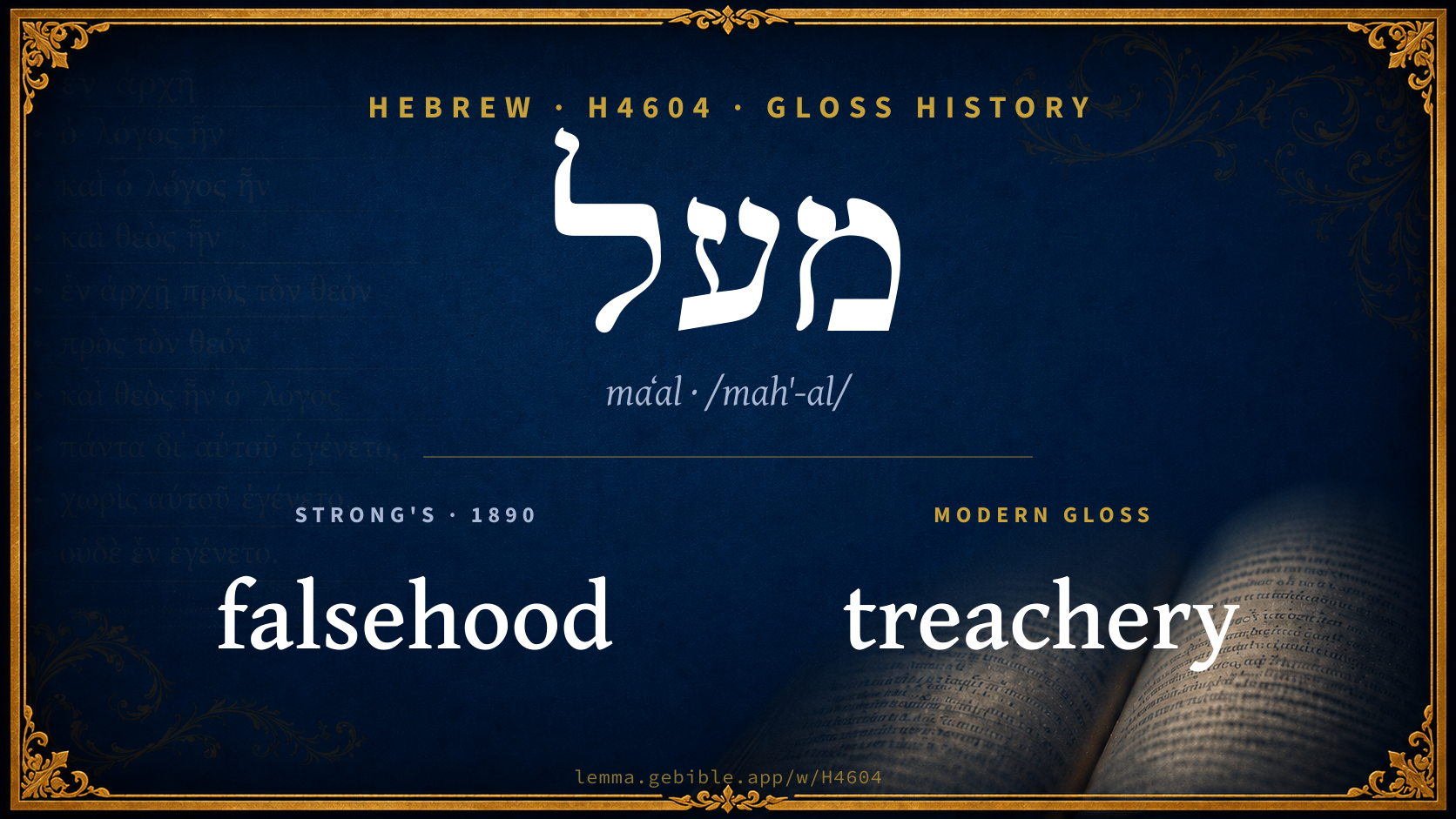
Gloss history
Strong's 1890 vs modern scholarship
About this word
Strong's H4604 catalogs a Hebrew word from the Hebrew Old Testament.
These counts are not copied from any lexicon or concordance. They are computed here, from the morphology-tagged Hebrew Old Testament. What Lemma adds →
- 28
- distinct verses
- The word appears in 28 distinct verses.
- 9 / 39
- OT books
- The word appears in 9 of 39 Old Testament books.
- #1,190
- by frequency
- Top 2500 most frequent Hebrew words (rank 1,190 of 8,640 Hebrew words by occurrence).
View all 28 occurrences in the concordance →
By section of the Old Testament
By traditional corpus
Conventional, traditional groupings — biblical authorship is debated, so this is a traditional corpus grouping, not an authorship claim. Each share is this word’s portion of its verses in that division of the Hebrew canon. Each figure is a share of the word’s 28 distinct verses.
- Prophets (Nevi'im) 11 verses · 39%
- Writings (Ketuvim) 10 verses · 36%
- Torah (Pentateuch) 7 verses · 25%
How translations render this word
Counts come from each version’s own published word-to-Strong’s tagging or interlinear alignment — an approximate guide to how each version renders this word, not a word-level alignment the data otherwise carries. Because each total is that version’s own tagged count, the per-version totals vary from one another and need not match the appearance or distinct-verse counts above. These counts may also differ from a printed concordance because Lemma counts each distinctly tagged rendering and does not collapse phrase taggings into a single head-word total. This is a fixed set of word-tagged versions (KJV, ASV, BSB, ULT) and does not change with the reading translation you choose elsewhere. Each version’s license is shown beside its name below (and on Sources).
BDB lists this Strong’s number as 3 distinct words (homographs). Each count above pools all of them and is not split by sense — see the Senses section below. A low-frequency rendering may belong to a different one of those words, not the primary meaning.
- King James Version†: Trespass 15×, Transgression 5×, He hath trespassed 2×
- American Standard Version†: Trespass 14×
- Berean Standard Bible†: Unfaithfulness 10×, Unfaithfully 5×
- unfoldingWord Literal Text†: Unfaithfulness 12×, In 2×, Sin 2×
King James Version Public Domain
Renders H4604 across 29† tagged occurrences — most commonly:
Plus 7 renderings that appear only once — usually multi-word phrases or single function words the recovered tagging swept in, not distinct renderings.
American Standard Version Public Domain
Renders H4604 across 29† tagged occurrences — most commonly:
Plus 15 renderings that appear only once — usually multi-word phrases or single function words the recovered tagging swept in, not distinct renderings.
Berean Standard Bible Public Domain
Renders H4604 across 22† tagged occurrences — most commonly:
Plus 7 renderings that appear only once — usually multi-word phrases or single function words the recovered tagging swept in, not distinct renderings. Not rendered by a distinct English word in 7 further occurrences.
unfoldingWord Literal Text CC BY-SA 4.0
Renders H4604 across 31† tagged occurrences — most commonly:
Plus 9 renderings that appear only once — usually multi-word phrases or single function words the recovered tagging swept in, not distinct renderings.
10 senses and sub-senses in the full BDB
What do BDB’s symbols mean?
BDB uses these scholarly abbreviations:
| Symbol | Meaning |
|---|---|
| 𝔊 | the Septuagint (the ancient Greek translation, LXX) |
| 𝔙 | the Vulgate (the Latin translation) |
| 𝔖 | the Syriac version (the Peshitta) |
| 𝔗 | the Targum (the Aramaic translation) |
| ψ | the Psalms |
| √ | root (the underlying root or stem) |
| ‖ | parallel passage (a synonymous or contrasted parallel) |
| † | the dagger: every passage where the word occurs is cited |
The 10 senses and sub-senses the full Brown-Driver-Briggs lexicon distinguishes for this word, in lexicon order (not ranked by frequency), with BDB’s own verbatim wording and sub-sense lettering. Shown in Hebrew script with BDB’s own scholarly abbreviations. The condensed entry is in the Lexicon Entry tab. See also the Forms in the corpus table below.
מעל I Ezr 9
- 1. ag. man: נשׁאר מעל Jb 21:34 faithlessness remains (cf. Nu 5:12, 27 Pr 16:10 under מָעַל). e.g. Job 21:34
- 2. elsewhere ag. God, c. בְּ, Jos 22:22 (P); without בְּ, 1 Ch 9:1 2 Ch 29:19; 33:19 Ezr 9:2, 4; 10:6.—מַעַל elsewhere only c. מָעַל q.v. (1; all cited). e.g. Joshua 22:22
מעל II subst., higher part, only in adv. and prep. phrases
- 1. מִמַּ֫עַל = above (v. מִן 1 c):
- a. as adv. Am 2:9 וָאָשְׁמִיד פִּרְיוֹ מִמַּעַל his fruit above (opp. שָׁרָשָׁיו מִתָּ֑חַת), Jb 18:16; 1 K 7:3, 20, 29; often in the phr. הַשָּׁמַיִם מִמַּעַל Dt 4:39; 5:8 (= Ex 20:4), Jos 2:11; 1 K 8:23; Is 45:8; Je 4:28; cf. שְׁחַקִים מ׳ ψ 78:23; Pr 8:28, אֱלוֹהַּ מ׳ Jb 3:4; 31:2, אֵל מ׳ 31:28. e.g. Amos 2:9
- b. מִמַּעַל לְ, as prep. (מן 1 c), on the top of, above, Gn 22:9 ממעל לָעֵצִים above the wood, Ex 28:27 = 39:20, Lv 11:21 כְּרָעַיִם מִמַּעַל לְרַגְלָיו, Is 6:2 שְׂרָפִים עֹמדים מִמַּעַל לוֹ, 14:13; Je 43:10; Ez 1:26; Dn 12:6, 7; = on higher ground than, Je 35:4; fig. Je 52:32 (‖ 2 K 25:28 מֵעַל). e.g. Genesis 22:9
- 2. With ה—ָloc. מַ֫עְלָה, מָ֑עְלָה, upwards (opp. מַ֫טָּה p. 641):
- a. fig. Dt 28:43 יַעֲלֶה עָלֶיךָ מַ֫עְלָה מָ֑עְלָה upwards, upwards, i.e. higher and higher (opp. מַ֫טָּה מָֽטָּה). e.g. Deuteronomy 28:43
- b. וָמַ֫עְלָה (a) of direction in space, Ju 1:36 מֵהַסֶּלַע וָמַ֫עְלָה from the rock and upwards (cf. Bu), 1 K 7:31 (corrupt: v. Sta VB Benz), 1 S 9:2 = 10:23 מִשִּׁכְמוֹ וָמַ֫עְלָה from his shoulder and upwards: so וּלְמ׳, †Ez 1:27 מִמַּרְאֵה מָתְנָיו וּלְמָ֑עְלָה, 8:2; 43:15. (b) of direction in time, or age:—(α) מִבֶּן עֶשְׂרִים שָׁנָה וָמָ֑עְלָה Ex 30:14; Nu 1:3 + 19 times P, מִבֶּן חֹדֶשׁ וָמ׳ Nu 3:15, 22 + 6 times P, simil. 4:3; 8:24 + 7 times P; elsewhere only 1 Ch 23:3, 24; Ezr 3:8, and with וּלְמַעְלָה †1 Ch 23:17; 2 Ch 31:16, 17; לְמִבֶּן … וָמ׳ †2 Ch 25:5; and 2 K 3:21 מִכֹּל חֹגֵר חֲגֹרָה וָמ׳. †(β) מהיום ההוא וָמ׳ from that day and onwards, 1 S 16:13; 30:25. †(γ) מן היום הזה וָמ׳ from this day and upwards (i.e. and back), Hg 2:15, 18.* e.g. Judges 1:36
- c. לְמַ֫עְלָה upwards, more common than מ׳ alone (a): (α) Ex 25:20 (= 37:9) פֹּֽרְשֵׂי כְנָפַיִם למ׳, Ju 7:13 ויהפכהו למ׳ overthrew it upwards, i.e. turned it downside up, Is 7:11 אוֹ הַגְבֵּהַּ למ׳ or make it (the request) high upwards, 8:21 וּפָנָה למ׳, 37:31 (2 K 19:30) זעשׂה פרי למ׳ (cf. Am 2:9, 1 a), Ez 41:7 a β (v a α bis למ׳ למ׳ = higher and higher), ψ 74:5; fig. וְהָיִיתָ רַק למ׳ Dt 28:13 (cf. a), Pr 15:24 אֹרַח חַיִּים למ׳ (opp. שְׁאוֹל מָֽטָּה׃), cf. Ec 3:21; sq. a noun, Ezr 9:6 למ׳ רּאשׁ over the head, sq. מֵעַל (cf. Aboth 2:1 לְמַעְלָה מִן) = on high above, 2 Ch 34:4: v. ba, ba. (b) metaph. = exceedingly, only in Chr, 1 Ch 14:2; 22:5 the house must be built to J. לְהַגְדְּיל למ׳ so as to shew greatness exceedingly, 23:17 וּבְנֵי ר׳ רָבוּ למ׳, 29:3 (sq. מִן; = over and above …), v 25 2 Ch 1:1 וַיְגַדְּלֵהוּ למ׳, 20:19; עַד לְמַ֫עְלָה, 16:12; 17:12; 26:8. e.g. Exodus 25:20
- d. מִלְמַ֫עְלָה (v. מִן 9 a), adv., above (the more usual prose syn. of מִמַּעַל): Gn 6:16 אֶל־אַמָּה תְּכַלֶּנָּה מ׳, 7:20 15 cubits מ׳ (i.e. above the mountain-tops), Ex 25:21 (40:20) וְנָתַתָּ֫ה אֶת־הַכַּפֹּרֶת על הארון מ׳ upon the ark above, 26:14 (36:19; 40:19; Nu 4:25) a covering of skins on the tent מ׳ above, 39:31; Nu 4:6; 1 K 7:11; 7:25; 8:7 (2 Ch 4:4; 5:8), Je 31:37 אִם יִמַּדּוּ שָׁמַיִם מ׳ (cf. 1 a), Ez 1:11 פְּרֻדוֹת מ׳ separate above, v 22, 26; 10:19; 11:22; 37:3; from above, Jos 3:13, 16 הַמַּיִם הַיֹּרְדִים מ׳. e.g. Genesis 6:16
Senses from the full Brown-Driver-Briggs lexicon (Brown, Driver, Briggs; Oxford 1906 — public domain), digitized via Sefaria, supplemented by the OpenScriptures HebrewLexicon (CC BY 4.0). Full attribution on Sources.
Word origin
I. n.m. Ezr 9:2 unfaithful, treacherous act (NH מְעִילָה);—מ׳ Lv 5:15 + 16 times; מָ֑עַל Nu 5:12 + 2 times; sf. מַעֲלוֹ Ez 17:20 + 4 times; מַעֲלָם Ez 39:26 + 3 times;—
III. subst., higher part, only in adv. and prep. phrases; above, upwards (Ph. מעל, v. sub מַ֫טָּה p. 641: abbrev. from מַעֲלֶה; cf. מַ֫עַן in לְמַ֫עַן from עָנָה: Köii 116):—
— Brown-Driver-Briggs (Oxford 1906, public domain), digitized via Sefaria, supplemented by the OpenScriptures HebrewLexicon (CC BY 4.0). See Sources.
Derived from מעל (mâʻal) (H4603) — to betray.
Jastrow Dictionary
A second Hebrew/Aramaic lexicon for comparison, covering Aramaic and post-biblical (Talmudic, Targumic, Midrashic) usage that the biblical-Hebrew BDB does not. Matched by lemma rather than by Strong’s number, so a lemma may carry more than one Jastrow headword (shown separately below), and the entries cover usage well beyond the Bible.
מֵעַל
- (adopted fr. Deut. XXV, 9) [from on,] upper of the shoe. Yeb. 102ᵃ התודה אמרה מ׳ ולא מ׳ דמ׳ the text says ‘from on’ (his foot) but not the cover of a cover, i.e. the upper must be immediate to the skin of the foot, v. אַפַּנְתָּא. Ib. א"כ ליכתוב רחמנא במ׳ רגלו if it were so (that חלץ, Deut. l. c. meant ‘to fasten’), the text ought to have read ‘on the upper part of his foot’. e.g. Deuteronomy 25:9
מַעַל
- circumvention; fraud, adulteration, faithlessness. Yalk. Ex. 343, v. דֶּלֶם. Num. R. s. 7, v. next w.
מָעַל
- denom. of preced.) to circumvent, defraud. Sifré Num. 7 (ref. to Num. V, 12) ומָעֲלָה בו מ׳ על דבר ערוה וכ׳ does ‘she was faithless to him’ refer to marital betrayal or to money matters?; v. מְעִילָה.—Esp. to make inappropriate use of sacred property, to be guilty of transgressing, be amenable to, the law concerning מְעִילָה (Lev. V, 15, sq.). Meïl. I, 1 מוֹעֲלִים בהן in using them inadvertently one commits m’ʿilah (i.e. they retain their sacred character in spite of a mistake made at their slaughtering). Ib. אין מוֹעֲלִין בה it has no longer a sacred character. Ib. III, 2 לא נהנין ולא מועלין בהן you must not make use of them, but if you did, you are not amenable to &c.; a. v. fr.—[Yalk. Num. 765 מועל ומשקר, read מְעַוֵּל, v. עָוַל.] e.g. Numbers 5:12
מְעַל
- Meïl. 14ᵇ דקמָעֵיל בקודשא that he makes improper use of sacred property; ib. דקא מועיל בקדשים (corr. acc.).
A Dictionary of the Targumim, the Talmud Babli and Yerushalmi, and the Midrashic Literature (Marcus Jastrow; London, Luzac, 1903) — Public Domain. Digitized via Sefaria. Digitized via Sefaria. Full attribution on Sources.
Forms in the corpus
The 18 distinct written forms H4604 takes in the Hebrew Bible, most frequent first — each parse links to that state’s occurrences in the concordance. Hebrew forms include their vowel points and cantillation, so a single lemma takes many written forms.
Same root — word family
Other BDB entries built from the same root as H4604, grouped by Strong’s listed origin. These share a root / origin per the lexicon — not necessarily a shared meaning. Each links to that word’s own entry.
Derives from
Shares the same root
Compare all same-root words → They share a root, not necessarily a meaning.
Septuagint verse parallels
This word appears in 28 verses that also exist in the Greek Old Testament (Septuagint), out of the 28 Hebrew verses it occurs in. You can read those verses in Greek by switching the Old Testament edition to the Septuagint.
Read these verses in the Septuagint
- Leviticus 5:15
- Numbers 5:6
- Joshua 7:1
- 1 Chronicles 9:1
- 2 Chronicles 28:19
- Ezra 9:2
- Job 21:34
- Ezekiel 14:13
- Daniel 9:7
This is a verse-level parallel only — the same verses exist in both the Hebrew and Greek Old Testaments. No word-level Hebrew↔Greek correspondence is claimed: the data carries no such alignment, so no Greek word is shown as this Hebrew word’s translation. Coverage is not total — the Septuagint omits the deuterocanon and renumbers the Psalms, so some Hebrew verses have no direct Greek parallel.