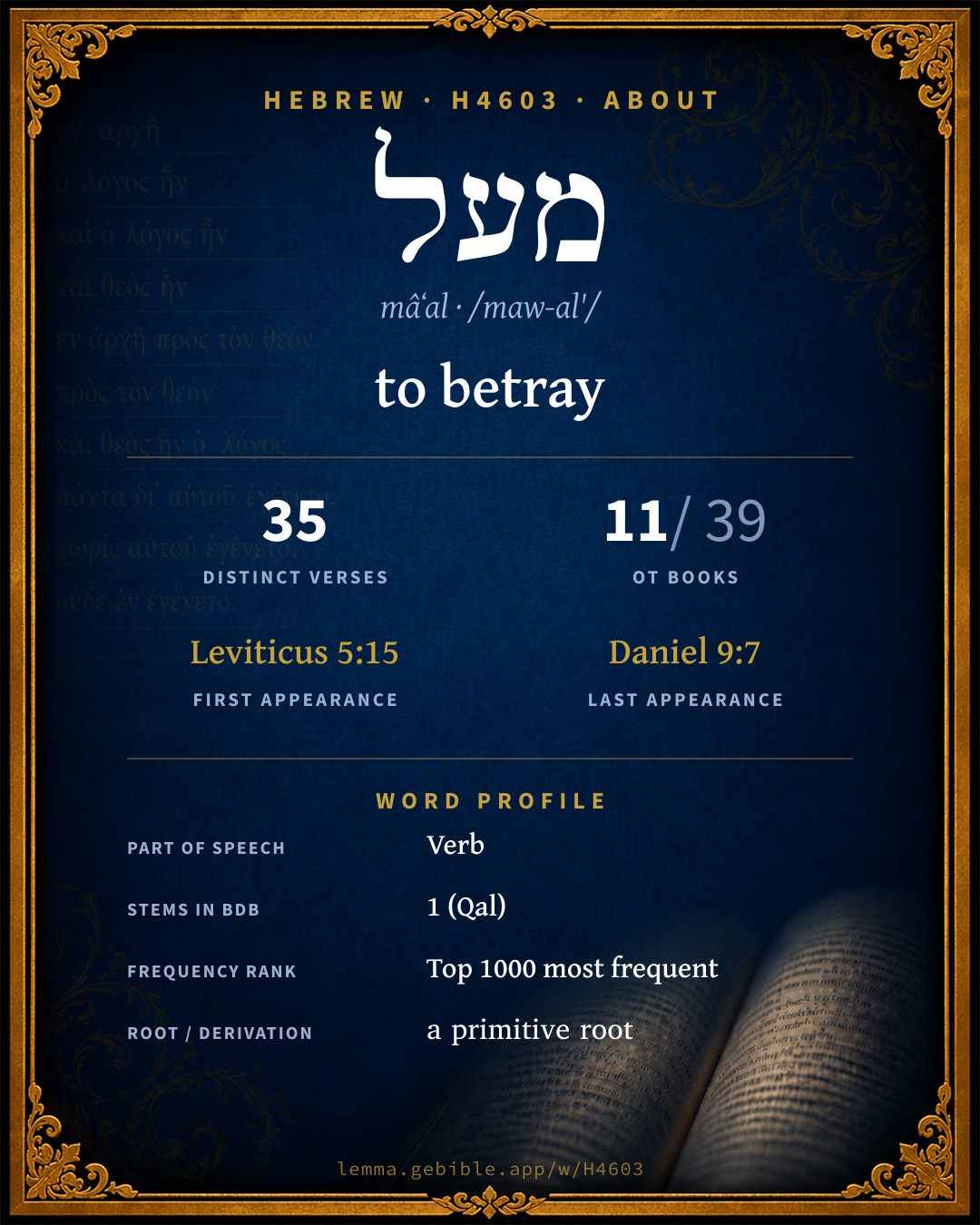
מָעַל
to betray
‘to betray’ is one of 2 main senses fuller range ↓
Full lexicon entry — Brown-Driver-Briggs (BDB)
From Brown-Driver-Briggs (BDB)
Where this word appears
Grammar key — what these labels mean
Part of speech
- Verb
- An action or state-of-being word.
- Noun
- A naming word — a person, place, thing, or idea.
Noun type
- Common
- A common noun — a general class of person, place, or thing (“king,” “city,” “water”), not a specific name.
Stem
- Qal
- The basic, simple active stem — the plain form of the verb (“he wrote”). Here: ‘wife against’
Form
- Perfect
- A completed action or state — Hebrew marks aspect (completeness) more than strict tense (“he wrote”).
- Infinitive Construct
- A bound verbal noun, frequently with prepositions (“to write / in writing”).
- Sequential Perfect
- A perfect with prefixed waw continuing a preceding imperfect or command (waw-consecutive perfect).
- Sequential Imperfect
- An imperfect with prefixed waw — the standard past-narrative form (waw-consecutive imperfect).
- Infinitive Absolute
- An unbound verbal noun, often intensifying or standing in for a finite verb.
- Imperfect
- An incomplete, ongoing, or future action (“he will / would write”).
State
- Absolute
- The independent form of a noun, not bound to a following word.
Person
- 3rd Person
- The one spoken about (“he / she / it / they”).
- 2nd Person
- The one addressed (“you”).
- 1st Person
- The speaker (“I / we”).
Gender
- Common
- Either gender — not distinguished for this form.
- Masculine
- Grammatically masculine.
- Feminine
- Grammatically feminine.
Number
- Plural
- More than one (in Hebrew, generally three or more).
- Singular
- One.
Grammatical forms 15 distinct
- Verb, Qal, Perfect, 3rd Person, Common, Plural 8 times (22%)
- Verb, Qal, Infinitive Construct 6 times (17%)
- Verb, Qal, Perfect, 3rd Person, Masculine, Singular 5 times (14%)
- Verb, Qal, Perfect, 2nd Person, Masculine, Plural 4 times (11%)
- Verb, Qal, Sequential Perfect, 3rd Person, Feminine, Singular 2 times (6%)
- Verb, Qal, Sequential Imperfect, 3rd Person, Masculine, Plural 2 times (6%)
- Verb, Qal, Infinitive Absolute 1 time (3%)
- Verb, Qal, Sequential Imperfect, 3rd Person, Feminine, Singular 1 time (3%)
+7 more forms (7 occurrences)
Parsed forms decoded from the imported morphology (morphhb / Westminster Leningrad Codex — WLC text public domain, morphhb tagging CC BY 4.0), counted across 36 parsed occurrences — not distinct verses.
Every verse where H4603 appears — 35 distinct verses across 11 books. Click any verse to open its interlinear word-by-word view. Verse text shown in the World English Bible for context — . Each verse’s Hebrew form is shown with its reference; the English is not keyword-highlighted, since the data carries no word-level English alignment. Use “Compare translations” on any verse to read it across multiple English versions. This concordance covers the Hebrew Bible; Septuagint (Greek Old Testament) occurrences are not indexed here.
Leviticus 3 verses
- Leviticus 5:15 תִמְעֹ֣ל Qal impf 3fs "If anyone commits a trespass, and sins unwittingly, in the holy things of Yahweh; then he shall bring his trespass offering to Yahweh, a ram without blemish from the flock, according to your estimation in silver by shekels, after the shekel of the sanctuary, for a trespass offering.
- Leviticus 6:2 וּ/מָעֲלָ֥ה conj + Qal wpf 3fs "If anyone sins, and commits a trespass against Yahweh, and deals falsely with his neighbor in a matter of deposit, or of bargain, or of robbery, or has oppressed his neighbor,
- Leviticus 26:40 מָֽעֲלוּ Qal pf 3cp "'If they confess their iniquity, and the iniquity of their fathers, in their trespass which they trespassed against me, and also that, because they walked contrary to me,
Numbers 3 verses
- Numbers 5:6 לִ/מְעֹ֥ל prep + Qal inf.cs "Speak to the children of Israel: When a man or woman commits any sin that men commit, so as to trespass against Yahweh, and that soul is guilty;
- Numbers 5:12 וּ/מָעֲלָ֥ה conj + Qal wpf 3fs "Speak to the children of Israel, and tell them: If any man's wife goes astray, and is unfaithful to him,
- Numbers 5:27 וַ/תִּמְעֹ֣ל conj + Qal wimpf 3fs When he has made her drink the water, then it shall happen, if she is defiled, and has committed a trespass against her husband, that the water that causes the curse will enter into her and become bitter, and her body will swell, and her thigh will fall away: and the woman will be a curse among her people.
Deuteronomy 1 verse
Joshua 4 verses
- Joshua 7:1 וַ/יִּמְעֲל֧וּ conj + Qal wimpf 3mp But the children of Israel committed a trespass in the devoted thing; for Achan, the son of Carmi, the son of Zabdi, the son of Zerah, of the tribe of Judah, took of the devoted thing: and the anger of Yahweh was kindled against the children of Israel.
- Joshua 22:16 מְעַלְתֶּם֙ Qal pf 2mp Thus says the whole congregation of Yahweh, What trespass is this that you have committed against the God of Israel, to turn away this day from following Yahweh, in that you have built you an altar, to rebel this day against Yahweh?
- Joshua 22:20 מָ֤עַל Qal pf 3ms Didn't Achan the son of Zerah commit a trespass in the devoted thing, and wrath fell on all the congregation of Israel? and that man didn't perish alone in his iniquity.
- Joshua 22:31 מְעַלְתֶּ֥ם Qal pf 2mp Phinehas the son of Eleazar the priest said to the children of Reuben, and to the children of Gad, and to the children of Manasseh, This day we know that Yahweh is in the midst of us, because you have not committed this trespass against Yahweh: now have you delivered the children of Israel out of the hand of Yahweh.
1 Chronicles 3 verses
- 1 Chronicles 2:7 מָעַ֖ל Qal pf 3ms The sons of Carmi: Achar, the troubler of Israel, who committed a trespass in the devoted thing.
- 1 Chronicles 5:25 וַ/יִּֽמְעֲל֔וּ conj + Qal wimpf 3mp They trespassed against the God of their fathers, and played the prostitute after the gods of the peoples of the land, whom God destroyed before them.
- 1 Chronicles 10:13 מָעַ֣ל Qal pf 3ms So Saul died for his trespass which he committed against Yahweh, because of the word of Yahweh, which he didn't keep; and also because he asked counsel of one who had a familiar spirit, to inquire [thereby],
2 Chronicles 8 verses
- 2 Chronicles 12:2 מָעֲל֖וּ Qal pf 3cp It happened in the fifth year of king Rehoboam, that Shishak king of Egypt came up against Jerusalem, because they had trespassed against Yahweh,
- 2 Chronicles 26:16 וַ/יִּמְעַ֖ל conj + Qal wimpf 3ms But when he was strong, his heart was lifted up, so that he did corruptly, and he trespassed against Yahweh his God; for he went into the temple of Yahweh to burn incense on the altar of incense.
- 2 Chronicles 26:18 מָעַ֔לְתָּ Qal pf 2ms and they withstood Uzziah the king, and said to him, It pertains not to you, Uzziah, to burn incense to Yahweh, but to the priests the sons of Aaron, who are consecrated to burn incense: go out of the sanctuary; for you have trespassed; neither shall it be for your honor from Yahweh God.
- 2 Chronicles 28:19 וּ/מָע֥וֹל conj + Qal inf.abs For Yahweh brought Judah low because of Ahaz king of Israel; for he had dealt wantonly in Judah, and trespassed severely against Yahweh.
- 2 Chronicles 28:22 לִ/מְע֣וֹל prep + Qal inf.cs In the time of his distress did he trespass yet more against Yahweh, this same king Ahaz.
- 2 Chronicles 29:6 מָעֲל֣וּ Qal pf 3cp For our fathers have trespassed, and done that which was evil in the sight of Yahweh our God, and have forsaken him, and have turned away their faces from the habitation of Yahweh, and turned their backs.
- 2 Chronicles 30:7 מָעֲל֔וּ Qal pf 3cp Don't be you like your fathers, and like your brothers, who trespassed against Yahweh, the God of their fathers, so that he gave them up to desolation, as you see.
- 2 Chronicles 36:14 לִ/מְעָול מַ֔עַל prep + Qal inf.cs n c ms Moreover all the chiefs of the priests, and the people, trespassed very greatly after all the abominations of the nations; and they polluted the house of Yahweh which he had made holy in Jerusalem.
Ezra 2 verses
- Ezra 10:2 מָעַ֣לְנוּ Qal pf 1cp Shecaniah the son of Jehiel, one of the sons of Elam, answered Ezra, We have trespassed against our God, and have married foreign women of the peoples of the land: yet now there is hope for Israel concerning this thing.
- Ezra 10:10 מְעַלְתֶּ֔ם Qal pf 2mp Ezra the priest stood up, and said to them, You have trespassed, and have married foreign women, to increase the guilt of Israel.
Nehemiah 2 verses
- Nehemiah 1:8 תִּמְעָ֔לוּ Qal impf 2mp Remember, I beg you, the word that you commanded your servant Moses, saying, If you trespass, I will scatter you abroad among the peoples:
- Nehemiah 13:27 לִ/מְעֹ֖ל prep + Qal inf.cs Shall we then listen to you to do all this great evil, to trespass against our God in marrying foreign women?
Proverbs 1 verse
Ezekiel 7 verses
- Ezekiel 14:13 לִ/מְעָל prep + Qal inf.cs Son of man, when a land sins against me by committing a trespass, and I stretch out my hand on it, and break the staff of the bread of it, and send famine on it, and cut off from it man and animal;
- Ezekiel 15:8 מָ֣עֲלוּ Qal pf 3cp I will make the land desolate, because they have committed a trespass, says the Lord Yahweh.
- Ezekiel 17:20 מָֽעַל Qal pf 3ms I will spread my net on him, and he shall be taken in my snare, and I will bring him to Babylon, and will enter into judgment with him there for his trespass that he has trespassed against me.
- Ezekiel 18:24 מָעַ֛ל Qal pf 3ms But when the righteous turns away from his righteousness, and commits iniquity, and does according to all the abominations that the wicked man does, shall he live? None of his righteous deeds that he has done shall be remembered: in his trespass that he has trespassed, and in his sin that he has sinned, in them shall he die.
- Ezekiel 20:27 בְּ/מַעֲלָ֥/ם prep + Qal inf.cs + sfx pers 3mp Therefore, son of man, speak to the house of Israel, and tell them, Thus says the Lord Yahweh: In this moreover have your fathers blasphemed me, in that they have committed a trespass against me.
- Ezekiel 39:23 מָֽעֲלוּ Qal pf 3cp The nations shall know that the house of Israel went into captivity for their iniquity; because they trespassed against me, and I hid my face from them: so I gave them into the hand of their adversaries, and they fell all of them by the sword.
- Ezekiel 39:26 מָעֲלוּ Qal pf 3cp They shall bear their shame, and all their trespasses by which they have trespassed against me, when they shall dwell securely in their land, and none shall make them afraid;
Daniel 1 verse
About this entry
At a glance — auto-summarized from this page’s data, not written by a person. Every figure links to its source below. This summary describes the numbers; it doesn’t interpret them.
מעל (mâʻal) is a Hebrew verb most often rendered “to betray.” Scripture first uses it in Leviticus 5:15. It turns up in 35 verses across 11 books, a moderately common footprint. Not a single-sense word: explore its full sense range. It clusters with מעיל and מעל under a shared root. The sections below give every sense, occurrence, and version rendering.
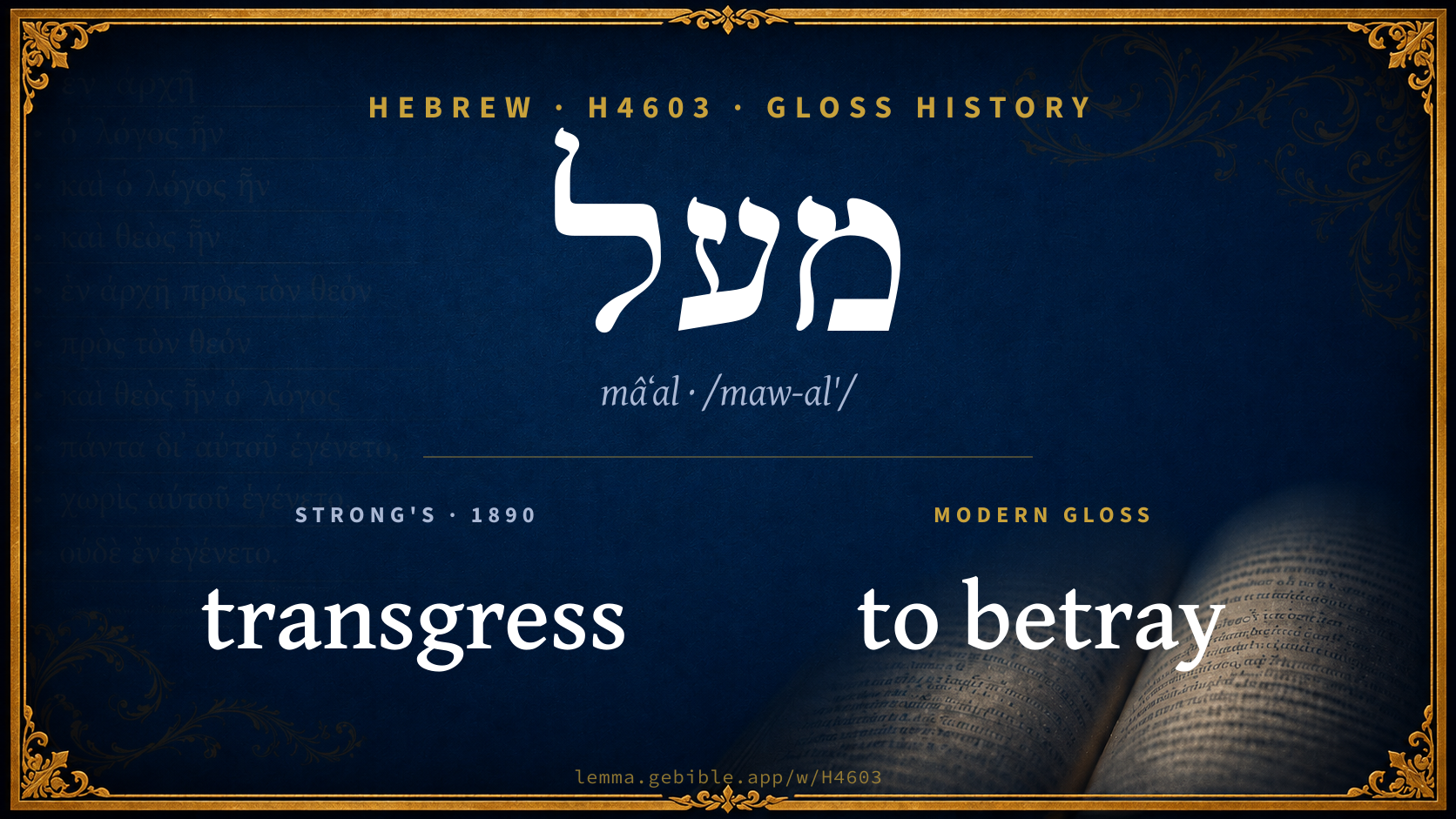
Gloss history
Strong's 1890 vs modern scholarship
About this word
Strong's H4603 catalogs a Hebrew word from the Hebrew Old Testament.
These counts are not copied from any lexicon or concordance. They are computed here, from the morphology-tagged Hebrew Old Testament. What Lemma adds →
- 35
- distinct verses
- The word appears in 35 distinct verses.
- 11 / 39
- OT books
- The word appears in 11 of 39 Old Testament books.
- #990
- by frequency
- Top 1000 most frequent Hebrew words (rank 990 of 8,640 Hebrew words by occurrence).
View all 35 occurrences in the concordance →
Most concentrated in
- 2 Chronicles 8 verses 23%
- Ezekiel 7 verses 20%
- Joshua 4 verses 11%
By section of the Old Testament
By traditional corpus
Conventional, traditional groupings — biblical authorship is debated, so this is a traditional corpus grouping, not an authorship claim. Each share is this word’s portion of its verses in that division of the Hebrew canon. Each figure is a share of the word’s 35 distinct verses.
- Writings (Ketuvim) 17 verses · 49%
- Prophets (Nevi'im) 11 verses · 31%
- Torah (Pentateuch) 7 verses · 20%
How translations render this word
Counts come from each version’s own published word-to-Strong’s tagging or interlinear alignment — an approximate guide to how each version renders this word, not a word-level alignment the data otherwise carries. Because each total is that version’s own tagged count, the per-version totals vary from one another and need not match the appearance or distinct-verse counts above. These counts may also differ from a printed concordance because Lemma counts each distinctly tagged rendering and does not collapse phrase taggings into a single head-word total. This is a fixed set of word-tagged versions (KJV, ASV, BSB, ULT) and does not change with the reading translation you choose elsewhere. Each version’s license is shown beside its name below (and on Sources).
- King James Version: Commit 5×, Transgressed 3×, They have committed 2×
- American Standard Version: Commit 5×, Trespass 4×, They trespassed 3×
- Berean Standard Bible: Acts 3×, Acting unfaithfully 2×, Have been unfaithful 2×
- unfoldingWord Literal Text: Act unfaithfully 4×, Acted unfaithfully 3×, Act faithlessly 2×
King James Version Public Domain
Renders H4603 across 35 tagged occurrences — most commonly:
Plus 21 renderings that appear only once — usually multi-word phrases or single function words the recovered tagging swept in, not distinct renderings.
American Standard Version Public Domain
Renders H4603 across 34 tagged occurrences — most commonly:
Plus 19 renderings that appear only once — usually multi-word phrases or single function words the recovered tagging swept in, not distinct renderings.
Berean Standard Bible Public Domain
Renders H4603 across 33 tagged occurrences — most commonly:
Plus 20 renderings that appear only once — usually multi-word phrases or single function words the recovered tagging swept in, not distinct renderings. Not rendered by a distinct English word in 2 further occurrences.
unfoldingWord Literal Text CC BY-SA 4.0
Renders H4603 across 42 tagged occurrences — most commonly:
Plus 23 renderings that appear only once — usually multi-word phrases or single function words the recovered tagging swept in, not distinct renderings.
8 senses and sub-senses in the full BDB
What do BDB’s symbols mean?
BDB uses these scholarly abbreviations:
| Symbol | Meaning |
|---|---|
| 𝔊 | the Septuagint (the ancient Greek translation, LXX) |
| 𝔙 | the Vulgate (the Latin translation) |
| 𝔖 | the Syriac version (the Peshitta) |
| 𝔗 | the Targum (the Aramaic translation) |
| ψ | the Psalms |
| √ | root (the underlying root or stem) |
| ‖ | parallel passage (a synonymous or contrasted parallel) |
| † | the dagger: every passage where the word occurs is cited |
The 8 senses and sub-senses the full Brown-Driver-Briggs lexicon distinguishes for this word, in lexicon order (not ranked by frequency), with BDB’s own verbatim wording and sub-sense lettering. Shown in Hebrew script with BDB’s own scholarly abbreviations. The condensed entry is in the Lexicon Entry tab. See also the Forms in the corpus table below.
Qal
- Pf. 3 ms. מָעַל Jos 22:20 + 4 times; 3 fs. מָֽעֲלָה Lv 5:21 Nu 5:12 + 13 times Pf.; Impf. יִמְעַל Pr 16:10 2 Ch 26:16; 3 fs. תִּמְעֹל Lv 5:15 Nu 5:27; 3 mpl. יִמְעֲלוּ Jos 7:1, וַיִּמְעֲלוּ 1 Ch 5:25; 2 mpl. תִּמְעָ֑לוּ Ne 1:8; Inf. cstr. לִמְעֹל, so read for ℌ למסר Nu 31:16 Thes Di;—act unfaithfully, treacherously, usually e.g. Joshua 22:20
- 1. מָעַל מַ֫עַל:
- a. abs. בַּחֵרֶם in the matter of the devoted thing (the sin of Achan) Jos 7:1 (JE), 22:20 (P), cf. Lv 5:15 (P), 2 Ch 36:14 Ez 14:13; 15:8; 18:24. e.g. Joshua 7:1
- b. wife against (בְּ) husband Nu 5:12, 27 (P; marital infidelity). e.g. Numbers 5:12
- c. elsewhere ag. (בְּ) God, Lv 26:40 (H), 5:21 Nu 5:6; 31:16 (?) Jos 22:16, 31 (all P), 1 Ch 10:13 2 Ch 28:19 Ez 17:20; 20:27; 39:26 Dn 9:7. e.g. Leviticus 26:40
- 2. usage without מַעַל (only late):
- a. במשׁפט לא ימעל פיו Pr 16:10 let not his (the king’s) mouth act treacherously against justice (RV in judgment). e.g. Proverbs 16:10
- b. elsewhere against God, c. בְּ, Dt 32:51 (P), 1 Ch 5:25 2 Ch 12:3; 26:16; 28:22; 30:7 Ezr 10:2 Ne 13:27 Ez 39:23; without בְּ, 2 Ch 26:18; 29:6 Ezr 10:10 Ne 1:8; בַּהֵרֶם 1 Ch 2:7. e.g. Deuteronomy 32:51
Senses from the full Brown-Driver-Briggs lexicon (Brown, Driver, Briggs; Oxford 1906 — public domain), digitized via Sefaria, supplemented by the OpenScriptures HebrewLexicon (CC BY 4.0). Full attribution on Sources.
Word origin
vb. act unfaithfully, treacherously, a priestly word (P Ez. Ch.), chiefly late (NH id., act unfaithfully; Arabic مَغَلَ whisper, backbite, مَغَالَةٌ perfidy, fraud);—
— Brown-Driver-Briggs (Oxford 1906, public domain), digitized via Sefaria, supplemented by the OpenScriptures HebrewLexicon (CC BY 4.0). See Sources.
Origin: a primitive root
Jastrow Dictionary
A second Hebrew/Aramaic lexicon for comparison, covering Aramaic and post-biblical (Talmudic, Targumic, Midrashic) usage that the biblical-Hebrew BDB does not. Matched by lemma rather than by Strong’s number, so a lemma may carry more than one Jastrow headword (shown separately below), and the entries cover usage well beyond the Bible.
מֵעַל
- (adopted fr. Deut. XXV, 9) [from on,] upper of the shoe. Yeb. 102ᵃ התודה אמרה מ׳ ולא מ׳ דמ׳ the text says ‘from on’ (his foot) but not the cover of a cover, i.e. the upper must be immediate to the skin of the foot, v. אַפַּנְתָּא. Ib. א"כ ליכתוב רחמנא במ׳ רגלו if it were so (that חלץ, Deut. l. c. meant ‘to fasten’), the text ought to have read ‘on the upper part of his foot’. e.g. Deuteronomy 25:9
מַעַל
- circumvention; fraud, adulteration, faithlessness. Yalk. Ex. 343, v. דֶּלֶם. Num. R. s. 7, v. next w.
מָעַל
- denom. of preced.) to circumvent, defraud. Sifré Num. 7 (ref. to Num. V, 12) ומָעֲלָה בו מ׳ על דבר ערוה וכ׳ does ‘she was faithless to him’ refer to marital betrayal or to money matters?; v. מְעִילָה.—Esp. to make inappropriate use of sacred property, to be guilty of transgressing, be amenable to, the law concerning מְעִילָה (Lev. V, 15, sq.). Meïl. I, 1 מוֹעֲלִים בהן in using them inadvertently one commits m’ʿilah (i.e. they retain their sacred character in spite of a mistake made at their slaughtering). Ib. אין מוֹעֲלִין בה it has no longer a sacred character. Ib. III, 2 לא נהנין ולא מועלין בהן you must not make use of them, but if you did, you are not amenable to &c.; a. v. fr.—[Yalk. Num. 765 מועל ומשקר, read מְעַוֵּל, v. עָוַל.] e.g. Numbers 5:12
מְעַל
- Meïl. 14ᵇ דקמָעֵיל בקודשא that he makes improper use of sacred property; ib. דקא מועיל בקדשים (corr. acc.).
A Dictionary of the Targumim, the Talmud Babli and Yerushalmi, and the Midrashic Literature (Marcus Jastrow; London, Luzac, 1903) — Public Domain. Digitized via Sefaria. Digitized via Sefaria. Full attribution on Sources.
Forms in the corpus
The 33 distinct written forms H4603 takes in the Hebrew Bible, most frequent first — each parse links to that stem’s occurrences in the concordance. Hebrew forms include their vowel points and cantillation, so a single lemma takes many written forms.
| Form | Parsing | Example | Uses |
|---|---|---|---|
| מָֽעֲלוּ | Verb, Qal, Perfect, 3rd Person, Common, Plural | Daniel 9:7 | 3 |
| וּ/מָעֲלָ֥ה | Verb, Qal, Sequential Perfect, 3rd Person, Feminine, Singular | Leviticus 6:2 | 2 |
| בְּ/מַעֲלָ֥/ם | Verb, Qal, Infinitive Construct | Ezekiel 20:27 | 1 |
| וַ/יִּֽמְעֲל֔וּ | Verb, Qal, Sequential Imperfect, 3rd Person, Masculine, Plural | 1 Chronicles 5:25 | 1 |
| וַ/יִּמְעֲל֧וּ | Verb, Qal, Sequential Imperfect, 3rd Person, Masculine, Plural | Joshua 7:1 | 1 |
| וַ/יִּמְעַ֖ל | Verb, Qal, Sequential Imperfect, 3rd Person, Masculine, Singular | 2 Chronicles 26:16 | 1 |
| וַ/תִּמְעֹ֣ל | Verb, Qal, Sequential Imperfect, 3rd Person, Feminine, Singular | Numbers 5:27 | 1 |
| וּ/מָע֥וֹל | Verb, Qal, Infinitive Absolute | 2 Chronicles 28:19 | 1 |
| יִמְעַל | Verb, Qal, Imperfect, 3rd Person, Masculine, Singular | Proverbs 16:10 | 1 |
| לִ/מְע֣וֹל | Verb, Qal, Infinitive Construct | 2 Chronicles 28:22 | 1 |
| לִ/מְעָול | Verb, Qal, Infinitive Construct | 2 Chronicles 36:14 | 1 |
| לִ/מְעָל | Verb, Qal, Infinitive Construct | Ezekiel 14:13 | 1 |
| לִ/מְעֹ֖ל | Verb, Qal, Infinitive Construct | Nehemiah 13:27 | 1 |
| לִ/מְעֹ֥ל | Verb, Qal, Infinitive Construct | Numbers 5:6 | 1 |
| מְעַלְתֶּ֔ם | Verb, Qal, Perfect, 2nd Person, Masculine, Plural | Ezra 10:10 | 1 |
| מְעַלְתֶּ֜ם | Verb, Qal, Perfect, 2nd Person, Masculine, Plural | Deuteronomy 32:51 | 1 |
| מְעַלְתֶּ֥ם | Verb, Qal, Perfect, 2nd Person, Masculine, Plural | Joshua 22:31 | 1 |
| מְעַלְתֶּם֙ | Verb, Qal, Perfect, 2nd Person, Masculine, Plural | Joshua 22:16 | 1 |
| מַ֔עַל | Noun, Common, Masculine, Singular, Absolute | 2 Chronicles 36:14 | 1 |
| מָ֣עֲלוּ | Verb, Qal, Perfect, 3rd Person, Common, Plural | Ezekiel 15:8 | 1 |
| מָ֤עַל | Verb, Qal, Perfect, 3rd Person, Masculine, Singular | Joshua 22:20 | 1 |
| מָֽעַל | Verb, Qal, Perfect, 3rd Person, Masculine, Singular | Ezekiel 17:20 | 1 |
| מָעֲל֔וּ | Verb, Qal, Perfect, 3rd Person, Common, Plural | 2 Chronicles 30:7 | 1 |
| מָעֲל֖וּ | Verb, Qal, Perfect, 3rd Person, Common, Plural | 2 Chronicles 12:2 | 1 |
| מָעֲל֣וּ | Verb, Qal, Perfect, 3rd Person, Common, Plural | 2 Chronicles 29:6 | 1 |
| מָעֲלוּ | Verb, Qal, Perfect, 3rd Person, Common, Plural | Ezekiel 39:26 | 1 |
| מָעַ֔לְתָּ | Verb, Qal, Perfect, 2nd Person, Masculine, Singular | 2 Chronicles 26:18 | 1 |
| מָעַ֖ל | Verb, Qal, Perfect, 3rd Person, Masculine, Singular | 1 Chronicles 2:7 | 1 |
| מָעַ֛ל | Verb, Qal, Perfect, 3rd Person, Masculine, Singular | Ezekiel 18:24 | 1 |
| מָעַ֣ל | Verb, Qal, Perfect, 3rd Person, Masculine, Singular | 1 Chronicles 10:13 | 1 |
| מָעַ֣לְנוּ | Verb, Qal, Perfect, 1st Person, Common, Plural | Ezra 10:2 | 1 |
| תִמְעֹ֣ל | Verb, Qal, Imperfect, 3rd Person, Feminine, Singular | Leviticus 5:15 | 1 |
| תִּמְעָ֔לוּ | Verb, Qal, Imperfect, 2nd Person, Masculine, Plural | Nehemiah 1:8 | 1 |
Same root — word family
Other BDB entries built from the same root as H4603, grouped by Strong’s listed origin. These share a root / origin per the lexicon — not necessarily a shared meaning. Each links to that word’s own entry.
Derived from this word
Compare all same-root words → They share a root, not necessarily a meaning.
Septuagint verse parallels
This word appears in 33 verses that also exist in the Greek Old Testament (Septuagint), out of the 35 Hebrew verses it occurs in. You can read those verses in Greek by switching the Old Testament edition to the Septuagint.
Read these verses in the Septuagint
- Leviticus 5:15
- Numbers 5:6
- Deuteronomy 32:51
- Joshua 7:1
- 1 Chronicles 2:7
- 2 Chronicles 12:2
- Ezra 10:2
- Proverbs 16:10
- Ezekiel 14:13
- Daniel 9:7
This is a verse-level parallel only — the same verses exist in both the Hebrew and Greek Old Testaments. No word-level Hebrew↔Greek correspondence is claimed: the data carries no such alignment, so no Greek word is shown as this Hebrew word’s translation. Coverage is not total — the Septuagint omits the deuterocanon and renumbers the Psalms, so some Hebrew verses have no direct Greek parallel.