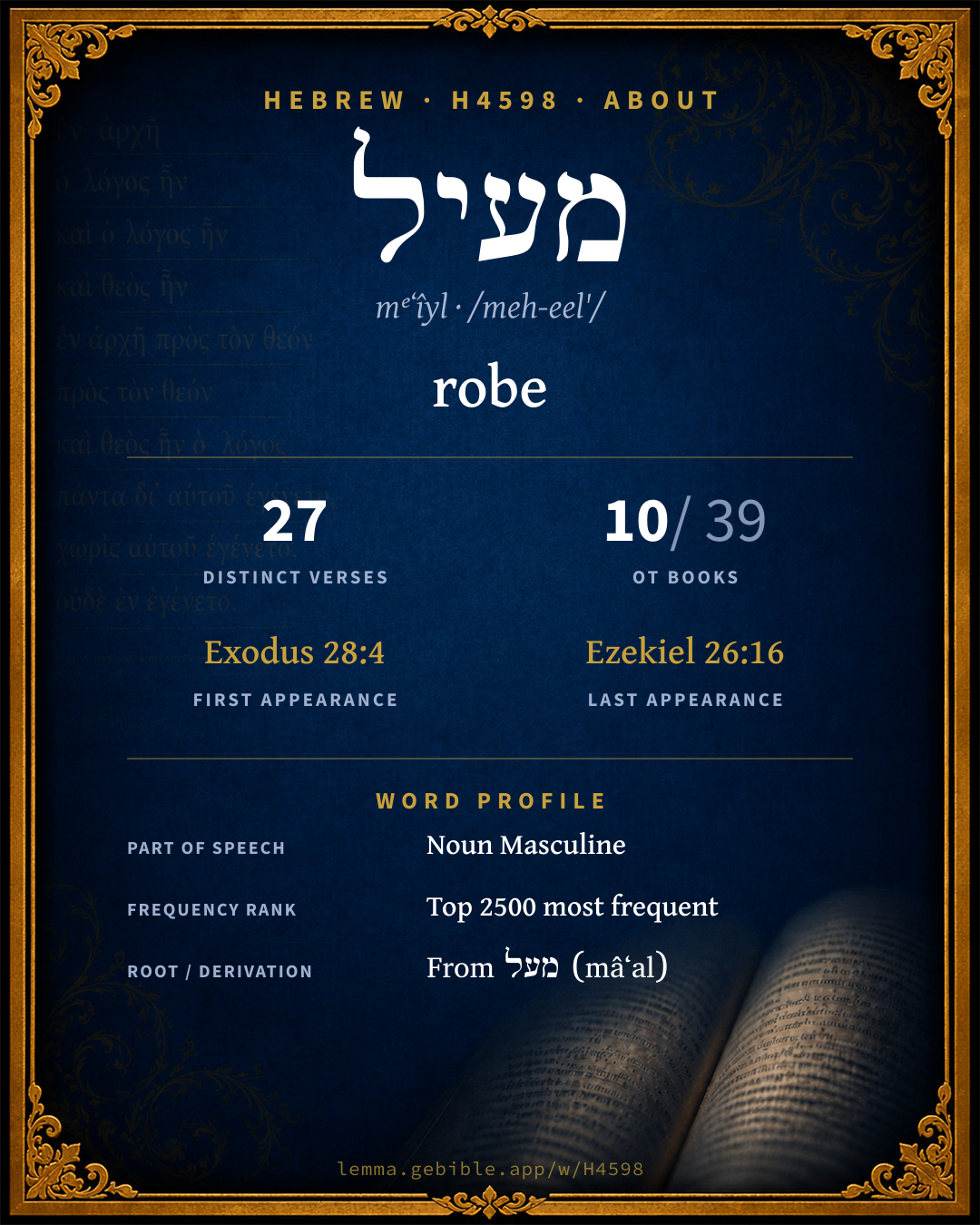
מְעִיל
robe
‘robe’ is one of 5 main senses fuller range ↓
Full lexicon entry — Brown-Driver-Briggs (BDB)
From Brown-Driver-Briggs (BDB)
Where this word appears
See every Absolute-state word in the Hebrew Bible →
Grammar key — what these labels mean
Part of speech
- Noun
- A naming word — a person, place, thing, or idea.
Noun type
- Common
- A common noun — a general class of person, place, or thing (“king,” “city,” “water”), not a specific name.
State
- Absolute
- The independent form of a noun, not bound to a following word.
- Construct
- A noun bound to a following noun in a possessive / “of” relationship (the construct chain).
Gender
- Masculine
- Grammatically masculine.
Number
- Singular
- One.
- Plural
- More than one (in Hebrew, generally three or more).
Grammatical forms
- Noun, Common, Masculine, Singular, Absolute 14 times (50%)
- Noun, Common, Masculine, Singular, Construct 12 times (43%)
- Noun, Common, Masculine, Plural, Absolute 1 time (4%)
- Noun, Common, Masculine, Plural, Construct 1 time (4%)
Parsed forms decoded from the imported morphology (morphhb / Westminster Leningrad Codex — WLC text public domain, morphhb tagging CC BY 4.0), counted across 28 parsed occurrences — not distinct verses.
Every verse where H4598 appears — 27 distinct verses across 10 books. Click any verse to open its interlinear word-by-word view. Verse text shown in the World English Bible for context — . Each verse’s Hebrew form is shown with its reference; the English is not keyword-highlighted, since the data carries no word-level English alignment. Use “Compare translations” on any verse to read it across multiple English versions. This concordance covers the Hebrew Bible; Septuagint (Greek Old Testament) occurrences are not indexed here.
Exodus 9 verses
- Exodus 28:4 וּ/מְעִ֔יל conj + n c ms These are the garments which they shall make: a breastplate, and an ephod, and a robe, and a coat of checker work, a turban, and a sash: and they shall make holy garments for Aaron your brother, and his sons, that he may minister to me in the priest's office.
- Exodus 28:31 מְעִ֥יל n c ms cs "You shall make the robe of the ephod all of blue.
- Exodus 28:34 הַ/מְּעִ֖יל ptcl def.art + n c ms a golden bell and a pomegranate, a golden bell and a pomegranate, on the hem of the robe round about.
- Exodus 29:5 מְעִ֣יל n c ms cs You shall take the garments, and put on Aaron the coat, the robe of the ephod, the ephod, and the breastplate, and dress him with the skillfully woven band of the ephod;
- Exodus 39:22 מְעִ֥יל n c ms cs He made the robe of the ephod of woven work, all of blue.
- Exodus 39:23 הַ/מְּעִ֥יל ptcl def.art + n c ms The opening of the robe in the midst of it was like the opening of a coat of mail, with a binding around its opening, that it should not be torn.
- Exodus 39:24 הַ/מְּעִ֔יל ptcl def.art + n c ms They made on the skirts of the robe pomegranates of blue, purple, scarlet, and twined linen.
- Exodus 39:25 הַ/מְּעִיל֙ ptcl def.art + n c ms They made bells of pure gold, and put the bells between the pomegranates around the skirts of the robe, between the pomegranates;
- Exodus 39:26 הַ/מְּעִ֖יל ptcl def.art + n c ms a bell and a pomegranate, a bell and a pomegranate, around the skirts of the robe, to minister in, as Yahweh commanded Moses.
Leviticus 1 verse
1 Samuel 6 verses
- 1 Samuel 2:19 וּ/מְעִ֤יל conj + n c ms Moreover his mother made him a little robe, and brought it to him from year to year, when she came up with her husband to offer the yearly sacrifice.
- 1 Samuel 15:27 מְעִיל֖/וֹ n c ms cs + sfx pers 3ms As Samuel turned about to go away, [Saul] laid hold on the skirt of his robe, and it tore.
- 1 Samuel 18:4 הַ/מְּעִיל֙ ptcl def.art + n c ms Jonathan stripped himself of the robe that was on him, and gave it to David, and his clothing, even to his sword, and to his bow, and to his sash.
- 1 Samuel 24:4 הַ/מְּעִ֥יל ptcl def.art + n c ms The men of David said to him, Behold, the day of which Yahweh said to you, Behold, I will deliver your enemy into your hand, and you shall do to him as it shall seem good to you. Then David arose, and cut off the skirt of Saul's robe secretly.
- 1 Samuel 24:11 מְעִילְ/ךָ֖ מְעִֽילְ/ךָ֜ n c ms cs + sfx pers 2ms n c ms cs + sfx pers 2ms Moreover, my father, behold, yes, see the skirt of your robe in my hand; for in that I cut off the skirt of your robe, and didn't kill you, know you and see that there is neither evil nor disobedience in my hand, and I have not sinned against you, though you hunt after my life to take it.
- 1 Samuel 28:14 מְעִ֑יל n c ms He said to her, What form is he of? She said, An old man comes up; and he is covered with a robe. Saul perceived that it was Samuel, and he bowed with his face to the ground, and did obeisance.
2 Samuel 1 verse
1 Chronicles 1 verse
Ezra 2 verses
- Ezra 9:3 וּ/מְעִילִ֑/י conj + n c ms cs + sfx pers 1cs When I heard this thing, I tore my garment and my robe, and plucked off the hair of my head and of my beard, and sat down confounded.
- Ezra 9:5 וּ/מְעִילִ֑/י conj + n c ms cs + sfx pers 1cs At the evening offering I arose up from my humiliation, even with my garment and my robe torn; and I fell on my knees, and spread out my hands to Yahweh my God;
Job 3 verses
- Job 1:20 מְעִל֔/וֹ n c ms cs + sfx pers 3ms Then Job arose, and tore his robe, and shaved his head, and fell down on the ground, and worshiped.
- Job 2:12 מְעִל֔/וֹ n c ms cs + sfx pers 3ms When they lifted up their eyes from a distance, and didn't recognize him, they raised their voices, and wept; and they each tore his robe, and sprinkled dust on their heads toward the sky.
- Job 29:14 כִּֽ/מְעִ֥יל prep + n c ms I put on righteousness, and it clothed me. My justice was as a robe and a diadem.
Psalms 1 verse
Isaiah 2 verses
- Isaiah 59:17 כַּ/מְעִ֖יל prep det + n c ms He put on righteousness as a breastplate, and a helmet of salvation on his head; and he put on garments of vengeance for clothing, and was clad with zeal as a mantle.
- Isaiah 61:10 מְעִ֥יל n c ms cs I will greatly rejoice in Yahweh, my soul shall be joyful in my God; for he has clothed me with the garments of salvation, he has covered me with the robe of righteousness, as a bridegroom decks himself with a garland, and as a bride adorns herself with her jewels.
Ezekiel 1 verse
About this entry
At a glance — auto-summarized from this page’s data, not written by a person. Every figure links to its source below. This summary describes the numbers; it doesn’t interpret them.
The Hebrew noun מעיל centers on the idea of “robe.” Its meaning spans more than one sense — see its full sense range. It turns up in 27 verses across 10 books, a moderately common footprint. The word gravitates to Exodus (33%), then 1 Samuel and Job. First canonically at Exodus 28:4, it enters the text early. The sections below give every sense, occurrence, and version rendering.
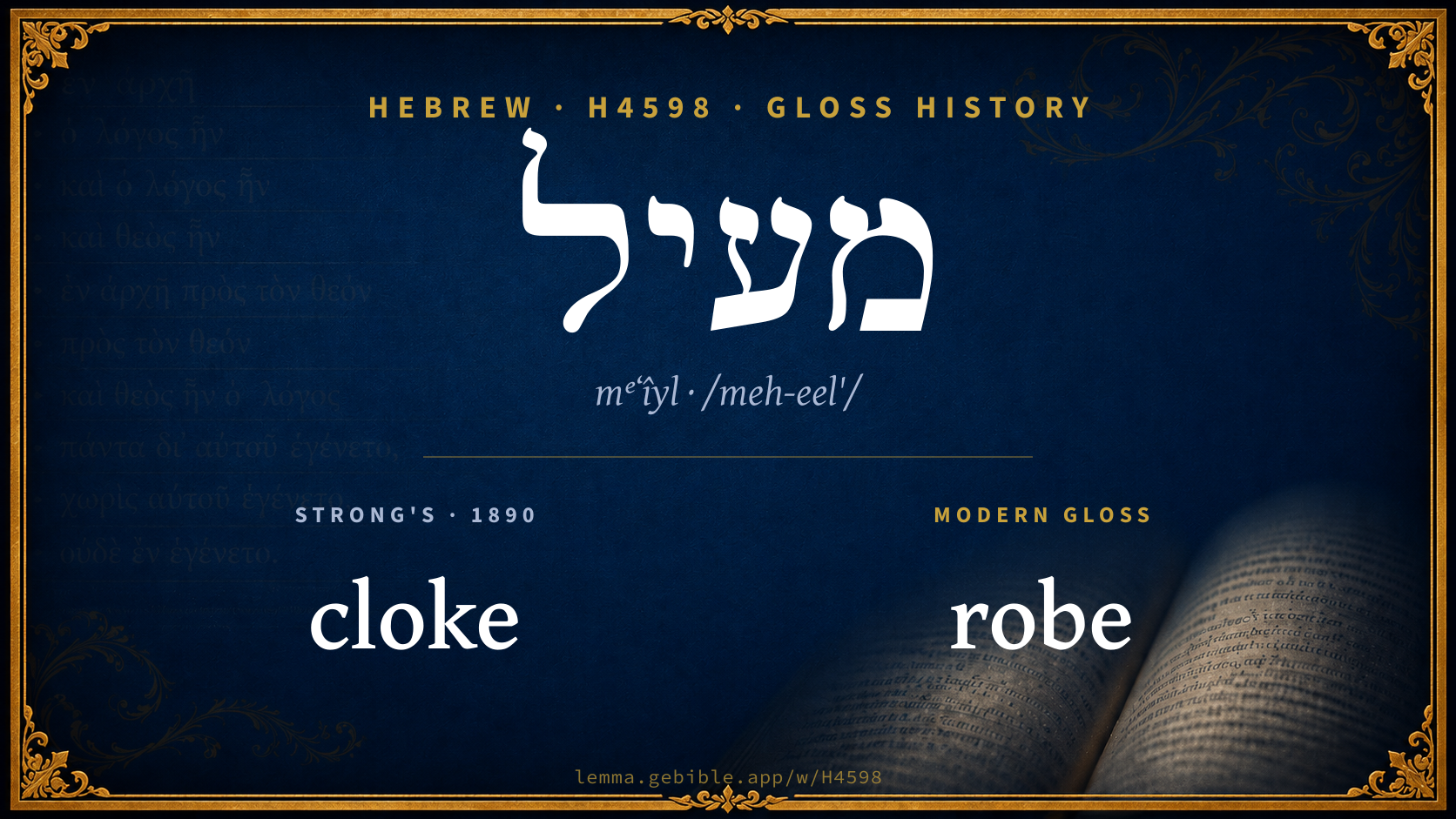
Gloss history
Strong's 1890 vs modern scholarship
About this word
Strong's H4598 catalogs a Hebrew word from the Hebrew Old Testament.
These counts are not copied from any lexicon or concordance. They are computed here, from the morphology-tagged Hebrew Old Testament. What Lemma adds →
- 27
- distinct verses
- The word appears in 27 distinct verses.
- 10 / 39
- OT books
- The word appears in 10 of 39 Old Testament books.
- #1,190
- by frequency
- Top 2500 most frequent Hebrew words (rank 1,190 of 8,640 Hebrew words by occurrence).
View all 27 occurrences in the concordance →
By section of the Old Testament
By traditional corpus
Conventional, traditional groupings — biblical authorship is debated, so this is a traditional corpus grouping, not an authorship claim. Each share is this word’s portion of its verses in that division of the Hebrew canon. Each figure is a share of the word’s 27 distinct verses.
- Torah (Pentateuch) 10 verses · 37%
- Prophets (Nevi'im) 10 verses · 37%
- Writings (Ketuvim) 7 verses · 26%
How translations render this word
Counts come from each version’s own published word-to-Strong’s tagging or interlinear alignment — an approximate guide to how each version renders this word, not a word-level alignment the data otherwise carries. Because each total is that version’s own tagged count, the per-version totals vary from one another and need not match the appearance or distinct-verse counts above. These counts may also differ from a printed concordance because Lemma counts each distinctly tagged rendering and does not collapse phrase taggings into a single head-word total. This is a fixed set of word-tagged versions (KJV, ASV, BSB, ULT) and does not change with the reading translation you choose elsewhere. Each version’s license is shown beside its name below (and on Sources).
BDB lists this Strong’s number as 2 distinct words (homographs). Each count above pools all of them and is not split by sense — see the Senses section below. A low-frequency rendering may belong to a different one of those words, not the primary meaning.
- King James Version†: Robe 15×, Mantle 7×, Robes 2×
- American Standard Version†: Robe 21×
- Berean Standard Bible†: Robe 19×, Cloak 3×
- unfoldingWord Literal Text†: Robe 21×, Robe of 3×, Like a robe 2×
King James Version Public Domain
Renders H4598 across 28† tagged occurrences — most commonly:
Plus 4 renderings that appear only once — usually multi-word phrases or single function words the recovered tagging swept in, not distinct renderings.
American Standard Version Public Domain
Renders H4598 across 27† tagged occurrences — most commonly:
Plus 6 renderings that appear only once — usually multi-word phrases or single function words the recovered tagging swept in, not distinct renderings.
Berean Standard Bible Public Domain
Renders H4598 across 25† tagged occurrences — most commonly:
Plus 3 renderings that appear only once — usually multi-word phrases or single function words the recovered tagging swept in, not distinct renderings. Not rendered by a distinct English word in 3 further occurrences.
unfoldingWord Literal Text CC BY-SA 4.0
Renders H4598 across 30† tagged occurrences — most commonly:
Plus 4 renderings that appear only once — usually multi-word phrases or single function words the recovered tagging swept in, not distinct renderings.
Senses in the full BDB
What do BDB’s symbols mean?
BDB uses these scholarly abbreviations:
| Symbol | Meaning |
|---|---|
| 𝔊 | the Septuagint (the ancient Greek translation, LXX) |
| 𝔙 | the Vulgate (the Latin translation) |
| 𝔖 | the Syriac version (the Peshitta) |
| 𝔗 | the Targum (the Aramaic translation) |
| ψ | the Psalms |
| √ | root (the underlying root or stem) |
| ‖ | parallel passage (a synonymous or contrasted parallel) |
| † | the dagger: every passage where the word occurs is cited |
The 4 senses and sub-senses the full Brown-Driver-Briggs lexicon distinguishes for this word, in lexicon order (not ranked by frequency), with BDB’s own verbatim wording and sub-sense lettering. Shown in Hebrew script with BDB’s own scholarly abbreviations. The condensed entry is in the Lexicon Entry tab. See also the Forms in the corpus table below.
- 1. worn by men of rank: Saul and Jonathan 1 S 18:4; 24:5, 12(×2); princes of the sea Ez 26:16; Job Jb 1:20; 2:12; Samuel 1 S 15:27; 28:14; Ezra Ezr 9:3, 5; David clothed with מ׳ בוץ 1 Ch 15:27 (in the procession of the ark); the child Samuel had מ׳ קָטֹן 1 S 2:19;—(it had a skirt כנף 1 S 15:27; 24:5, 12(×2)). e.g. 1 Samuel 18:4
- 2. worn by the daughters of David 2 S 13:18 (but prob. del., v. supr.) e.g. 2 Samuel 13:18
- 3. robe of high priest (only P): מְעִיל הָאֵפוֹד, made of purple stuff, Ex 28:31; 29:5; 39:22; אפוד ומעיל 28:4; הַמְּעִיל Lv 8:7, having שׁוּלֵי הַמְּעִיל skirts Ex 28:34; 39:24, 25, 26, around which were alternate coloured pomegranates and golden bells, and פִּי הַמְּעִיל, an opening or hole by which it might be drawn over the head 39:28. e.g. Exodus 28:31
- 4. fig. of attributes (of י׳, and of men), קנאה Is 59:17; צדקה 61:10; משׁפט Jb 29:14; בשׁת ψ 109:29. e.g. Isaiah 59:17
Senses from the full Brown-Driver-Briggs lexicon (Brown, Driver, Briggs; Oxford 1906 — public domain), digitized via Sefaria, supplemented by the OpenScriptures HebrewLexicon (CC BY 4.0). Full attribution on Sources.
Word origin
n.m. 1 S 2:19 robe (Thes conj. orig. meaning cover for √ מעל, cf. בגד; BAES 15 comp. Arabic مُلَاءَةٌ an outer garment, but against this StaThLZ, Apr. 28, 1894, 235);—מ׳ Ex 28:31 + 18 times; sf. מְעִילוֹ 1 S 15:27; מְעִלוֹ Jb 1:20; 2:12 + 4 times sg.; pl. מְעִילִים 2 S 13:18, (but del. We Klo Kit Bu SS; orig. gloss מֵעוֹלָם We Kit Bu); מְעִילֵיהֶם Ez 26:16;—exterior garment, robe, worn over the inner tunic כְּתֹנֶת:
— Brown-Driver-Briggs (Oxford 1906, public domain), digitized via Sefaria, supplemented by the OpenScriptures HebrewLexicon (CC BY 4.0). See Sources.
Derived from מעל (mâʻal) (H4603) — to betray.
Jastrow Dictionary
A second Hebrew/Aramaic lexicon for comparison, covering Aramaic and post-biblical (Talmudic, Targumic, Midrashic) usage that the biblical-Hebrew BDB does not. Matched by lemma rather than by Strong’s number, so a lemma may carry more than one Jastrow headword (shown separately below), and the entries cover usage well beyond the Bible.
מָעֵיל
- , v. מְעַל
מְעִיל
- cloak, robe. Ruth R. to IV, 8 (ref. to I Sam. XV, 27) מְעִילוֹ של מי whose cloak (did Samuel seize and rend)?; Midr. Sam. ch. XVIII; a. e.—Esp. the high priest’s robe. Yoma VII, 5. Zeb. 88ᵇ; Arakh. 16ᵃ; a. e. e.g. 1 Samuel 15:27
מְעִיל ²
- Targ. I Sam. II, 19. Targ. Ex. XXVIII, 4; a. fr.—Pl. מְעִילִין. Targ. Ez. XXVI, 16.
A Dictionary of the Targumim, the Talmud Babli and Yerushalmi, and the Midrashic Literature (Marcus Jastrow; London, Luzac, 1903) — Public Domain. Digitized via Sefaria. Digitized via Sefaria. Full attribution on Sources.
Forms in the corpus
The 20 distinct written forms H4598 takes in the Hebrew Bible, most frequent first — each parse links to that state’s occurrences in the concordance. Hebrew forms include their vowel points and cantillation, so a single lemma takes many written forms.
Same root — word family
Other BDB entries built from the same root as H4598, grouped by Strong’s listed origin. These share a root / origin per the lexicon — not necessarily a shared meaning. Each links to that word’s own entry.
Derives from
Shares the same root
Compare all same-root words → They share a root, not necessarily a meaning.
Septuagint verse parallels
This word appears in 23 verses that also exist in the Greek Old Testament (Septuagint), out of the 27 Hebrew verses it occurs in. You can read those verses in Greek by switching the Old Testament edition to the Septuagint.
Read these verses in the Septuagint
- Exodus 28:4
- Leviticus 8:7
- 1 Samuel 2:19
- 2 Samuel 13:18
- 1 Chronicles 15:27
- Ezra 9:3
- Job 1:20
- Isaiah 59:17
- Ezekiel 26:16
This is a verse-level parallel only — the same verses exist in both the Hebrew and Greek Old Testaments. No word-level Hebrew↔Greek correspondence is claimed: the data carries no such alignment, so no Greek word is shown as this Hebrew word’s translation. Coverage is not total — the Septuagint omits the deuterocanon and renumbers the Psalms, so some Hebrew verses have no direct Greek parallel.