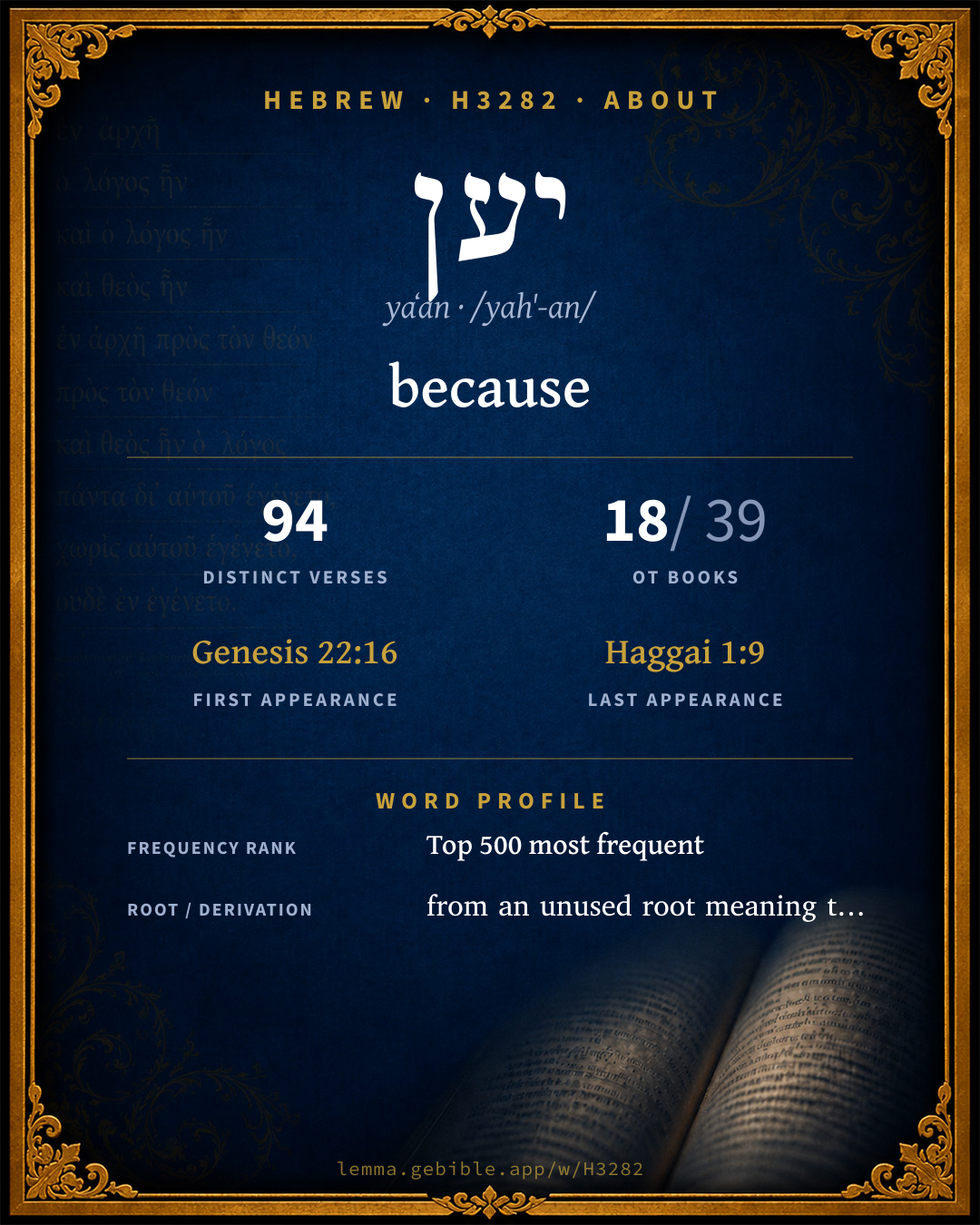
יַעַן
because
also: therefore, because that, on account of fuller range ↓
Full lexicon entry — Brown-Driver-Briggs (BDB)
From Brown-Driver-Briggs (BDB)
Where this word appears
Grammar key — what these labels mean
Part of speech
- Conjunction
- A joining word (e.g. “and,” “but”) linking words or clauses.
Every verse where H3282 appears in the Book of 1 Kings — 14 distinct verses. Click any verse to open its interlinear word-by-word view. Verse text shown in the World English Bible for context — . Each verse’s Hebrew form is shown with its reference; the English is not keyword-highlighted, since the data carries no word-level English alignment. Use “Compare translations” on any verse to read it across multiple English versions. This concordance covers the Hebrew Bible; Septuagint (Greek Old Testament) occurrences are not indexed here.
1 Kings
- 1 Kings 3:11 יַעַן֩ conj God said to him, Because you have asked this thing, and have not asked for yourself long life, neither have asked riches for yourself, nor have asked the life of your enemies, but have asked for yourself understanding to discern justice;
- 1 Kings 8:18 יַ֗עַן conj But Yahweh said to David my father, Whereas it was in your heart to build a house for my name, you did well that it was in your heart:
- 1 Kings 11:11 יַ֚עַן conj Therefore Yahweh said to Solomon, Because this is done of you, and you have not kept my covenant and my statutes, which I have commanded you, I will surely tear the kingdom from you, and will give it to your servant.
- 1 Kings 11:33 יַ֣עַן conj because that they have forsaken me, and have worshiped Ashtoreth the goddess of the Sidonians, Chemosh the god of Moab, and Milcom the god of the children of Ammon; and they have not walked in my ways, to do that which is right in my eyes, and [to keep] my statutes and my ordinances, as did David his father.
- 1 Kings 13:21 יַ֗עַן conj and he cried to the man of God who came from Judah, saying, Thus says Yahweh, Because you have been disobedient to the mouth of Yahweh, and have not kept the commandment which Yahweh your God commanded you,
- 1 Kings 14:7 יַ֛עַן conj Go, tell Jeroboam, Thus says Yahweh, the God of Israel: Because I exalted you from among the people, and made you prince over my people Israel,
- 1 Kings 14:13 יַ֣עַן conj All Israel shall mourn for him, and bury him; for he only of Jeroboam shall come to the grave, because in him there is found some good thing toward Yahweh, the God of Israel, in the house of Jeroboam.
- 1 Kings 14:15 יַ֗עַן conj For Yahweh will strike Israel, as a reed is shaken in the water; and he will root up Israel out of this good land which he gave to their fathers, and will scatter them beyond the River, because they have made their Asherim, provoking Yahweh to anger.
- 1 Kings 16:2 יַ֗עַן conj Because I exalted you out of the dust, and made you prince over my people Israel, and you have walked in the way of Jeroboam, and have made my people Israel to sin, to provoke me to anger with their sins;
- 1 Kings 20:28 יַ֠עַן conj A man of God came near and spoke to the king of Israel, and said, Thus says Yahweh, Because the Syrians have said, Yahweh is a god of the hills, but he is not a god of the valleys; therefore will I deliver all this great multitude into your hand, and you shall know that I am Yahweh.
- 1 Kings 20:36 יַ֚עַן conj Then said he to him, Because you have not obeyed the voice of Yahweh, behold, as soon as you are departed from me, a lion shall kill you. As soon as he was departed from him, a lion found him, and killed him.
- 1 Kings 20:42 יַ֛עַן conj He said to him, Thus says Yahweh, Because you have let go out of your hand the man whom I had devoted to destruction, therefore your life shall go for his life, and your people for his people.
- 1 Kings 21:20 יַ֚עַן conj Ahab said to Elijah, Have you found me, my enemy? He answered, I have found you, because you have sold yourself to do that which is evil in the sight of Yahweh.
- 1 Kings 21:29 יַ֜עַן conj See you how Ahab humbles himself before me? because he humbles himself before me, I will not bring the evil in his days; but in his son's days will I bring the evil on his house.
About this entry
At a glance — auto-summarized from this page’s data, not written by a person. Every figure links to its source below. This summary describes the numbers; it doesn’t interpret them.
יען — transliterated yaʻan — is a Hebrew word carrying the sense “because.” It first appears in Genesis 22:16. With 94 verses in 18 books, it is a moderately common word in the Hebrew Bible. Its uses concentrate in Ezekiel (39% of all occurrences). It also covers “therefore”, “because that”, and “on account of”, alongside “because” — see its full sense range. Each statement above links to its evidence; the full detail follows below.
Gloss history
Strong's 1890 vs modern scholarship
About this word
Strong's H3282 catalogs a Hebrew word from the Hebrew Old Testament.
These counts are not copied from any lexicon or concordance. They are computed here, from the morphology-tagged Hebrew Old Testament. What Lemma adds →
- 94
- distinct verses
- The word appears in 94 distinct verses.
- 18 / 39
- OT books
- The word appears in 18 of 39 Old Testament books.
- #427
- by frequency
- Top 500 most frequent Hebrew words (rank 427 of 8,640 Hebrew words by occurrence).
View all 94 occurrences in the concordance →
By section of the Old Testament
By traditional corpus
Conventional, traditional groupings — biblical authorship is debated, so this is a traditional corpus grouping, not an authorship claim. Each share is this word’s portion of its verses in that division of the Hebrew canon. Each figure is a share of the word’s 94 distinct verses.
- Prophets (Nevi'im) 84 verses · 89%
- Torah (Pentateuch) 5 verses · 5%
- Writings (Ketuvim) 5 verses · 5%
How translations render this word
Counts come from each version’s own published word-to-Strong’s tagging or interlinear alignment — an approximate guide to how each version renders this word, not a word-level alignment the data otherwise carries. Because each total is that version’s own tagged count, the per-version totals vary from one another and need not match the appearance or distinct-verse counts above. These counts may also differ from a printed concordance because Lemma counts each distinctly tagged rendering and does not collapse phrase taggings into a single head-word total. This is a fixed set of word-tagged versions (KJV, ASV, BSB, ULT) and does not change with the reading translation you choose elsewhere. Each version’s license is shown beside its name below (and on Sources).
BDB lists this Strong’s number as 3 distinct words (homographs). Each count above pools all of them and is not split by sense — see the Senses section below. A low-frequency rendering may belong to a different one of those words, not the primary meaning.
- King James Version†: Because 7×, Forasmuch 3×, Forasmuch as 2×
- American Standard Version†: Because 7×, Forasmuch 3×, Forasmuch as 2×
- Berean Standard Bible†: Because 73×, Since 7×, For 6×
- unfoldingWord Literal Text†: Because 71×, Of 4×, Yahweh 3×
King James Version Public Domain
Renders H3282 across 17† tagged occurrences — most commonly:
Plus 5 renderings that appear only once — usually multi-word phrases or single function words the recovered tagging swept in, not distinct renderings.
American Standard Version Public Domain
Renders H3282 across 17† tagged occurrences — most commonly:
Plus 5 renderings that appear only once — usually multi-word phrases or single function words the recovered tagging swept in, not distinct renderings.
Berean Standard Bible Public Domain
Renders H3282 across 92† tagged occurrences — most commonly:
Plus 6 renderings that appear only once — usually multi-word phrases or single function words the recovered tagging swept in, not distinct renderings. Not rendered by a distinct English word in 7 further occurrences.
unfoldingWord Literal Text CC BY-SA 4.0
Renders H3282 across 93† tagged occurrences — most commonly:
Plus 13 renderings that appear only once — usually multi-word phrases or single function words the recovered tagging swept in, not distinct renderings.
Senses in the full BDB
What do BDB’s symbols mean?
BDB uses these scholarly abbreviations:
| Symbol | Meaning |
|---|---|
| 𝔊 | the Septuagint (the ancient Greek translation, LXX) |
| 𝔙 | the Vulgate (the Latin translation) |
| 𝔖 | the Syriac version (the Peshitta) |
| 𝔗 | the Targum (the Aramaic translation) |
| ψ | the Psalms |
| √ | root (the underlying root or stem) |
| ‖ | parallel passage (a synonymous or contrasted parallel) |
| † | the dagger: every passage where the word occurs is cited |
The 6 senses and sub-senses the full Brown-Driver-Briggs lexicon distinguishes for this word, in lexicon order (not ranked by frequency), with BDB’s own verbatim wording and sub-sense lettering. Shown in Hebrew script with BDB’s own scholarly abbreviations. The condensed entry is in the Lexicon Entry tab. See also the Forms in the corpus table below.
יען I and conj. v. sub I. ענה.
יען II in דַּנָֿה יַעַן 2 S 24
יען III
- 1. as prep., rarely with a subst., †Ez 5:9 יַעַן תּוֹעֲבוֹתֵיכֶם, Hg 1:9 יַעַן מָה, v 9 יַעַן בֵּיתִי; with a ptcp. Ez 36:13 יען אמרים because of men saying to you (but read prob. אָמְרָם, Co Toy Berthol); freq. with inf. c., 1 K 21:20 יַעַן הִתְמַכֶּרְךָ on account of thy having sold thyself, Am 5:11; Is 30:12; 37:29 (= 2 K 19:28) יַעַן הִתְרַגֶּזְךָ אֵלַי, Je 5:14; 7:13; 23:38; 48:7, and often (c. 18 times) in Ezek., as 5:7 (read יַעַן הַמְרֹֽתְכֶם), 13:8, 22; 25:3, 6, 8, 12. e.g. Ezekiel 5:9
- 2. As conj.:
- a. יַעַן אֲשֶׁר (32 times), usually with pf., as Gn 22:16 יען אשׁר עשׂית זאת because that thou hast done this, Dt 1:36 (Jos 14:14), Ju 2:20; 1 S 30:22; 1 K 3:11; 8:18; Je 19:4; 25:8; 29:23 (not Is) +; with impf. (in frequent. sense) Ez 44:12. e.g. Genesis 22:16
- b. יַעַן כִּי, Nu 11:20 יַעַן כִּי מְאַסְתֶּם אֶת־י׳, 1 K 13:21; 21:29; Is 3:16; 7:5; 8:6; 29:13. e.g. Numbers 11:20
- c. יַעַן alone (23 times), with pf. Nu 20:12 יַעַן לֹא הֶאֱמַנְתֶּם בִּי, 1 S 15:23; 1 K 14:13; 20:42; 2 K 22:19; Ho 8:1; Is 61:1; 65:12; 66:4; with impf. (freq.) †Ez 34:21. Once יַעַן אֲשֶׁר of the fut. †Ez 12:12 because he shall not see, etc., (but 𝔊 Co לְמַעַן אשׁר לא יֵרָאֶה לָעַיִן). Usually the vb. follows immediately, but Ezek. sometimes puts the obj.first for emph., 5:11 יַעַן אֶת־מִקְדָּשִׁי טִמֵּאת, 20:16, 24; 36:6, cf. 34:21. e.g. Numbers 20:12
- 3. יַעַן וּבְיַעַן, q. d. because and by the cause (that), sq. perf., Lv 26:43 (H) יען וביען בְּמִשְׁפָּטַי מָאָ֔סוּ, Ez 13:10; יַעַן בְּיַעַן sq. inf., Ez 36:3. (In all, reckoning יען (ו)ביען once each, 93 times, 20 in 1–2 K, 11 in Je, 38 in Ez; only 9 in Gn-2 S.) e.g. Leviticus 26:43
Senses from the full Brown-Driver-Briggs lexicon (Brown, Driver, Briggs; Oxford 1906 — public domain), digitized via Sefaria, supplemented by the OpenScriptures HebrewLexicon (CC BY 4.0). Full attribution on Sources.
Word origin
I. prep. and conj. v. sub I. ענה.
I. in דַּנָֿה יַעַן 2 S 24:6 v. supr. p. 193.
II. proposes subst., purpose, intention, but always used as prep. or conj., on account of, because (for יַעֲנֶה, of the form יִצְהָר, etc., Sta§ 259 Köii. 403; cf. عَنَى mean, intend):—
— Brown-Driver-Briggs (Oxford 1906, public domain), digitized via Sefaria, supplemented by the OpenScriptures HebrewLexicon (CC BY 4.0). See Sources.
Origin: from an unused root meaning to pay attention
Jastrow Dictionary
A second Hebrew/Aramaic lexicon for comparison, covering Aramaic and post-biblical (Talmudic, Targumic, Midrashic) usage that the biblical-Hebrew BDB does not. Matched by lemma rather than by Strong’s number, so a lemma may carry more than one Jastrow headword (shown separately below), and the entries cover usage well beyond the Bible.
יַעַן
- v. עָנָה) corresponding; (conj) because. Sifra B’ḥuck. Par. 2, ch. VIII (ref. to יען וביען, Lev. XXVI, 43) וכי ראש בראש וכ׳ have I indeed paid them item for item (for all their sins)?—Ruth R. to II, 19; Lev. R. s. 34 י׳ ובי׳ הוא י̇ע̇ן̇ הוא ע̇נ̇י̇ ‘because and because’ (Lev. l. c.) yaʿan and ʿani have the same letters (intimating, ‘because they have rejected my statutes concerning the poor’). e.g. Leviticus 26:43
A Dictionary of the Targumim, the Talmud Babli and Yerushalmi, and the Midrashic Literature (Marcus Jastrow; London, Luzac, 1903) — Public Domain. Digitized via Sefaria. Digitized via Sefaria. Full attribution on Sources.
Forms in the corpus
The 16 distinct written forms H3282 takes in the Hebrew Bible, most frequent first — each parse links to that state’s occurrences in the concordance. Hebrew forms include their vowel points and cantillation, so a single lemma takes many written forms.
| Form | Parsing | Example | Uses |
|---|---|---|---|
| יַ֚עַן | Conjunction | Ezekiel 5:11 | 21 |
| יַ֗עַן | Conjunction | Ezekiel 12:12 | 19 |
| יַ֣עַן | Conjunction | Amos 5:11 | 19 |
| יַ֛עַן | Conjunction | Ezekiel 21:4 | 7 |
| יַ֤עַן | Conjunction | Ezekiel 5:7 | 5 |
| יַ֜עַן | Conjunction | Ezekiel 20:16 | 4 |
| יַ֠עַן | Conjunction | Ezekiel 26:2 | 4 |
| יַ֡עַן | Conjunction | Isaiah 61:1 | 4 |
| יַ֧עַן | Conjunction | Ezekiel 29:6 | 4 |
| יַעַן֩ | Conjunction | Ezekiel 25:3 | 4 |
| יַ֕עַן | Conjunction | Deuteronomy 1:36 | 3 |
| בְּ/יַ֡עַן | Conjunction | Ezekiel 36:3 | 1 |
| וּ/בְ/יַ֔עַן | Conjunction | Leviticus 26:43 | 1 |
| וּ/בְ/יַ֜עַן | Conjunction | Ezekiel 13:10 | 1 |
| יַ֖עַן | Conjunction | Ezekiel 5:9 | 1 |
| יַ֥עַן | Conjunction | Isaiah 30:12 | 1 |
Same root — word family
Other BDB entries built from the same root as H3282, grouped by Strong’s listed origin. These share a root / origin per the lexicon — not necessarily a shared meaning. Each links to that word’s own entry.
Derived from this word
Compare all same-root words → They share a root, not necessarily a meaning.
Septuagint verse parallels
This word appears in 85 verses that also exist in the Greek Old Testament (Septuagint), out of the 94 Hebrew verses it occurs in. You can read those verses in Greek by switching the Old Testament edition to the Septuagint.
Read these verses in the Septuagint
- Genesis 22:16
- Leviticus 26:43
- Numbers 11:20
- Deuteronomy 1:36
- Joshua 14:14
- Judges 2:20
- 1 Samuel 15:23
- 1 Kings 3:11
- 2 Kings 1:16
- 2 Chronicles 1:11
- Proverbs 1:24
- Isaiah 3:16
This is a verse-level parallel only — the same verses exist in both the Hebrew and Greek Old Testaments. No word-level Hebrew↔Greek correspondence is claimed: the data carries no such alignment, so no Greek word is shown as this Hebrew word’s translation. Coverage is not total — the Septuagint omits the deuterocanon and renumbers the Psalms, so some Hebrew verses have no direct Greek parallel.