
1 Kings 20:42

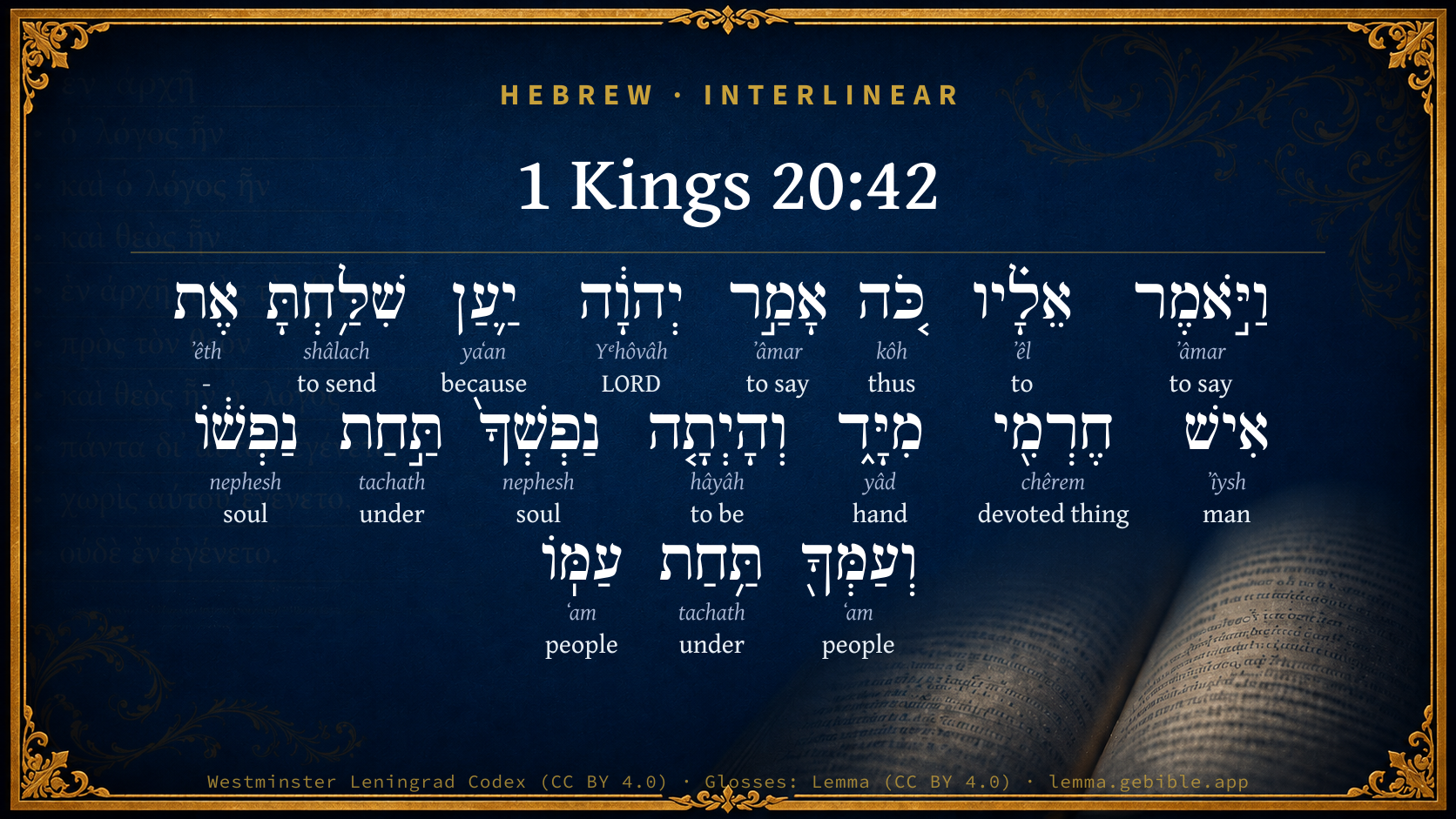
Hebrew (Westminster Leningrad Codex) 1 Kings 20:42 appears in the Hebrew Old Testament. The text above is from the Westminster Leningrad Codex. Each word links to its Strong’s number, a concise gloss, and parsing drawn from the Open Scriptures Hebrew Bible morphology. Click any word for its full Brown-Driver-Briggs (BDB) entry.
Download image
Cite this verse

1 Kings 20:42 (World English Bible). Public Domain. Lemma interlinear Bible study tool, https://lemma.gebible.app/v/1-kings/20/42.

Show BibTeX & RIS
BibTeX
RIS
English Translation
He said to him, Thus says Yahweh, Because you have let go out of your hand the man whom I had devoted to destruction, therefore your life shall go for his life, and your people for his people.
World English Bible · Public Domain
Download a study sheet

One document with this verse’s original text, its word-by-word gloss line, the meaning frame, cross-references with their text, attributed commentary, and full source and license credits — printable, and it pastes into notes with its structure intact.

This verse Autodidact and up

Study sheet (.html) Plain text (.txt)

A passage Seminary Student

Up to 50 verses in one chapter. A passage sheet keeps up to 6 commentary sources and 12 cross-references per verse, in the order this page ranks them, and says so on the sheet whenever that leaves anything out. Ask for a single verse and you get the Autodidact verse sheet above.

Everything on this page stays free to read, with no account — the sheet is a download of what is already on screen, not access to it.

Want to remove ads? Support Godless Engineer
Compare translations 3

The same verse in 3 English versions, stacked beneath the original-language interlinear above. Click any original word for its lexicon entry.

Each is an independent rendering of the whole verse — the interlinear is not word-aligned to these translations.

Highlighted words mark where these versions differ — a whole-verse word diff, not a word-by-word alignment.

  • World English Bible Public Domain
    He said to him, Thus says Yahweh, Because you have let go out of your hand the man whom I had devoted to destruction, therefore your life shall go for his life, and your people for his people.
  • King James Version Public Domain
    And he said unto him, Thus saith the LORD, Because thou hast let go out of thy hand a man whom I appointed to utter destruction, therefore thy life shall go for his life, and thy people for his people.
  • unfoldingWord Literal Text CC BY-SA 4.0
    And he said to him, “Thus says Yahweh, ‘Because you have sent away a man of my devotion from hand, so it will be your life in place of his life and your people in place of his people.’”

unfoldingWord Literal Text — © unfoldingWord, licensed CC BY-SA 4.0. Word-aligned USFM3 via Door43 (git.door43.org/unfoldingWord/en_ult).

Versions to compare (up to 4)

3 of 4 selected

Show all 18 translations

Every available English version of this verse, each an independent rendering of the whole verse.

  • World English Bible Public Domain
    He said to him, Thus says Yahweh, Because you have let go out of your hand the man whom I had devoted to destruction, therefore your life shall go for his life, and your people for his people.
  • Berean Standard Bible Public Domain
    And the prophet said to the king, “This is what the LORD says: ‘Because you have let slip from your hand the man I had devoted to destruction, your life will be exchanged for his life, and your people for his people.’”
  • Majority Standard Bible Public Domain
    And the prophet said to the king, “This is what the LORD says: ‘Because you have let slip from your hand the man I had devoted to destruction, your life will be exchanged for his life, and your people for his people.’”
  • King James Version Public Domain
    And he said unto him, Thus saith the LORD, Because thou hast let go out of thy hand a man whom I appointed to utter destruction, therefore thy life shall go for his life, and thy people for his people.
  • American Standard Version (1901) Public Domain
    And he said unto him, Thus saith Jehovah, Because thou hast let go out of thy hand the man whom I had devoted to destruction, therefore thy life shall go for his life, and thy people for his people.
  • Revised Version (1885) Public Domain
    And he said unto him, Thus saith the LORD, Because thou hast let go out of thy hand the man whom I had devoted to destruction, therefore thy life shall go for his life, and thy people for his people.
  • Geneva Bible (1599) Public Domain
    And he said vnto him, Thus saith the Lord, Because thou hast let goe out of thine handes a man whom I appoynted to dye, thy life shall goe for his life, and thy people for his people.
  • Douay-Rheims (1899) Public Domain
    And he said to him: Thus saith the Lord: Because thou hast let go out of thy hand a mall worthy of death, thy life shall be for his life, and thy people for his people.
  • Young's Literal Translation Public Domain
    and he saith unto him, `Thus said Jehovah, Because thou hast sent away the man I devoted, out of `thy' hand, even thy life hath been for his life, and thy people for his people;'
  • Literal Standard Version CC BY-SA 4.0
    and he says to him, “Thus said YHWH: Because you have sent away the man I devoted, out of [your] hand, even your life has been for his life, and your people for his people”;
  • Unlocked Literal Bible CC BY-SA 4.0
    The prophet said to the king, “Yahweh says, 'Because you have let go from your hand the man whom I had sentenced to death, your life will take the place of his life, and your people for his people.'”
  • unfoldingWord Literal Text CC BY-SA 4.0
    And he said to him, “Thus says Yahweh, ‘Because you have sent away a man of my devotion from hand, so it will be your life in place of his life and your people in place of his people.’”
  • Darby Bible Public Domain
    And he said to him, Thus saith Jehovah: Because thou hast let go out of thy hand the man that I had devoted to destruction, thy life shall be for his life, and thy people for his people.
  • World Messianic Bible Public Domain
    He said to him, “The LORD says, ‘Because you have let go out of your hand the man whom I had devoted to destruction, therefore your life will take the place of his life, and your people take the place of his people.’”
  • Webster's Bible Public Domain
    And he said to him, Thus saith the LORD, Because thou hast let go out of thy hand a man whom I appointed to utter destruction, therefore thy life shall go for his life, and thy people for his people.
  • Free Bible Version CC BY-SA 4.0
    He told the king, “This is what the Lord says: You have let go a man I had decided should die. Therefore you will pay for his life with your life, your people for his people.”
  • Bible in Basic English Public Domain
    And he said to him, These are the words of the Lord: Because you have let go from your hands the man whom I had put to the curse, your life will be taken for his life, and your people for his people.
  • JPS Tanakh (1917) Public Domain
    And he said unto him: 'Thus saith the LORD: Because thou hast let go out of thy hand the man whom I had devoted to destruction, therefore thy life shall go for his life, and thy people for his people.'

Literal Standard Version (2020), Covenant Press — licensed CC BY-SA 4.0. Text via the HelloAO Bible API (eBible.org). Unlocked Literal Bible (unfoldingWord) — licensed CC BY-SA 4.0. Text via the HelloAO Bible API (eBible.org). unfoldingWord Literal Text — © unfoldingWord, licensed CC BY-SA 4.0. Word-aligned USFM3 via Door43 (git.door43.org/unfoldingWord/en_ult). Free Bible Version, Dr. Jonathan Gallagher — licensed CC BY-SA 4.0. Text via the HelloAO Bible API (eBible.org).

Word by word

More ways to search: Search by grammar → Find every occurrence → Compare this word →

Practice this passage: Drill this verse → Learn its vocabulary →

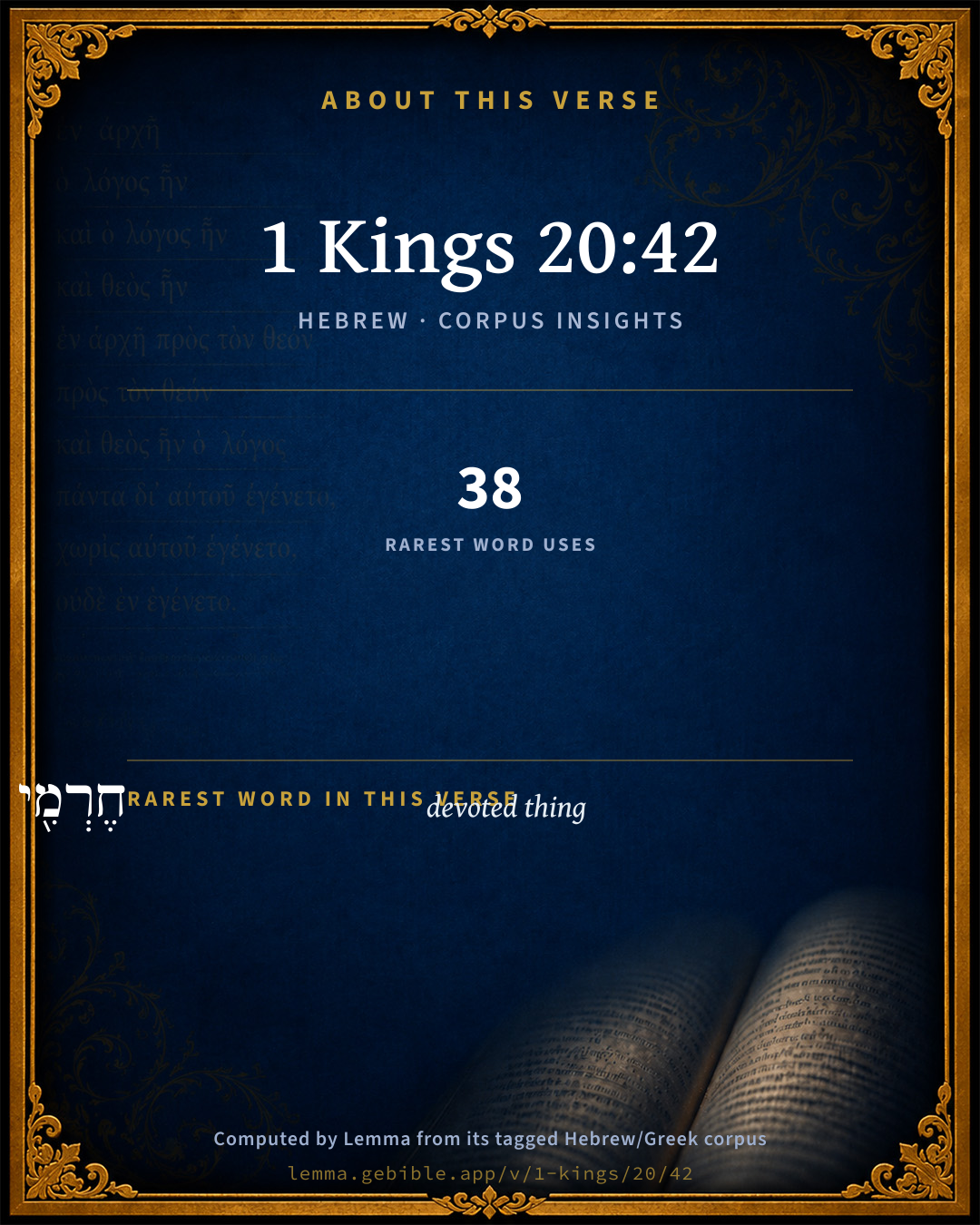
חֶרְמִ֖י
chêrem
H2764
“devoted thing · my”
Noun, Common, Masculine, Singular, Construct + Suffix, Personal, 1st Person, Common, Singular
Part of Speech
Noun
Type
Common
Gender
Masculine
Number
Singular
State
Construct
Full BDB Definition

Origin: from H2763

TWOT: 744a , 745a

a thing devoted, thing dedicated, ban, devotion - a net, thing perforated - have been utterly destroyed, (appointed to) utter destruction
  1. וַיֹּ֣אמֶר ʼâmar H559 “and · to say” Conjunction + Verb, Qal, Sequential Imperfect, 3rd Person, Masculine, Singular
  2. אֵלָ֗יו ʼêl H413 “to · him” Preposition + Suffix, Personal, 3rd Person, Masculine, Singular
  3. כֹּ֚ה kôh H3541 “thus” Adverb
  4. אָמַ֣ר ʼâmar H559 “to say” Verb, Qal, Perfect, 3rd Person, Masculine, Singular
  5. יְהוָ֔ה Yᵉhôvâh H3068 “LORD” Noun, Proper
  6. יַ֛עַן yaʻan H3282 “because” Conjunction
  7. שִׁלַּ֥חְתָּ shâlach H7971 “to send” Verb, Piel, Perfect, 2nd Person, Masculine, Singular
  8. אֶת ʼêth H853 “-” Particle, Direct Object
  9. אִישׁ ʼîysh H376 “man of” Noun, Common, Masculine, Singular, Construct
  10. מִיָּ֑ד yâd H3027 “from · hand” Preposition + Noun, Common, Both, Singular, Absolute
  11. וְהָיְתָ֤ה hâyâh H1961 “and · to be” Conjunction + Verb, Qal, Perfect, 3rd Person, Feminine, Singular
  12. נַפְשְׁךָ֙ nephesh H5315 “soul · your” Noun, Common, Both, Singular, Construct + Suffix, Personal, 2nd Person, Masculine, Singular
  13. תַּ֣חַת tachath H8478 “under” Preposition
  14. נַפְשׁ֔וֹ nephesh H5315 “soul · his” Noun, Common, Both, Singular, Construct + Suffix, Personal, 3rd Person, Masculine, Singular
  15. וְעַמְּךָ֖ ʻam H5971 “and · people · your” Conjunction + Noun, Common, Masculine, Singular, Construct + Suffix, Personal, 2nd Person, Masculine, Singular
  16. תַּ֥חַת tachath H8478 “under” Preposition
  17. עַמּֽוֹ ʻam H5971 “people · his” Noun, Common, Masculine, Singular, Construct + Suffix, Personal, 3rd Person, Masculine, Singular

About this verse

These counts appear in no published source. They are computed here, from the morphology-tagged text and Lemma’s own curated glosses. What Lemma adds →

18
words
14
distinct lemmas
Historical
section

Shared distinctive vocabulary

חֶרְמִ֖י devoted thing H2764 occurs in 31 verses of the Hebrew Bible. Also found in:

Grammatical profile

  • 4 verbs
  • 8 nouns
  • 3 prepositions
  • 1 conjunction
  • 1 adverb
  • 1 particle

Verb forms

  • וַיֹּ֣אמֶר Qal · Sequential Imperfect
  • אָמַ֣ר Qal · Perfect
  • שִׁלַּ֥חְתָּ Piel · Perfect
  • וְהָיְתָ֤ה Qal · Perfect

Repetition

Words recur within this verse — often emphatic in Hebrew:

  • וַיֹּ֣אמֶר to say H559 ×2
  • נַפְשְׁךָ֙ soul H5315 ×2
  • תַּ֣חַת under H8478 ×2
  • וְעַמְּךָ֖ people H5971 ×2

Cross-references

7

Topical passages linked to 1 Kings 20:42 in the Treasury of Scripture Knowledge — connected by theme and wording, ordered by reader-vote popularity; previews shown in the World English Bible.

  • 1 Kings 22:31–37 Now the king of Syria had commanded the thirty-two captains of his chariots, saying, Fight neither with small nor great, save only with the king of Israel.
  • 2 Chronicles 18:33–34 A certain man drew his bow at a venture, and struck the king of Israel between the joints of the armor. Therefore he said to the driver of the chariot, Turn your hand, and carry me out of the host; for I am sore wounded.
  • 1 Kings 20:39 As the king passed by, he cried to the king; and he said, Your servant went out into the midst of the battle; and, behold, a man turned aside, and brought a man to me, and said, Keep this man: if by any means he be missing, then shall your life be for his life, or else you shall pay a talent of silver.
  • 1 Samuel 15:9–11 But Saul and the people spared Agag, and the best of the sheep, and of the oxen, and of the fatlings, and the lambs, and all that was good, and wouldn't utterly destroy them: but everything that was vile and refuse, that they destroyed utterly.
  • 1 Kings 20:34 [Ben Hadad] said to him, The cities which my father took from your father I will restore; and you shall make streets for you in Damascus, as my father made in Samaria. I, [said Ahab], will let you go with this covenant. So he made a covenant with him, and let him go.
  • 2 Kings 6:24 It happened after this, that Benhadad king of Syria gathered all his host, and went up, and besieged Samaria.
  • 2 Kings 8:12 Hazael said, Why weeps my lord? He answered, Because I know the evil that you will do to the children of Israel: their strongholds will you set on fire, and their young men will you kill with the sword, and will dash in pieces their little ones, and rip up their women with child.

Cross-references courtesy of OpenBible.info (CC BY 4.0).

Hebrew and Greek witnesses Masoretic Hebrew ↔ Greek Septuagint

The same verse in the two great witnesses to the Old Testament, shown verse-for-verse.

These are two independent witnesses, not word-aligned to each other, and the Septuagint is shown in lemma (dictionary) form.

Hebrew 1 Kings 20:42 Masoretic · Westminster Leningrad Codex

וַיֹּ֣אמֶר אֵלָ֗יו כֹּ֚ה אָמַ֣ר יְהוָ֔ה יַ֛עַן שִׁלַּ֥חְתָּ אֶת אִישׁ חֶרְמִ֖י מִיָּ֑ד וְהָיְתָ֤ה נַפְשְׁךָ֙ תַּ֣חַת נַפְשׁ֔וֹ וְעַמְּךָ֖ תַּ֥חַת עַמּֽוֹ

He said to him, Thus says Yahweh, Because you have let go out of your hand the man whom I had devoted to destruction, therefore your life shall go for his life, and your people for his people.

World English Bible · Public Domain

Hebrew: Westminster Leningrad Codex (CC BY 4.0). Greek: Septuagint (public domain); English from a public-domain English Septuagint. How the Septuagint differs from the Hebrew →

Targum (Aramaic paraphrase)

1

The Targum is the ancient Jewish Aramaic paraphrase of the Hebrew Scriptures — an interpretive translation, not the Hebrew text itself. Onkelos (literal) and Pseudo-Jonathan (expansive) render the Torah, and Jonathan the Prophets. Coverage is partial: where no permissively-licensed English translation exists for a verse, only the Aramaic is shown. This is verse-level text, not a word-by-word alignment to the Hebrew.

  1. Targum Jonathan Prophets (Joshua–Malachi)
    וַאֲמַר לֵיהּ כִּדְנַן אֲמַר יְיָ חֲלַף דְשֵׁיזֵיבְתָּא יַת גְבַר דְחַיָב קְטוֹל מִיָד וּתְהֵי נַפְשָׁךְ חֲלַף נַפְשֵׁיהּ וְעַמָךְ חֲלַף עַמֵיהּ:

    (no public-domain English translation for this verse)

    Targum Jonathan — Aramaic: “Mikraot Gedolot” (public domain). English: “Sefaria Community Translation” (CC0 1.0 (public-domain dedication)); “London "Chaldee Paraphrase," 1871” (public domain). Text via Sefaria.

Commentary

Notes on 1 Kings 20:42 from classic Christian and Jewish commentators (each source and its license shown beneath its notes). The classic Christian expositions comment on the surrounding passage and are grouped to its opening verse, so a note may address several verses; the Jewish commentaries on the Tanakh (Rashi and others) are per-verse, so they appear only where the commentator wrote on this verse.

Lemma curates 59 commentaries, every one of them public domain or Creative Commons licensed, each selected and text-cleaned for this edition rather than reprinted as found. About our sources →

Trapp's Complete Commentary

John Trapp

1Ki 20:42 And he said unto him, Thus saith the LORD, Because thou hast let go out of [thy] hand a man whom I appointed to utter destruction, therefore thy life shall go for his life, and thy people for his people.

Ver. 42. A man whom I had appointed to utter destruction.] Heb., A man of mine accursing; such as was the king of Jericho, and his people, and afterwards Agag king of Amalek. {1Sa 15:33} He had vilified and blasphemed the God of Israel, {1Ki 20:28} and was therefore devoted to destruction. So was Julian the apostate, Chosroes king of Persia, Lucian the athiest, devoured by dogs, &c.

Therefore thy life shall go for his life.] Let princes and judges take heed by Ahab’s example, how they save the lives of such as by God’s law ought to die, of blasphemers especially. Ambrose, closing up the story of Ahab and Jezebel’s fearful end, saith, Fuge ergo, dives, eiusmodi exitum, &c. Shun Ahab’s sin, as thou desirest to shun Ahab’s end.

John Trapp, A Commentary or Exposition upon All the Books of the Old and New Testament (1647–1656) — public domain. Text from a community e-Sword module.

Joseph Benson's Commentary

1Ki 20:42. Thus saith the Lord, Because, &c. — “What was the great sin of Ahab in this action, for which God so severely punished him?” The great dishonour hereby done to God, in suffering so horrid a blasphemer to go unpunished, which was contrary to an express law, Lev 24:16. And God had delivered him into Ahab’s hand, for his blasphemy, as he promised to do, (1Ki 20:28,) by which act of his providence, compared with that law, it was most evident that this man was appointed by God to destruction. But Ahab was so far from punishing this blasphemer, that he did not so much as rebuke him, but dismissed him upon easy terms, and took not the least care for the reparation of God’s honour. And the people were punished for their own sins, which were many and great; though God took this occasion to inflict the punishment. The former part of this decree of God, Thy life shall go for his life, was fulfilled three years after, when Ahab was killed in a battle against the Syrians, 1Ki 22:1-40. But the latter, And thy people for his people, was deferred till the reign of Hazael, who fulfilled it by the wars he had with the Israelites, and the slaughter he made of them, 2Ki 10:32-33.

Joseph Benson's Commentary on the Old and New Testaments (1811–1818) — public domain. Text from a community e-Sword module.

Tyndale Open Study Notes

Tyndale Open Resources

20:42-43 The Lord had apparently told Ahab to put Ben-hadad to death (cp. Josh 6:17-21), but Ahab violated his charge, perhaps viewing the Aramean king as part of the spoils of war (cp. 1 Sam 15:1-23). The king of Israel would regret his folly: He later faced Ben-hadad in another battle that would cost him his life (1 Kgs 22:29-37). Rather than learning from the prophet’s rebuke, Ahab went home angry and sullen.

20:42 destroyed: See “Complete Destruction” Theme Note.

Tyndale Open Study Notes — © Tyndale Open Resources, licensed CC BY-SA 4.0. Text via the HelloAO Bible API.

Adam Clarke's Commentary

Verse 42. Thy life shall go for his life] This was fulfilled at the battle of Ramoth-gilead, where he was slain by the Syrians; see 1Kg 22:34-35.

Adam Clarke's Commentary on the Bible (1810–1826) — public domain. Text from a community e-Sword/MySword module.

Ellicott's Commentary for English Readers

(42) A man whom I appointed—properly, a man under my curse. The rash action of Ahab, like the deliberate disobedience of Saul (1 Samuel 15), may have been due partly to compassion, partly to weakness. In either case it had no right to stand unauthorised between God’s judgment and him on whom it was pronounced; for even soft-heartedness, as in the case of Eli, may be treason to the cause of righteousness. The prophet (like Elisha, in 2Ki_13:19) speaks partly as a patriot, jealous—and, as the event proved, with a sagacious jealousy—of the lenity which left the deadly enemy of Israel unsubdued; but he speaks also as the representative of God’s stern and righteous judgment. which Ahab, after signal deliverance, had treated as of no account. (For the fulfilment of his words, see 1Ki_22:34-36.)

A Bible Commentary for English Readers, edited by Charles John Ellicott (1878–1897) — public domain. Text from a community e-Sword module.

The Cambridge Bible for Schools and Colleges

gen. ed. J. J. S. Perowne

42. a man] R.V. the man. For the whole multitude, and of course the king above all, had been delivered into Ahab’s hand (see 1Ki_20:28), and the victory was to be an evidence that Jehovah had fought for Israel.

appointed to utter destruction] R.V. devoted to destruction. This was the purpose for which Ben-hadad had been brought into Ahab’s hand. The literal rendering is ‘the man of my banning’, whom I have laid under a ban. It is used Isa_34:5 ‘the people of my curse’.

The Cambridge Bible for Schools and Colleges (gen. ed. J. J. S. Perowne; Cambridge University Press, 1878–1918) — public domain. Text from a community e-Sword module.

John Gill's Exposition

And he said unto him, thus saith the Lord,.... He spake not his own sense, and in his own words, but in the name of the Lord, for which he had authority, that it might have the greater weight with Ahab:

because thou hast let go out of thy hand a man whom I appointed to utter destruction; meaning Benhadad; or "the man of my anathema or curse" (w); cursed of God for his blasphemy of him, and devoted by him to ruin on that account; or "of my net" (x), being by his providence brought into a net or noose at Aphek, out of which he could not have escaped, had not Ahab let him go:

therefore thy life shall go for his life; as it shortly did, and that by the hand of a Syrian soldier, Kg1 22:34,

and thy people for his people; which was fulfilled by Hazael king of Syria, the sins of Israel rendering them deserving of the calamities they endured by his means, see Kg2 8:12.

(w) "vir anathematis mei", Montanus, Piscator. (x) "Vir retis mei"; so some in Vatablus.

John Gill's Exposition of the Whole Bible (1746–1763) — public domain (CC PDM 1.0). Text via the HelloAO Bible API.

Albert Barnes' Notes on the Bible

A man whom I appointed to utter destruction - or to חרם chērem, i. e., a man on whom My curse had been laid (Lev 27:28 note).

Albert Barnes' Notes on the Bible (1834–1885) — public domain. Text from a community e-Sword/MySword module.

Haydock's Catholic Bible Commentary

Worthy. Hebrew, "of my anathema;" or, "the man who has fallen into my snares." (Vatable) Cherem is taken in this sense, Micheas vii. 2., &c. He was my prey, and you ought not to have disposed of him without my leave. (Calmet) --- People. This was verified (chap. xxii.; Menochius) within three years. (Salien)

George Leo Haydock (1774–1849), Haydock's Catholic Family Bible and Commentary, 1859 edition — public domain. Excludes Psalms (Douay-Rheims chapter numbering differs from Protestant) and Deuterocanonical books (Catholic canon only).

Matthew Poole's English Annotations

Quest. What was the great sin of Ahab in this action for which God so severely punisheth him?

Answ. The great dishonour hereby done to God in suffering so horrid a blasphemer, 1Ki 20:23, to go unpunished, which was, contrary to an express law, Lev 24:16.

Object. What is this to Ben-hadad, seeing that law concerned Israelites only?

Answ. It reached both to them that were born in the land, and (as is there expressed) unto strangers that were among them, and in their power, which was Ben-hadad’s case; for God had delivered him into Ahab’s hand for his blasphemy, as he promised to do, 1Ki 20:28, by which act of his providence, especially compared with that law, it was most evident that this man was appointed by God to destruction, as is here said. But Ahab was so far from punishing this blasphemer, that he doth not so much as rebuke him, but treats him like a friend and a brother; dismisseth him upon easy terms, and takes his word for the performance, and takes not the least care for the reparation of God’s honour, but only for the amplification of his own power.

Thy people for his people.

Quest. Why were the people punished for Ahab’s sin?

Answ. 1. Because Ahab was punished in the loss of his people.

2. The people were punished for their own sins, which were many and great; though God took this occasion to inflict it.

3. The great injury and mischief was hereby done to his own people, who by this most foolish and wicked act were exposed to all those rapines and slaughters which Ben-hadad either did commit, or might have committed, against them afterwards; of which consequently Ahab was guilty. And it must be considered that all the Israelites were the Lord’s peculiar people; nor did their apostacy from God deprive God of his right; and the kings of Israel and Judah had these committed to them, in way of trust, to be governed and protected by them. And therefore Ahab for this gross breach of his trust was justly liable, though not to the censures of his people, yet to the hand of God, who was his King and Governor.

Matthew Poole's English Annotations on the Holy Bible (1683–1685) — public domain. Text from a community e-Sword/MySword module.

Whedon's Commentary on the Bible

Daniel D. Whedon

42. A man whom I appointed to utter destruction — Literally, the man of my curse: that is, Ben-hadad, whom God had in judgment devoted to destruction. Compare Lev_27:29.

Daniel D. Whedon (gen. ed.), Commentary on the Old and New Testaments (1874–1909) — public domain. Text from a community e-Sword module.

The Pulpit Commentary

And he said onto him. Thus saith the lord, Because thou hast let go Heb. sent away; same word as in ver; 34. This is an in direct proof that those were the words of Ahab out of thy hand Heb. out of hand same idiom in 1Sa_26:23 i.e., power, possession. (Cf. Gen_32:12; Exo_18:9; Num_35:25) a man whom I appointed to utter destruction Heb. a man of my devoting. Cf. Isa_34:5; Zec_14:11. It is the word used of the Canaanites and their cities, Deu_2:34 Deu_7:2; Jos_8:26 Jos_10:28; and it gave a name to the city Hormah,, Num_21:3 Num_14:45. Ben-hadad, therefore, was doomed of God therefore thy life shall go for Heb. be instead of his life, and thy people for his people. By the lex talionis. It was probably because of this denunciation (cf. 1Ki_22:8) that Josephus identifies this prophet with Micaiah, the son of Imlah, "whom Ahab appears to have imprisoned on account of some threatening prophecy (Rawlinson). See 1Ki_22:9, 1Ki_22:26. For the fulfilment o! this prediction see ch. 22. It has seemed to some writers as if Ahab were here very hardly dealt with for merely gratifying s generous impulse, and dealing magnanimously with a conquered foe. Indeed, there are commentators who see in his release of the cruel and insolent tyrant s "trait which does honour to the heart of Ahab." But it is to be remembered, first, that Ahab was not free to do as he liked in this matter. His victories had been won, not by his prowess, by the skill of his generals, or the valour of his soldiers, but by the power of God alone. The war, that is to say, was God"s war: it was begun and continued, and should therefore have been ended, in Him. When even the details of the attack had been ordered of God (ver. 14), surely He should have been consulted as to the disposal of the prisoners. The prophet who promised Divine aid might at any rate have been asked as prophets constantly were in that age (1Ki_22:5, 1Ki_22:8) what was the "word of the Lord" concerning Israel"s overbearing and inveterate enemy. But Ahab, who had himself played so craven a part (vers. 21, 31), and who had contributed nothing to these great and unhoped-for victories, nevertheless arrogated to himself their fruits, and thereby ignored and dishonoured God. Secondly, if he had so little regard for his own private interests as to liberate such a man as Ben-hadad, he ought, as trustee for the peace and welfare of Israel, to have acted differently. The demand of ver. 6 should have revealed to him the character of the man he had to deal with. And lastly, he was acting in defiance of all the principles and precedents of the Old Testament dispensation. For one great principle of that dispensation was the lex talionis. The king was the authorized dispenser of rewards and punishments, not only to wicked subjects but to aggressive nations. It was his duty to mete out to them the measure they had served to Israel. And the precedents were all in favour of putting such wretches as this Ben-hadad to the sword (Jos_10:26; Jud_1:7:25; 1Sa_15:33) If he had been the first oppressor who fell into the hands of Israel, Ahab might have had some excuse. But with the fate of Agog, of Adonibezek, of Oreb and Zeeb, in his memory, he ought at any rate to have paused and asked counsel of God before taking Ben-hadad into his chariot and sending him away with a covenant of peace, to reappear at no distant period on the scene as the scourge of the Lord"s people.

The Pulpit Commentary (1880–1919), ed. H.D.M. Spence-Jones & Joseph S. Exell — public domain. Text from a community e-Sword module.

John Wesley's Explanatory Notes

Thy life - "What was the great sin of Ahab in this action, for which God so severely punisheth him?" The great dishonour hereby done to God, in suffering so horrid a blasphemer, to go unpunished, which was contrary to an express law, Lev. xxiv, 16. And God had delivered him into Ahab's hand, for his blasphemy, as he promised to do, ver. 28, by which act of his providence, compared with that law, it was most evident, that this man was appointed by God to destruction, but Ahab was so far from punishing this blasphemer, that he doth not so much as rebuke him, but dismisseth him upon easy terms, and takes not the least care for the reparation of God's honour, and the people were punished for their own sins, which were many, and great; though God took this occasion to inflict it.

John Wesley, Explanatory Notes Upon the Whole Bible (1754–1765) — public domain. Text via the GEBible commentary corpus.

Rashi

Rabbi Shlomo Yitzchaki (Rashi)

The man whom I condemned. איש חרמי means “the man of My war,” an expression of strife. An expression of strife [חרם] can be applied to war, and similarly, “on Edom it will descend and on the nation with whom I war [חרמי]. The Midrash Aggadah [states], “Many traps and nets [חרמים] have I spread for you until he fell into your hand.”

Rashi on the Tanakh — English translations: “The Judaica Press complete Tanach with Rashi, translated by A. J. Rosenberg” (CC BY 4.0); “Pentateuch with Rashi's commentary by M. Rosenbaum and A.M. Silbermann, 1929-1934” (public domain); “The Metsudah Tanach series, Lakewood, N.J” (CC BY 4.0); and “The Book of Joshua, Metsudah Publications, 1997” (CC BY 4.0). Text via Sefaria.

Lesson kit

Teaching starters — assembled from the data on this page, not authored interpretation. Every prompt links to the verse data it draws on. Edit before teaching.

1 Kings, in the Historical, opens this verse with 18 words (14 distinct Hebrew lemmas). Its most distinctive word is chêrem (“devoted thing”). A historical commentator’s framing appears above. Read the whole chapter for the surrounding context.

Discussion questions

  1. How does “devoted thing” (chêrem) shape what this verse is saying?
  2. How does Leviticus 27:21, which shares the word «devoted thing», read alongside this verse?
  3. What does the repetition of “to say” (2× in this one verse) do in this verse?
  4. These translations render this verse differently. What is at stake in choosing one wording over another?
  5. «וַיֹּ֣אמֶר» is a Qal Sequential Imperfect verb. How does that grammatical form shape the action described?
  6. Compare how Trapp's Complete Commentary and Joseph Benson's Commentary read this verse. Where do they agree or differ?

Things to notice

Reading settings

Reading text

Shown beneath each verse's original-language words.

Old Testament
Old Testament edition

Read the OT as the Masoretic Hebrew (MT) or the Greek Septuagint (LXX).

English shown for the Greek Septuagint (in the Hebrew ↔ Greek comparison).

Comparing translations? Open the Compare panel on any verse page to stack up to four side by side.