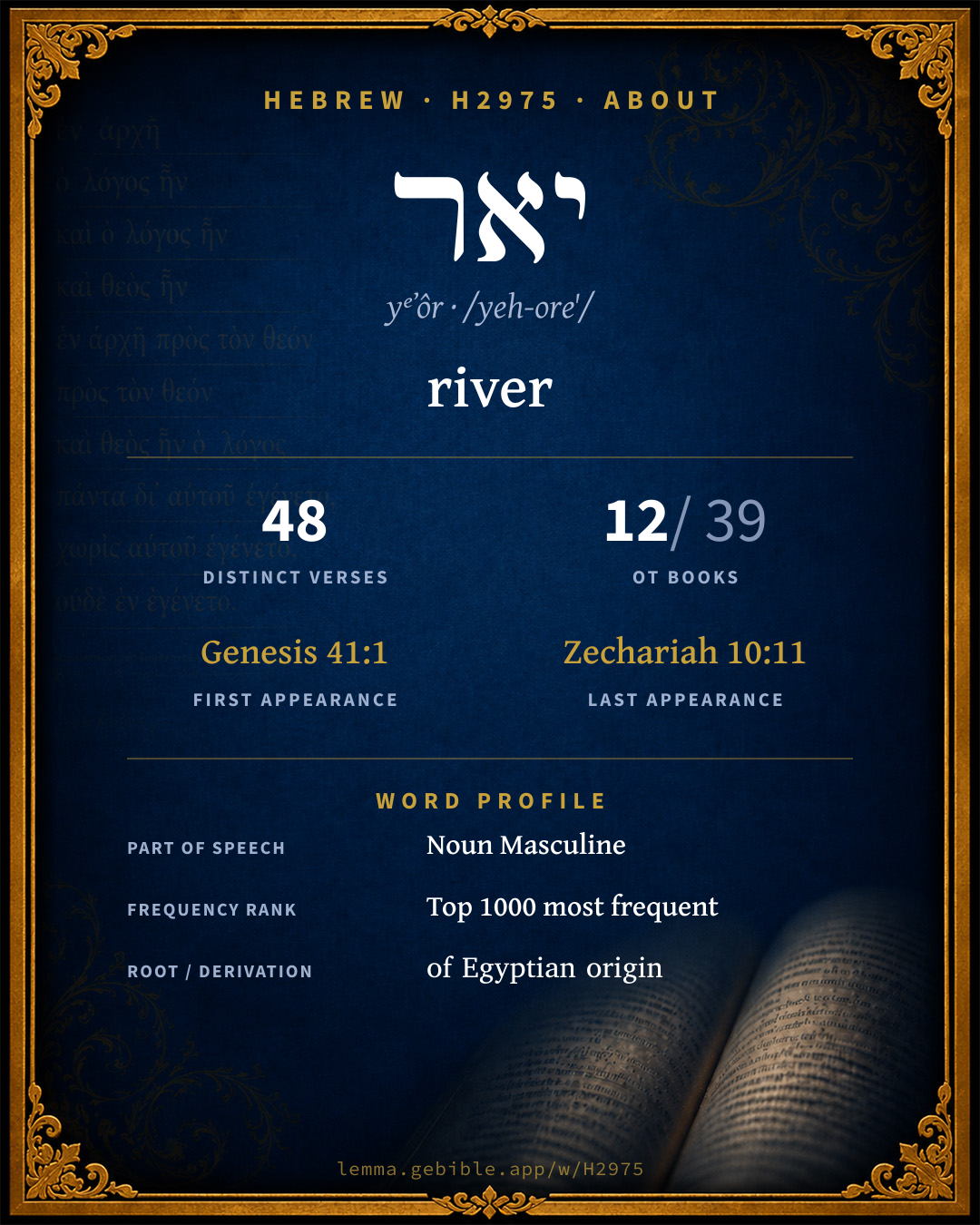
יְאֹר
river
also: stream, canal, Nile, Nile-canal fuller range ↓
Full lexicon entry — Brown-Driver-Briggs (BDB)
From Brown-Driver-Briggs (BDB)
Where this word appears
See every Absolute-state word in the Hebrew Bible →
Grammar key — what these labels mean
Part of speech
- Noun
- A naming word — a person, place, thing, or idea.
Noun type
- Proper
- A name of a specific person, place, or people (e.g. Abraham, Zion, Israel).
- Common
- A common noun — a general class of person, place, or thing (“king,” “city,” “water”), not a specific name.
State
- Construct
- A noun bound to a following noun in a possessive / “of” relationship (the construct chain).
- Absolute
- The independent form of a noun, not bound to a following word.
Gender
- Masculine
- Grammatically masculine.
Number
- Plural
- More than one (in Hebrew, generally three or more).
- Singular
- One.
Every verse where H2975 appears in the Book of Exodus — 17 distinct verses. Click any verse to open its interlinear word-by-word view. Verse text shown in the World English Bible for context — . Each verse’s Hebrew form is shown with its reference; the English is not keyword-highlighted, since the data carries no word-level English alignment. Use “Compare translations” on any verse to read it across multiple English versions. This concordance covers the Hebrew Bible; Septuagint (Greek Old Testament) occurrences are not indexed here.
Exodus
- Exodus 1:22 הַ/יְאֹ֨רָ/ה֙ ptcl def.art + n Proper + sfx dem Pharaoh charged all his people, saying, "You shall cast every son who is born into the river, and every daughter you shall save alive."
- Exodus 2:3 הַ/יְאֹֽר ptcl def.art + n Proper When she could no longer hide him, she took a papyrus basket for him, and coated it with tar and with pitch. She put the child in it, and laid it in the reeds by the river's bank.
- Exodus 2:5 הַ/יְאֹ֔ר הַ/יְאֹ֑ר ptcl def.art + n Proper ptcl def.art + n Proper Pharaoh's daughter came down to bathe at the river. Her maidens walked along by the riverside. She saw the basket among the reeds, and sent her handmaid to get it.
- Exodus 4:9 הַ/יְאֹ֔ר הַ/יְאֹ֔ר ptcl def.art + n Proper ptcl def.art + n Proper It will happen, if they will not believe even these two signs, neither listen to your voice, that you shall take of the water of the river, and pour it on the dry land. The water which you take out of the river will become blood on the dry land."
- Exodus 7:15 הַ/יְאֹ֑ר ptcl def.art + n Proper Go to Pharaoh in the morning. Behold, he goes out to the water; and you shall stand by the river's bank to meet him; and the rod which was turned to a serpent you shall take in your hand.
- Exodus 7:17 בַּ/יְאֹ֖ר prep det + n Proper Thus says Yahweh, "In this you shall know that I am Yahweh. Behold, I will strike with the rod that is in my hand on the waters which are in the river, and they shall be turned to blood.
- Exodus 7:18 בַּ/יְאֹ֛ר הַ/יְאֹ֑ר הַ/יְאֹֽר prep det + n Proper ptcl def.art + n Proper ptcl def.art + n Proper The fish that are in the river shall die, and the river shall become foul; and the Egyptians shall loathe to drink water from the river."'"
- Exodus 7:19 יְאֹרֵי/הֶ֣ם n c mp cs + sfx pers 3mp Yahweh said to Moses, "Tell Aaron, 'Take your rod, and stretch out your hand over the waters of Egypt, over their rivers, over their streams, and over their pools, and over all their ponds of water, that they may become blood; and there shall be blood throughout all the land of Egypt, both in vessels of wood and in vessels of stone.'"
- Exodus 7:20 בַּ/יְאֹ֔ר בַּ/יְאֹ֖ר prep det + n Proper prep det + n Proper Moses and Aaron did so, as Yahweh commanded; and he lifted up the rod, and struck the waters that were in the river, in the sight of Pharaoh, and in the sight of his servants; and all the waters that were in the river were turned to blood.
- Exodus 7:21 בַּ/יְאֹ֥ר הַ/יְאֹ֔ר הַ/יְאֹ֑ר prep det + n Proper ptcl def.art + n Proper ptcl def.art + n Proper The fish that were in the river died; and the river became foul, and the Egyptians couldn't drink water from the river; and the blood was throughout all the land of Egypt.
- Exodus 7:24 הַ/יְאֹ֖ר הַ/יְאֹֽר ptcl def.art + n Proper ptcl def.art + n Proper All the Egyptians dug round about the river for water to drink; for they couldn't drink of the water of the river.
- Exodus 7:25 הַ/יְאֹֽר ptcl def.art + n Proper Seven days were fulfilled, after Yahweh had struck the river.
- Exodus 8:3 הַ/יְאֹר֮ ptcl def.art + n Proper and the river shall swarm with frogs, which shall go up and come into your house, and into your bedchamber, and on your bed, and into the house of your servants, and on your people, and into your ovens, and into your kneading-troughs:
- Exodus 8:5 הַ/יְאֹרִ֖ים ptcl def.art + n c mp Yahweh said to Moses, "Tell Aaron, 'Stretch forth your hand with your rod over the rivers, over the streams, and over the pools, and cause frogs to come up on the land of Egypt.'"
- Exodus 8:9 בַּ/יְאֹ֖ר prep det + n Proper Moses said to Pharaoh, "I give you the honor of setting the time that I should pray for you, and for your servants, and for your people, that the frogs be destroyed from you and your houses, and remain in the river only."
- Exodus 8:11 בַּ/יְאֹ֖ר prep det + n Proper The frogs shall depart from you, and from your houses, and from your servants, and from your people. They shall remain in the river only."
- Exodus 17:5 הַ/יְאֹ֔ר ptcl def.art + n Proper Yahweh said to Moses, "Walk on before the people, and take the elders of Israel with you, and take the rod in your hand with which you struck the Nile, and go.
About this entry
At a glance — auto-summarized from this page’s data, not written by a person. Every figure links to its source below. This summary describes the numbers; it doesn’t interpret them.
At its core, יאר (yᵉʼôr) means “river.” The King James Version usually renders it “river,” while modern versions prefer “nile” (Berean Standard Bible) — see the renderings breakdown. With 48 verses in 12 books, it is a moderately common word in the Hebrew Bible. Its uses concentrate in Exodus (35% of all occurrences). Beyond its headline sense, its full sense range takes in “stream”, “canal”, and “Nile”. Each statement above links to its evidence; the full detail follows below.
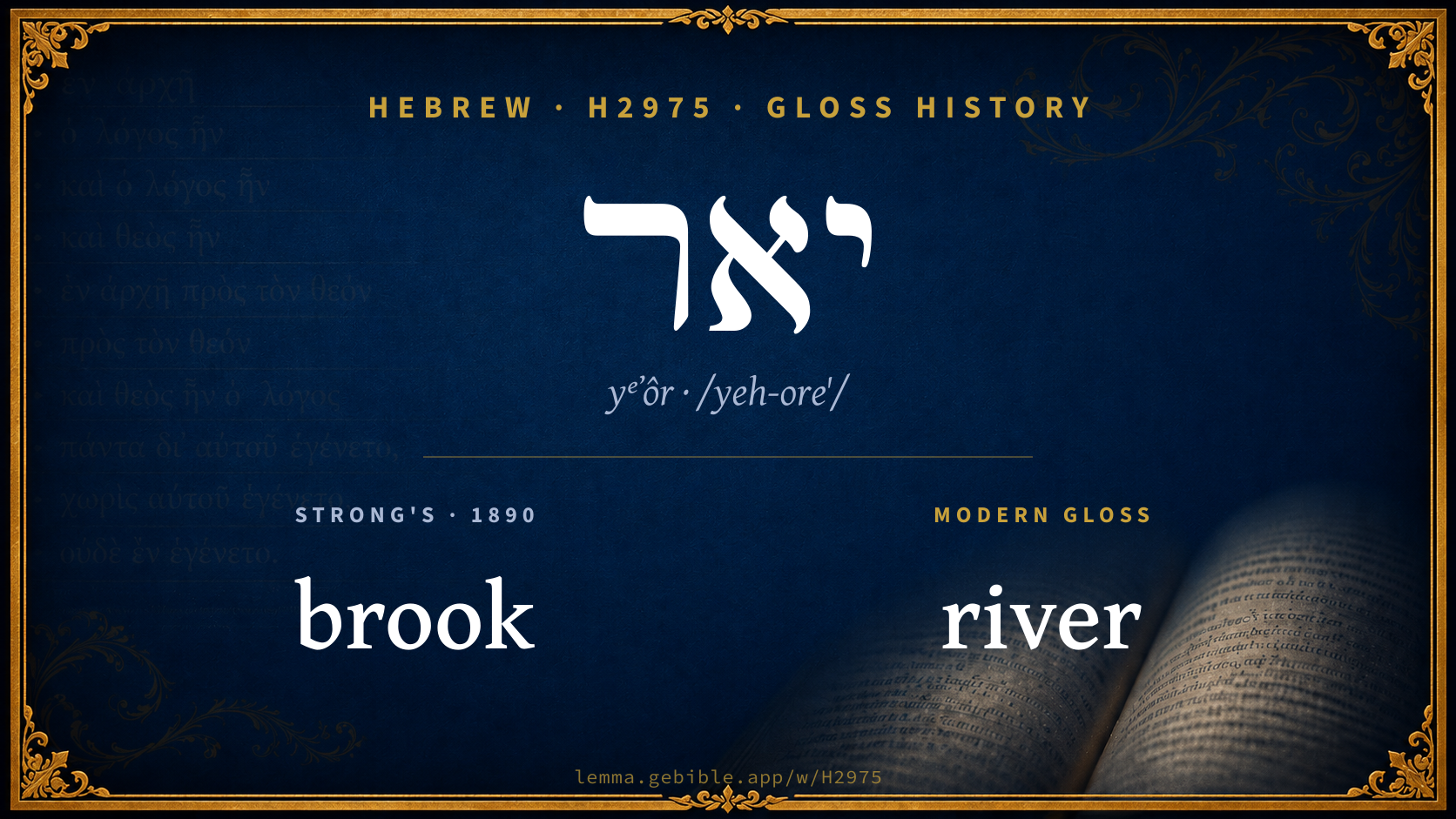
Gloss history
Strong's 1890 vs modern scholarship
About this word
Strong's H2975 catalogs a Hebrew word from the Hebrew Old Testament.
These counts are not copied from any lexicon or concordance. They are computed here, from the morphology-tagged Hebrew Old Testament. What Lemma adds →
- 48
- distinct verses
- The word appears in 48 distinct verses.
- 12 / 39
- OT books
- The word appears in 12 of 39 Old Testament books.
- #597
- by frequency
- Top 1000 most frequent Hebrew words (rank 597 of 8,640 Hebrew words by occurrence).
View all 48 occurrences in the concordance →
By section of the Old Testament
By traditional corpus
Conventional, traditional groupings — biblical authorship is debated, so this is a traditional corpus grouping, not an authorship claim. Each share is this word’s portion of its verses in that division of the Hebrew canon. Each figure is a share of the word’s 48 distinct verses.
- Torah (Pentateuch) 22 verses · 46%
- Prophets (Nevi'im) 21 verses · 44%
- Writings (Ketuvim) 5 verses · 10%
How translations render this word
Counts come from each version’s own published word-to-Strong’s tagging or interlinear alignment — an approximate guide to how each version renders this word, not a word-level alignment the data otherwise carries. Because each total is that version’s own tagged count, the per-version totals vary from one another and need not match the appearance or distinct-verse counts above. These counts may also differ from a printed concordance because Lemma counts each distinctly tagged rendering and does not collapse phrase taggings into a single head-word total. This is a fixed set of word-tagged versions (KJV, ASV, BSB, ULT) and does not change with the reading translation you choose elsewhere. Each version’s license is shown beside its name below (and on Sources).
- King James Version: River 29×, Rivers 10×, Brooks 5×
- American Standard Version: River 23×, Rivers 8×, Nile 6×
- Berean Standard Bible: Nile 25×, River 10×, Streams 8×
- unfoldingWord Literal Text: River 33×, Nile 7×, Stream 4×
King James Version Public Domain
Renders H2975 across 64 tagged occurrences — most commonly:
Plus 14 renderings that appear only once — usually multi-word phrases or single function words the recovered tagging swept in, not distinct renderings.
American Standard Version Public Domain
Renders H2975 across 65 tagged occurrences — most commonly:
Plus 14 renderings that appear only once — usually multi-word phrases or single function words the recovered tagging swept in, not distinct renderings.
Berean Standard Bible Public Domain
Renders H2975 across 62 tagged occurrences — most commonly:
Plus 4 renderings that appear only once — usually multi-word phrases or single function words the recovered tagging swept in, not distinct renderings. Not rendered by a distinct English word in 3 further occurrences.
unfoldingWord Literal Text CC BY-SA 4.0
Renders H2975 across 66 tagged occurrences — most commonly:
Plus 10 renderings that appear only once — usually multi-word phrases or single function words the recovered tagging swept in, not distinct renderings.
Senses in the full BDB
What do BDB’s symbols mean?
BDB uses these scholarly abbreviations:
| Symbol | Meaning |
|---|---|
| 𝔊 | the Septuagint (the ancient Greek translation, LXX) |
| 𝔙 | the Vulgate (the Latin translation) |
| 𝔖 | the Syriac version (the Peshitta) |
| 𝔗 | the Targum (the Aramaic translation) |
| ψ | the Psalms |
| √ | root (the underlying root or stem) |
| ‖ | parallel passage (a synonymous or contrasted parallel) |
| † | the dagger: every passage where the word occurs is cited |
The 6 senses and sub-senses the full Brown-Driver-Briggs lexicon distinguishes for this word, in lexicon order (not ranked by frequency), with BDB’s own verbatim wording and sub-sense lettering. Shown in Hebrew script with BDB’s own scholarly abbreviations. The condensed entry is in the Lexicon Entry tab. See also the Forms in the corpus table below.
- 1. stream of the Nile, river Nile, usually c. art. Gn 41:1, 2, 3(×2), 17, 18 Ex 1:22; 2:3, 5(×2); 4:9(×2); 7:15, 17, 18(×3), 20(×2), 21(×3), 24(×2), 28; 8:5, 7; 17:5 (all JE), Am 8:8; 9:5 Is 19:7(×3), 8; 23:3 (‖ שִׁחֹר), v 10 Je 46:7, 8 (sim. of Egyptian invasion), Ez 29:3b (read יאר, v. supr.), v 9 Zc 10:11; more fully יְאֹר מִצְרַיִם Am 8:8; 9:5. e.g. Genesis 41:1
- 2. pl.:
- a. 3, יְאֹרֵי מִצְרַים Is 7:18; יְאֹרֵי מָצוֹר 19:6 (‖ נְהָרוֹת), 37:25 = 2 K 19:24; v. also Na 3:8 Ex 7:19; 8:1 (both P; ‖ נְהָרֹת, אֲגַמִּים etc.), ψ 78:44 (‖ נֹזְלִים), Ez 29:3, 4(×2), 5, 10 + v 4 MT (but del. 𝔊 Co), 30:12. e.g. Isaiah 7:18
- b. watercourses in gen., יְאֹרִים רַחֲבֵי יָדָ֑יִם Is 33:21 (‖ נְהָרִים; cf. NH יְאוֹר, late Aramaic יְאוֹרָא). e.g. Isaiah 33:21
- 3. shafts, made in mining Jb 28:10 (בַּצּוּרוֹת). e.g. Job 28:10
- 4. יְאֹר, sg., of Tigris, Dn 12:5(×2), 6, 7 (cf. 10:4). e.g. Daniel 12:5
Senses from the full Brown-Driver-Briggs lexicon (Brown, Driver, Briggs; Oxford 1906 — public domain), digitized via Sefaria, supplemented by the OpenScriptures HebrewLexicon (CC BY 4.0). Full attribution on Sources.
Word origin
n.m. Ex 7:21 stream of the Nile, stream, canal (Egyptian loan-word = Egyptian ’iotr, ’ioʾr, watercourse, Copt. eioor, ior; also ’iotrʿo, ’io’rʿo, Copt. eiero, iaro, Nile, SteindorffBAs i. 612; in Assyrian i̯a’uru, stream, ’Iaruʾû, river Nile, Id.ib., Hptib. 171 Jägerib 466)—abs. הַיְאֹר Gn 41:1 + 37 times; הַיְאוֹר Is 19:8; הַיְ֫אֹרָה Ex 1:22; יְאוֹר Is 19:7(×3) + 2 times; כָּאֹר (error for כַּיְאֹר) Am 8:8; cstr. כִּיאֹר Am 9:5; כִּיאוֹר Am 8:8; sf. יְאֹרִי Ez 29:3 b (Co יאר, cf. v 9 and 𝔖 𝔗); pl. יְאֹרִים Ex 8:1 + 4 times; cstr. יְאֹרֵי Is 7:18 + 2 times; יְאוֹרֵי 2 K 19:24; sf. יְאֹרֶיךָ Ez 29:4(×2), 5 + v 4 (del. 𝔊 Co) + 29:10 (Co יְאֹרְךָ); יְאֹרָיו Ez 29:3; יְאֹרֵיהֶם Ex 7:19 ψ 78:44;—
— Brown-Driver-Briggs (Oxford 1906, public domain), digitized via Sefaria, supplemented by the OpenScriptures HebrewLexicon (CC BY 4.0). See Sources.
Origin: of Egyptian origin
Forms in the corpus
The 38 distinct written forms H2975 takes in the Hebrew Bible, most frequent first — each parse links to that state’s occurrences in the concordance. Hebrew forms include their vowel points and cantillation, so a single lemma takes many written forms.
Septuagint verse parallels
This word appears in 47 verses that also exist in the Greek Old Testament (Septuagint), out of the 48 Hebrew verses it occurs in. You can read those verses in Greek by switching the Old Testament edition to the Septuagint.
Read these verses in the Septuagint
- Genesis 41:1
- Exodus 1:22
- 2 Kings 19:24
- Job 28:10
- Isaiah 7:18
- Jeremiah 46:7
- Ezekiel 29:3
- Daniel 12:5
- Amos 8:8
- Nahum 3:8
- Zechariah 10:11
This is a verse-level parallel only — the same verses exist in both the Hebrew and Greek Old Testaments. No word-level Hebrew↔Greek correspondence is claimed: the data carries no such alignment, so no Greek word is shown as this Hebrew word’s translation. Coverage is not total — the Septuagint omits the deuterocanon and renumbers the Psalms, so some Hebrew verses have no direct Greek parallel.