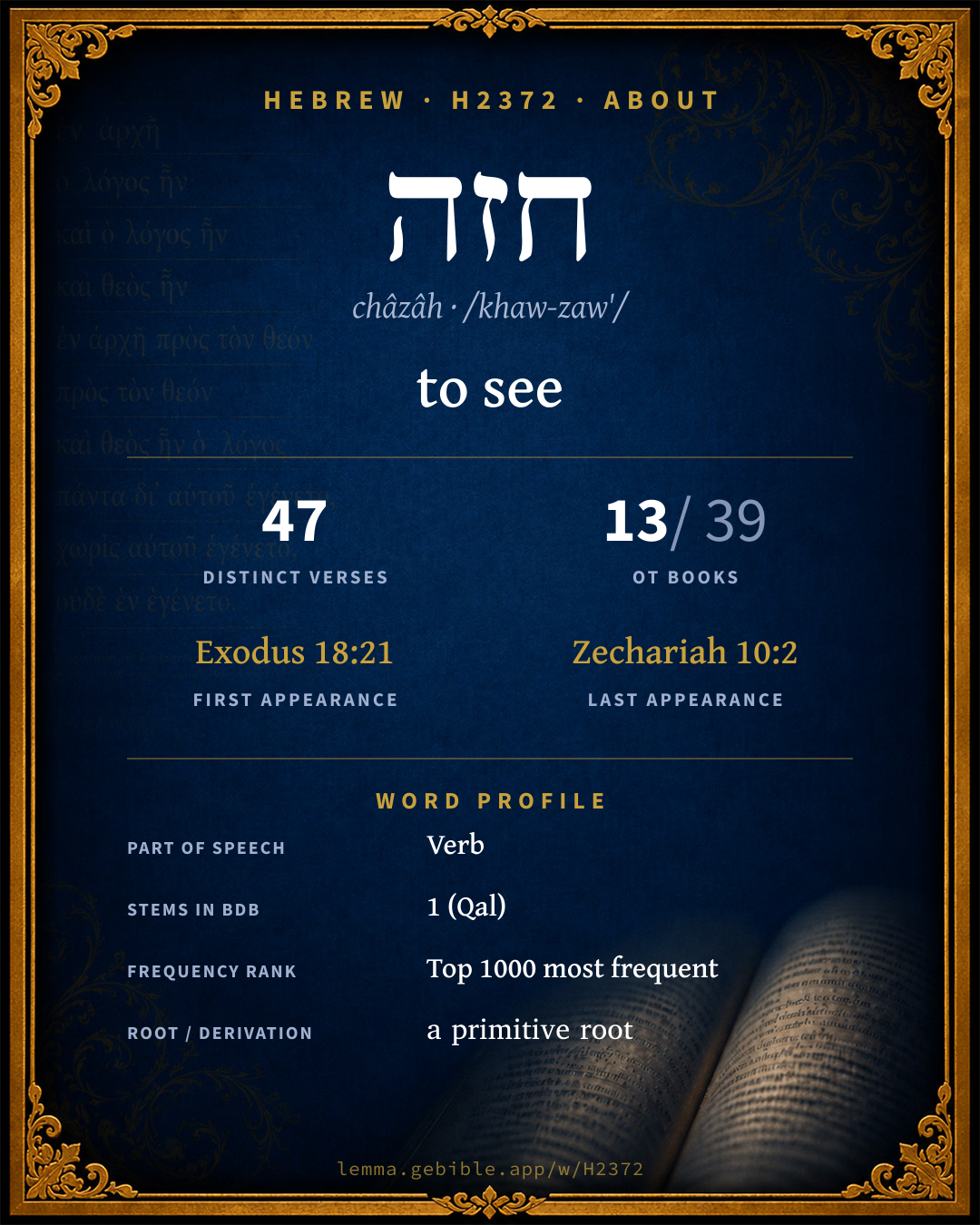
חָזָה
to see
also: perceive, look, behold, prophesy fuller range ↓
Full lexicon entry — Brown-Driver-Briggs (BDB)
From Brown-Driver-Briggs (BDB)
Where this word appears
Grammar key — what these labels mean
Part of speech
- Verb
- An action or state-of-being word.
Stem
- Qal
- The basic, simple active stem — the plain form of the verb (“he wrote”). Here: ‘see’
Form
- Perfect
- A completed action or state — Hebrew marks aspect (completeness) more than strict tense (“he wrote”).
- Imperfect
- An incomplete, ongoing, or future action (“he will / would write”).
- Sequential Imperfect
- An imperfect with prefixed waw — the standard past-narrative form (waw-consecutive imperfect).
- Infinitive Construct
- A bound verbal noun, frequently with prepositions (“to write / in writing”).
- Imperative
- A direct command (“write!”).
- Jussive
- A third- or second-person volitional form expressing wish or command (“let him write”).
- Cohortative
- A first-person volitional form expressing wish or resolve (“let me / let us write”).
- Participle Active
- A verbal adjective expressing ongoing or characteristic action (“writing / one who writes”).
State
- Absolute
- The independent form of a noun, not bound to a following word.
Person
- 3rd Person
- The one spoken about (“he / she / it / they”).
- 1st Person
- The speaker (“I / we”).
- 2nd Person
- The one addressed (“you”).
Gender
- Masculine
- Grammatically masculine.
- Common
- Either gender — not distinguished for this form.
- Feminine
- Grammatically feminine.
Number
- Singular
- One.
- Plural
- More than one (in Hebrew, generally three or more).
Grammatical forms 22 distinct
- Verb, Qal, Perfect, 3rd Person, Masculine, Singular 7 times (14%)
- Verb, Qal, Perfect, 3rd Person, Common, Plural 6 times (12%)
- Verb, Qal, Imperfect, 1st Person, Common, Singular 4 times (8%)
- Verb, Qal, Imperfect, 3rd Person, Masculine, Plural 4 times (8%)
- Verb, Qal, Imperfect, 3rd Person, Masculine, Singular 3 times (6%)
- Verb, Qal, Perfect, 2nd Person, Masculine, Plural 3 times (6%)
- Verb, Qal, Sequential Imperfect, 3rd Person, Masculine, Plural 2 times (4%)
- Verb, Qal, Infinitive Construct 2 times (4%)
+14 more forms (20 occurrences)
Parsed forms decoded from the imported morphology (morphhb / Westminster Leningrad Codex — WLC text public domain, morphhb tagging CC BY 4.0), counted across 51 parsed occurrences — not distinct verses.
Every verse where H2372 appears — 47 distinct verses across 13 books. Click any verse to open its interlinear word-by-word view. Verse text shown in the World English Bible for context — . Each verse’s Hebrew form is shown with its reference; the English is not keyword-highlighted, since the data carries no word-level English alignment. Use “Compare translations” on any verse to read it across multiple English versions. This concordance covers the Hebrew Bible; Septuagint (Greek Old Testament) occurrences are not indexed here.
Exodus 2 verses
- Exodus 18:21 תֶחֱזֶ֣ה Qal impf 2ms Moreover you shall provide out of all the people able men, such as fear God: men of truth, hating unjust gain; and place such over them, to be rulers of thousands, rulers of hundreds, rulers of fifties, and rulers of tens.
- Exodus 24:11 וַֽ/יֶּחֱזוּ֙ conj + Qal wimpf 3mp He didn't lay his hand on the nobles of the children of Israel. They saw God, and ate and drank.
Numbers 2 verses
- Numbers 24:4 יֶֽחֱזֶ֔ה Qal impf 3ms He says, who hears the words of God, Who sees the vision of the Almighty, Falling down, and having his eyes open:
- Numbers 24:16 יֶֽחֱזֶ֔ה Qal impf 3ms He says, who hears the words of God, Knows the knowledge of the Most High, Who sees the vision of the Almighty, Falling down, and having his eyes open:
Job 9 verses
- Job 8:17 יֶחֱזֶֽה Qal impf 3ms His roots are wrapped around the rock pile, He sees the place of stones.
- Job 15:17 חָ֝זִ֗יתִי Qal pf 1cs "I will show you, listen to me; That which I have seen I will declare:
- Job 19:26 אֶֽחֱזֶ֥ה Qal impf 1cs After my skin is destroyed, Then in my flesh shall I see God,
- Job 19:27 אֶֽחֱזֶה Qal impf 1cs Whom I, even I, shall see on my side. My eyes shall see, and not as a stranger. "My heart is consumed within me.
- Job 23:9 אָ֑חַז Qal impf 1cs He works to the north, but I can't see him; He turns south, but I can't catch a glimpse of him.
- Job 24:1 חָ֥זוּ Qal pf 3cp "Why aren't times laid up by the Almighty? Why don't those who know him see his days?
- Job 27:12 חֲזִיתֶ֑ם Qal pf 2mp Behold, all of you have seen it yourselves; Why then have you become altogether vain?
- Job 34:32 אֶ֭חֱזֶה Qal impf 1cs Teach me that which I don't see. If I have done iniquity, I will do it no more'?
- Job 36:25 חָֽזוּ Qal pf 3cp All men have looked thereon. Man sees it afar off.
Psalms 9 verses
- Psalms 11:4 יֶחֱז֑וּ Qal impf 3mp Yahweh is in his holy temple. Yahweh is on his throne in heaven. His eyes observe. His eyes examine the children of men.
- Psalms 11:7 יֶחֱז֥וּ Qal impf 3mp For Yahweh is righteous. He loves righteousness. The upright shall see his face.
- Psalms 17:2 תֶּחֱזֶ֥ינָה Qal impf 3fp Let my sentence come forth from your presence; Let your eyes look on equity.
- Psalms 17:15 אֶחֱזֶ֣ה Qal coh 1cs As for me, I shall see your face in righteousness; I shall be satisfied, when I awake, with seeing your form.
- Psalms 27:4 לַ/חֲז֥וֹת prep + Qal inf.cs One thing I have asked of Yahweh, that I will seek after, That I may dwell in the house of Yahweh all the days of my life, To see Yahweh's beauty, And to inquire in his temple.
- Psalms 46:8 חֲ֭זוּ Qal impv 2mp Come, see Yahweh's works, What desolations he has made in the earth.
- Psalms 58:8 חָ֥זוּ Qal pf 3cp Let them be like a snail which melts and passes away, Like the stillborn child, who has not seen the sun.
- Psalms 58:10 חָזָ֣ה Qal pf 3ms The righteous shall rejoice when he sees the vengeance. He shall wash his feet in the blood of the wicked;
- Psalms 63:2 חֲזִיתִ֑י/ךָ Qal pf 1cs + sfx pers 2ms So I have seen you in the sanctuary, Watching your power and your glory.
Proverbs 3 verses
- Proverbs 22:29 חָזִ֡יתָ Qal pf 2ms Do you see a man skilled in his work? He will serve kings; He won't serve obscure men.
- Proverbs 24:32 וָֽ/אֶחֱזֶ֣ה conj + Qal wimpf 1cs Then I saw, and considered well. I saw, and received instruction:
- Proverbs 29:20 חָזִ֗יתָ Qal pf 2ms Do you see a man who is hasty in his words? There is more hope for a fool than for him.
Song of Solomon 1 verse
Isaiah 9 verses
- Isaiah 1:1 חָזָ֔ה Qal pf 3ms The vision of Isaiah the son of Amoz, which he saw concerning Judah and Jerusalem, in the days of Uzziah, Jotham, Ahaz, and Hezekiah, kings of Judah.
- Isaiah 2:1 חָזָ֔ה Qal pf 3ms This is what Isaiah the son of Amoz saw concerning Judah and Jerusalem.
- Isaiah 13:1 חָזָ֔ה Qal pf 3ms The burden of Babylon, which Isaiah the son of Amoz did see.
- Isaiah 26:11 יֶחֱזָי֑וּ/ן יֶחֱז֤וּ Qal impf 3mp + sfx n Qal impf 3mp Yahweh, your hand is lifted up, yet they don't see: but they shall see [your] zeal for the people, and be disappointed; yes, fire shall devour your adversaries.
- Isaiah 30:10 תֶחֱזוּ חֲז֖וּ Qal impf 2mp Qal impv 2mp who tell the seers, "Don't see;" and to the prophets, "Don't prophesy to us right things, speak to us smooth things, prophesy deceits,
- Isaiah 33:17 תֶּחֱזֶ֣ינָה Qal impf 3fp Your eyes shall see the king in his beauty: they shall see a land that reaches afar.
- Isaiah 33:20 חֲזֵ֣ה Qal impv 2ms Look on Zion, the city of our solemnities: your eyes shall see Jerusalem a quiet habitation, a tent that shall not be removed, the stakes of it shall never be plucked up, neither shall any of the cords of it be broken.
- Isaiah 48:6 חֲזֵה֙ Qal impv 2ms You have heard it; see all this; and you, will you not declare it? I have shown you new things from this time, even hidden things, which you have not known.
- Isaiah 57:8 חָזִֽית Qal pf 2fs Behind the doors and the posts have you set up your memorial: for you have uncovered [yourself] to another than me, and are gone up; you have enlarged your bed, and made you a covenant with them: you loved their bed where you saw it.
Lamentations 1 verse
Ezekiel 6 verses
- Ezekiel 12:27 חֹזֶ֖ה Qal ptcp.act ms Son of man, behold, they of the house of Israel say, The vision that he sees is for many day to come, and he prophesies of times that are far off.
- Ezekiel 13:6 חָ֤זוּ Qal pf 3cp They have seen falsehood and lying divination, who say, Yahweh says; but Yahweh has not sent them: and they have made men to hope that the word would be confirmed.
- Ezekiel 13:7 חֲזִיתֶ֔ם Qal pf 2mp Haven't you seen a false vision, and haven't you spoken a lying divination, in that you say, Yahweh says; but I have not spoken?
- Ezekiel 13:8 וַ/חֲזִיתֶ֖ם conj + Qal pf 2mp Therefore thus says the Lord Yahweh: Because you have spoken falsehood, and seen lies, therefore, behold, I am against you, says the Lord Yahweh.
- Ezekiel 13:23 תֶחֱזֶ֔ינָה Qal impf 2fp Therefore you shall no more see false visions, nor practice divination. I will deliver my people out of your hand; and you shall know that I am Yahweh.
- Ezekiel 21:29 בַּ/חֲז֥וֹת prep + Qal inf.cs while they see for you false visions, while they divine lies to you, to lay you on the necks of the wicked who are deadly wounded, whose day is come in the time of the iniquity of the end.
Amos 1 verse
Micah 2 verses
- Micah 1:1 חָזָ֥ה Qal pf 3ms The word of Yahweh that came to Micah the Morashtite in the days of Jotham, Ahaz, and Hezekiah, kings of Judah, which he saw concerning Samaria and Jerusalem.
- Micah 4:11 וְ/תַ֥חַז conj + Qal juss 3fs Now many nations have assembled against you, that say, 'Let her be defiled, And let our eye gloat over Zion.'
Habakkuk 1 verse
Zechariah 1 verse
About this entry
At a glance — auto-summarized from this page’s data, not written by a person. Every figure links to its source below. This summary describes the numbers; it doesn’t interpret them.
At its core, חזה (châzâh) means “to see.” Alongside “to see” the lexicon also lists “perceive”, “look”, and “behold” — part of its full sense range. It turns up in 47 verses across 13 books, a moderately common footprint. Its earliest occurrence is Exodus 18:21. It shares a root with הזה, חזא and חזה. For the data behind this summary, explore the sense tree and the renderings breakdown below.
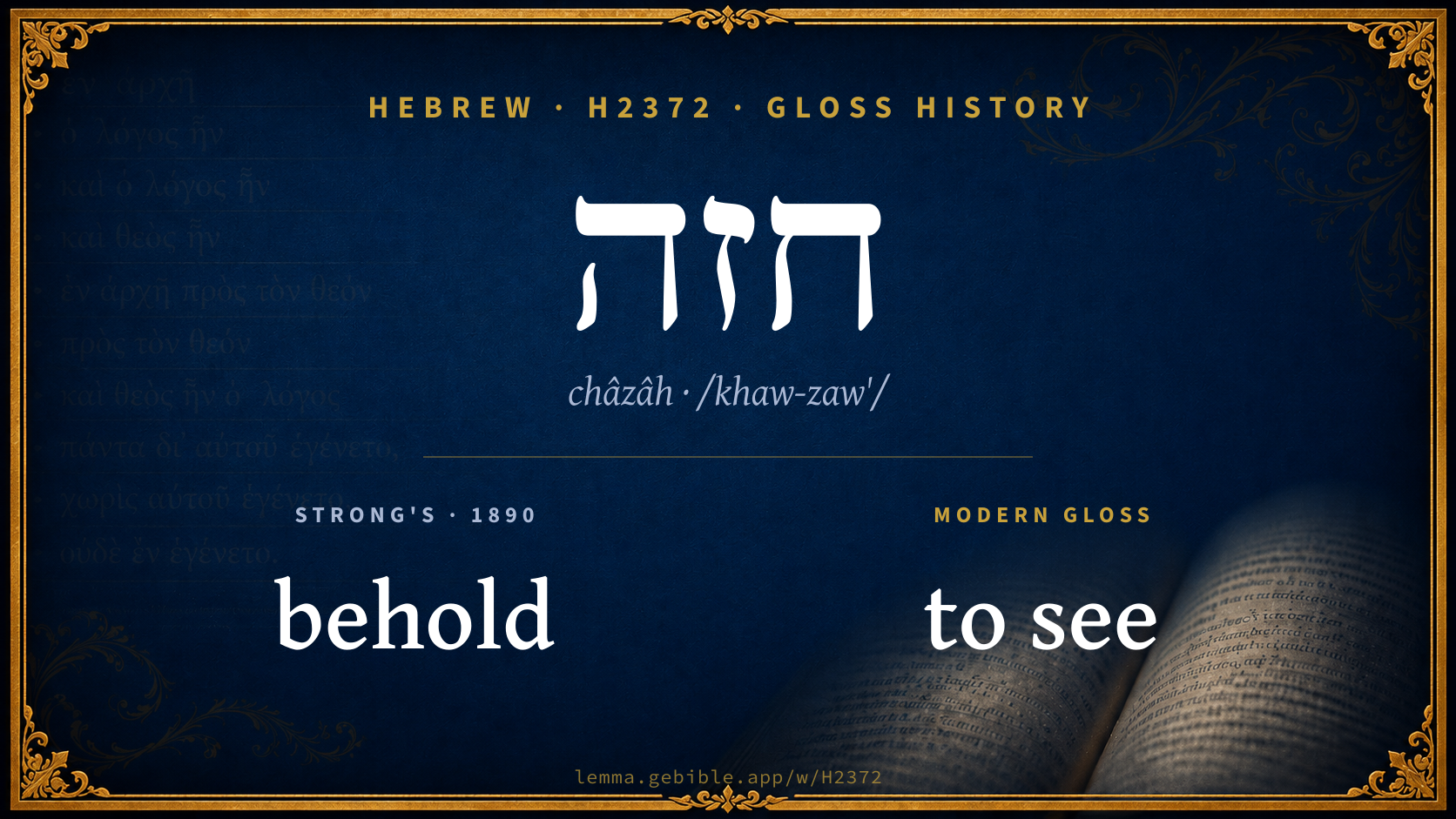
Gloss history
Strong's 1890 vs modern scholarship
About this word
Strong's H2372 catalogs a Hebrew word from the Hebrew Old Testament.
These counts are not copied from any lexicon or concordance. They are computed here, from the morphology-tagged Hebrew Old Testament. What Lemma adds →
- 47
- distinct verses
- The word appears in 47 distinct verses.
- 13 / 39
- OT books
- The word appears in 13 of 39 Old Testament books.
- #723
- by frequency
- Top 1000 most frequent Hebrew words (rank 723 of 8,640 Hebrew words by occurrence).
View all 47 occurrences in the concordance →
By section of the Old Testament
By traditional corpus
Conventional, traditional groupings — biblical authorship is debated, so this is a traditional corpus grouping, not an authorship claim. Each share is this word’s portion of its verses in that division of the Hebrew canon. Each figure is a share of the word’s 47 distinct verses.
- Writings (Ketuvim) 23 verses · 49%
- Prophets (Nevi'im) 20 verses · 43%
- Torah (Pentateuch) 4 verses · 9%
How translations render this word
Counts come from each version’s own published word-to-Strong’s tagging or interlinear alignment — an approximate guide to how each version renders this word, not a word-level alignment the data otherwise carries. Because each total is that version’s own tagged count, the per-version totals vary from one another and need not match the appearance or distinct-verse counts above. These counts may also differ from a printed concordance because Lemma counts each distinctly tagged rendering and does not collapse phrase taggings into a single head-word total. This is a fixed set of word-tagged versions (KJV, ASV, BSB, ULT) and does not change with the reading translation you choose elsewhere. Each version’s license is shown beside its name below (and on Sources).
- King James Version: Behold 4×, Have seen 3×, He saw 3×
- American Standard Version: Behold 4×, Have seen 3×, He saw 3×
- Berean Standard Bible: See 8×, Sees 3×, Visions 3×
- unfoldingWord Literal Text: See 5×, Visions 5×, Envision 3×
King James Version Public Domain
Renders H2372 across 51 tagged occurrences — most commonly:
Plus 24 renderings that appear only once — usually multi-word phrases or single function words the recovered tagging swept in, not distinct renderings.
American Standard Version Public Domain
Renders H2372 across 52 tagged occurrences — most commonly:
Plus 28 renderings that appear only once — usually multi-word phrases or single function words the recovered tagging swept in, not distinct renderings.
Berean Standard Bible Public Domain
Renders H2372 across 54 tagged occurrences — most commonly:
Plus 25 renderings that appear only once — usually multi-word phrases or single function words the recovered tagging swept in, not distinct renderings.
unfoldingWord Literal Text CC BY-SA 4.0
Renders H2372 across 64 tagged occurrences — most commonly:
Plus other, less common renderings. Plus 25 renderings that appear only once — usually multi-word phrases or single function words the recovered tagging swept in, not distinct renderings.
11 senses and sub-senses in the full BDB
What do BDB’s symbols mean?
BDB uses these scholarly abbreviations:
| Symbol | Meaning |
|---|---|
| 𝔊 | the Septuagint (the ancient Greek translation, LXX) |
| 𝔙 | the Vulgate (the Latin translation) |
| 𝔖 | the Syriac version (the Peshitta) |
| 𝔗 | the Targum (the Aramaic translation) |
| ψ | the Psalms |
| √ | root (the underlying root or stem) |
| ‖ | parallel passage (a synonymous or contrasted parallel) |
| † | the dagger: every passage where the word occurs is cited |
The 11 senses and sub-senses the full Brown-Driver-Briggs lexicon distinguishes for this word, in lexicon order (not ranked by frequency), with BDB’s own verbatim wording and sub-sense lettering. Shown in Hebrew script with BDB’s own scholarly abbreviations. The condensed entry is in the Lexicon Entry tab. See also the Forms in the corpus table below.
Qal
- Pf. ח׳ ψ 58:11 + 6 times; חָזִיתָ Pr 22:29; 29:20; חָזִית Is 57:8; חָזִיתִי Jb 15:17; חֲזִיתִךָ ψ 63:3; חָ֥זוּ Jb 24:1 + 5 times; חֲזִיתֶם Jb 27:12 Ez 13:7, 8; Impf. יֶחֱזֶה Nu 24:4 + 2 times; 3 fs. וְתַ֫חַז Mi 4:11; 2 ms. תֶּחֱזֶה Ex 18:21; 1 s. אֶחֱזֶה ψ 17:15 + 4 times; אָ֫חַז Jb 23:9; pl. יֶחֱזוּ Is 26:11 + 4 times; יֶחֱזָ֑יוּן Is 26:11; תֶּחֱזֶ֫ינָת Is 33:17 + 2 times; תֶּחֱזוּ Is 30:10 Ct 7:1; 1 pl. וְנֶחֱזֶת Ct 7:1; Imv. חֲזֵה Is 33:20; 48:6; חֲזוּ ψ 46:9 Is 30:10; Inf. cstr. חֲזוֹת ψ 27:4 Ez 21:34; Pt. חֹזֶה Ez 12:27; pl. חֹזִים Is 47:13 Ez 13:9, 16; 22:28. (All other ptc. forms are used as nouns, v. חֹזֶה.) e.g. Psalms 58:11
- 1. see, behold:
- a. with the eye, acc. rei ψ 58:9, 11 Pr 22:29; 29:20 Is 33:20; 57:8; God in theophany Ex 24:11 (JE); God, after death, apart from the flesh Jb 19:26, 27; the face of God ψ 11:7; 17:15 (after death). e.g. Psalms 58:9
- b. subj. the eyes themselves; man’s eyes: תֶּחֱזֶינָה עֵינֶיךָ thine eyes will behold Is 33:17; also of God’s eyes: ψ 11:4; 17:2. e.g. Isaiah 33:17
- c. with בְּ look on (intensely, with gratification); a damsel Ct 7:1, 1; Zion Mi 4:11; נֹעַם י׳ in the temple ψ 27:4; the work of God Jb 36:25; with investigation בַּכּוֹכָבִים on the stars, as stargazers, in astrology Is 47:13. e.g. Song of Solomon 7:1
- 2. see as a seer in the ecstatic state, with acc. of the vision seen: חזון Is 1:1 Ez 12:27; 13:16; מחזה Nu 24:4, 16 (JE; poet., Balaam); מחזה שׁוא Ez 13:7; משּׂא Is 13:1 Hb 1:1; משׂאות שׁוא La 2:14; שׁוא Ez 13:6, 9, 23; 21:34; 22:28 La 2:14; כזב Ez 13:8; שֶׁקֶר Zc 10:2; obj. deceitful things Is 30:10; דבר(ים) Is 2:1 Am 1:1 Mi 1:1; with לְ, be a seer, for any one Is 30:10; see a vision for one La 2:14, 14. e.g. Isaiah 1:1
- 3. see, perceive:
- a. with the intelligence, abs. Jb 34:32 Pr 24:32; acc. rei Is 48:6; Yahweh in his temple ψ 63:3; in his providential workings Jb 23:9 ψ 46:9 Is 26:11(×2). e.g. Job 34:32
- b. see, by experience abs. Jb 27:12; acc. rei Jb 15:17; 24:1. e.g. Job 27:12
- c. provide, תחזה מכל העם אנשׁי חיל Ex 18:21 provide from all the people men of ability (E). e.g. Exodus 18:21
- —בֵּית אֲבָנִים יֶחֱזֶה Jb 8:17 is difficult: RV renders he (it) beholdeth the place of stones (the root of the plant personified) Hengst, cf. Reuss al. after 𝔖 𝔗. Other renderings are: pierceth (cf. חָזַז) Bö Ew Hi (יְחַזֶּה), Di De MV; between (v. p. 108) the stones it liveth (יִחְיֶה) 𝔊 Siegf. e.g. Job 8:17
Senses from the full Brown-Driver-Briggs lexicon (Brown, Driver, Briggs; Oxford 1906 — public domain), digitized via Sefaria, supplemented by the OpenScriptures HebrewLexicon (CC BY 4.0). Full attribution on Sources.
Word origin
vb. (almost wholly poet.) see, behold (Aramaic ܚܙܳܐ, חֲזָא, see, perceive with the eyes; Palm. Ethp. אתחזי = ἔδοξεν Reckendorf ZMG, 1888, 397; Arabic حَزَى, perceive with the inner vision, only; حَازٍ astronomer, astrologer)—
— Brown-Driver-Briggs (Oxford 1906, public domain), digitized via Sefaria, supplemented by the OpenScriptures HebrewLexicon (CC BY 4.0). See Sources.
Origin: a primitive root
Jastrow Dictionary
A second Hebrew/Aramaic lexicon for comparison, covering Aramaic and post-biblical (Talmudic, Targumic, Midrashic) usage that the biblical-Hebrew BDB does not. Matched by lemma rather than by Strong’s number, so a lemma may carry more than one Jastrow headword (shown separately below), and the entries cover usage well beyond the Bible.
חזי
- (b. h.) [to divide,] to discern, see (cmp. בּוּן). B. Bath. 91ᵃ חֲזִיתֶם נעמי וכ׳ have you seen what has become of Naomi &c.?
- to distribute kindled chips between logs of wood. Sabb. I, 11 (19ᵇ) ומְחַזִּין Mss. (ed. Ven. מחיזין; Y. ed. Krot. ומחזיזן, read ומַחֲזִיזִין, Hif. of חזז, or מְחַזְּזִין), v. אָחַז.—V. חָזִית.
A Dictionary of the Targumim, the Talmud Babli and Yerushalmi, and the Midrashic Literature (Marcus Jastrow; London, Luzac, 1903) — Public Domain. Digitized via Sefaria. Digitized via Sefaria. Full attribution on Sources.
Forms in the corpus
The 46 distinct written forms H2372 takes in the Hebrew Bible, most frequent first — each parse links to that stem’s occurrences in the concordance. Hebrew forms include their vowel points and cantillation, so a single lemma takes many written forms.
| Form | Parsing | Example | Uses |
|---|---|---|---|
| חָזָ֔ה | Verb, Qal, Perfect, 3rd Person, Masculine, Singular | Habakkuk 1:1 | 4 |
| חָ֤זוּ | Verb, Qal, Perfect, 3rd Person, Common, Plural | Ezekiel 13:6 | 2 |
| חָ֥זוּ | Verb, Qal, Perfect, 3rd Person, Common, Plural | Job 24:1 | 2 |
| אֶ֭חֱזֶה | Verb, Qal, Imperfect, 1st Person, Common, Singular | Job 34:32 | 1 |
| אֶֽחֱזֶ֥ה | Verb, Qal, Imperfect, 1st Person, Common, Singular | Job 19:26 | 1 |
| אֶֽחֱזֶה | Verb, Qal, Imperfect, 1st Person, Common, Singular | Job 19:27 | 1 |
| אֶחֱזֶ֣ה | Verb, Qal, Cohortative, 1st Person, Common, Singular | Psalms 17:15 | 1 |
| אָ֑חַז | Verb, Qal, Imperfect, 1st Person, Common, Singular | Job 23:9 | 1 |
| בַּ/חֲז֥וֹת | Verb, Qal, Infinitive Construct | Ezekiel 21:29 | 1 |
| וְ/נֶחֱזֶה | Verb, Qal, Imperfect, 1st Person, Common, Plural | Song of Solomon 6:13 | 1 |
| וְ/תַ֥חַז | Verb, Qal, Jussive, 3rd Person, Feminine, Singular | Micah 4:11 | 1 |
| וַ/חֲזִיתֶ֖ם | Verb, Qal, Perfect, 2nd Person, Masculine, Plural | Ezekiel 13:8 | 1 |
| וַ/יֶּ֣חֱזוּ | Verb, Qal, Sequential Imperfect, 3rd Person, Masculine, Plural | Lamentations 2:14 | 1 |
| וַֽ/יֶּחֱזוּ֙ | Verb, Qal, Sequential Imperfect, 3rd Person, Masculine, Plural | Exodus 24:11 | 1 |
| וָֽ/אֶחֱזֶ֣ה | Verb, Qal, Sequential Imperfect, 1st Person, Common, Singular | Proverbs 24:32 | 1 |
| חֲ֭זוּ | Verb, Qal, Imperative, 2nd Person, Masculine, Plural | Psalms 46:8 | 1 |
| חֲז֖וּ | Verb, Qal, Imperative, 2nd Person, Masculine, Plural | Isaiah 30:10 | 1 |
| חֲזִיתִ֑י/ךָ | Verb, Qal, Perfect, 1st Person, Common, Singular | Psalms 63:2 | 1 |
| חֲזִיתֶ֑ם | Verb, Qal, Perfect, 2nd Person, Masculine, Plural | Job 27:12 | 1 |
| חֲזִיתֶ֔ם | Verb, Qal, Perfect, 2nd Person, Masculine, Plural | Ezekiel 13:7 | 1 |
| חֲזֵ֣ה | Verb, Qal, Imperative, 2nd Person, Masculine, Singular | Isaiah 33:20 | 1 |
| חֲזֵה֙ | Verb, Qal, Imperative, 2nd Person, Masculine, Singular | Isaiah 48:6 | 1 |
| חָ֝זִ֗יתִי | Verb, Qal, Perfect, 1st Person, Common, Singular | Job 15:17 | 1 |
| חָ֣זוּ | Verb, Qal, Perfect, 3rd Person, Common, Plural | Zechariah 10:2 | 1 |
| חָֽזוּ | Verb, Qal, Perfect, 3rd Person, Common, Plural | Job 36:25 | 1 |
| חָזִ֗יתָ | Verb, Qal, Perfect, 2nd Person, Masculine, Singular | Proverbs 29:20 | 1 |
| חָזִ֡יתָ | Verb, Qal, Perfect, 2nd Person, Masculine, Singular | Proverbs 22:29 | 1 |
| חָזִֽית | Verb, Qal, Perfect, 2nd Person, Feminine, Singular | Isaiah 57:8 | 1 |
| חָזָ֣ה | Verb, Qal, Perfect, 3rd Person, Masculine, Singular | Psalms 58:10 | 1 |
| חָזָ֥ה | Verb, Qal, Perfect, 3rd Person, Masculine, Singular | Micah 1:1 | 1 |
| חָזָ֨ה | Verb, Qal, Perfect, 3rd Person, Masculine, Singular | Amos 1:1 | 1 |
| חֹזֶ֖ה | Verb, Qal, Participle Active, Masculine, Singular, Absolute | Ezekiel 12:27 | 1 |
| יֶֽחֱזֶ֔ה | Verb, Qal, Imperfect, 3rd Person, Masculine, Singular | Numbers 24:4 | 1 |
| יֶחֱז֑וּ | Verb, Qal, Imperfect, 3rd Person, Masculine, Plural | Psalms 11:4 | 1 |
| יֶחֱז֤וּ | Verb, Qal, Imperfect, 3rd Person, Masculine, Plural | Isaiah 26:11 | 1 |
| יֶחֱז֥וּ | Verb, Qal, Imperfect, 3rd Person, Masculine, Plural | Psalms 11:7 | 1 |
| יֶחֱזֶֽה | Verb, Qal, Imperfect, 3rd Person, Masculine, Singular | Job 8:17 | 1 |
| יֶחֱזָי֑וּ/ן | Verb, Qal, Imperfect, 3rd Person, Masculine, Plural | Isaiah 26:11 | 1 |
| יֶֽחֱזֶ֔ה | Verb, Qal, Imperfect, 3rd Person, Masculine, Singular | Numbers 24:16 | 1 |
| לַ/חֲז֥וֹת | Verb, Qal, Infinitive Construct | Psalms 27:4 | 1 |
| תֶחֱזֶ֔ינָה | Verb, Qal, Imperfect, 2nd Person, Feminine, Plural | Ezekiel 13:23 | 1 |
| תֶחֱזֶ֣ה | Verb, Qal, Imperfect, 2nd Person, Masculine, Singular | Exodus 18:21 | 1 |
| תֶחֱזוּ | Verb, Qal, Imperfect, 2nd Person, Masculine, Plural | Isaiah 30:10 | 1 |
| תֶּחֱזֶ֣ינָה | Verb, Qal, Imperfect, 3rd Person, Feminine, Plural | Isaiah 33:17 | 1 |
| תֶּחֱזֶ֥ינָה | Verb, Qal, Imperfect, 3rd Person, Feminine, Plural | Psalms 17:2 | 1 |
| תֶּחֱזוּ֙ | Verb, Qal, Imperfect, 2nd Person, Masculine, Plural | Song of Solomon 6:13 | 1 |
Same root — word family
Other BDB entries built from the same root as H2372, grouped by Strong’s listed origin. These share a root / origin per the lexicon — not necessarily a shared meaning. Each links to that word’s own entry.
Derived from this word
- הזה hâzâh H1957 to dream
- חזא chăzâʼ H2370 to see
- חזה châzeh H2373 breast
- חזה chôzeh H2374 seer
- חזון châzôwn H2377 vision
- חזות châzôwth H2378 visions
- חזות châzûwth H2380 vision
- חזיון chizzâyôwn H2384 vision
- מחזה machăzeh H4236 vision
- מחזה mechĕzâh H4237 window
Proper names from this root
People and places named from this root — a name, not an additional meaning of the word.
- חזאל Chăzâʼêl H2371 Hazael
- חזו Chăzôw H2375 Hazo
- חזיאל Chăzîyʼêl H2381 Haziel
- חזיה Chăzâyâh H2382 Hazaiah
- חזיון Chezyôwn H2383 Hezion
- יחזיאל Yachăzîyʼêl H3166 Jahaziel
- יחזיה Yachzᵉyâh H3167 Jahaziah
- מחזיאות Machăzîyʼôwth H4238 Mahazioth
Compare all same-root words → Showing 4 of 19 — not the complete family. 8 of the same-root words are proper names (people or places). They share a root, not necessarily a meaning.
Septuagint verse parallels
This word appears in 46 verses that also exist in the Greek Old Testament (Septuagint), out of the 47 Hebrew verses it occurs in. You can read those verses in Greek by switching the Old Testament edition to the Septuagint.
Read these verses in the Septuagint
- Exodus 18:21
- Numbers 24:4
- Job 8:17
- Psalms 11:4
- Proverbs 22:29
- Isaiah 1:1
- Lamentations 2:14
- Ezekiel 12:27
- Amos 1:1
- Micah 1:1
- Habakkuk 1:1
- Zechariah 10:2
This is a verse-level parallel only — the same verses exist in both the Hebrew and Greek Old Testaments. No word-level Hebrew↔Greek correspondence is claimed: the data carries no such alignment, so no Greek word is shown as this Hebrew word’s translation. Coverage is not total — the Septuagint omits the deuterocanon and renumbers the Psalms, so some Hebrew verses have no direct Greek parallel.