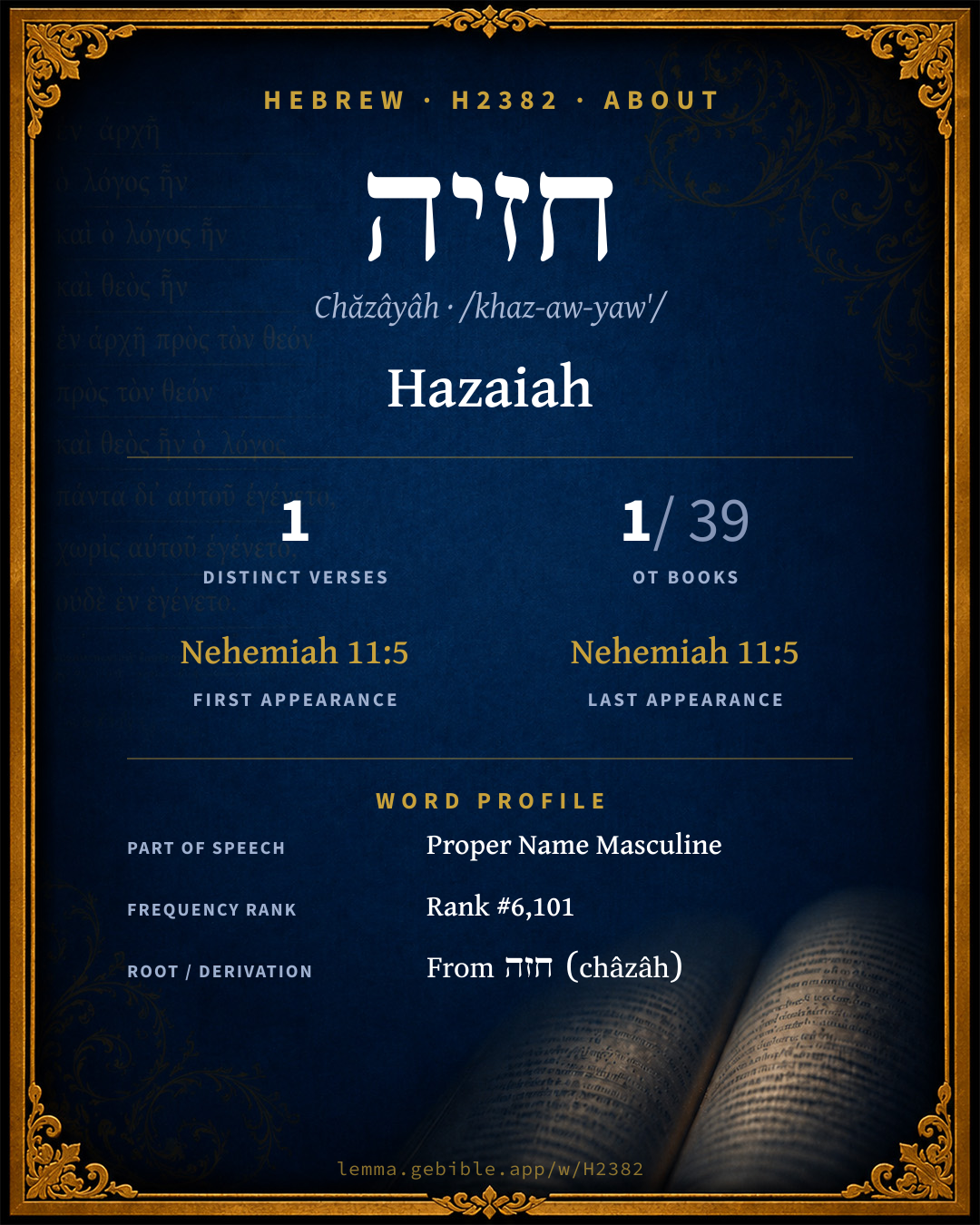
חֲזָיָה
Hazaiah
BDB lists 2 entries for ‘Hazaiah’ fuller range ↓
Full lexicon entry — Brown-Driver-Briggs (BDB)
From Brown-Driver-Briggs (BDB)
Where this word appears
Grammar key — what these labels mean
Part of speech
- Noun
- A naming word — a person, place, thing, or idea.
Noun type
- Proper
- A name of a specific person, place, or people (e.g. Abraham, Zion, Israel).
Every verse where H2382 appears — 1 distinct verse across 1 book. Click any verse to open its interlinear word-by-word view. Verse text shown in the World English Bible for context — . Each verse’s Hebrew form is shown with its reference; the English is not keyword-highlighted, since the data carries no word-level English alignment. Use “Compare translations” on any verse to read it across multiple English versions. This concordance covers the Hebrew Bible; Septuagint (Greek Old Testament) occurrences are not indexed here.
Nehemiah 1 verse
About this entry
At a glance — auto-summarized from this page’s data, not written by a person. Every figure links to its source below. This summary describes the numbers; it doesn’t interpret them.
“Hazaiah” is the headline sense of the Hebrew name חזיה (Chăzâyâh). It occurs a mere 1 verse across Scripture. It clusters heavily in Nehemiah, which alone accounts for 100% of its uses. It occurs only once, in Nehemiah 11:5. The sections below give every occurrence and version rendering.
Gloss history
Strong's 1890 vs modern scholarship
About this word
Strong's H2382 catalogs a Hebrew word from the Hebrew Old Testament.
These counts are not copied from any lexicon or concordance. They are computed here, from the morphology-tagged Hebrew Old Testament. What Lemma adds →
- 1
- distinct verses
- The word appears in 1 distinct verse.
- 1 / 39
- OT books
- The word appears in 1 of 39 Old Testament books.
- #6,101
- by frequency
- Rank #6,101 (rank 6,101 of 8,640 Hebrew words by occurrence).
View all 1 occurrence in the concordance →
Most concentrated in
- Nehemiah 1 verse 100%
By section of the Old Testament
By traditional corpus
Conventional, traditional groupings — biblical authorship is debated, so this is a traditional corpus grouping, not an authorship claim. Each share is this word’s portion of its verses in that division of the Hebrew canon. Each figure is a share of the word’s 1 distinct verse.
- Writings (Ketuvim) 1 verse · 100%
How translations render this word
Counts come from each version’s own published word-to-Strong’s tagging or interlinear alignment — an approximate guide to how each version renders this word, not a word-level alignment the data otherwise carries. Because each total is that version’s own tagged count, the per-version totals vary from one another and need not match the appearance or distinct-verse counts above. These counts may also differ from a printed concordance because Lemma counts each distinctly tagged rendering and does not collapse phrase taggings into a single head-word total. This is a fixed set of word-tagged versions (KJV, ASV, BSB, ULT) and does not change with the reading translation you choose elsewhere. Each version’s license is shown beside its name below (and on Sources).
- King James Version: Hazaiah 1×
- American Standard Version: Hazaiah 1×
- Berean Standard Bible: Hazaiah 1×
- unfoldingWord Literal Text: Hazaiah 1×
King James Version Public Domain
Renders H2382 across 1 tagged occurrence — most commonly:
American Standard Version Public Domain
Renders H2382 across 1 tagged occurrence — most commonly:
Berean Standard Bible Public Domain
Renders H2382 across 1 tagged occurrence — most commonly:
unfoldingWord Literal Text CC BY-SA 4.0
Renders H2382 across 1 tagged occurrence — most commonly:
Senses in BDB
The 2 senses BDB distinguishes for this word, in lexicon order (not ranked by frequency or importance). The full entry — with sub-senses — is in the Lexicon Entry tab.
- Hazaiah = "God has seen"
- an exile and descendant of Shelah of the tribe of Judah who returned in the time of Nehemiah
Word origin
n.pr.m. (Yah hath seen) one of the chiefs of the בְּנֵי יְהוּדָה Ne 11:5.
— Brown-Driver-Briggs (Oxford 1906, public domain), digitized via Sefaria, supplemented by the OpenScriptures HebrewLexicon (CC BY 4.0). See Sources.
Derived from חזה (châzâh) (H2372) — to see.
Same root — word family
Other BDB entries built from the same root as H2382, grouped by Strong’s listed origin. These share a root / origin per the lexicon — not necessarily a shared meaning. Each links to that word’s own entry.
Derives from
Shares the same root
- הזה hâzâh H1957 to dream
- חזא chăzâʼ H2370 to see
- חזה châzeh H2373 breast
- חזה chôzeh H2374 seer
- חזון châzôwn H2377 vision
- חזות châzôwth H2378 visions
- חזות châzûwth H2380 vision
- חזיון chizzâyôwn H2384 vision
- מחזה machăzeh H4236 vision
- מחזה mechĕzâh H4237 window
Proper names from this root
People and places named from this root — a name, not an additional meaning of the word.
- חזאל Chăzâʼêl H2371 Hazael
- חזו Chăzôw H2375 Hazo
- חזיאל Chăzîyʼêl H2381 Haziel
- חזיון Chezyôwn H2383 Hezion
- יחזיאל Yachăzîyʼêl H3166 Jahaziel
- יחזיה Yachzᵉyâh H3167 Jahaziah
- מחזיאות Machăzîyʼôwth H4238 Mahazioth
Compare all same-root words → Showing 4 of 19 — not the complete family. 7 of the same-root words are proper names (people or places). They share a root, not necessarily a meaning.
Bible dictionary
Public-domain dictionary articles matched to this entry by name (Hazaiah). A biblical name can be shared by more than one person or place, so an article may treat several.
Smith's Bible Dictionary · William Smith, 1863
(whom Jehovah sees), a man of Judah of the family of the Shilonites, or descendants of Shelah. (Nehemiah 11:5)
Hitchcock's Bible Names Dictionary · Roswell D. Hitchcock, 1869
seeing the Lord
Classic public-domain reference works; full attribution on Sources.