
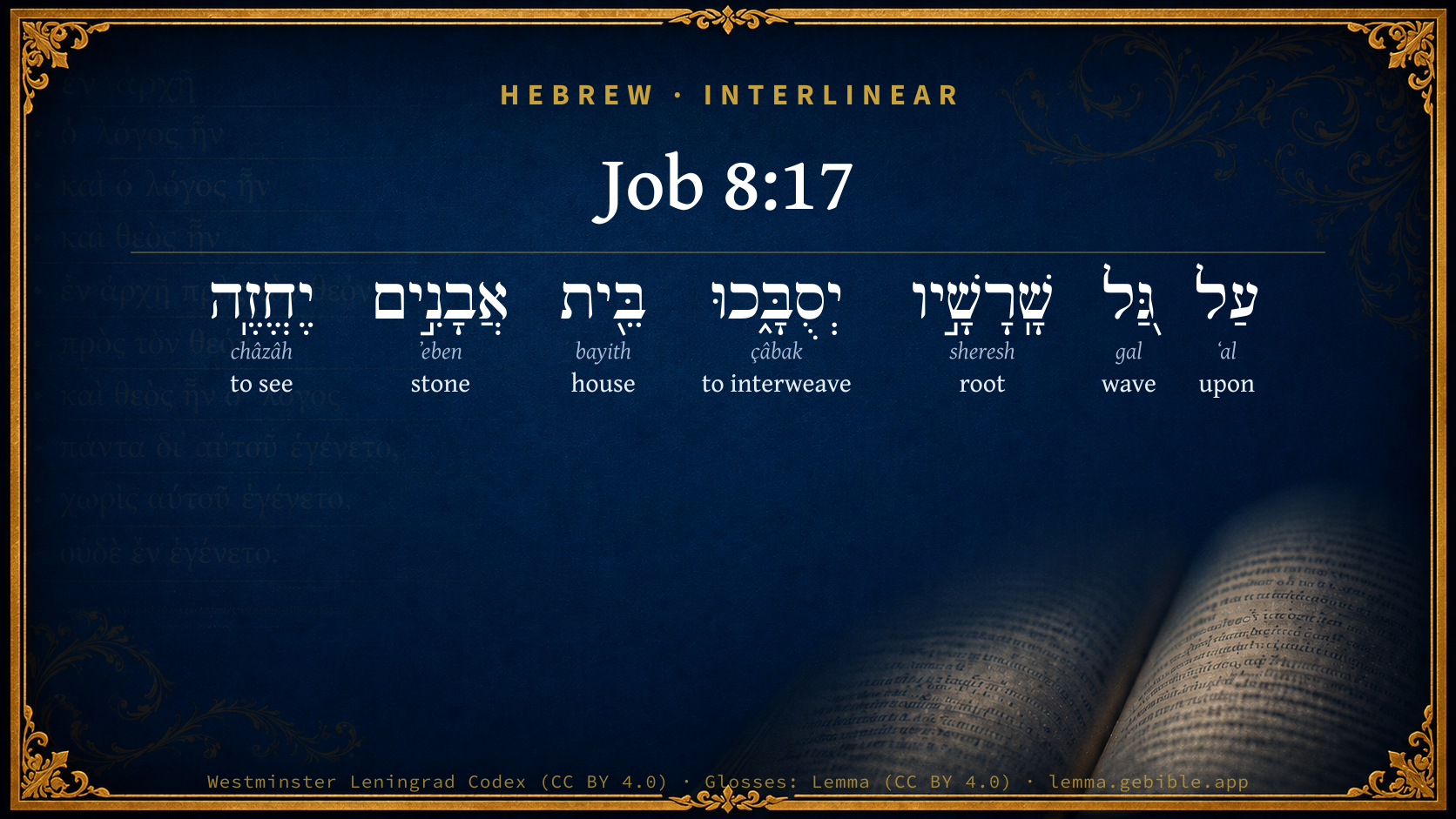
Job 8:17

Hebrew (Westminster Leningrad Codex) Job 8:17 appears in the Hebrew Old Testament. The text above is from the Westminster Leningrad Codex. Each word links to its Strong’s number, a concise gloss, and parsing drawn from the Open Scriptures Hebrew Bible morphology. Click any word for its full Brown-Driver-Briggs (BDB) entry.
Download image
Cite this verse

Job 8:17 (World English Bible). Public Domain. Lemma interlinear Bible study tool, https://lemma.gebible.app/v/job/8/17.

Show BibTeX & RIS
BibTeX
RIS
English Translation
His roots are wrapped around the rock pile, He sees the place of stones.
World English Bible · Public Domain
Highlights
  • 1 first appearance in the Hebrew Bible
Full analysis ↓
Download a study sheet

One document with this verse’s original text, its word-by-word gloss line, the meaning frame, cross-references with their text, attributed commentary, and full source and license credits — printable, and it pastes into notes with its structure intact.

This verse Autodidact and up

Study sheet (.html) Plain text (.txt)

A passage Seminary Student

Up to 50 verses in one chapter. A passage sheet keeps up to 6 commentary sources and 12 cross-references per verse, in the order this page ranks them, and says so on the sheet whenever that leaves anything out. Ask for a single verse and you get the Autodidact verse sheet above.

Everything on this page stays free to read, with no account — the sheet is a download of what is already on screen, not access to it.

Want to remove ads? Support Godless Engineer
Compare translations 3

The same verse in 3 English versions, stacked beneath the original-language interlinear above. Click any original word for its lexicon entry.

Each is an independent rendering of the whole verse — the interlinear is not word-aligned to these translations.

Highlighted words mark where these versions differ — a whole-verse word diff, not a word-by-word alignment.

  • World English Bible Public Domain
    His roots are wrapped around the rock pile, He sees the place of stones.
  • King James Version Public Domain
    His roots are wrapped about the heap, and seeth the place of stones.
  • unfoldingWord Literal Text CC BY-SA 4.0
    Its roots are wrapped around a heap; it looks for a house of rocks.

unfoldingWord Literal Text — © unfoldingWord, licensed CC BY-SA 4.0. Word-aligned USFM3 via Door43 (git.door43.org/unfoldingWord/en_ult).

Versions to compare (up to 4)

3 of 4 selected

Show all 18 translations

Every available English version of this verse, each an independent rendering of the whole verse.

  • World English Bible Public Domain
    His roots are wrapped around the rock pile, He sees the place of stones.
  • Berean Standard Bible Public Domain
    His roots wrap around the rock heap; he looks for a home among the stones.
  • Majority Standard Bible Public Domain
    His roots wrap around the rock heap; he looks for a home among the stones.
  • King James Version Public Domain
    His roots are wrapped about the heap, and seeth the place of stones.
  • American Standard Version (1901) Public Domain
    His roots are wrapped about the `stone' -heap, He beholdeth the place of stones.
  • Revised Version (1885) Public Domain
    His roots are wrapped about the heap, he beholdeth the place of stones.
  • Geneva Bible (1599) Public Domain
    The rootes thereof are wrapped about the fountaine, and are folden about ye house of stones.
  • Douay-Rheims (1899) Public Domain
    His roots shall be thick upon a heap of stones, and among the stones he shall abide.
  • Young's Literal Translation Public Domain
    By a heap his roots are wrapped, A house of stones he looketh for.
  • Literal Standard Version CC BY-SA 4.0
    His roots are wrapped by a heap, || He looks for a house of stones.
  • Unlocked Literal Bible CC BY-SA 4.0
    His roots are wrapped about the heaps of stone; they look for good places among the rocks.
  • unfoldingWord Literal Text CC BY-SA 4.0
    Its roots are wrapped around a heap; it looks for a house of rocks.
  • Darby Bible Public Domain
    His roots are entwined about the stoneheap; he seeth the place of stones.
  • World Messianic Bible Public Domain
    His roots are wrapped around the rock pile. He sees the place of stones.
  • Webster's Bible Public Domain
    His roots are wrapped about the heap, and seeth the place of stones.
  • Free Bible Version CC BY-SA 4.0
    It twists its roots down through the stones, and holds on to rock.
  • Bible in Basic English Public Domain
    His roots are twisted round the stones, forcing their way in between them.
  • JPS Tanakh (1917) Public Domain
    His roots are wrapped about the heap, he beholdeth the place of stones.

Literal Standard Version (2020), Covenant Press — licensed CC BY-SA 4.0. Text via the HelloAO Bible API (eBible.org). Unlocked Literal Bible (unfoldingWord) — licensed CC BY-SA 4.0. Text via the HelloAO Bible API (eBible.org). unfoldingWord Literal Text — © unfoldingWord, licensed CC BY-SA 4.0. Word-aligned USFM3 via Door43 (git.door43.org/unfoldingWord/en_ult). Free Bible Version, Dr. Jonathan Gallagher — licensed CC BY-SA 4.0. Text via the HelloAO Bible API (eBible.org).

Word by word

More ways to search: Search by grammar → Find every occurrence → Compare this word →

Practice this passage: Drill this verse → Learn its vocabulary →

About this verse

These counts appear in no published source. They are computed here, from the morphology-tagged text and Lemma’s own curated glosses. What Lemma adds →

7
words
7
distinct lemmas
Wisdom
section

Notable vocabulary

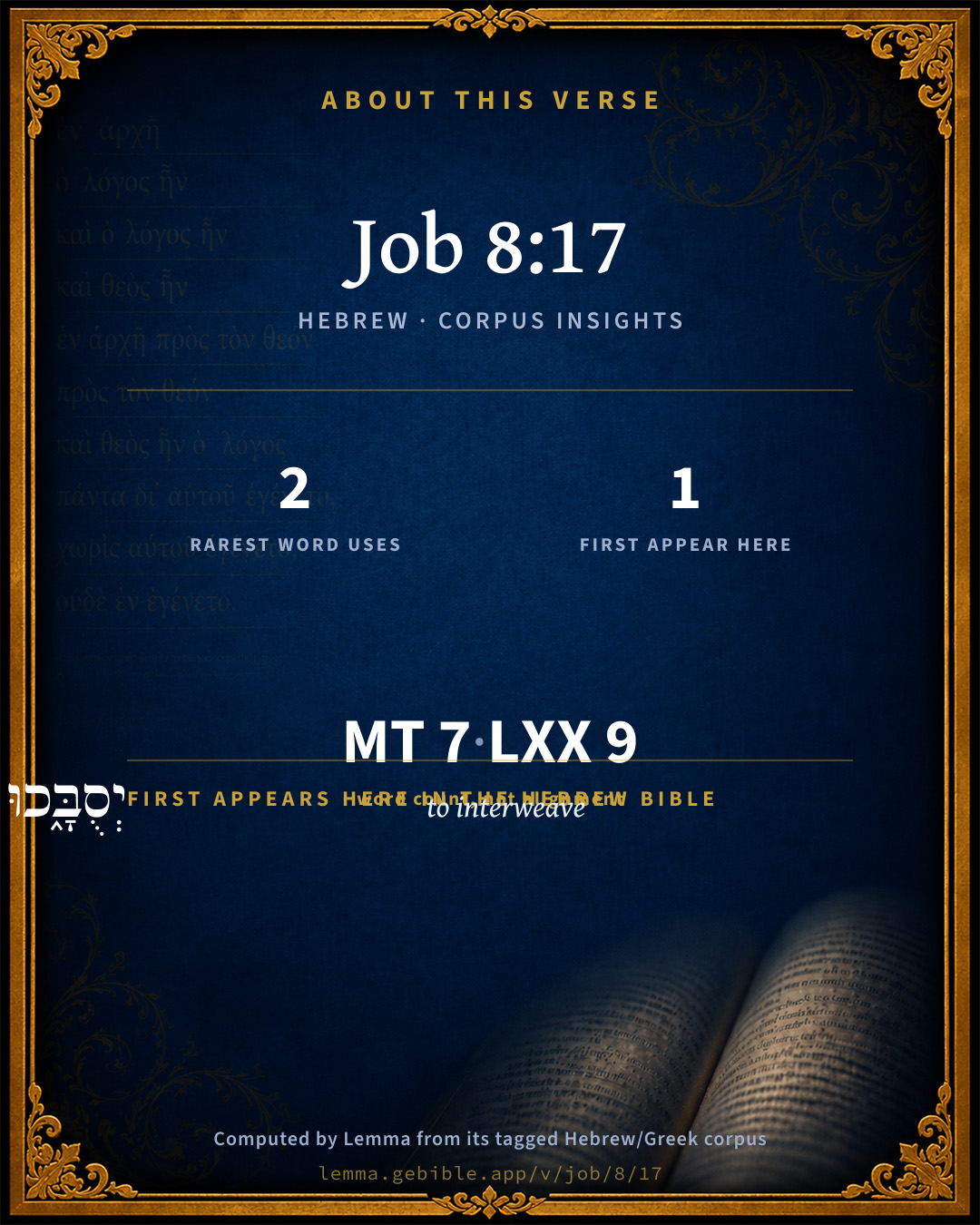
The rarest word here is יְסֻבָּ֑כוּ to interweave H5440 — appearing just 2 times in the whole Hebrew Bible.

First appearance in Scripture

This word makes its first canonical appearance in the Hebrew Bible here:

  • יְסֻבָּ֑כוּ to interweave H5440

Shared distinctive vocabulary

יְסֻבָּ֑כוּ to interweave H5440 occurs in 2 verses of the Hebrew Bible. Also found in:

Grammatical profile

  • 2 verbs
  • 4 nouns
  • 1 preposition

Verb forms

  • יְסֻבָּ֑כוּ Pual · Imperfect
  • יֶחֱזֶֽה Qal · Imperfect

Hebrew & Septuagint length

In English translation the verse runs 14 words from the Hebrew and 16 from the Septuagint (LXX English) — closely comparable.

A rough comparison of the two English renderings, which tokenize alike — not a word-level alignment.

Word counts can differ between the Hebrew and the Greek without any difference in meaning — e.g. the Hebrew direct-object marker אֵת has no separate Greek word, and Greek often adds the article ὁ.

In the original languages it is 7 Hebrew tokens and 9 Greek tokens — but the two are counted differently (Hebrew bundles its prefixes and suffixes into one token; the Greek is in lemma form), so that isn’t a like-for-like length.

Cross-references

7

Topical passages linked to Job 8:17 in the Treasury of Scripture Knowledge — connected by theme and wording, ordered by reader-vote popularity; previews shown in the World English Bible.

  • Job 18:16 His roots shall be dried up beneath, Above shall his branch be cut off.
  • Job 29:19 My root is spread out to the waters, The dew lies all night on my branch;
  • Isaiah 5:24 Therefore as the tongue of fire devours the stubble, And as the dry grass sinks down in the flame, So their root shall be as rottenness, And their blossom shall go up as dust; Because they have rejected the law of Yahweh of Hosts, And despised the word of the Holy One of Israel.
  • Isaiah 40:24 Yes, they have not been planted; yes, they have not been sown; yes, their stock has not taken root in the earth: moreover he blows on them, and they wither, and the whirlwind takes them away as stubble.
  • Jeremiah 12:1–2 Righteous are you, Yahweh, when I contend with you; yet would I reason the cause with you: why does the way of the wicked prosper? why are all they at ease who deal very treacherously?
  • Mark 11:20 As they passed by in the morning, they saw the fig tree withered away from the roots.
  • Jude 1:12 These are hidden rocky reefs in your love feasts when they feast with you, shepherds who without fear feed themselves; clouds without water, carried along by winds; autumn leaves without fruit, twice dead, plucked up by the roots;

Cross-references courtesy of OpenBible.info (CC BY 4.0).

Hebrew and Greek witnesses Masoretic Hebrew ↔ Greek Septuagint

The same verse in the two great witnesses to the Old Testament, shown verse-for-verse.

These are two independent witnesses, not word-aligned to each other, and the Septuagint is shown in lemma (dictionary) form.

Hebrew Job 8:17 Masoretic · Westminster Leningrad Codex

עַל גַּ֭ל שָֽׁרָשָׁ֣יו יְסֻבָּ֑כוּ בֵּ֖ית אֲבָנִ֣ים יֶחֱזֶֽה

His roots are wrapped around the rock pile, He sees the place of stones.

World English Bible · Public Domain

Greek LXX Job 8:17 Septuagint · lemma form

ἐπί συναγωγή λίθος κοιμάω ἐν δέ μέσος χάλιξ ζάω

He lies down upon a gathering of stones, and shall live in the mist of flints.

LXX2012 (modern English Septuagint) · Public Domain

On this verse, Albert Barnes' Notes on the Bible discusses the Septuagint’s reading. Read the note in Commentary ↓

Hebrew: Westminster Leningrad Codex (CC BY 4.0). Greek: Septuagint (public domain); English from LXX2012 (modern English Septuagint) (Public Domain). How the Septuagint differs from the Hebrew →

Commentary

Notes on Job 8:17 from classic Christian and Jewish commentators (each source and its license shown beneath its notes). The classic Christian expositions comment on the surrounding passage and are grouped to its opening verse, so a note may address several verses; the Jewish commentaries on the Tanakh (Rashi and others) are per-verse, so they appear only where the commentator wrote on this verse.

Lemma curates 59 commentaries, every one of them public domain or Creative Commons licensed, each selected and text-cleaned for this edition rather than reprinted as found. About our sources →

Trapp's Complete Commentary

John Trapp

Job 8:17 His roots are wrapped about the heap, [and] seeth the place of stones.

Ver. 17. His roots are wrapped about the heap, &c.] i.e. They are deeply intrenched, and strongly incorporated into the ground, wreathed in with the heap, as thorns about a hedge. The hypocrite seemeth to be notably well rooted ( intricantur), not in the world only, but in the Church too, which we may compare (as Plato doth man, whom he calleth φυτον ουρανιον, a heavenly plant) to a tree inverted, with the root above, and the branches below. Our Saviour speaketh of branches in him (seemingly so) that bear not fruit, Joh 15:2. These are hypocrites, who think themselves to be rooted in Christ, and others also think no less of them, but it proves otherwise, for they are fruitless; as a pole fixed in the earth, but not rooted there; as a rotten leg cleaves to the body, but is no part of it; or as wens and ulcers, which are taken away without any loss to it. How far a hypocrite may go, see the parable of the stony and thorny grounds, Mat 13:20-23 See also Heb 6:4-5; Heb 10:39 2Pe 2:20-21. He may come as far as Kadeshbarnea, within 11 days’ journey of the heavenly Canaan, and yet fall short of it; he may seem to be steadfast and unmoveable, as a tree whose roots are wrapped about a rock.

He seeth the place of stones] Mr Broughton rendereth it, He planteth about the house of stone: others, He looketh into the house of stone; he looks in at the windows, and so hindereth the light, annoying the master’s house both below and above, who therefore resolves to have him down; as it followeth.

John Trapp, A Commentary or Exposition upon All the Books of the Old and New Testament (1647–1656) — public domain. Text from a community e-Sword module.

Joseph Benson's Commentary

Job 8:17. His roots are wrapped about the heap — Heath renders this, He windeth his roots about a spring; he twisteth himself about a heap of stones: and he approves a slight alteration of the text made by Houbigant; who, rather more elegantly, reads, He has his roots involved, or, fixed, in a hill; he adheres to the midst of stones. This circumstance is added to signify the tree’s firmness and strength; that it was not fixed in loose and sandy ground, which a violent wind might overthrow, but in solid ground, within which were many stones, which its numerous and spreading roots embraced, folding and interweaving themselves about them. He seeth the place of stones — The tree reacheth thither, takes the advantage of that place for the strengthening of itself. By this the writer seems to express the apparent firmness and worldly dependance of the hypocrite.

Joseph Benson's Commentary on the Old and New Testaments (1811–1818) — public domain. Text from a community e-Sword module.

Jamieson, Fausset & Brown

Robert Jamieson, A. R. Fausset & David Brown

seeth the place of stones--Hebrew, "the house of stones"; that is, the wall surrounding the garden. The parasite plant, in creeping towards and over the wall--the utmost bound of the garden--is said figuratively to "see" or regard it.

Jamieson, Fausset & Brown — Commentary Critical and Explanatory on the Whole Bible (1871) — public domain (CC PDM 1.0). Text via the HelloAO Bible API.

Ellicott's Commentary for English Readers

(17) His roots are wrapped about.—This is the cause of his continual luxuriance, that his roots receive moisture from below, where they are wrapped about the spring which fertilises them underneath; they are planted near to a perennial fountain, and therefore (see Job_8:6) “he is green before the sun.”

And seeth the place of stones.—Rather, the house of stones—i.e., the stone house. He seeth the permanent and durable edifice of stone which is the habitation of civilisation and culture, and here his holding is so firm that, even if plucked up, his roots and suckers are so numerous that they leave behind them descendants and offshoots, so that out of his earth others grow; or, more correctly, out of another dust they grow. Even if transplanted, this luxuriant tree will flourish equally well in another soil.

A Bible Commentary for English Readers, edited by Charles John Ellicott (1878–1897) — public domain. Text from a community e-Sword module.

The Cambridge Bible for Schools and Colleges

gen. ed. J. J. S. Perowne

17. seeth the place of stones] This translation can hardly mean that in his high growth he looks down upon the stone heap, or bends over it, but rather that he chooses it, fixes himself upon it. Others prefer the sense: he pierces between the stones, that is, with his roots, or, he pierces the place of stones, the word which ordinarily means to see having it is said in the dialect of the Hauran the sense of cut, or split (Wetzstein in Delitzsch, note, p. 120). This affords a more distinct sense. The luxuriance of the plant and its hold of the soil are graphically described. It is fresh and green under the heat of the sun; its suckers spread out and run over all the garden; its shoots clasp the heap of stones and weave themselves about it; and, finally, its roots thrust themselves down and pierce the stony soil, grasping the heart of the earth.

The Cambridge Bible for Schools and Colleges (gen. ed. J. J. S. Perowne; Cambridge University Press, 1878–1918) — public domain. Text from a community e-Sword module.

John Gill's Exposition

If he destroy him from his place,.... If the sun when he is risen strikes the tree with such vehement heat that it withers and utterly perishes from the place where it grew; or roots it up, so the Targum and Nachmanides; or, if God destroys the hypocrite from his place, or he is by one means or another removed out of the garden, the church, being detested and rejected by good men; or from all his worldly enjoyments, his honour, credit, and esteem with men, which are all precarious, fickle, and inconstant; or out of the world, being cut down as a cumber ground:

then it shall deny him, saying, I have not seen thee; that is, either the tree shall deny that it ever was planted in such a place, or rather the place shall deny that the tree ever was planted there; the sense is, that it shall be so utterly destroyed, that neither root nor branch shall be left, nor anything to show that it ever grew there; its place shall know it no more, see Job 7:10; or God shall deny the hypocrite, and say he never saw him nor knew him; he never belonged to him, nor was under his care; he never looked upon him with a look of love, grace, and mercy; he never had any delight and pleasure in him, nor regarded him as one of his; he was no tree of his planting, watering, and keeping, see Mat 7:23; this seems most difficult to accommodate to a good man, and those who carry it that way seem to be most puzzled with this; some render it, "shall he be swallowed?" or, "shall anyone in, allow him up?" (p) destroy or root him out of his place? none shall: the root of the righteous cannot be moved, nor they from that; not from the everlasting love of God, in which they are rooted, nor from Christ, in whom they are fixed: others understand this of the digging up of a tree, and transplanting it to another place, where it grows as well, or better; and so the people of God, though they have many stripping providences, and are removed from place to place, and from one condition to another, so that their former state and place know them no more; yet all things work together for their good.

(p) "num absorbebitur a loco suo?" Beza; "num absorbebit cum quisquam e loco suo", Diodatus.

John Gill's Exposition of the Whole Bible (1746–1763) — public domain (CC PDM 1.0). Text via the HelloAO Bible API.

Albert Barnes' Notes on the Bible

His roots are wrapped about the heap - There has been great diversity of opinion in the interpretation of this passage. Jerome renders it, “over the heap of stones his roots are condensed.” Walton, “super fontem - over a fountain.” The Septuagint, “he lies down (or sleeps, κοιμᾶται koimatai) on a heap of stones; and he lives in the midst of flint-stones.” According to some, the word rendered heap גל gal means a fountain; according to others, it means a heap or pile of stones; according to Dr. Good, it means a rock. According to the view of the former, it refers to the flourishing condition of a hypocrite or sinner, and means that he is like a tree that sends its roots by a fountain, and is nourished by it. According to others, the reference is to the fact that the hypocrite is like a plant that has no depth of earth for its roots, that wraps its rooks around anything, even a heap of stones, to support itself; and that consequently will soon wither under the intense heat of the sun. The word גל gal, rendered “heap,” means either

(1.) A heap, as a heap of stones, from גלל gâlal - to roll, as e. g. stones. It may denote a heap of stones, Jos 7:26, but it commonly refers to the ruins of walls and cities, Jer 9:11; Jer 51:37; Isa 25:2. It means

(2.) A fountain or spring, so called from the rolling or welling up of the waters, Son 4:12, and hence, rolling waves or billows, Psa 42:7; Psa 89:9; Psa 107:25, Psa 107:29. The parallelism, if nothing else, demands that the usual signification should be given to it here; and the true sense is, that the prosperous wicked man or the hypocrite is like a plant which stands in the midst of rocks, rubbish, or old ruins, and not like one that stands in a fertile soil where it may strike its roots deep. The reference is to the fact that a tree or plant which springs up on a rock, or in the midst of rocks, will send its roots afar for nutriment, or will wrap them around the projecting points of rocks in order to obtain support. All have observed this in trees standing on rocks; but the following extract from Sillinian’s Journal for January, 1840, wil illustrate the fact referred to here more fully.

“About fifteen years ago, upon the top of an immense boulder of limestone, some ten or twelve feet in diameter, a sapling was found growing. The stone was but slightly imbedded in the earth; several of its sides were raised from four to six feet above its surface; but the top of the rock was rough with crevices, and its surface, which was sloping off, on one side, to the earth, was covered with a thin mould. From this mould the tree had sprung up, and having thrust its roots into the crevices of the rock, it had succeeded in reaching the height of some twelve or fifteen feet. But about this period the roots on one side became loosened from their attachment, and the tree gradually declined to the opposite side, until its body was in a parallel line with the earth. The roots on the opposite side, having obtained a firmer hold, afforded sufficient nourishment to sustain the plant; although they could not, alone, retain it in its vertical position. In this condition of things, the tree as if ‘conscious of its needs, ‘ adopted (if the term may be used) an ingenious process, in order to regain its former upright position. One of the most vigorous of the detached roots sent out a branch from its side, which, passing round a projection of the rock, again united with the parent stalk, and thus formed a perfect loop around this projection, which gave to the root an immovable attachment.

“The tree now began to recover from its bent position. Obeying the natural tendency of all plants to grow erect, and sustained by this root, which increased with unwonted vigor, in a few years it had entirely regained its vertical position, elevated, as no one could doubt who saw it, by the aid of the root which had formed this singular attachment. But this was not the only power exhibited by this remarkable tree.

“After its elevation it flourished vigorously for several years. Some of its roots had traced the sloping side of the rock to the earth, and were buried in the soil below. Others, having embedded themselves in its furrows, had completely filled these crevices with vegetable matter. The tree still continuing to grow, concentric layers of vegetable matter were annually deposited between the alburnum and liber, until by the force of vegetable growth alone, the rock was split from the top to the bottom, into three nearly equal divisions, and branches of the roots were soon found, extending down, through the divisions into the earth below. On visiting the tree a few months since, to take a drawing of it, we found that it had attained an altitude of fifty feet, and was four and a half feet in circumference at its base.”

The image here shows that the author of this beautiful fragment was a careful observer of nature, and the comparison is exceedingly pertinent and striking. What more beautiful illustration of a hypocrite can there be? His roots do not strike into the earth. His piety is not planted in a rich soil. It is on the hard rock of the unconverted human heart. Yet it sends out its roots afar; seems to flourish for a time; draws nutriment from remote objects; clings to a crag or a projecting rock, or to anything for support - until a tempest sweeps it down to rise no more! No doubt the idea of Bildad was, that Job was just such a man.

Seeth the place of stones - Septuagint, “and lives in the midst of flints,” not an unapt rendering - and a very striking description of a hypocrite. So Castellio, “existit inter lapides.” Its only nutriment is derived from the scanty earth in the stony soil on which it stands, or in the crevices of the rocks.

Albert Barnes' Notes on the Bible (1834–1885) — public domain. Text from a community e-Sword/MySword module.

Matthew Poole's English Annotations

About the heap, to wit, of stones, which word may be here understood out of the latter branch of the verse, as is very usual in Scripture use. This circumstance of the tree is added to signify, either,

1. Its firmness and strength, that it was not in loose and sandy ground, which a violent wind might overthrow, but in solid and hard ground, within which were many stones, which its numerous and spreading roots embrace, folding and interweaving themselves severally about several stones. Or,

2. Its singular and extraordinary growth, in spite of all disadvantages and oppositions; that even stony ground, which is very prejudicial to trees, Mat 13:5, doth not hinder its growth, but only add to its strength. So God and man seem to conspire, and all things concur, to secure and perpetuate this man’s happiness. Some render the words, His roots are wrapped, or folded, or spread about, or beside, a spring, as the Hebrew gal sometimes signifies, as Jos 15:19; Son 4:12, i.e. a moist ground, which is much to its advantage: see Psa 1:3; Jer 17:8. Seeth he, i.e. the tree whose roots he last mentioneth, reacheth thither, spreadeth himself so far, takes the advantage of that place for the strengthening of itself. Seeing is oft put for enjoying, and is frequently attributed to lifeless things, by a known figure, called prosopopeia. The place, Heb. the house, which is oft used for a place; as 2Sa 6:17; 1Ki 8:6. Others render the words thus, he looketh upon the house of stones, i.e. made of stones for greater beauty and strength. He standeth proudly, and looketh boldly upon its owner’s house, nigh unto which it is placed, even in his garden, as was said before.

Matthew Poole's English Annotations on the Holy Bible (1683–1685) — public domain. Text from a community e-Sword/MySword module.

Whedon's Commentary on the Bible

Daniel D. Whedon

17. About the heap — Literally, Over a heap (of stones) are his roots intertwined: he seeth a house of stones. A stone heap (גל) sometimes served for a memorial of honour. Gen_31:46-48. Joseph, (also of Egypt,) on the contrary, was a fruitful bough, whose branches ran over the wall. Gen_49:22.

Seeth the place of stones — Rather, A house of stones. “He is like a tree which seems firmly rooted in a heap of stones, and looks down, as it were, with a domineering aspect and a proud consciousness of strength on a house of stone, in which he appears to be firmly built as in a marble palace; yet he will soon be withered and rooted up, and vanish from the face of the earth.” — Wordsworth. Comp. Mat_13:5-6.

Daniel D. Whedon (gen. ed.), Commentary on the Old and New Testaments (1874–1909) — public domain. Text from a community e-Sword module.

The Pulpit Commentary

His roots are wrapped about the heap, and seeth (rather, he seeth) the place (literally, house) of stones. This passage is very obscure The word gal, translated heap, means sometimes a spring or stream of water; (Son_4:12) and many of the best Hebraists regard it as having that meaning here (Buxtorf, Lee, Stanley Leathes, Revised Version). In this case we have to regard the rapidly growing plant as having its roots wrapped about the perennial spring, which was a not uncommon, and always a much-desired, feature of an Eastern garden. Thus nourished, it naturally increased and spread itself, and "was green before the sun." May we suppose that it "saw the house of stones," because the spring which nourished it gushed forth from the native rock so that its roots were in contact with both?

The Pulpit Commentary (1880–1919), ed. H.D.M. Spence-Jones & Joseph S. Exell — public domain. Text from a community e-Sword module.

John Wesley's Explanatory Notes

Heap - Of stones. This circumstance is added, to signify its firmness and strength, that it was not in loose and sandy ground, which a violent wind might overthrow, but in solid ground, within which were many stones, which its numerous and spreading roots embrace, folding and interweaving themselves about them. Seeth - The tree reacheth thither, takes the advantage of that place for the strengthening of itself.

John Wesley, Explanatory Notes Upon the Whole Bible (1754–1765) — public domain. Text via the GEBible commentary corpus.

Rashi

Rabbi Shlomo Yitzchaki (Rashi)

are entwined Will be entwined with the branch and with the thicket.

a stone house He sees a strong place and builds it for himself as a stronghold. Menachem, however explains יֶחֶזֶה as an expression of a border: will border him; he will build it up to his border. [Perlow ed, reads: on his border.] Likewise (Ps. 107:30), “their desired haven.” Likewise (I Kings 7:4), “an edge to an edge (מחזה אל מחזה)” (Machbereth Menachem p. 86). All these are before his plague.

Rashi on the Tanakh — English translations: “The Judaica Press complete Tanach with Rashi, translated by A. J. Rosenberg” (CC BY 4.0); “Pentateuch with Rashi's commentary by M. Rosenbaum and A.M. Silbermann, 1929-1934” (public domain); “The Metsudah Tanach series, Lakewood, N.J” (CC BY 4.0); and “The Book of Joshua, Metsudah Publications, 1997” (CC BY 4.0). Text via Sefaria.

Lesson kit

Teaching starters — assembled from the data on this page, not authored interpretation. Every prompt links to the verse data it draws on. Edit before teaching.

Job, in the Wisdom, opens this verse with 7 words (7 distinct Hebrew lemmas). Its most distinctive word is çâbak (“to interweave”). A historical commentator’s framing appears above. Read the whole chapter for the surrounding context.

Discussion questions

  1. How does “to interweave” (çâbak) shape what this verse is saying?
  2. This is the first place “to interweave” appears in Scripture (first appears here). What does its debut here establish?
  3. How does Nahum 1:10, which shares the word «to interweave», read alongside this verse?
  4. These translations render this verse differently. What is at stake in choosing one wording over another?
  5. «יְסֻבָּ֑כוּ» is a Pual Imperfect verb. How does that grammatical form shape the action described?
  6. Compare how Trapp's Complete Commentary and Joseph Benson's Commentary read this verse. Where do they agree or differ?

Things to notice

Reading settings

Reading text

Shown beneath each verse's original-language words.

Old Testament
Old Testament edition

Read the OT as the Masoretic Hebrew (MT) or the Greek Septuagint (LXX).

English shown for the Greek Septuagint (in the Hebrew ↔ Greek comparison).

Comparing translations? Open the Compare panel on any verse page to stack up to four side by side.