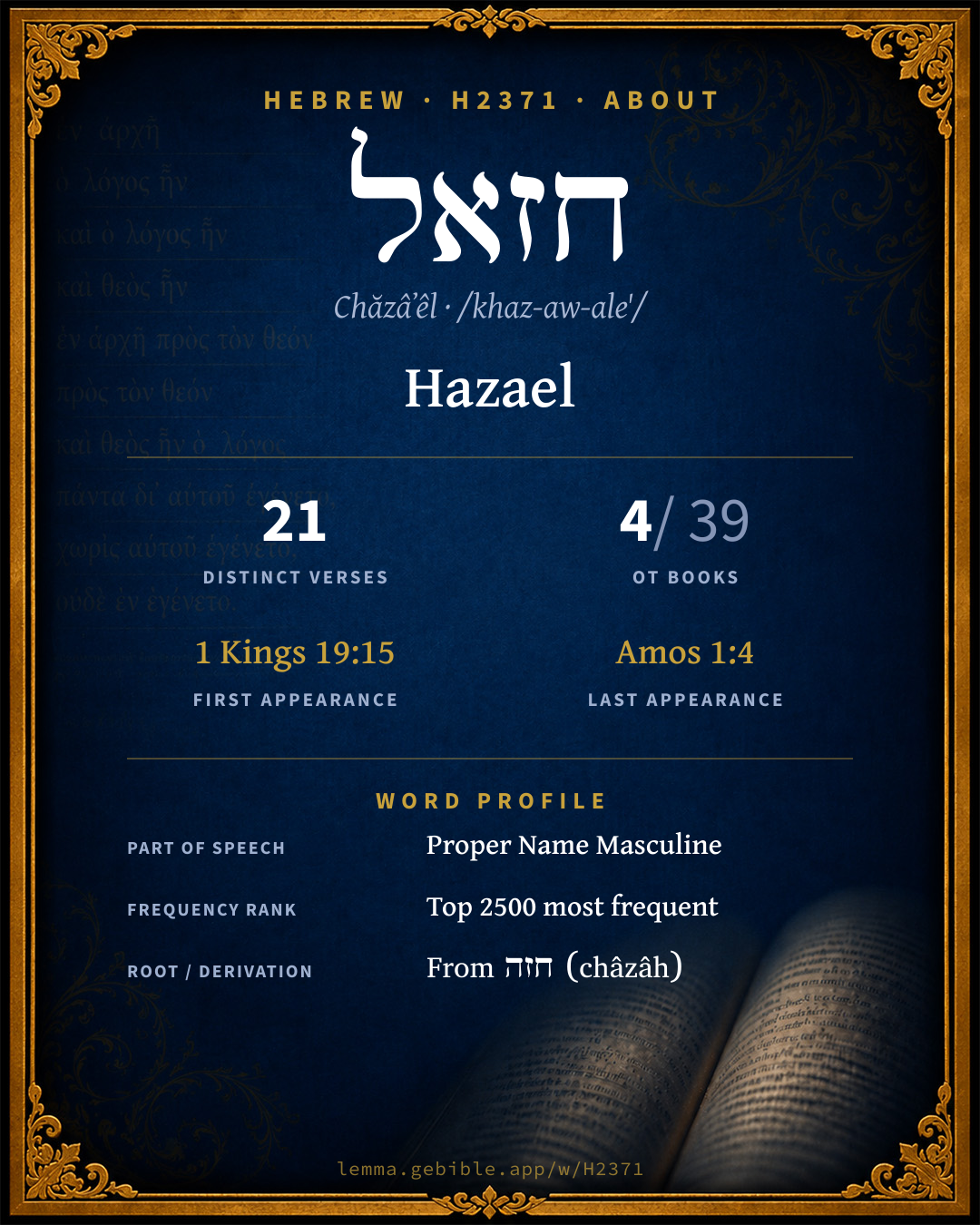
חֲזָהאֵל
Hazael
BDB lists 2 entries for ‘Hazael’ fuller range ↓
Full lexicon entry — Brown-Driver-Briggs (BDB)
From Brown-Driver-Briggs (BDB)
Where this word appears
Grammar key — what these labels mean
Part of speech
- Noun
- A naming word — a person, place, thing, or idea.
Noun type
- Proper
- A name of a specific person, place, or people (e.g. Abraham, Zion, Israel).
Every verse where H2371 appears — 21 distinct verses across 4 books. Click any verse to open its interlinear word-by-word view. Verse text shown in the World English Bible for context — . Each verse’s Hebrew form is shown with its reference; the English is not keyword-highlighted, since the data carries no word-level English alignment. Use “Compare translations” on any verse to read it across multiple English versions. This concordance covers the Hebrew Bible; Septuagint (Greek Old Testament) occurrences are not indexed here.
1 Kings 2 verses
- 1 Kings 19:15 חֲזָאֵ֛ל n Proper Yahweh said to him, Go, return on your way to the wilderness of Damascus: and when you come, you shall anoint Hazael to be king over Syria;
- 1 Kings 19:17 חֲזָאֵ֖ל n Proper It shall happen, that he who escapes from the sword of Hazael shall Jehu kill; and he who escapes from the sword of Jehu shall Elisha kill.
2 Kings 16 verses
- 2 Kings 8:8 חֲזָהאֵ֗ל n Proper The king said to Hazael, Take a present in your hand, and go, meet the man of God, and inquire of Yahweh by him, saying, Shall I recover of this sickness?
- 2 Kings 8:9 חֲזָאֵל֮ n Proper So Hazael went to meet him, and took a present with him, even of every good thing of Damascus, forty camels' burden, and came and stood before him, and said, Your son Benhadad king of Syria has sent me to you, saying, Shall I recover of this sickness?
- 2 Kings 8:12 חֲזָאֵ֔ל n Proper Hazael said, Why weeps my lord? He answered, Because I know the evil that you will do to the children of Israel: their strongholds will you set on fire, and their young men will you kill with the sword, and will dash in pieces their little ones, and rip up their women with child.
- 2 Kings 8:13 חֲזָהאֵ֔ל n Proper Hazael said, But what is your servant, who is but a dog, that he should do this great thing? Elisha answered, Yahweh has shown me that you shall be king over Syria.
- 2 Kings 8:15 חֲזָהאֵ֖ל n Proper It happened on the next day, that he took the coverlet, and dipped it in water, and spread it on his face, so that he died: and Hazael reigned in his place.
- 2 Kings 8:28 חֲזָהאֵ֥ל n Proper He went with Joram the son of Ahab to war against Hazael king of Syria at Ramoth-gilead: and the Syrians wounded Joram.
- 2 Kings 8:29 חֲזָהאֵ֖ל n Proper King Joram returned to be healed in Jezreel of the wounds which the Syrians had given him at Ramah, when he fought against Hazael king of Syria. Ahaziah the son of Jehoram king of Judah went down to see Joram the son of Ahab in Jezreel, because he was sick.
- 2 Kings 9:14 חֲזָאֵ֖ל n Proper So Jehu the son of Jehoshaphat the son of Nimshi conspired against Joram. (Now Joram was keeping Ramoth-gilead, he and all Israel, because of Hazael king of Syria;
- 2 Kings 9:15 חֲזָאֵ֖ל n Proper but king Joram was returned to be healed in Jezreel of the wounds which the Syrians had given him, when he fought with Hazael king of Syria.) Jehu said, If this be your mind, then let none escape and go forth out of the city, to go to tell it in Jezreel.
- 2 Kings 10:32 חֲזָאֵ֖ל n Proper In those days Yahweh began to cut off from Israel: and Hazael struck them in all the borders of Israel;
- 2 Kings 12:17 חֲזָאֵל֙ חֲזָאֵל֙ n Proper n Proper Then Hazael king of Syria went up, and fought against Gath, and took it; and Hazael set his face to go up to Jerusalem.
- 2 Kings 12:18 לַֽ/חֲזָאֵל֙ prep + n Proper Jehoash king of Judah took all the holy things that Jehoshaphat and Jehoram and Ahaziah, his fathers, kings of Judah, had dedicated, and his own holy things, and all the gold that was found in the treasures of the house of Yahweh, and of the king's house, and sent it to Hazael king of Syria: and he went away from Jerusalem.
- 2 Kings 13:3 חֲזָאֵ֣ל חֲזָאֵ֖ל n Proper n Proper The anger of Yahweh was kindled against Israel, and he delivered them into the hand of Hazael king of Syria, and into the hand of Benhadad the son of Hazael, continually.
- 2 Kings 13:22 וַֽ/חֲזָאֵל֙ conj + n Proper Hazael king of Syria oppressed Israel all the days of Jehoahaz.
- 2 Kings 13:24 חֲזָאֵ֣ל n Proper Hazael king of Syria died; and Benhadad his son reigned in his place.
- 2 Kings 13:25 חֲזָאֵ֔ל n Proper Jehoash the son of Jehoahaz took again out of the hand of Benhadad the son of Hazael the cities which he had taken out of the hand of Jehoahaz his father by war. Three times did Joash strike him, and recovered the cities of Israel.
2 Chronicles 2 verses
- 2 Chronicles 22:5 חֲזָאֵ֥ל n Proper He walked also after their counsel, and went with Jehoram the son of Ahab king of Israel to war against Hazael king of Syria at Ramoth-gilead: and the Syrians wounded Joram.
- 2 Chronicles 22:6 חֲזָהאֵ֖ל n Proper He returned to be healed in Jezreel of the wounds which they had given him at Ramah, when he fought against Hazael king of Syria. Azariah the son of Jehoram king of Judah went down to see Jehoram the son of Ahab in Jezreel, because he was sick.
Amos 1 verse
About this entry
At a glance — auto-summarized from this page’s data, not written by a person. Every figure links to its source below. This summary describes the numbers; it doesn’t interpret them.
חזאל — transliterated Chăzâʼêl — is a Hebrew name carrying the sense “Hazael.” Its uses cluster heavily in 2 Kings (76% of all occurrences). With 21 verses in 4 books, it is an uncommon word in the Hebrew Bible. Debuting at 1 Kings 19:15, it then recurs through the corpus. Each statement above links to its evidence; the full detail follows below.
Gloss history
Strong's 1890 vs modern scholarship
About this word
Strong's H2371 catalogs a Hebrew word from the Hebrew Old Testament.
These counts are not copied from any lexicon or concordance. They are computed here, from the morphology-tagged Hebrew Old Testament. What Lemma adds →
- 21
- distinct verses
- The word appears in 21 distinct verses.
- 4 / 39
- OT books
- The word appears in 4 of 39 Old Testament books.
- #1,368
- by frequency
- Top 2500 most frequent Hebrew words (rank 1,368 of 8,640 Hebrew words by occurrence).
View all 21 occurrences in the concordance →
Most concentrated in
- 2 Kings 16 verses 76%
- 1 Kings 2 verses 10%
- 2 Chronicles 2 verses 10%
By section of the Old Testament
By traditional corpus
Conventional, traditional groupings — biblical authorship is debated, so this is a traditional corpus grouping, not an authorship claim. Each share is this word’s portion of its verses in that division of the Hebrew canon. Each figure is a share of the word’s 21 distinct verses.
- Prophets (Nevi'im) 19 verses · 90%
- Writings (Ketuvim) 2 verses · 10%
How translations render this word
Counts come from each version’s own published word-to-Strong’s tagging or interlinear alignment — an approximate guide to how each version renders this word, not a word-level alignment the data otherwise carries. Because each total is that version’s own tagged count, the per-version totals vary from one another and need not match the appearance or distinct-verse counts above. These counts may also differ from a printed concordance because Lemma counts each distinctly tagged rendering and does not collapse phrase taggings into a single head-word total. This is a fixed set of word-tagged versions (KJV, ASV, BSB, ULT) and does not change with the reading translation you choose elsewhere. Each version’s license is shown beside its name below (and on Sources).
BDB lists this Strong’s number as 2 distinct words (homographs). Each count above pools all of them and is not split by sense — see the Senses section below. A low-frequency rendering may belong to a different one of those words, not the primary meaning.
- King James Version†: Hazael 20×, Against hazael 3×
- American Standard Version†: Hazael 17×, Against hazael 4×
- Berean Standard Bible†: Hazael 21×
- unfoldingWord Literal Text†: Hazael 22×
King James Version Public Domain
Renders H2371 across 23† tagged occurrences — most commonly:
American Standard Version Public Domain
Renders H2371 across 23† tagged occurrences — most commonly:
Plus 2 renderings that appear only once — usually multi-word phrases or single function words the recovered tagging swept in, not distinct renderings.
Berean Standard Bible Public Domain
Renders H2371 across 23† tagged occurrences — most commonly:
Plus 2 renderings that appear only once — usually multi-word phrases or single function words the recovered tagging swept in, not distinct renderings.
unfoldingWord Literal Text CC BY-SA 4.0
Renders H2371 across 23† tagged occurrences — most commonly:
Plus 1 rendering that appears only once — usually multi-word phrases or single function words the recovered tagging swept in, not distinct renderings.
Senses in BDB
The 2 senses BDB distinguishes for this word, in lexicon order (not ranked by frequency or importance). The full entry — with sub-senses — is in the Lexicon Entry tab.
- Hazael = "one who sees God"
- a king of Syria…
Word origin
n.pr.m. (Ēl sees; Assyrian Ḫazaʾilu COT Gloss) king of Aramaic 2 K 8:8, 13, 15, v 29 = 2 Ch 22:6; contr. חֲזָאֵל 1 K 19:15, 17 2 K 8:9, 12, v 28 = 2 Ch 22:5, 2 K 9:14, 15; 10:32; 12:18(×2), 19; 13:3(×2), 22, 24, 25; בֵּית חֲזָאֵל Am 1:4.
— Brown-Driver-Briggs (Oxford 1906, public domain), digitized via Sefaria, supplemented by the OpenScriptures HebrewLexicon (CC BY 4.0). See Sources.
Derived from חזה (châzâh) (H2372) — to see.
Forms in the corpus
The 14 distinct written forms H2371 takes in the Hebrew Bible, most frequent first — each parse links to that state’s occurrences in the concordance. Hebrew forms include their vowel points and cantillation, so a single lemma takes many written forms.
| Form | Parsing | Example | Uses |
|---|---|---|---|
| חֲזָאֵ֖ל | Noun, Proper | 1 Kings 19:17 | 5 |
| חֲזָהאֵ֖ל | Noun, Proper | 2 Chronicles 22:6 | 3 |
| חֲזָאֵ֔ל | Noun, Proper | 2 Kings 8:12 | 2 |
| חֲזָאֵ֣ל | Noun, Proper | 2 Kings 13:3 | 2 |
| חֲזָאֵל֙ | Noun, Proper | 2 Kings 12:17 | 2 |
| וַֽ/חֲזָאֵל֙ | Noun, Proper | 2 Kings 13:22 | 1 |
| חֲזָאֵ֑ל | Noun, Proper | Amos 1:4 | 1 |
| חֲזָאֵ֛ל | Noun, Proper | 1 Kings 19:15 | 1 |
| חֲזָאֵ֥ל | Noun, Proper | 2 Chronicles 22:5 | 1 |
| חֲזָאֵל֮ | Noun, Proper | 2 Kings 8:9 | 1 |
| חֲזָהאֵ֔ל | Noun, Proper | 2 Kings 8:13 | 1 |
| חֲזָהאֵ֗ל | Noun, Proper | 2 Kings 8:8 | 1 |
| חֲזָהאֵ֥ל | Noun, Proper | 2 Kings 8:28 | 1 |
| לַֽ/חֲזָאֵל֙ | Noun, Proper | 2 Kings 12:18 | 1 |
Same root — word family
Other BDB entries built from the same root as H2371, grouped by Strong’s listed origin. These share a root / origin per the lexicon — not necessarily a shared meaning. Each links to that word’s own entry.
Derives from
Shares the same root
- הזה hâzâh H1957 to dream
- חזא chăzâʼ H2370 to see
- חזה châzeh H2373 breast
- חזה chôzeh H2374 seer
- חזון châzôwn H2377 vision
- חזות châzôwth H2378 visions
- חזות châzûwth H2380 vision
- חזיון chizzâyôwn H2384 vision
- מחזה machăzeh H4236 vision
- מחזה mechĕzâh H4237 window
Proper names from this root
People and places named from this root — a name, not an additional meaning of the word.
- חזו Chăzôw H2375 Hazo
- חזיאל Chăzîyʼêl H2381 Haziel
- חזיה Chăzâyâh H2382 Hazaiah
- חזיון Chezyôwn H2383 Hezion
- יחזיאל Yachăzîyʼêl H3166 Jahaziel
- יחזיה Yachzᵉyâh H3167 Jahaziah
- מחזיאות Machăzîyʼôwth H4238 Mahazioth
Compare all same-root words → Showing 4 of 19 — not the complete family. 7 of the same-root words are proper names (people or places). They share a root, not necessarily a meaning.
Bible dictionary
Public-domain dictionary articles matched to this entry by name (Hazael). A biblical name can be shared by more than one person or place, so an article may treat several.
Easton's Bible Dictionary · M. G. Easton, 1897
Whom God beholds, an officer of Ben-hadad II., king of Syria, who ultimately came to the throne, according to the word of the Lord to Elijah (1 Kings 19:15), after he had put the king to death (2 Kings 8:15). His interview with Elisha is mentioned in 2 Kings 8. The Assyrians soon after his accession to the throne came against him and defeated him with very great loss; and three years afterwards again invaded Syria, but on this occasion Hazael submitted to them. He then turned his arms against Israel, and ravaged "all the land of Gilead," etc. (2 Kings 10:33), which he held in a degree of subjection to him (13:3-7, 22). He aimed at the subjugation also of the kingdom of Judah, when Joash obtained peace by giving him "all the gold that was found in the treasures of the house of the Lord, and in the king's house" (2 Kings 12:18; 2 Chr. 24:24). He reigned about forty-six years (B.C. 886-840), and was succeeded on the throne by his son Ben-hadad (2 Kings 13:22-25), who on several occasions was defeated by Jehoash, the king of Israel, and compelled to restore all the land of Israel his father had taken.
Smith's Bible Dictionary · William Smith, 1863
(whom God sees), a king of Damascus who reigned from about B.C. 886 to B.C. 840. He appears to have been previously a person in a high position at the court of Ben-hadad, and was sent by his master to Elisha to inquire if he would recover from the malady under which he was suffering. Elisha's answer led to the murder of Ben-hadad by his ambitious servant, who forthwith mounted the throne. (2 Kings 8:7-15) He was soon engaged in war with the kings of Judah and Israel for the possession of the city of Ramoth-gilead. Ibid. (2 Kings 8:28) Towards the close of the reign of Jehu, Hazael led the Syrians against the Israelites (about B.C. 860), whom he "smote in all their coasts," (2 Kings 10:32) thus accomplishing the prophecy of Elisha. Ibid . (2 Kings 8:12) At the close of his life, having taken Gath, ibid. (2 Kings 12:17) comp. Amos 6:2 He proceeded to attack Jerusalem, (2 Chronicles 24:24) and was about to assault the city when Joash bribed him to retire. (2 Kings 12:18) Hazael appears to have died about the year B.C. 840, (2 Kings 13:24) having reigned forty-six years.
Hitchcock's Bible Names Dictionary · Roswell D. Hitchcock, 1869
that sees God
Classic public-domain reference works; full attribution on Sources.
Septuagint verse parallels
This word appears in 21 verses that also exist in the Greek Old Testament (Septuagint), out of the 21 Hebrew verses it occurs in. You can read those verses in Greek by switching the Old Testament edition to the Septuagint.
Read these verses in the Septuagint
This is a verse-level parallel only — the same verses exist in both the Hebrew and Greek Old Testaments. No word-level Hebrew↔Greek correspondence is claimed: the data carries no such alignment, so no Greek word is shown as this Hebrew word’s translation. Coverage is not total — the Septuagint omits the deuterocanon and renumbers the Psalms, so some Hebrew verses have no direct Greek parallel.